Month: May 2005

  • The natural balance of power

    In the book Freakonomics that I mentioned the other day, there’s a chapter called “Where Have All the Criminals Gone?”. In it, author Steven Levitt examines various theories of why violent crime has decreased in the country. Many explanations are examined: more prisons, more police, better policing strategies, aging population, stronger economy, and gun laws.

    Since our legislature seems again determined to re-pass the idiotic conceal carry law, let’s talk about that. Oddly, Levitt has in his book an example that exactly fits the circumstances of the murder last week at Nye’s restaurant in Northeast Minneapolis.

    On page 131, here’s what Levitt says, “A gun scrambles the outcome of any dispute. Let’s say that a tough guy and a not-so-tough guy exchange words in a bar, which leads to a fight. It’s pretty obvious to the not-so-tough guy that he’ll be beaten, so why bother fighting? The pecking order remains intact. But if the not-so-tough guy happens to have a gun, he stands a good chance of winning. In this scenario, the introduction of a gun may well lead to more violence.”

    This is exactly what happened at Nye’s. The little jerk who was bounced from the bar had the legal right to carry a gun, thanks to the 2003 mandatory permit issue law. (The gun-bill-totin’ State Senator Pat Pariseau’s take was this, though: “I don’t think it proves problems with the law. I think it proves that someone got [a permit] who shouldn’t have gotten one.” Could Pat Pariseau be any stupider? I’ll give a free peronalized “We ban guns here” poster to the reader with the best answer to that one.)

    Levitt goes on to discuss the alternate scenario of a girl out for a nighttime stroll who is accosted by a mugger. Three possible scenarios, actually.

    One: the girl is not armed and the mugger is. The most likely–and there will be a bad outcome for the girl. She’ll be robbed, (or worse.)

    Two: the girl is armed and the mugger is not. Highly unlikely that a mugger who is robbing people won’t be armed, but, if the mugger is a complete idiot, the outcome is better for the girl.

    Three: they are both armed, but, it’s reasonable to believe the mugger has his gun drawn, while they girl does not. Still a bad outcome for the girl. Perhaps even a worse one if she goes for her gun and the mugger shoots her instead of just taking her purse.

    Levitt goes on to discuss other facets of gun laws, but comes to the conclusion that there are so many guns in the United States that neither the Brady Laws nor concealed carry will affect crime in a macro sense.

    So what is the cause of the drop in violent crime? I guarantee you, the right ain’t gonna like the answer. It’s fewer babies born to people who don’t want them. Looks like it took just about 20 years after Roe v. Wade for the effects to make themselves apparent.

    Discuss.
  • I Believe It's Raining All Over The World

    bezo-rocks.jpg

    Remember when you imagined stars on the roof of your mouth, and stood in the river in the rain, naked and mooing, your head and palms raised significantly (or so you imagined)? You desperately wanted something momentous to wash over you; to be claimed by something outside yourself, even as you were almost utterly incapable of feeling the presence of anything outside yourself.

    I’m sure you have no idea now why you wrapped your feet in aluminum foil.

    Still, how could you forget all that time you spent falling, those days when you just let it all go, your whole self, surprisingly heavy, a sinker dragging all the world’s earnest bobbers right down with you? Twice, at least, you thought yourself done for and drowned, and in those moments there was just this vague glimpse of sadness mixed with regret, almost like the last fragments of an evaporating dream.

    Remember the lights and the way everything smeared, blurred, and swerved away from you for a while? In the distance, sometimes, you imagined a fire tower, then a lighthouse, then a tiny chapel deep in the woods and dimly illuminated like a jack-o’-lantern, then finally a graveyard down a long gravel road somewhere in the country. The thin ones, your desperate companions reduced to nothing but haunted eyes and bones, they were so dangerous, and you were perhaps the most dangerous of all.

    Can’t you even remember anymore how you were saved? Isn’t that one memory you should have held on to with –as some would say– dear life?

  • We Hold These Truths To Be Self-Evident…Or Maybe Not

    A walk is as good as a hit.

    Never make the first or third out at third.

    A bloop single looks just like a line-drive in the box score.

    You can’t steal first.

    Homerun hitters drive Cadillacs.

    Respect the game.

    Bust your tail and have some fun.

    Good pitching beats good hitting.

    Pitching is ninety percent of the game.

    Chicks dig the long ball.

    Throw strikes.

    Get it over.

    Let the guys behind you make the plays.

    Keep your head in the game.

    Hit it where they ain’t.

    Swing hard and hope you hit something.

    If the double-play is a pitcher’s best friend, then the three-run homer is a groomsman.

    You better check your ego at the door.

    It’s a team game.

    There’s no I in Team. There is a U in Us.

    Take it one game at a time.

    That’s why they play the games.

    A buck-eighty will get you a cup of coffee and a slap on the back on your way out the door.

    Baseball is a funny game.

    It ain’t cheating if you don’t get caught.

    This game will humble you in a hurry.

    The game will eat you alive.

    Mistakes will kill you.

    Don’t try to do too much.

    Keep it in front of you.

    Stay within yourself.

    Youneverknow.

    It ain’t over until it’s over.

    Leave it at the ballpark.

    The totals on the board are correct.

  • Throwing Heat

    We adore David Carr, one of our own who left the Twin Cities Reader to edit Washington City Paper in the midst of a long boom of greatness there that produced folks like Jack Shafer and Brett Anderson. Carr now writes sober and precise media stories for the New York Times, although he is no longer officially on the media beat. But we must say that we never expected him to drink the Kool-Aid when it came to Tina Brown. After giving us a clear signal as to how this happened (he admits in a parenthetical disclosure that he has been a guest on Tina’s now-defunct cable-TV show “Topic A”), he trots out an astonishing string of sycophantic silliness that seems to propose that Ms. Brown invented the modern celebrity. Now, we have as much respect for Tina Brown as the next guy, but let’s be reasonable here. Tina did not create celebrity, nor even very many celebrities—she merely identified the crest of their ephemeral waves. As he says, her knack for timing was uncanny (actually, it was more a consequence of holding deadlines until they were insanely late, driving all of her sub-editors rabidly insane), but we think Carr went way, way overboard here. Hey, we think she’s cute and smart and MILFY too. But never having got an audience with her royal pain-in-the-highness, we feel our vision is somewhat clearer than our Manhattan friend’s.

    In Carr’s 1,200 word hagiography, we extracted a few reconstructions and reformulations of the Queen Bee’s virtues. This thing has more glowing appositives than the Manhattan Yellow Pages:

    “Ms. Brown, who all but invented the escalator that makes people famous in nothing flat…”

    “Tina Brown’s streak as America’s premier magazine editor demonstrated that she understood American culture in a way few natives did.”

    “Ms. Brown, who knows more about the thermodynamics of hype than almost any person alive…”

    “As the chief architect of a formula where celebrities and media outlets colluded to create a fizzy, fabulous world, Ms. Brown has no one to blame but herself, of course.”

    “Ms. Brown, who can be good at math if not budgets, knew the score.”

    “A Middle Atlantic media phenomenon, Ms. Brown edited the British Tatler magazine at 25, crossed over and revived Vanity Fair at 30, dusted off The New Yorker at 38, and at 45 created Talk. Boy, did she create talk. She imported a British disposition about celebrity, turning gossip and glitz into a not-so-dirty pleasure, with a knack for turning magazines into crucibles of heat.”

    “Despite the money lost during her tenures – she spent millions to make Vanity Fair profitable and racked up $70 million in losses or so at The New Yorker – she was a necessary figure at both magazines.”

    “The start was rugged – she frequently looked surprised when the camera came her way – but Ms. Brown, who once was lauded by her husband for “ratlike cunning,” gradually got the hang of it.”

    “Ms. Brown had an uncanny knack for deadline alchemy.”

    “The unchallenged queen of the A-list seems to be flailing in a B-list nation.”

    “Ms. Brown, who had long been the Simon Cowell of American…”

    “Once something of an alien and unspeakably fabulous, Ms. Brown has become, oddly, one of us.”

    “Ms. Brown is still the best-connected editor in New York. Someone should give her a magazine.”

    At last, we seem to have arrived at Carr’s point. We get it! A referral from a friend—well, why didn’t you just say so?

  • Look, I Said I'm Sorry. What More Do You Want From Me?

    Bud Blanchard-5.jpg

    Dan Corrigan, Bud Blanchard, Motivational Speaker. Omaha, Nebraska, 1978.

    …he does not notice that he has reached the age of forty-five; then suddenly he realizes that all the time he has been acting and making a fool of himself, but it is now too late to change his way of life. Once in his sleep he suddenly hears like the report of a gun the words: ‘What are you doing?’–and he starts up all in a sweat.

    –Chekhov, Notebooks

    But the sadder and more troubled they were, the more they yearned for omnipotence. The really troubled ones believed they had it.

    –Ross MacDonald, The Zebra-Striped Hearse

    I’m not going to lie to you. I could sit here and throw words at you until the cows come home, but who the hell really wants the cows to come home or even pretends to understand what that phrase means? I don’t suppose it means a damn thing to anybody, including farmers. Do cows really run away from home? And, supposing they do, would you actually sit around waiting for them to come home? I’d think you’d probably have to go looking for them, and if it was up to me I doubt that I’d bother. I’d say the hell with the delinquent cows. Let somebody else stun them, slit their throats, and hack them up into meat.

    I guess I’m feeling pretty much the same way about words right now.

  • Uncle Jumbo's Playground

    uncle jumbo 2.jpg

    –Illustration by James Dankert

    That was horseshit.

    I’m a superstitious guy, and I should have known better than to drag my ass from the house on Friday the thirteenth. I already had a sick feeling on the drive downtown. The muffler on my Celica was kicking up sparks all the way down Portland, and was drowning out Motorhead even with the fifteen-year-old cassette player cranked up as high as it would go.

    I also should know better than to sit in the expensive seats. A guy in my building gave me one of his season tickets, but I’ve got no business sitting anywhere inside the foul poles, let alone above the visiting dugout. I know when I’m an interloper, and I was hemmed in on all sides by yahoos. The clown beside me, noticing that I was keeping score, kept asking me who was batting, and though I pointed out early on that this information was provided in various prominent places all over the ballpark, he was clearly addled by all the 3.2 beer he’d consumed (and continued to consume); he was one of those cup-stackers who apparently feel it’s some kind of achievement to spend forty dollars on beer at a baseball game. By the seventh-inning stretch he practically had to get down on his knees to pour beer into his face from his wobbling tower of plastic souvenir cups.

    This guy and his pals appeared to have driven in from Dogpatch, and I was almost disappointed that they made it through the eighth inning without taking off their shirts. Actually, they didn’t make it through the eighth inning. Before the Twins came to bat they stumbled away up the aisle and disappeared. Maybe they had some weird animal instinct that a shitstorm was brewing, or perhaps their faithless departure –and they weren’t alone– brought the thing on.

    Either way, they ruined the game for me even before the game was completely ruined for me by its ruinous outcome. They thought Buck Showalter was Buddy Bell, and that Orel Hershiser was also Buddy Bell, or at least the same person as Showalter. Every time Hershiser or Showalter went to the mound they chanted, “Buddy! Buddy! Buddy!” or “Bell, you suck!”

    I have no doubt that by three o’clock tomorrow afternoon the whole lot of them will be drunk in a boat somewhere, attempting to murder innocent fish with their new Kent Hrbek fishing lures, which I was frankly surprised they didn’t throw at Buddy Bell.

    My God, though, I honestly don’t know what happened. That game was over. I’m not about to go back and look at my scorebook to try to recreate the nightmare, but I swear to God if I ever see Terry Mulholland trundling in from the bullpen to relieve Joe Nathan again I’m giving up the lousy game once and for all.

  • Sightings (or Listenings)

    If you missed us on MPR this morning, you could probably catch us in their audio archives.

    One thing we wanted to talk about, when we were on the topic of media credibility, was this: This morning, the Strib broke the news early that undercover officer Gerald Vick was legally drunk (well, he was loaded, actually) when he was murdered last week. Naturally, an undercover cop can’t sit around drinking O’Doul’s if he’s trying to establish credibility. The terrible irony here is that, as any beat cop will be glad to tell you, around 90 percent of the people they deal with on a regular basis as a part of doing their jobs have serious alcohol issues. The vast majority of street-level crimes are committed by people under the influence of one intoxicant or another.

    But what we wanted to dwell on for a few moments was the almost certain backlash that will come at the Strib for publishing this nasty bit of posthumous dirt. Our point of view is that it is most certainly legitimate news, and touches on broader issues of interest to the general public. But it can’t make the Strib or its reporters look very good, aspersing the good name of an honored cop so immediately in the wake of Vick’s, er, wake.

    And we are reminded, again, of Ombud Kate Parry’s somewhat pandering approach to the idea of better serving readers–that is, “building trust” among new readerships. The fact is that the truth is very frequently an unpopular commodity, and one of the reasons the public assumes journalists are unethical cretins, whereas the truth is just the opposite, generally speaking. We think reporting hard truths is valuable to the community–it’s what newspapers are supposed to do. But we wonder what Kate Parry will make of the inevitable flood of mail accusing the Strib of urinating on the grave of a public hero. Will she read this as successfully “building trust” and “servicing” the Strib’s beloved readership? We think this is what is normally referred to as a “good teaching moment,” and we’re sure she’ll rise to the occasion.

  • Rain Delay

    It’s been a damn fine day here in the Twin Cities. Cold rain and temperatures forty degrees below normal. A perfect day for an indoor baseball game, in other words, or for hunkering down on the couch to watch the Twins playing somewhere better else.

    No such luck, which means we have an extra twenty-four hours to gargle Mountain Dew and attempt to rinse the lousy taste of yesterday’s game out of our mouths before the Rangers come to town. There’s nothing worse than an ugly game against an ugly pitcher, and yesterday’s 7-4 loss to the Orioles and Sidney Ponson more than fit the bill on both counts. After already seeing Ponson, Bartolo Colon, and C.C. Sabathia, the Twins just need to face Randy Johnson and David Wells to complete their tour of the American League’s All-Ugly rotation.

    The Baltimore series was disappointing on a lot of fronts. The pitching match-ups going in couldn’t have been more promising for the Twins, with Silva, Radke, and Santana all taking a turn. Those eye-popping control numbers for Minnesota’s staff are starting to catch up to them, though, with opposing teams taking a very aggressive approach in the early going. The Twins coaches have always preached the importance of strike one, and both Radke and Santana have long been in the habit of pounding fastballs in the strike zone in the early going, and early in the count, in an attempt at getting ahead in the count. The scouts have obviously noticed, and now it’s time for the Twins to make their own adjustments.

    When an opposing team makes three errors at the major league level you really need to make them pay for those mistakes, but the Twins just haven’t been able to capitalize. The bottom of the order continues to be a train wreck. Yesterday the one through five hitters were a combined seven-for-eighteen; the other four guys (and pinch hitter Matthew LeCroy, batting in the eight spot) went 0-13.

    The other thing I’ve noticed lately is that with Torii Hunter struggling teams can pitch very carefully to Justin Morneau, and he’s not going to see a lot of balls to drive until Hunter starts hitting consistently and taking a more patient approach at the plate.

    I’ve also decided that J.C. Romero is virtually worthless unless he starts an inning with the bases empty. He’s got a bit of LaTroy Hawkins syndrome going on the last couple years. Consider that opposing hitters are batting .231 against Romero with the bases empty (over twenty-six at-bats), with a respectable .333 on base percentage. They’re actually hitting worse with runners in scoring position (.091, if you’d care to believe that), but thanks to Romero’s apparent case of the yips the opposing OBP in those same situations is .412. That’s almost hard to fathom, yet between the walks (five BB and one K w/runners in scoring position) and his penchant for uncorking wild pitches at the most inopportune times, Romero’s simply not a guy who can be trusted with inherited runners. So far this year he’s averaging 6.28 walks per nine innings, which is the worst ratio on the staff by a huge margin.

  • Brave New World

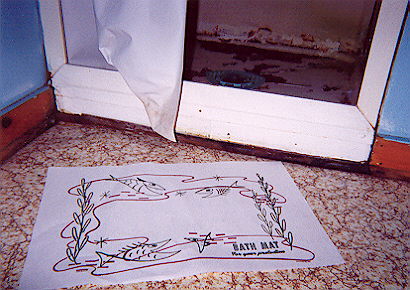
    bathmat001.jpg

    I’ll burn this life down and climb on a plane for Iceland. My new life might be waiting for me there. Or I might pack my bags and light out for a village in Peru. Maybe I’ll head to Boise. That might be the place of answers and inspiration.

    Or, no, I’ll go someplace warm where there are palm trees and I can live right around the corner from a 7-11 and a tattoo parlor. Every morning I’ll walk over to the 7-11 in my flip-flops for a Big Gulp, a chili dog, and a game of pinball, and then I’ll go up the street to get some more ink drilled into my flesh. I’ll have a map of the world tattooed around the circumference of my torso, just like a globe, very detailed and colorful, complete with ornate compass roses and the whole fucking works.

    I’ll never wear a shirt if I can help it. I’m thinking there’ll be a driving range or a batting cage somewhere in the vicinity where I can go every afternoon and hit balls until my hands bleed. I’ll become a fucking hitting machine. There for damn sure will be a barbecue joint in the neighborhood, and a bar with a decent jukebox. I’m thinking this might be Tempe, maybe, or Orlando.

    I’ve got nothing against living in a trailer, just so long as I can have a dog and people leave me the fuck alone. I don’t give a rat’s ass if I never look at a television again in my life. At night I’ll work on my screenplay, and when I turn out the lights I’ll stretch out on the bed and gently trace with my fingers all my broken dreams across the continents and deserts and oceans of my body.

  • A Happy, Active Retirement

    Tim McGuire, ever the genteel former editor of the Star Tribune, weighs in today from the chitlins circuit of academic punditry with yet another defense of the newspaper industry’s prospects for the future. (Yes, officially everyone now has had his or her say; no, newspapers will not die. They have survived TV, radio, telephones, palm pilots, fax machines, XY-Write, sliced bread, the internal combustion engine, homebrewing, and even the internet. We expect they’ll survive a while longer. For the record, we think Tim is basically right about one salient fact–newspapers still enjoy massive profit margins, and they should stop whining about doing what any other industry would do–reinvest some of that margin into evolving the product. Our approach would be to hire more and better reporters and expand the breadth and depth of–ready for this?–the reporting.) We only met McGuire once, and merely noticed that he is a snappy dresser. We also noticed that he spent much of his career trying to evolve the newspaper to his own somewhat quirky specss–if we recall correctly, wasn’t he the guy who reorganized the newsroom into “teams,” installed mood-enhancing medititative bubblers, and implemented a pro-active plan to stop using Native American names for professional sports teams? These sorts of “investments” in the future of newspapering seemed alike a good idea at the time, but most would say they are now safely obsoleted in the past.