Month: September 2005

  • The Technology of Spirit

    Offering perhaps conclusive proof that fewer Americans are reading these days, Best Buy’s health and wellness retail experiment, called Eq-Life, will soon occupy the space vacated by Grand Avenue’s now defunct independent bookstore, Bound to Be Read. It’s worth noting that about a mile down the street, the space left open by Ruminator’s closure is now a Patagonia store. Do Americans prefer fleecy jackets, scented candles, and heart monitors to the comforts of a good read? Mike Marolt, the president of Eq-Life, is hoping they do. Marolt’s own brainchild, the new store bills itself as a neighborhood resource for health, wellness, and technology, seemingly unlikely bedfellows. Its first test store, which opened in Richfield earlier this year, has been successful enough that Marolt has decided to expand the control group, opening both the St. Paul store and another in Stillwater later this year.

    So what, exactly, is Eq-Life? And why is Best Buy trafficking in health and wellness? And what the devil does that have to do with technology? Before visiting the Richfield store, I pictured a group of women in hot pink capri pants who’d been lured in by the pedicure stations and had gone ahead and purchased more expensive cell phones and picked up an MP3 player on their way out the door, walking ever so gingerly in flip-flops toward their SUVs to protect freshly polished toes. Surely this was Best Buy’s way of selling computers and corollaries—peripherals? Whatever—to women who are intimidated by geeky techno-babble at the company’s warehouse stores, yes? Well, not exactly.

    Imagine that by some magic of origami, O magazine could be folded out into an eighteen-thousand-square-foot retail space, and you’re getting a little bit closer. Borrowing from the Latin root aequilibrium—or perhaps just abbreviating the English cognate—Eq-Life seeks to provide its customers with an array of goods and services that “help people find balance,” said Sue Lee, who handles PR for the enterprise. These include salon and spa services (“Sea Facials,” the “Exfoliating Citrus Spa Manicure,” the “Gentleman’s Buff & Shine”); a range of self-help and health care texts (from He’s Just Not That Into You and What Not to Wear to Conquering Infertility and How Full Is Your Bucket?) to organic towels, tampons, and cleaning supplies, upscale scales that read your body fat and metabolic age, blood pressure monitors, fountains, air purifiers, motion detectors for keeping track of grandma, digital pedometers, nail polish, and herbal supplements. It is also the only retail location in the country licensed to sell something that everybody needs at a good party: defibrillators. And it offers consultations with nurse practitioners, diabetes and diet specialists, and members of the Geek Squad.

    Mike Marolt believes that the connections between wellness and technology are untapped and many, and noted that one of the store’s most popular resources has been the health notes kiosk, where customers can tap a screen for information on everything from acid reflux to zinc malabsorption. And he knows what you’re thinking: The customer base isn’t just women. “Throughout our research we kept coming back to an equally balanced demographic, progressively minded around health and wellness, people who are online researching this information—highly engaged health and wellness consumers.”

    However, many of Eq-Life’s new St. Paul neighbors are worried about all those highly engaged health and wellness consumers logging off and heading to Grand Avenue. Parking will be a huge issue in the already congested Victoria Crossing neighborhood. Then, too, Eq-Life may threaten smaller businesses in the area that offer similar products and services. While Patagonia seems to have received a warm welcome, so far Eq-Life has suffered a fair amount of conflict. Luckily, it has plenty of stuff to deal with that sort of stress. And if precedent is any sign, Eq-Life on Grand will be fine. When I asked Jennifer, a customer loading up on bath products at the Richfield store, why she had come in that day, she laughed and said, “My friend raves about this place. She’s a product whore!” There is undoubtedly an herbal remedy for that, too.

    —Shannon Olson

  • The Wizardry of Osmo

    Over the summer, as a new orchestra season neared, Minnesota Orchestra Artistic Director Osmo Vänskä started cropping up with more frequency and in interesting places. He fell out of the Sunday New York Times, for example. His smiling face was spotted on a friend’s bookshelf, atop a collectors’ edition bobble-arm, and, in one colorful portrait in a local advertising circular, on his Yamaha motorcycle. His name was pronounced during radio ads and underwriting spots. And when a new orchestra season finally fired up again, in mid-September, concerts bore such names as “Vänskä Opens the Season” and “Osmo at Harriet.”

    But the most significant Osmo sighting happened at Orchestra Hall itself, where a massive, building-side photograph of the conductor has risen, printed full-color on weather-resistant vinyl, the same stuff used to bedeck city buses and trains in advertising. The image is “wrapped” around the exterior of the concert hall, alongside candid shots of players and audience members. But Vänskä is the centerpiece. Plastered above the box office and front entry, the sixty-five-foot maestro wields a ten-foot baton and gazes up at the sky with an exalted but slightly dopey smirk, as if he just bumped his head.

    The project was inspired, supposedly, in New York City one day last February, when Orchestra president and CEO Tony Woodcock took a stroll through Central Park while Christo and Jeanne-Claude’s monumental public art installation, The Gates, was on display. But, according to marketing director Cindy Grzanowski, Orchestra Hall’s new veneer is not without practical aplomb. The intent, she said, was to “turn Orchestra Hall inside out.” To introduce the orchestra to “people who don’t ordinarily come to concerts.” Yes, that.

    Vänskä, it seems, is a powerful new weapon in the old struggle for relevance. He is, after all, something of a people’s conductor. Grzanowski confirmed that he is eager, when compared to his predecessors, to front the orchestra’s more populist offerings; namely, its educational, free, and outdoor concerts. It helps that he also possesses the kind of work ethic Minnesotans find so endearing. In just two years with the orchestra, he has led a European tour and spearheaded a project to record all the Beethoven symphonies. Audiences admire his style on the podium, which is animated and solicitous, demanding but gracious. Some say the orchestra never sounded better. Grzanowski said that Vänskä, a modest guy, found the sight of his giant self “overwhelming.” But, she added, “He’s very understanding of our marketing efforts. He’s very supportive.”

    Grzanowski declined to say what the exact cost of this campaign has been. But with two major corporate sponsors involved, Target and 3M, and a press release that compares the scale of the project with “wrapping twenty-five buses or an entire football field,” it’s on par with your average Christo budget line. The “wrap” will remain in place through the spring.

    Out on Eleventh Avenue the other day, Vänskä dwarfed his target market—the hundreds of passersby who do not attend orchestra concerts. Among them were a nuclear family, a naval officer, two thirty-somethings who live in a nearby high-rise, and a loiterer who also inquired about the availability of spare change.

    In all, people said they thought the motif improved upon things. “I put it as a bland building before. It’s got more character now, I guess,” said the officer.

    One resident of Orchestra Hall’s downtown neighborhood, a regular on Eleventh Avenue, had been admiring the project as it progressed. She remarked, “I’ve been walking by every day. At first, only the conductor’s face was on there. I forget his name—?” She snapped her fingers. “I sort of liked that better.”

    “I hadn’t noticed it. Who is he?” asked a pixie twenty-year-old, her eyes glacial as she scanned the facade.

    “I don’t think he’s as visible as the last guy—what was his name?” said another bystander, who also lives within blocks of the concert hall. She squinted as she looked up at Vänskä’s mammoth head.—Christy DeSmith

  • What Is a Human, Anyway?

    Adulthood is overrated in many ways, and that’s especially so in Istanbul, according to this comedy set in an apartment building full of nosy folks. There’s the six-year-old who doesn’t want to get circumcised. There’s the teenager who doesn’t want to join the military. And then there’s the poor guy who’s exiting his twenties, but doesn’t want to move out of his parents’ home. And why would he? The grownup world is just so demanding, and oftentimes so stupid. Reha Erdem’s lighthearted look at three phases of manhood is part of the Walker’s “Global Lens” series of films from developing and under-filmed countries. 612-375-7622; www.walkerart.org

  • The Quiet Landscapes of William B. Post

    In his mid-fifties, New York financier William B. Post developed a new hobby, photographing comely young Edwardian women primping and simpering in sentimental poses. He would have remained a dilettante had he not gone outside for a little fresh air. Post’s country place in Maine set him in the midst of a wild beauty and changing terrain that inspired him to craft a new kind of landscape photography. In exquisitely processed scenes featuring graceful forest paths, unruly apple trees, and waters moving through frozen fields, Post documented what looks like a lost or mythical land (and a century later, it probably is lost). Post’s work was eventually championed by Alfred Stieglitz, proving that the gentleman hobbyist had become an artist, but it was all but forgotten in the years after his death. Now it’s once again on the radar; this gathering of fifty-nine silver prints is the largest exhibition of his photographs to date. 612-870-3131; www.artsmia.org

  • Gabriel Garcia Marquez

    It’s been ten years since this Nobel laureate last published a work of fiction, so the arrival of the English translation of Memories of My Melancholy Whores qualifies as a major event—even though, at just more than one hundred pages, it’s more novella than novel. Still, after a bit of journalism and the obligatory stab at a memoir, it’s nice to see the Colombian master of magical realism returning to his bread and butter. Memories is unquestionably the work of a man with mortality on his mind, but it should come as no surprise that Garcia Marquez’s elderly protagonist (he is approaching his ninetieth birthday) retains a lust for life. Lust, period, in fact. The lifelong bachelor, a bit incredibly, decides to observe this milestone in his senescence by procuring the services of a young virgin. That’s something of an unseemly proposition, but yet there’s something oddly moving about this story of a randy and philosophical codger determined to be done in not by old age, but by love.

  • Screaming "STUPID" in a crowded museum

    bible (Custom).gif
    As dangerous as an allegory on the banks of the Nile

    Yesterday this from the NY Times about the Biblical literalists’ invasion of natural history museums and how they are accosting and interrupting guides while they are explaining the scientific view of how we got here.

    The article explains how members of B.C. groups (B.C. stands for Biblically Correct, which has to be one of the greatest oxymorons of all times,) have started showing up at museums to challenge Darwin, Newton, or anyone else who ever had a coherent thought.

    But, they have their backers. According to recent polls, 54 percent of Americans do not believe in evolution. I suggested earlier that those who don’t believe in evolution shouldn’t get to partake in the benefits science has provided us. If you don’t believe in survival of the fittest, you shouldn’t get the benefits our evolved brains’ study of viral and bacterial evolution have provided us, e.g. vaccines.

    Now some thought that was too harsh, so I’m going to suggest another tactic. Let’s form groups called FART (Fundamentalists Are Really Thick) and start going to churches and challenging their ministers to debates on whether their beliefs aren’t prima facie evidence that they are closely related to chimpanzees who can be trained to do tricks on command–such as pulling the Republican voting lever and getting a banana.

  • Night Stand: Reading In The Dark

    dashboard-night.jpg

    A pair of epigraphs and some random gleanings from the archives of the Wangensteen Medical Library at the University of Minnesota:

    When I lie down, I say, when shall I arise,

    and the night be gone? And I am full of tossing

    to and fro unto the dawning of the day.

    –The Book of Job, 7-4

    This relentless repetition of the same illegible text….

    –Yannis Ritsos, “Insomnia”

    Melancholics are not so sleepless as maniacs, yet the want of sleep is often an early and prominent symptom. They do not readily sleep, and if they do, they awake soon to be tormented by the vilest misery that it is possible for human creatures to endure.

    –A.W, MacFarlane, M.D., Insomnia and its Therapeutics, 1891

    Want of refreshing sleep we believe to be the frequent origin of insanity, dependent upon moral causes.

    –John Charles Bucknill and Daniel H. Tuke, Psychological Medicine. 1858

    Those who pursue a desultory method of thinking are very often the victims of an obstinate and peculiarly distressing form of insomnia. During the day such persons are observed to apply themselves with apparent zeal to the regular vocations of life; but, if closely observed, there is often visible a certain absence of concentration and devotion to the particular matter in hand. When questioned upon this point, they admit that they are ‘absent-minded’; and, while only too willing to apply themselves, are frequently tormented by the intrusion of ideas totally foreign to the particular subject at hand….they carry their responsibilities to bed with them; and, while other minds are at rest, their own intellection is morbidly active. Midnight, and even the small hours of the morning, find such individuals speculating upon the pros and cons of the past and future with an intensity which often drives them to a state of positive desperation. The small ills of life assume alpine proportions, and even the most trivial circumstances are distorted and magnified a thousand-fold. When at last sleep actually does supervene, it is no longer psychological, but, on the contrary, perverted by dreams and unconscious cerebration to such a degree that these unhappy individuals can hardly be said to have slept in the ordinary sense of the word.

    –J. Leonard Corning, Brain Rest. 1885

    Under [insomnia’s] influence injurious changes are permitted by the patient to be made in his daily habits; pursuits which formerly engaged his attention no longer interest him; even important business concerns are sacrificed; and against such tendencies no pre-existing vigour of intellect will afford any defence; the strongest minds (intellectually considered) may sink into apathy and feebleness.

    –James Russell, M.D., “On Sleeplessness.” British Medical Journal, November 16, 1861

    After dinner, my friend drove me, in a carriage, some five miles back into the country –the greater part of the way, along the margin of Migunticook Lake, and under a terrific precipice, whose boulders every moment threaten destruction. In fact, the whole of a bright sunny day, cooled with healthful zephyrs, was spent in pleasurable excitement. Interesting conversation beguiled the evening; and, after family worship, I sunk to rest in a luxurious curtained bed. Ere long, I slept; and, about five o’clock next morning, was awakened by the crowing of the cock. This was the only night’s sleep I have had these last six years and seven months; so help me God. Since then, my nights have been tedious, as usual, without sleep, and some of them distressing.

    –“An Example of Protracted Wakefulness,” Boston Medical and Surgical Journal. July 31, 1845

    Experience in private practice, and extended observation in the wards of general and lunatic hospitals, have taught me that the ordinary hypnotics are frequently unreliable, and that in some instances their use is attended by results as bad as, if not of more serious consequence than, the conditions they were intended to remove. I do not wish by this somewhat sweeping assertion to be understood to condemn the ordinary hypnotics, or to doubt their efficacy in suitable cases; but it seems to me that we run great danger of becoming routinists in the matter of sleeping-draughts….Like most of my fellow practitioners, I constantly meet patients who have run through the whole gamut of sleep-producing drugs, and find their last condition, in many instances, worse than their first.

    –Edward N. Brush, M.D., “Some Clinical Experiences With Insomnia,” The Practitioner, January 1889

    nocturne2.jpg

  • Ugly Duckling

    Joe brought to my attention this morning that the term “mud duck” has emerged as a derisive name for Minnesotans. It’s trend enough to have made the pages of the Star Tribune, although to be fair, the Strib appears to have perched its considerable reporting credibility in this very important matter on the back of a newspaper produced by high school students in Maple, Wisconsin. Apparently, the word is used by Wisconsinites who live near the Minnesota-Wisconsin border, and who are in a position to interact involuntarily with a lot of Minnesotans.

    It’s probably about time we had an aspersing nickname. We all know that modesty and graciousness are well-dressed stand-ins for misanthropy and insecurity; and if you want to see Minnesotans at their worst, truly losing their cool, spend a weekend trying to find a quiet campsite on the south shore, an organic sandwich in Bayfield, at the gas pump in Bismarck, or saying good-bye to their valedictorian down in Iowa City. If the truth be known, probably the worst “mud ducks” belong to the City and Regional Magazines Association. These kinds of magazines are forever urging their readerships to trample the greenswards of bucolic little villages in search of morel mushrooms, fall color, and antique trivets. They are designed to reach a certain local subspecies of the Ugly American.

    “Mud duck,” of course, is a term that is potentially cute and nonthreatening, even if it’s a little dismissive. Thus, it’s a lot like “cheese head,” but a little less obvious. Which raises the disturbing possibility that the Wisconsin coiners of “mud duck” are more subtle than the Minnesota coiners of “cheese head.” But whoever was the first to create the mold for those cheddar-wedge styrofoam hats, he was most definitely not a native Minnesotan.

    But let’s not forget the original mud duck, otherwise known as the spoonbill or the shoveller duck. James Audobon himself was very fond of the bird. He wrote:

    “We have no Ducks in the United States whose plumage is more changeable than that of the male of this beautiful species…. The Shoveller walks prettily, and I have often admired its movements in the puddles formed by heavy dashes of rain in our southern corn-fields, where I have found it in company with the Wood Duck, the Mallard, and the Pin-tail. Its flight resembles that of the Blue-winged Teal; and in tenderness as well as in flavour, it rivals, as an article of food, that beautiful bird. No sportsman who is a judge will ever pass a Shoveller to shoot a Canvass-back. It is rarely however found on salt water, and that only when compelled to resort thither.”

    That, I think, is a namesake we can all live with.

  • Jump the Snark

    A moment away from a very busy week of production:

    It’s too early to see whether the roll-out of Times Select is going to bung up the daily “most e-mailed” list–and whether articles behind the firewall, that is, primarily the celebrities of the Op-Ed pages, will even be emailable and thus eligible for the honors they have previously monopolized. Whatever. I’ve been meaning to go back to reading the daily paper edition anyway– the Times is one of the few newspapers that has actually done a good job of reproducing the paper on the web, by which I mean that when I look at the paper edition after having looked at the website, it feels very familiar–the web didn’t miss the high points, the way it often does at lesser operations.

    I did want to comment on an article in the Times magazine from last week, and I went looking for it, and of course it is now archived and thus inacccessible without a financial transaction. From the Times, anyway. As I’ve said a few times before, a savvy googler will always find premium content squirrelled away somewhere, and so it is.

    I have to admit, too, that I haven’t really finished reading this nice story for a couple of reasons. First, I guess, is the usual: I like Dave Eggers about as much as I like any really talented young popular writer I’ve never met. (Actually, I have met him, and he’s pretty cool.) I like him. I like what he writes. I like nearly everything he sets to paper, which is great, because there are a lot of popular professional writers who don’t fit into my general mathematical tables plotting quality against popularity.

    Still, I am probably more weary of the hagiographies of Dave Eggers than even Dave Eggers is, and it strains my patience when the New York Times finds yet another reason to cobble together another exalting story badly concealed as a summary-trend piece. (It’s not JUST about Eggers! Lookit, he wasn’t even in the lead–it was about Benjamin Kunkel!

    I imagine the pitch went a little something like this:

    Writer: “It’s Dave Eggers, everybody loves Dave Eggers!”

    Editor: “Yes, but everyone knows about Dave Eggers already.”

    Writer: “But he’s just the peg! There is a whole new generation of literary critics.”

    Editor: “Such as?”

    Writer: “Uhm. The Believer women.”

    Editor: “Great! Who started that magazine, love it!”

    Writer: “Well, it’s edited by Vendela Vida”

    Editor: “Great name! Who she?”

    Writer: “Uhm. Dave Eggers’ wife.”

    Editor: “Is there an echo in here?”

    Writer: “I’ll find some other Gen-X literary types, promise.”

    Time passes.

    Editor: “Find anybody else? Two’s an accident, three’s a trend.”

    Writer: “Yes, I think so. There are these kids at something called n+1. They’re in Brooklyn!”

    Editor: “Yeah but Eggers is in Brooklyn.”

    Writer: “No! He moved back to Frisco years ago!”

    Editor: “Okay, good. But Eggers is in the lead, right?”

    Writer: “Well, let’s say the first 500 words.”

    Editor: “Awesome. Due yesterday.”)

    Anyway, what I really wanted to say, before I indulged in that long patch of badly concealed schadenfreude–or was it weltschmerz? Whatever, I’m German, I’ve got it all in spades–was that a single pull-quote really caught my eye. It was from the lovely and brilliant Heidi Julavits, Egger’s executor at The Believer. Now, our little magazine has been compared favorably with The Believer, for the right reasons, I think. You can call it “post-ironic” or a vehicle of the “new earnestness,” but basically it comes down to trying to stand out in the publishing marketplace by actually being enthusiastic without being cynical–celebrate the written word, be funny, take care, try not to hurt anyone that doesn’t REALLY deserve it, and so on. According to the author of the article,

    For The Believer, the way to take things seriously is to care about them – “to endow something with importance,” in Julavits’s words, “by treating it as an emotional experience.”

    I thought, Geeze what an unfortunate pullquote. The way I normally operate, I don’t “endow” things with importance through a willful act of emotional positing. I do that simply by caring. I had no idea my generation was so far gone that it is almost an unnatural, philosophical act to openly sympathize.

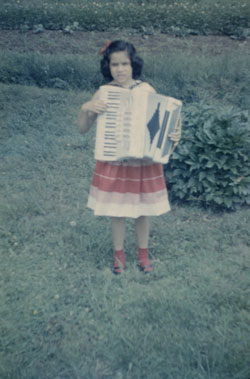
  • Gloria Was The Little Girl's Name, And An Accordion Was Her One Fierce Desire

    accordian.jpg

    For many months, on her way to and from school each day, Gloria had paused at the pet shop window to gaze with a combination of adoration and desire at the pretty little accordion nestled there in its kennel.

    Each night at the dinner table she would beg her parents to let her have an accordion –and not just any accordion, but the one, lonely accordion in the pet shop window. How she longed to have that accordion in her arms, to have it for her very own!

    Her father, however, was insistent that they would never have an accordion in their home; Gloria, he said, was much too young, and an accordion was a serious and expensive thing. The world, he proclaimed, was already full of abandoned and unloved accordions.

    Perhaps, her mother said, when she was a bit older, Gloria might get an accordion. But her father looked sternly at his daughter across the table and said, Not as long as I am in charge of this house. I don’t have a moment of peace and quiet and can barely make ends meet as it is.

    At this, Gloria’s mother winked at her and said, Someday you will be older and you can work hard and save your money for an accordion of your own.

    Finally, one day when she had all but given up hope, Gloria came home from school to find the pet shop accordion wrapped in a red bow and resting on her bed. She took it lovingly in her arms and was startled to discover how much larger it had grown since the first day she had laid eyes on it in the store window.

    And then, as she cradled the accordion in her arms, Gloria found herself seized with a sort of panic that cast a dark shadow over her joy. An accordion, she suddenly realized, was a tremendous and perhaps terrible responsibility.

    What, she wondered, shall be my accordion’s name? And what will I feed it?

    As Gloria studied her accordion intently and ran her fingers over its beautiful details she also thought, How will I ever sleep again?

    family.jpg