Year: 2005

  • What This Is, And Isn't

    herd on the move.jpg herd on the move 2.jpg

    I don’t know, to be quite honest with you.

    There does, though, seem to be some confusion on that question, if the handful of puzzled emails I’ve received in the last week are any indication. I’m still trying to get a handle on who stumbles in here, into The Rake‘s little sidecar in cyberspace. I’m not even sure who reads The Rake, but I’m guessing I’ll get a general idea in due time.
    I should warn you right now, though, those of you who are unfamiliar with my previous stint of hard labor shoveling words into a hole: this is probably not the place for literalists, for people who are earnestly prepared to believe what they read. I am, as more than one of you has already observed, an unreliable narrator. And, yes, there are more important things in the world than the sort of nonsense you’re likely to find here, many more important things.
    It’s not that I don’t care about those things. I do care, and I already spend entirely too much time reading about them and railing about them until I’m blue in the face to my wife and friends. The thing, though, is that I’m not, unfortunately, a man who’s going to be able to shed any important light on any of the pressing issues of the day. My opinions on those important things and issues are pretty much the same as those held by tens of millions of other people, and every bit as impotent in the face of the opposing views held by tens of millions of my other fellow Americans (as if you can ever really say “my fellow Americans” with a straight face anymore, as if you could ever truly say “jury of one’s peers”).
    I’m not indifferent, and I’m not yet ready to throw up my hands, even when it appears that I am, quite literally, throwing up my hands. I plod my way glumly through the newspapers every morning, page by page and column by column. I do some of the things that I consider to be my duty as an American; I vote, write the occasional angry letter to public figures, and volunteer my time. I routinely give money to organizations or causes that seem worthy to me. Yet these gestures feel increasingly like inadequate acts of atonement or pathetic attempts at absolution –which they doubtless are– rather than meaningful forms of redress for the mess we’re in.
    “There will be much hope, but not for us,” Franz Kafka wrote in his diaries, and like so much else he wrote, those words could well serve as an epitaph for our time.
    If you’ve made it this far you’re likely thinking by now that I have, in fact, thrown up my hands. Like I said, though, I do throw up my hands, but I haven’t yet thrown up my hands, and I think there’s an important distinction in there somewhere.
    The problem at the bottom of all the other many problems right now is this: political discourse [sic] in this country is insufferable. I find politicans and the parasitic pundits who live off the beached and bloated host of the American political leviathan to be as uncompelling, unconvincing, and unattractive a group of characters as has ever been assembled in any one time and place in the history of mankind.
    They don’t move me. They don’t change my mind. And even given their now acknowledged place as part of the entertainment industry they fail to entertain me.
    And the American heart doesn’t really move much anymore, either. (William Merideth’s “great sloth heart” has never been more universally apt.) Oh, it wiggles a bit now and then, trembles or constricts (timidly, violently, almost imperceptibly), or shifts a few degrees to the left or right, but it doesn’t move. When the heart won’t move, the mind can’t be changed, and the wonderful thing about the lost art of real, stirring political oratory and strenuous debate was that it had the ability to both move hearts and change minds. Go to the library and check-out a volume of great speeches sometime, or, better yet, get your hands on a copy of Say it Plain: Live Recordings of the 20th Century’s Great African-American Speeches. That wonderful book and CD package is full of passionate, roaring orations that moved hearts, changed minds, and moved and changed the world.
    I’m sorry, but this thing –whatever it is– will never do that.

  • For The First and Last Time, With Feeling

    The Koufax awards were announced today, and you will be forgiven for having no idea what they are. They are the blogging world’s equivalent of the Oscars or the Grammys. And now it can be admitted that there is an award for every channel of human industry ever conceived and exercised. Can there be any doubt that there are now small gold statuettes on shelves somewhere celebrating the best stamp collection, sausage making, shoe tying, rope jumping, sign painting, phone answering, carpet cleaning, bottle washing, newsprint recycling, and commercial broadcasting? And the best new anonymous grafitti left with a pencil over the urinal in the men’s room goes to… the guy who keeps writing “BJ” wherever he micturates.

    We don’t want to dismiss the Koufax awards. But we do want to finally and conclusively clarify something, and we’re afraid we’re going to have to raise our voices a little to do it: BLOGGING IS NOT JOURNALISM. STOP EQUATING THE TWO, AND STOP GIVING THESE “BLOGGING” PEOPLE ACCESS TO THE “MSM” WHICH THEY ARE CONSTANTLY RAVING ABOUT. At the very least, make sure you permanently dismiss one pundit for every blogger you hire.

    And another thing: Get Frank Rich on the Op-Ed page, or fire him. We’re half convinced that global warming is a result of all the hot air being emitted by self-evident experts in all quarters. In a newspaper, particularly one that aspires to be the paper of recrod, opinion belongs on the opinion page. Even if we agree with Rich, which we do with alarming regularity, we still don’t much appreciate the ammunition he—and a hundred other professional soap-boxers—have given to all the belligerant wingnuts who have managed to spread skepticism about the world’s authoritative news sources because they cannot or will not see the difference between one person’s beliefs and another’s reported observations and sourced quotes. Ever noticed how National Public Radio does not broadcast any opinion—except as rare, carefully isolated, and identified “commentaries”?

    Blogging is criticism, it is cross-referencing and self-referencing, it is exegesis, and it is frequently a form of over-amplified soap-boxing. It does not typically involve any reporting, and if it does, it instantly stops being a blog and becomes a news dispatch. The only blogs that qualify even remotely as journalism are blogs that involve a writer getting off his or her duff, observing real-world incidents and interviewing real-world people, recording the results of this information gathering, and submitting the results to a skeptical editor whose job it is to make sure you’re not making any of it up or picking any private fights. Reading another persons’ news reports or blogs does not qualify as reporting. It qualifies as criticism and opinion, and in rare cases, entertainment.

    Okay, with that now clear, we can point you to some further refinements, from one of the big, deserving winners in this year’s Koufax awards, Digby. As he makes clear, people have been expressing themselves and their sordid opinions since they first started scratching burnt bones against blank cave walls. What is different and interesting and maddening about this modern medium is the spontaneous regeneration and retransmission of response and riposte from tens of thousands of readers. That is all. That is a big deal, relatively speaking, but that is all.

  • A Brief Primer On Insomnia, Along With Some Personal Anecdotes

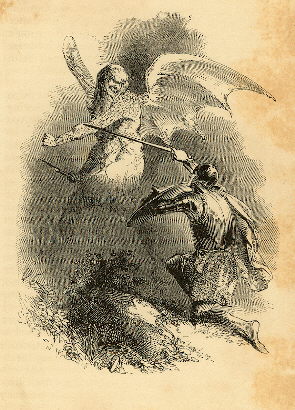
    angel attack.jpg

    Waking, by reason of their continual cares, fears, sorrows, and dry brains, is a symptom that much crucifies melancholy men.

    Robert Burton, The Anatomy of Melancholy

    All he could do was transcribe the interminable babbling voice of the night, the insinuating perverse voice of the demons.

    Pietro Citati, Kafka

    One time I was in south Florida, in the central part of the state, and I was staying in a roadside motel in a little swamp town. The desk clerk had sold me a six-pack of beer, and I sat around watching something called “The National Bird Dog Field Trials” on television until the local station went off the air. I couldn’t sleep so I went back out to my car and drove out to a truck stop diner at the edge of town and went in for coffee and hash browns. I sat in a booth near the window and eavesdropped on a conversation between two guys and a woman at an adjacent table.

    “They can finger you with nothing but bones,” I heard one of the men say.

    “Slivers,” the other guy said. “The fucking scientists can nail you with nothing but slivers. You have to be burning very hot to do it right, and they can still figure you.”

    “You can’t just toss a body on a plain wood fire and expect you heard the last of it,” said the first guy. “That won’t cut it. It wasn’t just teeth they found.”

    “And all that swamp out there,” the other guy said.

    “Gene wasn’t thinking,” the woman said. “He was crazy to burn her, that’s all. It wasn’t no thought at all.”

    “He still would have been wise to take a step back and bury what he had left,” one of the men said. “Bury it deep.”

    “Swamp it,” said the other. There was laughter around the table.

    “Gene just plain fucked up,” the woman said, and everyone nodded their heads and kept right on forking food into their faces.

    What if an individual is perceiving a daydream and a series of external sensory inputs at precisely the same time, and has lost the capacity to distinguish one from the other? What happens to his perceptual world? Clearly he will be peopling his universe of awareness with elements that are altogether private, presences generated from within which for him will be a genuine part of the real world; these are what he sees, or hears, or is otherwise sensing. And should he then be unable to differentiate these from his everyday perceptions, then indeed he may move into a haunted, nightmarish world, and be a very troubled human being.

    Joseph D. Noshpitz, “Reality Testing: A Neuropsychological Fantasy,” in Comprehensive Psychology

    A common notion about the relationship of sleep to mental health is that total sleep loss…deranges the mind and may result in some kind of breakdown….When serious sleep disturbances are present, as they almost always are in the mentally ill, the patient’s history often indicates that the sleep disturbance preceeded the actual break from reality.

    William C. Dement, Some Must Watch While Some Must Sleep –Exploring the World of Sleep

    Some nights you’d sit there tracking moonlight across the floor, or studying the garage roof next door as if it were a radar screen. Your mind on a very low flame, a few tired words alternately see-sawing in the silence or surfacing through the waves of static. You’d sit there barely conscious, but the moment you’d try to climb into bed and close your eyes the whole chorus would convene again with a vengeance. The variety show of hypnagogia. Channel surfing long before the advent of cable television and remote control. So random, stuttering, and relentless was your consciousness in those hours that you would make an exercise of trying to isolate a particular fragment, and then attempt to concentrate your mind on the fragment’s origin, trying to trace it back, if possible, to its original source. Sometimes it would be a line from a book or a television commercial, other times it might be something you’d overheard in school, or a snippet from a song or a random conversation. You would find yourself obsessing about an outrageous pair of shoes you had seen on a complete stranger in a grocery store, weeks earlier.

    Ultimately, towards dawn, you were always left with nothing but the barely-beating heart of the sleeping world. The under-hum and throb of its basic operating systems. The furnace. The ticking of the clock. The world on the back burner, as close as the modern world comes to stasis: You were left with only you and what was left of the night, the retreating darkness, shadows receding on the walls, the cruel pinch of exhaustion, the terrible reality that you were going to have to sleepwalk through another lost day. What was that they were saying about what?

    Eventually, every night you would reach a point where you could not fall asleep but you could nonetheless not be truly awake. You were reduced to fumbling around, grasping, in a dense and hazy subterrannean no man’s land, lost in the gauzy, impressionistic foothills of sleep. You would take a walk to try to resuscitate your sanity, to get clear thoughts moving again in your head. You moved in slow motion through a woozy, muslin-filtered border country, imagination and hallucination bleeding into reality. You heard what sounded like chanting. You heard the clanking of a cowbell. You heard the distant tolling of a clock, and a burst of faint music sucked from a car window somewhere out in the town. You heard a baby crying, then someone laughing, wretching, congested laughter. You heard a radio playing in a junkyard. You heard what sounded like a piano. You heard windchimes twisting in a backyard somewhere. You heard the barking of a dog, answered by another, in the next block. You thought of the men across town, in the slaughterhouse, exhausted on their feet in the slippery dead mess, blood bubbled everywhere, the tangy reek of animals being broken down into meat. You would go there from time to time to stand at the mouth of the tunnel that took the tired men to and from the slaughterhouse. You would stand there in the last of the darkness with a little collection can for UNICEF, and you would shake your can at the blood-soaked, broken-knuckled zombies as they plodded past blank-faced, clutching their empty lunchboxes, moving almost unconscious into the bruised light that was just then creeping into the eastern sky.

    Wakefulness during the time when one ought to be asleep is frequently a distressing condition, undermining the strength and incapacitating for active and efficient work. Insomnia or sleeplessness often afflicts those of active mental habits and lays the foundation of premature decay.

    When sleeplessness overtakes a brain-worker it is a sure indication that less intellectual work must be done, and that he ought to betake himself, if possible, to out-of-door exercise in the pure air of the country.

    Encyclopedia Brittanica, Ninth Edition. 1899

    The victim of insomnia, having seen the slowness of the dawn, arises with every nerve tattered and the capacity for happiness ruined. His morning is a desolation.

    Arnold Bennett, Things That Have Interested Me. Third Series. 1926

    Among the imposts which humanity pays for the true or imaginary advantages of what, for lack of a more consistent term, is denominated ‘civilization,’ there is not one whose tyrannical invasion of physiological law is so fraught with mental and physical bankruptcy as sleeplessness.

    J. Leonard Corning, Brain-Rest: A Disquisition on the Curative Properties of Prolonged Sleep. 1885

    Aristotle, On Sleep and Sleeplessness

    The BBC’s brief History of Insomnia

    The National Pain Foundation’s Insomnia Page

    When I lie down, I say, when shall I arise,

    and the night be gone? And I am full of tossing

    to and fro unto the dawning of the day.

    The Book of Job, chapter seven, verse four.

    This relentless repetition of the same illegible text….

    Yannis Ritsos, “Insomnia.”

    Melancholics are not so sleepless as maniacs, yet the want of sleep is often an early and prominent symptom. They do not readily sleep, and if they do, they awake soon to be tormented by the vilest misery that it is possible for human creatures to endure.

    Insomnia and its Therapeutics, A.W, MacFarlane, M.D. 1891.

    Want of refreshing sleep we believe to be the frequent origin of insanity, dependent upon moral causes.

    Psychological Medicine, John Charles Bucknill and Daniel H. Tuke. 1858.

    Those who pursue a desultory method of thinking are very often the victims of an obstinate and peculiarly distressing form of insomnia. During the day such persons are observed to apply themselves with apparent zeal to the regular vocations of life; but, if closely observed, there is often visible a certain absence of concentration and devotion to the particular matter in hand. When questioned upon this point, they admit that they are ‘absent-minded’; and, while only too willing to apply themselves, are frequently tormented by the intrusion of ideas totally foreign to the particular subject at hand….they carry their responsibilities to bed with them; and, while other minds are at rest, their own intellection is morbidly active. Midnight, and even the small hours of the morning, find such individuals speculating upon the pros and cons of the past and future with an intensity which often drives them to a state of positive desperation. The small ills of life assume alpine proportions, and even the most trivial circumstances are distorted and magnified a thousand-fold. When at last sleep actually does supervene, it is no longer psychological, but, on the contrary, perverted by dreams and unconscious cerebration to such a degree that these unhappy individuals can hardly be said to have slept in the ordinary sense of the word.

    Brain Rest, J. Leonard Corning. 1885.

    Under [insomnia’s] influence injurious changes are permitted by the patient to be made in his daily habits; pursuits which formerly engaged his attention no longer interest him; even important business concerns are sacrificed; and against such tendencies no pre-existing vigour of intellect will afford any defence; the strongest minds (intellectually considered) may sink into apathy and feebleness.

    James Russell, M.D., “On Sleeplessness.” British Medical Journal, November 16, 1861.

    After dinner, my friend drove me, in a carriage, some five miles back into the country –the greater part of the way, along the margin of Migunticook Lake, and under a terrific precipice, whose boulders every moment threaten destruction. In fact, the whole of a bright sunny day, cooled with healthful zephyrs, was spent in pleasurable excitement. Interesting conversation beguiled the evening; and, after family worship, I sunk to rest in a luxurious curtained bed. Ere long, I slept; and, about five o’clock next morning, was awakened by the crowing of the cock. This was the only night’s sleep I have had these last six years and seven months; so help me God. Since then, my nights have been tedious, as usual, without sleep, and some of them distressing.

    “An Example of Protracted Wakefulness,” Boston Medical and Surgical Journal. July 31, 1845.

    Experience in private practice, and extended observation in the wards of general and lunatic hospitals, have taught me that the ordinary hypnotics are frequently unreliable, and that in some instances their use is attended by results as bad as, if not of more serious consequence than, the conditions they were intended to remove. I do not wish by this somewhat sweeping assertion to be understood to condemn the ordinary hypnotics, or to doubt their efficacy in suitable cases; but it seems to me that we run great danger of becoming routinists in the matter of sleeping-draughts….Like most of my fellow practitioners, I constantly meet patients who have run through the whole gamut of sleep-producing drugs, and find their last condition, in many instances, worse than their first.

    Edward N. Brush, M.D., “Some Clinical Experiences With Insomnia,” The Practitioner, January 1889.

  • Byline Vs. Timeline

    For some reason our attempt to point you to Steve Gilliard’s compelling thoughts on “New Journalism” failed yesterday, so we’ll try again. I am envious of Gilliard’s broad-ranging feel for the middle-distance history of journalism—particularly as it was affected by the convulsions of the sixties and seventies. How could such intense social and political upheaval have NOT energized journalists and journalism? (How can it fail to do so today? And I am not talking about blogs.) In a free society, it is impossible for these sorts of phenomena to happen without the press taking notice, and once they do, the phenomena can kind of feed on themselves and develop in new trajectories. How much longer would Vietnam have lasted without television cameras in the field? How would the world be different today if Gerald Ford had never been president? (Uh… hmm…)

    But but but. Several issues to follow-up on from yesterday’s addendum. Gilliard’s lowest diss is to call someone or something “irrelevant” and we think this could bear a little unpacking. It is Gilliard’s paradigmatic assumption that journalism can and should change the world, right the wrongs, redress the complaints of the timid and weak, fix flat tires, and generally point in the right direction out of the slough of the present. We have no problems with this view of journalism—it is what the nation’s daily and weekly newspapers should be doing, and generally are doing, when they aren’t publishing the lifestyle tripe they believe is necessary to attract all those solipsistic, suburban TV addicts.

    We must confess that we took a moment to enjoy the sweet taste of schadenfreude in Gilliard’s funny and precise dismissal of Dave Eggers—”a silly, irrelevant man. ” We also couldn’t agree more that The Writing Program has done more violence to writing than a half-century of TV, radio, video games, and the web combined. Still, we think it is a little unfair to expect someone like Eggers to bear the cross of New, New Journalism. Yes, it would be nice to have a class of literature that embraced the world more directly and energetically, rather than turning inward, but why throw out with the bathwater anyone who has ever out pen to paper? Besides,Galliard is being selectively myopic when he carps about the state of literature today. I think, for example, that Franzen and Lethem are the spearhead of a new, new literature that synthesizes the introversion of young people today with a terra-stomping kind of allegorical quality. And what about the medium-old guard, folks like Margaret Atwood, Paul Auster, Nick Hornby, not to mention the old old guard like Philip Roth and John Updike? To see these writers as essentially hermetic is to read them in less than one dimension, while at the same time idolizing youth.

    Anyway, the whole point is this: Why expect literature to do journalism’s job? Good writing, no matter what the genre or category—whether you’re talking about first-edition hardcovers or cereal boxes—has only one obligation, and that is to the Truth. There are inward and outward truths, and presumably these can inform each other.

    The problem with workaday beat journalists is that they approach literature and the truth on a deadline, and they believe that great work is measured by the writer’s last byline. History moves in bigger circles than that. It is easy, today, to see that Hunter Thompson’s work transcends its time, transcends itself. It is not primarily about its outward marks—the stylistic departures, the lack of formalism, and it’s a fool’s errand looking for a contemporary equivalent. The reason there are no Thompsons today is not that there aren’t any; it’s that we won’t know about them for a decade or so.

  • Can't we all just get along?

    polly.jpg
    Please can I have some health insurance?

    Representative Jim Ramstad gave us a good chuckle this morning in his Strib op-ed piece, “Too much at stake for continued partisan warfare.”

    He rattles off a litany of the nation’s problems: social security, hungry children, crisis in public schools, out of control health care costs, national security, dependence on foreign oil, etc, and calls for a bipartisan effort to solve them. He goes on to say, “I’m not talking about singing “Kumbaya,” holding hands on the Capitol steps.”

    Well, Jim, that’s exactly what you are talking about. In case you haven’t noticed, your party now controls both houses of congress and the White House. If your party were really in power for the good of the people as you see it, they could do all these things.

    For example, they could raise the retirement age a squeak and eliminate the limit on the amount of income that is taxed for Social Security benefits. They could add to, rather than cut, poverty programs, especially for children. The party of Lincoln could establish a reasonable basic health care system for all Americans that would make our businesses more, not less, competitive internationally. You could put a tax on gasoline that would raise the price to somewhere near what the rest of the world pays, and use the income from that tax to repair roads and bridges and build a mass transit system that would use less gas. While you are at it, you could put a huge tax on gas guzzlers and require car manufacturers to increase their fleet mileage. You could pay for increased security measures where we really need it–around our ports and chemical plants–instead of sending seven times as much money per capita for increased security measures to Wyoming (home of Dick Cheney) than you do to New York.

    I could go on, but you get the point, Jim. It’s your party, firmly in the control of the DeLay wing, which is against all those things you say the country needs. They are the ones who want to cut taxes at the same time we’re at war in order to starve the government enough to effectively repeal the New Deal.

    Jim, if you really think these things need doing, you need to round up the few remaining moderates in your party and get together with some of the same from the Democratic side and get to work to wrest the power from those who simply want to destroy government.

    Writing a polyannaish letter to the Strib ain’t gonna cut it.

  • The Basic Drill

    Welcome to this thing, yet another old thing reconfigured as a new thing. It’ll be mostly about baseball, but I have a wandering mind, so it’ll likely occasionally stray pretty far afield –at some point, I suppose, I’ll feel compelled to talk about other random nonsense as well. Sometimes the random nonsense and the baseball will intersect in strange ways. I might, for instance, tell you about the time I saw Boxcar Willie throw out the first pitch in a Southern League game.

    Willie was wearing overalls, of course, and uncorked a wild pitch to the screen. I could then seque into the story about being present on another occasion when Boxcar Willie had a street named after him in Branson, Missouri (he was wearing overalls). Every time I see a celebrity of even the most forgotten, nearly-dead sort at a baseball game I’m for damn sure going to tell you about it. Like this: I once saw Don Knotts and Norman Fell at Kauffman Stadium in Kansas City on the night Paul Molitor got his 3000th hit.

    I might ask you to tell me the strangest person you’ve ever seen throw out the first pitch or sing the National Anthem at a baseball game. What the hell, as long as I’ve already mentioned it we may as well get that out of the way right now.

    Mostly, though, as I said, I’ll write about baseball, because baseball is one of the few things I’m passionate about in a world where the things I’m passionate about are diminishing by the day.
    I say this even though baseball has nearly destroyed my life, and may yet manage to finish me off. I think it was F. Scott Fitzgerald, talking about Ring Lardner, who once observed that baseball had ruined more good writers than alcohol. I’m not going to pretend to be a good writer, but I can tell you that I’ve done more than a little dabbling –dabbling is almost certainly not the right word– in both baseball and alcohol, and I’m pretty sure baseball has taken more years off my life.

    Perhaps not all truly obsessive baseball fans are stunted oafs, but a great number of them are, and I don’t suppose I’m any exception.
    I once ran away from home to work at a spring training ballpark (sure, I was 25 years old, but like I said, I was a stunted oaf). I’ve been to more baseball games than I could count, although I’ve scored every one of them, and the scorebooks are heaped in my basement along with several thousand baseball books, a couple hundred mitts, and scads of other baseball-related nonsense.

    I’ve tried to wean myself over the years, but to no avail. The overpaid, cheat-at-any-cost bastards and their cretinous overlords have got their hooks in me for good. If I were to wake up one morning in April and read in the newspaper that Derek Jeter had been arrested for having a freezer full of human body parts, dead cats, and growth hormones in his basement I’d immediately skip happily along to the boxscores and by six-thirty I’d be in my seat at the Metrodome with a scorebook in my lap.

    I have nothing whatsoever against complete monsters as long as they can swing the bat and make the necessary plays in the field. As soon as their production starts to slip, you’re welcome to lock them up for the rest of their lives as far as I’m concerned.

    I could tell you about all the reasons why I love baseball despite its many serious flaws and blemishes (unsightly steroid rash, most prominently, and Bud Selig), but people do that all that time, and you’ll surely have noticed by now that they’re always essentially the same reasons: the perfect accounting of the game, the absence of a clock, the rich history and repository of statistics, the easy and expert comparisons those statistics make possible for even the most casual fan, the lulls that allow time for plenty of idle conversation, the quirks and characters and long season.

    That’s all absolutely true, but Roger Angell and George Will and a host of others have been going on about that sort of thing forever, and sometimes it can almost make me resent the sheer perfection of the game. If it were a little less tidy and entrenched maybe most of the highbrows would go back to their chess boards and fat volumes of political philosophy and Civil War history.

    Mostly, I have to admit, I love baseball because it takes up so much time that would otherwise have to be taken up with something else, and I don’t have much in the way of something elses in my life. Spring training, 162 games, the postseason –that’s essentially eight months steeped in obsession, and over a lifetime that adds up to an awful lot of the most basic sort of prison subtraction.

    I like the way we’ve all come to take for granted the ridiculous uniforms of the sport. I love the fact that there are no cheerleaders. I love the suicide squeeze (and despise the sacrifice bunt) and the grand slam –or, as my wife calls it, the four-run thing. I love the various plot lines and dramas large and small that play out over the course of a season, the countless opportunities for pure joy and abject misery.

    I’m not sure baseball builds character, but I do know that it creates characters, and I adore characters. The game also doesn’t necessarily reward devotion, but it does reward attention, and for the attention deficient it’s like a daily Ritalin injection directly into the heart of the cerebrum. I can’t think of any other thing that can make me sit still for four hours at a time.

    And after four months of bouncing off the walls I can’t tell you how good it’s going to feel to be able to sit still again, even if I once more end up with my heart yanked out of my chest and kicked into the gutter with the last leaves of autumn.

    This, though, will be about those months when my heart will still be beating, hopefully like a man’s with a gun in his mouth. Seriously, that would be a good thing. That would be a seriously good thing.
    I’ll be here –and elsewhere– all year. Feel free to drop me a line any time. I’d be happy to hear from you.

  • Stand Down

    Exit 127 off Interstate 90 doesn’t seem to go anywhere. There are no towns, no farms, no apparent reason to build an exit in the middle of the driest, flattest section of South Dakota, a desolate expanse of land. If you steal a glance at the right moment, though, you may notice a nondescript vinyl-sided building sitting just off the highway. It’s surrounded by a tall chain-link fence and topped with a yellow weather vane.

    “Here we are!” announced my cheerful guide, Ranger Mark Herberger, dressed in a tan park ranger uniform and wearing a stiff, wide-brimmed hat. We were entering one of the country’s newest national parks: the Minuteman Missile National Historic Site. It was established in 1999 as a sort of Cold War museum. Limited guided tours began last summer.

    “This is Delta One Launch Control Center, where they controlled ten missile silos,” explained Herberger. The park is but a remnant of a missile field that once spanned 13,500 square miles of South Dakota countryside. Under grazing cattle and bison, and barking prairie dogs, lay dark secrets: one hundred and fifty Minuteman II missile silos and fifteen launch control centers. Built in 1962, these were the nation’s first solid-fuel intercontinental ballistic missiles. And for thirty years, they stood ready to annihilate every living being in the U.S.S.R.—and possibly the rest of the world. According to the doctrine of the time, if the Soviets initiated a nuclear war, it was believed that at least some of South Dakota’s missiles might survive the attack. They would be used to return fire.

    Though the building looks like an average house, curious sightseers during the site’s active days would have been greeted by unhappy armed guards racing toward them in armored vehicles, known as Peacekeepers. “Millions of people drove by every year on the interstate and did not realize they were on the front lines of a war zone,” he said.

    Many South Dakota residents were just as oblivious to the existence of the silos, but that was part of the appeal in building the silos here in the first place. There weren’t a lot of people around to ask questions. Recently declassified documents explain that here, there was “an existing network of roads, large amounts of easy-to-acquire public land, and a low population density to minimize civilian casualties in the event of a nuclear accident or attack.” There were other strategic reasons. The government figured that if the Soviets attacked, they would have gone the most direct route, over the North Pole and through our undefended border with Canada. Suddenly, in the era of intercontinental ballistic missiles, sleepy South Dakota was flung into the middle of the Cold War.

    The same goes for North Dakota, where many national defense sites are still in operation (though the targets undoubtedly have been updated). For example, the five-thousand-acre Air Force base in Minot, built in 1956, along with the base in Grand Forks, currently provides staging areas for hundreds of bombers equipped with nuclear warheads. When the Minuteman silos were still online, North Dakota had the heaviest concentration of nuclear weapons on earth. People used to joke that if the state seceded from the U.S., it would have been the third largest nuclear power in the world.

    The specter of the apocalypse did not dampen the upbeat tone of Herberger’s tour. Stretching an upturned hand toward the parched yard, he said, “Here’s a volleyball court where soldiers could pass their time, and a horseshoe pitch, too.” While officers perfected their bump-set-spike, two officers below ground maintained a hot line to the White House and plotted coordinates in the Soviet Union, calculating nuclear strikes that would cause maximum damage.

    This site, along with others like it, was decommissioned after President George H. W. Bush and Soviet leader Mikhail Gorbachev signed the Strategic Arms Reduction Treaty in 1991. Inside the house, Herberger opened a door that led to a garage-like space. “We call this the Retro Room,” he said, “because of all this old exercise equipment and the bumper pool.” In this carpeted area, soldiers relaxed, shot the breeze, and kept in shape. A long-neglected Ultra Gympac weight-lifting system with cables, bars, and iron weights sat slumped in the corner.

    Next to the Retro Room, plush modular furniture filled a lounge with a picture window that framed an expansive view of the empty skyline. “Everything in here is exactly as the Air Force left it,” said Herberger, with more than a little pride. “All the books, magazines, and videos.” He picked up a yellowed copy of Popular Science from the early nineties. The magazine’s cover depicted an ominous-looking nuclear weapon under the headline, “Taking Apart the Bomb.” Apparently, the soldiers stayed in touch with their sensitive sides, too: A dog-eared copy of Shirley MacLaine’s Dance While You Can held a place of honor at the center of the coffee table.

    The launch control center was a self-contained little world. It had a backup generator that could produce enough power to supply all of Rapid City. It had its own well, three thousand feet deep. There was a helicopter pad and a hardened antenna system, designed to survive attack. “Everything above ground is just to support those two men underground,” said Herberger. Even if a near miss knocked out all the above-ground equipment, he added, the underground capsule still could have operated for two weeks. “Nothing could have withstood a direct hit, though.”

    We went down for a look at that underground capsule. A shabby old service elevator lowered us three stories—about forty feet—and stopped with a clunk. Herberger opened the lift gate to reveal a large mural of an American missile dramatically piercing a Soviet flag. “Each site had its own artwork that the men painted,” he said. He showed me a photo of a mural from another silo. It showed a pizza box with the ominous promise, “Worldwide delivery in thirty minutes or less—or your next one is free.”

    At the mouth of Delta One, the launch center itself, I noticed a cryptic message stenciled on the wall. Near a wide yellow line painted across the floor, it read, “No-Lone Zone Two Man Concept Mandatory.” Herberger explained. “If you crossed this line alone you’d probably be shot. At all times there had to be two people in the capsule.” We crossed a little gangplank, passing five-foot-thick concrete walls reinforced with quarter-inch steel plates. The capsule looked like a train car suspended by enormous springs—the idea being to lessen the shock of a nuclear blast.

    Inside the pod, there were two red chairs set on runners so they could roll from control panel to control panel, all festooned with sixties-era dials, knobs, and switches. Next to the capsule was a cot for catnaps, a toilet, and an ancient microwave oven. It was like a tiny high-tech bachelor pad, circa 1962, buried deep in the earth.

    To prevent any horrific mistakes, each officer wore a key around his neck. These had to be inserted simultaneously into two separate locks, ten feet apart, in order to activate the missiles in any of ten remote silo sites. But that was just the start: Two codes and two more keys allowed access to a red do-not-touch box prominently mounted on the wall. “Actually, you needed more than two people to fire the missiles,” says Herberger, “because the command had to be approved by another launch control center.” If the Soviets knocked out all fifteen control centers managing the one hundred and fifty missiles in South Dakota, the Air Force crossed its fingers that confirmation could be obtained from a launch control center in another state.

    Although it’s true that the fixed locations of these missile silos made them sitting ducks for a Russian strike, they were less vulnerable to accidents than the mobile bombs the military carried around on submarines and airplanes. (According to some sources, as many as fifty nuclear weapons lie at the bottom of the world’s oceans, jettisoned from distressed planes or lost during naval mishaps.)

    The threat of nuclear annihilation had its benefits. The silos brought jobs and federal funds to an often financially strapped state. “The interstate, jobs, and rural electrification—they were all put in because of the missile fields,” explained Herberger. Many Dakotans also thought the missiles made them safer. They didn’t necessarily consider that their wheat fields were now ground zero on a map somewhere in Moscow.

    Herberger pulled aside a Velcro patch on the ceiling of the pod and told me, “Here’s the escape hatch, but it just dead-ends in five feet of dirt, tar, sand, and clay.” Herberger said that in order to escape, a soldier would have had to shovel. And what would they have found, had there been a serious attack? “Some guys who manned this launch control center called the escape hatch a joke, because you’d find total destruction and nuclear winter,” he said.

    Now that we’d viewed the switches and panels, the brains of the operation, it was time to inspect the brawn. “Do you want to see a nuclear weapon?” asked Herberger. We drove about ten miles farther down the interstate to another exit to nowhere. Standing in an empty field with the wind howling, Herberger explained that we were right next to the Delta Nine silo, which was invisible except for a tall fence and a thick cement slab.

    He opened the padlock and we scrambled onto the silo’s concrete lid. Pointing to a group of ten-foot pilings fifty yards away, Herberger said, “See those cement pillars out there? In the early days, they took measurements for navigation from pillars placed in the field and by the stars.” In other words, if the little cement poles were moved or misread, the navigation system sent the missile to the wrong city. And back then, there was no turning back, he added, “no redirecting it, no self-destruct mechanism like there is now.”

    We stepped up on a platform and peered down, into the silo, sunk eighty feet into the earth. Cupping my eyes against the sun’s reflection on the protective Plexiglas cover, I could see it. Poking up from the enormous concrete pit, a gigantic Minuteman II missile. It had been waiting here—silent, lethal—for more than forty years, ready to level Moscow within a half hour. Looking down into the hole was like peering into the business end of a gun, except that this thing was designed to kill not just one person, but an entire nation. Suddenly I was overcome by the powerful memory of maps showing the impact-radius of a twenty-megaton bomb; old newsreels of Hiroshima; scenes from The Day After—all the fantastical, nightmarish visions I inherited from my parents and their war. And here was the weapon itself, the real deal, more or less pointed at my forehead.

    These are the silos my grandmother refused to believe existed when I pointed them out on our way to the Rocky Mountains. Other relatives of mine, who lived in Montana, remember seeing the missiles on flatbed trucks in the parking lot of a restaurant called Eddie’s Corner. The airmen used to go inside to ogle the voluptuous Fergus County sheriff’s daughter, Carol Couch, who waited tables in a pink low-cut T-shirt. David Arnott of Moccasin, Montana, remembered this beautiful threat to national security. “The Air Force boys used to hang around quite a lot in those days, and she could keep a whole counter of them occupied for hours,” he said. “The missile and warhead trucks would sit idling in the parking lot.”

    Through eminent domain, which allows the government to take personal property for certain public purposes, Arnott’s father had a missile silo placed on his ranch. His sister Sigrid remembered, “The Air Force would drive three hours from Great Falls to check on the silo and always forget to close the gate so our cows would get out. We used to joke that the cattle could trigger the alarm and start a nuclear war. One day, my dad wound the gate shut with wire and snipped off the ends so they’d have to use wire cutters to open it. A colonel called and yelled at Dad. ‘This is a threat to national security!’ he said. ‘You’ve endangered our country!’ After that, the Air Force remembered to shut the gate.”

    The fenced perimeter of each silo, including the one on the Arnott property, was equipped with dozens of motion sensors, in case industrious teenagers tried to break in on a dare. With little to do on a Saturday night, why not break into a missile silo? Thankfully, even if a group of drunken teens did manage to get through the fence and past the sensors in an attempt to blackmail the world with a thermonuclear device, they’d never penetrate the silo’s blast-proof doors. Plus, as an extra layer of security, the missiles were controlled remotely and couldn’t be detonated on site.

    The Delta Nine missile was the last of the Minuteman II missiles in the Midwest. The other underground silos in the Dakotas, Montana, and northwestern Minnesota were imploded beginning in 1991, as part of the START treaties. The resulting craters were left open so Russian satellites could verify their destruction. The missiles casings themselves, minus the warheads, are in storage for possible future deployment or even as space launch vehicles. The government has tried to sell the abandoned land back to local farmers, but it’s tough going since just two feet below the topsoil, there is plenty of asbestos, leaked fuel, and PCBs.

    A visit to the Minuteman Missile National Historic Site may feel like a trip back in time to the heart of the Cold War, but the credo “peace through superior firepower” is still very much on active duty. Eight countries possess the thirty-thousand or so nuclear weapons known to exist in the world—the U.S., Russia, China, Great Britain, France, Pakistan, India, and Israel. In all, forty-four countries have the technology and material to build nukes, including North Korea and Iran. (Experts now believe North Korea has twelve to fifteen nuclear weapons.) Today, the U.S. spends $100 million per day to maintain our existing, though significantly diminished, nuclear arsenal. Currently, we possess the explosive force of roughly 140,000 Hiroshima bombs.

    In 2002, President George W. Bush and Russian President Vladimir Putin signed the Strategic Offensive Reduction Treaty to further reduce our nuclear arsenals by 2012. Still, peace is tenuous at best. As rustic as the Cold War may seem today, and as scintillating as it is to look down a hole at a neutered Minuteman II missile, the possibility of nuclear war is hardly a relic of the past.

    The U.S. withdrew from the Anti-Ballistic Missile Treaty of 2001. We have developed—and exercised—a policy of preemptive military strikes. Some of our leaders still dream of a missile defense shield in outer space. Others seriously consider using new, smaller, “tactical” battlefield nuclear weapons. And three years ago, an interesting document was leaked. It was a “Nuclear Posture Review” that recorded official U.S. strategies for nuclear strikes against Russia, China, Syria, Iran, Iraq, and North Korea. Perhaps most discouraging of all: Despite its overwhelming lethality, the U.S. nuclear arsenal apparently has not deterred countries like North Korea and Iran from developing their own weapons in the post-Cold War world. Even if the Minuteman silos are being turned into parks, there are new targets being mapped every day.


  • Now we are three!

    click on the PDF files below to see this story in its technicolor glory.

  • to the editor

    REPRESENTATIVE MAN
    While Clinton Collins’ musings have long been a favorite of mine, it is a shame that he is perpetuating the (implied) myth of how the shortest month of the year came to be Black History Month [Love It and Leave It, February]. The selection of February, in fact, was made by a black scholar, Harvard professor Carter G. Woodson, in 1926 when he initiated “Negro History Week” in the second week of February. Dr. Woodson chose that week in homage to Frederick Douglass and Abraham Lincoln. There are numerous websites with information on the origins of Black History Month, such as www.freemaninstitute.com/woodson.htm.
    Patty Dean
    Minneapolis

    HERE, HERE
    African-American history doesn’t fit into white-American folk history in the same way that black South African history didn’t fit into Afrikaan’s folk history. It took years of revolt and international pressure to change apartheid South Africa. Mainstream American history, despite the revolt of the 1960s, is still a folk history filled with tall tales and omissions. American music, writing, the visual arts, and political change owe much to African-Americans. A month of lip-service is insulting.
    Walt Rupp
    St. Paul

    MILL CITY MUSEUM: ALIVE AND WELL
    It was wonderful to read last monthÕs cover story about the great things happening with the new Minneapolis Library [Who Needs All These Books, Anyway? February]. But given the flurry of activities that happen daily at Mill City Museum, we were bemused to see ourselves described as an “exquisite corpse.” The grand architectural achievement created at the museum is becoming well known through various awards and public acclaim, but we fear that the article missed the point of how this architecture was envisioned, and how visitors experience history at the museum. Since our opening in September 2003, more than thirty thousand schoolchildren have explored their roots through our engaging programs. Another one hundred thousand regular visitors have experienced history in a variety of innovative ways–through the eight-story “Flour Tower,” a modern music series in our Ruin Courtyard called Mill City Live (sponsored by The Rake), and numerous events such as weddings, class reunions, corporate parties, and, yes, a multitude of museum programs and demonstrations that put the past into context. And if readers need further convincing about the vitality of this place, then they simply need to come marvel at the transforming and vibrant Minneapolis riverfront from the top of our building–perhaps the most dramatic observation deck in the state. According to the National Historic Trust for Preservation, Mill City Museum is now the national standard in successful public/private preservation. Even the American Institute of Architects recently honored Mill City Museum with its highest award for architectural achievement. These awards are testament to the power of making history matter for people in the current moment, and for the ability of this unique venue to create a sense of the past that informs our communityÕs hopes for the future. We invite you to come down and give us a pinch. You’ll find we are alive and well, and eager to treat you to a taste of Minneapolis past and present.
    John Crippen
    Mill City Museum Director
    Minnesota Historical Society

    LIBRARIANS DO IT IN THEIR STACKS
    What a great article! I live in western Hennepin County but I sent my check for twelve dollars (and more) to the Minneapolis Public library. I used this system extensively when in college and could not have graduated from college without it. Well-staffed and stocked school libraries actually boost all students’ test scorces K-12. We have test data for more than six years that prove it. Regardless of socio-economic factors and education level of parents. What a great buy! Let’s all rejoice in all libraries.
    S. Mays
    Minneapolis

    EXTEND THOSE HOURS, ASAP
    When I was a kid in Chicago, libraries were open until midnight on Friday and Saturday. They also showed educational films to the general public. The libraries were a place to go, learn, and talk to your neighbors, and they were pretty busy. The libraries here are not typically available for anyone other than people who have the day off or on weekends. I believe they should all be open until 10 P.M. and they should start to open themselves up to more community events. Whatever happens, libraries are a great resource and could be more effectively used as the hub of a community.
    Daniel Blackburn
    St. Paul

    TRAFFIC RADIO
    Regarding 511 Is A Joke [Good Intentions, February]: MnDOT’s cancellation of the KBEM partnership is yet another major public education cut made by a governor’s administration that is simultaneously pretending it is increasing funding to public schools and has yet to do anything real about our traffic situation. We all know that traffic changes by the minute. 511.org is outdated by the time I get to my car, and calling 511 takes more time to use than driving during rush hour. I do hope the partnership will be reconsidered (reinstated) by MnDOT. Minneapolis Public Schools should consider selling airtime to other metro school districts. Not only would MPS retain ownership of this important asset, but students from all metro districts would learn about all facets of operating a radio station while getting a first-class education in jazz. That is a win for students, MPS, and those of us stuck in traffic.
    Tom Madden
    Minneapolis

    SMOKE ‘EM IN THE BOYS ROOM?
    In response to Fred Eisenbery, the smoking bike-messenger who complains, “Minnesota is such a mommy state, where absolutely nothing is allowed … ” [One Step Forward, Two Smokes Back, the Rakish Angle, February]: If you want to smoke your lungs out like I did when I was eighteen, so be it. I strongly recommend that you quit, but you’re a big boy now. My main beef is with your secondhand smoke, not your bad habit. You and your buddies are standing outside Dunn Brothers on Nicollet because that smoke coming off your cigarettes and out of your lungs is not only putting you at risk, but also everyone working there, and the people like me who start off every day with some high-octane joe. That’s why indoor workplaces are going smoke free in Hennepin County in March, and hopefully statewide in August. Still think smoking isn’t so bad? Check out our website: www.alamn.org.
    Robert Moffitt
    Communications Director
    American Lung Association of Minnesota

  • Soundtrack to Mary

    We’ve all heard about the different levels of grief and Abraham Maslow’s hierarchy of needs. Lately I’ve had reason to re-examine the varying levels of “relevance and cool” in the music business. There are phases, to be exact.

    Level 1. You start out, fresh, unknown, and interestingly unstudied. Someone more famous than yourself has gone on the record as saying that you’re cool–motivated likely by his or her own impending relevance slippage. You’re not reinventing rock ‘n’ roll, but you are adding something to the pantheon of rock that hasn’t been bludgeoned to death. Yet.

    Level 2. You as a performer are at your most confident. You’ve tasted success and are fairly certain of your own cool factor; you now have people surrounding you that do little more than affirm your great taste and unlimited sex appeal. However, it’s at this exact moment in your career that no one who isn’t on your payroll would agree with them.

    Level 3. This is the most depressing phase. You are now painfully aware of how uncool you are, but at your manager’s/ spouse’s insistence, you try to keep a brave face and live publicly in utter denial. It’s at this point you might seriously consider developing a wicked drug problem, if you don’t have one already. Words like “royalties” and “publishing deals” are now being replaced with words like “health insurance,” “restraining order,” and “comeback.”

    Level 4. You are so irrelevant and uncool, it’s become ironically cool to dig what you do again. You’re a hack and the weird offers start pouring in. Indie-rock vampire boys want to produce your next record. You will embrace your small role in the next Quentin Tarantino flick. If for some reason you became impatient after Level 1, charter a small twin-engine plane to your next gig. Works every time.

    Email Mary at popularcreeps@yahoo.com