Year: 2005

  • Will someone please lance this boil?

    Katherine Kersten is a carbuncle on the ass of the Star Tribune.

    I said a few weeks back I was going to swear off Katherine, because she’s such an easy target, but damnit, yesterday she just made me mad all over again.

    The story was one of her usual: the good soldier, or the good religious person, or the good whatever. Today was about a medic from Rochester who went beyond the call of duty to teach Afghan medical personnel some advanced therapy techniques.

    It was going fine (except for the inevitable smarminess) until she got to the last graph. Here it is: “We’ve grown used to news media reports that portray U.S. troops as a malign influence. In recent months, the words prisoner and torture have frequently appeared in the same sentence. Is Buhain the odd man out in an army that is otherwise an oppressive occupying force? Or does our military have countless soldiers like him?”

    I forgot. It’s the media’s fault that reports of torture have leaked out of the war zone. It’s not the fault of the torturers. IT’S THE GODDAMN MEDIA!

    Right you are, Katherine. If it weren’t for the media, we wouldn’t know about there being no WMD. We wouldn’t know about “rendition.” Hell, we wouldn’t even know there were American casualties or burned up Afghani and Iraqi babies. And, of course we wouldn’t know that the NSA has been listening in on our phone conversations.

    And, we wouldn’t know that all of our loved ones who are in the military have somehow changed into monsters and forsaken all their moral values and become vicious torturing thugs.

    Thanks Katherine for setting us all straight again. How would we ever know what’s important without you?

  • Their lips are moving

    abramoff.jpg
    This was the hand I used to hand over the payments to the “scholars”

    A month or so ago, I took the Strib to task for their uncritical printing of a letter which opined that conservative think tanks were staffed by those whose conservative views prevented their hiring by legitimate universities.

    More on that topic today from Paul Krugman in the NY Times (subscription required.) As Krugman notes, Republican lobbyist extraordinare Jack Abramoff’s involvement in using the ostensibly scholarly works of these think tanks for conservative political purposes was reported before in The New Republic (subscription required.) Now it seems Abramoff was directly involoved in handling payments to think tank “fellows” at the Cato Institute and the Institute for Policy Innovation. Thank that bastion of liberalism, Business Week, for bringing that to our attention.

    Anyway, as Krugman points out, Abramoff paying for “scholarship” on behalf of his clients doesn’t deviate much from the Republican norm of planting softball questions at news conferences or paying directly for op-ed pieces on behalf of Administration programs.

    So, when they say, “You can’t believe everything you read,” that’s certainly the truth these days. You can believe that much.

  • If I Were To Venture A Guess…

    willis-laughing.jpg

    It has long been rumored that somewhere in a remote part of the world there survive at least a few remnants of a pack of laughing dogs. The existence of these dogs has never been conclusively proved (or so I am told), but what is purported to be the distant, haunting sound of their hysterical, congested laughter has been captured on tape and subjected to years of study and speculation.

    The sound on these tapes, recorded late at night from the edge of a deep, dense forest, is of a creature –clearly amused– that sounds neither wholly human nor like any known animal.

    For generations, natives of the region where these animals are said to live have passed down the legend that the laughing dogs are descendents of a dog that was created by God in the earliest days of the genesis of the world. God, it is surmised, originally intended to provide this dog with the gift of speech, and had given the beast the initial fundamentals necessary for forming words when He thought better of the idea and aborted the project, leaving the poor creature with nothing but a primitive voice box and the ability to form crude, guttural sounds.

    Initially, as the story goes, the dog had been confused and embittered by this betrayal, and had sputtered and raged unintelligibly like a mute.

    In time, however, this original dog had found a companion in the woods and had fallen in love. Together these animals –the one capable of producing sounds slightly more advanced than the barks and yaps of an average dog, and the other almost mute from loneliness– produced offspring that had for the most part inherited the dubious genetic gifts of the male.

    The happiness experienced by this family of dogs (a family that over the years became a small community), and the pleasure and contentment they discovered in each other’s company, found expression in the laughter that eventually evolved from their stunted capacity for speech. It has been hypothesized that even those dogs that did not inherit the ability to produce the actual sounds of laughter learned to laugh along with the others by using nothing but their expressive eyes, nodding smiles, and innate talent for howling.

    I have recently had an opportunity to hear the tapes of these purported laughing dogs, and though I am in no position to confirm the source of the sounds on these recordings, there is absolutely no mistaking what is being heard: Laughter. Joyous, uninhibited, full-throated laughter that ranges from a raspy, incredulous chuckle to a wild giggle to rollicking communal hysteria. It is a wonderful sound, and hearing it I have to imagine that even the most rational and humorless of scientists must be hard-pressed not to join in the laughter.

    Having listened to this merriment, however, there is one question that continues to intrigue me, and it is apparently a question that holds little or no interest for the researchers: Just what the hell is it that those dogs find so damned funny?

    christmas-ornament 2.jpg

  • Off The Screen

    Yesterday Radar magazine closed–again. And true to established pattern, editor Maer Roshan is not conceding defeat, he’s just back to trying to find another financial backer. Roshan has managed to be gainfiully employed in launching his magazine for three years now, while putting out a total of five issues. Nice work if you can get it!

    There’s no question that one of the more idiotic things a person can do with his money is try to launch a stand-alone glossy national magazine, but it was never clear to me how they thought such an erratic, periodic publishing schedule would ever fly. Never has an editor got more press and more buzz for doing so little as Roshan has now for thirty-six months– excluding his former mentor Tina Brown, of course.

    It seems to me that what Radar really needed was some sort of unique business model as selling proposition to advertisers, and the “we’ll-publish -whenever-we-get-enough-ad-pages-put-together” approach was apparently not unique enough to convince ad-buyers to drop the 15 to 20 grand per page that Radar was asking. Cool counts for a lot among readers, and to a lesser degree, among advertisers. But I’m convinced that ninety percent of cool is the rather mundane job of showing up, punching the clock, and publishing on a regular basis. Nothing says “we’re a legitimate business, dammit” like doing what other magazines do–that is, publishing at least once a month, bimonthly in a pinch.

    But regularlity is not just a good business practice. It’s necessary to establish a creative rhythm and continuity. Hell hath no fury like a writer who has been sandbagged. A magazine that is published quarterly at best doesn’t have much chance of inspiring the people it most needs to inspire: those who are responsible for creating it. When I first looked through Radar (which never managed to send me any copies, although I’d dutifully subscribed), I thought it felt like a magazine put together by a managing editor. It contained a lot of well executed material without any obvious overarching vision or voice. But now I think that may have been a function of never having enough pages or enough issues to fully realize whatever vision was sown there.

    Then too, financier Mort Zuckerman is coming in for some heat from the likes of Keith Kelly at the New York Post. This is justified. Zuckerman and a partner had committed $20 million to get Radar off the ground, but decided to pull the plug after spending just half of that. An insider at Radar said that Zuckerman left $1.3 million “on the table” in withdrawing their backing in the midst of production on the next issue, which was pencilled in for late January street date. The Post’s Page Six also suggests that Zuckerman caved to the lobbying of powerful friends who did not wish to be written about in such an irreverent periodical. If there is a grain of truth to that, it would have been slathered into oblivion by the vaseline of massive ad sales–if those massive ad sales had ever materialized. For disappointed staffers and contributors, that kind of gossip is a ready-to-hand self-servicing lube; it is shorthand for saying “we were doing our job TOO well. The man shut us down.”

    A person has to wonder what Roshan and his minions were doing with all that money and time. I know lunches in Manhattan tend to be long and expensive, but it’s hard to believe that the rest of their time could be adequately occupied with self-googling and Gawker. It is, of course, terribly bad form to criticize Roshan. He’s a good, smart, popular editor who obviously knows a few powerful people around town. But the real reason one’s conscience is troubled by razzing the Radar folks is that we all secretly know what a magazine like that represents–hope. When a smart young editor gets the backing of big money to create a nifty magazine from scratch for himself and people like him–well, it gives everyone in the business a little spring in their step and joy in their hearts. Not every magazine in the world has to model itself on LuckyCargoDomino, and not every editor has to pretend he isn’t publishing a catalog.

  • Stop Me If You've Heard This One Before…

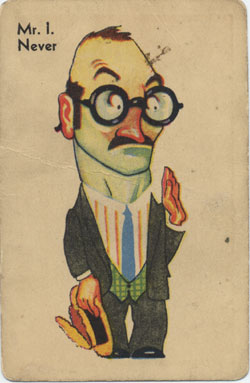
    mrINever.jpg

    I feel like I need to explain myself.

    The aliens drilled a hole in my soft palate and inserted an energy depleter that uses my saliva to deliver a continuous feed of a stupefying agent into my bloodstream.

    Do you feel this rough spot behind my left ear? That’s an even more sophisticated negative energy implant that inhibits the secretion of adrenaline and dopamine and sets up neural roadblocks that impede the assembly of rational thoughts and makes concentration of any kind virtually impossible.

    Few of you, God willing, will ever know what it’s like to be taken from your place on the floor and transported to a planet millions of miles away, where the greatest minds of an alien race subject you to exhaustive experiments on the circuitry of the human mind. There’s no doubt that such an experience changes a man, and makes him a veritable stranger among his fellows.

    I should also say that I can find little in my own experience that corresponds to anything I’ve yet heard in my alien abduction support group, and I’ve grown tired of the endless game of anecdotal one-upsmanship that I encounter there. It’s no longer enough to simply claim that one has been abducted by aliens, and these days everybody and his grandmother purports to have had a chip implanted in their buttocks or brain by aliens; those sorts of stories won’t even raise eyebrows anymore, so these folks –most of whom I have come to realize are discrediting the stories of legitimate Alien Abduction (AA) survivors like myself– have to concoct ever more fantastic claims to get the attention they so clearly crave.

    As a result I’ll admit that I’ve grown increasingly self-conscious about my own experience, and find myself reluctant to relate the tale to even my closest friends and family members. I worry, though, and wonder how much longer the fact that I am slowly turning green will go unnoticed and unremarked upon by the people around me.

    don't really know.jpgfind information.jpg

  • Vulcanized Rubber

    I’ve been meaning for awhile to write a bit about the Minnesota Wild, and how nice it is to have the NHL back this season. Well, not nice exactly. Just another demand on my time, actually, but at least there is TiVo. I wrote last year that there were no truly great hockey writers on the continent or in the language–at least not since Ken Dryden–and I wanted to take a stab at a new sort of hockey writing that honored the flow of the game, the rich metaphors, the blah de blah blah. I’m not gonna be that guy, but just as an exercise, I thought maybe I’d type something up now and again.

    There really can be no good hockey writing without good play-by-play recall; and beyond describing assists, goals, saves, and penalty shots, good play-by-play is very difficult to write, because hockey is a game of intense serendipity. Writing about the general direction of a period, much less a game, is an exercise in extreme editing and summarizing.

    In hockey, as in basketball, there are basic “plays” for breaking out, configurations for two-on-ones and so on, channels and lanes, and general philosophies. But in hockey, what results when these plans clash with the plans of your rival, mixed with funny bounces, breakdowns in communication, referees of varying degrees of watchfulness, unforeseen matchups, unintended rebounds, slop around the goals–well, the complexity of any given situation is boggling. In Basketball, each rush results in either a basket or not. Hockey is so much more complicated than that.

    I missed last nights win against the Islan ders, which seems a shame, because I have lately been operating in a cloud of suspicion that the Wild are losing because I am watching, and this is confirmation. But I did see Saturday’s (Firday’s?) heartbreaking loss to the Flyers– heartbreaking, of course, because of their winning goal in the final minute of the game, but heartbreaking too because the Wild had dominated play for most of the game, anbd they’d done it in a very interesting way that, to me, represents the future of the game.

    I’m talking about forechecking, the positive/aggressive half of dump-and-chase, which is the much derided style and philosophy of Jaques Lemaire. In enemy territory, this style of play seeks out the corners rather than the open ice. When the puck is behind the goal line, in particular, you see Wild players collopase on the puck and on the net; you see a lot of scrappy hitting and scrumming, short quick passes, one-timers at the net, jabbing rebounds. It’s not the prettiest form of hockey, although there are occasionally glorious bursts from the top of the circle, or from the slot, which has become an open channel. That’s because the defense and opposing wingers are forced into the corners.

    But when I say “the future of the game,” I mean the open-ice form of forechecking– the seemingly futile runs at loose pucks, forcing the pass from behind the defensive net even when the zone has been conceeded and all have fallen back for a clash in neutral ice. What I saw Friday (or Saturday, or whenever the hell I got around to watching the game on TiVo) impressed me, because Minnesota forwards–especially Marian Gaborik–were forcing a lot of plays on the forecheck in open ice, and getting the bounces. It is very easy for a player in this situation to make the perfunctory run and cycle, a swipe with the stick– a gesture more than anything that is one of those little things you do to look like you are working. It’s a longstanding tradition of hopelessness, but a mark of honor at least that you make these sorts of gestures, or risk being singled out for being a laggard long before you’re ever celebrated for being a realist. The odds are very much against you, but it also becomes one of those parts of an otherwise unpredictable game where hustle eventually DOES payoff, and where you can determine your own fate and take the game into your own hands for a few brief moments. Which is all it takes to shake the frost off the back of the net.

    By the way, I find it very gratifying that the Flyers have held firm with their traditional uniforms–that classic logo and the fire-hydrant orange (yes orange–fire hydrants were never red in my neighborhood). In my mind, this provides historical continutity, and pays tribute to what I think of as the golden age of the Flyers circa 1976, with Bobby Clark, Kenny” The Rat” Linseman, Bernie Parent, and that big thug Dave “the Hammer” Schultz.

    Great traditional uniforms let every hockey fan recall their own private golden age. The Wild, of course, don’t yet have a golden age–except maybe the magical first and third seasons–but I still love their retro red jersey the best, for reasons I’ll go into some other time.
  • Publius strikes again

    Another big hand for MN Publius for outing Pat Shortridge, Mark Kennedy’s campaign manager. No, he’s not gay…he’d cost too many Christian votes. He was a lobbyist for Enron and a participant in the secret energy policy talks with Cheney that made sure the world was kept safe for big oil.

    This is the second big story that the two college guys who are MN Publius have dug up. (Here’s the first.)

    What’s Kennedy’s response to this? Amy Klobuchar’s guy once worked for (gasp) Howard Dean.

    Are Minnesota Republicans so stupid that they are going to actually nominate this guy, instead of say, this guy, who although he’s made a lot of votes we don’t necessarily agree with, has some integrity and doesn’t mind siding with Democrats if he thinks it’s the right thing to do?

    Hey Republicans, think about it. Do the right thing now and dump Kennedy before it’s too late. This ain’t Texas, you know.

    Technorati Tags: ,

  • On the Air II

    Here’s last night’s MPR commentary, for those who have asked. I’d warn you when they’re coming, but I often find out after you do. (They’re prerecorded–thank gawd. Live radio is truly for the professionals.)

    Bike Commuter

    For the past five years, I’ve been a bike commuter. But last year was the first time I gave up the car entirely, and rode right through the winter. My coworkers find this astonishing and demoralizing. I tell them its just a matter of the right clothes-nothing high-tech or glitzy, just a lot of wool. And if you can get around in the snow with two-wheel drive, I can generally get around fine with one-wheel drive.

    Being a good, modest Minnesotan, I would never say that I ride the bike to save the world. Nor do I ride to save against the high cost of gas, although I can appreciate that. I ride for purely selfish reasons–I like it and it’s good for me. And I don’t mean physically, although it’s certainly not bad in that way. The value of my ten-mile bicycle commute each day, each way is spiritual. As I ride down the old railroad corridor of the Cedar Lake bike path, dodging killdeer and jackrabbits, I often glance up at the I-394 overpass and see gridlocked cars coming in from the western suburbs. Honking, squeeling brakes, a slight hanging smog. I can feel the road rage in the air. I have to say, I sometimes laugh out a loud, a little wickedly. During rush hour, I can get to work about ten minutes faster on my bike–without ever losing my temper.

    I’m sure scientists have been able to measure all the ways that exercise is good for a person, and the psychologists will tell you that it releases endorphins and adrenaline. Exercise can become an obsession because it relieves stress. It’s certainly better for you than drugs, alcohol, or shopping. For me, it gives me a half hour of time to clear my head, to transition from home to work. I suppose that would be possible in a long car commute. But I once lived in New York and had a two-hour commute into Manhattan by car and train–and I recall arriving at work feeling shattered rather than centered.

    My family, like so many others, has always dreamed of living in the country. My wife Jessica and I both grew up on farms and in small towns, and we’d love to give our kids that experience. But work in the city, and home in the country means one thing: cars, every day. I don’t think I can do it.

    A couple years ago, a widely cited study said that Twin Citizens commuted by bicycle more than any other American city of comparable size. At the time, I was skeptical. Riding the Cedar Lake bike path each day, I’d noticed one of those counting boxes with the black hose running across the path. I’d also noticed kids jumping up and down on that hose. I quietly kept this information to myself. Why would I want to ruin the happy story that hardy Minnesotans think so little of winter weather that we ride our bikes year around?

    But in the years since then, I have seen the proliferation of bicycles around town. New bike paths have been painted and paved, million dollar bike bridges have been built. I even saw recently that the Univeristy of Minnesota is paying bike commuters a hundred dollars a piece to study our commuting patterns with a little GPS unit attached to our handlebars. If we’re not careful, we may become another Copenhagen, where almost ninety percent of the population use bikes as their primary daily vehicle. I say the more the merrier; I look forward to the day when bike traffic slows to a rage-inducing crawl around Lake Calhoun, and I’ll have to jump on the parkway–where they used to drive cars–to avoid the traffic.

  • A draft solution

    fdr.jpg
    We’ll teach those Japanese not to attack us. Let’s invade Kamchatka.

    Bob Herbert in the NY Times weighs in today with a good idea, one that I advocated obliquely just yesterday: that we reinstitute the draft.

    After all, if this war is really in the national interest, we should all have to fight it, no? I can hardly wait to see the sons and daughters of Bush, Cheney (oops, she can’t go because she’s a lesbian) and members of Congress in uniform. Bet we’d have the appropriations for body armor and armored Humvees then, don’t you think?

    Contributing to my general malaise yesterday was making the mistake of not changing the radio channel immediately when I heard Bush talking about winning in Iraq. What really gassed me was when he declared that more Americans were killed on 9/11 than were killed at Pearl Harbor, and this was somehow justification for the Iraq war.

    Here’s some news for you, George. On December 8, 1941 FDR did not start blaming any country other than Japan…(ok, maybe Germany.) And both of them really did have weapons of mass destruction.

    One other observation: Japan surrendered 1365 days after Pearl Harbor. Tojo was under arrest (and would later be executed) and Hitler had been dead for four months. It has, as of yesterday, been 1548 days since 9/11/2001, and the guy behind the attack is still running around loose blowing up London, Madrid, Bali, etc.

    Technorati Tags: ,