Here’s a guy whose novels always start with really good ideas. In fact, Whitehead’s jacket copy often is more interesting than other authors’ entire novels. That’s an impressive gift, indeed. Nor does he disappoint over the long haul, spinning those ideas–hooks, really–into clever, entertaining, and deceptively weighty stories. For instance, his first novel, The Intuitionist, which focuses on a group of elevator inspectors, addresses questions of racial equality and upward mobility. Whitehead’s latest zeitgeist comedy of manners and errors involves a former whiz-bang “nomenclature consultant” who is summoned to help the citizens of a community choose a new name for their town. Given WhiteheadÕs track record, that should be good raw material for his imagination to work with.
Month: February 2006
-
Allegra Goodman
Allegra Goodman is one of those ridiculous prodigies who managed to sustain and build on her early buzz. Her first collection of stories, Total Immersion, was written while she was an undergraduate at Harvard, and she’s since published another collection and a couple of novels, including the remarkable Kaaterskill Falls (a National Book Award finalist). Intuition initially seems like a bit of a departure, but on closer inspection, the book explores many of the writer’s signature preoccupations. Goodman is particularly adept at zeroing in on individuals within closed communities and intensely collaborative situations. In this case, that means a cash-strapped research lab where a group of scientists believes it has stumbled onto a cure for cancer. When the discovery is scrutinized and deemed fraudulent, Goodman’s novel becomes a mystery that addresses such complex and timely subjects as medical ethics and unchecked human ambition.
-
Kiki Smith: A Gathering
While some artists can explore one theme or medium for years, Kiki Smith is notable for how far and wide she has ranged in her work. Despite its variety, you can see it shifting, in a sense, from the micro to the macro. In the eighties, Smith was sculpting individual body parts and organs, moving from there to life-size human forms, with an emphasis on the female body. Then she began looking at the larger cultural world, incorporating elements from folklore, myths, and religion, often by using animals that have symbolic roles in those stories. While this retrospective brings together 125 pieces, Smith herself has curated one gallery as an intimate “cabinet of wonders,” showcasing some of her oldest and most recent works. 612-0375-7600; www.walkerart.org
-
Chris Felver
Working in portraiture must be a little unnerving at times. Imagine all those eyes staring back at you in the darkroom. Perhaps that’s why Chris Felver, who is best known for his portraits of “creative revolutionaries” (writers, poets, filmmakers, actors, musicians, and protesters) turned his back on all those eyes and wandered outside. The latest work from this San Franciscan seeks out and amplifies patterns and structures in stone walls, walkways, windows, and other structures–starkly beautiful abstractions based in the concrete, man-made world. 611 Grand Ave., St. Paul; 651-312-1122; www.thegrandhand.com
-
Mala Ke Manke: Indian Drawings from the Collection of Subhash Kapoor
When your dad knows so much about antiques and fine art that people like Jackie Kennedy come to him seeking help in building their personal collections, you either watch closely and soak it all up, or rebel and become a stockbroker. Subhash Kapoor chose wisely, taking up where his father left off and cultivating an astonishing knowledge of Asian art while also running a New York gallery and building his own collection. The latter includes material dating back several centuries and spanning a variety of regions, styles, and subject matter. The selection on view at the Weisman focuses on drawings: complete works as well as fascinating sketches used to plan murals. 333 East River Rd., Minneapolis; 612-625-9494; www.weisman.umn.edu
-
Jon Langford
The Mekons, who came roaring out of Leeds in the wake of British punk’s late-seventies explosion, remain shining exemplars of a band as a committed, progressive community. Jon Langford, a Mekons ringleader, is now rolling through his fourth decade of creating provocative and politically charged music and art. The man remains ridiculously busy, with various working bands (the Waco Brothers and the Pine Valley Cosmonauts, among others) and other musical collaborations, plus art: prints and paintings that incorporate influences ranging from Jose Guadelupe Posada to some of the great poster artists of the twentieth century. His artwork also shares a political sensibility–not to mention a keen understanding for the dark back alleys of American popular culture–with his music. 2402 E. Hennepin Ave., Minneapolis; 612-331-3889; www.roguebuddha.com
-
Going Back, Going Home
From somewhere he heard a few hesitant notes from a piano. Perhaps it was coming from the back room, but it sounded even further away than that. It was the sound of a piano stretched to the point where it could possibly not even be a piano you were hearing. It could have been an audio hallucination, or just some of the loose and jangling noise of the world. There was no pattern, just a random pinging at the high end of the keyboard. Silence, then a burst of four or five notes.
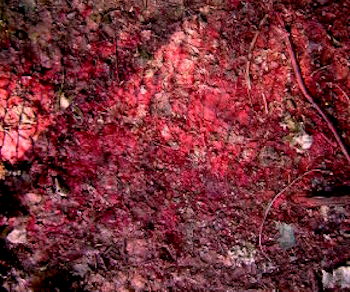
He went through the front room and into a hallway heavy with shadows. The place was sealed up tight, and only an occasional angle of light snuck in from outside, crepuscular and loaded with slow cruising dust. There was blood on the kitchen floor, a substantial patch of it, cooled to the black edge of maroon, and become almost chalk, or tempera powder. It had splashed up onto the cupboards and across the refrigerator door.
From the kitchen window he could see out into the backyard, where there was an empty doghouse, and there he found his piano: a clunky set of windchimes swaying slowly from a clothesline pole.
At the end of town there were ruins of an ancient fort, perched right at the edge of the ocean on a hill. The ramparts and parapet were all more or less in place, thrown up around a cluster of terraces, each of them situated at a different height and connected by a series of damp tunnels and stone steps and the occasional wooden ladder. Above it all at the southermost end overlooking the water was a large terrace, completely exposed to the stars and sky.
He made his way through the tight lanes of the town to this fort, and through the labyrinths of the fort to the terrace above the ocean. It was a wonderful place for silence; whatever sound made the journey up there was oddly transformed and amplified. The voices from the little tavern at the bottom of the hill sounded as if they were rising from a great well.
The whine of an unseen boat in the darkness lulled him almost to sleep. He saw blazing cruiseships creeping along the distant horizon, and, exhausted and splayed on his back, watched stars crashing again and again into the ocean.

-
A Week Without News is Like a Week of Sunshine

How can you not love ice dancing?I’m back after a week of visiting a tropical isle where my only form of mental exertion was figuring out how to bash tennis balls back in the general direction of their origin without having to stop sipping on my rum drinks. I couldn’t quite get it right so I retreated to the veranda to spend my time on trashy novels without having to worry about yellow projectiles upsetting my mojito schedule.
So, I missed the two big stories of the week: the Cheney shooting and the Olympic snowboarder who tried a trick as she was headed for the gold medal and fell on her ass. Which is more “dog bites man” I wondered, when I got back yesterday: Cheney not giving a shit about who gets hurt, or a snowboarder being a show off? Didn’t give it too much thought as I concentrated on getting back to a place with a television and renewing my quadrenninal love affair with ice dancing.
But, in the cold light of a Minnesota Monday, I thought of some more similarities between the two non-stories. Other than the disdain they truly deserve, it’s that the press seems to elevated them both, particularly the Cheney story, to the level of say, a Presidential blow job.
It doesn’t take much to distract the press from the boring work of actually doing some work. Bush going on the stump behind his cynical “addicted to foreign oil” crap? Who cares what’s behind that? That would require doing some background stories on what Bush’s energy policy has been to date. Oh, yeah, I forgot that’s secret.
I could come up with some more, but I have to only 50 pages left to find out if Dirk Pitt gets the girl and the treasure. (Sorry, fell asleep on the plane.)
But you get the point: any fortuitous incident that can be covered with a minimum of reportorial expertise and a minimum expectation of the attention span of the audience is just what our press is after today.
What’s next? Somebody’s house burning?
Film at 10.
-
The Demise Of An Impossible Man

—Mark Rothko, Untitled, 1953

–Zellar, Basement Window, 2005
Monsieur Centrine was a fierce proponent of impossibility. That’s not to say he was one of these characters who will insist that anything is possible. Quite the contrary, in fact. Mssr. Centrine believed that life, the world, and every aspiration of the human heart represented a thoroughly impossible proposition.
From this belief he could not, and would not, be swayed by anything in the way of evidence to the contrary. Achievement or accomplishment that appeared to clearly refute his insistence on the thorough impossibility of everything was dismissed with a growl and wave of his fat hand.
Mssr. Centrine would not even grant such incidents –and he was routinely presented with many such incidents– the status of aberration, and he had no tolerance for the notion of miracles. No, Centrine chose instead to entirely deny the reality of the possible in any of its manifestations.
“That is quite simply impossible!” he would say. “It is inconceivable!”
Despite this stubborn embrace of what would seem to be a paralyzing idea, Mssr. Centrine was a man of considerable intelligence, immodest talent, and wide-ranging accomplishment. Presented with proposals that were easily within the range of his abilities, he would, without fail, offer one of his usual exclamations: “Never! I won’t even consider the idea! It can’t be done!” And then, inevitably, he would proceed to do whatever it was that had been asked of him, and to do it well.
Whenever he had succeeded in demonstrating the possibility of the very things he had proclaimed impossible, Mssr. Centrine would of course decline all praise and congratulations by protesting that what he had just done was, in fact, quite impossible.
Over time Centrine’s perverse world view permeated the thinking of many of those who were closest to him, to the point where there were some who began to regard the man as a sort of miracle worker or magician. Such, apparently, was the persuasive conviction of Mssr. Centrine.
Eventually, however, something appeared to shift in the man’s attitude, or perhaps it was a sort of evolution in his way of thinking about the question of impossibility. It seemed to some observers that Mssr. Centrine’s denials of the widest range of the possible became more reckless and extreme. Many of the things he now pronounced as impossible were, in fact, quite clearly impossible, and yet he would nonetheless attack these challenges with the odd determination of the possessed.
It was almost as if Centrine had come to believe the claims of his small legion of admirers, and that he had somehow become convinced that he alone was equipped to conquer all manner of impossibility. For a time he succeeded in many spectacular and seemingly impossible endeavors.
In the end, however, it was a challenge of a more prosaic sort that ultimately did in Mssr. Centrine.
While strolling one day with a small group of his followers, Centrine had paused for a moment to survey the intersection of a quiet and absolutely ordinary street.
“This street is utterly impassable!” he pronounced. “One cannot possibly hope to make it to the other side. It is impossible!”
And with that he plunged blindly from the curb out into the crosswalk and was immediately struck down by a garbage truck as it came hurtling around the corner.

—Mark Rothko, Black on Gray, 1969

–Zellar, Carpet, Shadows, 2006
-
Rusty Hitch
I was not much surprised to read Chris Hitchens over at Slate, defending his friend Bernard Henri Levy from Garrison Keillor’s scurillous review of American Vertigo. While Hitch wins points for style as ever –“turkey-wattled congressmen” and “the Homer of Middle America”, he shoots, he scores!–I have to say that he almost entirely missed the point of Keillor’s review. While others found the review more humorous than I did, its laugh track perfectly paralleled Keillor’s straight quotation of excrutiatingly cliched interpretations of Americana. So within the realm of dueling reviews, I have to say that Keillor provides a lot more evidence for his more tenable argument that Levy basically doesn’t have a clue, and it’s emphatically not because he somehow overlooked Lake Woebegon in his travels, as Hitch would have you believe. It is, in a sense, merely tit-for-tat-for-tit. The Frenchman reduces his America to a saccharine shot of lukewarm cliches, the American takes a sip and spits it out, and the boozy Brit drops his coat on the floor and starts in on the “vulgar, nativist American” nonsense. Vulgar, of course, means common–and Keillor’s populist shtick (Hitch perhaps started in on the Scotch too early in the review to recognize that it was, in fact, shtick) is precisely the antidote to Anglo-Franco-American miscommunication that is needed, but it is a shtick that almost always is too subtle for British ears, which are most finely tuned to the extremes of the King’s English or the Cockney wallows. I’m usually not that interested in these reviews of reviews, unless the principals take their gloves off–in part, because there is a reason Keillor was asked to review the book in the first place, not the bad-breathed Hitchens. And I’m loathe to review a review of a review, but what the hey. I fear Keillor has, in recent years, lost energy for the public parley, the way he used to do. Still, it would be fun to read him responding to Hitch, since Keillor is more than the expat’s equal, and has the advantage of a native’s sober understanding of the quick jab and the non-nonsense uppercut, so easy to land when a man like Hitch is running around the ring loudly protesting what he in the first place misread.