After a six-year hiatus, David Treuer (Little and The Hiawatha) returns with a pair of titles that make an audacious claim for a prominent place among Native American writers. An Ojibwe from the Leech Lake Reservation, Treuer teaches English at the University of Minnesota, but his focus remains on the history and current plight of Indians. Native American Fiction: A User’s Manual takes a rigorous and occasionally controversial look at the work of some of the biggest names in the field—which makes the simultaneous release of Treuer’s new novel a pretty gutsy move on his part. With A User’s Manual he throws down the gauntlet, and with The Translation of Dr Apelles—a love story within a love story—he steps directly into potential crossfire from critics armed with his own bullet points. 612-625-6000; www.bookstore.umn.edu
Month: August 2006
-
Barbara Ehrenreich
Barbara Ehrenreich’s one of those virtuous full-immersion journalists whose work inspires more admiration than envy. Nickel and Dimed: On (Not) Getting by in America (2001), in which she recounted working within America’s hardscrabble underworld of hand-to-mouth laborers, was an eye-opening, compassionate, frequently funny, and dispiriting piece of reportage. It was also an unlikely success story, a book about class that sold more than a million copies and established its author as a celebrity. In her followup, Bait and Switch, Ehrenreich once again went undercover, this time attempting to land a mid-level job in corporate America; it is in many ways an even more depressing book. With forty-four percent of the country’s long-term unemployed coming from the white-collar ranks, Ehrenreich has zero luck in her job search, which unfortunately makes for a sort of anti-climax. Dog eat dog, not surprisingly, is a pretty ugly business all around. 810 31st St. W., Minneapolis; 612-825-3019; www.lyndaleuss.org
-
Jane Hamilton
Jane Hamilton has been blessed or cursed—take your pick—by not one but two bolts of Oprah’s lightning. Having her novels The Book of Ruth and A Map of the World chosen for the distaff Midas’ book club elevated Hamilton to the rarefied ranks of best-selling literary authors and guaranteed her books ample display space in stores until the end of her days. You’d think such success might stifle a writer, or at the very least make her cautious. Yet Hamilton keeps producing novels of disturbing domestic complexity, loaded with echoes from classic literature. When Madeline Was Young is a family saga that spans six decades and revolves around a brain-damaged woman who is living with her ex-husband, his new wife, and the couple’s children. With its gothic undertones, wide-ranging themes, and moral concerns, Madeline appears certain to provide hearty new fodder for book clubbers everywhere.
-
Life in Shadows: Hidden Children and the Holocaust
The tiniest detail, one that would seem perfectly innocuous in another context, can in this exhibit bring to bear the full horror of the Holocaust. Take, for example, a picture of some children on an outing. In the front row, a girl called Celina Cedarbaum appears to be caught in a merry moment, turning her head to laugh with a friend. In fact, the five-year-old had been trained to obscure her face whenever confronted by a camera—someone, out of kindness, had made this child understand that she would die if she were identified in a photograph. Life in Shadows is made up of such details: tiny toy soldiers stored in a pillbox, a drawing of a farmer, diary pages, and other artifacts from the few thousand Jewish children who went into hiding in their attempts, which were not always successful, to elude the Nazis. 651-296-6126; www.minnesotahistorycenter.org
-
Incidental
Hand it to Coen + Partners for establishing this gallery as an adjunct to its offices; by doing so, this landscape architecture firm has been admirably carrying on—if not reviving—the gallery tradition within the legendary Wyman Building, featuring both local artists and guest curators. Incidental brings together a quintet of artists whose work, according to curator Michael Fallon, is “not about anything in particular, but happens to be about everything at once.” Among them are the gum-obsessed Andy Powell, whose paintings, with titles like Bubblishous and Little Big Red, include chewed-up wads that transcend grossness to look playful and even sensuous; and Alexis Kuhr, who pencils delicate patterns, evocative of eyeball, headphones, and chain-link fencing, onto oil backgrounds. 400 1st Ave. N., Minneapolis; 612-332-5252; www.galleryco.net
-
Ordinary Culture: Heikes/Helms/McMillian
Broader even than “pop culture,” the theme of this show seems so all-encompassing as to be almost pointless (or, at least, to invite too much esoteric theory for our tastes). The good news is that the show itself is elegantly sparse and impressively installed, showcasing several works each from three artists, who’ve shown mostly at hip, cutting-edge galleries on the coasts, but also locally at the Soap Factory and Midway Contemporary Art. In the middle of the gallery is Jay Heikes’ grid of acoustic-tile ceiling hanging from—and doing insult to—the gallery’s own lofty white beams. This cheap slab of ordinariness plays nicely off Rodney McMillian’s huge sheet of vinyl flooring, whose pattern is a grid of imitation stone tiles; presumably lifted from a dilapidated home, it is hung as a sort of imitation painting. Meanwhile, Adam Helms’ grid of forty-eight “portraits”—black masks, hoods, and kerchiefs, rendered in ink on mylar—points to his interest in the “ordinary culture” of rogues, renegades, and outlaws. 612-375-7622; www.walkerart.org
-
George Morrison: Finding Abstraction
Those who regret missing George Morrison’s drawings at Todd Bockley last winter can more than make up for it with this exhibition. Though the museum points out that this exhibit is not a retrospective, it is, in fact, a decent overview of Morrison’s career from the 1940s to the 80s—effective but not overwhelming. Included are life studies from the 40s and 50s, Abstract Expressionist-inspired paintings from the 50s and 60s, and a lovely 1976 example of Morrison’s “paintings in wood” made from driftwood. There’s also a series rendering the same view overlooking Lake Superior from his studio at different times of day, a project that recalls Monet’s late series of haystacks and the Rouen Cathedral; and, finally, a selection of Morrison’s thrillingly intricate line drawings. 651-266-1030; www.mmaa.org
-
Paul Shambroom
Although he has focused throughout his career on the political realities of life in America after the Cold War, Paul Shambroom’s work isn’t the sort of blunt, unambiguous photo-polemics that one traditionally expects from strictly documentary art. His images are open for interpretation, and more likely to raise questions than offer easy answers. The New Jersey native and Minneapolis College of Art and Design alum has had a rambling career to date; he’s photographed factories and corporate environments, spent ten years documenting the country’s nuclear facilities and stockpile of weapons, and traveled thousands of miles to take pictures of town council meetings. Here, he discusses works from his most recent project, Security.
Initially, at least, these new photographs look like a huge departure from the Meetings project. How do these things come together?
The Meetings photos came about after I had wrapped my nuclear weapons project, and as a result of that experience I had become fascinated and sort of obsessed with the whole command-and-control aspect of nuclear weapons—you know, the question of when and if these things are ever going to be used, who makes that decision and how is it arrived at. That led me to the question of citizen responsibility for the actions of our government, and the way many of the basic civic decisions at both the highest and lowest levels are made.
Was there a natural evolution from Meetings to Security?
I knew I wanted to do something in response to September 11th, but it took a couple years for the idea to percolate. It’s difficult to wrap your head around history or see it with any perspective when you’re in the middle of it. My process always works pretty much the same way; I’ll have a subject in my head that I’m interested in, and as I research and dig around, I’ll start trying to figure out a way to put a visual face on it. Not necessarily to provide answers, but to offer a visual form in which to raise questions and issues.
That visual form here isn’t the typical sort of thing we’re accustomed to seeing labeled as response to September 11th. There’s no flag-waving, for instance, and no real military presence.
Well, with all the Homeland Security issues, I wanted to do something about what was going on here in the U.S. There are all these political issues with the money and how it’s being spent, and the role fear plays in public policy. You realize that fear is both a natural human response and also a valuable political currency. This was a really difficult project in that previously there wasn’t much question about how I felt about the subjects I was working on. After September 11th, though, there are no easy answers. I don’t have a clear stance, which makes it very complicated.
You made most of these photographs at training facilities around the country. How did you get into these places, and what was going on there?
Visits had to be arranged well in advance, and access can be very difficult. I did a lot of research into the places I wanted to go, and then it was just a matter of figuring out who controlled access and how to work with them. Most of the sites are funded by Homeland Security. There are five of these institutions around the country, and most of the people who go to them are law-enforcement people, firefighters, first responders. I have one photo taken at a place in New Mexico—Playas—which is this old mining town that Homeland Security uses for really large-scale exercises. Everybody calls it Terror Town.
The portraits are particularly interesting. You have these guys wearing bomb-squad outfits or biohazard suits, covered from head to toe.
The portraits were sort of a departure. They’re very mannered and posed. I was looking for these iconic subjects, and I thought it was interesting that you couldn’t see their faces. They became almost superhero-like. Some of them had a science-fiction quality to them, and in some of the others I guess I was looking even further back for inspiration, to the grand-portrait tradition in Europe in the seventeenth and eighteenth centuries, painters like Gainsborough and Joshua Reynolds.
How long have you been working on Security?
I made the first photograph in November 2004, so it’s been two years of traveling and photography, preceded by three years of scratching my head and research. And the project is still very much in progress. There are other things I’d like to do with it, and I think we’re probably going to be living with this reality as a major part of our consciousness for the rest of my lifetime.
The Weinstein Gallery will exhibit photographs from the Security series September 15–October 28
(908 46th St. W., Minneapolis; 612-822-1722; www.weinstein-gallery.com).
-
The Toll of City Living
I was asked once to reveal some “universal truth” I’d learned. When I couldn’t dredge up the Fundamental Theorem of Calculus from my faded memories, I settled for, “Things are usually more complicated than they seem.” I give the same answer when asked why I live in Minneapolis.
Each day here is an exercise in ambiguity. My commute to our Warehouse District office is short. I can follow one route that never leaves city streets. That path passes the three cathedrals that reach up to God from their plots on Lowry Hill, then curves behind the Christian mission. There the sidewalk is lined by shopping carts full of scrap and their custodians, who sit on a low concrete wall, smoke cigarettes, and wait for their next meal.
Sometimes I vary my route and enter the freeway at the Basilica entrance to skirt downtown for one exit. I usually take a long look at the suburban commuters at a dead stop in the oncoming lanes. They are all angry, I imagine, as they wait for their turn to exit into a high-rise parking ramp and begin their daily visit to purgatory in the city. They don’t see the line behind the mission, but I expect some may be panhandled at lunch time or hear the dreadlocked drummer in front of the Target store on Nicollet Mall.
The suburban tourists sometimes venture downtown at night, too, and lap up Cold Stone ice cream or Applebee’s margaritas on the second floor of Block E. Some grab a burger and beer on First Avenue before a Timberwolves game. You don’t see the same scrubbed faces so much at Café Brenda, though. There you know nearly everyone, at least by face, because they are from the neighborhood. They are the people who have perhaps seen Kevin Garnett going into a dance club in his impeccably fitted five-button suits, but have never seen him in his baggy white basketball shorts.
One suburban tourist was killed this summer on First Avenue, hit in the head by a bullet that wasn’t meant for him. Another man from out of town was shot dead by a robber as he left an Uptown restaurant. Forty others who lived here have been murdered in the city this year. Hundreds have been wounded. The reactions to this vary from resignation to outrage, from mere sadness to fury. My city friend who was robbed at gunpoint last week in Uptown says it was “no big deal. He only got twenty bucks.” My other Golden Valley friend, whose wife and daughter were subjected to some obscene suggestions when he brought them to a Hennepin Avenue musical last year, says he will never come downtown at night again.
The people who live in the city pay a price. The cacophony of the streets assaults us daily. We know nearly every walk through downtown is going to mean, at best, being panhandled at least once, or, worse, being actively menaced. Most busy intersections feature mendicants with cardboard signs containing a “God Bless” and a short plea for a donation. Our City Council members didn’t bother to offer an apology when they told us last week that our property taxes were going up eight percent. Any available additional revenue would be used to hire more police. The amount available is limited, however, by the many bad decisions the city has made in the past. We pay off the purchase of Kevin Garnett’s showcase arena, yet provide scant playgrounds for youth soccer. We finance downtown office towers while most of our branch libraries are open three or four days a week. There was a bullet hole in the second-floor window of the Central Library before it even opened in May.
But this is what we pay for having sidewalks in front of our homes. In my neighborhood, we’re thankful for quirky restaurants like Auriga, which you can walk to for an imaginative pizza and Malbec by the glass after 10:00 p.m. Though the drug dealer next door in a Northeast neighborhood does a brisk business every night, we can still walk to the 331 Club. In Southeast, we can get a three-course Chinese lunch at Shuang Cheng that costs less than six bucks and wasn’t cooked an hour ago.
The tourists who visit the city daily for their wages or nightly for their entertainment don’t sleep here and don’t pay the day-to-day toll exacted from the people who live here. Instead, they take what they come for, retrace their paths home, cluck their tongues at our problems, and only rarely partake of our real treasures.
-
All's Fair
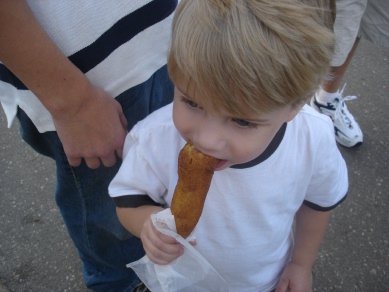
Jake’s first corndogI swear that I have been on an aggressive veggie and lean protein diet for the last week in preparation for the upcoming marathon. That’s right, I mean the Great Minnesota Eat Together.
Because that’s what it is, a marathon.
Beyond the the must-have vanilla ice cream cone from the dairy barn, what follows is my 2006 hit list (including this year’s new items). May Escoffier have pity on my soul.
Axel’s
new battered and deep fried chocolate chip cookies OAS (on-a-stick)Blue Moon Dine-In Theater
new gorilla bread, popcorn topped with melted candybarsButcher Boys
sliced London broil steak sandwichesChicago Dogs
new breakfast dog: jumbo smoked frank topped with scrambled eggs and cheese on a poppyseed bunCinnamon Roasted Nuts
habanero pistachiosCinnie Smith’s
mini cinnamon rolls topped with ice creamCorn Fritters stand
fried green tomatoesCorn Dog stand
shun the pronto pupDonna’s BBQ
organic apple bratFamous Dave’s
new deep-fried “hell fire” pickle chipsFish & Chips
fried clamsFrench Meadow Country Scones
black currant ice teaGalaxy of Drinks
orange whip (“we’ll have 3 orange whips”)Giggles Campfire Grill
walleye friesThe Jerky Shoppe
peppered jerkyKropp’s Cheese Curds
cheese curds, of courseLeeann Chin
new buffalo chicken wontonLynn’s Lefse
lefse with lingonberries and peanut butterLuigi Fries
hot dago OASMiddle East Bakery
tabouli saladMN Farmers Union Coffee Shop
new frozen espresso OASNitro Ice Cream
chocolate ice cream in the new pretzel coneO’Garas
breakfast monte cristo, new brew dog: deep-fried beer battered brat OASOle and Lena’s
new tater tot hotdish OASPizza Palace
focaccia with roasted garlic (and Courtney the Pizza Queen)Sausage Sister & Me
new Nacho Sistah: Tex-Mex sausage wrapped in doughTejas
Monteray jack and asiago nachosWest Indies Soul Cafe
new jerk pork chop drummyWild Bill’s Curly Fries
cajun curly friesI’m still waiting for someone to come up with the kind of pretzels they sell in Munich: giant, soft beauties that you can wear around your neck and eat as you walk.
If you’d like to plan your own Walk-of-Shame, or need coordinates for any of the above locations, consult Fairborne’s Fabulous Food Fair Finder.