The Rake & supplement in front of CBs Gallery and one of the whole group in front of the Bowery Poetry Club across the street of CBGBs.
Month: December 2006
-
Athens
Athens. 2006. It’s hot. The Acropolis on its hilltop is floating above the city on a shimmer of heat. But here on the hotel balcony I’m cool. I’m reading The Rake. Everyone who reads The Rake is cool!
-
Alaska
Me and your excellent magazine at the Mendenhall Glacier, Juneau, AK.
Mendenhall Glacier is in the Tongass National Forest and falls under the
jusrisdiction of the National Forest Service. The have an excellent
visitor’s center and trail system around the area and down the glacial
morraine. This was my fourth trip to Alaska and Mendenhall and it has
been neat to see how it has changed over the twenty-plus years. -
Florida
St. Paul high school seniors Ana and Erin traveled to Florida during their spring break. They visited the Everglades Holiday Park where peacocks roam freely. This bird exposed himself in the background of the The Rake issue with the cover feature, “Exposed!”
-
For Your Christmas Consideration: The Shop Around the Corner

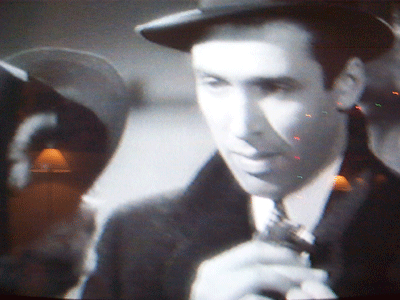
The Shop Around the Corner, 1940. Directed by Ernst Lubitsch; written by Miklos Laszlo, Samson Raphaelson, and Ben Hecht. Starring James Stewart, Margaret Sullavan, Frank Morgan, Felix Bressart, Joseph Schildkraut, and William Tracy.
Available at DVD stores, your public library, and hopefully in whatever paradise we’ll find in the afterlife…Did Margaret Sullavan finally kill herself in 1960 because life would never match The Shop Around the Corner? Did Frank Morgan, Felix Bressart, Joe Schildkraut and William Tracy all succumb to the melancholy of life, unable to touch the magic of this sweet little film? Did they watch the movie in darkened rooms, alone, wondering to themselves about missed opportunities? Or did they sit with another, their faces silvered, holding hands and inching closer as the film rises to its inevitable, heartbreaking (and heartwarming) climax? Did Margaret wonder which of the many people who breezed through her life could have been the one to give her what we all seek? When we finish with this movie, when the videotape is rewinding or the DVD has ceased to spin, we have to ask ourselves: can life ever match The Shop Around the Corner? Keep looking for answers… and watch the movie.
For those of you who are sick and tired of the great It’s A Wonderful Life–which is an amazing film, in spite of its being bear-hugged by corporate bastards–you could do no better than finding a copy of The Shop Around the Corner, which, in my mind, is the greatest Christmas gift a filmmaker ever left the world. It is about what Christmas really means, and that doesn’t mean gifts or gatherings or even the reason for the season, H.R.H. Jesus Christ. It’s about love: which is really what the whole religion’s about anyway, isn’t it?
Director Ernst Lubitsch’s little world spins in Budapest during the depression, in a gift shop called Matuschek & Co., run by the grumpy Hugo Matuschek, played by the Wizard of Oz himself, Frank Morgan. The film begins as the employees gather on the sidewalk, waiting for the store to open. The setup is deceptively simple: there’s seething Alfred Krelik, captured by a young Jimmy Stewart, himself the greatest of the long-suffering men, already in a slow-boil, suffering from indigestion. There’s his cheapskate pal Hugo Pirovich (Felix Bressart, just fabulous), the irritable delivery-boy Pepe (William Tracy), and the louse Vadas (Joseph Schildkraut)–all actors who bring real moxie to their small roles, and make this little comedy run like a well-oiled music box.
Alfred Krelik’s got a sweet secret that he confides in his good friend Hugo: he’s engaged in writing and receiving beautiful love letters from an anonymous woman who makes his heart flutter and his soul snap in the wind like a kite up high. She is amazing, and she makes his humdrum world seem so worth living.
Now enter Klara Novak. Margaret Sullavan fills this role the way a gust of wind fills a tree and makes its leaves shudder, a girl with the wide eyes, quick to scowl and argue, a woman who can look so young when she’s happy, drained and aged when misery falls upon her. She speaks, as one critic says, “like singing in the snow”, and it’s intoxicating to soak in all the conflicting energy that flows from her, all these years later. Klara desperately needs a job. Alfred claims that Mr. Matuschek can’t afford her. Old man Matuschek disagrees (or rather, is tricked by the wily Klara into disagreeing and hiring her), and from then on Sullavan and Stewart are at odds, loathing one another, sniping, grousing, and unbeknownst to them, falling in love.
For Sullavan’s Klara also has a secret: she’s engaged in writing and receiving letters from an anonymous man whose words make her feel alive and her heart beat faster with every envelope, her soul flitting about like a light and living thing and not some rock upon which the world’s troubles can rest.
Of course, Stewart and Sullavan are the letter writers. Of course, nothing in the world could ever get these two cranks together. Of course, their mutual hatred is part of what will make them such a lovely couple at film’s end. In the meantime, Mr. Matuschek believes, correctly, that he is being cuckolded, and he believes, incorrectly, that it is his most trusting and loyal employee, Alfred Kralik. So Kralik loses his job on the same day that he discovers Klara is the one writing him the letters. That same night Mr. Matuschek tries to kill himself when he discovers his error, but is saved. Kralik and Klara meet in a hilarious scene in which he knows the truth but doesn’t let on. In the end, all is well: Alfred and Klara are together and deeply in love, Pepe the delivery-boy is finally a clerk, and Pirovich is together his wife, son and little baby. And Mr. Matuschek–lonely, wifeless, rejected three times for dinner from different employees–finally encourages the new boy, a young dope who doesn’t seem to have a lick of sense about him, to join him for a dinner of goose and cucumber salad on Christmas Eve. “Oh boy, Mr. Matuschek!” the kid says. Oh, boy, indeed.
And yet, The Shop Around the Corner is terrifying and fraught with anxiety. There is scene after scene of some of the most touching moments in film history: Klara reaching into her mailbox to look for a letter that is not there; Alfred happily looking to get the raise he deserves from Mr. Matuschek, the man he looks upon as his father, only to be fired (in a scene so damn real it makes your throat ache); Mr. Matuschek, realizing his error, walking amongst the sheet covered store, floating in sadness and looking like a ghost; the way that everyone goes from appearing alive to dead in a heartbeat–all because of love. Love between husband and wife, between fathers and sons, between friends. Love is the reason for the season to Ernst Lubitsch and the folks of The Shop Around the Corner. These people who argue and bicker and laugh behind each other’s backs, well, they love one another. And yet they are all so close to never seeing one another again: leaving the job, a letter lost, almost dying by your own hand… I cannot think of a film that so acutely observes, as David Thomson writes, “the fear of good people missing their chances”.
The laughter is intense in The Shop Around the Corner because the pain is equally so: you would be hard-pressed to find a movie that jumps so nimbly between both. The film contains, like all great stories, a lesson: Matuschek & Co. is your own home, it is the place you work, the bars you frequent, your community. Ignore these lessons at your peril.
As you watch this movie, think of those moments in your life when you might have missed your chance, or cling tightly to the one that you truly love. When Jimmy Stewart pins the red carnation to his lapel to show tragic Margaret Sullavan that it is he who is her true love, inch closer to that person, touch them, let those feelings overwhelm you in the silvery light of the screen, the multicolored hue of your Christmas lights. This is Christmas. And laugh, a bit nervously perhaps, just to release the tension. Each one of us can look back at moments when a different drive, a different movie, a different step would have altered the happiness in our lives… or just the opposite, given us what we so desperately long for. If you’re lucky, you have found the red carnation on each other’s lapel, and Christmas has meaning. I wonder: had Ms. Sullavan?
-
Mayhem, Murder, Love and Forgiveness From the Man of La Mancha

Volver, 2006. Written and directed by Pedro Almodovar. Starring Penelope Cruz, Carmen Maura, Lola Duenas, Blanca Portillo, Yohana Cobo, Chus Lampreave, Antonio de la Torre, and Carlos Blanco.Now showing at the Edina Cinema.
As a strong, hot wind rages in a La Mancha graveyard, as groups of determined women scrub and brush down the marble headstones of the men who have proceeded them in death. The women have their hair pulled back, their skirts rustle in the harsh, hot winds of La Mancha and they work, work, work, struggling to keep the dust off the headstones, which is a task of almost hilarious futility for all the wind that rages through the countryside. The men are at rest, enjoying what Borges described as sleep and indifference. Alive, the women carry on, laughing, crying, haunting, farting… and carrying the weight of this miraculous world on their shoulders. This is Almodovar’s world.
Volver is the latest film by perhaps our greatest living filmmaker, and though it’s a slight movie by his lofty standards, lacking perhaps the intensity and surprise of classics like Talk to Her, it is nonetheless a supreme entertainment. Ostensibly a murder mystery, an homage to Hitchcock (with a score that reminds us of Bernard Herriman) and Mildred Pierce had it been really a picture about women (and not eventually dismissive of strong women), Volver is like many of Almodovar’s films–informed by movies, by art design, by color, by theater, but most of all, and most importantly, by the torrent of emotion that grips each and every character and undoubtedly the director himself. Volver is melodrama, but it is never turgid. Volver flatters its female characters (some of whom are murderers), relies on some bathroom humor, gives us great bursts of bright color, and suggests, most prominently, that murder and incest take a backseat to the vicissitudes of friendship and family. It is one of the best films of the year, and a movie whose technical accomplishments, sharp writing, and spot-on acting would have made a lesser director shoot to the front of film magazines and art-house accolades in an instant. As it is, since we’ve become accustomed to Pedro’s work, Volver is likely to vanish from theaters in a few weeks, forgotten for the doggrel that takes up space and counts as decent filmmaking.
The plot is as typically bizarre as anything that springs from the mind of Almodovar: three years prior, a house fire killed the mother and father of Raimunda (Penelope Cruz) and Soledad (Lola Duenas). Their parents were a supposedly happy couple who were locked in a loving embrace as the flames devoured them. After polishing their folks’ headstone, the girls, with Raimunda’s daughter Paula (Yohana Cobo) in tow, go to visit their addled aunt, sister of the deceased woman. They discover that this poor lady believes that she is being visited on occasion by the ghost of their dead mother. A childhood friend, Augustina (Blanca Portillo) whose mother disappeared on the same day, lives across the street and attests to the hauntings. Returning to Madrid, Raimunda and Paula run afoul of the husband, a drunken, masturbating soul who tries to screw his daughter one night in the kitchen. The girl responds by driving a knife into chest, killing him. Like Mildred Pierce before her, Raimunda will not allow her daughter to hang for this crime–instead, she cleans up, hides the body in a freezer (later to be buried on the riverside with the help of a local whore), and opens her own restaurant.
Ignoring its deeper meanings, Volver is, above all, a blast. Its plot twists are pure Almodovar, nearly ridiculous events that are at once shocking and hilarious, like the murder punctuated by Cruz having to tuck her husband’s cock back into his pants, or explaining away a smudge of blood on her neck to a male neighbor as ‘female troubles’. Indeed. Kisses are amplified into loud smooches, tears flow like the mojitos Raimunda serves at the restaurant, memories are shared with wide-eyed glee, and in no time we find ourselves caught in the friendships of these women, hoping for their emotional success–even if it means getting away with murder. Almodovar is on record that he consider’s Cruz’ bustline to be the greatest in the world and films this treasure with as if it were the most beautiful sculpture in Europe–a wonderful concession for a gay man to give to his heterosexual audience members. Little scenes stand out–the sisters sitting opposite their cancer-stricken friend, offering them pot while the daughter lounges on a chair, and the mise-en-scene is startling for its beauty. At their Aunt’s funeral, Soledad and Augustina are the ‘primary mourners’ and walk into a room and are converged upon by fan-fluttering ladies dressed in black, shot from above, like moths attracted to a loving flame.
There are murders and incest here, but unlike, say, Hitchcock and Pierce, Almodovar is intrigued only by the way these women survive such turmoils. And in how they learn to forgive and move on. Ultimately, Volver–Spanish for ‘The Return’–is a film of forgiveness. Pedro has returned to the La Mancha that rejected him, his actress Carmen Maura has returned to his loving fold after a notable split many years ago, and the characters have returned to caring for the people who have hurt them, from the mother to even the man who is murdered, carefully buried in a spot that he once loved.
There has been a number of critical backlash against Almodovar’s seeming disregard for men in his films, especially here, and yet I can’t help but wonder what the fuss is all about. This is a film about women, just as Apocalypto or Flags of Our Fathers are about men. Penelope Cruz’ tough stance against the murder of her husband is little different than Apocalypto’s Jaguar Paw’s fighting to return to his wife, who isn’t anything more than a womb trapped in a hole in the ground.
But Almodovar’s intense respect for his characters makes this film shine brighter and with more joy than anything I’ve seen this year. From the senile, beautiful old Aunt that he lovingly frames behind shiny glasses, to the dignity of her friends, including a whore, not with a heart of gold but who is interested in her neighbor’s life and seeks to get ahead herself, honestly and with dignity. This, in spite of a plot whose inner workings hinge on incest, murder, lying, and all the other bittersweet confections in Almodovar’s chocolate box. In the end, however, mothers and daughters fight and forgive, and the ghost is a creature of nearly unbearable kindness. Volver is a beauty, a film that wears its kindness proudly on its sleeve.

-
The Dinner's Eve

Know what sucks? Pink-Eye before Christmas.
Know what rules? A husband who can cook. In my low and itchy state, I couldn’t possibly think about cooking for the fam. In a move that always puts me to shame, he pulls whatever he can find from the fridge and makes a meal. He took a Niman Ranch pork roast, unwrapped it and pounded it flat. Then he layered it with sage, chopped green apples and brie cheese, then rolled it back up. He and the daughter threw down some risotto and we had something much better than my suggestion of rice and beans.
But we have 20 coming for Christmas Eve.
Truth be told, I’m not contagious and I’m feeling better, so it shouldn’t be too hard. As long as there is Bourbon present, I’ll be fine.
The group is interesting, family and friends, a mixed bag of palates, one who has a distinct aversion to cheese. All cheese, sigh. We pondered pork, ham, for a moment there was talk of roast goose and figgie pudding, but nay.
We’re going for rich and luxe but comfortable and accessible. Simple elegance, perhaps? It’s a surf n’ turf story we’re telling.
Cocktail Hour
Assorted cheeses, like Sottocenere and Ossau-Iraty
(most likely from Premier Cheese)
Prosciutto cups with arugula and herbed goat cheese
(I just made this up last week)
Escargot and puff pastry
(we’ll see who braves these morsels)Dinner
Prime Rib Roast
(possibly done encrusted in rock salt)
Halibut
(most likely wrapped in parchment and cooked cartoccio style)
Zucchini with leeks
Mashed potatoes with olive oil and Manchego cheese (shhhh)
Creamy baked polenta
Creamed corn (a special request)
Oven roasted tomaotes with Cabrales cheese
Home baked bread
(ciabatta without fail, maybe we’ll attempt some whole grain rolls)Post Feast
White and dark chocolate bread pudding with bourbon cream (duh)
Grand Marnier and cranberry torte (this one looks yummy to me) -
Road tunes. How to avoid the rage.
I ocassionaly excerpt work from my bulletin board of blogs called groovyman.com. If you are traveling over the holiday, allow “The Road Rake” to offer his comments on how to end arguments between “family DJs” during long drives.
Because most people lack the time, talent or inclination to actually master a musical instrument, their “music” is actually a vicarious form of self-expression. Express yourself the wrong way (i.e. advocate some totally ungroovy music) and you open yourself to ridicule. The opposite happens when you name a groovy tune.
But what makes a tune groovy?
Like a groovy book, it should be a shining example of its genre. It will be a pure breed. That is why Reggae will always be groovy, and the latest “world beat” house music will not. The same can be said of be-bop versus fusion (although jazz purists would argue this). Even the hip hop of The Roots versus the skitterish grunts of Kanye West.
While the lastest “genre-maker” is always upon us, it’s better to build a music collection with works that have received the baptism of time. The grooviest music is also very frequently an acquired taste, and it certainly has soul (not be confused with Soul music–although that is usually pretty groovy). If it’s exclusivity you are after, this is the fast track to the arcane (provided you develop a taste for the groovy stuff).
And money has little to do with taste in music (just ask John Lyndon). It even has a tendency to squeeze the life out of better artists over time. A musician simply needs to “put knowledge to imaginative use” to make a groovy tune. And DJs should “spin” by the same principle.
-
Yule Stomp
I’m signing off early for the holiday this year. Wracked as I am by last-minute shopping lists and Catholic guilt, I’m afraid I’ll need an extra day to physically and mentally prepare. I will, however, arrive back in Minneapolis on the evening of December 25, when I’ll carry-on the long-held tradition of meeting my friends at Liquor Lyle’s for some decompression. In the meantime, for those staying back, there’s a decent lineup of concerts these next few days: Soul Asylum, The Steeles and Peter Ostroushko, Heiruspecs. If you’ve got family in town (you know, that mom who’s just dying to go downtown for a show), you might consider The Altar Boyz, a funny musical that spoofs Christian boy bands, or Hurricane on the Bayou, a new Omni film at the Science Museum. I caught the preview of Hurricane a few weeks back, and I sort of dug it, thanks to the contributions made by New Orleans musicians Tab Benoit and Allen Toussaint. Not that I didn’t appreciate the film’s resounding message–the need to restore Gulf Coast wetlands. It’s just that the sweet sounds of New Orleans-style blues were fairly distracting.
-
God, The Early Years
He was a god like no other. That much was apparent almost right from the beginning.
I’ll be the first to admit that I thought there was something sort of funny about the boy; and though you probably won’t find anyone to publicly acknowledge it now, many thought his problems went beyond funny. Lots of folks thought he was just plain off his rocker.
I’ve never seen a lad so ambitious at such an early age. Ambitious, and smart as a whip. He was always building things, creating little animals and plants, all sorts of unusual stuff nobody had ever seen before. I can also tell you that he made a lot of noise. Certainly at least early on there were some very vocal people who didn’t much care for either his attitude or his monkey business, and who felt something should have been done to discourage him.
I remember when he built his first chicken, and then his first body of water, with a mountain range alongside it. At that point some were fascinated, while others were flat-out scared to death. He was emboldened by those early successes, though, and seemed to only get more and more ambitious and even reckless as time went on.
The day he pulled off his biggest trick you just had a sense that this time something really big was going to happen. It was early evening, and he’d been raising a racket and brewing up fearful storms for almost a week. And then, almost as if on command, it all blew over, the sky opened up below us, and everything grew sort of eerie and still.
That night pretty much everybody left their dinner dishes in the sink and took their lawn chairs out to the curb to watch the world be born.