Year: 2006

  • Cord Wood

    A slightly earlier, tongue-twistier version of last night’s MPR commentary:

    Probably many Minnesotans have been happy that, so far, it’s been a pretty mild winter. My family is on one of those stabilized payment plans where we pay the same amount for heat each month of the year, even in the summer months–not because I’m a speculator in energy stocks, but because I’m lazy: I don’t like to deal with sudden, surprising utility bills. Out of sight, out of mind.

    Last fall, at about the time that oil and natural gas prices were spiking, I called up my friends at a farm in Western Wisconsin. I’d heard there was a run on firewood because of the panic over energy costs. Carter the farmer confirmed that he’d increased his prices by ten dollars per face cord. The price was going up not so much because of demand, but because of the cost of gas, since he had to drive into the city to deliver most of his wood. Each sale meant roughly a sixty-mile round-trip drive to town.

    At this point I asked a question I ask everytime I buy firewood. What’s a face cord? And how does it compare to a regular cord of wood? This time, Carter explained it in terms that I feel confident are going to stick with me for a year or more. It’s like this: A normal cord of wood is four feet wide, four feet high, and eight feet long. A face cord is a third of a cord–a natural division that happens to a cord of wood when it’s cut up to fit into your typical stove or fireplace. Carter told me that most folks who actually depend on wood for heat will order at least a full cord, whereas folks who just enjoy a nice fire for aesthetic reasons–folks like me– will normally order a face cord.

    I paid Carter $125 for a face cord of wood, mostly oak and birch, well dried and nicely split. When Carter backed into my driveway and up to my garage, I’d cleared all the kid’s bikes out of the way. I asked if he wanted help stacking the wood, and he said, “As you please.” He gave me to understand that we might enjoy each other’s company in the process, or we might not. It was all the same to him. I helped. I recall an old needlepoint on my grandmother’s wall that said something like, “When you split your own wood, you warm yourself twice.” Well, I wasn’t doing the splitting, but I’m a city slicker, so stacking counts.

    I build fires just about every night. And the funny thing is, it actually makes my house cooler. The former owner had done such a great job insulating the house, sealing it up tight, that the fireplace has a draw something like an industrial wind tunnel. I’ve fallen asleep on the floor with the dog, not three feet from the blazing grate, only to wake up shivering as all the heat in the room is hoovered up the chimney.

    And the other downside is that I have to go outside to smell that rich, wonderful, complex, and evocative smell. The aroma of birch and oak burning is, to me, comparable to the taste of a fine wine, or an expensive cheese–and I feel vaguely cheated to have to go outside to smell it. But then, of course, I’m rewarded by a view of the stars and the haloed moon in the cold, crisp night air.

    Recently, though, I have developed a trick. After the fire is cracking nicely, I close the flue for just a few seconds. Just long enough to fumigate the liginv room with the thick, rich, aromatic smoke, but not long enough to endanger the wife, the kids, or the other smaller mammals. Sure, the fire alarms scream into life. But I breathe deep, smile, and lay my head back on the dog’s belly, and don’t give a second thought to the heating bill.

  • Stating the obvious

    The Minnetonka police officer who gave U of M student Nick Stremer a ticket for underage drinking, it could be argued, was just doing his job. It could be argued, I said. But, arguing with a fool is always a bad idea.

    Like a lot of the people quoted in today’s Strib story and on MNSpeak, I think Nick is a hero…and Minnetonka Police Chief Joy Rikala is a constipated boob. As she justifies the ticketing of Nick, she admits that the girl who actually drank herself unconscious wasn’t ticketed. According to the story, “Rikala said officers were concentrating on saving the woman’s life.” Except for the officer who was concentrating on giving Nick Stremer a criminal record, that is.

    Joy Rikala is the former chief of the U of M police. Imagine the experience she has dealing with drunken minors. Too bad she doesn’t seem to have learned anything from it.

    So, I’m sending a contribution of $70 to MADD in Nick Stremer’s name, and a like amount to the Minnetonka police. I encourage them to use it to buy a dictionary and look up the word “discretion.”

  • Night Stand

    snails 2.jpg

    We are contemptuous of transient well-being, as if there were any other kind. Routinely discounting the preponderance of evidence is not the behavior of reasonable people, nor is devaluing present experience because it may be overtaken by something worse….

    Powerless people can hardly demand coherency of themselves, since they must always react to forces they cannot trust, whose wiles they cannot anticipate. They are safe from responsibility, safe from blame….

    Our civilization believed for a long time in God and the soul and sin and salvation, assuming, whatever else, that meaning had a larger frame and context than this life in this world. Polls indicate that we in America have not really abandoned these beliefs, and that is interesting, because what I have called our collective fiction is relentlessly this-worldly, very serious indeed about material success, of all things. Success, that object of derision in every wisdom literature ever penned, not more dignified now that it is so very slackly bound to real attainment, not more beautiful now that its appurtenances generally amount to a higher tawdriness. Knowing this, we nevertheless make it stand in the place of worth….

    It is because we hope to acquire rather than to achieve –in the old language of religion, to receive rather than to give– that the good we imagine can truly be taken from our hands….

    What if we understood our vulnerabilities to mean we are human, and so are our friends and our enemies, and so are out cities and books and gardens, our inspirations, our errors. We weep human tears, like Hamlet, like Hecuba. If the universe is only all we have so far seen, we are its great marvel. I consider it an honor to follow Saint Francis or William Tyndale or Angelina Grimke or Lydia Maria Child anywhere, even to mere extinction. I am honored in the cunning of my hand. This being human –people have loved it through plague and famine and siege. And Dante, who knew the world about suffering, had a place in hell for people who were grave when they might have rejoiced.

    Marilynne Robinson, “Facing Reality,” from The Death of Adam

    gluttony.jpg

    Yet I turn, I turn,

    exulting somewhat,

    with my will intact to go

    wherever I need to go,

    and every stone on the road

    precious to me.

    In my darkest night,

    when the moon was covered

    and I roamed through wreckage,

    a nimbus-clouded voice

    directed me:

    “Live in the layers,

    not on the litter.”

    Though I lack the art

    to decipher it,

    no doubt the next chapter

    in my book of transformations

    is already written.

    I am not done with my changes.

    Stanley Kunitz, from “The Layers”

  • Klobuchar the Elder

    jk.jpg
    Klobuchar Pere: “l’etoile c’etait moi”

    For those of you who remember afternoon newspapers, you know that one of the best things about the Minneapolis Star was columnist Jim Klobuchar. When it came to homespun humor, he was Garrison Keillor before there was a Prairie Home Companion.

    Characteristic, often, of his portraits of typical Minnesotans, was his outrage at how they’d been treated by government, circumstances, or just plain bad luck. He was the first thing I went to in the paper I actually liked.

    He’s weighed in again, over at voxverax, (which means true voice in my favorite dead language). There’s nothing startling here. In fact, the Louis XIV reference showed up in a Helen Thomas column on Friday. It’s another Bush bash, but we love it when the old indignation raises its head. Let’s hope his daughter has inherited it enough to start taking some real stands on some critical issues. This “we can do better” pap we’re getting from her is not worthy of her father’s straight forward example.

  • This Business, This Project

    hand heart.jpg

    Hardening your heart is difficult, stressful, and taxing work.

    You’ve never been much good at it. You’re getting better, though, as you learn to accept how necessary this work is to your survival in a world where the heart is mostly useless anymore beyond its function as pump and plumbing.

    The heart, you recognize, has always been a lazy symbol, unfairly expected to carry too much of the metaphorical burden for all the things –dreams, essentially– that people don’t really feel like believing in enough that they’re willing to actually do anything to make them possible. And every complicated, unrealistic, and fucked-up emotion or situation –the things people can’t process or express or think their way through– gets dispatched with cardiac shorthand.

    You say you’re willing to predict that the metaphor of the heart as the repository for all of the finer sorts of human longings and dreams and desires (not to mention human damage) won’t survive the twenty-first century.

    That’s what you say, just for the hell of it, just to say something.

    But where then, if not the heart, do you pin all these things? What are they, really, and where do they reside?

    They don’t reside anywhere, you say. They’re not residents. They’re exiles and nomads, traveling in your blood with their suitcases full of memories and grudges and desires. They wish the heart was a home and not just a useless metaphor. They’re what you are and what you feel and what you’ve been through; what’s been done to you and what you’ve done to yourself. They’re what you’ve allowed yourself to believe and become.

    What have you allowed yourself to believe and become?

    You’ll be damned if you know.

    This world, this life, is constantly forcing you to relinquish your beliefs, sometimes incrementally, through circumstance and stealth and the process of growing older; other times through brutal shocks that we have all somehow agreed to call reality.

    By now you’ve stopped believing in so many things. Shouldn’t you, though, reach a point where you recognize that you can’t afford to stop believing in a single one of the diminishing things you still believe in?

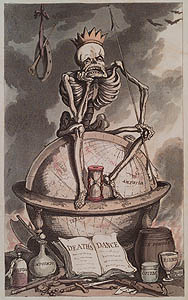
    danceofdeath.jpg

  • This Post More Interesting & To-The-Point Than The Next

    New issue is up. Print edition–the real thing–will hit the streets on Monday. This is what we’re doing most of the time.

  • The Narcissist At Work

    With the news that our publisher and son have taken the reins of the ab fab MNSpeak, I was reminded of an ongoing monologue I’ve been developing (I know, among all the other ongoing monologues) about the variety of blogs. Just within any particular medium, there are so many varieties that creating a typology is an endless task, and probably a pointless one. Consider, for example, the world of vlogs or video podcasts. This is a nascent thing–iTunes currently lists 83 vlogs. I guarantee that number will be in the thousands, if not the tens of thousands in twelve months– and already it makes very little sense to compare, say, Chasing Windmills with Rocketboom. One is a sort of daily variety show with an astonishingly annoying host, the other is an artful and funny and professionally produced soap opera. The same is true, of course, of the text-based crowd. There’s humor, memoir, political punditry, book reviews, gossip, just some guy’s random thoughts, and so on.

    But this obvious point makes me consider what the essence of a blog is, if there is an essence. If there is anything new to it (particularly in print) it is the foreshortened form– the quick hit, the editorializing link, the ribald punchline, and on to the next post. By that criteria, this here operation is no blog at all, but a frequent writing exercise with disparate, idiosyncratic subjects like magazine publishing, hockey, life in the Midwest, and so on. Anyone who writes for a living ought to write as often as they can–sort of like if you consider yourself a professional skier, you should probably ski quite a lot. Now the difference is that most professionals don’t wish to practice in public. Most writers, if they know what’s good for them, will self-edit aggressively. That’s to keep up the quality of the stuff that makes it to the point of public consumption. You could also make the argument that too much publishing, whether it’s in a blog or a newspaper, devalues the product and the producer.

    On the other hand, I think you write differently if you know there is a possibility that someone other than yourself is going to read it. It’s similar to the question of whether the artist can or should think about his audience. It changes the art, generally for the better I think, when it is intended for public viewing, because it should compell the artist to make extra sure things are looking their best. So blogging, for the writer anyway, is maybe a zero-sum game. Probably the best advice is to continue to write publicly AND privately.

    If I tried to guage how much I write that actually ends up in the public domain–including here on the web–I’d say roughly half of it never sees the light of day. And that’s not because it’s unfinished or unintended to have readers. I hardly ever start a project without finishing it, whether its a bloggy graf or a magazine article or a novel. (Tried once. It is the worst thing ever written in the English language. No, that would be a selling point. It’s the most useless thing ever written in the English language, and I may well go to hell just for the vanity of forcing it on the one or two people who did look at it. I used to think the thing was merely unfinished–at 100,000 words. Now I know it’s not that. It’s that it is relentlessly bad from beginning to end.)

    Not sure what my point was here, other than to do my own pushups today out here in view of everyone and everything, after spending a week or so writing in a closed circuit. The upside for readers, generically speaking, is that a good writer like Woolcott or TMFTML or Diablo works differently and more loosely in this medium, and often times they really shine without the interference of an editor or a publisher or, more subtly, their own censorious professional within. I like to compare the online and print writing particularly of Woolcott, because he’s always a gas to read. But on the web, he flexes all those ripped metaphorical muscles, and he regularly beats up on the deserving weaklings who dare to darken his doorstep with their muddled thinking and their mannered contempt.

  • Nothing At All Like A Voyage, Nothing At All Like A Journey

    wrestlers2.jpg

    Your ideals are invisible clouds

    So try not to suffocate the poor,

    the peasants, with your sympathies.

    They know that you’re staring at them.

    Jim Harrison, from “Easter Morning”

    Dance on, you pigs, what concern is it of mine?

    Franz Kafka, Diaries, 1914

    Could any of this possibly be true, these things you tell us?

    No, please understand, they could not possibly be true. They could not be further from the truth.

    Where is Further From The Truth? Does such a place, in fact, exist
    ?

    Yes, there is in fact such a place, and you might be surprised to learn that it is not nearly so far away as you perhaps imagine. I have myself been there many times.

    You have made the voyage?

    It is not a voyage, nothing at all like a voyage.

    You have made the journey, then?

    It is not a journey, nothing at all like a journey.

    Would you at least say that when you have visited Further From The Truth it involved a trip of some sort?

    I would say that it involved a short drive; I’ve even walked there on occasion. The original watertower still retains a faint trace of the town’s name, but these days people are free to call the place whatever they like, as befits a community founded by liars. Most of the natives are completely indifferent. They couldn’t care less, which is the name, by the way, of one of the suburbs of Further From The Truth.

    What name is that?

    Couldn’t Care Less. When Further From The Truth became such a teeming Mecca for every sort of liar and fraud, many of the residents started to move out into new suburban developments and sub-divisions, where they were free to cultivate the indifference made possible by their great fortunes, every one of which had been acquired through careers of appallingly successful deceit. The people there, it is said, are among the laziest and most contented on the entire planet.

    wrestlers.jpg

  • What have the Vulcans been up to since last year?

    “The Winter Carnival suspended the 2005 Vulcan Krewe and ordered future krewes to wear their real names on their costumes. In the past they have used character names, including ‘Baron Hot Sparkus’ and ‘Grand Duke Fertilious.’ The new Vulcans will also stop placing garters on women’s legs and attaching pins to their clothing. They will also take sexual harrassment and cultural sensitivity training.”—MPR

    **To view the complete side-splittingly funny comic, scroll down and click on the PDF file named RakeVulcans.pdf

  • Cut Out

    By summer, the hulking, multi-ton blade sharpening machines of Printers Service Inc. will be gone, hauled out through the big front windows of 716 Washington Avenue North. For more than half a century, Ken Springer has run his business here, with the help of various employees who tend to stick around like family, and his sons, Wayne and Keith. The shop is a throwback to a time when people and machines interacted in a way that didn’t include a keyboard. It’s grimy, too. The sharpeners are constantly lubricated with a fine mist of oil, which coats everything not encased in plastic or stashed under a cardboard box. The Washington Avenue Business Center, which for decades has housed artists and musicians, along with Penco art supplies, is undergoing an upscale renovation; many of its tenants are being evicted. The plan doesn’t include Printers Service, which will seek a less pricey locale outside of downtown Minneapolis.