Year: 2006

  • Low Five

    chef.JPG
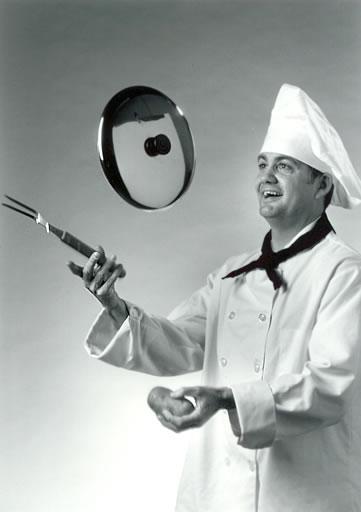
    juggling, juggling, juggling …

    Did you hear the news about Five Restaurant?

    Chef Stuart Woodman, the one who was recently named a Best New Chef by Food & Wine, was asked to leave his restaurant by his partners. This was supposed to be the best new restaurant in the state, an epiphany of foodie dining. What happened?

    There have been rumors, I have to admit. Woodman is an old-school chef, and his temper is not a secret. Were pots thrown? Were guests asked to leave the restaurant just for sending back tepid soup? I can’t confirm, I wasn’t there, I do not know.

    I do know that, not long ago, they sent out a discount promotion, so much off on Tuesdays or a certain percentage off here or there. For an upscale restaurant, that’s a red flag.

    I guess it’s the classic Fhima question: Is being a great cook enough to run a successful restaurant?

  • The voice that is great within us

    Whether you be toasting liberally or crying in your beers about the election results (I have a feeling that, like me, my readers are doing a little of both), it’ll probably be a good night to go way, way back (before you were too young or unborn to care about this shit): there’s B.B. King at Orchestra Hall and, if you’re really hating life, some sort of Johnny Cash backup band playing over at Lee’s (with opener “Johnny Trash”).

  • This Is Better

    The founders planned for it to work out this way: one party controls the executive; the other party controls the legislature. Except for the fact that the chief executive is George Bush, things could be a lot worse. God knows they have been for the past 6 years.

    If there is one thing that’s been clear, it’s that old saw about absolute power corrupts absolutely. With few exceptions, the power party was clearly governing for the benefit of the party, not of the country.

    But what I’m most encouraged about is that the American people may be slow, but they’re not completely stupid. It took them longer than it should, but to be fair, the Democrats certainly put up some dreadful candidates. (John Kerry, Coleen Rowley and Patty Wetterling come immediately to mind.)

    But they also came up with some good ones, like Tim Walz.

    Now the Democrats have to actually prove that they have some ideas. We know that Bush’s strategy in Irag is wrong. However, we don’t know what is right. The Democrats better figure it out soon, because the people seem to be demanding it.

    Congress, you’re on. Don’t screw it up.

  • One More Morning In America

    circus-tigers.jpg

    A morning like this, a morning on which you will not truly wake up, but rather go through the habitual motions of waking up –brush your teeth, shower, change your clothes, walk the dog, and go off in the usual stupor to work– you’re left wrestling with the old, hard-wired reactions to nights like the one now behind you.

    All night you heard ridiculous phrases like “the tide of history” and “the winds of change.” You understand, even if you cannot reconcile, the cyclical nature of politics and public opinion. Waves break on the beach and roll back out to sea. Stuff always gets washed up and left behind. The moon works its reliable and spectacular magic and the sun comes up in the east.

    Still, you hope and you doubt. A morning like this you like to think your world has been transformed, that things will be somehow different, if only in terms of a heightened sense of solidarity and shared values (which would be no small victory, really); yet you know that whatever actual changes might result from our collective yawp into the void of representative democracy will likely be small, incremental, and subject, as all such changes are, to swift and arbitrary reversal.

    Meanwhile, some things seem both inevitable and irreversible, things like enchantment and disenchantment, which somehow manage to eternally coexist in their inevitability and irreversibility. The former a blessing that comes with simply being alive in this world; the latter an affliction that unfortunately also comes with simply –or not so simply– being alive in this world.

    If your little red “I Voted” sticker is some acknowledgement of a small and utterly painless investment in faith, what exactly is the nature of your investment? What is the nature of that faith? And what sort of return, if any, do you expect to earn on that investment?

    You’re not so sure, really. Maybe it ultimately boils down to little more than a feeling, a hope, a sneaking suspicion that this country might still work, might still be a better, more compassionate, more peaceful place. Or at the very least that it might one day soon make more sense.

    Maybe whatever happened last night just means that you, along with millions of other people, are exhausted by a political and cultural climate of virulent dishonesty, a strain of dishonesty so fierce and prevalent that you no longer feel safe in your own skin, and can no longer trust the words that are lobbed in your direction every day, or even the words that tumble around in your own head and roll off your tongue.

    This, however, is another day, another pure opportunity to be stunned. The first bruise of sunlight is creeping behind the houses across the alley. Does the world this morning feel like a better or safer place? Maybe you’re one of the lucky ones, and can’t answer that question with any real honesty or perspective.

    You know this much: When you drive downtown the hobbled parade of scrap metal entrepreneurs will still be pushing their grocery carts slowly along the streets around your office, and your desk will be exactly as you left it yesterday afternoon.

  • In Case You Missed It

    And those of you who depend on the newspapers or the TV for your news did, Minneapolis School Board Candidate Chris Stewart wrote and posted this “spoof” of Tammy Lee’s website front page on his blog, americanhotsausage.com.

    It’s since been removed and the blog has been passworded so you can’t see any of his previous scurrilous screeds unless you have the secret password, which I’m guessing is probably “honky” or “ofay” or whatever is slang for “white motherfucker” these days.

    Stewart goes by Rev. Rahelio Soleil on his blog and as a letter writer (to The Rake, among others) and frequent commenter on local blogs. If you want to google him, you can, and you can read some of his stuff if you click the “cached” link on the google listing.

    He commented here the other day as RS2, and stopped just short of calling me a racist. On the Tammy Lee page, he didn’t hesitate to put racist words in my mouth.

    I spoke to Stewart yesterday and asked him point blank if he’d written the site. He refused to answer a simple yes or no question.

    Chances are Chris Stewart will be elected to the Minneapolis School Board today, and by God, we’ll be proud to have a thoughtless cowardly racist like him representing us. Especially one who says such things behind a pseudonym.

    (Pardon us while we laugh our ass off when we quote what Stewart says he stands for on his website: “A intense focus on core knowledge, character education, and civic accountability.”)

    At least Keith Ellison put his name on stuff he wrote. Too bad Stewart can’t muster the same courage.

    And too bad none of the main stream media couldn’t do so either. Maybe the Strib just didn’t want to make themselves look any stupider than they already do by ignoring this story about their endorsed candidate.

  • Political mobility

    It is well known that certain types of cars are blue, green and red.

    The bluest of the blue is the Volvo station wagon. The sedans, however, are quite popular in Georgetown, where you find the ocassional conservative. Locally, however, Bush supporters and Volvos are rarer than Amy Klobuchar apologists at, say, Grace Church.

    The poster child of green cars is the Subaru station wagon. It also serves as a moving billboard for civil union amendments. I could easily see myself in such a car provided it was the English STI 306 HP version of the Forrester wagon — a car worthy of Martina Navritilova and Billie Jean combined.

    The reddest vehicle on the planet is not the Hummer (Neil Young drives a bio-diesel variant) but the Suburban XL, the “national car of Texas.” Before you Prius prissies diss this behemoth realize that a flex fuel version currently exists that can run on 85 percent ethanol. That makes the Suburban more politically correct in the corn growing states like Minnesota but still red meat for liberals in Texas.

    Do they have corn in Texas?

  • May the best men and women win…

    Happy election day. Two related happenings, where the worlds of art and politics collide: there’s an election night cocktail party at Gallery 13. And Bedlam Theatre will set about spoofing the television news in a one-night show at Bryant Lake Bowl.

  • A Matter Of Great Importance

    Dear George Washington Bush,

    I have to confess to you, sir, that I’ve grown weary of your monkey business. Tomorrow I intend to join with millions of other Americans in voting you out of office.

    I’m not ashamed to admit that I voted for you last year, but that was last year. I lived in a different America –and a different shitty apartment– then, and was so drunk and tired I could barely find my mouth with a soup spoon. I had all manner of mental and physical hygiene issues, and I appreciated the fact that you seemed cleaner than some of the other fellows. I also appreciated your commitment to physical fitness, a commitment that has always proved so personally difficult for me. I figure it counts for something that an older guy like you can run circles around his fat mob of handlers.

    I admired your “saltiness,” the way you said “fuck” and “pussy” all the time and were always chasing tail. I thought your tattoo of a mongoose biting the breasts of a naked woman was fabulous, and I liked the whack, pimpy hats you were always wearing. It didn’t bother me in the least that you purportedly smoked methamphetamine and drove that dune buggy into the river and shot some other dude in the ass. What was it to me that you were, according to some hag in the Washington Post, “notoriously gropey”?

    Big deal, I would say to people at work when they’d complain about your “indiscretions.” Sometimes, in your defense, I’d quote my (and your) favorite philosopher, Friedrich Nietzsche: “Human, all too human.” None of the nitwits had any idea what I was talking about, but I figure that’s their fucking problem.

    What I’m saying is that I was willing to cut you some slack. I thought it was sort of cool to have a fuck-up for a President. Still, I never did buy into the popular perception that you were “dumber than a tube sock full of gravel.” Nor, however, did I believe you were sly as a fox. I just thought you were an average, good-shit sort of guy.

    Now, though, I’ll have you know that you have one seriously fucking dissatisfied customer on your hands.

    I don’t know how many times I’ve written you complaining about those sticky plastic strips they put on CDs, and you haven’t bothered to send me even one stinking reply –not one!

    And then I went to pick up my car tabs at the department of motor vehicles and they wanted to charge me more than a hundred bucks for a couple of shitty stickers, and the skanky old Bush administration functionary who waited on me insisted that I either write a check or pay cash, neither of which I was in a position to do.

    So here’s what it boils down to, I guess: Thanks for nothing, you cracker bastard. And good riddance.

    Let’s just see how much tail you get when you’re no longer the President.

    Sincerely,

    Brad Zellar

  • The Mirror Screen

    lindsay1.gif

    Certainly people grow tired of mere contraptions. But they never grow weary of imagination. Vachel Lindsay, The Art of the Moving Picture

    One summer I met with a gentleman named Harley Buckwilliams, a tall fellow bent with osteoporosis and pigeon toed, a wanderer and would-be filmmaker from Topinabee, Michigan, on Mullet Lake. Buckwilliams–I never got to the bottom of whether that was his real name or a nom de plume–had seventeen minutes of what was to have been an epic feature film called Vachel Lindsay Will Trade Bread for Photoplays. How he came across my name I’ll never know, but it was this strange request which prompted me to drive the two hours from a visit with my mother in Mt. Pleasant. I arrived at a dilapidated clapboard farmhouse in the middle of a forest that looked as if someone had hacked down the trees twenty years ago and replanted evergreens in very straight lines. Harley met me out front, offered me a bottle of homemade beer, and then welcomed me around the back to a shack barely big enough to hold two people, much less a projector and screen. The place smelled not unpleasantly of metal and dust and old wood. Above the entrance was a sign that read Gryphon Theater, and inside and on shelves above our head were rows and rows of film canisters, a collection from over thirty five years. It included the usual found footage–old educational films, (Paddle to the Sea among them), footage of Flint for that city’s Chamber of Commerce, advertisements, and, he claimed, a copy of the Lyman Howe’s old silent Moving Day that Lindsay enjoyed. Buckwilliams refused to show this last one to me “for fear of enchantment”–I would, like Lindsay, take to the roads, hoboing, trying to encourage my fellow man to fall in love with poetry and the moving picture.

    We sat on a pair of old kitchen stools, and he projected his film onto the back of an ancient high school school map of the United States. “My original idear was to cast Rich Brautigan in the role of Vachel Lindsay. You can see him there.” Quickly, there was a shot outside of what looked like a steep San Francisco street, and Brautigan, with his characteristic mustache, smiling and then flipping off the camera. Then the projector died. Buckwilliams cleared his throat as he tried to fix it. “He agreed at first. I get to keep this footage ’cause of that. I kept after him but then he died. Both Vachel and Richard killed themselves. One with Lysol, one with a pistol. I’d go with the pistol myself.”

    The crux of the film was this: Brautigan was to wander from Illinois to New Mexico, as Lindsay had, preaching the gospel of beauty. As time progressed, Brautigan would gather poor souls to a makeshift theater by every town–merely a sheet strung up between birch trees, at dusk, hopefully by a river or railyard–and screen what had already been shot. All the while, characters in the background would be reciting Lindsay’s Art of the Moving Picture in its entirety. There was really no plot, except that Brautigan needed to get to New Mexico and there the film would be seen in its entirety. “The movie would sink into your head,” Buckwilliams said, as he fiddled the projector, blowing dust out of the guts of the machine. “I’m not talking the garbage you see today. But the movies that come out of your every waking day. That’s what V. saw in poetry and movies. This thing,” he said, slapping the reel, “is about life. What other movie can say that?”

    I scoffed at that overblown statement, and asked him how he planned to get the financing to finish it–or was it already completed? The film would not lose money, he claimed, because barter would rule–for every time they needed film, or to use an editing studio, or to eat, Buckwilliams and his crew (one brother serving a year for vagrancy, and two pals of Harley’s from his very brief time in the Coast Guard before he was tossed out for desertion) would trade what they need for the promise of a spot in the motion picture. “Of course,” Harley said, in a voice gouged by cigarettes and no doubt shouting over trains, “that meant you had to find someone with imagination. Someone who’s brave.” Then he asked me if I would fund part of it, and I gave him thirty dollars and the promise of helping him screen what he had if he made it to Minneapolis.

    With that he turned the projector back on and we watched the remainder of Vachel Lindsay Will Trade Bread for Photoplays. What remains is a thing of beauty. Whatever’s going through Mr. Buckwilliams’ head, no matter how scatterbrained he appeared, he does has an eye for the people he’s shooting. They are weary, most are drunk, the dregs of society beaming at the camera, no doubt shocked that someone wants to take a movie of them, and not just some tv crew out to capture the plight of the homeless. One fellow does a little jig, another tries (and fails) to juggle, one woman kisses at the lens and winks, smiles and then her instincts react and she immediately covers that happy grin with her hand and her eyes lower. Hilarious and heartbreaking all at once, with a little murmur of someone reading, I assume, chapter one of The Art of the Moving Picture. “But what’s important,” Buckwilliams added, “is that we don’t get anyone else talking. Talking ruins the Hieroglyphics of the individual. Film reveals the language. It reveals the person. It is, as Vachel said, the mirror-screen. It will make all of us happy, all of us equal.” He seemed to be suddenly aware of the gravity of the statement, for he shrugged and gave me a sideways smile. “Anyway, that’d be nice wouldn’t it?”

    A little tipsy from the combination of strong beer and an empty stomach, I watched this little movie, impressed with Buckwilliams’ triumphant close to the picture: in 2018, when Lindsay’s vision of the arrival of a winged book should appear in Springfield, Illinois, the filming will cease. Harley would then show the world premiere of the film that day as well. The movie will be shown in the center of town, and maybe, just maybe, the spirit of Vachel Lindsay will rise to greet the new Millennia of the city of Springfield, which was holy to Lindsay.

    Thanking Harley for his hospitality and the clip of his movie, I retreated to my car, a little overwhelmed. What I had just seen was as gossamer as a spider web on a tomato plant–here one day, gone the next. No one will bother to save Mr. Buckwilliams’ precious canisters of film; needless to say it will never make the switch to DVD and the film itself will eventually decay to nothing. Perhaps that is as it should be, like Lindsay’s impromptu poems recited for a meal or a night’s sleep in a hayloft. I felt a bit guilty with my promises to screen his movie if he ever made it out my way, for I knew that we both knew that that was an empty promise, that he would probably never leave Topinabee alive. And when he died, the movie would die with him.

    …As we peer into the Mirror Screen some of us dare to look forward to the time when the pouring streets of men will become sacred in each other’s eyes, in pictures and in fact. –Vachel Lindsay, The Art of the Moving Picture.
  • Welcome to the Shadow Chamber

    The Minneapolis College of Art and Design just opened Roger Ballen: Shadow Chamber, a show that’s running for a few short weeks and thus, probably won’t get the props it deserves. Ballen is a Johannesburg-based photographer specializing in eerie, black-and-white images, in any case. Check out the show on a quiet Monday afternoon…
    RB.jpg