Infamous and The Queen.
Infamous, 2006. Written and directed by Douglas McGrath. Starring Toby Jones, Daniel Craig, Sandra Bullock, Jeff Daniels, Sigourney Weaver, John Benjamin Hickey, Lee Pace, Peter Bogdanovich, Hope Davis, Isabella Rossellini, and, in a small but powerful role, Gwyneth Paltrow.
Now playing at the Edina Cinema.
If you were to look at some of the yellowing old Truman Capote paperbacks from the 50s & 60s, those slim volumes with the red stained pages and turgid covers, you’d discover two Capotes. In Other Voices, Other Rooms, his debut novel, there’s Truman in his notorious pose, lounging seductively on a couch, precocious as all hell. Turn, then, to In Cold Blood, and on the back you’ll find a photo of a man considerably sobered by his experiences, and looking very much like some sort of flatfoot with the Kansas Bureau of Investigation. One of the Trumans is vivacious and keen to take on anything and anyone; the other, suddenly not as outgoing (though certainly not introverted), colder, now, perhaps a bit afraid of the world he once commanded. He is a shell of himself.
The magnificent and thoroughly entertaining Infamous is about the transformation of the one man to the other. The film opens with Truman Capote (Toby Jones), sitting in the front row of a swanky bar with his pal Babe Paley (Sigourney Weaver). They’re gossiping, smoking and drinking, soaking in the high life that insulates them. The singer Kitty Dean (Gwyneth Paltrow, in a short, sharp performance) comes up to warble “What is This Thing Called Love?” and then, halfway through, is struck down with melancholy, and barely able to continue for her pain. Clearly, a man has left her, hurt her, and the audience, especially Truman, is caught in the rapture of her emotions. After a long pause, she gathers herself with a few snaps of her fingers, the band starts up anew, and she finishes the song with a flourish.
Truman will not be so lucky.
There is, of course, an elephant in this review, as no doubt you might be wondering how Infamous compares to Capote, which covers essentially the same story. They were filmed simultaneously, and, fortunately for Philip Seymour Hoffman and the makers of Capote, Infamous was shelved for a year. For Infamous is a vastly superior film. Where Capote gave us a Truman that was all actor’s tricks (Hoffman’s eponymous character was easily last year’s most overrated performance), a calculating man, cruel, impassionate, contrasted sharply against a small town that doesn’t seem to have a breath of life in it at all, Infamous is warts and all… and the ‘all’ includes Capote’s sunny personality and tremendous charm. Infamous, though obviously stretching the truth, nonetheless taps into Capote the artist, the man who may have used his subjects, but produced a volume of such emotional intensity that you cannot help but wonder what it did to the man. Where Capote was shallow waters, Infamous’ depths are nearly fathomless.
Infamous throws us headlong into the cosmopolitan life of Truman Capote, and Toby Jones’ performance as the writer is as startling as Roman candle in a crowded subway. With a tart Django Reinhart-style soundtrack, we hop from table to table as Truman gossips with his high-society friends, all the while keeping his introverted boyfriend at bay. One morning, while perusing the New York Times, he comes upon an item about the brutal murder of the Clutter family in Holcomb, Kansas. “This story has stuck in my teeth like a piece of pull candy,” he admits, and solicits the aid of his friend Harper Lee (Sandra Bullock) to accompany him there. Truman and Harper are close friends, and their chemistry is a joy to watch. She is, at first, reluctant, but later admits–in a series of onscreen interviews that add surprising poignancy to an already moving film–that she is interested in crime, and when Truman asked, it was “deep calling to deep”. With that, they’re off to Holcomb, Kansas. It is the beginning of a long and torturous end to Truman Capote.
Truman charms the socks off everyone: his pals in New York, publishers, detractors, the people of Holcomb, Kansas, their police, the killers, and, best of all, the audience. For anyone who has ever read In Cold Blood, Capote must have seemed odd: that book is difficult to endure, a wrenching experience and a piece of writing that seems to have tapped into the pulses and fluttering emotional stability of everyone Capote encountered. How could the monster of Capote have written such a moving work? The short answer is that he couldn’t have–but Toby Jones’ Truman could. He alone could weave his manic tales of arm-wrestling Bogart and drinking with Sinatra to the point where staid KBI Agent Alvin Dewey becomes a friend. This Capote is a good listener, he is a gossip, can be cruel and manipulative, but you can’t take your eyes off him, and wish you could spend an evening drinking and laughing right along with him. Not actually sexy, Toby Jones’ Truman is a creature of startling attractiveness.
All of which makes his inevitable downfall all the more profound. Infamous is almost two films, one of great humor and one of uncomfortable tragedy. When they mingle, and Truman returns to New York for his dinner parties, like Kitty Dean in the opening he has to pause to allow pain and grief to wash over him. He dances the twist with his high-society friends, but the shadow of his experiences in Kansas clouds his psyche. As time goes on and on, the executions are delayed, humor slowly drains from the film. At last, when Truman, later lying about the final words of Perry Smith (Daniel Craig), tries to return to his old life, he is wrecked. The wind-up toy has wound down.
Infamous has a bundle of energy, an intelligent script, and some of the most winning performances you’ll see this year. Its director, Douglas McGrath, does not have an especially cunning camera style, but he wants us to understand this man, as best he is able, to try to get in touch with the sacrifice it took to create a work like In Cold Blood. No one–the people of Holcomb, the two men who killed the family, the New York intellectuals, and especially Truman–emerge unscathed… nor, though, do they emerge without anything but their dignity. Unwilling to demonize Truman, McGrath and Co. offer us a treatise on the joy of being an artist, and the often times treacherous path it takes us down. “You die a little,” Lee says about writing in one of the interviews, “getting it right.” Sometimes you die a lot.
…
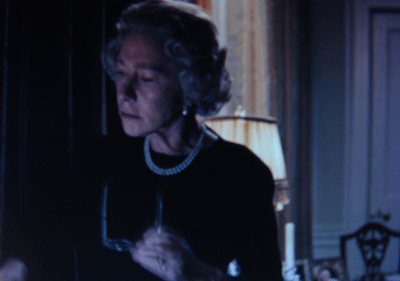
The Queen, 2006. Directed by Stephen Frears, written by Peter Morgan. Starring Helen Mirren, Michael Sheen, James Cromwell, Sylvia Syms, Helen McCrory, Alex Jennings, Roger Allam, and Mark Bazeley.
Now showing at the Uptown Theater.
One day shortly after the death of Princess Diana, I was buying groceries at the Rainbow foods in Uptown. A young punk girl in front of me was being rung up, and when the cashier heard the young woman’s obviously British accent, asked where she hailed from. “London”, the punk said, very friendly. The cashier’s face fell. “I’m sorry for your loss,” she said with all earnestness. “Loss?” the girl answered, now irritated. “That fecking bitch can rot for all I care. You know what my country could do with the Royals money? It’s robbery, and she deserves a thieves burial.”
Can you recall where you were when Diana died? I don’t, though it was probably on the street, overheard in a coffee shop or at work. Other than the punk’s exchange a few days later, what I do recall is that, for the next few weeks, I couldn’t help but think that Britain was one bat-shit crazy nation. The Queen does nothing to lessen this belief.
The Queen is a very well made film, another feather in the cap of underrated (here) director Stephen Frears. It is funny, brilliantly acted by the lovely Helen Mirren, and a cast of top-notch actors. Taking place in the year 1997–which still seems too recent for one of the most powerful nations on earth to be wrestling with questions of monarchy–The Queen opens with the triumphant election of Labour Party leader Tony Blair. Blair–young, handsome, a savior–comes swooping in on the promise to modernize Britain and take her into the 21st Century. He is a man of the people, surely, and this is emphasized in a ridiculous scene in which his wife still bakes fish sticks for the family at 10 Downing Street.
Blair and the Queen have an icy relationship. She is obviously conservative, very old school, and there’s a cheeky moment where Blair goes uncomfortably through the ceremony of the Queen asking him to run Parliament. At the end, Blair and his wife must walk out backwards–the Queen must not see their backs. Though funny, this is one of a few scenes that are meant to sum up the film’s themes, somewhat hamhandedly: we are to see the collision of this ‘modern new Britain’ and ‘traditionalist’ England.
Things progress relatively smoothly until the night of Di’s death. Shock waves crash through Britain, but of course the crown is unmoved. The Queen does not believe that they should mourn in public, nor leave their summer home in Scotland. Blair scores major points especially as he dubs Diana “The People’s Princess”. The PR machine is now rolling. Blair will triumph. The crown will suffer.
Certainly, the Diana situation was a tough one for millions of star-crossed Brits. But let’s call it like it was: the love of Princess Diana was certainly nothing more than celebrity worship. She was cute and liked to hold starving African children in an attempt to add some gravity to her shallow life. She was no different than, say, Bono, who at least has given us a catalogue of music that moves millions, and it is from that that he’s acquired his millions. Di got hers, like her ex-in-laws, from the public coffers.
The Queen is an odd film, one that relishes making fun of these royals (the scene in which the Blairs walk out backwards) and acknowledging the above feeling (Blair’s wife is of the same mind-set as the punk in the grocery store), but one that feels as if Frears wants to have his cake and eat it too–he admires the monarchy as much as he thinks it’s outdated. As well made as The Queen is, as well acted and written, it could have used a Monty Python treatment. In his New Yorker review, Anthony Lane noted that when he went down to visit the giant crowds of mourners, there was definitely a sense that many people would have been glad to have done some bodily harm to the royals had they arrived. What a great sub-plot that would have been! Instead, the dull history of the 90s gets top-treatment here, and Diana’s death appears, to the filmmakers (and no doubt the people of Britain), to be one of the defining moments of the late 20th Century. Perhaps we need a few more years, and a new Python, to make the comedy this subject deserves.