Jack Black and Mos Def team with director Michel Gondry (Eternal Sunshine of the Spotless Mind, Science of Sleep) to give us this oddball comedy about a man who becomes magnetized and erases the entire inventory of videotapes in his pal’s rental store. (The movie takes place in the ’80s.) They end up having to “swede” all the movies. What’s sweding, you ask? “Remaking something from scratch, using whatever you can get your hands on,” explains Black. Natch. So the boys take whatever junk they can find, grab a video recorder, and remake everything from RoboCop (with Black in tinfoil) to The Lion King to 2001: A Space Odyseey to Boyz n the Hood. Black even asserts: “Our version is better!” Undoubtedly.
Month: December 2007
-
Big Hands in His Heart: An Interview with The Kite Runner's Homayoun Ershadi
In The Kite Runner (opening Friday in area theaters), actor Homayoun Ershadi plays Baba, an Afghani intellectual and father of the child Amir, whose friendship and eventual betrayal from the servant boy Hassan forms the crux of the story. Ershadi is a graceful actor, whose intelligence and dignity shines in this movie. Originally an architecht, he was literally plucked from his car to play a role in the Iranian film A Taste of Cherry. Mr. Ershadi was kind enough to speak to me on behalf of the film, based on the bestselling novel by Khaled Hossein.
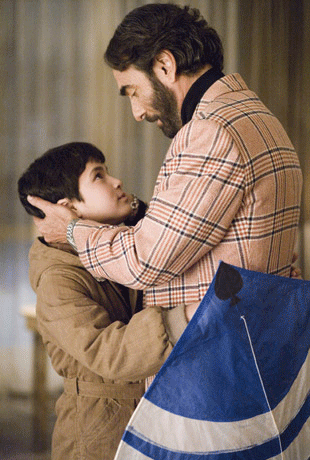
Rake: What brought you to this project? I know you enjoyed the novel…
Ershadi: I had finished reading The Kite Runner three months before they called me. Kate Dowd, the casting manager based in London, called to say that Mark Forster (the director) had seen my first film, A Taste of Cherry, and wanted to meet me. So I went to Kabul to see Forster and audition.
Rake: For the sake of authenticity, the characters speak Dari. Did you speak that language yourself?
Ershadi: No, but it’s very close to our language, to Iranian Farsi. The accents are different. Khalid Abdalla, who plays the older Amir, didn’t know one word of Dari so he stayed one month in Kabul and he learned. Now he speaks better than me and some people there. Before shooting we had a teacher who helped us learn Dari.
Rake: What was it like working with the children? You had a great rapport with both Zekeria Ebrahimi and Ahmad Khan Mahmidzada [who play the younger Amir and Hassan, respectively]. Not only were they children, but totally untrained as actors.
Ershadi: I had the experience before. I had a television show in Iran where I was a schoolteacher and had to work with kids. But these two kids—I can’t explain, I don’t have the words. They are so fantastic, so talented, diligent. They didn’t speak a word of English when they came to Beijing [where some of the production began]. It was very easy working with them.
Rake: Had you ever been to pre-invasion Kabul?
Ershadi: Never. This was my first time in Kabul.
Rake: What was it about The Kite Runner that especially intrigued you? Is your relationship with Iran similar to the relationship that Baba has to Afghanistan?
Ershadi: Yes, you can tell that. There’s some similarity to the story of Baba. I left Iran and went to Canada and returned in 1991. But you’re asking me why this book made me want to be part of the movie? When I read the book I couldn’t even imagine being a part of the movie. I was very proud when they called me. And I hope this brings out more Iranian actors. We have lots of talented actors and actresses. I hope this is a start for the movie industry in Iran.
But The Kite Runner is a story about friendship, guilt, forgiveness, redemption. These are the terms that people connect with. It is not just for Afghan people, it is very human, it crosses religion, culture, background. The story’s human.
Rake: What were some of the more interesting challenges filming The Kite Runner?
Ershadi: We never had a problem. Everything was very smooth. There was teamwork—everyone helped one another. It was a big crew, 200-300 people. I never worked with such a crew, but we all worked together.
Rake: The kite scenes were interesting. Did the kids actually fly the kites?
Ershadi: Yes! They knew, but had to learn a little bit before they came to Beijing. Kite flying, you know, is a part of their culture in Afghanistan. Still you go to Kabul you’ll see kites in the sky. But as you know, they can’t afford to buy kites, they make them from plastic bags you get for garbage or from stores.
Rake: You don’t physically resemble the character you play in The Kite Runner. He’s described as big, as someone who could wrestle a bear. But the director, Mark Forster, noticed that you "acted from the inside". What does that mean?
Ershadi: When they called me to go to Kabul I was surprised. Baba in the book is 6′ 8", big hands, etc. I saw Mark and I said, "Are you sure I’m the right person?" He asked why. I explained our differences, and he said, "Don’t worry about that. Read your lines." After that I realized that he saw the 6′ 8" and the big hands in my heart and my face and the way I read my lines. It was a big risk to cast a small guy as Baba.
Rake: Are you still in touch with a number of the actors?
Ershadi: Before The Kite Runner I had one son and one daughter. But with Khalid Abdalla, who plays the older Amir, I realized that I had two sons and one daughter. He became my son, too. Our relationship grows. Even now we talk every night on the phone, asking about each other’s day. The other actors I email and call.
Rake: Your performance is very touching, very impressive.
Ershadi: It was not acting. [Touches heart] It comes from here.
-
Cloverfield
It looks like producer J. J. Abrams (the man behind Lost and Alias) took a few cues from legendary horror-meister Val Lewton. In Cloverfield, Abrams’s Godzilla-like monster wreaks havoc on New York City—except he does so at night, and we can’t see a damn thing except shadows and fleeting images of the beast as things blow apart, casting flickers of light on the carnage. Abrams understands, as did Lewton when he made The Curse of the Cat People some sixty-five years earlier, that imagination is the best special effect—and it’s cheap. The web is already alive with anticipation for this one. If the trailer is any indication of Cloverfield’s thrill-a-minute qualities, this should be one helluva popcorn flick.
-
Las Momias de Guanajuato
This is arguably the greatest lucha libre horror film in history. Yes, friends, we know that’s like saying Evan Almighty is the greatest congressional ark-building comedy ever, but this entertaining schlock—starring those masked Mexican wrasslers—cost a hundredth as much, and looks to be ten times more amusing. In Las Momias de Guanajuato (1972), the wrestler/sorcerer Satan has been mummified for over a century and returns to wreak havoc on the peaceful city of Guanajuato. What’s to stop him? Why, those kindly masked wrestlers Santo, Blue Demon, and Mil Mascaras, that’s who! Marvel as this trio fights off a horde of rotting mummies in tights and those crazy masks. We challenge you to find a more memorable film to inaugurate your new year.
Parkway Theater, 4814 Chicago Ave. S., Minneapolis; 612-822-3030.
-
There Will Be Blood
The latest from director Paul Thomas Anderson (Boogie Nights, Magnolia) is rumored to be a frontrunner for the best-picture Oscar, but that’s highly unlikely. There Will Be Blood is magnificent, epic, and utterly bizarre; films this weird never win the big one. Based loosely on Upton Sinclair’s 1927 novel Oil!, There Will Be Blood features Daniel Day-Lewis and Paul Dano as an oil man and a preacher, respectively, at odds over money, faith, and oil rights. These actors perform like serpents fighting to swallow the film whole and there is vast pleasure in watching them coil around one another in mortal combat. With an equally audacious score by Radiohead guitarist Jonny Greenwood (he summoned Stravinsky’s screeching violins), an impressive cast, and startling direction, Blood is the boldest Western since Sam Peckinpah walked the earth.
Uptown Theatre, 612-825-6006.
-
Particularly in the Heartland
Part of the Walker’s Out There festival of experimental theater, this show, by a youthful New York City ensemble called the TEAM (Theater of the Emerging American Moment) defies rampant cynicism by presenting a work of resounding optimism. Set in Kansas, the action unfolds within an evangelical household. The parents have just been killed by an awful Kansan storm, but the children believe the rapture has taken them. What’s surprising about this work, especially in this age marked by Colbert Report satire, is how the TEAM avoids irony in painting its portrait of the earnest, often anti-intellectual culture of Evangelicalism. Instead, their feel-good show teems with rigorous dance and movement, sincere character study, and even wholesome Stephen Foster songs.
Walker Art Center, 612-375-7600.
-
Raw Stages
The History Theatre has hit its share of fouls lately—last fall’s production based on the life of Kirby Puckett was uniformly blasted, and the recent Hormel Girls had a lackadaisical score and a script wholly reliant on stereotype. But this institution also boasts a singular and noble characteristic: It commissions more original works by living, local playwrights than any other Twin Cities theater. Its annual Raw Stages series bundles four samplings of works-in-progress, each with a certain destiny for the History Theatre mainstage. This year’s lineup includes the chronicle of a haunted Summit Avenue mansion, by the edgy Minneapolitan Deborah Stein (see “Heavy Rotation”); and the story of Tyrone Guthrie and Ralph Rapson’s collaboration building the landmark Guthrie Theater at Vineland Place—by the prolific, Minnesota-based playwright and screenwriter Jeffrey Hatcher.
History Theatre, 30 E. Tenth St., St. Paul; 651-292-4323.
-
Wreck
Black Label Movement received a hearty welcome with its debut 2006–07 season, garnering praise both for its evocative choreography and athletic, hyperkinetic dancers. The company repays that kindness by opening its sophomore season with the ambitious Wreck, artistic director Carl Flink’s first evening-length piece. Claustrophobics beware: Wreck depicts ten sailors trapped inside the last watertight compartment of an ore boat at the bottom of Lake Superior. Confined to a small space defined by several benches, the dancers artfully flail, careen, and collide as they run out of air and time. Vintage 8-millimeter footage of an ore boat, along with a score by acclaimed Twin Cities-based composer Mary Ellen Childs, provide a backdrop.
Southern Theater, 1420 Washington Ave. S., Minneapolis; 612-340-1725.
-
Peer Gynt
Who better than Robert Bly to revive this cautionary tale of misdirected masculinity? Peer Gynt is the most deplorable of characters, a swashbuckler who, during the course of a single play, manages to desert his mother, cajole a bride into the mountains on her wedding night, get crunk with some hillbillies, and go on a globe-trotting black-market bender. Contemporary audiences will notice that nineteenth-century playwright Henrik Ibsen makes an apt statement about a familiar, modern archetype: the fatherless adolescent whose thuggish ambitions eclipse all kindness within. What’s more, Ibsen wrote the entire thing in Norwegian verse; as with most English translations, Bly’s new adaptation duplicates that effort.
Guthrie Theater, 612-377-2224.
-
Deborah Stein’s Playlist
It might seem strange that Deborah Stein sees more rock shows than she does plays, but it does much to explain the genesis of the Minneapolis playwright’s own new work, God Save Gertrude. A theatrical rock concert in the style of Hedwig and the Angry Inch, Stein’s play also manages to riff on one of the stage’s most familiar tales, Hamlet. Never mind the overexposed prince and his poor, dear Ophelia; this time it’s Queen Gertrude going under the metaphorical knife. She’s a punk rocker now—replete with her own all-girl backup band, the Shortcuts, and a wardrobe of asymmetrical spiffs by local clothing designer Laura Fulk. Asked what kinds of tunes informed such a spectacle, Stein—whose list here is weighted toward live tracks—noted that her taste tends toward artists who can “tear out their heart and give it to us as a glorious, noisy gift.” Just like her Gertrude.
1. “Tomorrow,” Patti Smith
This is an outtake at the end of the last track of Land, a collection of greatest hits and B-sides. I think it’s from a New Year’s Eve show; she’s exhausted, her voice is shot, everyone is drunk. “Now I’m gonna sing a little song for my mother,” she says before launching into “Tomorrow” from Annie. Yes, that Annie.2. “Success,” Iggy Pop and David Bowie.
They’re basically just taking the piss out of each other, making themselves laugh.3. “Art Star,” Yeah Yeah Yeahs
Karen O puts on a sick live show, and this track (from the self-titled EP) exemplifies the experience. You can practically hear her sticking the mic in her mouth as she roars on the chorus.4. “The Man That Got Away,” Judy Garland
Judy opens herself up raw for the audience, letting us see every crack and fissure.5. “Jersey Girl,” Bruce Springsteen
This 1981 live recording is a real heartbreaker. You can hear the kids in the audience [at the Meadowlands Arena in New Jersey] recognize themselves in this Tom Waits cover. They go nuts when Bruce hits the chorus.6. “Christmas Card from a Hooker in Minneapolis,” Tom Waits
I get chills every time I listen to this one. It’s basically a mind-fuck, where he gets you to sympathize with the narrator and then, in the last verse, yanks the rug out. I wish I could write a play that pulled off this trick!7. Most recent mind-blowing live show: Ted Leo and the Pharmacists
For the sake of choosing one song, I’ll go with “Ballad of the Sin Eater”—that build of “you didn’t know they could hate you, now did you?” sounds like it could go on forever, which is how it feels to see Leo live. There’s a certain excitement generated by both the best live music and the best theater—something unexpected or virtuosic, happening in real time in front of you.8. Most recent song on “repeat”: “Oxford Comma,” Vampire Weekend
So catchy I almost can’t stand it. But I also can’t stop myself from starting the song over before it’s even finished.9. Favorite local band of the week: The Shortcuts!
All-girl, adorable, and fierce. They’re playing in my show.10. Best recent use of music in film: “Sonata for a Good Man” by Gabriel Yared, in The Lives of Others
As it is played during a crucial moment in the story, one character quotes Lenin on Beethoven: “If I keep listening to it I won’t be able to finish the revolution.”God Saves Gertrude runs January 25–February 10 at the Playwrights’ Center, 2301 E. Franklin Ave., Minneapolis. For more information, visit www.workhauscollective.org. For tickets, call 612-332-7481, ext. 20.