Year: 2007

  • From the Heart, Hear the Pounding

    WRITING FESTIVAL
    A Decade of Prose and Poetry at Powderhorn

    Ten years ago, Roy McBride had the brilliant idea to gather together Powderhorn area writers and artists for a writing festival to celebrate grassroots, literary endeavors. The festival, which has continued to this day, hosts myriad events, from writing workshops to
    poetry/puppetry cabarets. Tonight’s event includes readings by Amy Ballestad, Emily Bright, Laura Flynn, Margo McCreary, and Maureen Skelly. Roy McBride himself will be the evening’s keynote performer and will enjoy the unveiling of a 10th Anniversary Powderhorn Writers Festival broadside, featuring his poetry and the visual art of Powderhorn’s renowned color woodcut master, Nick Wroblewski.

    Fridat at 7 p.m., May Day Café, 3440 Bloomington Ave. S., Minneapolis.

    DRUMS
    The Taiko Artistry of Mu Daiko

    This weekend our very own Twin Cities taiko ensemble Mu Daiko will be joined by LA’s TaikoProject for a rhythmic and energetic performance. The TaikoProject has been featured on network TV and Mitsubishi commercials in
    performance infused with hip-hop movement, theater, music, and video. They are, in fact, the first American-based group to win the Tokyo International Taiko Contest. And Mu Performing Arts, the foremost Asian American theater and taiko company in the Midwest, lends traditional and contemporary theatre to the presentation. With two of the country’s most recognized Japanese drumming ensembles, this ought to be an incredible performance.

    Friday & Saturday at 8 p.m., Sunday at 2 p.m., Ritz Theater, 345 13th Ave. N.E., Minneapolis; 612-824-4804; $26 (students and seniors $24).

    DANCE
    Tu Dance

    In 2005, Toni Pierce-Sands (“T”) and Uri Sands (“U”) hit the Twin Cities dance scene by storm with an innovative and powerful performance that somehow led to a proper dance company, complete with nonprofit status
    and a new name, TU Dance. Tonight, the two former Alvin Ailey dancers present two world premieres choreographed by Sands: Beverly, which explores the background music of his Miami childhood, And Let Go, which explores release and meditation. Also on the agenda is Clear as Tear Water, Ron Brown’s McKnight-commissioned solo for Toni Pierce-Sands.

    Friday& Saturday at 8 p.m., Sunday at 2 p.m., The O’Shaughnessy, College of St. Catherine, 2004 Randolph Avenue, Saint Paul, 651-690-6700, $27.


    THEATER & PERFORMANCE
    Anton in Show Business

    “The American theater’s in a shitload of trouble.” So reads the
    opening line in the latest offering from the small St. Paul-based
    troupe Starting Gate Productions.
    As both poison-pen letter and love note to the theater, this play is
    directed by a woman with no small opinions on the matter: Leah Cooper, former executive director of the Minnesota Fringe Festival. Anton depicts the chaos behind the scenes of a production of Chekhov’s Three Sisters.
    An all-female cast depicts everyone involved, from producers and actors
    to critics. Embedded within Jane Martin’s drama are countless
    meta-theater references; characters range from an Our Town-esque stage manager to audience members who just won’t shut up. —by Danielle Kurtzleben

    Friday and Saturday at 7:30 p.m., Sunday at 2 p.m., Mounds Theatre, 1029 Hudson Rd., St. Paul; 651-645-3503; $18 (students & seniors $16).

    ART
    Enchanted

    Fantastical, magical creations are very popular as of late—lots of
    dragons and magicians and cyber-wonders fill pages and screens—and the
    art world is stepping into that terrain as well. Does it mean dreams
    will become reality, or does it mean dreams will keep reality at bay?
    That’s for the viewer to decide. But these artists’ confected worlds
    will be interesting to contemplate regardless. Curated by Minneapolis
    sculptor Andréa Stanislav, Enchanted is colored by her surreal tastes: Local fabulists Chris Larson, Alexa Horochowski, and Erik Ullanderson will show alongside Hawaiian Scott Yoell and Londoner Isha Bohling, among many others. Tune out the evening news; when reality sucks, these artists create new ones. —by Ann Klefstad, art by Jenni Schmid

    Opening reception Friday from 6 to 8:30 p.m., Katherine Nash Gallery, 405 21st Ave. S., Minneapolis; 612-624-6518.

    Minnesota Bienniel: 3D II

    Eagerly anticipated by sculptors across the state, this overview of
    the medium promises to be quirky and eye-opening. Jennifer Jankauskas,
    associate curator at the John Michael Kohler Arts Center in Sheboygan, Wisconsin, chose just twenty-seven sculptors from 147 submissions. Some, such as Pete Driessen and Ruben Nusz, are better known as painters than sculptors; others, like David Swanson and Anastasia Ward,
    predicate alternate realities that are by turns amusing and disturbing.
    Some are well known in the Cities; some are completely new. Expect some
    surprises; sculpture has been spreading out to embrace new territories.
    Perhaps it is the medium best able to absorb the constant shifts in
    contemporary culture. —by Ann Klefstad, art by David Swanson

    Opening reception Saturday from 7-10 p.m., free tour Sunday at 1 p.m., Minnesota Museum of American Art, 50 Kellogg Blvd. W., St. Paul; 651-266-1030, $10 (members $5).

    MUSIC
    Judy Collins

    Of the two folk-pop female vocalists who broke through to massiveappeal beginning in the late ’60s, Joni Mitchell was the hippieartiste, Judy Collins
    the classically trained songbird. Now, atsixty-eight, Collins has taken
    care of her clarion soprano, deliveringup lush, conservative material
    ranging from children’s and Christmasfare to interpretations of Dylan
    and, most recently, Lennon andMcCartney. Don’t be surprised if these
    supper club concerts mix goldenoldies (“Someday Soon,” “Both Sides
    Now,” “Suzanne,” “Send in theClowns”) with more overtly political
    songs, plus a poignant dollop ofpersonal revelation. Collins’s own “My
    Father” is a career highlight,and her book about her son’s suicide, Sanity and Grace, is an honestand elegant chronicle of a harrowing episode in her life. —Britt Robson

    Saturday at 8 & 10:30 p.m., Sunday at 8 p.m., Rossi’s Blue Star, 80 S. Ninth St., Minneapolis; 612-312-2828; $50-$225 (premiere dinner package.

  • A Surge in Spanish Wines

    A correction. In my last entry, I mistakenly listed the old — last week’s — Happy Hour wine at Sapor. Rather than the Austrian Gruner Veltliner, the Washington Avenue wine bar is now featuring a Spanish Protocolo Blanco (in addition to the Luzon Mourvedre-Grenache). I’m not famliar with this wine — a blend of Airén and Macabeo grapes — but the tasting notes cite an aroma of banana, apple, and peach, with a "silky" mouthfeel and a strong finish. And this new pairing reflects a trend I’m seeing in the popularity of cheap but interesting Spanish wines.

    For example at Sam’s Wine Shop, just down the street from Sapor, I recently tasted the Salneval Albarino Valle del Salnes 2006, from the area of northwestern Spain that borders Portugal. Salneval is a cooperative of more than 360 growers and is considered one of the highest quality wineries in the region. Their Albarino is a lucid, complex wine: pure lime on the nose, with a foretaste of green leaves and ocean surf and a finish that hints at bell pepper and flint. It has 12.5% alcohol and sells for just $11.99.

    Bill Summerville, partner at La Belle Vie and the principal wine buyer for its sister restaurant, Solera, says it’s about time the general public learned to appreciate fine Spanish wine.

    "Everyone in town is trailing Solera," Summerville says. "The ball was rolling on this five years ago. Wine gains in popularity based on two things: value and people who are willing to take a chance on very high quality. Spain has always produced a lot of value wines, but now they’re also producing wines of fantastic quality on the other end."

    Like France, Spain defines its wines by region (or Tierra) more than varietal: Rioja is one of the most well-known winemaking regions. Others include Rías Baixas, Rueda, and Toro. Summerville warns, however, that the sudden surge in Spanish winemaking has led to "new appellations appearing out of the woodwork," mostly for political or economic purposes.

    Like Italian wines roughly ten years ago, Spanish wines, both great and terrible, are suddenly flooding liquor store and bottle shop shelves. The solution, Summerville says, is to buy from people who know — and care about — the Spanish imports they’re selling. His top recommendations: Sam’s, Solo Vino, and The Wine Thief.

  • Tears of a Clown, Redux

    I was born a clown, and in retrospect my parents were incredibly good sports about what must surely have been on a number of levels a shock and a disappointment. They’d been trying for years to have a child, and they accepted me immediately as a blessing and loved me unconditionally for what I was.

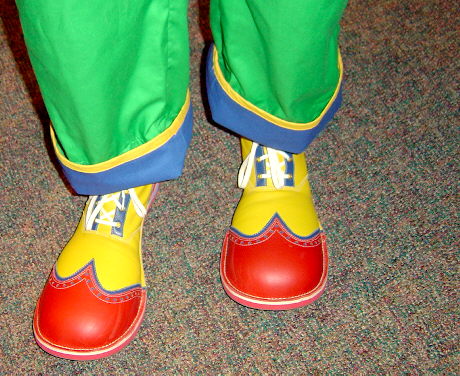
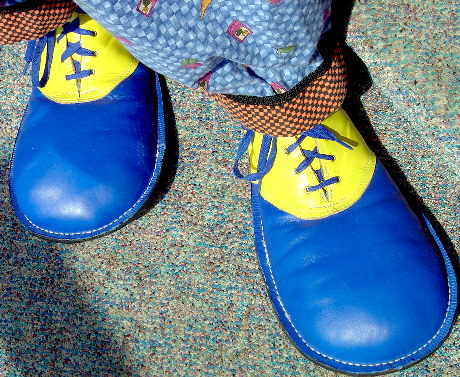
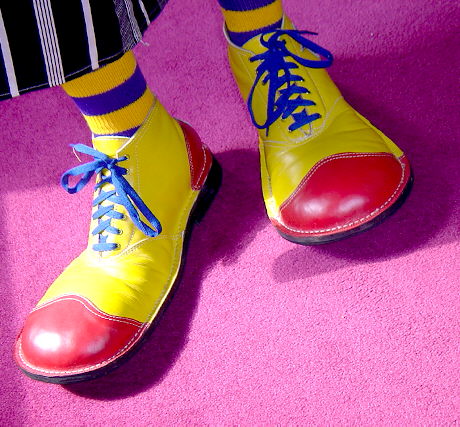
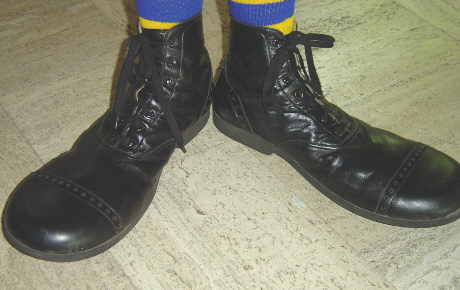
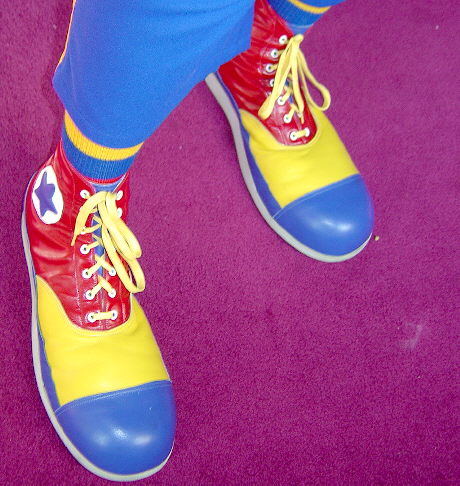
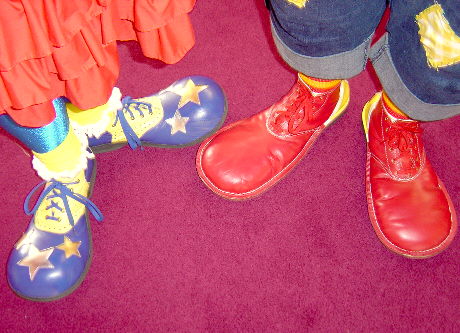
    My father likes to tell the story of how on the day I was born he went right out and bought me my first pair of big red shoes. I took my first tentative steps in those shoes.

    From the very beginning my lips were preternaturally large, and I have never required much in the way of embellishment beyond a basic application of lipstick for color and a bit of accenting around the outline. I have no memory of being outfitted with my rubber nose, but from the first time I can recall gazing at my reflection in a mirror it was a source of great pride and enduring pleasure.

    One morning in early childhood I awoke to discover that overnight my chin and jowls had acquired an application of Vaseline and coffee grounds.

    I was, I am told, an uncommonly stubborn and willful child, with a clear and unwavering self-image. I was as a result always allowed to choose my own clothing, and favored a ragged old porkpie hat, an oversized smock with red polka dots and shiny buttons, and baggy trousers covered with brightly colored patches. I was a very happy boy, and a happy clown.

    Childhood is of course an awkward and confusing time in the life of a clown. By the time I was old enough to attend school I had grown used to the charmed attention of adults. All of those I had come in contact with had seemed both amused and enchanted to find themselves in the presence of a happy little clown. I suppose in hindsight there was a good deal of condescension in this response, but I loved the attention all the same. I craved and needed attention; there was nothing I could do about it. It was hard-wired in my brain. My self-esteem was entirely dependent on entertaining people and making them laugh.

    My parents were an unfailingly compliant audience. They adored me, and I could induce heaving fits of laughter in them with little more than a wide-eyed grin or a startled spit-take at the breakfast table.To their credit they never pushed me. They didn’t have to. I was, however, an unusually sheltered child, and though I don’t believe this was ever a conscious decision on the part of my parents, I had had precious little interaction with other children by the time I started elementary school. As such I was utterly unprepared for the reactions I received from the other students. I understood neither the casual cruelty of children, nor the irrational fear that clowns seem to inspire in so many youngsters.

    There were long, unhappy stretches where I got the shit kicked out of me every day I went to school. Bullies on the playground held me down and wiped my beard of coffee grounds from my face; they stole my ragged hat, stepped on my big red shoes, and tore the shiny buttons from my polka dot shirt.

    In my teenage years I would stand alone and friendless in the darkened gymnasium at school dances. No girl would dance with me. Even balloons could not get me a date. I eventually taught myself a few simple magic tricks to try to impress my classmates, but it was too little, too late.

    In what I can now see was a desperate plea for help and attention, I fell in with a bad group of self-destructive adolescents during my junior year of high school, and was persuaded to join a heavy metal band called Lucifer’s Dong. The band was terrible, and was completely and justifiably ignored. I also realized pretty quickly that I was just a gimic the band hoped would help it to secure a certain reputation, and practices tended to be little more than a series of mean-spirited jokes at my expense.

    Even so, it was only at my parents’ insistence that I quit Lucifer’s Dong.

    I ate too much candy, gained a great deal of weight, and learned that a clown is simply not equipped to handle the brutal truth.

    By the time I dropped out of high school to join the circus my fate was sealed: I would be a sad-faced clown to the end of my days.

  • The New Mini. A Maximum Bummer.

    I have driven the new Mini Cooper. So has half the British Press (the one that matters–Jeremy Clarkson in particular–he is the "dog’s bollocks.")

    The universal rap on the new car is that it has been "Americanized." In other words, the automotive equivalent of a nice hot casserole. Its a little bigger, the dashboard is less fussy, it has a few more HP (under 10) and it is sprung a tad bit more softly.

    Pulease. I have written about this car before (see "Big–a meditation on the MIni Cooper). At that time I pondered whether this joyous little piece of sculptured iron was a "Chick Car." I came to the conclusion that if it was, I would change my sex (I already have a gender neutral name, like "Pat", a little snip and we’d be done. Like Hedwig, sorta.)

    The previous Mini was that much fun.

    This new Mini is, how shall I say, all hat and no cattle. Style without substance. It has been egregiously compromised by the Germans and I hold BMW responsible.

    Here are my road notes: The new Mini compared to gen one.

    "Interior: grown up and that’s good. Exterior: bigger, er, no, no make that bulbous (compared to the first generation.) Clutch engagement: Damp noodle (I am reminded of that oxymoronic concept called "British cuisine") Turn-in: Cool but not crisp. Handling: More distant, like an ex-girlfriend. Throttle response: Gen one: atta-boy Gen-two: La-Z-Boy
    Suspension: see "La-Z-Boy." Desire to drive like a German person: nein, nahzink, no vay (can you hear me BMW?)."

    Where the rubber meets the road: In world where a little Honda pumps out 200 HP and DODGE CALIBERS (for chrissake) 300 HP, you need peerless driving dynamics and "feel" to do better with less power. The previous Mini did just that. The current Mini does not. It will sell but its soul has been sold.

  • The TV Writers Strike: Reverb into Newsrooms?

    The average couch tuber probably isn’t tracking this TV writers strike too much. Not beyond fretting over an early end to Heroes and no new Daily Shows. Beyond that the affected "workers," a lot of smart-ass Bimmer-driving West L.A. espresso sippers, are never going to win an outpouring of empathy from the people who obsessively consume their programming.

    I’m not going to argue that this is the moral equivalent of the Harlan County coal miners, but as so many businesses, media in particular, try to find a way to monetize the Internet, this particular strike seems likely to set some important precedents for a lot of industries, possibly even newspapers.

    For a short (and funny) primer on the basics of the TV strike, check out this video posted yesterday by The Daily Show writers.

    The central claim is this: On one hand a media tycoon like Viacom’s Sumner Redstone, (Viacom owns Paramount Pictures, CBS, MTV, Blockbuster video, etc.), will sue YouTube for $1 billion based on its perceived effect — financial — to his value, while simultaneously arguing that there isn’t enough value on the Net to justify sharing …. ANYTHING … brought in via new technologies with the people who created it.

    No one knows for sure what tomorrow will bring, but the TV writers are smart enough to know that unless they nail down every possibility today they will continue seeing zip tomorrow … as billions in value pile up around the feet of the Redstones, and Rupert Murdochs of the planet.

    Ron Moore, showrunner for the series, Battlestar Galactica gave an interview offering a tangible example of how the media empires are overplaying their hand.

    He says:

    "Fundamentally this is about the internet, and this is about whether
    writers get paid for material that is made for the internet or if
    they’re paid for material that is broadcast on the internet that was
    developed for TV or movies.

    "I had a situation last year on Battlestar Galactica where we were asked by Universal to do webisodes, which at that point were very new and ‘Oooh, webisodes! What does that
    mean?’ It was all very new stuff. And it was very eye opening, because
    the studio’s position was ‘Oh, we’re not going to pay anybody to do
    this. You have to do this, because you work on the show. And we’re not
    going to pay you to write it. We’re not going to pay the director, and
    we’re not going to pay the actors.’ At which point we said ‘No thanks,
    we won’t do it.’"

    "We got in this long, protracted thing and eventually they agreed to
    pay everybody involved. But then, as we got deeper into it, they said
    ‘But we’re not going to put any credits on it. You’re not going to be
    credited for this work. And we can use it later, in any fashion that we
    want.’ At which point I said ‘Well, then we’re done and I’m not going
    to deliver the webisodes to you.’ And they came and they took them out
    of the editing room anyway — which they have every right to do. They
    own the material — But it was that experience that really showed me
    that that’s what this is all about. If there’s not an agreement with
    the studios about the internet, that specifically says ‘This is covered
    material, you have to pay us a formula – whatever that formula turns
    out to be – for use of the material and how it’s all done,’ the studios
    will simply rape and pillage."

    If you missed it, Damon Lindelhof, co-creator/writer of NBC’s Lost, wrote an Op-Ed piece in last Sunday’s New York Times, a key assertion of his was this:

    "Twenty percent of American homes now contain hard drives that store
    movies and television shows indefinitely and allows you to fast-forward
    through commercials. These devices will probably proliferate at a
    significant rate and soon, almost everyone will have them. They’ll also
    get smaller and smaller, rendering the box that holds them obsolete,
    and the rectangular screen in your living room won’t really be a
    television anymore, it’ll be a computer. And running into the back of
    that computer, the wire that delivers unto you everything you watch? It
    won’t be cable; it will be the Internet."

    He adds:

    "My show, Lost, has been streamed hundreds of millions of times
    since it was made available on ABC’s website. The downloads require
    the viewer to first watch an advertisement, from which the network
    obviously generates some income. The writers of the episodes get
    nothing. We’re also a hit on iTunes (where shows are sold for $1.99
    each). Again, we get nothing.

    If this strike lasts longer than
    three months, an entire season of television will end this December. No
    dramas. No comedies. No Daily Show. The strike will also prevent any
    pilots from being shot in the spring, so even if the strike is settled
    by then, you won’t see any new shows until the following January. As in
    2009. Both the guild and the studios we are negotiating with do agree
    on one thing: this situation would be brutal."

    With talk that a long strike, relegating viewers to 52-week runs of Dog the Bounty Hunter and Tila Tecquila (and worse) could do for internet "programming" what the 1988 writers strike did for cable programming this Los Angeles Times piece, with a quote from Twin Cities-based media guru, John Rash, lays out the consumer conundrum. In short, pulp TV junkies though we may be, most of us have been spoiled by the production values of scripted television.

    Personally, I’ve got a stack of unwatched DVDs six feet high, college basketball will soon be in high gear and I can happily spend months without a fresh episode of Two and a Half Men.

    But the somewhat out-of-left field relation to newspaper writers is not so much that Katherine Kersten deserves a cut of every dollar Avista Capital Partners might make re-packaging her "Worst of the Flying Imams" columns for dowloading, but rather the pressure to add blogging and other web-related work to the existing job description … without additional compensation.

    It goes without saying that there aren’t more than a half dozen writers at either paper with the leverage to demand more compensation for anything, even if they agreed to spit polish the publisher’s car. But the point is … the future, man.

    The Pioneer Press recently wrapped a new contract with Dean Singleton’s Media News group and Guild officer/reporter Alex Friedrich says discussions of additional duties were pretty much brushed away in the rush to conclude negotiations quickly.

    "There is no new language in the contract that forces us provide any new work for the web," says Friedrich. There was also no discussion of anyone getting paid more for blogging and taking pictures, etc.

    Friedrich says the Guild made the point that they see a need to "get this thing laid out" in the not -too distant future, but that it just didn’t happen this time around.

    "Our big thing," he says, "is what ‘What are we going to judged on?’ All of us recognize that things are changing, and I know I don’t mind taking a picture. But I want some assurance that I won’t be dinged if it takes time away from my main job."

    The bet here is that, win or lose, the TV writers will establish precedents for a lot of other "creative" industries.

  • T-Day Seven Days Out: The Bird

    The bird is the word.

    We used to go to my aunt’s house in North Oaks for Thanksgiving. I clearly remember her perched on a chair next to the oven, heater and scotch in one hand, turkey baster in the other as she dutifully doused the bird every five minutes. From that chair she barked orders to the rest of the family to execute the remainder of the meal, I was in charge of rolling butter into pretty balls. Others can mash the potatoes or slice the beets, but she couldn’t, wouldn’t leave her post or her mission, all in the name of moisture.

    A dry turkey is a sin. You don’t build an entire feast around one main protein only to realize you’ve served a chew-toy. I can’t seem to get my mother-in-law to see that you don’t need to start cooking the bird at 6am for a 4pm dinner. Gravy needn’t be the real main course, there is another way.

    In the past few years, it’s been all about the brine. Brining a turkey involves soaking the thawed bird in a salt and herb solution. The theory is that the meat absorbs the flavorful solution and the proteins, when heated, lock the moisture inside. Although it does change the texture slightly, the resulting meat is ultra-moist, even when slightly overcooked.

    Change the flavor of your brine with the addition of cider or different herbs, just don’t oversalt. The first time I made my own brine, my turkey tasted like ham. There are a ton of good brines on the market, Golden Fig’s locally made brine mix is one of the best.

    If your bird is frozen, start thawing it in the fridge on Monday. By Tuesday, you should mix your brine solution and let it sit overnight. If you don’t have a big enough pot or bucket, don’t worry, there are plenty of giant bags meant for brining. I don’t even need to say that you shouldn’t use a scented garbage bag, do I? Get the bird into the solution by Wednesday and let it soak until you get it ready for the oven.

    I guarantee that any old-timers who haven’t had a brined bird will flip over the juiciness.

    Now for the ultimate question: to baste or not to baste? I’ve never basted a brined bird, and have yet to be disappointed. I have a chef friend that laughs at the basters, swearing that they only thing you have to do is slow-roast the bird at a low temp wrapped in parchment paper and foil, followed with a turn under high heat to add the crispiness.

    I’m sure I could have explained this all in detail to my aunt, but I fear not even a lecture from the turkey himself could have moved her from her perch.

  • Up North

    The Minnesota heat waves had passed in September when, visiting her
    sister, Anna Lefebvre, in Minneapolis Theresa Gumbleton and her
    sidekick, the shaded Sheila Sheils from Derry and Carndonagh, Ireland
    took a few days Up North lake lounging on Lower South Long Lake.

    Theresa Gumbleton and Sheila Sheils, Lower South Long Lake
    Red Handed

  • India

    Reading The Rake in a hand-pulled rickshaw is not recommended for a weak stomach. Tim Leone-Getten and Leslie Olmen visited Calcutta, India with other area teachers on a South Asia teacher exchange program with Hamline University and Relief International.

    Tim Leone-Getten and Leslie Olmen, Calcutta
    Red Handed

  • Food Police to the World

    Jim Harkness never expected to return to Minnesota. A native of South Minneapolis who studied Chinese in high school, he started his career as an activist specializing in Asian birds, then giant pandas. His work took him to China often, and eventually he became a full-time resident of Beijing, working first with the Ford Foundation, then serving as executive director of World Wildlife Fund China.

    But in 2005, when he heard the Institute for Agriculture and Trade Policy (IATP)—a Minneapolis-based nonprofit that promotes sustainable farming and ecosystems—was searching for a new president, Harkness picked up and moved back home.

    “When I was first told about IATP, I’ll admit, it sounded removed from my lofty ideals,” Harkness says. “But when I saw what this organization does, looking at issues that affect everyone in this world, I realized that food is a very powerful force.”

    IATP was born out of the farm movement in the 1980s that opposed global trade and supported a traditional model for rural family farms. Today, the organization is still fighting the North American Free Trade Agreement and the World Trade Organization, on the premise that both promote nonsustainable, commercial farming that harms both the environment and public health.

    Also among the major issues IATP addresses are the federal subsidies that favor commodity crops such as corn, soybeans, and wheat—as well as the corporate farm entities that produce them—over smaller, independently owned operations that produce a diverse range of foods. The result, according to Harkness, is that roughly eighty-five percent of arable land in the Midwest’s “Farm Belt” is devoted to soybeans and corn. This in turn leads to an economy where other foods must be shipped in from around the country and overseas—making them both ecologically damaging and expensive—while processed products, made with soy byproducts and corn syrup, are plentiful and cheap.

    “Over a fifteen-year period, from about 1985 to 2000, the cost of fresh produce went up thirty-five percent, whereas the price of ground beef and Coca-Cola, in real terms, went down about an equivalent amount,” Harkness says. “That’s because feedlots and the soft-drink industry suddenly had all this very cheap raw material at their disposal, which they would not have had without massive government intervention. And if you look at the onset of America’s obesity crisis, it coincides almost exactly with these changes in policies.”

    According to Food Without Thought, IATP’s 2006 report, childhood obesity skyrocketed between 1970 and 2000—at the same time as spending on processed food climbed to forty percent of the average American’s grocery bill, while produce dropped to claim less than nine percent. Perhaps most alarming: The consumption of high-fructose corn syrup rose one-thousand percent. A cheap, shelf-stable sweetener found in soft drinks and most processed foods, corn syrup provides no nutrients and very little usable energy, but must be processed entirely by the liver, like a toxin. So concurrent with the rise in obesity has been a surge in cases of type 2 diabetes.

    Harkness and IATP are waging battles on many different fronts. The key is for the tiny agency to operate on whatever level is appropriate to the issue at hand, explains Harkness. A major initiative is to lobby for changes in the federal price support system of payments to farmers, so most of IATP’s energy is devoted to rewriting the byzantine national farm bill and swaying national lawmakers. (Part of this involves countering messages from large-scale agribusinesses such as Cargill and General Mills, which is one reason IATP is based in Minnesota.) One goal is to develop language around a “common farmer/public health policy platform” for the next farm bill, developing policies that are good for both producers and consumers.

    But Harkness and his staff also work locally—in North Minneapolis, for instance—to establish farmer’s markets in urban neighborhoods and encourage low-income residents to buy fresh food. Regionally, their top concern right now is the growing enthusiasm for farms that will produce corn exclusively for ethanol. And Internationally, they’re focused on exposing how the World Trade Organization’s policies shape our communities and our lives. IATP’s promotion of fair trade practices has even led to a for-profit company of its own: Peace Coffee is perhaps its best-known success.

    “I took this job because for most of my life, I’ve been concerned with social justice and the sustainability of our planet,” Harkness says. “And I keep working toward those goals using all sorts of different means, whether it’s talking about conserving pandas or giving people decent, affordable food to eat.”

  • Be Kind: Go To Rewind

    Um, I hardly ever do this. But since I missed the big
    opening of the Gucci boutique at Nordstrom MOA last week, I figure I’d better slobber over some other local shop or other. Now, I assume that some of you, like me,
    are decidedly lacking in coin these days, and therefore cannot rationalize the
    purchase of a new GG bag. So, I’ve decided to take you to a shop that won’t
    unravel the billfold …

    Rewind is a vintage store on Johnson Street in Northeast
    Minneapolis
    . Of course, this corner of the world is particularly tough to get
    to now that the 35W bridge is gone, especially if you’re coming from the
    Southside. But it’s worth the trek. I stopped in Tuesday night, and the first
    thing I spotted once inside: A slice of Uptown history.


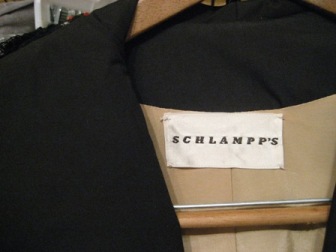
    Schlampp’s Furs was a high-buck store in the Uptown Area
    that closed in, oh, I think it was sometime in the ’70s. (I don’t have my
    Uptown History book with me at the office today, but I’m pretty sure that’s
    where I acquired this hazy factoid). Now, here’s the cool thing: At stores vintage
    and consignment stores all over town, you will occasionally spot a beautiful 40s, 50s, or 60s-era Schlampp’s store-brand coat—and no, they’re not all fur. But they are extremely
    well-made. Last year, I picked up a 60s-era slate-blue wool one with big buttons and a
    flattering sash along the waistline. (But that wasn’t at Rewind. It was at
    Everyday People.) This one I’d like to buy for my mother.

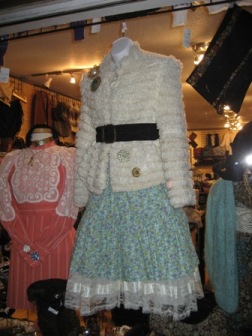
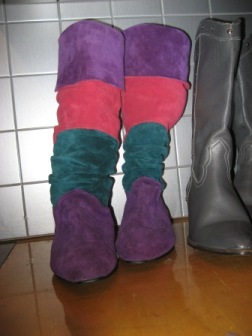
    Note that Rewind favors looks from the 70s and 80s. For
    example, these killer boats …

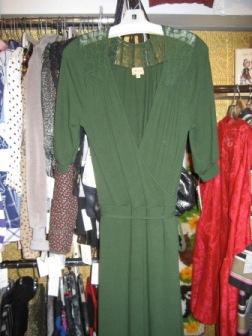
    This knit Ella Moss dress I’d like to buy but, sadly, I
    implemented a Christmas gifts-only policy as of the first paycheck of November. Here’s a question, while I’m at it: Is it tacky to buy presents second-hand? I
    think not.

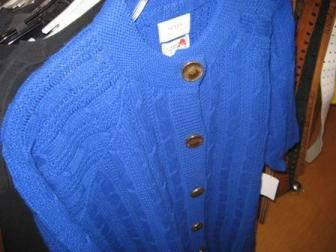
    Love this season’s over-sized sweaters, but choke every time
    you spy the associated price tags? Here’s a lovely vintage version, from Sears

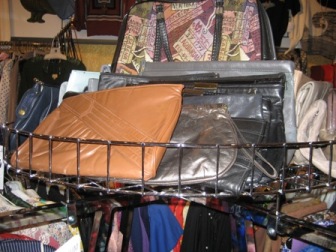
    Finally, check the selection of clutches. We love clutches
    and, yes, sadly, that has much to do with packing these teensy purses into the
    ginormous, back-breaking sacks we all lug around these days.