Year: 2007

  • Worship David Beckham for 200 Bucks

    I’ve been puzzling all morning over the logistics of this thing, but I think I’ve finally got it figured out.

    Seems David Beckham is coming to town with his soccer team, the Los Angeles Galaxy to play OUR soccer team, the Minnesota Thunder (what is it with soccer, by the way, aren’t team names are usually plural: Bears, Bulls, Timberwolves?) in something they have dubbed Copa Minnesota — which I frankly don’t get at all — tomorrow at the Metrodome.

    My initial confusion came in because the website devoted to this event lists it under Current News and claims it’s happening. . . .or rather happened. . . .on October 10. But apparently it didn’t, David had some reality TV-related or Spice Girlesque emergency. Some problem occurred, in any case, and the game was postponed.

    Further obfuscating my understanding was this quote from the Galaxy manager, Alexi Lalas: “We are pleased to be able to bring the Galaxy to
    Minnesota and give fans of that state and the entire Midwest a first
    class friendly." I’m not sure what a friendly is or what it has to do with soccer, but as I said, I’m not a sports fan.

    For those of you who are, Temple Restaurant and Bar is hosting a private reception tonight, from 6-9 p.m., in honor of Beckham and his teammates, with hors d’oeuvres and a complimentary host bar. And I think that’s just about as friendly as you get, because don’t we usually revile the incoming team and boo the players and make all their fans sit on the opposite side of the stadium (or have I just been to one too many St. Louis Park – Edina high school football games?) rather than fete them with spicy tuna rolls and Grey Goose?

    Anyway, the good news is that for $200 you can enter the Temple and brush shoulders with Beckham himself — or so I’m told — eating what’s bound to be excellent appetizer fare, and giving the soccer king whatever sort of friendly you like. No word on whether Victoria will be there.

    Temple will re-open for regular business at 9 o’clock tonight. For more information, call 612-767-3770.

  • The (Perhaps Deservedly) Lost Recordings Of Burt Sikorski, DBA The Burt Sugar Trio

    Every town and city has its share of genuine characters and eccentrics, but I think you could say that it’s somewhat easier to get a real feel for the personalities of such characters in a smaller town, where there are so few public secrets and mysteries, and where what might be mere sidewalk spectacle in a big city is often fleshed out with well-known family histories and personal anecdotes from actual encounters and conversations.

    True oddballs also seem to appear in even starker relief when looked at against the largely homogenized backdrop of an average midwestern small town.

    In my own hometown, a place of almost abject modesty and blandness tossed up in the middle of flat farm country, there were a number of such characters –flamboyants and dandies, for the most part, colorful fellows whom I now suppose were probably homosexuals– but the one who made the biggest impression on my adolescent self was a guy by the name of Adelburt "Burt" Sikorski.

    Burt was perhaps a dozen years my senior, and by the time I was really aware of him he was a rumpled, shaggy character who always wore bright polyester pants and what I now recognize were ironic tee-shirts (featuring musical acts like Rick Wakeman or Styx, or phrases along the lines of "Up Your Nose With A Rubber Hose," "Kiss My Grits," and "Keep On Truckin’"). He was also one of those muttering guys who was constantly walking all over town, and I guess in retrospect he was sort of the local one-man counter culture.

    You’d occasionally see him downtown, standing on a corner across the street from the courthouse and waving a sign that said something like "Don’t Rush Me Out!" or "Stop It!" He was also, so far as I know, the town’s only street musician, and he’d often play his guitar outside the Sterling Drug Store. I remember one time a friend and I rode our bikes over to the store to buy some candy –we were probably 12 years old– and Burt was out front with his guitar and said to us, "Hey, little dudes, want to hear something by your main man John Denver?" Which, even then, we thought was funny. I also recall him playing a manic version of "Tie a Yellow Ribbon Round the Old Oak Tree," which was at the time in heavy rotation on the local AM radio station.

    The town’s only movie theater was a single-screen affair that mostly showed family films, and it seemed like Burt Sikorski would be there every Saturday afternoon, sitting by himself in the back row, heckling and lobbing Sno Caps at the screen. One time I was with my parents and my little sister, and we were watching some Disney comedy –"Son of Flubber," or something like that– and Burt kept shouting out stuff like, "Fred MacMurray’s an adulterer! He’s a sociopath! The man’s a stone-cold killer!" until some of the grown-ups complained to the manager and Burt was asked to leave.

    By the time I was a teenager Burt Sikorski was regularly engaging my friends and me in conversation on the sidewalks around town. We were always "the little dudes," and Burt was always after us to join his band. His old man, Adolph Sikorski, had a meat market on the east side of town, and there was an abandoned smoke house out back that was Burt’s purported "practice space." Sometimes we’d ride our bikes by there and we could hear him pounding away on drums or creating distortion on an electric guitar.

    I knew a few guys who eventually got roped into jamming with Burt, and they all said he was crazy.

    When I was a junior in high school Burt opened, for a very short time, the town’s first and only head shop, The Soviet Revolution, and once when I went in there to poke around with a couple buddies Burt gave us a cassette tape of his band (which, of course, we all knew wasn’t a real band; to the best of my knowledge they never played a single public show in that town, or anywhere else).

    "What’s the band called?" we asked.

    "It used to be called Burton Veal and the Dead Baby Cows," he told us, "but that proved too provocative for local mores, so I’ve settled on the less threatening but classy Burt Sugar Trio." We spent a lot of time driving around in the country outside town getting high and listening to the Burt Sugar Trio, and I have very fond memories of that time in my life.

    After I graduated from high school, though, I moved to the Twin Cities, and I’d been living there for almost a decade when my mother called me one night and told me in passing that Burt Sikorski was dead. He’d died, she said, from an allergic reaction.

    "To what?" I asked.

    "I have no idea," she said. "The obituary didn’t specify."

    My father, who was on the other line, said, "My best guess would be life."

    "Burt had grown very fat in recent years," my mother said, "and he always seemed so depressed. Last time I saw him he was working at his father’s market."

    My parents are preparing for a move to Arizona, and I recently went down there to help them clear out the house. As I dug through the boxes in my old bedroom I was surprised to find my original tape of the Burt Sugar Trio. I listened to it on my drive back up to Minneapolis and it sort of broke my heart.

    Listen to a sampling by clicking the audio links in the left column (go to permalink).

  • Tripping the Road Fantastic

    Soon you may be heading off on a thanksgiving vacation. The trip may be short or it may be long. Unless your relations live next door, however, you will have to make that journey in an automobile. These days that will likely mean a minivan or small European "touring wagon" (which Chrysler attempted to call its Pacifica with no luck).

    Alas, I can remember a time when my family made the journey in something closer to a submarine replete with paisley patterned vinyl seats. It was a bright yellow Pontiac Safari wagon. I truly believe it was the closest my parents ever came to experiencing the 60s. Yet for me those Thanksgiving rides always seemed like some kind of trip.

    The Pontiac Safari

    For starters, the Pontiac Safari (and its GM cousins) was the largest station wagon ever built. I found a reference that confirms this:

    "Most of the truly huge station wagons seem to have
    been built before 1982 ( in fact up until 1978). The station wagons with the greatest interior volume
    (passenger volume plus cargo volume) would seem to be the 1971-1976 full-size GM
    wagons with approximately 184 cubic feet of volume. Other leading wagons are the
    1974-1977 Chrysler Town and Country and Dodge Polara/Monaco (177 cubic feet), and the 1969-1978 full-size Ford and Mercury station wagons (169 cubic feet).

    Yet the preponderance of information suggests that the largest
    station wagons of all time were the 1971-1976 Buick Estate, Oldsmobile Custom
    Cruiser , and Pontiac Safari."

    Now I realize my timing is a little off. We owned a 1971 Pontiac Safari which would have placed my family trips safely out of the 60s. Still there was something about this wagon that made me lose my head.

    Was it all that space?

    Was it my sister spitting blue meanies (she kept blue scratch paper that she would chew up into little gross little projectiles) or scratching my forearms (still have scars) with her face flushed as red as Enzo at the racetrack?

    Or was it a little voice inside of me that said, "Someday Chris you will design things for a living. So know right now that these seats belong in a bathroom or a really ugly house. And cars, little boy, are never supposed to be yellow."

    That must have been it. Car seats were just NOT supposed to match the formica on the kitchen counter. And my sister be dammed.

  • Case of the Missing Partygoers

    Hate to say it, but last night’s RetroRama was sort of a disappointment. Not only was there little to no cleavage, but there were also little to no people. Where were you, folks? (You were at the 10,000 Arts party, from what I hear.) Of course, the first RetroRama, in April, was such a raging success that perhaps our expectations were a wee unrealistic. And something else must be said: We have sciatica, which means we’re not having much fun right now. Still, it didn’t get past us that the MNHS folks went all out in
    preparation for last night. Once again, they erected a fabulous vintage
    clothing and accessories boutique with the help of folks from Succotash and Up
    Six
    . There was also an on-site pulp bookstore courtesy of Midway Books – very handy! Booze and snack
    foods were readily available. There were even cigarette girls wandering the
    joint, although they only had the candy versions. Some impressive costumes
    turned out, too. Exhibit A:


    (Above) She certainly cultivated an air of menace, no? But then
    again, she co-owns Go Vintage (on Selby
    Avenue
    in St.
    Paul
    ) so she had something of a competitive advantage.

    Now, as for these next ladies: I followed them in through the front door. They
    didn’t exactly look as though torn from the cover of a pulp paperback, but I sure
    did enjoy their hats.


    (Below) I mentioned this guy in the Rakish Angle I wrote for the
    November issue. His name is Matt Schmidt; and he’s absolutely everywhere,
    always surrounded by beautiful women. His gangsta-style zipper hat was
    something to behold. Also, his date was rockin the femme fatale look, don’t ya
    think?


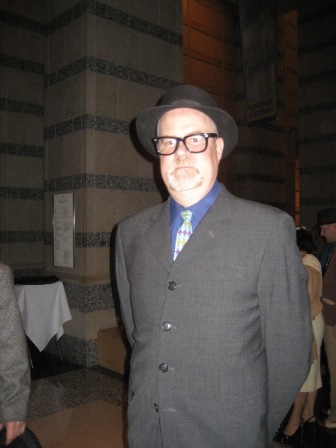
    And finally: As it happened, one of the few noteworthy men’s get-ups
    belonged to Dan Spock,
    Director of the History Center Museum.
    Please note: My Elph didn’t perform so well in the ambient light.


  • Food and Sex. . . Hungry?

    There’s nothing new about the link between great food and sultry sex. It’s been around since the era of the ancient Romans, then flagged during repressive periods such as the Dark Ages and the 1950’s, but went through a glorious renaissance right around the time I was born.

    Gael Greene, an outrageous and perversely reed-thin journalist began writing about food for New York Magazine in 1968 and subsequently launched the so-called "forkplay" genre. Her novel Blue Skies, No Candy, was like Erica Jong meets Julia Child — one big orgy, slippery with sauces and peaks of whipped cream. Body secretions and wine; kissing, tasting, and swallowing. Sating every hunger, those located in one’s stomach and those located between the legs.

    Now in her late 60’s, Greene is still writing. Last year, her memoir Insatiable came out, in which she detailed (and I do mean detailed) her sexual encounters with Elvis Presley, Clint Eastwood, the chef at Le Cirque in 1977, and a porn star named Jamie Gillis. In an endearingly sharp turn from haute cuisine and personal erotica, Greene also founded Citymeals-on-Wheels, a charity organization that
    delivers more than two million free meals a year to New York City’s elderly
    shut-ins.

    Now, I’m no Gael Greene (for which my husband is thankful). But I recently wrote a novel about the life of an "accidental" food critic, sent it off to my agent, and received his feedback this week. Great sex, he said. I want more. The food’s important but that can slip into the background. All that hot, post-dinner lovemaking, that’s what we want. White Bordeaux, the sticky steaming meat of braised artichoke hearts, sandwiches of salty little capers with smoked salmon and lemon mayonnaise. Then to bed: taut naked skin, slick contact, whispered words and hard effort, the scents of garlic, wine, and dark chocolate still wafting through the room.

    I’m working on all that.

    Meantime, right here in Minneapolis, there’s a new generation of Greene-style food writers, including Alexis McKinnis who writes a sex column for vita.mn and an about-town foodie blog called Girl Friday. She’s been featured on Kare 11 and elsewhere, but the focus has been entirely — or so it’s seemed to me — on the salacious aspects of her life. And she’s been portrayed as some brand-new species of food writer, rather than someone who’s following in the tradition (fairly well, I might add — McKinnis’s blog is always current and well-written) of food-and-sex journalists from nearly 40 years ago.

    Others are simply trashy, a mess of string bikini odes, scatalogical tales, and gluttony. What Greene understood, and I think McKinnis does, too, is that there’s a delicate balance between sex and food. You have to deliver a vicarious thrill, then back off and leave just a touch to the reader’s imagination. . . .or experience.


  • Dogs, Monkeys, Pups, Ghosts, and Fire

    ART

    Alec Soth: Dog Days, Bogotá

    One of these photos—a scruffy dog isolated in the center of
    the frame—appeared in passing on a web page and immediately snagged my
    eye. There was no attribution provided but I thought, that’s got to be Soth. And
    it was. Why was this goofy, tragic dog as good as a signature? For a
    young guy, Soth seems to have an old guy’s emotional chops—and not just
    any old guy. If you want to see Lear as a dog, or Cordelia as a ghetto
    kid, then go see this show. You’ll be so happy you’ll cry your eyes out
    and go home confused—the best possible outcome for an art show. Ann Klefstad

    Opening reception Friday from 6 to 8:30 p.m., Weinstein Gallery, 908 W. 46th St., Minneapolis; 612-822-1722.

    WINE & DINE
    Wild about Wine

    Sun bears and chardonnay, monkeys and merlot; join us for a wine
    tasting that is wild, exotic, and tropical! This second annual tasting
    will take place along the Minnesota Zoo’s Tropics Trail featuring a
    variety of wines. Proceeds benefit Minnesota Zoo conservation programs.

    Saturday from 5:30 to 8:30 p.m., Minnesota Zoo, 13000 Zoo Blvd., Apple Valley; 952-431-9200; $50.

    MUSIC
    Meat Puppets

    The supposedly big news is that Cris Kirkwood
    is back from drug addiction and a stint in jail. But the exciting part
    is that older bro Curt Kirkwood—the alpha talent responsible for both
    the blistering, psychedelic guitar explosions and the sardonic,
    semi-sage lyrics thatare the Pups’ signature one-two punch—has responded to the sibling reunion by spooling forth Rise to Your Knees. While perhaps not as crystalline or cow-punked as vintage classics like Meat Puppets II from
    the ’80s, it’s a strong Meat Puppets collection from the same lineage,
    which augurs well for the trio (a new drummer is on board) as they prove
    that contemporaries of The Replacements and The Minutemen can still raise and daze a ruckus in 2007. Britt Robson

    Saturday at 8 p.m., Varsity Theater, 1308 Fourth St. SE, Minneapolis; 612-604-0222; $15.

    Ghostface Killah/Rakim/Brother Ali

    This is the most informative seminar on hip-hop microphone skills the Twin Cities will likely ever experience. While Biggie Smalls, Jay-Z, and KRS-One would all get some votes, Rakim is
    rightfully regarded as the greatest MC who ever drew breath, duemostly
    to his quicksilver-smooth flow and pioneering, now
    pervasively influential, rhyme schemes. The Wu-Tanger Ghostface Killah is
    a gloriously idiosyncratic word-slinger who has dropped as
    many five-star discs as Jay-Z over the past decade, without Jigga’s
    boorish materialism. And Brother Ali has pulled slightly ahead of Atmosphere’s Slug
    in their thrilling competition for best local rhyme slayer. Speaking of
    competition, we suspect that none of these three will be slacking when
    the potential for embarrassment by comparison is so high and nigh. —Britt Robson

    Sunday at 8 p.m., First Avenue, 701 First Ave. N., Minneapolis, 612-338-8388; $30.

    THEATER & PERFORMANCE
    Shining City

    Along with Sarah Ruhl (see here), Minneapolis is also conducting a love affair with Irish playwrights. There was Martin McDonagh’s The Pillowman at Frank Theatre in September and Brian Friel’s tragic The Home Place, currently on stage at the Guthrie; now the Jungle Theater adds to the bleak themes put forth by Irishmen with Conor McPherson’s Shining City. Billed as a “ghost story for the holidays,” it’s certainly no Christmas Carol. John
    is a widower who seeks therapy when he starts seeing his wife’s ghost
    everywhere. But his own past, and that of his troubled therapist, prove
    to be more haunting. Uplifting? Maybe not. But arresting? Probably so.
    What’s more, the play is directed by local favorite Joel Sass, who also
    quietly assumed the title of associate artistic director at the Jungle
    this past year. Rumor has it he’s being groomed to succeed founding
    artistic director Bain Boehlke. Danielle Kurtzleben, photo by Ann Marsden

    Friday & Saturday at 8 p.m., Sunday at 2 p.m., Jungle Theater, 2951 Lyndale Ave. S., Minneapolis; 612-822-7063; $36,$28.

    FILM
    Lake of Fire

    Seventeen years in the making, Lake of Fire, the epic abortion documentary by Tony Kaye (best known for American History X), has
    finally arrived. Mercifully shot in silvery 35mm black and white (thus
    making its horribly graphic imagery that much less disturbing), Lake of Firees chews
    narration to rely on 152 minutes of talking heads, protests, and, of
    course, actual abortions. Kaye has been unflagging in his insistence
    that the film does not fall on either side of the debate, and that he
    seeks only to give us images and information necessary to help the
    viewer see both sides of the issue. Oddly enough, the film doesn’t move
    entirely into the present day—some viewers have already complained that
    the movie barely addresses RU-486 (the abortion pill) which has radically changed the face of the debate. Peter Schilling

    Opens Friday at 7:30 p.m., Saturday & Sunday 4:30 & 7:30 p.m., Bell Auditorium, 10 Church St. S.E., Minneapolis; 612-627-4430.

  • Diabulimia: Delicious but Deadly

    Imagine you have a medical condition that causes you to lose weight.
    And miraculously, the more you eat, the more you lose. Pastry for
    breakfast, pasta with clam sauce for lunch, a five-course dinner with
    crusty bread and any dessert you like, plus snacks in between — the
    sweeter the better. Follow this diet
    and you can drop five pounds by tomorrow morning, shrink a dress size
    for the weekend, show up at your high school reunion enviably trim.

    There are a few downsides: Your hair will fall out, you’ll be tired
    all the time, your mind will be muddled, and your extremities might
    tingle strangely. Over time, you’ll likely go blind, lose a limb, end
    up on dialysis, or suffer a sudden heart attack. But in the meantime,
    you’d be able to eat anything you want and wear a size two.

    Thousands of the approximately one million people with Type 1 (or juvenile-onset) diabetes are willing to take the risk. Mostly teenagers and young women, they suffer from a unique eating disorder called diabulimia.

    These are girls growing up in the same diet-obsessed America as
    everyone else. They might begin childhood average size, or even a
    little fleshy. Then, inexplicably, they begin to lose weight no matter
    how much they eat. The other symptoms of illness — excessive thirst
    and fatigue — are far less compelling than the ability to eat an
    entire bag of chips without getting fat. But eventually, someone else
    catches on, a parent or a doctor, and they’re diagnosed with diabetes:
    taught to read food labels as carefully as a scientist; warned to
    restrict their caloric intake religiously; and put on a medication
    called insulin that perversely, literally overnight, causes them to
    plump up like a water-soaked sponge.

    Further, they must go through life focused, constantly, on food —
    but only its chemical elements, never its comfort or taste. And the
    cure is hardly attractive: They will gain weight, even eating as
    ascetically as monks. The untreated disease, however, with its wasting
    syndrome? Now that has its appeal.

    Katie, a young woman from suburban Minnesota, was a competitive
    gymnast on a team that was Olympics-bound several years ago. At
    4-foot-10, she weighed about 60 pounds; she collapsed often, but at the
    end of every practice, her coach would stand her in front of the other
    girls. This, he told them, was how a gymnast ought to look.

    One day, Katie’s mother took her to the team doctor, not because of
    her low weight or bouts of fainting, but because the team was going to
    California for a meet and Katie was afraid to fly. They needed
    sedatives. Katie’s regular physician, a man who’d been ignoring her
    appearance and (it would later emerge) blood tests, in order to help
    keep her ultra-slim, happened to be away on an emergency. The doctor
    who was filling in took one look at the emaciated girl and ordered a
    series of tests, then ordered an ambulance. Katie’s blood sugar levels
    were the highest he had ever seen and she was on the brink of
    ketoacidosis, a combination of high blood sugar and dehydration so
    severe it causes a toxic buildup, deteriorates fat and muscle tissue,
    and can cause coma or, if untreated, death.

    In the hospital, endocrinologists diagnosed severe diabetes, got
    Katie’s glucose (blood sugar) levels under control, and taught her how
    to test her blood and give herself insulin injections. She left
    mid-summer weighing 40 pounds more than when she’d gone in — a sturdy,
    round-cheeked girl.

    The response was horror: from her coach, who banished her from the
    team, and from her parents, who had dreamed for years of sending their
    daughter to the Olympics. Her peers weren’t horrified; they were
    amused. People whispered when Katie walked down the halls at school and
    taunted her constantly about how fat she’d become.

    At first, Katie didn’t make the connection between insulin and her
    weight. She tried dieting and wound up going into insulin shock
    (potentially fatal hypoglycemia, or low blood sugar) twice. But it
    wasn’t until college — after she’d begun eating pizza and drinking
    beer and bulked up even more — that Katie realized she was doing
    things backward. Rather than take her insulin and cut down on her food
    intake, she had to do just the opposite if she wanted to lose weight.

    "I remembered back to the time that I was admitted to the hospital
    and how skinny I was," she says. "So I started skipping my shots."
    Also, she ate only refined carbs and sugars: bread, brownies,
    cookies, candy. The opposite of Atkins, this was a diet devoid of
    protein and most nutrients, but it ensured she would absorb no
    calories. No matter how many Dove Bars, croissants and bags of
    M&M’s she consumed, the weight fell off.

    The "magic" Katie had discovered actually was the most dangerous
    component of her disease. Insulin, a hormone produced by the healthy
    pancreas, breaks down sugars and carbohydrates and helps store their
    component molecules — and calories — in the body’s cells. With Type 1
    diabetes, the pancreas produces little or no insulin, so all the sugars
    and simple carbs a juvenile diabetic consumes are "wasted," flushed
    through the body without being stored. It all gets urinated out.

  • The Waste Land

    No Country for Old Men opens with a series of shots of a dry, desolate Texas, a place that seems unkind to both man and beast. Sheriff Bell (Tommy Lee Jones) begins to speak in voice-over, ruminating on his life, on his being a sheriff, admiring the men who served before him, and lamenting the way that crime has spun out of control these days.

    His words come straight from Cormac McCarthy’s source novel, but if the scene looks familiar, it’s because the Coen Brothers have used it before. Shot by shot, this scene is cribbed from their debut picture Blood Simple. There, the sleazy detective, played by the great character actor M. Emmett Walsh, delivered lines that were so much more potent that McCarthy’s overwrought sermon. Walsh muses on the Russians, and how Communists are theoretically supposed to help each other out in life. Not in his backyard. "What I know is Texas," he says. "And down here… you’re on your own."

    The Coens have been known for borrowing from other movies, which is no crime except in the fact that, as I pointed out in November’s Rake, it seems as though they’re more concerned with winking at their sly references than actually developing character or building tight plots. Oddly enough, No Country continues that trend, except that the Coens have taken to devouring their own tails: this movie references their own films repeatedly, with shots that mimic Blood Simple, Raising Arizona, Miller’s Crossing and Fargo. Once again, with No Country for Old Men, they’ve made a slick, entertaining film utterly devoid of emotional resonance and meaning. It’s as empty as a toy gun.

    By now, we all know the story: Llewelyn Moss (Josh Brolin) is out antelope hunting in the Texas plains when he comes across a drug deal gone bad. A number of dead bodies are rotting in the sun, inexplicably left untouched by the desert animals (this is noted later and then casually dismissed in that "coyotes don’t eat Mexicans".) Moss discovers a truck bed full of bags of some illicit drugs, investigates further and finds a satchel containing two million dollars. Of course, people will be after that two million bucks, including Anton Chigurh (Javier Bardem.)

    We’ve been introduced to Chigurh earlier–he was arrested and then strangled a sheriff’s deputy with a pair of handcuffs. This maniac wanders around Texas with a slaughterhouse stun gun, murdering or toying with the ever-polite townsfolk of rural Texas, caricatures that have stepped right off the set of Fargo. Chigurh is not a real human being, but a force of nature. He is hired to go after the money, but for whatever reason doesn’t really seem to care about the money. In fact, he kills the men who hired him, has no regard for the police who pursue him, and basically wrecks everything in his path. He goes after bumpkins at truck stops, old chicken farmers, blows up automobiles, shoots up small towns, walks into high-rises to blast businessmen, kills other hit men, hotel desk clerks, you name it. No one can stop the man. If he is a man.

    Tommy Lee Jones’ Sheriff Bell serves as our moral guide, and is the utterly ineffective arm of the law who is chasing Moss in the hopes of saving him from Chigurh. In the course of the film, he will ruminate at length about the decline of Western Civilization, usually over a cup of coffee. He will do little else.

    Ah, but there’s more–the men who were involved in the drug deal, a number of faceless Mexicans who are easily dispatched and their white counterparts. The Mexicans don’t talk, don’t get any screen time except to die easily, while the white guys are given time to wonder about the phenomenon that is Anton Chigurh. One of these is the bounty hunter Carson Wells, who compares Chigurh to the bubonic plague. Hint, hint, our killing machine is a random act of the God of the Old Testament, just like plague, just like floods, just like locusts. In case you didn’t get it, the lesson will be repeated throughout.

    No Country for Old Men is exciting in much the same way as John Carpenter’s original Halloween, except that it’s long, talky, and its characters nothing more than props on which Cormac McCarthy can drape his endless moralizing. Tommy Lee Jones, looking wearied from the lawlessness and chaos spinning out of his control, gives us one of his few weak performances. There is little reason for his inability to deal with the changing society–if it is changing (one fellow officer blames their woes on piercings and tattoos, as if that’s what’s prompted Chigurh to roam about blasting people.) Jones had a similar role, that he bit into with relish, in the superior In the Valley of Elah. There he was a vet who saw the same thing: values challenged in a modern society that seems in a state of flux. Here he stares and speaks, a man without urgency, who seems more interested in sipping coffee and figuring out what the killings mean than actually solving anything.

    This is clearly the Coens most "serious" film. And yet, it is full of references to their other movies, ones that didn’t think quite as highly of themselves, and at times it’s hard not to laugh at the similarities. Like when Llewelyn hurls his bag of money over the fence at the U.S.-Mexican border and into the reeds, hoping it will suffice as a hiding spot. This is right out of Fargo, when Steve Buscemi digs a hole in the snow with an ice scraper, hoping to hide his loot. Or Chigurh slowing down in his car, leaning over with his gun and shooting at a hawk, just to indicate what a bad-ass he is. Shot by shot it’s the same as the one in Raising Arizona, when Randall "Tex" Cobb, the demon motorcyclist, blows rabbits away from his motorcycle while Nick Cage narrates, "He was especially cruel to little things," a line that would be a good fit here.

    As usual in a Coen film, the "small" people in No Country for Old Men are dolts with goofy accents, people who wouldn’t give second thought to giving a man a smile and directions into town even if he were holding a bloody axe and covered in chunks of flesh. The Coens seem unwilling to trust their actors to bring more to their small roles than the lines they read–great films allow the small parts to shine, to enrich the overall plot. Here, they’re dead, empty. And Kelly McDonald, playing Llewelyn’s wife Carla Jean, is simply awful, with a grating accent to match her mother’s. Javier Bardem is very good, with what he has to work with. His Anton Chigurh is chilling. But more so than any other horror villain? Bardem seems to have taken a cue from Sir Anthony Hopkins–this’ll probably win him his Oscar.

    There are moments of genuine suspense here, and the Coens are crack filmmakers when it comes to shooting scenes of chase and gunplay. They have an eye for detail that remains impressive, like sweating milk bottles, scuff marks on a tile floor (from the strangling of the first sheriff’s deputy), dust swirling through the light of a hole where a lock used to be as Chigurh waits for another victim.

    If only they would devote as much attention to their characters and their plots. What are the motivations of these people? Llewelyn takes the money, but never talks about what it would mean to him. Chigurh never addresses why he’s intent on killing people, any people. At times the gunplay gets so out of hand you wonder where all
    the rest of the world has gone–how the hell do you shoot up a Main Street in a small town and not have the cops arrive or other folks darting about for their lives?

    Worst of all, the fate of Llewelyn Moss indicates a cavalier or contemptuous attitude from both Cormac McCarthy and the Coens. The climax of this film happens offscreen, merely an afterthought, to allow the Meaning of the Story to be hammered into our brains, just in case we didn’t get it in the first two hours. All Moss’ work, all his pain and suffering, all the multitude of death that he’s seen, merely drifts away so that Sheriff Bell can drink coffee and philosophize in not one but two lengthy scenes. Imagine this in, say, A Nightmare on Elm Street, or Halloween–law enforcement officers stopping from chasing these teen-killers to stop at a diner to mutter things like "the crime you see now, it’s hard to even take its measure." Well, it’s hard to take its measure because it’s not real. Chigurh isn’t any more a reflection of the modern criminal than Freddie or Mike Myers. But that this ostensibly probing dialogue comes at the expense of understanding Moss’ plight is a disgrace.

    The act is getting old. No Country for Old Men was no great shakes of a novel, and now it is an overpraised thriller, impressed with itself, all technique and no heart. I’ll take Blood Simple, as it was brief and funny in spots, or, even better, cheap 70s fare like Charley Varrick or the great modern noir One False Move, both heartfelt, moving thrillers. I want to see movies about people. No Country for Old Men is a story about men struggling in a waste land of conflicting moralities, but the real waste land is the filmmakers’ attitude towards their characters. Maybe someday the Coens will abandon their props, look around, and see the human beings that live and breathe around them.

  • MinnPost Debut: A "Thoughtful" Approach to News

    RYBAK: Sigh.

    For some time, I’ve put off writing a post about today’s 11 a.m. debut of what’s being touted in some circles as the divine answer to the Twin Cities’ current Crisis in Journalism. I’m referring, of course, to the launch of MinnPost.com, the online newspaper creation of Joel Kramer, the former Star Tribune editor-turned-publisher-turned journalistic manumitter.

    Kramer stepped forward this summer to, I guess, rescue the Twin Cities from the ravages of PiPress owner Dean Singleton and the faceless Avista-owned Star Tribune. Both, you see, have condensed news, bought off and spit out reporters at such an alarming rate (well, alarming if you’re a reporter), that it seems Kramer decided it was his sacred duty to restore Twin Cities journalism to its illustrious past.

    I want to put some emphasis on the word “sacred.” It contributes to the fact that—as much as I’m trying to keep an open mind about MinnPost and as much as I would like to see it succeed as a kick-ass publication—the whole undertaking makes my teeth hurt.

    As Kramer makes clear in his rather dry lectures–um, presentations– (one of which I recently attended) that there will be nothing frivolous about MinnPost. No sports scores, no stocks, no movie, music or theater reviews. No oddball, newsy feature stories that gave newspapers of old their vibrancy. Instead, Kramer emphasized, his new publication is designed to attract “news-intense,” “civically-engaged” readers, the sort of readers “who like to read The Economist,” and who value news written by “high quality” “professional” reporters “who care about Minnesota.”

    Hence, his new publication’s motto: “A Thoughtful Approach to News.”

    That’s where my hackles really start heading north.

    Let’s talk about how Thoughtful it is to tout this new online/new media approach, then, just to be on the safe side, announce that you’ll be passing out 2,000 printed copies of the paper every day. They won’t look like a paper, mind you, (just eight sheets of 8×11 paper stapled together) and they’ll be handed out on street corners in downtown Minneapolis, St. Paul, the 494 strip and Edina. How Thoughtful is it, when you’re operating on a shoestring and paying only your editors full-time wages, to be spending 20 cents a copy on that endeavor, for a total of $104,000 per year? Oh, and then brag about the fact that, as a non-profit, you’ve already raised about $120,000. Guess we know where those Thoughtfully-donated dollars will be going.

    It just doesn’t make sense.

    Nor does it make sense to tout yourself as an online version of the extraordinarily popular Slate and Salon online journals where little similarity exists. Kramer has taken pains to distance his Thoughtful Approach to News from Thoughtless, opinionated outfits (well, like ours). However, Slate was just described recently in the New York Observer (probably not a Thoughtful enough publication to suit Kramer) as a fixture of “opinion journalism.” The San Francisco-based Salon is an online magazine (as opposed to a collection of tiny posts or news stories) which prominently features reviews and articles about music, books, and films.

    LAMBERT: Damn, talk about a tough crowd. I knew I needed a little sharper knife when I was alone in here, but you, girl, are one hard sell. Do you heckle funeral eulogies? … not to make any connection between funerals and the arrival of MinnPost.I’ve listened to more than a few of Kramer’s presentations, and I concede they aren’t exactly 20 minutes of Chris Rock. And I’m assuming he will steer MinnPost in a direction I wouldn’t go … entirely.

    But before anyone accuses me of being closed off and utterly negative to MinnPost I have to say I admire and will root for anyone who can deliver more credible content into the public news diet. Too many people consume too much fact-free bullshit. Anyone who is working to re-balance that situation has my support. Moreover, I admire someone who is willing to stick $250k of his own money into the venture and actively work at it, as Kramer has and is.

    I attended his open house, too. Remember? I was the one encouraging hugs between you and my old drinking buddy, Neal Justin, (who we told we were going to rip for his new Monday column, and which we did a couple days ago). The concept and the cost of this 2,000 stapled copies thing strikes me as kind of funky. The sort of thing that could be the first item red-lined when someone screams, “belt-tightening!” But I do recall Kramer talking about some kind of feature/analysis style sports coverage.

    In fact, one of the more interesting conversations I had over at the MinnPost office was with ex-Strib Timberwolves beat writer, Steve Aschburner, who will contribute stories to the site. Steve’s separation from the Strib was one of the most hamhanded of many hamhanded episodes. But he seems philosophical about it now.He said two things that I found interesting. One, he sees in Kramer – for all his wonkiness and lack of hip-hop cred – “an actual leader,” as he put it. A much overlooked factor in the struggles of modern newsrooms is that while the staffs may be aging-to-aged veterans, middle level editing/managing jobs – thankless eye-glazing jobs — are often handled by comparatively inexperienced people for whom budget control is as high or higher a priority than quality writing and reporting. Too many, in my experience, don’t even qualify as avid newspaper readers themselves. I’m paraphrasing here, but Aschburner’s view was that, “I’m tired of being told to respect and follow somebody just because they’ve been handed a title. With Joel, I have no proble
    m following his direction because he’s proven he can lead.”

    The other thing Aschburner mentioned was that as a sports writer he doubts he’ll have the difficulty making the transition to the less formal and freer style of the Web. Sports departments everywhere have long had a special license for language, attitude and commentary that newsroom managers in other departments – some for reasons of inexperience, others for reasons of incompetence and/or timidity – don’t allow their staffs.

    RYBAK: I truly am sorry. I don’t mean to be so nasty. But as a ratty-ass reporter, undue pretentiousness beckons like an overfull balloon to a pinholder. Oops, there I go again, not being Thoughtful.

    I want to say something nice about J-Kram, so you’ll get off my butt. I wasn’t working at the Strib when Joel was in the building. But my homies say that he was one of the finest editors the paper ever had during his days in the newsroom. A guy you wanted looking over your shoulder as you wrote. The best.

    Once he ascended to the publisher’s suite, however, opinion shifts. Kramer the publisher, in order to save journalism back in the mid-1990s, implemented procedures at the Strib that remain laughable to this day.

    He divided its reporters into “teams,” (which totally Balkanized the newsroom), and engaged in a whole bunch of newsroom renaming: Subscribers became “reader-customers,” the managing editor became the “news leader,” and the newspaper became “perhaps the most ridiculed newspaper in the country,” according to a New York Times article about the Strib written in 1995. Kramer, the once-accessible editor dug in his heels and stubbornly defended his rampant jargonism, which was dismantled after he left the paper.

    I see Joel the editor in his commitment to an ambitious undertaking like this and in seeking to bring some legitimate news gathering back to the marketplace, even if I think he is severely underpaying the talent. There are some real standouts among the reporters he’s signed up and I look forward to seeing their bylines regularly.

    However, I see Joel the publisher in his stubborn belief that he knows better than anyone else when it comes to the Internet. If he really believed in the Internet, he wouldn’t be messing around with handing out expensive stapled copies of an online paper. If he really understood the Internet, I think MinnPost would be a lot more Daily Mole and a lot less refried mainstream media.

    That said, I’ll be reading with great interest.

    LAMBERT: The other issue that caught my attention was when he declared that MinnPost, with people like Doug Grow, Britt Robson, Susan Albright, David Brauer, my old buddy Sarah Janecek, G.R. Anderson and Steve Berg, to mention just a few, would not be offering political endorsements … on the advice of his attorneys and their interpretation of the 501(c)3 statutes.

    I don’t get this.

    As it is, MinnPost might be tilted more heavily left-of-center than the old Strib – Sarah can’t do all the righty lifting – but other than porn and Britney Spears (a redundancy, I suppose) nothing drives traffic like politics, and a fair and open Op-Ed board-style discussion of candidates and referendums would be pretty damned interesting.

    This will be a fascinating test of the appetites and affinities of web users, web-intense users. Will Kramer appeal to an MPR quality audience with a product that goes only a little bit further than the existing daily papers? Or will he find that the stories/posts that earn the largest audience – and hold out the greatest potential for ad revenue – point in him a different direction, possibly more Slate and Salon than StarTribune.com?

    I wish him and his crew the best.

  • Parties, Poetry, Mystery, and Virgins

    ART, MUSIC, FOOD

    10,000 Arts Party

    Join us this evening for a highly charged 10,000 Arts Party at The Bakken Museum.
    This electric event features the music of Bella Koshka and performances
    of Mary Shelley Finding Frankenstein by the Bakken Science Theatre. You’d think that’d be enough, but not even close! Tonight’s event also features Four Seasons Dance, Live Action Set, Minnesota
    School of Botanical Art
    , The Bakken’s Amber Jewelry Collection, Ear
    Things by Laura
    , Lowell Lundeen Jewelry, Lightening Photo Exhibit by
    Photopixels
    , Recycled Art by House of Balls, and a projected art show of
    MNartists’ work by Clement Shimizu. Plus, enjoy beverage sampling and featured appetizers by Simon
    Delivers’
    local favorites.

    6-9:30 p.m., The Bakken Museum, 3527 Zenith Ave. S., Minneapolis; 612-926-3878.

    THEATER & PERFORMANCE
    Melancholy Play

    You heard it here first, folks: Sarah Ruhl
    is the hottest contemporary playwright in the country right now, and her
    work is particularly popular in Minneapolis. While Ruhl’s The Clean House continues at Mixed Blood (through November 18), 3 Sticks, a gem of a troupe, takes on Ruhl’s remarkable Melancholy Play. (There’s more on the horizon, including Ten Thousand Things’ production of Ruhl’s Eurydicein
    February.) This contemporary farce concerns Ruhl’s distinction between
    depression and melancholy—the latter, she postures, can be a beautiful,
    even healthy, thing—but that’s not to say this is heavy material. After
    all, one character is so melancholic she turns into an almond. And the
    almond, as Ruhl writes in her notes for the play, is shaped the very
    same as the amygdala, the part of the human brain that processes emotion. —Christy DeSmith

    7 p.m., Bryant Lake Bowl Theater, 810 W. Lake St., Minneapolis; 612-825-8949; $12-$15.

    BOOKS & AUTHORS
    Loft Instructors Read from Their Work

    There’s nothing quite so rewarding as hearing an author read his/her own work. Good or bad — the author’s own rendition opens a new avenue for interpretation, and a very important one at that. Granted, I’ve heard my fair share of wretched readings in the past, suprising ones that blare out the distinction between pen and tongue, that remind us that writing is something to be done in silence. But somehow I highly doubt that’s what is in store for us this evening as Loft instructors Cindra Halm and Carol Pearce Bjorlie share their work and show us how it’s done. Surely Halm creates her poetry in a space between pen and tongue, the birthplace of sound and rhythm. And surely Bjorlie… surely Bjorlie… (Sorry, but it sounds so beautiful. See. Words do sound.) Surely Bjorlie can sing her poetry as masterfully as she plays that cello. “As a musician, I
    listen with every fiber of my being," claims Bjorlie. "As a writer, I listen for the ‘still small voice’ inside.” Tonight, we have a rare opportunity hear that ‘still small voice’ ourselves.

    7 p.m., The Loft Literary Center, 1011 Washington Ave. S., Minneapolis; 612-215-2575.

    Protect and Defend

    If you prefer a good political thriller over poetry, you might want to head out to Galleria this evening to meet New York Times bestselling author Vince Flynn. His latest novel, Protect and Defend, begins in the heart of Iran,
    where billions of dollars are being spent on the development of a
    nuclear program. As you can imagine, all hell breaks loose. Israel attacks. Iran cries out for blood. U.S. counterintelligence steps in — of course. And the threat of war ensues. How will Mitch Rapp save the day this time?

    7:30 p.m., Barnes & Noble Booksellers Galleria, 3225 W. 69th St., Edina; 952-920-0633; free.

    FILM
    Perestroika

    I have to admit (and please don’t be offended by this), my favorite all-time movie line is from Slava Tsuckerman’s Liquid Sky: "I kill with my [female body part]." (You figure it out.) It’s no wonder his sci-fi heroin film became a cult classic. But tonight you can catch a different side of Tsuckerman, perhaps a more mature side at this point, in a test-screening — the first showing ever — of his new film Perestroika. The film, currently being prepared for the 2008 Berlin Film Festival stars the great F. Murray Abraham (Salieri from Amadeus, a role that won him the Oscar), Ally Sheedy and Sam Robards.

    7:30 p.m., Oak Street Cinema, 309 Oak St. S.E., Minneapolis; $8 (students $6, members/seniors $5).

    STYLE AND MORE
    The Vengeful Virgin

    “Low-cut gowns.” That’s all my boyfriend had to read (in the ad copy) before agreeing to accompany me to RetroRama, the Minnesota Historical Society’s celebration of ’50s pulp. Does Minnesota have a particular connection to pulp, other than the impressive collection of titles now residing in the dusty basements of a few area bookstores? I guess we’ll soon find out. As for me, I’ve found inspiration in a few of Gil Brewer’s titles: Satan Is a Woman, Backwoods Tease, Nude on Thin Ice, and, of course, The Vengeful Virgin.
    Not to be a dead giveaway, but I’ll be there with my trusty sidekick,
    monsieur Elph, so as to keep all eyes on the glorious cleavage—plus,
    with any luck, a few dozen sweater girls, ruby-red lipstick, sparkling
    jewels, and at least one stiletto through some sucker’s heart. The
    fellas are supposed to wear fedoras and blah blah blah … There’ll also
    be dancing and a performance by the Lit 6 Project. For tips on what to wear, visit the Historical Society’s handy, little tutorial (halfway down the page). Christy DeSmith

    7 to 11 p.m., Minnesota History Center, 345 W. Kellogg Blvd., St. Paul; 651-259-3000; $15, MHS members $12.