Month: May 2008

  • Still 80s After All These Years

    Originally written for Realbuzz

    Never has an entire decade of music been so thoroughly consolidated within the confines of a single album. Because we’re talking about the 1980s here — or more precisely, 1983-1993 — this can be viewed as either a good or bad thing, depending very much on your personal taste. If you didn’t like hair metal (and, just as importantly, hair ballads) the first time around, you won’t now. Regardless, and this is sort of amazing: Def Leppard’s aesthetic has by no means been softened by the two decades of safe-pop-rock that has infiltrated the mainstream since their 1987 hit "Pour Some Sugar on Me." Or rather, it has softened – their last album, X, was derided for ‘not having much kick to [its] rhythms’ — and now re-calcified. Abrasive, spasmodic, at times just plain noisy, Songs from the Sparkle Lounge is, for better or worse, a return to a lost era.

    If you miss shaking your perm’d mullet to power chords, or if you were too young in the ‘80s to appreciate the charm-less allure of bands such as this, there is presently cause to rejoice.

    The worst one can say about Sparkle Lounge is that it’s put together like a comeback effort. Despite the fact that Def Leppard has been releasing albums fairly regularly, this one in particular cycles through so many sub-genres that it does, regrettably, feel a bit like a cry for attention. That said, the group attacks each style – rock ballad, thunder metal, New Wave metal – with such sincerity, and even mastery, that when you’re listening to it you really feel as if you’re in a different (louder) era.

    Though it may attract the same fan base, this isn’t the campy, half-ironic rock of artists like Andrew W.K. who capitalized on the resurgence of ‘80s culture; this is the real stuff, the prima materia. "Gotta Let it Go," for example, would be a pretty good match for a movie montage. Again – not the satirical sequences of Wet Hot American Summer or Team America: World Police; this is suitable for Top Gun, or even Rocky IV. There’s really fast, meandering electric guitar work that serves as filler, but its strength is a never-ending chorus, with the mantra "Gotta let it go!" shouted over and over, reinforced by some heavy chords and drums.

    "Love," then, serves as a nice counterpoint, as the hair ballad is, after all, the inverse of the rock anthem. I think even Meat Loaf might tip his hat to this one. After a bastardization of the introductory licks to "Stairway to Heaven," lead singer Joe Elliot comes in crooning, "Love! Love! Why do I keep searching high and low?" One imagines candelabras and white poofy shirts, just like twenty years ago.

    The rest all falls within the spectrum of leather jackets with lots of zippers, professional wrestling, patriotic bandanas, and the straightforward punchlines of Andrew Dice Clay. "Bad Actress," "C’mon C’mon," and "Go" all hold the elements of an oversized culture. That Def Leppard is British in origin seems incidental to me; I would say this is a profoundly American album. "Nine Lives," the single featuring Tim McGraw, has just enough twang to sound a bit like recent commercials for Ford Trucks. To show their versatility within the U.S. canon, they’ve even thrown in "Tomorrow," which sticks its nose into the mid-90s, emulating a bit of the Boy Band pastiche. Even this, though, is pulled off with the blunt confidence of the rest of the album. If there are a few adjectives that can be used describe every song, here they are: Loud, bold, and impossible to ignore.

    Track listing:

    1. Go
    2. Nine Lives
    3. C’mon C’mon
    4. Love
    5. Tomorrow
    6. Cruise Control
    7. Hallucinate
    8. Only the Good Die Young
    9. Bad Actress
    10. Come Undone
    11. Gotta Let It Go
    12. Love

  • What is your secret weapon?

    Publisher Kristin Henning: x-ray vision

    Chief Operating Officer Matt Bartel: [No response yet, but here’s a guess from the editor.]

    Advertising Director A.J. Kiefer: short shorts

    Chief Editor Cristina Córdova: Self-righteous indignation!
    A&E Editor Kate Iverson: Carrot Juice (only sometimes with vodka)

    Contributing Writers
    Chris Birt: [No response yet, but here’s a guess from the editor.]
    Rich Goldsmith: "The power of Greyskull"
    Jeremy Iggers: Musk glands.
    Melinda Jacobs: Being friends with Society’s Finest and Hardest Working People…. Cops.
    Chris Kelleher: Charm
    Britt Robson: [No response yet, but the editor guesses it’s Jiggly Boy.]
    Erin Roof: a well-honed bullshit detector
    Brandon Root: My African fat-tailed gecko, Dr. Heywood Floyd
    Max Ross: my razor wit
    Todd J. Smith: my
    thick neck

    Brian Voerding: [No response yet, but the editor guesses it’s his uncanny foresight.]
    Brad Zellar: invisible ink

    Weatherman Jimmy "Dutch" Gaines: Bullwhip/Leather Fedora

    Videogragher Tyler Jensen: a switchblade comb and some grease lightning

    Edit Interns
    Tom Bartel: an ejection seat (and a Beretta .25 under my left arm)
    Joshua Fischer: [No response yet, but the editor guesses it’s his mature sense of humor.]
    Andrew Newman: I pack a fierce Star Trek gun.
    Hannah Simpson: sarcasm

  • Dance Is a Visceral, Powerful Voice

    We read with disappointment the open letter from Marcie Rendon — "The
    Cost of Silence
    " — and several other online posts she has written
    attacking our work with her on our recent production, Border Crossing.
    In some of these communications she has gone to the unfortunate, and
    offensive, extreme of describing our process as "racist." As the artistic directors of Off-Leash Area, we feel a responsibility to
    address some of the concerns Marcie has raised.

    We are a dance and movement theater company, and we work in a very
    open, collaborative way with all of the artists who work with us — the
    performers, the composer, designers, rehearsal directors, and a writer
    if we engage one. Some of our shows have text, some have very little,
    some have none. Marcie has worked with us twice before; she knows how
    we work. As Artistic Directors, it is our job to bring all of these
    elements together in the way we believe has the highest artistic merit.

    Evidently stung by some of the editorial and artistic decisions that
    are an unavoidable part of any creative process, and that are also well
    within our contractual agreement, Marcie has chosen a regrettably
    public venue in which to air her grievances, some of which we find
    untruthful. Rather than exhaustively catalog our collective grievances
    here, however, we would like to address a few of the charges we feel
    are unwarranted.

    1. Marcie commented that we removed the only Native American character
    in the show, and so removed a significant part of her voice as a Native
    American. What Marcie did not clarify is that the performer we hired
    for this part fell down his stairs and fractured his ribs four weeks
    before the show opened. Marcie helped us try to find a replacement, but
    we were unable to do so, and with just weeks left in rehearsals, we
    felt we had no choice but to remove this part.

    2. Marcie stated that Off-Leash Area did not make any attempt to
    publicize this show to the Latino community. On the contrary: Rosita
    Balch, a Colombian human rights activist who worked with us in the
    development of the show, contacted many Latino and human rights
    organizations, personally emailing them, talking to them, and
    distributing postcards. One of the Latino cast members translated our
    press release into Spanish. Our marketing director sent press
    information to his entire list of press contacts, which included
    minority publications. A Latino cast member who works deeply in the
    Latino community as a performing artist contacted the Latino press and
    organizations he knows. We sent emails from the artistic directors to
    minority press contacts and Latino organizations. We made every effort
    we knew how to.

    3. Marcie wrote that we took away the voice of the migrants by not
    having them speak. Since we first began creating this show a year ago,
    we decided to represent the migrants through the language of dance.
    This statement is included in grant narratives written last summer — of
    which Marcie was given copies. We are, after all, a dance and
    movement theater company; much of our most effective work is wordless.
    We believe the voice we gave to the migrants through dance is a
    visceral, powerful voice.

    4. Marcie stated that we did not engage the community of color in the
    production. Our artistic and development team included a Colombian, a
    Mexican American, an Argentine, a Puerto Rican, an Algerian American,
    an African American, and two Jews. For our auditions we sent notices to
    Latino organizations and Latino performers to spread the word that we
    were especially looking for Latino performers. At the same time
    contradicting herself, Marcie has registered her disappointment that
    members of our multicultural cast were invited to comment upon all
    aspects of the work, including the script. Strangely, this amounts to
    claiming that the voices of minorities were suppressed by input from
    too many diverse voices, a charge we can’t make enough sense of to
    address.

    We are sorry that our creative process on Border Crossing did not
    satisfy Marcie’s wishes, but it was nothing if not inclusive, and one
    would be hard pressed to read anything resembling racism into it. It
    may be that her dissatisfaction stems from a lack of clarity in our
    initial informal working agreement with her, and we resolve to better
    define the nature of our collaborations in the future. We ask only
    that our partners deal in truth, and not in allegation.


    Paul Herwig, on behalf of the artistic directors of Off-Leash Area, Minneapolis
    Letter

  • Lizz Wright

    The 28-year old Georgia native flexes her emotional range on The
    Orchard
    (which dropped in late February), her third and best disc to
    date. Producer Craig Street concocts the sort of pop-jazz-soul-gospel
    stew he fashioned to break Cassandra Wilson into the mainstream, and
    Wright provides a similarly breathy, atmospheric vocal. Left field
    covers of Led Zeppelin (a graceful "Thank You") and Patsy Cline (a
    soulfully dumbstruck "Strange") are stuck at the end, prefaced by a
    half-dozen tunes Wright co-wrote with guitarist-singer Toshi Reagon,
    including the seething "Leave Me Standing Alone" and the gorgeous,
    crooning baptismal, "Song For Mia." There’s also the nurturing maturity
    of "Speak Your Heart" and a sexy blues, torch-song rendition of Ike
    Turner’s "I Idolize You" that reportedly slays in concert. Wright has
    always had the rep of being better onstage than in the studio. Now that
    she’s stepped it up a notch on record, who knows what this shift from
    the clubs to the midsized Varsity venue portends.

  • Many Rivers to Cross

    Photo by Gregory Shamus/Getty Images

    The impatience and exasperation leaking out of commentator Hubie Brown last night ratified my impressions of the Celtics-Cavs series. Brown, who was actually courtside covering the Lakers’ inevitable takedown of the Jazz, not only felt compelled enough to detour for an analysis of Boston-Cleveland, but broke the unwritten commandment that ex-coaches don’t directly rip current members of the fraternity. It is on the Boston coaching staff, Brown flatly stated, to figure out how to get three premium scorers off enough to reach 90 points in a game.

    Think about that for a moment: A team with Garnett, Pierce and Allen in this era of hand-check fouls not getting to 90 in 5 of the 6 games versus Cleveland thus far (Brown mistakenly thought they hadn’t done it once, probably seeing that they are well below a 90 point average in the series). Now some of this clampdown should be credited to Cavs’ coach Mike Brown, a Gregg Popovich disciple who routinely gets ripped for his unimaginative offense while those same pundits discount that Brown’s gameplans took his team to the Finals last year and are a game away from the conference finals this season. But Brown’s point is the salient one: On a ballclub with three players who each had been their team’s #1 offensive option for years and years, why can’t Doc Rivers and his crew figure out a way to put the ball in the damn bucket?

    Looking at the numbers more carefully damns Rivers a little deeper. If the Celts blow this series, his decision to ride Sam Cassell instead of Eddie House will have shamrock adherents cursing into their brews for years to come. Yes, the Celts need to spread the floor. But Cassell is more a midrange jumpshooter and post-up guy, and he is waaaay too slow to play effective defense. Eddie House has legit three point range–indeed, that’s his specialty. So instead of playing House and stretching the Cleveland D, Rivers goes to Sam I Am, who wants to play it cute off the dribble and post-up and lean-in, etc. Big mistake.

    Then, in the most informative of all the "Wired" comments viewers have been able to glean in these playoffs, we hear Doc Rivers cautioning all his players, but particularly his young point guard Rajon Rondo, from taking too many "heroic shots" during the game, presumably meaning high-risk, high-reward missives. Is that really what you want to impart to your high-strung 22-year old point guard in his first-ever playoff run?

    Here’s a news flash for Rivers and his assistants: The Cavs’ bigs, especially Joe Smith, are showing hard and deep into the perimeter on pick and rolls. LeBron has effectively locked up top scorer Paul Pierce. Garnett is being allowed some success on midrange and in the paint–he’s shooting 56.7% for the series, while his teammates are clanking away at 37.4%. But the Cavs have decided Ray Allen isn’t going to get any open looks from outside, and Allen, either by reason of temperament, age, injury, or whatever, has gone along with the plan and not managed to score, or even shoot very often, He’s tied for first with KG on the Celts with 232 minutes played in this series but is 4th on the team in field goal attempts and 8th in FGA per minute! And maybe that reticence is a good idea, given that he’s only converting 34.5% of his shots, and just 18.2% from outside the arc.

    In other words, this is a hell of a time for the coach to be telling the other guy in the backcourt, the impressionable Rondo, to be careful about his shot selection. And then subbing in another guy, Cassell, who had the will, and the stones, but, alas, no longer the talent, to be heroic.

    Rivers finally caught a clue in last night’s mud-wrestling Game Six defeat, but too little and too late. After a nice breakout in Game Five, Rondo was backed to being cowed–he took 4 shots in 30:33–but, ta da!, we saw some extended time for Eddie House. And whaddaya know, he came in and immediately stretched the Cavs’ defense. In fact with House sharing the backcourt with Allen, and KG in the low block, the Celtics were the better team–specifically ten points better, in a combined 11:57. Take KG out of the equation and consider just House and Allen sharing the backcourt: the Celts were still a plus +16 in 16:13.

    Yes, that’s right, with two outside shooting threats and a vital low post option, Cleveland’s defense is less effective. And yes, you need that high-low critical mass. KG with Allen was plus +8 in 38:09 and a whopping minus -15 in the mere 4:33 Allen wasn’t on the floor with him. But House and Allen make each other much more effective too. They were plus +16 in the mere 16:13 they played together–nor was it a fluke of the game flows, as they were at least plus +4 in each of three separate stints together. Ah but without Allen to draw perimeter attention, House was minus -9 in 1:58.

    Each game is different of course. But the newfound aggressiveness Pierce has shown, even when LeBron is on him, demonstrates what he thinks of Rivers’ "no heroic shots" mantra. To prevent his team from an outright mutiny, Rivers needs to play House more often and/or give Rondo the green light to shoot when the Cavs’ D is keyed on KG and Allen and LeBron is checking Pierce. That’s blatantly obvious. Rivers also has to be thankful he didn’t ruin House’s confidence by essentially shelving him the first five games of the series (when House played a grand total of 11 minutes).

    Some other observations about Game Six and the series in general…

    * Rivers was absolutely right to bitch about the charging call on Pierce in the final minutes, a crucial whistle that denied the Celts’ comeback. Replays clearly showed LeBron reaching in, and the fact that both men flopped dramatically–you’d think each was equipped with reverse magnetism on the play–in no way should detract from the substantial contact that was clearly initiated by LeBron.

    * All season long I have been a staunch defender of "the other two" in the Celts’ starting lineup, and have seen that faith justified by both Rondo and center Kendrick Perkins. But while Rondo has remained impressive (if predictably inconsistent), Perkins has had a terrible postseason, with his lack of quickness apparent and his grit lacking in the offensive rebounding battles the Cavs keep winning. A big game from Perkins–not scoring, so much as boxing out and staying out of foul trouble–would be huge in Game Seven.

    * I’m not the first person who has said this (or at least it seems so obvious that I’m sure others have alluded to it) but where the Cavs have an uber alpha dog in LeBron, the Celts have a trio of betas as their semi go-to guys. As good as KG has been in this series, I’ve seen a couple of short-armed jumpers in the paint in the 4th quarter. Allen has little or no inclination to rustle himself out of his mental barcalounger and try to take over. And Pierce is meeting his match and then some trying to contain and then rid himself of LeBron. Bottom line, as good as KG-Pierce-Allen have been throughout their careers, Garnett’s Game Seven versus Sacramento four years ago remains the top example of one of these three seizing the game by the throat and delivering the victory. This entire series has felt like the Cavs scrabbling uphill, hell bent for triumph, while the Celts are trying to avoid embarassment. The question is, if they thrash the Cavs (or even beat them by more than a last-second bucket) tomorrow, does two of these do-or-die survivals finally get them over the mental hump in time for the Pistons?

    Final note: I haven’t forgotten about the other three series, and especially Game Seven for the Spurs and Hornets. I’ll be posting more in the next day or two.

  • First Place Winner for Most Original Sculpture

    1st place winner for most original sculpture:— 2007 Minnesota Celebrity Butter Carving Contest:

    Every year I participate in a week’s worth of events at the Minnesota State Fair, and granted, the Fair is not until August, BUT I figured this year I should get a jump start honing my skills so I can shoot for the Gold in the AGRI-OLYMPICS.

    It started several years ago when I was a sidekick on KS95’s morning show. My two partners at the time, Rob and Mark, thought it would be fun to nominate me to participate in the Celebrity Cow Milking Contest. "Yeah, let’s get Princess Melinda to walk through the fair in her fancy shoes and see if she can Milk a Cow in front of a live audience."

    "No problem, GUYS. I am up for the challenge," I thought to myself, "but first I am going to require some practice." So I went into the Moo Booth and asked a very cute dairy farmer if he would help me learn how to milk a cow.

    Two hours, people! I spent two hours with my new best friend (Steve) from Albert Lea, learning the proper techniques to milk a cow.

    Lights, TV cameras, and a few drunks in the audience all focused on me for one whole minute (on the official clock), and my lessons paid off. I filled that bucket almost right up to the top, even though my cow decided to use my pretty shoes as the perfect spot to relieve herself.

    Unbelievable! All the D-LIST celebrities took their turns, one by one, squeezing their cows to get more milk in their buckets, but nobody was going to beat me.

    All of us Media types got so competitive, that Rusty Gatenby and Joe Schmidt actually starting using their cow’s teats as weapons
    against each other.

    Had everyone stopped yanking and squeezing the teats so hard and taken the time to learn the proper way to milk a cow (making an OK sign with one hand and massaging the milk down), perhaps they, too, would have had a shot.

    Long story short… For six years straight I was the crowned champion
    of the Celebrity Cow Milking Contest.

    Last year, though, I was off my game and came in third, so I did what any person would do to regain the admiration and respect of my peers: I entered the 2007 Celebrity Butter Carving Contest, using my good buddy TONE FLY as my inspiration.

    Let’s see… How do I carve a work of art — a portrait of T, as I call him — with a plastic knife?

    After studying his bald head and facial features, I had the perfect idea.
    I went to Walgreens and picked up a Mr. Potato Head kit, grabbed a pair of my diamond hoop earrings, cut off a chunk of hair from my Hair Extensions, threw in one of my old sets of fake lashes,
    found a little airplane from one of my son’s old boxes of junk, and created the 1st place award-winning butter sculpture of 2007.

    Well, actually, I got first place in the most original category.
    The real winner was Princess Kay of the Milky Way, whose creation got a standing ovation.

    For the next three months I will be working on butter sculpting techniques in hopes that I can both redeem myself in the Cow Milking Contest and sculpt something that will earn me the title of not just "Most Original Butter Sculpture" but also "Hardest Working
    D-list Celebrity in the 2008 Minnesota State Fair Agri-Olympics."

  • Mikenastics: 50 Years and Tumbling

    They don’t know what to expect, and why would they, they’re just passing by with dogs or strollers on this sleepy Coon Rapids sidewalk, and out of nowhere a stout bald man wearing nothing but cutoff jeans or tight shorts comes bolting down the side yard, throws his hands forward, leaps toward a padded sawhorse, and, if all goes well, flips up and lands on his feet.

    They stop, some of them, cheer him on, call out that he should be in the Olympics. Cars slow down or honk, and more than once they’ve circled the block and stopped to watch some more. Because who can help it, watching this middle-aged man launch himself at homemade gymnastics apparatuses, and actually, as it turns out (if they watch long enough), doing it pretty well?

    Not that Mike Geronsin notices. Or at least tries not to. He’ll put on headphones and rest for three minutes and then take off again toward the vault and—assuming, again, that all went well, that he flipped up and over and landed on his feet and held the pose for three seconds—he’ll clap his hands and clamp them on his hips, chuckle to himself, peer into an old VHS camera mounted on a tripod, and announce: "That’s a ten right there." Or, "I stuck it."

    Twenty-five repetitions—why twenty-five? It’s always just twenty-five—and then on to the next exercise.

    Geronsin, better known to the cult following of his public-access shows as Mikenastics, never tried gymnastics until ten years ago, when he was alone in his home for the first time. (The above 1969 photo is just him goofing around on a clothesline bar in the backyard
    of his parent’s house.) "Everyone has voids, feel they were deprived of something in their earlier years," he says. "At forty-three, the youngest of my three kids moved out. I’ve been through two marriages that failed. You get to my age and you start thinking to yourself, ‘now what, where do I go now?’ You start recalling what you enjoyed in your previous life, and for me, that was gymnastics."

    It wasn’t so much something he enjoyed as it was an absence he regretted. In high school, after acing routines in gym class, he was asked to join the gymnastics team. But his wrestling coach talked him out of it, and Geronsin never had another chance: He dropped out after his sophomore year.

    So there he was, a quarter-century later, with an empty house and that void and the nagging idea that even though he didn’t like change, he needed to try something new.

    He briefly considered buying professional equipment, but it was too intimidating, too polished, too expensive. So he built some. The high bar, steel piping attached to his deck. The basement practice floor, a rubber mat on top of plywood on top of 168 regulation foam squares. The rings attached to his garage rafters, first wood until he broke one and now steel from an industrial supply company. The vault, a sawhorse wrapped in Styrofoam, the poleless pole vault, a mini trampoline and a bamboo bar set on sticks anchored by tires, the balance beam, a slab of wood on top of two stools, and so on.

    He sized everything for indoors because he couldn’t bear waiting out winter, and besides, he had that space to fill. For the poleless pole vault routine, for instance, Geronsin sprints from an upstairs bedroom down the hallway and into the living room, where he leaps on the trampoline and dives over the bamboo bar.

    He developed a personal scoring system. Seven for completing the exercise, and a point for each second, up to three, that he holds the landing. For certain exercises, like rings and the high bar, it’s seven for getting up and ten for holding himself upside down for three seconds. Sometimes he practiced routines a few times a week, sometimes almost daily, rotating them. He loved it. He couldn’t believe he had waited this long to try. He obsessively recorded each routine’s results. The void began to vanish.

    Nobody was going to see any of this. Geronsin started recording his practices only so he could critique himself. Then one day his son asked if he could put together a highlight reel and send it off to public access channels, just for fun.

  • Art Market: Gather around art and home

    In an age when we can fill our homes with an abundance of uniform, sleek, inexpensive, mass-produced goods, the gracious imperfections of handmade objects provide a particularly human comfort. A few artisanal pieces incorporated here and there into your living spaces, whether it’s a simply constructed paper pendant lamp or a bit of ornate whimsy for your yard, lend your surroundings the warmth of a maker’s hand. And with the variety of lovely, functional objects offered up by Minnesota’s talented craftspeople, the hunt for just the right piece for your garden or living room may prove almost as gratifying as the pleasure you’ll get once that one-of-a-kind treasure has taken up residence in your home.

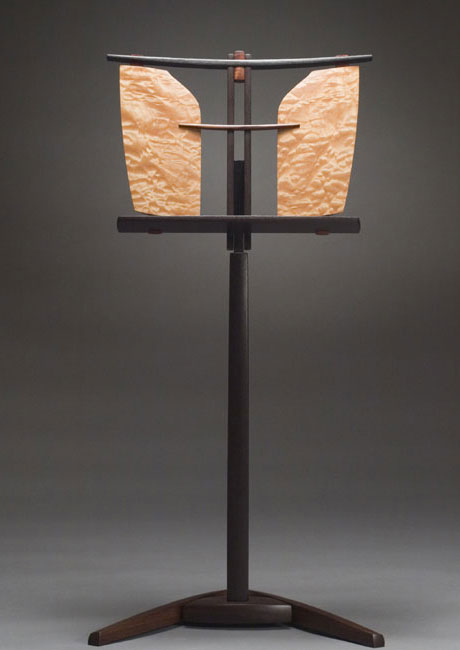
    Music Stand by Ross Peterson, wenge, quilted maple, Goncalo Alves.
    This elegantly crafted music stand by Ross Peterson, for which rare figured woods have been re-sawn and laid out to showcase the natural grain, is similar to one commissioned from the artist by President Bush as a gift for Japan’s Emperor Akihito. www.mnartists.org/Ross_Peterson


    Cocktail Cart (top) and Treadirondack (bottom), by Dean Wilson
    Wilson’s whimsical cart offers a playful, stylish home to the booze that sits atop it. His retrofitted lawn chair-cum-vehicle will be the envy of your friends. www.mnartists.org/Dean_Wilson

    Neruda Pendant by Claire Moyle, recycled paper, 2006.
    Claire Moyle’s contemplative play on word and light is a thoughtful accent for any reading nook. www.mnartists.org/Claire_Moyle

    Ellipsoid Table by Tim Gorman, maple, walnut, bird’s-eye maple, bubinga veneer, ebony, oak, birch plywood, brass, 2006.
    This opulent, Deco-inspired table by Tim Gorman would be equally at home in sleekly modern or eclectic, antique-filled living spaces. www.mnartists.org/Timothy_Gorman

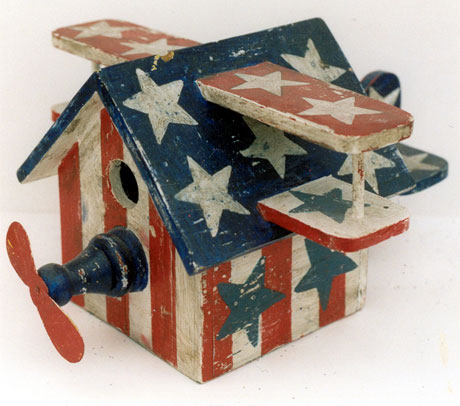
    Birdhouse by Mari Newman, wood and paint.
    The homey charm of Mari Newman’s rough-hewn birdhouse is designed to warm up any garden corner. www.mnartists.org/Mari_Newman

    Jack Splash Lotus by Holly Anderson Jorde, glazed stoneware & acrylic painted wood, 12"h x 24"w x 16"d
    Jorde’s beautifully executed ceramic sculptures are both elegant and fanciful like childhood toys refashioned for grown-ups. www.mnartists.org/Holly_Anderson_Jorde

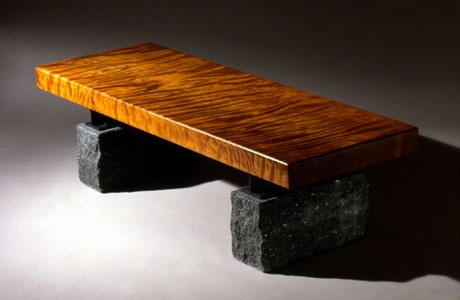
    Perpich Bench by Glenn Gordon, Mesabi black granite, steel, curly redwood, 2004.
    This bench, constructed in 2004 in honor of Rudy Perpich, is made from black granite native to Perpich’s Mesabi Iron Range and
    an extraordinary plank of highly figured curly redwood recovered a few years back from a lightning-struck stump left standing by 19th century redwood loggers. www.mnartists.org/Glenn_Gordon

    Modular Media Shelves by Keith Moore, birch, 2002
    These funky shelves offer functional storage with playfully fluid lines.
    www.mnartists.org/Keith_Moore


  • The Mice

    For the Greeks, who had no word for irreversible death, one did
    not die, one darkened.

    —Mark Strand

    Where the Japanese iris right
    now stand ready to
    accept the inevitable
    purple blossom

    she found four dead mice
    in their nest of dirt and dusty fur
    all with their small ears pointed like pilgrims
    toward the trunk of the huge cottonwood.

    What happened here?
    Cat? Owl? Dog? A silent disease?
    Or had they just frozen one night as the air
    on their bodies fell back to winter?

    Their dusk bodies were soft as she picked them up
    unsure of whether to leave them buried where they would
    melt back into earth, first fur, then intestine,
    vertebra, and finally small pocket of skull.

    She put a rock over them but came back later,
    removed them to a black plastic bag, afraid
    of something, some disease, that the cat
    would chew on them, get sick, maybe die.

    Now where the grave was there is a space
    in the clump of iris, a darkness, an open mouth.


  • Zoom In: Charles Beck

    On the wrong side of the tracks in Fergus Falls, we drive past homes patched together by peeling paint, and climb up through the cement factory’s back lot. At the top of the hill, there’s a silver mailbox: C. Beck. A trail of faded wood steps carries us through the woods, over a ravine; the path becomes a bridge, the bridge becomes a porch lightly dusted by snow.

    Among the firs is a driftwood-colored Bauhaus-style house. Charlie Beck comes to the door in a worn flannel shirt. He has the freckled complexion of a farm boy, faded into a pale chamois and framed by wild white hair.

    Beck’s studio is much like any garage workshop in rural Minnesota. Cluttered work benches are pigeonholed with drawers, and punctured boards on the wall hold hooks for hanging tools. Duck decoys in various stages of disrepair congregate on a shelf. At one end of the room, light from a skylight spills onto a single woodcut print of winter poplars, illuminating a pattern of notched trunks. I notice a note on the woodcut reading "Cathedral." This is the road less taken, where tiny panes of light glimmer through the crisscrossed branches.

    Beck is not so different, on the surface, than his deer-hunting, farming, small-town neighbors. As poet Mark Strand put it, Charlie Beck is "a modernist in regionalist camouflage." It is autumn when we talk: open fields of turned earth, the startle of a cloud, wisps of snow between the great skeletons of trees. Quarreling geese resolve on point, and the ancient gilded light lingers over bent grasses. "It’s this," Beck waves his hand at the world around him: the trees, the fields, the little barns on hills. "It’s a feast. The temptation [to create art] is everywhere."


    Excerpted from a profile published in access+ENGAGE. Subscribe to this free arts e-magazine at mnartists.org/accessengage.