Author: Alan Berks

  • Everywhere Signs Fall

    photos by Rose Johnson

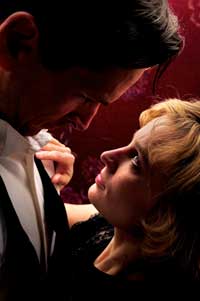
    Finally, for my last blog post here at The Rake, we have rehearsal photos. Above: Paul Cram and Tracey Maloney. See more below.

    Everywhere Signs Fall — "The most exciting play you’ll see all year!" I actually do believe this to be true, but I’m willing to put it out there for debate. Come see the show. Tell me I’m wrong.

    In a hot motel room in Phoenix, a brother and sister lead an ominous investigation into the reasons that their lives have gone the way that they have. (Don’t we all wonder that sometimes?) They record and analyze and replay memories in an attempt to understand the meaning of the events that have changed their lives. (Cool! I’ve always wanted to be able to relive and rewrite my memories!) When they bring a down-on-his-luck bartender back to their room for an interview, their investigation takes a dark, deadly turn. (Cue music: Dun dun Dum! Call now, 651-228-7008). Everywhere Signs Fall is a thrilling psychological rollercoaster ride through mystery, tragedy, and romance, filled with sharp dialog and raw but humane passion.

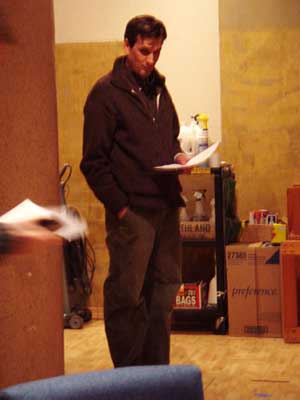
    John MiddletonHere’s John looking all film noir-y and handsome, even with a script in his hand. He plays the down- on-his-luck bartender. Over the course of the last two years, I’ve seen him in plays from Torch’s Thousand Clowns to Our Town at the Theater Garage to King Lear at Starting Gate Theater. His performance in Gremlin’s Petrified Forest is still one of my favorite performances ever in the Twin Cities. I’ve tried to see everything he’s been in since then, but he works so much, I’ve missed a lot.

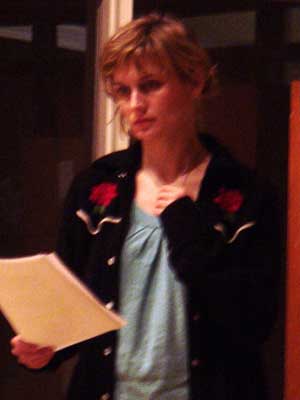
    Tracey MaloneyI think Tracey Maloney is one of the most intoxicating actresses in the Twin Cities. (You may have seen her as Laura in the Guthrie’s Glass Menagerie, among other shows.) She has an insightful intelligence combined with raw, emotional, instinctual energy that’s hypnotic. We’ve worked on small plays together at Thirst Theater, where the actors mingle with the audience in a bar as they perform, and I have literally seen mouths drop open around the bar as people watched and even fell a little for her. (No pressure, Tracey.) Sorry that the image is blurry.

    Paul Cram is an emotionally available, smart, brave actor with a wide range of experience in film who hasn’t seemed to find it hard at all to adjust to the differences in theater.

    For me, great theater is passionate, smart, interesting, mysterious, and unique. More heart than mind. A journey and experience that is as worth leaving your house for as much as a exotic trip outside of Minnesota. A story about people in extreme, interesting circumstances that illuminates the struggles and passions we all share. Honestly, you may not understand everything you see in this play, but you will feel a lot, and — we hope — you’ll be talking about what you feel and what you think for a while after you see it.

    We certainly have the cast to pull it off. Hope to see you there.

    Thank you for reading.

    —Alan

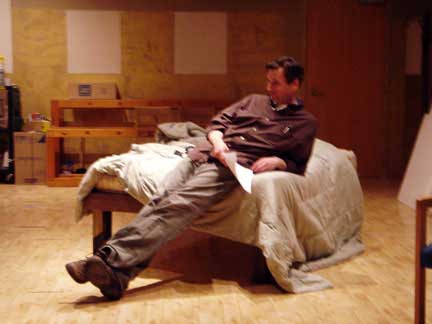
    And here’s one more picture of John in the rehearsal room — just because the whole "come hither" posture amuses me.

  • Dialogue

    No pictures from the rehearsal yesterday. We forgot. Too many other things came up. Hopefully, we’ll get them tonight, and I’ll post them tomorrow — which will be my last post and where I’ll make a final pitch for you to pick up that phone and make a reservation.

    I suspect that hearing how the sausages get made isn’t as interesting to the sausage eater as the sausage-maker, so in the interest of providing a taste of the sausage, here is just some dialogue from Everywhere Signs Fall that I like hearing the actors say:

     Guy: How do you sleep in this heat? You sleep nude? I bet. I can imagine.

    Juliet: (dry) O my. I guess I’ll have to slap your imagination.

    —–

     Juliet: If you must move your mouth, make sounds that play a tune.

    —–

    Jeremy: The universe is a mystery and scientists are like nature’s private dick.

    —–

    Guy: She’s dead. Now she looks sadder.

    ——

    Guy: This is Phoenix. People melt to death here. I’ve watched ’em.

    ——

    Juliet: I’m twenty-six. My father died for no reason and then my mother died exactly eleven months later.  I think I’m entitled to cynicism. (PAUSE) Aren’t you sorry?

    Guy: About what?

    Juliet: My parents. Death.

    Guy: Sure. I’m sorry about death.

    ——

    Guy: I looked. Couple ol’ guys in the bar since their retirement, someone’s drunk wife from two nights ago still here, later afternoon, and me. I looked at you. What else did I have to do?

    ——

    Juliet: I was thinking of the sky, the sunrise. The sky. – I’m a photographer. – how easy it would be to get lost in the desert in that sky.

    —–

    Guy: Point that gun like you know what you’re pointing at, Kiddo. Aim for something at least.

    —–

    Guy: Guy. Nice to meet you. We weren’t probably introduced.

    Jeremy: We can see that you’re a guy.

    Guy: My name is Guy.

    Jeremy: O

    Juliet: It doesn’t matter.

    Guy: Tell that to my mother.

    —-

    Jeremy: Time is an illusion. The essential — the essential evidence — we discover outside of the present. We study and replay memories.

    —–

    OK. I could do this all day. I’ll stop. Come hear the dialogue starting April 18 at Loading Dock Theatre. It’s fun. . . And I haven’t even got to the really intense stuff. 

  • The Play That Won't Go Away

    This play, Everywhere Signs Fall, has been around my life in some form or another longer than any other play I’ve written. When I was 24 and still more of a person who said he was a writer than a person who wrote, I remember sitting at a bar somewhere with my girlfriend-at-the-time and the friendly bartender who knew us well enough to keep us in free liquor all night long. I said I wanted to write a memory play. I wish I could remember why, particularly, at that moment I wanted to write a memory play. Maybe I had just read The Glass Menagerie and was feeling inspired. In retrospect, I’m not even positive that "memory play" is a genre that a person can write on purpose.

    On the other hand, memory – or at least the way in which were constitute our memories in the form of narrative – has always been and continues to be a big issue in my writing. My first real play (whatever that means) was called The Past is Always Present. It isn’t the greatest play in the world, it isn’t even one of the better plays in my file cabinet right now, but I’m still a fan of the title.

    Very soon after this evening in the bar, which I don’t remember well except for this particular announcement that I was going to write a memory play, I found myself in grad school in Phoenix, Arizona. (Very soonafter that I found myself without that particular girlfriend-at-the-time.) I don’t like Phoenix, Arizona for a variety of reasons, but I have to say that it’s a great location for noir-ish stories. How have I heard it described by the many other visitors who hate it? "An overgrown truck stop." "The valley where all the shit in an otherwise beautiful state comes to rest." "A mirage in the middle of the desert." The place just ain’t right somehow. Strip malls, strip clubs, and movie theaters. New York bagel shops, Chicago hot dog joints, and bright green grass lawns – in the desert inthe southwest!

    Grad school in Phoenix, Arizona wasn’t a well-thought out decision on my part. I was running from stuff – a fact that probably, unintentionally, informs a number of character choices in Everywhere Signs Fall.

    During the first day of the first seminar, Professor Guillermo Reyes chatted with second year grad student Trista Baldwin about her play Accidents and Short Conversations.(Trista, by the way, has since moved to Minneapolis too. Dear Jerome Foundation, the fellowship program is working.) Guillermo to Trista: "Are you rewriting Accidents."Rewriting accidents? Rewriting accidents?!?! People trying to rewrite the accidents that have changed their life! That’ll be my memory play.

    I walked out of this seminar, looked up at the sky in Phoenix, which is humongous and always blue all the time no clouds ever or maybe one cloud every few days and stunning especially if you’re used to pale-ish, low-hanging Midwestern skies, and I started writing this play. I wrote the first 75 pages of it in less than three days. I remember writing fast. I remember flying. I don’t think I planned much out. The characters toldme who they were by the language they used. Somehow a gun snuck in and got passed around among the characters and the heightened reality of film noir became an integral part of the play.

    Desert

    Though I didn’t set out to write about my life at the time, I’m sure, in retrospect, that the environment of the play was informed by my surroundings. My apartment complex was right off a highway, five minutes down the road from the airport. Life around airports in most cities is somewhat seedy. Though a few blocks of desert was a buffer between me and the strip, I knew exactly where I could find the good and the bad drugs and the hookers if I wanted them. I drove by them all the time on my way to the central post office.I suspect that this is a side of Phoenix most people don’t know about or notice because the place seems so sunny and clean so much of the time, but, as a character in this play says, "If you were a crack addict, wouldn’t you want to be where you could tan and smoke up at the same time?"

    In general, Phoenix and its surrounding suburbs are, from what I remember, a feudal society with a rich, anglo Republican and corrupt royalty at the top and everyone else, mostly middle and lower class people of all ethnicities, just happy to be somewhere that is all 80 degrees and sunny all the time. A shiney surface with a dirty underbelly. An ideal situation from which a noir-like thriller to spring. It seems so obvious now. . .
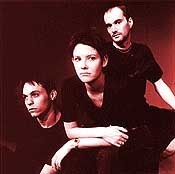
    Blackball Ensemble

    Throughout grad school, I was forced to tweak and rearrange and rewrite various parts of this play until it made me almost sick to think about. Also, the play, in its early drafts, was produced under the title of Mourning Rituals by a small theater company called Blackball Ensemble. (That’s the young cast in 1998, looking all serious and Mourning-like.) It was well-reviewed – surprisingly earning praise from thealternative newspaper’s resident snark. We don’t appear to have this type oftheater critic in Minnesota – the one who only tears down because tearing down is funny and fun and he hates himself for being a critic and therefore hates everyone who isn’t a critic. Even this self-loathing piece of trash grudgingly complimented the play. And the critic at the largest daily newspaper, apparently, began to obsess about it. He gave the play an initial mediocre topositive review but then seemed to revise his opinion with each passing week, praising the play more and more in blurbs in the entertainment section and calling up my professors at the grad school to amend his opinion directly to them.

    The play deals, in part, with loss, with learning to live with grief. Apparently, the critic’s mother had recently passed away, and something in the play struck a chord that kept vibrating in him long after hesaw the play. Which of course makes me humble and happy. Nobody else, however, really came to see this production. Minnesota theater makers really wouldn’t complain about attendance problems if they ever lived in Phoenix. Theater simply doesn’t make sense in a place that is 80 degrees and sunny all the time (except for the 3 months that are 110 degrees and sunny). Why would you ever want to be inside? Also, I suspect the title, Mourning Rituals, wasn’t a big draw. "Hey, Honey, it’s Friday night. Wanna go to a funeral?"

    So you know: The play isn’t funereal, so I’ve changed the title.

    In 2001, back in Chicago and living with my friend, Narciso Lobo, I pulled out a copy of this play just to hear it read by a bunch of actor/friends who graciously came over to our place every other week or so just to keep me writing. Seriously. They were really sweet people who somehow, subtly, forced me to continue to be a writer simply by coming over to my apartment with the expectation that I wrote something for them to read. I am grateful.

    After reading this play out loud, Narciso leaned back alittle, looked at me, and said, "It’s good and all. It is. But if you ever want anyone to produce it, I think you’re going to have to cut out a lot of the poetry and give it more plot. Your choice. It’s still good. I’m just saying. .." Ciso would probably fit right in Minnesota. He’s passive-aggressively effective. It’s always like he’s saying, "I’m not telling you what to do but – I know exactly what you should do if you’d just listen to me."

    I rewrote the play. Played up the psychological thrillerparts and, as much as I felt I could without losing some really cool stuff, played down the poetic, lyrical memory parts. I renamed the play Everywhere Signs Fall and sent it to the Playwrights’ Center, where someone liked it enough to give me a Jerome Fellowship for it. The play has also been read by a bunch of edgy theaters around the country and, for a while, I really believed that some mid-sized major theater might produce it.. .

    By the way, all the rewriting I did on this play at Ciso’s request happened in October of 2001. Again, I’m struck by how, in retrospect, the world around us finds itself creeping in to the work we do without our knowing it. I wasn’t consciously thinking about the events that occurred on Sept 11, 2001 as I worked on these rewrites, yet a play that deals with unexpected loss and grief seems like an ideal outlet for my feelings at the time.

    Bare in mind: I don’t believe that artistic expression should attempt to tackle the "important issues" of our time head on. I think that if you have opinions about politics then you should write editorials. If you think you can solve the health care crisis, then you should solve it in the health care industry. I think that if you want to stop war, then you should march on Washington, or something. Not theater. But it is so hard sometimes to resist the urge to write directly about whatever topic is much in everyone’s minds. As in, this is my play about the war. Or, this is my play about women’s body image issues. Or, this is my play about this important issue in the news.

    But – as William Faulkner said in his Nobel Prize speech: "Our tragedy today is a general and universal physical fear so long sustainedby now that we can even bear it. There are no longer problems of the spirit.There is only the question: When will I be blown up? Because of this, the youngman or woman writing today has forgotten the problems of the human heart inconflict with itself which alone can make good writing because only that is worth writing about, worth the agony and the sweat." I take that to mean, in part, that the anxieties of the day are too hard for writers to ignore but an impediment to truly transcendent writing. When will I be blown up? How did we get to this place where we all might be blown up? What should we do about thefact that we all might be blown up? But these literal-minded responses to the culture at large don’t make for effective writing. . . You should google Faulkner’s entire speech. It’s fantastic. . . Creative writer’s concern, our usefulness, our purpose is not to explicate the issues of the day directly but to search deeper in to the "human heart in conflict with itself." This is what we can and should do that others don’t. The rest we should leave to the political pundits. I don’t mean that we write in a vacuum and don’t consider or write about the world we live in; I simply mean that we should come at the topics from better, more original, more exciting and transformative creative perspectives. The experience of an intense, entertaining, relevant but original story is as valuable, if not more valuable, than any editorial expression I may have on the news of the day.

    At the same time, I guess, I’m saying, I found this play that I wrote about three damaged people in a hot motel room in Phoenix with a gun, liquor and some entertaining memories to be somehow worth working on inthe late months of 2001. I don’t want to make any claim more broad than that.

    Some larger, edgier theaters clucked a little about looking at Everywhere Signs Fall, but nothing really happened. For some reason, the expectation seems silly now. On the really silly side of the spectrum of silliness, an actor friend of mine who was a waiter in Hollywood passed the script along to Maggie Gyllenhaal for her and her brother to make in to a movie of it. Maggie Gyllenhaal ate at his restaurant, and he was absolutely positive that they were the best of friends.. . What is it about Hollywood that actually turns people in to clichéd sitcom characters? Of course, nothing came of that either.

    In 2004, I began a period of writing and producing that was incredibly fruitful. I wrote more than 10 short plays. Invented and produced Thirst Theater (with Tracey Maloney and Chris Carlson). Completed four full length plays and two one-acts. Saw three productions of my work in Minnesota. Saw a production of my show about goatherding in New York that was nominated for some kind of award. Forgot entirely about this play.

    Then my wife read it and begged me to let her direct it. I said no. Repeatedly. But she wore me down. She connected with the play on a visceral level as a result of the experience of her own life, and she seemed to know how to direct it in a way that I had never thought of. I love working with people who have ideas that I have never thought of. This is another one of the joys of collaboration that is theater.

    Gremlin Theatre, who commissioned me to write a new play for them two years ago, agreed to produce the play, and I started rewriting it AGAIN.

    So here we are. With a play that was initially written in one big burst of inspiration in 1997 and then rewritten at odd moments over the next 10 years. We’ve got a great cast. A great director. In a hardworking small theater. And I’m probably a much better writer than I was ten years ago, so hopefully I’ve made the right rewrites. I’m genuinely looking forward to seeing what it is on stage after all this time.

    While this long post may make the play seem somehow dark and therapeutic, please let me remind you that I believe all theater should be a good evening of entertainment. Ideally, we transform our personal thoughts into something engaging and sometimes funny and thrilling on its own merits.

    I just thought it was fascinating for a moment to look at how plays sometimes develop over time. Regardless, I think you’ll enjoy the experience of the production, and my own journey with it won’t even enter your mind.
  • Things are Looking Up

    I’ve got to remember to bring a camera to rehearsal so I can post some pictures on this blog. Right now, imagine a photograph that is so cool it makes you want to see Everywhere Signs Fall at Gremlin Theatre. I don’t care what you picture as long as you trust your imagination and call 651-228-7008 for reservations.

    Saturday’s rehearsal felt like a breakthrough of sorts. From what I witnessed on Saturday everyone seemed to be channeling a better sense of the electricity and odd subtext throughout the play. Both scenes that we worked on Saturday were charged with an increasing tense energy. A gun. A hotel room. It’s hot. These three people are damaged. . . It seems to be coming along in a heart-stoppingly good way. Which makes me think of three things:

    1. Theater can be hard to do. You try to invent an entirely new and believable person/world/story one day. It has its challenges. In some ways, we’re stabbing in the dark and hoping that when we stab ourselves it doesn’t bleed too much. I’ve worked a lot of jobs in my short adult life — from construction to technical writer to goatherd to bartender — and I find theater harder. More fun but also harder.
    2. In my plays, the scenes that appear to be the most confused and hopeless when you read the script, often hold the keys to the success of the play. Though this makes it hard for me to send my plays out to theaters outside the Twin Cities, it also makes me happy. If anyone reading this also saw my play How to Cheat in the 2006 Fringe Festival, you may enjoy knowing that the sex/card game that the audience liked so much is also the scene that made the actors want to scream at me. Saturday, for this show, they seemed to solve one of the most difficult scenes to the point where it was the best rehearsal I’d watched so far.
    3. Without great actors, I’m sunk. Thankfully, we have three great actors in this play. Again, though it makes my scripts a little hard to read, it also makes me happy. One of the reasons I stayed in Minnesota after I moved here in 2003 is that I very quickly met a lot of actors who made me look really really good. I was going to include a story about D.H. Laurence here, but I couldn’t phrase it in such a way that wouldn’t make me look bad. As I write this blog, it occurs to me that I’ve grown accustomed to actors making me look good. I’m going to have to consider that for a while. For the moment, though, I’ll just enjoy it and be grateful.

    A short contribution today. . . Tomorrow will be longer. Pictures. Must have pictures.

  • Minnesota v. Chicago Actors

    I’m from Chicago. Chicagoans are different than Minnesotans. Everyone is different than Minnesotans. OK, everyone is different than everyone, but I live in Minnesota now, so Minnesota is what I think about.

    When you move to Minnesota, everyone warns you about the passive-aggressive thing. So, you nod and think that you’re prepared. But you’re not really prepared because all your life passive-aggressiveness has been the punch line of a joke on a sitcom. Someone who obviously has no life and incredibly bad taste in shirts, holding his or her hand up to the neck in some kind of clichéd gesture of vulnerability, expresses the opposite desire from what he or she really wants. On television, they usually do it in a high-pitched voice – as though shrillness makes it funnier.

    Here, in Minnesota, in reality, however, otherwise normal people – people who wear nice suits and dresses, who look good and not crazy atall – Here in Minnesota, even these types of people won’t tell you what they’re really thinking. And they do it in clever ways that make it almost impossible to know that they aren’t telling you what they’re really thinking. Not only are Minnesotans passive-aggressive, they’ve got passive-aggressive skills. They’re good it. It’s really passive. It’s oddly aggressive. It works.

    What does this have to do with my play? Bare with me: Chicago is the City of Big Shoulders. Chicago prides itself on its blue-collar, hard-working, straight-shooting, big, blunt citizens. Chicagoans aren’t exactly aggressive-aggressive as much as they are just, kind of, there. Raw. Decades of slaughterhouses and corrupt politics have nurtured a rough-around-the-edges, unpretentious, bloody, messy thereness.

    The character of each city can actually be experienced in the way that theaters do plays. When Steppenwolf Theater in Chicago did a production of Craig Wright’s Orange Flower Water, a play about adultery, there was screaming and shoving. When the Jungle Theater in the Twin Cities on Lyndale did it, well, there was less shouting. People in Minnesota shout less. In general, Minnesotans are more restrained, more stoic. They aren’t really precisely passive as much as stolid. Live theater reflects the community. Hence, the same play is entirely different in a different place.

    Unfortunately, because I grew up in Chicago and because I wrote the original version of this play Everywhere Signs Fall ten years ago, there is a certain blunt thereness to the characters that is hard to explain if you didn’t grow up in Chicago. It’s like trying to explain Jewishness to someone. You can read all the books and know all the rules but there is a certain indefinable something. Example: During the Guthrie’s basically enjoyable production of Neil Simon’s Lost in Yonkers, I couldn’t shake the feeling that I was watching a play about the Irish immigrant experience rather than the Jewish immigrant experience. It was just a feeling. While the actors were excellent, there was something indefinably not Jewish about them.

    The Chicago acting style has a clear but hard to pinpoint approach. So does Minnesota. Chicago actors are raw, loud – sometimes like a really cool looking bull in a china shop. Minnesota actors are restrained. They’re never false. They’re smart. Intellectual and effective. Their choices are like surgical punches that land. They’re clear and talented and hard-working. But – and – they are stolid. Restrained. Their instinct is to pull back. Like their town.

    In this play Everywhere Signs Fall, the characters are working very hard to avoid dealing with the problems they should be confronting. They’re distracted and desperate and irrational. It’s like the house is on fire, but they’re trying to pretend its not. But then moments come for the characters when they can’t ignore that they’re burning and they explode in fear or rage or desperation or humor. Something unrestrained. And aggressive.

    I’m just describing how strange it is to watch a play being rehearsed and realize how many ways it can be altered, changed, and adjusted because of the different live energies that different live actors and acting styles bring to a script. Even geography effects the final production.

    In case you didn’t know it already, in case you’ve heard it but didn’t really believe it, in case you really did think that “Live theater is always different” is as much a performance cliché as “I’m just taking it oneday at a time” is a sports cliché, please believe me that live theater is always different. I don’t mean that someone might flub a line or forget a few pages of dialogue or say a certain line in a slightly different way. I mean that the show you watch on Thursday and what you feel and think when you watch it will be entirely different the next time you see that play – depending on the actors who do thescript, the town in which you’re watching it, the size of the audience, the style of the director, the weather, the stage, the day, etc., etc., etc.

    I’ve heard poets say that their poems should mean different things to different people. In theater, we actually dramatize the concept.

    If you don’t believe me, you should spend the next month seeing a few plays three different times. As an added bonus, if you actually pay for three tickets to the same show, you’ll earn the undying love of every theater in town. Love is good. Enjoy.

  • Investigating Accidents On Stage

    Everywhere Signs Fallis about a brother and sister who travel around the country investigatingaccidents. They interview and record people who have experienced accidents thathave changed them somehow, then they pack up and head to the next town. Whenthe play begins, we see Juliet and Jeremy interviewing a down-on-his-luckbartender in a hot, seedy motel room in the Phoenix, Arizona in the middle ofthe summer. It’s hot. It’s very hot. And something isn’t exactly right. . .

    And so it begins.

    The way we’re describing it in our press materials is: “EverywhereSigns Fall is a thrilling psychologicalrollercoaster ride set in a steamy hotel room in hot, seedy Phoenix, Arizona. Outof the Past meets Donnie Darko; Petrified Forest crossed with Memento. After losing their parents under mysteriouscircumstances, Jeremy and Juliet take to the road, recording and analyzingrandom accidents around the country that have changed the course of people’slives. When they bring a down-on-his-luck bartender back to their hotel roomfor an interview, their investigation takes a dark, deadly turn. This play isfor anyone who has ever experienced loss and wondered about whether fate orfree-will control our destiny.”

     Other things you should know about the play:

    • They’ve got video equipment. In Jeremy’s words, “We’re really scientific.” Which means that we get to not only have incredible live actors on stage but also beautiful close-ups of their photogenic and expressive faces. We get to do this within the context of the play itself rather than with some large and strange video screen behind the actors that gives nothing more than the impression that someone in the theater thought they had to be multimedia in order to be cool.
    • The scenes take place out of order – hence the reference to the film Memento above – and, for some reason, I’ve taken this as an opportunity to do cool things with sound too. (You’ll have to see the play to discover the reason.) We’ve got Ivey award winning sound designer Mike Hallenbeck helping us out; sometimes you  just increase one element of a play’s content because you have the chance to work with someone so good.
    • Film noir is fun. A hot motel room. A mysterious stranger. A dangerous investigation. A young beautiful girl. Somewhere in the process of writing this play I slipped in to certain film noir tropes. Some people associate film noir, it seems, with dark lighting, brooding actors, and windows whose blinds are always down in order to make that slatted light effect on a person’s face. What I notice now that I’ve been watching and watching different films is that all the dialogue is damned funny and the characters are usually more amused than depressed. They’re active and strong, and they know what they want and how to get. It’s just the damn corrupt world that keeps getting in their goddamned way. O, and they aren’t really angels themselves either. . . I don’t know. Sounds like life to me.
    • The play isn’t film noir. It’s noir-ish.


    After two evenings of rehearsal everyone is still feelingtheir way just to the place where they can actually see the way in front ofthem and my thoughts aren’t coherent enough to share. I’m still processing. Ican say that John Middleton can go from looking like a Classics Professor at asmall liberal arts college to Humphrey Bogart just by the way he holds hisshoulders. And Tracey Maloney looks nowhere near the age of the birthday she iscelebrating today. . . I have sometimes seriously thought that we all couldmake more money in theater if we could somehow market it as a real Fountain ofYouth. Think about the theater people you may know in this town. Can you reallyaccurately guess their age? Odds are better than average that you’reundercounting by at least ten years. Isn’t this the type of secret everyonewants to know? If only we could bottle it. . .

    Tomorrow, I think I’ll have something more specific to say.For now, let me remind you of the reservation hot line to see this modern takeof a film noiry premise live on stage. 651-228-7008


  • First Day of Rehearsal Jitters

    Rehearsals for my play at Gremlin Theatre begin this evening. For a playwright, rehearsals are the beginning of a particular kind of hell. For an actor, rehearsals are sometimes the best experience of the play. Anything is possible in a rehearsal room. You don’t know the character yet. You start crawling in to the skin of another person and playing around – like Tom Hanks in Big, only better. For a playwright, there is very little to do now except worry about what needs to be fixed. When playwrights go to rehearsals, we wind up hiding in the corner somewhere, biting our nails or trying to keep our legs from jittering loudly while we watch the actors play around, discover, explore, stumble, experiment, etc. All the while, we’re wondering whether the reason that they can’t seem to say a particular line effectively is because, “I am the worst writer on the face ofthe planet! What was I thinking?!?!” Personally, neurotically, I wear hats to rehearsals so that I have something to hide under and, also, perhaps, as a disguise. If the actors can’t recognize me, then, I figure, they can’t blame me.

    Other kinds of writers probably never experience this unique type of torture. Like all writers, the playwright has to confront critics who believe the writing isn’t up to par. Oddly, we sometimes confront those people live and in person as they are experiencing the work itself. In a room full of 100 people or more the odds are high that at least one person is going to despise whatever is happening. Really despise. Like, want to get revenge despise. Playwrights, theater people in general, invite all those people into the same room, join them in that room, then shut ourselves in together. (As I write these words, I suddenly realize what sadomasochists we must be. That’s a revelation that’s gonna smart.) The overarching torture of being a playwright is that, no matter how good or bad we are, we’re dependent on so many other people to put the words – and the world of the play those words create – out to the audience successfully. I confess this to you now, but trust me, you’ll never hear me say it again. It’s incredibly bad form, when someone criticizes your play, to point petulantly at the lighting designer and say, “It wasn’t my fault! It was her! Of course you can’t enjoy the lines when you can’t SEE the people saying them! You don’t understand! It wasn’t my fault! I swear!”

    Of course, the reason I am a playwright is because I actually love actors and theater and the unique and dangerous energy in a roomfull of diverse people who have come together, live, in order to see a show and create a show. The best experiences I have ever had with any kind of art have always been in theaters where I felt as though I could quite precisely feel exactly what the character on stage was feeling. Watching an actor in Dario Fo’s We Won’t Pay! We Won’t Pay! reach slowly toward his chest, I could feel – even though I was 50 feet up in the most ridiculously steep theater seating in the world – I could literally feel the heartache that the character felt. In other situations, I’ve felt clarity or sensuality or anxiety or confusion. Fear, delight, desire, and tragedy. But more clear and transcendent in a way that I can’t comprehend in everyday life. I’ve felt – not often, but enough– that somehow the confusing and overwhelming chaotic truth of life has been distilled like crack cocaine into the very air around me. I’m not kidding. Like, the world in a bottle in my hand, in my lungs, in my blood and my brain. Universes of emotion and understanding that I could never experience in my day-to-day, moment-to-moment, who-walked-the-goddamned-dog-this-morning life. If I hadn’t felt that, then I’m confident I would have given up theater years ago – and probably been happier or, at least, more financially prosperous.

    What am I saying? I guess . . . playwrights are like sadomasochistic, nail-biting crack addicts with shaky legs. O, and some of us like to wear silly hats.

    Tracey and JohnWait! Go see my play! Have I mentioned this yet? Seriously. Don’t take any of the above rambling as an indication that the play isn’t worth seeing. Getting you to see the play is the reason I’m writing this blog. Buy tickets. The reservation number is 651-228-7008. It’s called Everywhere Signs Fall, starring Tracey Maloney (incredible actress!), John Middleton (amazing actor!), and Paul Cram (I don’t really know his work yet, but he gave a heartbreaking audition, and he seems like a serious guy!). It runs from April 18 to May 11 at the Loading Dock Theater in St. Paul. It’s produced by Gremlin Theatre. And it’s directed by Leah Cooper, who I’d praise to high heaven for all her various talents, but she also happens to be my wife, so, you know, if I tell you too much about her charms, you might try to steal her from me. Yes, while you may think positively of her already because you may know that she used to run your favorite Minnesota Fringe Festival, I really need to keep her true brilliance secret, so that I can keep the competition manageable.

    I think the content of the play is pretty phenomenal too. I really do. All playwrights do. We wouldn’t write the plays that we write unless we thought that they were going to blow your mind into the next time zone. At least, I hope we do. That’s why I write plays. I assume that’s why other people do too, because I know for a fact that they don’t do it for the money. I personally cherish the experience of having my mind blown, and I want to share it. I believe we all have a mind-blowing pleasure node in our brain. It may be buried deeply underneath the stare-at-the-internet-for-no-good-reason pleasure node or the television-is-shiney-too pleasure node, but it exists. I’m sure of it.

    I’ll talk about the specifics of the play more in upcoming blog posts. I’ll introduce myself in some more concrete detail. And I’ll give more details of the odd stuff that happens in a rehearsal room. But seriously, call now – 651-228-7008. Make reservations.

    Because while I love a good rant, I really wouldn’t be writing this blog if I didn’t hope that you, Rake reader, can be convinced to spend an evening with this play. I’d rather not have the personal attention really. I prefer to translate what I’m feeling and thinking in to actual, creative narratives that aren’t about me, serve you a good evening of entertainment, and, just maybe, blow your mind. Unless you have the Guthrie’s budget, howe
    ver, its pretty hard to market theater. So I’m writing this blog, getting the word out. Because it isn’t really theater unless there are people in the audience for it. Not just a few people but a bunch of people. I don’t know what the precise number is, but somewhere over 50% capacity, the experience of the play changes completely for everyone involved, audience and performers. Have I mentioned the theater’s phone number? Why haven’t you made a reservation yet?

     
    I really don’t blame you for missing all the other great, intimate productions that get produced on a monthly basis in the Twin Cities. How were you supposed to know which ones were good? And I bet you feel that there are few experiences worse than bad theater. You’re trapped. You can’t step over people to escape. You’re forced to laugh occasionally at some lame joke because you feel so bad for the actors who are standing 10 feet from you, live, and trying so hard. You start to wonder whether your watch has stopped – and the time-space continuum has been forever mangled right there during that insufferable show. Meanwhile, on stage, you know the playwright is lecturing at you about some news item that you were hoping to ignore until your monthly utility bills got paid and your goddamned dog got walked. You’d actually like to stick forks in your eyes in order to dull the pain of the play you’re watching and the experience you’re having. Bad television is never this bad.

    But with great risk comes great reward. At least that’s what my fortune cookie said last week. And this play is great. At the very least I can promise you that I don’t lecture in my plays. I rarely write directly about current events. I think people are more important than issues. Or, at least, issues are subordinate to people. And the multitude of people in this world and how we all try to live in this world is enough fodder, the only real fodder, for the best art. I don’t need or want to whack you over the head with a metaphorical pedagogical baseball bat. If I did, I’d be a well-paid and infinitely useless political pundit.

    Mostly, I just love the real spinning of real good yarns. Really, good, engaging, complex, active stories. – This is a great play. I’m not kidding. If you go, you will stroke the pleasure node in your brain that likes complex intellectual and emotional engagement. I’m telling you, so now you know. No excuses. Call for reservations right now 651-228-7008. It’s produced by Gremlin Theatre at the Loading Dock Theatre in St. Paul. It’ll be worth it.

    Future blog posts will be more brief. Today’s verbose rambling is brought to you by my "first day of rehearsal" jitters.

  • Big Box Theater

    A few months ago, while walking along the Stone Arch Bridge with a friend from Manhattan, the bright blue Guthrie Theater looming above us, I realized that Jean Nouvel’s big new thing might be one of the few places in Minneapolis that would actually impress a New Yorker. So we wandered into one of its many bars and, though it was early in the afternoon, ordered cocktails. Why not? In the dim interior light, we quickly lost track of time. Patrons for the 2:00 p.m. matinees and the 7:00 p.m. evening shows meandered through while we sank deeper into the seductive leather seats, drinking and talking and drinking. We considered seeing a show ourselves, but ordered a six-dollar bowl of almonds instead.
    By 9:00 p.m., we were standing out on the “Bridge to Nowhere,” squinting drunkenly at the lights reflecting off the Mississippi River and talking about how beautiful theater in the Twin Cities can be. (When I’m drunk, I say “beautiful” too much.) If the purpose of theater is to entertain, then the new Guthrie succeeds, beautifully. We never even bothered to enter any actual theaters, and we were happy.
    On the other side of the river, just north of downtown St. Paul, the Gremlin Theatre company lives in the back of a building on an astonishingly isolated stretch of Sibley Street. Their performance space used to be the loading dock for the rug company that occupied the space after the shoe factory vacated. In 2002, Gremlin renovated it for—no joke—five thousand times less than it cost to build the new Guthrie Theater. The only visible sign that a theater lives inside is a wooden sandwich board set out on the sidewalk on show days.
    Sometimes, at an intermission for a show in the Loading Dock Theater, the owners of a coffee shop in another corner of the building remember to open. But they’ve always appeared deeply bewildered by the line of customers waiting to buy something from them. Once I ordered a cup of tea, and the guy behind the counter asked me how to make it.
    In fact, the experience of live performance at Gremlin appears on the surface to be so different from the Guthrie experience that I wonder whether they’re referring to the same thing when they refer, in their names, to “theater.”

    So what do we—and should we—look for when we go? Tennessee Williams’ The Glass Menagerie, currently playing on the Guthrie’s McGuire Proscenium stage until March 25, inspires an interesting analogy to the local theater community. Indeed, Tom, the narrator, informs the audience that the play is, in part, about what theater can and should be. Other theater folk, he tells us, “give you illusion that has the appearance of truth. I intend to give you truth in the pleasant guise of illusion.”
    Tom is the play’s writer. He works in a shoe factory (coincidentally apropos of Gremlin’s current digs), though he has bigger dreams. His coworkers call him “Shakespeare,” and he eventually gets fired for writing poems on shoeboxes. At night, he escapes to the movies, avoiding an equally suffocating home life in a St. Louis tenement apartment. (Most living playwrights, too, can be seduced by the movies on the off chance they’ll make some real dough.) He lives with his overbearing mother Amanda—who is like your annoying-but-amusing theater friend from high school who speaks in a distracting, slightly put-upon accent and always wants you to appreciate her—and his terminally shy sister Laura, both of whom await the arrival of Jim, the Gentleman Caller.
    Tom describes the Gentleman Caller as “the long-delayed but always expected something that we live for.” We, the audience, are to the theater community what the Gentleman Caller is to the The Glass Menagerie. Without us, the drama doesn’t happen. Yet when we head out for the evening, we, like Jim, are almost always oblivious to the nature of the drama we are about to enter. Generally, we’re just out looking for a good time.
    Finally, Laura is theater itself. She can be hopelessly awkward, embarrassingly sensitive, torturously maladjusted, and uniquely beautiful. Sometimes, you just want to scream at her to grow up, get away from her mother, and get a real job. But then, when the lights are magically altered just so and music wafts in from some unknown location, you surprise yourself by suddenly falling for her. As Jim tells Laura in the play, “ … different people are not like other people, but being different is nothing to be ashamed of … They’re one hundred times one thousand. You’re one times one!” And before you realize what you’re doing, before you can think better of it, you have to kiss her.
    Laura reminds me of a young girlfriend who loved me even when I didn’t deserve it. In retrospect, I wish she had given up on me sooner and found healthier, more practical ways to expend her energy. Yet her unwillingness to turn off her emotions—the way she insisted on taking seriously things that the rest of the world takes for granted—is a quality that I still admire in theater. The flaws make me reach out to her more tenderly and hopefully.

    All the other theaters in the Twin Cities exist in the shadow of the new Guthrie. None of the others have such a grandiose physical presence or sleek production values; in fact, few theaters in the entire world, let alone the Twin Cities, provide as luxurious an experience. Even the almonds are expensive. The Guthrie is to the theater world what the New York Yankees are to baseball, paying large-market premiums to showcase world-class talent—and occasionally nabbing actors from productions at smaller companies that can’t compete with the salaries it offers.
    Unlike the Yankees, however, the Guthrie’s presence so changes the landscape that it can take some credit for actually supporting theaters that nominally compete with it for audience. By employing so many artists and technicians, it helps keep talented people in the Twin Cities year round. It makes leftover props and furniture available to many small companies at reasonable cost. It has even begun to help bring these companies to larger audiences by running their productions in the new Dowling Studio. (You can see four top-selling shows from last year’s Fringe Festival in the studio February 1–4.)
    Finally, the Guthrie experience is alluring to people who don’t normally consider live performance a part of their life. An evening there is an event in the same way that going to the Metrodome includes more than a baseball game. You can have food, cocktails, and a beautiful view. If the show disappoints, at least there are pretty lights and booze.
    At the same time, unfortunately, many people never have an alternative experience. (One full house at the Guthrie is a good-sized audience for an entire four-week run of a Gremlin production.) For them, the Guthrie is synonymous with theater—even more so now that even New Yorkers are willing to acknowledge its grandeur. I wonder, however, whether this showplace fosters false expectations in its audiences and, even sometimes, its artists. If the Guthrie has the expertise and financial wherewithal to create on the stage the type of clean, luxurious, virtually perfect experience that it offers in its numerous bars, why should it hold back? But on the other hand, should a play be that comfortable? Should it be that shiny and impressive? Watching incredible sets fly in and out, for example, you may find yourself marveling at the quality of air-traffic control rather than the quality of the play.
    And what then becomes of Laura, whose strangeness makes her so special? “Art is a kind of anarchy and theater is a province of art,” as Tennessee Williams himself insisted, in an essay titled “Something Wild.” “It runs counter to the sort of orderliness on which organized society apparently must be based.” (By his measure, purchasing tea at Gremlin Theater may actually be the more beautiful theater experience.)
    Theater, at its best, not only entertains but also nurtures what Tennessee Williams called a “highly personal, even intimate relationship” with us, the audience. We enter a unique, often-flawed world that nonetheless sometimes offers a closer approximation of truth than we see in our day-to-day lives. “It is sad and embarrassing and unattractive,” Williams admitted in another essay titled “Person to Person,” “that those emotions that stir [the playwright] deeply enough to demand expression, and to charge their expression with some measure of light and power, are nearly all rooted, however changed in their surface, in the particular and sometimes peculiar concerns of the artist himself.” In The Glass Menagerie, for example, Williams recreates his memory of his sister in such a way that the true, heartbreaking beauty beneath her odd, fragile exterior can be more easily seen. We simply cannot experience theater if we substitute, consciously or unconsciously, comfort for this peculiar, sometimes “embarrassing and unattractive” light and power.
    Of course, no theater should be defined by the experience you have in the lobby. Good theater—being alive and different every night—may seduce us like Laura on the Guthrie’s grand proscenium stage, up in its Dowling Studio, and just as well, down at the Loading Dock Theater (where Gremlin is producing a fun new play, Bach at Leipzig, by a young playwright named Itamar Moses)—or anywhere in the Twin Cities that wants to call itself a theater. Afterward, I recommend going to the new Guthrie for cocktails. I hear the cheese plate is good, too.