Author: Peter Schilling

  • Cults of Personality

    The Departed and Last King of Scotland.

    departed.gif

    The Departed, 2006. Directed by Martin Scorsese, written by William Monahan. Starring Leonardo, Jack, Matt, Marky-Mark, Charlie Sheen’s Dad, Ray Winstone, one of the Baldwin brothers, Anthony Anderson, Kevin Corrigan, and the winsome Vera Farmiga.

    Now showing pretty much everywhere.

    Having failed to garner much in the way of Oscar glory with Gangs of New York and The Aviator, M. Scorsese has turned his camera back to the subject that seems to suit his temperament: the underworld. Hoping to score at least something in the way of a box office success (it’s unlikely this thing will garner many awards), Scorsese has taken the Hong Kong action hit Infernal Affairs and remade it into his new thriller, The Departed. While it might be cynical to assume that a man like Scorsese is thinking in these terms, his track record suggests that he’s desperate for some traction in the cruel city of Hollywood. Look at his past five features (not including his masterful No Direction Home, made for television): Kundun, Bringing Out the Dead, Gangs of New York, The Aviator, and now this. Not a success in the bunch, critically or financially. With The Departed, an unholy mess of a movie with some of the most indulged and overwrought performances in recent memory, we see a director spinning his wheels, desperately trying to rekindle old magic. And failing miserably.

    The Departed is the story of a young cop with a troubled past, one William Costigan, played by Leonardo DiCaprio, Scorsese’s new muse. Costigan is a brooding fellow, whose motivations are never entirely clear: in the course of the film it becomes apparent that he’s brilliant, should be going to law school or Harvard, and is tough, dedicated, and can actually screw the cute chick in the film. Contrast this with Colin Sullivan (Matt Damon). Sullivan has been in the employ of devilish Frank Costello (Jack Nicholson), the gang leader upon which whole film hinges. Costello is the film’s bad guy, and Nicholson looks as if he’s having fun, growling and ranting, even wielding a giant purple dildo at one point. His boy, Sullivan, trains to become an elite cop, desperately wishes he were a yuppie and well educated, is a charmer, and finally seduces, but can barely have sex with, the police shrink Madolyn (that’s spelled correctly, thank you), played with dull charm by Vera Farmiga. In fact, at one point it becomes clear that Sully is impotent or a premature ejaculator, we’re never sure except that he’s reassured, post-coitally, that whatever it is happens to a lot of men. So when Madolyn is pregnant, we’re also never certain whose baby is in her toned belly. Along the way it becomes apparent to Vera that her man Sullivan is a rat in the police department; Costigan is an insider within Costello’s group. One has to find the other. The chase is on.

    And it could have been a good chase except that Scorsese and scriptwriter William Monahan have it in their heads to be Important. They also seem to think that what made their past movies so good was a confusing plot and barrels of macho humor, most of which, here, falls flat on its face. They should have looked at his best films–like GoodFellas most recently–and determined that their strength lay in startling performances from small actors (like Ray Liotta), swift and economical plots, and simple chemistry. That is enough to create a masterpiece, but here the men decided to fill this bloated flick with a top notch cast that’s weighed down with some of the most hilarious New England accents I’ve heard. From Alec Baldwin to Martin Sheen, this crew seems utterly out of its element, almost ducking as Scorsese’s camera whips around the room. Mark Wahlberg stands out with a performance that veers on embarrassing, and only Ray Winstone emerges unscathed. There are countless tough-guy jokes thrown around, so many that one begins to wonder if that’s all the police department is capable of, flipping off everyone and questioning each other’s manhood.

    It used to be that every gesture in a great Scorsese film was fraught with menace. The Departed relies on gunshots and statements of intent to ratchet up the tension, and the result is a seriously tedious work. This is a surprising misstep for the director: The conversations in GoodFellas were almost unbearable for their edginess, and even a scene of a dark hallway was limned with the possibility of violence. Raging Bull seemed ready to blow up at any moment and even his somewhat derided (but wonderful in my mind) After Hours was so frantically insane that one almost had to burst out in nervous laughter just to endure that picture. But The Departed suffers from assumptions and personality: Scorsese appears to believe that Jack Nicholson is enough to make you grip your armrests. Edited haphazardly by the usually sharp Thelma Schoonmaker, it juggles your attention so that moments of conflict fall flat. There is no narrative force to this film as backstory is shoehorned in at inopportune moments, stalling whatever pace Scorsese had tried to achieve. To make matters worse, the plot is also thoroughly baffling. “Where’s the rat?” Costello roars, while the former cop, informant, and obvious suspect Costigan, who is forever text-messaging at key moments (!), is overlooked. Sullivan’s spy in the police force is also forever on his cell, calling his “father” while bewildered special forces officers look around the room wondering where the mole could be hiding. Apparently it is customary for cops and criminals to hold their phones conspicuously at their sides during drug deals, stealing glimpses at the display to make sure contact has been made. In the meantime, Costigan needs to see a shrink, so of course he coincidentally runs into Sullivan’s girlfriend Madolyn. At a the climax, Costigan sends her a disc that implicates Sullivan–to the house they share, with Costigan’s return address (and name!) on the envelope. I guess Sully never checks his mail. And perhaps for the first time, Scorsese gets hung up on a McGuffin, a side story about selling microchips to the Chinese that is of no interest and results in a monumentally silly stand-off between Costello and a pack of Hong Kong thugs. And so on and so forth, until, in a ridiculous climax, everyone is taken down in a way that makes you wonder why the cops didn’t just blow Costello away in the first place.

    In better times, Scorsese would have cast Ray Winstone in Nicholson’s role, for Winstone is a man whose gravity seems to pull everyone toward him–he is outstanding in this film, and one really wonders why his character would take any gaff from Nicholson’s Costello. Scorsese also used to excel at giving us the tight society of the underworld: consider the mob’s attempt at saving Ray Liotta’s marriage in GoodFellas. Here, the Irish gangs seem like nothing more than a series of endless cliches and silly brogues. Scorsese is a big man, a player, and he can get his stars to shine bright over a limp screenplay, and ignore the small miracles that made his past films so thrilling… and beautiful. This stretch for credibility is his loss, and ours, too.

    The Last King of Scotland, 2006. Directed by Kevin McDonald, written by Jeremy Brock. Starring Forest Whitaker, James McAvoy, Kerry Washington, Simon McBurney, David Oyelowo, and Gillian Anderson (and this question: why the hell is Gillian relegated to ten-minute parts while Duchovny gets to write and direct his shit?).

    Now showing at the Uptown Theater.

    Yet another story of an African nation through the eyes of a white protagonist (see last year’s Constant Gardner), The Last King of Scotland is redeemed through the thrill of watching some very good actors strut their stuff, and a director and screenwriter who realize, for half the movie, that this could simply be a good popcorn flick. Forest Whitaker, who is brilliant, and James McAvoy, who is sexy and fun, carry this often times routine thriller on their shoulders, playing at times like a deadly comic duo.

    The Last King of Scotland is the story of a young doctor named Nicholas (McAvoy) who decides to utilize the age-old cliche of spinning a globe in order figure out to where he’s going to escape. A lad from Scotland, freshly educated and bored to tears, desperately wants to abandon his stew-eating family for some foreign action. Well, he finds it, both medically and sexually, in Uganda. Through a strange coincidence, Nicholas meets and befriends the evil Idi Amin, played with titanic moxie by Forest Whitaker. From there our doctor falls deeper and deeper into the madness of the Amin regime, until at last everything he cares for is corrupted. Or killed.

    The Last King of Scotland starts out as one hell of a fun ride. With its 70s Ugandan rock filling the soundtrack, and our hero screwing everything in sight and driving like a maniac (not to mention loving the largess he receives at the hands of the Amin administration), Last King appears to have taken the old saw of the white man’s burden and shown it for what it is: a time for whites to either party or exercise their righteous morality on a country that deserves neither. We’re not meant to sympathize too much with McAvoy, who is spot-on as a kid in over his head and loving every minute of it; Whitaker is just amazing as Amin, appearing to have taken his cue from Brando’s Godfather, refusing simply to mimic the dictator, instead choosing to make his character utterly his own, hilarious, real, and terribly frightening.

    As a popcorn movie, The Last King of Scotland succeeds for a good hour and a half, until it devolves into the usual uptight hysteria, trying to cram in any number of messages about race and corruption into its often ridiculous finale (where the great soundtrack has been replaced by a hackneyed score). Again, it becomes simply the story of a poor, righteous white guy in Africa, leaving one wondering why his story is more compelling to the filmmakers than, say, Amin’s wife or the Ugandan doctor who saves our hero at the expense of his (the Ugandan doctor’s) life. Finally, our hero gets a Mel Gibson-like comeuppance, and I mean the Gibson of the Christ, not the drunken anti-Semite, and by this time the whole movie has fallen apart. See it, though, for its performances, especially Whitaker’s, and enjoy its entertaining first half.


    kingscot.gif

  • Movies of the Afterlife: A Worthless Review of a Film You Will Never Be Able to See

    immortal1.gif

    The Immortal Story, 1968. Written and directed by Orson Welles, from a novella by Isak Dinesen (Karen Blixen). Starring Jeanne Moreau, Roger Coggio, Norman Eshley, and Orson Welles.

    With our books and interviews, our videotapes and compact discs, we can try to reach back in time and speak with a dead man when we are confused. We can sit late at night and watch a movie so blurry and off-color we wonder if we’re not locked in some deep cave on another planet, or in another lifetime, the faint signal of some desperate soul, alive or dead, trying to communicate on some profound level. With The Immortal Story, made for French television by an old man who was once in love with Karen Blixen, Orson Welles set aside much of his tricky shots, his excessive thespianship, and gave us a story that shakes us to the core, and makes watching film almost unbearable.

    In the city of Macao, there is an old man named Mr. Clay. Once, ages ago, he gypped his partner out of his share of their fortune; the partner eventually committed suicide. Now an ancient man who sits amongst his wealth, Clay has lapsed into ruminating. Unable to sleep, he asks his bookkeeper, Mr. Levinsky, to read to him from the day’s receipts in order to eventually fall asleep. Clay wonders if there is nothing more than business to occupy one’s time, and Levinsky pulls a crumpled bible tract from his pocket and reads to him from the prophet Isaiah. But Clay is baffled: what is this prophecy? Ridiculousness, that’s what–nothing should be written that has not happened. Then he remembers an odd story:

    Once, there was a destitute sailor resting on a curb in a seaside town. A wealthy man in a cart pulls up and asks him if he would like to earn five guineas–a fortune. The sailor agrees, and the man takes the poor fellow to his home. There the sailor is fed from silver trays and crystal goblets, everything lit by candles on gold candlesticks. The old man complains that he has not long to live, that he would like to bequeath his millions to a child, but has no child, only a young wife. After dinner, the young man is led into the bedroom, where rests the wife…

    At this point the clerk interrupts to say that he has heard the story: everyone has. It’s as ubiquitous as it is apocryphal. Banging his cane on the marble floor, Clay makes his demand: I want this to happen to someone in real life.

    And so the story goes: Levinsky, armed with hundreds of guineas, convinces Virginie, the daughter of Clay’s dead partner, to pretend to be his wife. Later, a sailor is enlisted to make love to the ‘wife’, who is much older than the young man. But it matters not, for he is enthralled, having spent the better part of his teenage years (he is seventeen) stranded on a desert island, wishing for a love like hers.

    In the end, after the story is consummated, the sailor is forced to return to his ship and leave his love behind. He will never tell his story to a living soul, for who would believe it? Besides, it is his, to cherish in his heart forever.

    When it is over, Mr. Clay is dead. Levinsky is out of a job, and sits listening to a story inside a conch shell that the sailor has left behind. Virginie, standing in the distance, looks for her lover in vain.

    What are we to take from this? Supposedly, Welles fell in love with Blixen from reading her work, and once even traveled to Denmark to meet her. He would have been young; she would have been in her forties. Unable to bring himself to make her acquaintance (he knew the power of imagination versus real life), Orson spent decades writing her a love letter, which he never delivered. He repaid her with this film.

    Or so Welles tells us. For, like everything of his, it could be nothing more than beautiful embellishment. Which is often enough.

    For with every story we watch, with every movie and television show, ask yourself if we erode the importance of the life we lead to the point where real life becomes nothing more than a painful reach toward dreamland? Or does the story enrich our understanding of life, turning pain and heartbreak, the desire for that which is unattainable into a thing which can be understood and endured? Welles refused to discuss this little movie, ignoring its obvious connection to his life as a storyteller. Or a lover.

    But The Immortal Story defies this analysis, anyway. It is slow, uneven, harshly lit, and probably unavailable to any but the most passionate and dogged of Welles’ admirers (it took me forever to get my copy, which, like a dream, will leave me in a matter of days). Scary in its implication, The Immortal Story spins in the nether regions of the film world, a dark ex-planet like Pluto, ignored, but majestic in its own mysterious way. Like the young sailor, I remain baffled and afraid and, ultimately, moved.

    immortal2.gif

  • Conversations Real and Imagined: The Substitute

    science1.gif

    The Science of Sleep, 2006. Written and directed by Michel Gondry. Starring Gael Garcia Bernal, Charlotte Gainsbourg, Alain Chabat, Miou-Moiu, and Emma de Caunes.

    Now showing at the Uptown Theater.

    Hello class, my name is Mr. Fresno and I’m your substitute for today. What do we have here–this is Health Education? You guys are, what… 13, 14? Sophomores? OK… they tell me this is a sex education class, but I’m assuming you guys know the biological score, yes? You in the back row, pull those out of your ear and turn off that iPod! What I have to say is important, and then you can watch this movie called The Science of Sleep. This lovely thing is about being in love with someone–something you cats probably don’t know shit about. This freaking little gem is about how you boys can win the love of a woman, and for you girls, it is about what you should demand from your man. It’s sexy–you kids wouldn’t know sexy if I locked you in a room with P.J. Harvey. Watch this movie and you will. The Science of Sleep will not be sunny and have a sugary ending like those J-Lo crapfests, but it will be mysterious and bizarre and painful, which is really what love is all about. And anyone my age should know.

    The Science of Sleep is about a young man, a hunk to you girls, this fellow named Gael Garcia Bernal. You may remember him from Y Tu Mama Tambien, a film that every high-schooler should see–especially boys. Girls too: listen, if you can’t get a one of these lunks to go down on you, then don’t let him into your pants. If I could get every teenager to follow that advice we’d certainly have a lot less ‘accidents’, if you know what I mean. Anyway, The Science of Sleep is about young Stephane, returned from Mexico to visit his mother in Paris. He is a fabulous artist, a real crazy dude, whose dreams quite often follow him into the day. On his first morning in Paris, he meets the new girl next door, Stephanie, played by the ravishing Charlotte Gainsbourg. Unfortunately for this lug, he is at first attracted to her friend Zoe. When he overhears Zoe suggest that the landlady (his mother) is a bitch, he decides to lie about living next door, which is a great comic twist. Soon, he realizes that it is Stephanie who is his true love, although his subconscious thwarts this by making him sleepwalk naked in the night, slipping a note under Stephanie’s door that concludes by asking for Zoe’s number. See, Stephane–that’s the hunky boy, pay attention!–has such powerful dreams they interfere with his daily life. He loves Stephanie, but can’t quite figure out if Stephanie loves him or not, and he’s too chickenshit to really find out. So what does he do? Anyone? You there in the back row… well, no, he doesn’t bust her cherry. Damn, you kids these days, no respect. Boy, you’re on the short track to a lousy marriage, let me tell you.

    Now I want you kids to pay close attention to Ms. Gainsbourgh. See, the guy, Bernal, is a typical Hollywood-style hunk. He’s ripped, nice face, be around for a long time. But the girl is simply beautiful. Here’s a picture of her, pass it around, but you better give that son of a bitch back or I’ll kill you. You can see she’s not some Jessica Alba-type you young studs typically appreciate. But Gainsbourg, lovely Charlotte, probably can’t find a decent job in Hollywood because she’s not conventional enough. In the movie she even acknowledges having less-than-ample breasts, though any man would give a pirate’s fortune to be acquainted with them. Excuse me for saying that: anyway, Stephane still falls in love with her, despite her not looking like a starlet, and wants to make love to her badly. Because–pay attention!–she is beautiful and this movie is about lovemaking instead of raging sex. This actually happens in real life! Men falling for women who don’t look like Chalize Theron! Charlotte has wit and strength and anger, and she’s got beautiful legs and that face… well, kids, that’s beauty. Boys, look around you. There are Charlottes walking everywhere around you. There aren’t too many J-Lo’s. One’s real, the other’s plastic.

    And no, guys, there’s no nudity. Well, I take that back: you get to see Bernal’s ass. Calm down, girls, it’s brief. I don’t have a clue why it’s rated R.

    Listen: So Stephane tries to talk with Stephanie, and tap into her intelligence. He knows that being with her will be a challenge, that his own powerful imagination will grow by mingling with hers. But the poor sap blunders along the way, many times. In fact, and there’s so many miscommunications between them, you wonder if they will ever get together. Sound familiar, kids? If not, that means you have never tasted the bitter draught that is a serious relationship. See, both are artists, and the artist is a temperamental soul, children. Both seem to communicate with each other in a way that is very special, with little gestures that do not go unnoticed, with each person feeding the other the best parts of themselves, saving some for later, actually, to use a silly old term, wooing one another. On the other hand, they also pay close attention to each other’s every move, cautiously, so as to protect their own hearts. She doesn’t want a boyfriend; he does not want to be rejected.

    This movie is a charmer! That’s right, charm! You know, being yourself and encouraging the best in one other! Ladies, young women, please, pay close attention: Stephanie is not bug-eyed over this guy because of his crazy little tricks and his dashing looks. A guy’ll do that to you every time, show off, look like he’s a genius and then bam! Once he’s got you, it’s back to being a jerk. I see you nodding, you know I’m right. Well, Stephanie doesn’t let him walk all over her, doesn’t let him have all the magic tricks–she’s got quite a few of her own, thank you. And soon he’s reeling.

    Stephane’s a crazy character. He’s someone who can barely hold a job for the dreamworld he’s stuck in. Stephanie clearly loves him, but she wants him to stop being such a dip. He’s terribly confused, cries easily, doesn’t know what he wants. Give him this: he’s persistent. And his dreams are too cool to ignore.

    The Science of Sleep gives you cellophane streaming out of kitchen faucets, gives you cardboard cars and trains, and wacky little toys that jump and play on their own. But that’s just the tobasco in the Bloody Mary, kids: the real substance, the liquor if you will, is the characters. Stephane, Stephanie, Zoe, the lascivious Guy… like life, it is the people who make the day shine.

    The Science of Sleep will teach you how to make nervous small talk when you meet someone new. It will instruct you on the value of friendship and conversation. A man throws his television into the river, a great lesson for all you tubeheads. Guess what? It also shows you how to party, how to treat your mother, how to be bold and how to retreat. The Science of Sleep proves there’s still imagination in the world. You could almost make this movie yourself from stuff laying around your McMansions–its special effects are cheap and contain more imagination in one frame than Harry Potter, Lord of the Rings, and Narnia thrown together.

    Look, guys, if you can just slow down for a moment, pay attention and let a movie soak into your brain, let it be this one. The person who wrote it and directed did so with love in his heart. Michael Gondry has an imagination and he trusts that you do, too. Trust is good, right? You kids get sick of the fact that no one trusts you with the car, with a credit card, with booze–this Gondry guy, he trusts you’ll get him. I think he made this movie for everyone, but especially people your age. He wants to give you a roadmap through this treacherous time in your life. He wants to show you something beautiful, to do for you what the movies did for generations before Star Wars and Shrek ruined everything. Some movies are meant to waste two hours of your time, give you an excuse for greasy popcorn and a cheap date. Sure, it’s often good that you get a break from having to actually talk for two hours. But this one’ll shut you up, too… but it will make your heart quicken and you might just look over to your date and see the silver reflecting off their face, their reaction in the dark. And afterward, you might talk, really talk, and good things will happen. Jesus, if I had this movie to win the heart of that Laura girl back in the day, I’d probably have three kids by now. But forget that: The Science of Sleep might just make you look around in wonder at this awful planet, and realize that it is good to be vulnerable, and that it takes two hearts to endure. Michael Gondry made this movie because he cares about his audience! He loves you.

    You! Please turn out that light. Thanks. That’s enough talk. Enjoy the The Science of Sleep, kids, let its beauty and humor and wisdom feed you for the next couple of hours. At your age, you need all the love you can get.

    science2.gif

  • An Empty Seat in the Temple Theater

    templefirst.gif

    My grandmother, L. Josephine Schilling, “Jo” to those who didn’t call her Mom or Grandma, passed away last week at age 89. What does this matter to anyone who reads a movie blog? Nothing, really, except to the writer of said blog, so maybe it will have a passing interest to you. For this kind lady introduced me to the movies, one of many wonderful things she gave me over the years. My father later whipped that love into the near-frenzy it became in later years, when, as a sullen teen, I would eventually distance myself cruelly from my Grandma. I wanted to see The Hunger more than Harvey, the De Palma Scarface over the Hawks version. No Grandmother worth her salt would sit and listen to so much cursing and endure such onscreen gore. And I wasn’t going to waste my precious teenage years with any more Capra films. I was better than that. Now I know I’m the worse for not spending the time with her.

    This last week found the family in Saginaw to attend to her funeral. Our family is haunted by movies: my father and I spent our time with the usual banter, over Truffaut, over L’Atalante, and, inexplicably, debating the merits of Talladega Nights. Grandma had piles of John Wayne films, and I remember last year buying her Red River, and what a chore it was trying to find a version on VHS. I still remember being shocked to the core that my cousin asked for and received Queen of the Damned for Christmas one year, and I’m not concerned with its pagan message, either. One of my aunts has a very personal, obviously distant and fantastical relationship with Mel Gibson (though she’s cooled on him lately). Everyone on that side of the family is daffy for movies, and seeing them together isn’t as static as you might think. Arsenic and Old Lace was the nonpareil, however, and I can’t forget seeing it on a snowy night at the Temple, with fresh popcorn, creaky seats and the wheezing organ. The gales of laughter that came out of Grandma and my Aunt Mary were almost as hilarious as what unfolded on the torn screen. Grandma used to flip over Cary Grant and Arsenic, cackling for days afterwards and fancying herself one of the murderous biddies (that was her term). We would talk about that movie for days, us kids at times pretending to be the old man who thought he was Teddy Roosevelt, charging up and down the stairs as he did (and shouting “Charge!” at the top of our lungs). Or Peter Lorre or Raymond Massey, the creepy serial-killing brother of Cary Grant’s Mortimer. And their house, right next to the cemetery! Why, it was just like Grandma’s house… without the dead people next door (though we could pretend).

    Later, I would come to dismiss that movie as cloying and unwatchable and beneath me. If someone has a time machine to loan me, to go back and kick that pompous ass in the behind, I’d sure appreciate it.

    In the afternoon following the service, pops and I drove around Saginaw, a town that has somehow managed to look worse in the fifteen years since I’ve wandered its streets. The Temple has been saved by some local multimillionaires, and it is a gorgeous thing, with new red-velvet seats, a restored organ, and the scent of mildew has been driven out. But not showing movies much anymore. Dad said it looked better than when he was a kid. But it’s among blocks of dying buildings: who goes to see movies in a ghost town? Ghosts?

    The Green Acres Cinema is closed, and the Court Street Theater has one 7:00 showing of a two-buck feature, and the Quad, our mall theater, is also a second-run house. And worse: the mighty neon bunny, the logo of the Jack Rabbit Beans silo, is now dark. The rabbit used to greet us as we left the Temple for the warmth of my Grandma’s home.

    I haven’t a clue where I’m going with this piece, other than to say that a movie isn’t just something to waste a couple of hours, but it can be as rewarding an experience as, well, the proverbial baseball game with the proverbial father and son (though I enjoyed that experience… with the same Grandma). Just do these simple things: listen to the laughter that surrounds you in a favorite film and remember the feeling of the hand you held in the dark. Take the time to see the movies you don’t want to see that make another person happy, especially if that person is your mother or father or grandparent.

    Even if it’s Arsenic and Old Lace.

    temple2.gif

  • The Bottomless Welles

    I was ten years old when I first saw Citizen Kane. My father hauled my brother and me to the enormous Temple Theatre in downtown Saginaw, Michigan, and with a crowd of maybe two dozen, we noticed that Citizen Kane was more than just a chapter of film history; it was hilarious and melancholy and eminently bizarre. Like the eponymous boy in The Little Prince (which Welles at one point adapted into an unfilmed screenplay), Charles Foster Kane is less William Randolph Hearst and so much more the young Orson, bouncing from experience to experience in his fruitless quest for true love. Here was a curious and melancholy figure, trying desperately to hold on to his childhood as he grew older. Just like the rest of us. Or so I thought.

    Reading about Orson Welles in the hopes of understanding his character (or his movies) is akin to dropping into a deep and unmapped cave. For someone who made only twelve full-length features (one remains unreleased due to myriad legal problems, and there are many others he may or may not have directed), Welles has had a tremendous amount scribbled about him. On the whole, the assessments about the man and his career are notably contradictory. Pauline Kael staked part of her considerable reputation on devaluing Welles’ contributions to his masterwork in her “Raising Kane,” a thirty-five-year-old New Yorker essay that is hotly debated to this day. Another eminent writer on film, David Thomson, went bonkers in Rosebud: The Story of Orson Welles, analyzing much of Welles’ life and making an unfounded accusation that he raped an actress in one of his films. Director and friend Peter Bogdanovich interviewed Welles, who spun so many tales that the resulting book reads like a cineaste’s Thousand and One Nights, with most of the facts twisted to suit the moment. Followers have held up the man as a genius, while detractors slam him for failing to live up to the promise of Kane.

    Now, adding to the dozens of volumes on Welles and his work, there’s Orson Welles: Hello Americans. It’s the second volume of a three-part biography by Simon Callow, probably best known as an actor (his was the funeral in Four Weddings and a Funeral). Considering that this labor of love was originally proposed as two volumes, it could very likely stretch to four should the excesses of Welles’ later years begin to overwhelm his biographer.

    Hello Americans is a strange but effective book, encompassing only seven of the director’s seventy years, albeit perhaps the most thoroughly documented ones. It opens in 1941, as Welles basks in the critical afterglow of Citizen Kane, with the cinematic world his proverbial oyster. He had a sympathetic studio head in RKO’s George J. Schaefer, America had recently plunged into World War II, the press was still very much awed by the boy wonder, and Welles himself was bursting with ideas. As Callow writes, “Welles was an early sufferer from the condition … described as projectitis. His fertility in engendering ideas was astonishing.”

    In the short span between December 1941 and February of the following year, Welles seemed like a kid with an extreme case of Attention Deficit Disorder. (He actually took amphetamines to keep his weight down.) He met Rita Hayworth, whom he would eventually marry; worked on a short film about bullfighting in Mexico called Bonito the Bull; and labored continuously on his radio programs and those of his contemporaries—including Norman Corwin’s We Hold These Truths, rightly considered one of the finest radio shows in history. All the while Welles was toying with the notion of making The Life of Christ, bringing Mein Kampf to the screen, and selling a germ of an idea that would eventually become Chaplin’s overpraised Monsieur Verdoux. Finally, he settled on making not one but three films to follow up his freshman triumph—the tragic Magnificent Ambersons, the relatively unseen thriller Journey into Fear, and, most ambitiously, It’s All True.

    The Magnificent Ambersons is often referred to as Welles’ most butchered film, and the best example, for his supporters, of how the studio bosses quickly lost their faith in the wunderkind when his films strove for brilliance over commercial success. (By early 1942 it was evident that Kane, despite the glowing reviews, was going to lose money.) To his detractors, Ambersons provides abundant evidence of the genius-as-spoiled-brat, for with it—and many of his later films—he would prove uninterested in finishing the product or working within the system. Callow’s scene-by-scene critique brilliantly takes the reader through this relatively unseen picture, which tells the story of the wealthy and out-of-touch Amberson clan at the turn of the last century as their fortunes declined with the rise of the automobile. What remains of Ambersons boasts some of Welles’ most assured direction and shows his strong hand with his actors while also offering a foray into the sentimental mind of its creator.

    Welles made Ambersons, which he narrated but did not appear in, while simultaneously starring in and clandestinely directing (with Norman Foster) the forgotten thriller Journey into Fear. Here, Callow shows Welles as a man with far too many plates spinning in the air. With insufficient time to helm both films, Welles gave Foster extensive notes—and full credit—for directing, something he was hitherto unwilling to do. Shooting on lots as opposed to location, Welles and many of the loyal Mercury actors were shuttled between the two pictures, shooting one after another and racing between sets. Joseph Cotten, who appeared in both films, was even pressed into writing Journey’s screenplay when Welles became too busy. In early February, Welles finished work on Journey, concluded principal photography on Ambersons, then fled, two days later, to Brazil.

    While juggling both Journey and Ambersons, Welles had been pegged to film the famous carnival in Rio de Janeiro. Given that his flat feet and bad back had kept him from putting on fatigues, it was Welles’ attempt to do his part for the war effort. The footage he shot in Rio would become the basis for It’s All True, his fourth feature. Despite some vague directives from the federal government about strengthening “pan-American” unity during wartime, no one, least of all Welles, knew quite what this film would be about. But that doesn’t mean the director was apprehensive. To the contrary, he was thrilled at the prospect and managed to convince officials from the studio, the government, and his own stable of Mercury actors to join him in South America for a project that he himself could barely articulate. All he knew was that it would be fabulous.

    This was the first of Welles’ many glaring mistakes. Having finished principal work on both Ambersons and Journey, he left the fate of the former picture in the hands of the pedantic editor, Robert Wise (despite the passionate entreaties of his allies at RKO). Preview audiences loathed it, so Wise, with RKO’s support, mangled the film, cutting it from 148 minutes to just 88. The studio stuck it on the tail end of a double bill, and in a matter of weeks the film vanished, losing the studio’s shirt in the process.

    Working in Brazil, Welles was at first oblivious to all this. Stranger still, once he was clued in to the problems back in Hollywood, he ignored pleas to return to the states to try and save his film from RKO’s money-driven suits. Down south, things went from triumphant to disastrous. Initially greeted as a hero, Welles shot miles of film, often with his camera pointed at the wrong people (the Brazilian government did not want the world to see its poor, its lascivious, and especially its darker-skinned citizens). After months of often scatterbrained work (Welles still hadn’t provided RKO with an acceptable plot outline for It’s All True), the studio cut off his financing. His reputation took a beating, and in shooting the “Four Men on a Raft” sequence, one of the four original sailors drowned while recreating a scene. It’s All True ended up essentially unmade. Journey, released a year after Ambersons, failed miserably. Welles would never again taste the freedom that he’d enjoyed with Citizen Kane. The Magnificent Ambersons and Journey into Fear are unavailable on DVD in the United States; what remained of the miles of It’s All True footage was cobbled together in a virtually unseen documentary of the same name in 1993.

    This episode, perhaps little more than a year in Welles’ life, takes up about a third of Hello Americans but offers the most telling clues about the character of this amazing, and amazingly aggravating, artist. After his failed cinematic hat trick, Welles temporarily abandoned filmmaking, throwing himself into politics. He worked tirelessly for Roosevelt, considered a run for president, wrote a daily newspaper column that flopped, and became embroiled in a hugely controversial moment in the Civil Rights movement, working to hunt down a Southern sheriff. Then, in 1946, he staged the ambitious musical Around the World in Eighty Days (another flop), among other pursuits too numerous to summarize. He also got back into the director’s chair that year, overseeing a mediocre thriller, The Stranger, followed by the near-classics The Lady from Shanghai and Macbeth. Callow’s biography leaves off as Welles flees to Europe, both to avoid the taxman and to find comfort in the greater appreciation for his work on that continent. Once again, he abandoned a movie (Macbeth) in postproduction and remained a wayward traveler to the end of his days.

    Critics of Hello Americans have been as divided as those critics of Welles himself. Some accuse Callow of hagiography, others suggest he’s nearly libeling the man’s reputation. But I found Hello Americans to be a surprisingly evenhanded account of an often infuriating artist. In fact, it’s Callow’s mastery of acting that makes his analysis of Welles’ films required reading for anyone interested in why movies succeed or fail. He tries to come to grips with the legend, sorting through enough material to fill the great warehouses of Xanadu. What results is like a kaleidoscope pointed at a moving picture; every reader of Hello Americans will come away with a different image of the fractured Orson Welles. Which is just as it should be.

    Reading the many Welles biographies and the stories he himself spun, one wonders if their subject was purposely trying to keep his legend, as opposed to his reality, alive. He always wanted us to return to his movies and forget about him. Callow’s work on the third installment—Welles in his last years, from 1948 until his death in 1985—should prove almost as quixotic as the man whose life he is writing, for it will take him from the land of strict documentation into the shadowy realm of the unknown. Whereas Callow could previously avail himself of the Lilly Library at the University of Indiana—a storehouse of Welles’ material, from letters and speeches to manuscripts, photographs, and films—he will now have to hunt down individuals and innumerable loose ends; Welles’ own record is notoriously dubious. It’s hard not to wonder if we wouldn’t be better served by heeding filmmaker Ernest R. Dickerson’s loving analysis of Citizen Kane: “One word can’t explain a man’s life. But the final two words in this film can: ‘No Trespassing.’”

  • Nowhere Man?

    franken1.gif

    Al Franken: God Spoke, 2006. Directed by Nick Doob and Chris Hegedus. With Al Franken, Franni Franken, good sport Henry Kissinger, Ann Coulter, Sean Hannity, Michael Medved, and Walter Mondale (all as themselves, obviously).

    Now showing at the Uptown Theater. Franken will appear tonight after the 7 o’clock show for a Q and A.

    There are a number of very telling moments in the documentary Al Franken: God Spoke that should raise red flags for us liberals. At a speech in Minneapolis following the 2004 election Mr. Franken mumbles “I’m… thinking of, uh, running in 2008 against Norm Coleman.” Despite facing a crowd of enthusiastic supporters, Franken can barely look up from the podium and sounds as if he’s telling his neighbor that his cat just killed their parakeet. On other occasions Al is outgunned by the likes of Anorexic Ann Coulter and Michael Medved the Movie Critic. In fact, Al Franken: God Spoke seems to accomplish the very opposite of what its makers surely intended. For the film gives us an Al Franken who is shrill, arrogant, often misguided, and who might just be the worst candidate for Senator in Minnesota come 2008.

    Al Franken: God Spoke begins with Franken the bestselling author and follows our intrepid comedian/pundit as he helps start up his radio show, on whose shoulders the beleaguered network Air America rests. From here we go back to the hell that was the 2004 Presidential Campaign, made even worse because Franken believes, seemingly wholeheartedly, that Kerry’s going to whomp Bush. The film then follows Franken as he wades into the political tidepool and thinks about running for Senate. Then we get our man and Walter Mondale eating lunch and solemnly discussing just how dastardly the Republicans will be against brave old Al.

    The worst thing about God Spoke is its utter tedium. For a film that is about a former comic with a political bent, it is surprisingly short on good jokes or humorous moments. Mostly, it’s a campaign film: it is the second film this summer to serve as both a warning and an early political ad for two candidates with the same first name. There’s a fine moment when Franken impersonates Henry Kissinger… for Henry Kissinger himself (who looks baffled). But, for the most part, we get footage of Al as Saddam at a USO function, Al on a book tour, Al at the Republican Convention, and Al on the radio.

    As the film progresses, and begins to address its much more serious task of revealing the future Senatorial candidate, difficult questions begin to arise. Al Franken stands for… what? He certainly hates Bill O’Reilly, and God Spoke does a stellar job of giving that loathsome creature ammunition. In fact, it makes you wonder if, in the interest of being fair, the filmmakers gave O’Reilly, Hannity, and Coulter some choice barbs against Franken and left our hero looking flustered. In debates the guy starts slamming his fist on desks, demanding apologies, performing his jujitsu (as he calls it) by tossing out a barrage of facts that he can barely articulate without rambling. But the film succeeds only in making him sound like the aforementioned Al Gore . Which is not a good thing.

    So Mr. Franken has a strong position on… what? Al Franken hates the right-wing pundits. So do a lot of us, but here’s some news: Norm Coleman is not a right-wing pundit. In fact, like it or not, Coleman is doing a moderately decent job of not appearing to be entirely in the President’s front pocket (as opposed to Mark Kennedy, who is doing a lovely job of sailing his ship into icebergs) and will make a formidable candidate in the next election. We know Franken hates Bush, and dislikes Republicans. Is this enough? Is it enough that Coleman is a jerk, a whiny bastard who only sits in his Senate office because of the death of the beloved Wellstone? That’s lousy, sure, but why would Joe Schmoe vote for Al Franken? Why would anyone in a primary against legitimate Democratic candidates? Because he hates Coleman more than anyone and has a radio show? That’s hardly enough.

    In God Spoke, Franken and company exist high in the political stratosphere. We see him schmoozing at the Capital City Grille, hanging out with Hillary Clinton, making senators laugh, drinking wine in Newsweek’s wine cellar (who knew?) and being on the air with Michael Moore. We learn that his parents were staunch Republicans who became staunch Democrats when Barry Goldwater was the nominee in ’64. They did so because of Goldwater’s refusal to support the Civil Rights movement. It is interesting that, for a guy who brings this up as often as Al does, he is surrounded almost entirely (if not entirely) by whites… and if this were a film about, say, Norm Coleman, we’d certainly be braying about his ‘lily-white’ entourage.

    Al Franken believes passionately about… what? The movie never really says. He is a comedian, a smart man, and a pundit. He has a crack staff of fact-checkers that put the right-wingers to shame. But does he have a history of public service? What does he think about education? About Iraq? About terrorism, health care, you name it. It’s not enough to just assume that there are left-wing answers to these concerns and that Al Franken is a better man than Norm at addressing these issues. Will the guy actually do his job? Introduce legislation? Or will he just gripe all the time… kind of like he does right now.

    So what does Al Franken believe? Perhaps Al Franken believes that he is the liberal response to the Republican’s Hollywood onslaught. Maybe he sees that the right has successfully co-opted the movies and politics, giving us the right honorable Ronald Wilson Reagan in the performance of a lifetime, and now A. Schwarzenegger as the California Gov. They’ve raised the curtains on Fred Dalton Thompson and Fred Grandy (oddly enough, both guys are from Tennessee). Conservatives have learned the lessons from the media, from television and radio and the movies; now perhaps we have learned and are serving up a likeable face of our own.

    But is this a good thing? Is it enough to simply detest a candidate and be amused by another? Isn’t it better to feel as though your man or woman has a vision, like Wellstone’s, someone utterly comfortable wandering amongst the crowds, maybe even someone who’s accomplished more than just acting like Stuart Smalley and barking into a microphone. Even if his facts are correct.

    So when watching Al Franken: God Spoke it’s entirely fair to wonder just what Al Franken stands for as a candidate. And then to ask: can’t we do better than this?

    franken2.gif

  • Conversations Real and Imagined: The Subtle Psychopath Jimmy Stewart

    Winchester ’73, 1950. Directed by Anthony Mann, written by Borden Chase and Robert L. Richards. Starring James Stewart, Millard Mitchell (guy looks just like my Grandpa Schilling), Shelley Winters, Dan Duryea, Stephen McNally, John McIntire and both Rock Hudson and Tony Curtis in small, unrecognizable roles.

    Note: Circumstances prevented me from attending last evening’s Blue Dahlia preview. Winchester ’73 plays Saturday, September 16 at 7:00pm and Sunday, September 17 at 5:00pm on Turner Classic Movies.

    Everybody loved Jimmy. Loved the way he waved at you from his front porch, washed his car regularly, kept his lawn mowed. You could see him at dusk, walking the streets, a neighborhood-watch thing. At times I heard a couple of punks chuckle that the old man couldn’t do much, but they were tame with him around. The guy had four sweet kids and a wife, loved his dogs but always petted your cats. I know that ‘way back in the day he tried to be an architect but watched the Depression eat that dream right up. Fought in the big war, really fought too, a pilot. That meant seeing a lot nasty things. Didn’t seem to bother him, really, though you could see something simmering behind his eyes. He lived a long time, even scratched out a collection of poems that’s still thumbed through in nursing homes around the country. Like I said, a great guy.

    But if you sat with him for awhile, you’d hear some stories. And I mean stories–not just some garbage about how he could get a square meal for a quarter back in the day, but stories that, well, a couple of times they had my hair up on end.

    Like the time he was Lin McAdam in Winchester ’73. That Lin, boy, the guy could shoot. Shoot rifles or Colts, with a speed and accuracy that suggested he hadn’t just fired at cans on a post. His cowboy hat wasn’t a community theater prop, it had a jagged ring of sweat around its band, and it wouldn’t fit any but the head of the man that wore it on long rides through the west. You ask him: Had he killed a man? Jimmy would keep talking, saying “Well, now…” He’d been shot at, been beaten nearly to death, had arrows pierce his saddle, but… and here’s a laugh, he was never thrown from a horse. Horses, Anthony Mann once said, seem to take to Jimmy. They’d turn and look for him when they heard his voice, like they wanted him near.

    In Winchester ’73 Lin came into town looking for his brother and found a celebration: a shooting contest, the winner won a Winchester ’73. That magnificent rifle, one in ten thousand they said! Gave one to the President, even. When Lin came to town he was really looking for his brother. And if it hadn’t been for Earp, who took everybody’s guns, it would’ve ended right there, with either him or Dutch–Mike was his real name, the one their father gave him–dead. Shot through the heart, quick. One shot would’ve done it: both brothers could hit a sparrow’s forehead at a hundred yards. They learned the skill from their father, but Dutch used it to rob stagecoaches and eventually to murder their old man. So they just circled one another until the contest started, which, of course, Lin won. But he never got a chance to fire the thing, as that brother, Dutch, and his henchmen beat the tar out of Lin and took it from him.

    But had he killed a man? Jimmy would smile and recall the heat, the heat… it was unbearable, and those little watering holes, oh boy, they were like ovens. What was the place–and Jimmy would do that thing, snapping his fingers flaccidly, silently–oh, yeah, Riker’s Hotel & Bar. Made that place for the film, and it looked like Bud, one of the set designers, painted the sign while he was drunk. The colored water they used as whisky was warm as spit, but the coffee was actually ice cold water. Once, Jimmy thought he and Millard were going to die from the heat and the food. Heat like that and they serve piping hot bowls of Mann’s famous chili. That’s not wise, its just not wise.

    Jimmy enjoyed remembering that place, even if it was the spot that Dutch had that Winchester taken from his character Lin, first by an Indian trader played by the great character actor John McIntire. Cheated dumb Dutch out of it in a card game. Then Little Bull killed John, the gun trader, and took it himself. When Little Bull and his men were slaughtered by the cavalry, the gun went to that coward, Steve, the one in the movie who’s engaged to Shelley Winters. But Steve’s yellow and he knew it, so it wasn’t any trouble for Waco Johnny Dean to kill Steve and take the Winchester and kidnap his girl to boot. Then, what do you know, Waco joins Dutch in a robbery, and gives the gun to the bastard to keep them from killing one another, and the circle was complete. Dutch has the damn thing in his grubby hands again. But it was never about the gun, Jimmy said. No, it was never about the gun.

    But had he killed a man? Well, Waco was played by Dan Duryea, who always seemed a bit half cocked in real life. Jimmy laughed at the thought: you never knew what he was going to do, but he was a swell guy. A guy like that would have played nothing but a serial-killer nowadays. Thinking back, Duryea could seethe, too, like he’d seen too much in the world to trust even a hearty laugh. He really filled that role out, that Waco Johnny. Waco Johnny Dean. The way he looked down at Jimmy’s Lin McAdams, eager, and poured that whisky like it was nothing to having a drink and shooting a man down. And when Lin took Duryea’s arm and bent it, he bent it back hard, why, you’d squirm in your seat and stretch your own arm because it looked like it hurt like hell. And his face… Jesus. Lin looks like he’s really going to break Duryea’s arm. When it’s done old Dan, Waco Johnny Dean, he looked like he really wanted to pop Jimmy’s Lin across the chops, whether it’s in the script or not. Telling the story, Jimmy catches himself, because he’s a bit out of breath. Maybe he relished twisting poor Dan’s arm just a bit too much. Maybe he understood Lin just a bit too much.

    Jimmy talked about chasing Dutch into the mountains, of him and McNally, who played Dutch, hauling after each other while they dragged cameras around that God-forsaken wasteland. It was brutal. They were thirsty but they didn’t take a drop of water ’til it was over. And when it was over–and Lin shot his brother down–he just hung his head down. No words, no gloating. Nothing but the job’s done, and he wished it hadn’t ever have happened. Then he walks into town and the whole thing’s over. Just like that.

    He was a sweet old fellow, that Jimmy, as nice a man as you could ever hope to find. But he didn’t use his kindness to shield cowardice, or shallowness, or a simple politeness at the expense of actually seeing the real world. Onscreen, the pain is evident in his face. The hate and frustration are boiling just under the surface. Don’t ever call Tom Hanks the new Jimmy around me–the boy’s just not tough enough to face himself like Jimmy could. Jimmy lived next door to all of us, but like all of us he read the papers, he saw friends die, knew injustice, and dreamed the strange hallucinations that make us all want to fly, or cry, or hide for the violence we might commit. Jimmy knew he was as capable of bumbling around with an invisible rabbit as he was of being a backstabbing bounty hunter or driving a woman much younger than him to suicide. Just like Lin McAdam. And George Bailey. And Scottie Ferguson. Nearly demented men, obsessively chasing something they know will warp them.

    Though you can see trace elements in Jimmy’s earlier pictures, it all began with Winchester ’73. All of the troubled Mann westerns and the crazy Hitchcock stuff started with Lin McAdam nearly breaking Dan Duryea’s arm, with Lin taking his brother down on a hot Arizona bluff.

    But did he ever kill a man? It’s nothing to brag about, Jimmy says, quietly. Try it once, even in a movie, and you’ll never get it out of your head.

  • Post-Art Paranoia at the Soap Factory

    parallax.gif

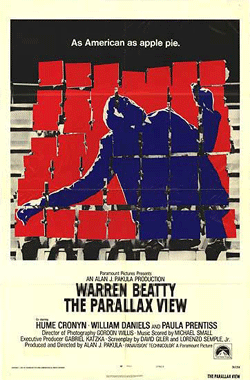
    Here’s a cool night for you: wander through the Soap Factory’s amazing 99 dollar sale and then, around 8:30, head on out for that masterpiece of paranoia, The Parallax View, part of Take-Up Productions and S.F.’s “You Were Never Here” autumn film series.

    I’m not DeSmith, but I’ll put in a plug for the art sale anyway. It’s not just that the art is 99 bucks, but it’s all the same size (5 by 7–and that’s inches, so don’t go making a Spinal Tap mistake) and the artist’s name is hidden. It’s like the best of an art gallery, grab-bag, Salvation Army collection, and Antiques Roadshow discovery all wrapped up into one! That’s might be a stretch, but it’s still a great concept, and if you go tonight, you and your $35 bucks will get wine and comestibles and first dibs at trying to figure out which is Dan Savage’s doodle, should you seek such a prize. Even better, you could end up with a David Rathman.

    Being the movie reviewer, I’ll also mention that the night will end perfectly if you wander outside and catch Alan J. Pakula’s Parallax View. One hell of a crazy movie, this. Warren Beatty plays a reporter whose colleague/lover Paula Prentiss witnesses the assassination of a prominent politician and believes it was a conspiracy. Beatty begins to believe her when she and all six other witnesses suddenly die. Soon, Beatty’s investigation takes him within the Parallax Corporation, and events begin to spiral out of control.

    It’s a terribly creepy film. Plied on fine wine and the feeling that you just bought a cheap masterpiece will make the experience even more profound. Fellows, be sure to bring your sport coats to drape over the shoulders of your lady friends, as it is sure to get brisk outside as the sun falls and your heart chills at what’s unfolding on the silver screen.

  • Dramatist, Filmmaker, Lipstick King for A Day

    presto.gif

    For those film-loving homebodies too tired to go out on a Wednesday night: American Masters profiles the inimitable Preston Sturges. Preston Sturges: The Rise and Fall of an American Dreamer shows tonight on TPT Channel 2 at 9:00.

    If you recall, the Walker screened two of his films, The Lady Eve and Sullivan’s Travels, in their Summer Music and Movies program this summer. But this guy’s history is nearly as madcap as his flicks. Briefly, the guy’s mother hung with Isadora Duncan, he invented a kissproof lipstick, and became a playwright only when recuperating in a hospital bed (and was an immediate success).

  • Got Me A Movie, I Want You To Know: The Best Songs About Movies and the People Who Make Movies

    A bee got into my bonnet the other day, and I started thinking about my favorite songs about the movie industry. Not songs from movies–those are a different beast altogether. And then there’s the songs that were used in movies that are now joined at the hip: “In Dreams” by Roy Orbison will forever be remembered as the point in which Blue Velvet really falls down the rabbit hole.

    No, I want songs that celebrate or lament Hollywood, tributes to the stars or reminiscences of some actor’s tragic demise. Here’s my half-assed list–it is by no means exhaustive. I’m sending out the clarion call: if you can think of others, please send them in. Please spare me Candle in the Wind–that song sucks.

    By the way, these are in no particular order:

    Debaser, The Pixies. A tribute to Bunuel.

    Take, Take, Take and The Union Forever, The White Stripes. The first about an obsession with Rita Hayworth; the second about an obsession with Citizen Kane.

    Lon Chaney, Chickasaw Mudd Puppies. Great song that you’ll never find–these guys (a guitarist and a guy in a big rocking chair, singing and keeping the beat with his boots) are long gone. All about the “Man of a Thousand Faces”. Nearly indecipherable lyrics, most of which are references to his many films.

    The Right Profile, The Clash. And…
    Monty Got A Raw Deal, R.E.M. A pair of songs about the tragic life of Montgomery Clift.

    Act Naturally, Buck Owens (and later sung by Ringo on Help!). “They’re going to put me in the movies…”

    David Duchovny, Bree Sharp. She’s probably regretting not going with Gillian Anderson on this one.

    King of the Mountain, Southern Culture on the Skids. Fab song about a back-woods pornographer.

    Martin Scorsese, King Missile.

    “He makes the best f–king films
    He makes the best f–king films
    If I ever meet him I’m gonna grab his f–kin’ neck and just shake him
    And say thank you thank you for makin’ such excellent f–kin’ movies!”

    That’s a short list, I know, but it’s a Monday morning, and I still haven’t had enough coffee. Send in your suggestions when you’re clear-headed.