Author: Peter Schilling

  • Could Your Kid Paint That? An Interview with Director Amir Bar-Lev

    Marla.gif

    Here’s a great night out: dinner, drinks perhaps, and then Amir Bar-Lev’s fascinating documentary My Kid Could Paint That (opening tomorrow at the Lagoon Cinema.) The story of four-year-old Marla Olmstead, the little girl who made abstract paintings that sold for nearly a half million dollars, My Kid will have you and your cohorts debating for hours afterward. Going into the film you might have opinions about whether or not this child’s parents are charlatans or saints, about the validity of modern art, about what we seek as patrons of said art. I guarantee that when you emerge you’ll be rethinking everything.

    Before watching the movie, my wife and I were pretty much at odds about Marla–I was convinced she didn’t create these paintings, my wife thought there was a good chance she was a prodigy. When it was over, our opinions were pretty much reversed.

    I had the great pleasure to interview My Kid Could Paint That director Amir Bar-Lev and ask him about the reaction to his film, what brought him to make it, and whether we’ll ever get to the bottom of this mystery.

    Rake: You’ve been to a number of showings that have involved post-screening Q & A’s. What’s been the general reaction?

    Bar-Lev: I’m happy to say that in straw polls we’ve taken after the shows we’ve found that 20% still think the parents are completely innocent. This gets at what I was trying to do with this film. I wanted to occupy a middle ground. The TV outlets encouraged both extremes: Marla’s either Mozart or a con.

    Rake: What brought you to this story?

    Bar-Lev: I read the article in The New York Times, which spoke to my own cynicism about modern art. You can assess a piano prodigy, for instance–they either play well or they don’t. But with modern art, there are questions of intentionality, and this four-year-old’s paintings challenged that. These questions are also important when judging the paintings she made on camera and off-camera. Who are we to say that one painting is more polished than another? Are there any standards?

    When I first met the Olmsteads I realized that this movie was going to be a family drama. At first, I really had no skepticism about the girl. The film happened in stages, and at first I didn’t actually see any of the things that later on made me question their story. That’s what this movie turned into–it’s story about stories, how we project what we want to onto Marla’s tale.

    When the “60 minutes” piece aired [that suggested the father coached and/or actually did the painting] I knew my documentary just got more interesting. I felt I desperately needed to get more footage to ease my nagging doubts.

    As time went on, making this film became very difficult. I didn’t sleep well for six months. There’s an interview in there that sums it up, when the mother’s telling me that she needs me to trust them, and I have to tell them I’m not sure. Going over that footage, it’s awful–when you hear your voice in an uncomfortable situation… well, I was barely capable of talking. I was sitting on documentary gold but it still didn’t feel right, having spent so much time with the family. You’re basically accusing them of lying, which is highly unpleasant especially when they trust you. But I had to hold to my own standards and get at the truth.

    Rake: It’s interesting, because there’s that scene in the car where you’re expressing your concerns out loud. You put your own doubts in the movie itself, and made yourself part of the story.

    Bar-Lev: I didn’t intend for that scene to happen. One of my interns was recording it, and fortunately they didn’t stop the tape. My role was minimal, but it was difficult to edit and it took a long time. It was emotional, complicated.

    As I said, I discovered was that this film is about adults, about people projecting what they want onto Marla and her art. It’s like Chauncey Gardner in Being There. Her childlike simplicity brings out things in people.

    The film is also about how people control information. The parents so desperately wanted their name cleared. That’s what they wanted from me. As I said, My Kid Could Paint That is a story about stories, and less about greed. The parents want that control. But it’s a Faustian bargain. By deciding to remain in the light, they actually lose more control.

    Rake: You really wanted to get footage of Marla painting, but watching the film one gets the sense that you were never satisfied. At least I wasn’t.

    Bar-Lev: I did pick the best footage of Marla painting but it never truly answered the questions. Marla would never talk about her art. It was a puzzle–at first I thought she was being bashful. But when I look at the footage of “Ocean” [the first painting captured entirely on film, though not by Bar-Lev] it’s more bewildering. You do see her employ a variety of techniques, but is it as good as the others? Can we see the same squiggle over and over again, suggesting genius? And again, is it fair to make those comparisons?

    Rake: It’s fascinating to me how one can come into this movie thinking one thing, very strongly in fact, and emerge questioning those beliefs. I was convinced the father was a con, and while I still question his veracity, the closer you get to the supposed con, it doesn’t quite add up.

    Bar-Lev: I saw this as an existentialist story. There’s no ten commandments. While there’s certainly right or wrong, it’s not in terms of art. When you stop and think about the facts of this case, no scenario makes sense. You can tell yourself that there’s no way Marla’s doing the paintings, that the father painted them or really coached her. But then the mother clearly believed her daughter painted these, so how did the father hide his own involvement from her? How did he hide it from everyone? Sometimes I think the only way to explain it is that they really have nothing to hide.

    It’s like that Escher painting, with all the steps that go up and down and all lead into one another. There’s no end, no easy way out.

    Rake: What does the family think of My Kid Could Paint That?

    Bar-Lev: Marla’s mother actually said “It’s a great film, I just wish it wasn’t about us.” I’ve encouraged them to lend a dissenting voice, and even offered them an opportunity to do the DVD commentary. But they’re distancing themselves from it. They don’t want to publicize the film in any way.

    Rake: I did appreciate that you avoided pigeonholing certain people, like Anthony Brunelli, the art dealer, and Stuart Simpson, one of Marla’s earliest patrons. If you were to make this a more good vs. evil story, Brunelli could come off as a cad, and Simpson as perhaps a fool. But they’re good people who both who truly believe in Marla.

    Bar-Lev: Anthony’s a true believer. He’s a salesman in the best sense of the word. Because he’s one of those salesmen who truly believe in their product, and that it has meaning. The paintings get sold for as much as humanly possible because of his belief, and not because he’s trying to scam anyone. He’s earnest.

    Stuart Simpson follows this story closely, and will chime in on blogs and chatrooms defending Marla. He credits her with helping him follow his lifelong dream of becoming an art dealer.

    They’re all very civil when defending Marla.

    Rake: Do you think we’ll ever know the true story?

    Bar-Lev: I think we’ll know in ten years or so. Something will happen. When Marla gets older, she’ll tell us.

  • Count Down From 100 With The Movies

    The Guardian Unlimited film blogs are hailing this as the greatest YouTube clip of all time. I don’t know about that, but it is fecking cool: counting down from 100 using classic movie clips. How many can you name?

  • The Insanely Eupeptic

    “ … Sure, it’s all there, but it’s kind of a tease. We’re definitely guilty of teasing.”
    —Joel Coen, on Barton Fink

    If you’ve visited the website for No Country for Old Men (opening November 9), you might have read the claim that the Coen brothers’ newest film “strips down the American crime drama and broadens its concerns to encompass themes as ancient as the Bible and as bloodily contemporary as this morning’s headlines.” As promotional copy goes, this is not just a bold assertion, but quite out of character for the Coens, suggesting that, for once, they have attempted to make a real-world movie and not the usual cartoonish oddity on which they have built their artistic reputations. If you’ve been watching the Coens’ movies since the beginning, you know that the boys have made their mark in peddling fun and don’t take anything seriously. But after years, this outlook has yielded films with, to paraphrase Gertrude Stein, very little there there.

    So fans of the Coen brothers have taken heart at the news that the brothers, in adapting a novel for the first time in their careers, chose a title from the decidedly hard-boiled Cormac McCarthy; coming out of the Cannes Film Festival, it was seen as a triumphant return after years of mediocrity.

    With its strange characters, Southwest setting, a complex plot involving a lost bundle of cash and plenty of outrageous violence, McCarthy’s novel shares a number of hallmarks from the Coen oeuvre—more specifically, from their noir films, which include their first, Blood Simple (1984), Miller’s Crossing (1990), and 1996’s Oscar-winning Fargo.

    Blood Simple was a cool piece of work, slow yet compelling, with its bizarre camera angles, low-life characters and their oddball dialogue, and a plot that circled back on itself like a snake swallowing its own tail. Its deadpan humor and gushing violence were great thrills in that pre-Tarantino era; personally, it made me want to make movies (though I didn’t get around to it), and seek out noir beyond Dashiell Hammett and Raymond Chandler. Eventually I discovered Jim Thompson and James M. Cain—the latter’s work was a primary influence on Blood Simple, which, as a shallow masterpiece, portended great things for its creators.

    The Coen brothers are certainly neither the first nor the last filmmakers to pay homage to their favorite cinema. After all, these were boys who, growing up in St. Louis Park, used to remake movies on Super-8, including one title, Advise and Consent, that they hadn’t seen but thought sounded cool. For a fledgling cinephile, watching the Coens’ work could lead to other discoveries through its references to Howard Hawks, Preston Sturges, Busby Berkeley, and even David Lynch. You could do little wrong hunting down the myriad references at your video store—even though it begins to expose the Coens as less than meets the eye by comparison.

    Miller’s Crossing was the single instance of the brothers’ homage working in utter service to the plot. This incredible film, based on a hybrid of Dashiell Hammett’s Red Harvest and The Glass Key, was at once their greatest work and the one movie that seemed to reflect a deeper concern for their characters. The plot bedevils anyone who tries to summarize it, but involves rival gangs, Irish and Italian, and musings on the nature of loyalty and friendship. Its violence was at once disturbing and ridiculous, most notably in the scene in which Leo (Albert Finney) shoots a man through a window, making the guy do what one critic called the “Thompson jitterbug”: a quivering gangster is kept standing by the bullets from a rival’s Tommy gun, while simultaneously firing his machine gun (and shooting his own toes off). If the manic pace and startling violence didn’t hook you, the rich characters made you want to watch it again and again.

    But after that, the Coens hit a wall called Barton Fink. It’s often forgotten that Fink was, before Fargo, their most acclaimed film, becoming the first and only movie in the history of Cannes to win best picture, actor, and director. But the movie is a strange thing, schizophrenic, the first half seeming to be their most personal effort yet, the second half a baffling parable of … what? The Coens had written the script in three weeks, supposedly in an attempt to recharge their brains while writing the demanding screenplay for Miller’s Crossing. And Fink looks tossed off: Is this merely a parody of the writer in Hollywood, a Lynchian examination of an artist’s mind, or a strange entertainment devoid of meaning? Is it just, as Joel Coen said, “a tease”?

    It’s a question that dogs their every film. In interviews, the Coens fail to answer probing questions—such as the meaning of the myriad hats that show up throughout Miller’s Crossing, or the weird scene in Fargo with Marge and her pal from high school. The brothers seem determined to obfuscate, arguing that they’re only having fun, that the movies are just entertainment devoid of connection to life in general and their lives in particular—or else they shift the focus to their detailed craftsmanship.

    At times it does seem as if the Coens look on their subjects cavalierly. When asked by one interviewer about the comic and thriller elements in their movies, the two evoked Chandler and Hammett and Cain, suggesting that those writers were grim, but that the tones were upbeat, or as Ethan put it, “insanely eupeptic.” This is a pretty shallow interpretation of these works, especially Chandler’s, whose novels are bleached with the sun-bright despair of Los Angeles. Think of the doomed Harry Jones in The Big Sleep, who gulps poison to protect the woman he loves, or the ruined blonde, Silver Wig, a tragic figure who vanishes into the night. These characters, each of whom probably takes up fewer than five pages in the book, have more emotional resonance than any figure in the Coens’ entire body of work.

    Consider death in the Coens’ films. Their characters kick the bucket in a variety of distinctive ways: buried alive, blown apart by a grenade, diving off a skyscraper, fried in the electric chair, drowning at the bottom of a river (in a knowing but ultimately empty nod to The Night of the Hunter), succumbing to a heart attack, and, most famously, by ax, then disposed of in a woodchipper. Now, in No Country for Old Men, they are dispatched by a coin-flipping psychopath wielding a slaughterhouse stun gun. But we remember the gruesome murders more than we mourn the people who suffer them. Joel Coen has said that he loathes people crying in movies. So he’s made no film that has ever moved anyone to tears, or even a lump in the throat. Even Preston Sturges, whose work has influenced so many Coen brothers films, has done as much in his madcap comedies.

    With this in mind, could the Coens be hoping to piggyback onto some deeper meaning by adapting a novel from Cormac McCarthy? From early reviews, it sounds as if No Country for Old Men sticks close to the intensity—and the spiritual gravity—of the book, and you certainly couldn’t describe this McCarthy title (or anything from him) as “eupeptic.” There’s also some indication that No Country resurrects some of the gravity of Miller’s Crossing and its literary inspiration in Hammett. As with McCarthy, novels from Hammett are sparse things, where violence explodes suddenly and affects people in all too real ways.

    This change from the Coens would be a welcome relief. While there’s nothing wrong with films as simple entertainment, if they lack any feeling, any sense of emotional connection, any characters who are remotely real, what makes a Coen brothers film any more significant than, say, the newest Michael Bay flick—except that it’s made to appeal to artsy cinephiles? Looking back at a Preston Sturges comedy, it’s easy to see how it speaks both of its specific time and of people in general. Not so with the Coens.

    For nearly twenty years, I’ve been hungering for them to make another movie on the order of Miller’s Crossing, and I’ve been disappointed with every new film. Just as I’ve come to wonder if anything truly concerns the Coen brothers, maybe the brothers themselves have come to ask themselves a similar question. And maybe with No Country for Old Men, we’ll both have an answer.

  • Eye (and Oscar) Candy

    lizzy.gif

    Monty Python’s Elizabeth: The Golden Age; The Darjeeling Limited, and Michael Clayton.

    One should never glean one’s history from the movies. Not knowing the least bit about the age of Elizabeth, the Virgin Queen of England, I can still tell you that Elizabeth: The Golden Age is about as true to the facts as any of the great Monty Python flicks, and at least as entertaining. Did the red-haired monarch really stare deeply into the limpid pools that were Walt Raleigh’s eyes, hungering for a shag but settling for a chaste kiss? Probably not. Did the Virgin Queen stand atop Dover’s cliffs in fetching chain-mail and watch the Armada burn, all the while muttering “it’s only a model.” No, again (that last part I made up.) But that’s what the movies do, and often do best: they make history sexy, exciting, and, whether intended or not, hilarious. And let me tell you, there’s lots to laugh at in Elizabeth.

    Elizabeth is a stellar production, a sumptuous feast for the eyes, and one that boasts a top-notch, Oscar-hungry cast: you’ve got the lovely Cate Blanchett, normally moody Clive Owen (a bit out of his element as the scallywag pirate Walter Raleigh), the always reliable Geoffrey Rush, and the underrated actress Samantha Morton, who will someday get a decent role to chew on (perhaps in the forthcoming Joy Division biopic, Control.) Throw into the mix a riotous screenplay that never really takes itself too seriously, and you have yourself a time-killer that’s loads of fun provided you don’t think too much about it.

    In this Elizabeth, there’s an evil Spain hell-bent on taking control of England in a variety of ways. (This might have also been the plot of the first–I don’t remember that one at all.) They want to install Mary, Queen of Scots (Morton), still a Catholic girl, and hopefully someone who’ll inspire the country’s legions of Pope-followers into revolt.

    There are two ways that they can overthrow England: They can assassinate the Queen. Or they can outright attack with the famous Spanish Armada. The leader of the vile country of Spain is Philip II, played by Jordi Molla, who gnashes his teeth and wrings his hands as if he’s about to cackle “No one expects the Spanish Inquisition!” Later, people will try to kill our Lizzy, the Armada will attack and be turned away, and there will be intrigue and romance and kisses in front of soft-lit fireplaces. If you’re not laughing at these scenes as I was, you need to lighten up, man

    Elizabeth, then, is not much different from Spider-Man, or Transformers, is it? It’s got love and action and instead of men in tights or machines, you’ve got men in pantaloons. A big budget emptiness meant to pack theaters and kill time. Except that this one has a tenuous connection to history and scores of Oscar winners on the payroll, not to mention people who want Oscar’s gold, so it’s somehow more important than what springs from Michael Bay’s mind. The scenes with the Armada attack are nothing more than CGI, and poorly staged at that–the director, Shekhar Kapur, would have been wise to stay inside the castle.

    Elizabeth is fun, if a bit long in the tooth. Going over to the film’s website, I couldn’t help but notice, in the “interactive timeline”, a mention that Sir Francis Walsingham, the Queen’s advisor, was considered by many historians (real ones, not the advisors to this film) to also have been her lover. That’s Cate Blanchett and old Geoffrey Rush for those of you keeping score. Probably it’s easier to digest the notion of Cate and Clive sharing a loving embrace, but while the thought of a tryst with Walsingham and the Queen might seem a bit dodgy, it is so much richer. History, perhaps, shouldn’t always be ignored.

    Wes Anderson’s The Darjeeling Limited, his first since the risible Life Aquatic With Steve Zissou, begins with a running start. Both an aged Bill Murray, dressed in a 50s suit and hat, and young Adrien Brody, are running to catch the eponymous locomotive. The youth prevails, and watches the gasping Murray stare bewildered at the distance growing between them. It is a beautiful, funny, and strangely moving scene. One has his whole life ahead of him; the other is watching life pass him by.

    From there, Anderson introduces us to the three brothers, Francis, Peter and Jack (Owen Wilson, Brody, and Jason Schwartzman), who are taking this trip at the behest of the oldest brother Francis, whose head is swathed in bandages from a horrible car accident. They are brothers, and at the beginning of this flick, perfectly realized. Francis orders everyone about, tries to shove peace and reconciliation down his brothers’ throats. The youngest, Jack, is a free-wheeler, putting the make on the sexy girl in the train, although he’s also trying desperately to forget his former flame (played briefly by Natalie Portman.) (Note: To get the background for this relationship, check out the “prologue” to Darjeeling, a short called Hotel Chevalier.)

    Brody’s Peter is anxious about the coming birth of his first child. He also can’t believe that he’s not divorced yet–he loves his wife, but the weight of his parents’ failures are almost too much for him to bear.

    And all three brothers are still reeling at the death of their father, struck down by a taxicab in New York City just a year earlier. That, and the fact that their mother has sequestered herself into a temple in the mountains of India, and has refused to see them, even going so far as to miss their father’s funeral. Obviously, these boys have issues.

    At first, The Darjeeling Limited is simply wonderful. These three goofy Americans are touched with new-age spirituality and an earnest desire to try and fix what’s broken in their lives. The artifice in every scene is a perfect reflection of the emotional lives of these boys–and, despite their ages, they are boys–and we are at once swept up in the beauty of the set design, the camerawork, and the way these work in conjunction with the actors and their material. The train is a metaphor for their own sheltered lives. Anderson knows boys, he understands the crazy ways they try to assert themselves, their secret language and the in-jokes they make to one another, and the clumsy ways they try to open their hearts. TWilson, Brody and Schwartzman display beautiful chemistry–they seem as though they’ve been sharing sleeping quarters and arguing between bunk-beds for years.

    Would that they stayed on the train. Thanks to Peter’s bringing in a poisonous snake, the trio’s kicked off the Darjeeling Limited, and from there Anderson seems utterly lost. The train is symbolic of the cocoon these man-children have lived in and will probably always live in, and it’s fine and dandy to see them shagging a bored Indian girl or insulting the German tourists next to them. It’s another thing altogether for Anderson to try and ratchet up the emotions by having the brothers save a couple of young boys from drowning in a river, only to lose another. And when Anderson takes our heroes into the village, and heaps on the details of the Indians’ poverty and grief, the shallowness of the brothers becomes apparent to everyone but the director. The young child’s funeral is so secondary to their own story as to be deeply insulting: if Anderson’s going to show us the father’s pain and suffering to such degree, then don’t cut away to a slo-mo of the three walking to the ceremony with the Kinks blaring away.

    Sadly, The Darjeeling Limited never regains its footing. This is a shame, because for a moment Wes Anderson, who is a truly original voice in American cinema, had himself a film that was both touching, funny, and strangely wise. It has wonderful performances, including small roles that make one marvel at the joy of great character acting. But Anderson doesn’t understand his boundaries. His three boys morph from being three confused souls and turn into three asshole Americans who can’t see past the end of their broken noses.

    Michael Clayton looks good, and, man, it certainly sounds good. Tony Gilroy directed the flick, from his own screenplay, which he obviously adores. Gilroy was the screenwriter for the Bourne series, which are some of the greatest spy thrillers ever made, but their screenplays weren’t their strength. But someone doesn’t agree with that assessment, because Gilroy was given the keys to the kingdom, being allowed to direct his own “thriller”, and people it was some big stars, most notably George Clooney. Unfortunately, Michael Clayton’s script, which will be soundly praised, is nothing more than smoke and mirrors.

    The film opens with a breathless speech by Arthur Edens, played with tremendous brio by Tom Wilkinson, another of our unheralded actors. Edens has gone crazy. Normally the chief council for a law firm defending a pesticides company that’s killing people, he meets one of the plaintiffs, a beautiful farmgirl whose parents died from the poisons his company has sprayed all over this great green earth. Upon seeing this vision of feminine loveliness, he loses his mind and, seeking to purify himself from the wickedness of his ways, decides to strip naked during a deposition and renounce his life.

    In comes George Clooney’s Michael Clayton. Clayton is a fixer. He’s going to set everything straight. The fact that he never does in the course of this film, nor does he seem to be able to even convince people that he has any authority whatsoever does not to be of any concern to us, since everyone says he’s the man who fixes things, we’re meant to believe that. Needless to say, Edens won’t go away, the giant company murders the poor man, and Michael Clayton has a spiritual awakening.

    The problem isn’t that the plot is an old, haggard thing that’s been recycled from better paranoid flicks from the 1970s (such as The Parallax View or Network, movies that had no problem ending on cynical, dour note, as opposed to Clayton’s triumphant end), but that Tony Gilroy is no Paddy Chayefsky. Namely, a writer whose words dominated his films. Chayefsky (Network) knew that his speeches needed to excite, needed to make the characters real, and needed to move the plot forward. Michael Clayton is so full of empty bluster it never ends up being about anything, saying nothing about our times or the characters that people the film. The film is full of startling contradictions: the murder of a key character is a great scene, meant to show us that the heavies who do this dirty work are professionals of the highest order. They kill in such a way as to leave everyone believing this was an accident… and yet, they try and off Clayton with a car bomb. What?

    Subplots take far too long to play out, the dialogue has no snap, the women in the film are treated as either virginal young things or dry, shrewish corporate mouthpieces. And Clooney is way out of his league: moments where he’s supposed to be awakening to the truth make him look like a deer caught in the headlights. Clayton’s ending, too, is an insult: back in the days of The Parallax View (a film that Clayton is similar to) we weren’t force fed a happy ending. The characters in 70s paranoid thrillers were often destroyed by the machine. It was up to us–the audience–to emerge from the theater frustrated and angry, to take that anger home and maybe, just maybe, pay attention to the shitty things corporations did and do something in real life.

    Michael Clayton will garner its nominations and the script, which is created partially to call attention to itself, will surely get a nomination and probably a gold statuette. Strip away the excess dialogue, some of which is very good (if not well done by Tom Wilkinson, at least) and you’ll find that the men and women are cliched, the plot is creaky and often contradictory, its ending insulting. We deserve better than this.

  • Conversations Real and Imagined: The Past, The Past, Into the Past!

    brand!.gif

    Brand Upon the Brain!. Now showing exclusively at The Parkway Theater.

    You might find this strange, but here goes: I often wonder if cinema was ruined with sound. That the noise and the clatter wrecked an image that so subtly tapped into your subconscious, made you dream differently, hell, even live differently. Have you ever seen a silent movie? Or even better, watched it on the silver screen? I have, a number of times. That’s all I do, it seems. Watch the silents, enjoy pure cinema. In theaters it’s so different: to sit with that many people, in the quiet, with only a piano tinkling away in service to the story. Once, I even closed my eyes. Piano. And then reaction. Gasps, laughter. The darkness and the silver quaking past my eyelids. Give me the silents–oh, the movies were never better. But I was born too late. I missed it by a long shot.

    I’ll tell you something else: benshi. That’s right, a benshi, those crazy Japanese performers who narrated silent film all those years ago in mighty Japan. Live performance, a man in a flowing robe, explaining poetically the scene as it unfolded behind him, or, like a haiku, in few words and timed hush, allowing the image to move you. Often, this fellow would make sound effects. Sometimes he would do a back flip upon the death of a character. Or pull out a sword, its blade glistening in the light of the projector. Each town had its own benshi, their favorite, and I like to imagine great silent films coming to our town, in a painted van, with fanfare, and our favorite benshi doing his thing for our utter enchantment. A piano accompanying. Maybe a cello. I love the cello.

    If I told you that there was a silent film in town, with a benshi, you’d go, wouldn’t you? I mean, if I told you to shake that little metal ball in there–tap, tap–in your brainpan, the one that rattles like a can of spray paint, and dredge up all that strange and foggy memory that’s settled in the sludge of daily life, you would, wouldn’t you? I mean, if I told you a movie could do that to you, make you a human being composed of moment and memory, you’d beg me for information, right? You’d say “To hell with the Cineplex, to hell with George Clooney and the Rock and malls!” and you’d drop your plans and go sit in an old neighborhood theater and watch something that, later, made you shiver?

    This is Brand Upon The Brain! It is playing in an old movie theater whose front rows are comfy chairs. Painted on this theater’s walls are strange images on billowing, dusty curtains. When the lights go out, they go out, and there’s quiet, not the thump, thump of whatever movie’s blundering about next door.

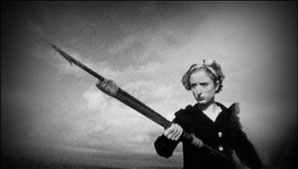
    Brand Upon the Brain! is black and white and silent. Brand gives us music, beautiful music, melancholy and thrilling, and reminiscent of the sea. You can almost smell the brine from the moan of the cello. Isabella Rossellini narrates, breathlessly, ordering us to participate, shouting her entreaties. She is a benshi, and one of the best. Of course, there is only a recording of Isabella, sweet Isabella. But she is our only benshi, sadly, and she wears that international crown with pride. “The past, the past, into the past!” she shouts, and with her we are thrust headlong into that past. We follow Guy Maddin, filmmaker, into his past and discover, simultaneously, that there are some discomforting parallels in all our childhoods.

    What is it about? Man returns to island of his youth, called back by his mother, paints a lighthouse, cannot cover the grime, and falls back into the sticky tar-baby of memory. This past involves sexy detective work (with harp-playing shamuses), horrific childbirth, and a plot to drain the youth-giving orphan nectar from the kids who are housed there. There are mad scientists, the Undressing Gloves, the Light-Bulb Kid, a turpentine bath, and the great line, “What is a suicide attempt without a wedding?”

    There are beautiful women, rugged men who get caught in their memories like a sailor trapped in a tropical storm, there are orphans, and, as mentioned, orphan nectar. There is science fiction, witchcraft, cross-dressing, and the manic, fearful, joyful and confusedly sexual life of a child.

    What… are you scared of the silent film? Worried that you’ll be bored? Oh, you won’t be bored. Do you get bored when you dream? When you reminisce? When some little thing triggers a decidedly uncomfortable memory? That’s not boredom, it’s fear. Confront your fears my friends. Brand Upon the Brain! is a time machine, into cinema’s past, coming to us from Winnipeg, through Japan and American movie history, and somehow pitching its tent on the rocky surface of your own moony memories. As much as I love Isabella, if we were truly lucky, we’d have our own benshi, some lovely actor or actress gesticulating and singing and wielding harpoons on stage as this silver, silent madhouse shines on.

    Then again, it’d probably be Garrison Keillor.

  • Plant A Tree, Destroy The World

    Conservationist Ted Williams (the writer, not the frozen ballplayer) argues that the wanton planting of trees by short-sighted environmental groups (like the Arbor Day Foundation) are actually hurting the planet. (Though the link is to his blog, the article originally appeared in the “Incite” section of the always thought-provoking Audubon Magazine).

  • Dance With the Sailors on the Silver Screen

    OntheTown.gif

    Movie musicals–I love ’em. This magical celluloid hybrid of dancing, singing, acting, and (very importantly) cinematography simply amazes me. If Broadway’s your bag, that’s wonderful, but I’ll take cinema’s version any day: on stage, it would impossible to track Gene Kelly as he splashes through the Hollywood streets in that iconic scene in Singin’ in the Rain. To make that scene perfect, you need the camera swooping around the hoofer as his umbrella swings around and around, and then you join him as he ascends the streetlight, the camera rising to meet him in the sky… simply awe-inspiring. Furthermore, if you want to experience the full force of these treasures, well, get thee to the big screen, my friend. This week, our pals at the Parkway Theater are presenting, for our viewing pleasure, two sassy little Gene Kelly/Frank Sinatra MGM numbers, On the Town and Anchors Aweigh.

    On the Town is a personal favorite, the first MGM musical to be filmed on location in New York City. The story, as usual in a movie musical, is nothing more than cotton candy: three sailors, Gabey, Chip and Ozzie, (Kelly, the Frank, and horse-faced Jules Munshin, respectively), have a one-day leave. So they decide to hit the town, visit all the sights, drink milkshakes and dance… you know, like sailors do on leave. Along the way, our heroes meet three girls–the saucy cabdriver Brunhilde Esterhazy (Betty Garrett–what a cutie) who lusts after Chip with singular determination; the anthropologist Claire Huddesen (Ann Miller, whose last role in this world would be the creepy landlady in David Lynch’s Mulholland Dr.), who sees in Ozzie the remnants of a sexy prehistoric man; and Ivy Smith (Vera-Ellen), Miss Turnstiles, a dancer whom Gabey falls in love with.

    By some insane coincidence, Miss Turnstiles is from the same milkshake-and-clover small town that Gabey also calls home, there’s a mean old Russian piano teacher who has Ivy in her clutches, and a horrible running gag about Lucy Shmeeler (Alice Pearce) being just about the ugliest woman in the world (it’s actually quite disturbing how they make fun of this poor lady). But the musical numbers are dynamite, with its book and lyrics by Betty Comden and Adolph Green (who gave us the masterpiece Singin’ in the Rain). Despite the fact that it was filmed on the Brooklyn Bridge, in Rockefeller Center, and the Empire State Building, directors Stanley Donen and Kelly (again, the minds behind Singin’) gave On the Town the needed intimacy that one would usually associate with a movie shot in a studio soundstage. And being a Gene Kelly musical it has one of those crazy dance sequences toward the very end.

    Anchors Aweigh is also highly regarded–it’s famous for the scene with Gene dancing with the cartoon mouse Jerry. Frank Sinatra’s also in tow, and the pair also play sailors on leave.

    These are a pair of great movies for young and old–I imagine children especially taking to dancing like cavemen in the “Prehistoric Man” number from On the Town, or singing, as I did when I was a pup, that movie’s opening tune “I Feel Like I’m Not Out of Bed Yet”, and trying to hit those low, low notes. I still sing that song today–it just gets the morning started right.

  • First Thoughts on The War

    Ken Burns’ The War launched last evening. It was virtually impossible not to know this, as it had been advertised almost literally everywhere, and if you have any interest in anything that public radio or television broadcasts, you’ll have heard or seen tons of ads already. As usual, Burns is exceedingly earnest, and, as usual, The War–like The Civil War, Baseball, and Jazz before it–is being not-so-subtly billed as the definitive account of that incredible event. Unfortunately, the first episode is an unholy mess, weighed down with cliched narration and an irritating soundtrack, a confused narrative that lurches forward and stumbles back in time, and interviews that are both startling for their candor and startling for their tedium.

    I had the very great pleasure to interview dozens of World War II vets for an unpublished (and unpublishable) first novel that I wrote many years ago. As in The War, the men I spoke with were gentlemanly and brave–it is no small feat to recount such horrors, not to mention to pause mid-sentence to try to keep oneself from weeping in front of a perfect stranger. But these were the fascinating interviews: in every conflict are the men and women whose lives only marginally touched the grinding machine of war. Some of the men I spoke with (they were all Navy combatants) had enlisted at the tail end of the war and the whole of their experience was tooling around the coast of America.

    There’s nothing wrong with that–my own Grandfather Derr was drafted into the occupying Army that wandered the ruins of the far East in the wake of World War II. He had no horrors to recount, and I’m damn glad for that. My other Grandfather, Grandpa Schilling, was a medic who landed in Normandy two hours after the first soldier hit the beach on D-Day. He was haunted by that experience his whole life, and never spoke of it except to my Aunt Mary. I wish that he had seen only peace. But there were also countless people who remained at home, and many have great stories to tell about the trials of living at home during the war.

    But Burns doesn’t seem to get that there’s also a lion’s share of people whose experiences were, well… they were boring. Perhaps because he limited himself and the scope of his film to the tribulations of the citizens of four small to smallish towns in America. (Those towns are Sacramento, California; Mobile, Alabama; Waterbury, Connecticut; and Luverne, Minnesota.) For instance, Burns gives us the testimony of the man who befriended a young English kid, and we’re told that this British boy lost his dad to a German submarine, and he (the narrator) felt just awful hearing about that. Well, Mr. Burns, it is probably much more potent to have interviewed someone who actually lost their father, rather than a second hand account. There are many such discussions, usually with the same people.

    Even worse, Burns got into some trouble for initially excluding Hispanics and Native Americans from this story, which is a grievous error. So Burns tacks on a few interviews with Hispanic soldiers (after a heinous Norah Jones song that was obviously meant to close out part one.) This section is suddenly riveting, and makes it appear as if the protest were less about including Hispanics and more about making this thing actually entertaining.

    Would it have been so awful to have included a major city in The War? Why only small towns? Including, say, either Los Angeles or Detroit would have given Burns myriad sources from various cultures and first hand accounts of two of the most famous riots in history: the Zoot Suit riots of ’42 or the Detroit race riots of ’43, both of speak volumes about race and the war at home.

    The War is a diffuse effort, a film that juts and sways all over the historical map and can’t seem to find its footing. One minute you’re in Hawaii during Pearl Harbor, then you’re in Europe in 1939, then you’re back listening to an elderly woman recount how they really didn’t like Hitler in Mobile, Alabama, and you go “what?” Tom Hanks makes his appearance, narrating–they can’t make a movie about the Second World War without his participation. Too often, we get lofty speeches about what the war meant, in lieu of first hand accounts of the suffering. The old soldiers descriptions of Bataan and Pearl Harbor say so much more than you ever could, Mr. Burns.

    What The War made me yearn for was some Studs Terkel and specifically his World War II masterpiece, The Good War. The Good War is a surprising work, and its people never boring, but often shocking to the extreme. Studs knew enough to find folks from every walk of life, in the small towns and the great cities, in the halls of Washington and the ghetto. He spoke to the men and women who felt the war was justified, the downtrodden who fought despite knowing that they had their own fight for freedom back home, and the few brave souls who objected to this war and sat out. It is a crazy book, and Burns could stand to have some of the real madness that accompanies war in his epic.

  • “We Was Right All Along”

    On a perfectly sunny day for a baseball game, as thousands of fans swarmed to the dust heap that is to be the future home of the new Twins Stadium, a good half-mile away a small but dedicated group of curmudgeons gathered outside Cuzzy’s Bar on Washington Avenue. They were preparing for their own little celebration. “We’re geniuses, you know,” boasted Julian Loscalzo, chewing on a fat cigar and quaffing the first of many beers. “My good, personal friend Sid Hartman used to call us geniuses, back when he was all for the Dome,” he explained, his words punctuated by hoarse laughter. “We’ve proven him wrong by actually being geniuses.”

    Loscalzo used to be a beer vendor at ballgames and other sports events around town; now he works as a tour guide, hauling paying guests around the country to see outdoor baseball, and counts selling parking spaces at the State Fair among his many other occupations. He is also the de facto leader of the Save the Met organization. This is the same ragtag collection of baseball cranks that tilted at windmills in the mid-1970s, hoping to persuade the Twins to remain at the scenic Metropolitan Stadium rather than move to the Metrodome. All these years later, Loscalzo and Co. are feeling a tad vindicated by the Dome’s impending obsolescence. Thus, a “We Was Right All Along” march down to the new stadium site was in order, replete with an old “Save the Met” banner from someone’s attic and well-preserved T-shirts bearing the same slogan, along with the likeness of the Twins’ old haunt.

    Michael Samuelson (“Sammy” to friend and foe alike), was part of the original sturm und drang, going so far at one point as to vow publicly never to set foot in the Dome. “And I didn’t go for two years,” he claimed. But, he noted, his love of the game overwhelmed his principles—and besides, “if it weren’t for the Dome, I would never have met my wife.” Loscalzo shook his head. “I never made the promise that I wouldn’t go. I knew better. I’m a big fan.”

    The “We Was Right” march didn’t amount to anything resembling, say, the recent Critical Mass bicycle gathering that sent not a few people to the clink for a long weekend. In fact, the Save the Met group kept to the sidewalks and their banner remained under wraps until they reached the construction site. Probably their only transgression involved chugging cans of Gluek beer in public.

    Once at the site, the clan gave some weak cheers to other protesters who were unable to enter the ceremony, whose handmade placards read “Foul!” and “Corporate Welfare,” among other admonishments. Although the Twins security granted access to the Save-the-Metters, Loscalzo paused and considered, instead hanging the sign on a fence. “I don’t know if I have the stomach to go in there.”

    Inside, there was little strife. In front of a large stage, a temporary diamond was set up, with actual Major League bases and thick swaths of deep green sod, all of which was surrounded by bleachers. Fans of every stripe were on hand, taking photos of dirt, eating dollar dogs and brats, and watching videos touting the new arena. Most of the crowd was suited up from a day of work, but there were also families in from the ’burbs and bicyclists galore—lines of bikes were chained to the fences. A few protesters stood on the Seventh Street overpass, trying desperately to get their message across; one sign read “Make necessary bridge repairs, not war.” But the amplified speeches by Twins alumni—not to mention the steady din of the garbage incinerator next door—kept their shouts from being heard below.

    One fan, Willie Rauen, an elderly gentleman from Pine Island, was holding aloft an old seatback from Met Stadium. He’d yanked it out during the last game ever played at the Met, which happened to be a Vikings and Kansas City Chiefs game. “Some guy had a wrench, and I took my seat,” Rauen crowed. “Others went crazy. They took toilets!” The front of Rauen’s seat—Number 8, “by the first base side”—was autographed by various Twins from that era, including Harmon Killebrew, Tony Oliva, and Rod Carew; Rauen was determined to get the front autographed by current Twins when the new stadium opens. “This is a pretty good piece of history here.”

    As Commissioner of Baseball Bud Selig began to speak—among other comments, he inexplicably suggested that the best thing about the groundbreaking was that it made Carl Pohlad smile—a chant emanated from the back of the crowd. “Con-trac-tion!” bellowed the Save the Met group, and this time they were joined by a larger crowd with still more beers. Loscalzo received hugs from a number of women. Someone blew a raspberry. A man who looked very Wall Street shouted, “Give me a tomato and I’ll hurl it at ’im!” Finally, Loscalzo beamed at the small crowd that had gathered around him to admire the banner, which, he claimed, had been to the Baseball Hall of Fame. He toasted it with his Budweiser. “We made it,” he said, wearily. “Thirty fucking years.”


  • My Kid Could Paint That

    In 2004, director
    Amir Bar-Lev first approached the parents of young
    Marla Olmstead with the idea of making a documentary of her extraordinary talent. Over the course of a year, this four-year-old girl from Binghamton, New York, sold nearly $300,000 worth of abstract paintings, was covered by news outlets from around the world, and then, on 60 Minutes, had her reputation sullied by accusations that her father was the real artist, or at least an over-imposing coach.

    .

    Bar-Lev’s masterful My Kid Can Paint That leaves viewers questioning what they see, and pondering the nature of modern art, parenting, and the role and responsibility of the media.

    Uptown Theater, 2906 Hennepin Ave., Minneapolis; 612-825-6006.