In the strange Earrings of Madame de …, a lonely woman, cloistered in an upper-class existence of endless soirées and empty finery, sells the pair of diamond earrings her husband gave her on their wedding day; the unnamed heroine needs spending money to cavort with her long queue of suitors. Oddly enough, the earrings make a complete circle, going from jeweler back to husband, from him to his mistress, then lost gambling in a casino, then back to our eponymous Madame (given to her by the paramour with whom she eventually falls in love). Max Ophüls’s moving 1953 picture is not so much an indictment of upper-class mores (both husband and wife make no secrets of their affairs), as it is an examination of the complex trappings of love, jealousy, and marriage.
Author: Peter Schilling
-
There’s Always Tomorrow
Oh, that Douglas Sirk. The king of suburban ’50s melodrama is being given his due at this year’s Walker Summer Music and Movies program, and it’s about time. In There’s Always Tomorrow, Fred MacMurray—possibly the most underrated actor of his generation—plays a successful family man who is, nevertheless, plagued by disappointment. His wife is focused on their kids, who live their own lives and leave Dad pondering the meaning of it all. And then in walks Barbara Stanwyck—remember their pairing from Double Indemnity?—and sparks fly. But while the wife remains oblivious to her husband’s absence, MacMurray’s oldest child suspects treachery. Per the usual with Sirk, emotions are crushed beneath the stifling norms of the ’50s, and no one can emerge unscathed. 612-375-7600; www.walkerart.org
-
Vitus
When it all boils down, Vitus is nothing more than a story about a child prodigy who seeks to be a normal boy. But in the hands of director Fredi M. Murer, the simple tale becomes a small but complex masterpiece about the universal difficulties of childhood. Murer, who is unknown in this country but considered Switzerland’s greatest director, obsessively captures the details of youth, including the rich interactions between child and adult. You will not find a movie that better addresses the pains and frustrations of childhood. Vitus is a must-see for parents seeking to challenge their children. Something tells us Mom and Dad will be moved, as well. 651-649-4416; www.landmarktheatres.com www.landmarktheatres.com
-
Ratatouille
This collaboration between writer/director Brad Bird (The Incredibles) and the animation geeks at Pixar takes the medium to new heights. Ratatouille is the simple tale of Remy (voiced by Patton Oswalt), a rat hiding in the shadows of a famous Parisian restaurant who seeks to become a chef. Like The Incredibles, Ratatouille is a comedy of startling action, consistently hilarious jokes, and mechanically brilliant slapstick. But the film is also a deeply felt meditation on the pleasures of hard work, friendship, eating (of course), and, surprisingly, the often cantankerous relationship between artist and critic. Avoid pigeonholing this one as a child’s diversion; Ratatouille is a profound joy, and the best film of the year.
-
The Chill Shack
“I made this so that my daughter Ayla and her friends from Watershed [High School] could have a place to hang out,” said Phil Vandervoort of his “Logville Café.” The café is a sort of a miniature shed/diner amalgamation, a rec-room that ascended from the basement and set up in Vandervoort’s South Minneapolis backyard. Its walls, made of cast-off goods from his sign-painting job, are a testament to his faith in the re-use philosophy—as are the used chairs scattered around the fire pit and the giant spools used for fencing. Ayla has since left home for college, but her friends can still be found at the café, nursing cups of Vandervoort’s strong coffee while lounging in salvaged wood booths from a long-gone diner. The structure is partly sheltered by a black locust tree hung with a trio of vintage plastic rocking horses. As the tree ages, Vandervoort hopes the wood will envelop the horses, so that someday, if he has to cut it down, he might have an intriguing piece of art on his hands. “We do three things with old stuff—turn it into art, use it, or burn it,” Vandervoort said. He knocked on an old sign, pulled from the set of Feeling Minnesota. “These old things deserve to go that way. They’ve served humanity well.”
-
Killer of Sheep
Shot on location in the Watts neighborhood of Los Angeles in the early ’70s, Killer of Sheep tells the neo-realist tale of Stan, an African-American man numbed by the pressure of life in the ghetto and his slaughterhouse job. Director Charles Burnett’s movie is also widely considered one of the finest examinations of children’s reaction to crushing, inner-city poverty. Because Burnett never secured the rights to all the songs comprising his film’s score, the sublime Killer of Sheep never had a commercial release; in fact, during the past thirty years, it has become a well-known but ultimately hidden treasure. It was one of the first fifty films placed on the National Film Registry of the Library of Congress and proclaimed one of the hundred all-time greatest movies by the National Film Critics Circle. This long overdue theatrical release is not to be missed. 612-825-6006; www.landmarktheatres.com
-
La Jetée and Sans Soleil
At least one critic has dubbed Chris Marker a “cosmonaut”—this in apparent admiration of the French documentary filmmaker’s ability to make other cultures look like products of distant planets. Marker’s documentaries jettison conventional narrative, instead telling stories by way of letter-writing and striking imagery. Sadly, his fascinating oeuvre has rarely, if ever, been seen in this country. But the good folks at Criterion are now trying to remedy this problem by releasing Marker’s two most popular films on DVD. Sans Soleil (1983) involves odd footage of Africa and Japan—images of people and their ceremonies paired with poetic observation. La Jetée (1962), Marker’s sole fictional work, is a thirty-minute photo-roman—that is, a variety of stills culled together—with narration. The movie is a short and stunning science fiction work and noted in this country as the inspiration for the inferior 12 Monkeys. With its striking imagery and haunting story of time travel, love, and the trap of memory, you can watch La Jetée in the time it takes you to sit through an episode of My Name Is Earl, and be moved in ways you never imagined.
-
Knocked Up
Judd Apatow seems to be everywhere. He was the executive producer of the critically acclaimed television show Freaks and Geeks and the writer-director of The 40 Year-Old Virgin. He will also lend his imprimatur to the upcoming teen sex comedy Superbad. In the meantime, he has produced another ribald farce in the style of Virgin (sans Steve Carell). In Knocked Up, a lovable stoner and budding internet-porn businessman played by Seth Rogen impregnates the Ashley Judd look-alike Katherine Heigl. She’s a gorgeous television personality; he’s a loser with a heart of gold. When they decide to have the baby together, laughs ensue. That’s the formula anyway, and what made Virgin work so well was Apatow’s fondness for Altman-like conversation and his healthy respect for these flawed, immature characters. (A plethora of dick- and boob-jokes didn’t hurt matters either.) Here, though, Apatow seems to think he’s making serious commentary on parenthood. Clocking in at two hours and ten minutes, it’s a bit long-winded. Still, much of the humor won’t be matched by any other movie this summer—in particular, there’s a hilarious passage about shaving one’s privates.
-
Mr. Brooks
Kevin Costner plays the upstanding Earl Brooks, a family man and business leader who just happens to also be a serial killer with an alter ego named Marshall. Our starring cast includes Costner, Demi Moore, and William Hurt … well, that makes three actors who have seen better days. And yet, Mr. Brooks was written and directed by Bruce A. Evans, the guy who penned Stand By Me and the underrated Starman. Sometimes—not very often, but sometimes—these types make decent, straightforward, and entertaining B-movie fare that’s good for passing a summer evening. They did it a lot during the golden age of the studios, generating movies still watched today (such as Desperate Hours and the original Cape Fear). Who’s to say they can’t still do it today?
-
What To Watch When You're Watching At Home
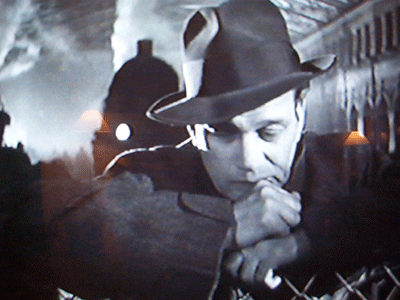
Lots of great (or intriguing) DVDs coming out this week: Pan’s Labyrinth, Army of Shadows, La Revue des Revues, something freaky called Woodenhead, and Darren Aronofsky’s baffling Fountain, which I walked out on because it was so incomprehensive. And stupid.
But today marks the 102nd birthday of the great Joseph Cheshire Cotten (thanks to Steve Monaco for the reminder). Cotten’s one of my favorite actors, and appeared in two of my favorite films: Citizen Kane and The Third Man, the last of which just recently received the Criterion treatment all over again. Cotten was a close pal of Orson Welles and had a significant role in the big boy’s Mercury Theatre–in fact, Joe was pressed into writing the screenplay for Journey Into Fear, some scenes of The Magnificent Ambersons (when Welles had vanished into Rio to film It’s All True), and was a go-between for Welles and RKO over the Ambersons mess (all of which is a long, long story for another day).
Cotten was a likeable onscreen personality, with nary a whit of sex appeal, but perfect in the role of The Third Man’s Holly Martins, the bumbling guy who can’t get the girl. Cotten was an everyman, but one with a terrific sense of humor, a biting wit, and whose frustrations bubbled just beneath that weary smile of his. He made his name in theater first (originally a critic), playing the Jimmy Stewart role in the original Broadway production of The Philadelphia Story. He starred in Hitchcock’s personal favorite of all his films, Shadow of a Doubt and his menace there is palpable. Other greats, many of which are available at your library or local video store, include The Farmer’s Daughter, Duel in the Sun, and Gaslight.
Oddly enough, Cotten also is present in the very opening of Kane, playing one of the reporters in the shadows–you can see him there, grinning, eager to be a part of that crazy production. Above all, he looked like a man who relished being in the movies, and giving us a solid night’s entertainment. Priceless.