Tag: 35W bridge

  • Looking Back on 2007

    Say you were offered the option to go forward or backward in a time machine. Which would you choose?

    If science fiction is any indication, most people would leap ahead to find out what the world will be like at some future time. Me? I’d go back: to the Last Supper, to Ludwig Beethoven’s Vienna, to the birth of my firstborn. I’m fascinated by what has happened and by the changes wrought. Whereas others blow horns and throw confetti, kissing strangers and drinking too much to welcome the new year, I tend quietly to look to the past.

    This is why I love those recap shows — even the really sappy montages set to music — that show the events of the previous year. It never fails to awe me how much transpires in so short a time and how long the events echo.

    In 2007, for instance, we as a world suffered the loss of Kurt Vonnegut, Ingmar Bergman, and Luciano Pavarotti. There were other deaths, of course, which for whatever reason don’t rank as high on my personal list. I’ll admit I’m irrational. That Norman Mailer finally shuffled off this mortal coil, leaving some 17 wives and 98 children, seems fitting somehow; but the silencing of Vonnegut’s wit and preternatural understanding struck me as abrupt and left me cold.

    There were the iPhone and the Kindle; the collapse of the 35W bridge; the massacre at Virginia Tech; and the real estate crisis that precipitated a slow-moving but monstrous economic slump. As a result, people are reading The Da Vinci Code on handheld screens. Commuters of sound mind are taking long detours to avoid crossing rivers. College professors who teach writing are on alert (I know, because I am one) to pick out troubled students. Once secure and successful homeowners who thought they’d made a failsafe investment are going broke. And all this took place in the space of a year.

    In my smaller corner of the world, 2007 was the year I celebrated my one-year wedding anniversary to a man I never expected to meet — and whom I did not yet know on New Year’s Eve 2005. I was 39, the longtime single mother of three teenagers, and happily resigned to a life of independence (though far less happily to a life of celibacy) when we brushed against one another for the first time in the Heartland Wine Bar. That we are now a family simply amazes me.

    I also watched the resurrection of my older son — the one whose birth haunts me because of its profound normalcy — from a trancelike condition called autistic catatonia. In 2007, I allowed the doctors at Mayo to hook my child up to machines and jolt him with electricity in hopes it would bring him back to life. And in the sort of weird coincidence that appears in books like The Sirens of Titan, I took comfort from the fact that Vonnegut once made the same decision regarding his son, Mark.

    I spent an afternoon with Leonid Hurwicz, the 90-year-old winner of the Nobel prize who fled the Nazis as a young man and came to Minnesota where he developed economic theories touched with the humanity of one who knows both honor and sin. I met Max Fink, one of psychiatry’s most well-known and controversial figures. I finished my second novel. I joined the staff at the Rake.

    Truth? I also culled a lot of people out of my life this year. It happened around the time of my son’s illness as the community I knew divided neatly into those who remained admirably steadfast and those who became distant, accusing, or mean. It saddens me to say that several friends and my own younger sister were among the latter. And while I try not to live with the grudge in my throat, I find it’s a relief to know where in the world you stand.

    All this happened, and yet it feels like no time at all has passed since the night of December 31, 2006. I was in a hotel room in Madison, WI, drinking a glass of something red and watching my then-brand-new husband sleep as the bells and whistles and gongs of some faraway New Year party announced midnight’s turn.
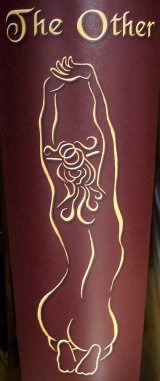
    I began contemplating all this last night, while sipping on a strange wine called The Other. I will rarely admit this, but I bought the bottle mostly because the label rather appealed to me. It’s simple and incredibly off-topic but the line drawing somehow speaks to what it is to be a woman in flux. It’s inexpensive: about $12 in most stores. A blend that, confusingly, changes each season depending upon both crops and the winemaker’s whim, this Peirano Estate Heritage Collection variety doesn’t list a year. But the one I tried was 60 percent Cabernet, 30 percent Merlot, and 10 percent Syrah. Heavy, fruity, and almost leathery, today’s Other belies the naked yoga pose on the label. Like hearing the voice of Queen Latifah come out of the mouth of Heidi Klum. This is a thick, thoughtful, serviceable wine. It exists in no time, apparently, and contains an oddly specific 13.8 percent alcohol.

    It’s a wine with a wallop, a rough finish that lasts for full minutes, and a dissonant drawing on the front. But after such a year, I’m thinking Kurt definitely would approve.

  • Making Hay in the Winter

    There’s going to be another inquiry into why the bridge
    fell. On top of the NTSB, the Legislative Auditor, and the Governor Pawlenty-hired
    consultants, we’re going to have the Minneapolis
    law firm of Gray Plant Mooty looking into things on behalf of a bi-partisan
    State House-Senate committee.

    One wonders why we need another such investigation. But it’s not
    too hard to figure out if you read the comments of the politicians who oppose
    its formation. One needs to look only as far as our head politician for the
    answer. Governor Pawlenty said that the
    purpose of the investigation was "to make political hay out of a tragic
    situation."

    I agree whole heartedly with the governor, but not because
    it’s wrong to make political hay here, but because it would be wrong not to.
    Here’s why: the bridge didn’t fall because we didn’t know that it needed
    repair. The bridge fell because we knew it needed repair and someone made a
    political, or, to be generous, a budgetary, decision not to make the repairs.
    That’s what I’d like to find out: who made that decision to play dice with the
    chances with the lives of the thousands of people who drove over that bridge
    every day?

    Applying Occam’s Razor (which is a principle of
    investigation which states, in essence, that the simplest possible solution to
    a problem is most often the correct one) I’m going with Pawlenty’s appointment
    of Carol Molnau, an anti-transportation, anti-tax ideologue, as transportation
    commissioner as the proximate cause.

    That political decision trumped all the engineering and
    maintenance recommendations that might have saved the bridge. And that’s hay
    that should be cut, baled and stacked for all of us to see every time we drive
    over a Minnesota
    bridge.

  • The Roman Arch

    In the introduction to his comprehensive history of Rome, Livy invited his readers to “trace the process of our moral decline, to watch, first, the sinking of the foundations of morality … then the rapidly increasing disintegration, then the final collapse of the whole edifice, and the dark dawning of our modern day when we can neither endure our vices nor face the remedies needed to cure them.”

    A strong metaphor indeed: the collapse of the societal construct as the result of too much of personal aggrandizement and the unwillingness of leaders to provide the harsh medicine that will stop the flux that drains us to the point of death.

    There was no such poetry evident in the discourse following the collapse of the non-metaphorical I-35W bridge. Republicans, who rightfully feared that Democrats would jump on Governor Pawlenty’s two vetoes of gas tax increases as the proximate cause, began right away with the “let’s focus on the disaster instead of the politics” bleating. Of course, politics being, well, politics, that lament sounded just like the report of a starting pistol to Democrats lined up to trample Pawlenty under the race to assign blame.

    That race has a long way to go. So far, what is clear is that the Minnesota Department of Transportation knew the bridge needed maintenance. What is not clear is who exactly made the decision not to perform it. My guess is that will never be clear. What is also clear is that performing the maintenance would have inconvenienced a lot of drivers. And, finally, it’s clear as well that politicians, and bureaucrats who answer to politicians, have no stomach for inconveniencing drivers … or anyone else who might vote, for that matter.

    We all decry the failure to maintain our roads, yet what representatives of our government’s work receive more irate looks than the guys who put out the orange cones that slow us down? (At least the people who hand out welfare checks, regulate polluters, teach our children, and write speeches for members of Congress have the decency to work where we can’t actually see them.) Indeed, since Ronald Reagan’s famous “government is not the solution to our problem; government is the problem” inaugural speech, the official position of his party (to which Bill Clinton later acceded) is that people who work for the government pretty much play the same role for today’s politicians as the Jews did for the Nazis in the 1930s. Everything that goes wrong—from Katrina to the I-35W Bridge—is the fault of some nameless scapegoat who is taking your tax dollars under false pretenses.

    This isn’t the strategy of just one party. It’s the modus operandi of both. Politicians, whether in Washington or St. Paul, have no stomach for prescribing sour medicine for the mundane aches and pains of quotidian America. Mayors, governors, senators, and presidents will all rush heroically to the side of a collapsed bridge, pausing only long enough to remove their ties so they’ll look more like the common concerned citizen. However, a politician who actually rolls up his sleeves and sponsors a spending bill to maintain that bridge in the first place might as well put on one of those orange vests to toil by the side of the road and be reviled, or even worse, ignored, while we zip by at seventy miles per hour.

    The Roman system of roads, bridges, and aqueducts was the very emblem of their power to dominate and administer their empire. Julius Caesar caused the first bridge over the Rhine to be erected just to prove to the Germans that Rome could do whatever it pleased. In a sense, our interstate network is the equivalent American demonstration of our national will. But building a road system, and a governmental system that is also modeled on Rome’s, was relatively easy. The truly difficult work of government is the work that confers no glory on those who do it.

    Think ahead eighteen months or so to the opening ceremony for the rebuilt bridge. No doubt we’ll see a mayor, a governor, senators, and perhaps even a president. But, we won’t see the government workers—the engineers, the inspectors, the accountants, the police and firefighters—who provide the actual foundation that buttresses our civilization. My guess is they’ll still be shouldering the blame for rotten re-bars and rusted gussets, while our leaders take credit for the shiny new monument to their dominion.