All the ingredients for an experimental disaster are there: six characters on a non-elevated platform of white cardboard — a sterile space carved out in the corner of a dingy art gallery — all dressed in white, speaking in seemingly disjointed sentences, hugging the wall behind them, twisting, writhing, gasping. But Socktesting, however experimental, is no disaster. Somehow, creators Mark Abel Garcia and Megan Mayer — with the help of six very able actors — have pulled it off masterfully.
In truth, it’s a simple story. Yes, there is a story. Thank goodness — for one of the dangers (my own frustration, perhaps) of experimental art is the lack of story. Socktesting has a story, and it’s about a baby. A baby. A baby, perhaps. More like a paper clip. I couldn’t see exactly. But a baby is a baby is a baby. And our projects are our babies. Our ideas are our babies. And we can care for them as such, or we can toss them away, neglected step-children, like dropping a load.
I am only thinking about this now, as I write. As I sat and watched Socktesting, I thought only of masturbation, of life, of pregnancy. And while I knew there was a deeper level of meaning (layers, even), what moved me, what held me, was this. I am almost 40. I have no children. I have tried. Clearly, I may have been inordinately moved by the story. But I was indeed moved.
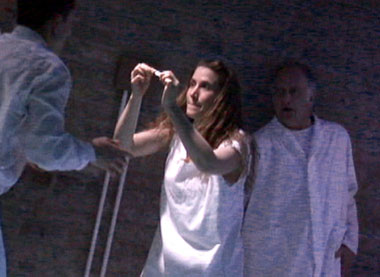
The protagonists of this play are Lydia and Rupert. Lydia has a baby. She has a baby — something, anyhow — but she does not know if she can keep the baby. No one should know about the baby — not yet. And they must not get attached to the baby — or name it — because they may lose the baby. Everything is lost, isn’t it? Perhaps "it has a curiosity aspect we must dispose of."
Another character, Darnelle, has lost her lover — perhaps her lover. Perhaps her baby. Bill. She cannot accept it, though. And she pretends he is still alive. Is Is Is. Bill Bill Bill. Baby.
There is a rhythm in the writing. In the delivery. In every element of this play. An attention to rhythm. An attention to sound. A unusual and beautiful willingness to not just accept, but use, all the organic by-products of performance. Just as Garcia and Mayer compose their symphony of meaning, they conduct the actors in a symphony of sound and movement. The sound of feet dragging on cardboard. Steps. Coughing, snoring, hiccuping, releasing air. Perfect silence. There are no coincidences here. (Even when a band playing outside the Soap Factory invades the silence, they make it work. It simply joins the symphony.)
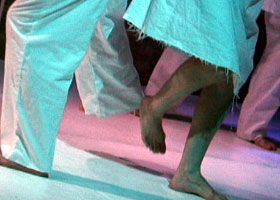
The play is divided into four parts, four days over which the six characters asphyxiate. In between, they sleep. In between, they cough. In between, they lose air. They struggle. They die. Le petit mort, dropping the load. Unrealized potential.
When three white-clad figures lift Lydia — the protagonist — into the air, prostrate, with back arched, flying, and bring her down to the ground, wresting from her the baby she has hidden in her womb, however, it’s the audience that experiences the asphyxiation. It’s the audience who gasp.
Each of the four sections includes several scenes — interactions between Rupert and Mimi (the couple), interactions between Mimi and Darnelle (friends). Interactions between Rupert and Ethan (an over-sexed, under-satisfied co-worker of sorts), interactions with the doctor (who performs tests on the baby and determines whether it shall live or die). And the Shadow. The Shadow is always there, because even the Shadow plays it part. Nothing is left to chance.
And each of the scenes includes a coming together of all of the characters — walking, ranting, clustering into a moving circle, chaos, shouting, screaming, bitching, moaning. And the most impressive thing about these scenes is, again, the symphony. Only in music (and perhaps in nature) have I heard sounds come together in perfect unison, to create an entirely new sound. It’s not easy to turn six voices into one indistinguishable sound — clearly composed of multiple elements. Somehow, they pull it off. You hear the chaos. You hear the shouting. You know it comes from multiple sources — though it sounds like many more than it is. But you hear no one voice over the others. They are using words, and you hear none, only chaos, shouting. Perhaps I make too much of this, but I am impressed.
Though I am initially disturbed by the seemingly disjointed dialog between Lydia and Rupert — expecting them to begin hopping on one leg, repeating "fish sandwich, fish sandwich, fish sandwich" — this is not dada. Schizopolis, in fact, is what it brings to mind (and if you haven’t seen this Steven Soderbergh masterpiece, you must). It’s the perfect lack of affect in Mats Sexton’s delivery to which I am reacting. It’s the meaningless, stale interaction of day-to-day life, empty relations — a Stepford couple placed in an ascetic, sterile universe — a lab almost, where we can examine life through a microscope, an autopsy of sorts. It’s Andy Warhol’s version of Pleasantville, without the commodification.
Lydia, played by Mimi Holland, is perfection, sweet. She is the mother. She is possibility. She is life, affect, genuine engagement — and entirely nonexistent in masturbation. Holland pulls off a superb performance, drawing you in with a childlike smile in the beginning, and paving the way for a most powerful ending with nothing but her silence and her gasps. While her face is turned away from me, I notice the streak of tears upon her cheek.
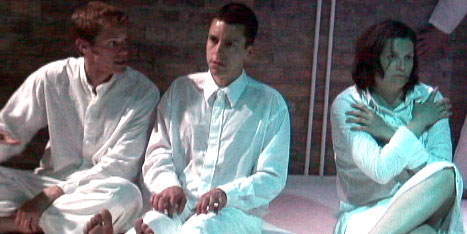
Heather Stone, as Darnelle, is extraordinary, truly disturbed, jumping effortlessly from one emotional reaction to another without missing a beat. And Samuel Van Wyk, as Ethan, plays the perfect sex-crazed boy — who shines when he’s getting his dick sucked.
Somewhere between metaphor and reality, Socktesting delivers a powerful commentary on… well… I could say masturbation (which the title alone declares the interpretive lens); but I’m going to say life, affect, potential, latency, even waste. What turns us on? What makes us engage, move forward? What breathes life into us and gets us out of the inherent inertia of day-to-day existence? Perhaps I’m reading too much into it. But any work of art that makes me think this much (while remaining entertaining), I say, is a success.
Socktesting runs at the Soap Factory, June 5-8, 12, 13, and 15, 2008.