Tag: painting

  • Crate 1 of 2 Opened

    It’s the middle of July and the melons on the fruit stands are sweet. I see a woman in a cotton dress, its translucence making visible the form of her body under the skirt. She is lovely. She isn’t stuffed into jeans; she’s wearing a dress of diaphanous cotton, compared to which denim is about as interesting, erotically, as sackcloth or sandpaper. The dress dances in the breeze. It dances around her, with her, because of her, and the extreme feminine grace of this gets to me in the pit of my stomach. Short of carrying her off on my bike, the only thing for it is to go cool out somewhere, so I do—I go to the Minnesota Museum of American Art to look at some art.
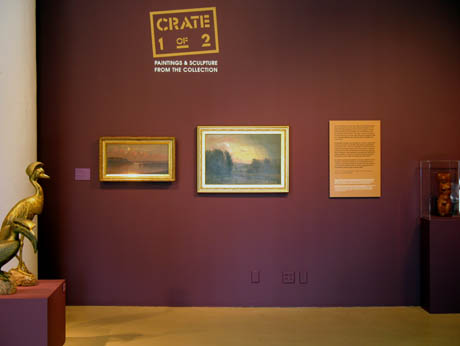
    The museum’s summer show is Crate 1 of 2, a selection of works from its permanent collection. The gallery walls have been painted a deep and luscious aubergine (that’s “eggplant” to you, pal) a color that for me evokes the vanished era of drawing rooms. I myself have never been in a drawing room, but from novels I know that they were peopled with brilliant conversationalists and beauties listening with heaving bosoms to pianists tossing off Chopin Etudes by heart. The aubergine of the MMAA’s galleries is tinged with nostalgia for that moment just before the crumbling of our civilization started picking up speed, say, a hundred years ago–before people took to saying “awesome,” and using the expression “closure” when talking about the death of their hamsters.

    Crate 1 of 2 is not a consistently great show, but it is a moving exposition of what it meant, not so long ago, to be a human making art in America. A good many of these painters and sculptors are no longer alive, and most of the works, exhumed from obscurity by the tender solicitude of the curators, are fated to return to oblivion at the close of the show. When the dead were alive, however—and this is easy to forget– they were as alive as you and I are right now, as driven by desire, as whipsawed by love and by hatred, hope and despair, innocent wonder and dreary ennui. The paint on their canvases has dried, but it was laid on wet by people not so different from us.

    Visitors to the museum sense this, I think, making their way from one work to the next like mourners slowly moving down a line to offer condolences; except that here it’s with unhurried pleasure, the way they lean in to look at a work, enfolding it into themselves, to sleep on it later. They take it in. Something is transacted across spans of time between them and the artists.

    Periods of art come as a succession of breaking waves. If you’re a full-immersion total hipster, each new wave obliterates all traces of the last. But as your own history lengthens, you see not only the next new thing and the next, you also see further back in time. One day, idly flipping through a magazine, you find yourself awestruck by pictures showing the images on the walls of the caves at Altamira and Lascaux. The past that you blew off as dead turns out to be not only not dead but more vitally alive than all the crap that’s on TV tonight. “The past is never dead,” wrote Faulkner. “It’s not even past,” a line often quoted when the present feels shaky. It keeps coming at you, each wave different but all essentially and eternally the same.
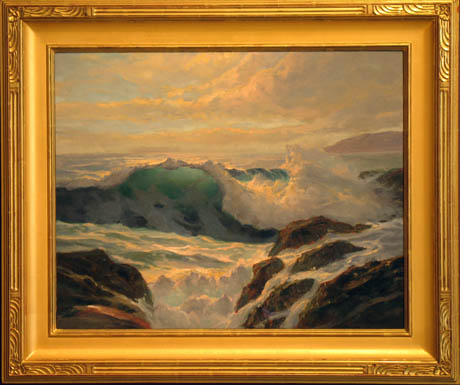
    One of the earliest and most beautiful paintings uncrated for Crate 1 of 2 is a seascape. Its focal point is a cresting wave, backlit and transcendentally translucent. The artist, Frederick J. Waugh, was so obsessed with capturing the form and movement of the ocean’s heaving swells and waves that in his long life he did something like 2500 seascapes. A photograph can nail the sea down with a click, but I don’t think Waugh painted to pull off quick raids on phenomena. I think he kept painting the ocean’s massive, surging volumes not to make the restless sea stand still but because, like his mind, it never would.
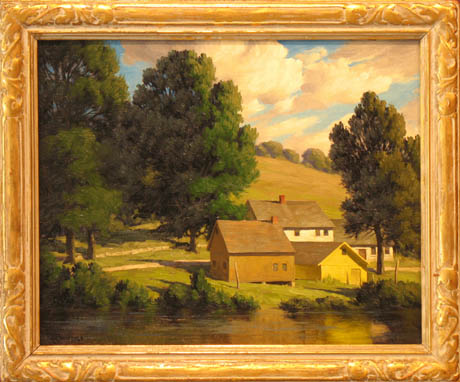
    Another early 20th century painting with the feeling of nature closely studied and absorbed before it is expressed is a farmstead scene by Bertram G. Bruestle. The light, somewhat like Edward Hopper’s, uncannily evokes an acutely particular moment of the day, not five minutes before or five minutes after. The painting is meticulous but not strangulated. Its fleeting light inflicts you with the ache of the ephemeral, the knowledge that an evanescent moment is dying even as it lives.

    A few mid-20th century abstractions are included in the exhibition, but the most interesting paintings in the show are more representational than not. William Meritt Chase’s society Portrait of a Lady,1914, might easily be mistaken for a work by his friend and contemporary John Singer Sargent. Right nearby, from 1906 and not quite so lofty, is a full-length portrait, conceivably the lady’s dressmaker, Modiste of Madrid, by one of the Ashcan school, Robert Henri.
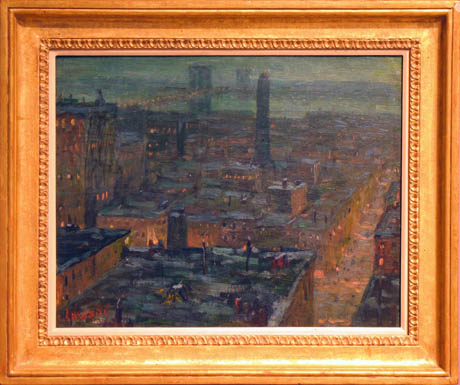
    From about the same time, but grittier, is a vivid aerial nightscape of Brooklyn by Earnest Lawson, another of the painters of the Ashcan group.
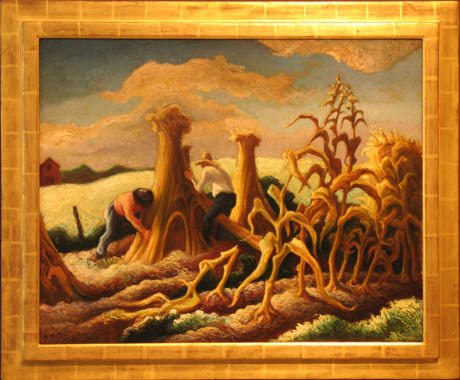
    Thomas Hart Benton is represented with a work done in his characteristically torqued perspective, 1945’s Shocking Corn, the cornstalks writhing in a way that strangely foretells the work, hardly more than ten years later, of his student Jackson Pollock.
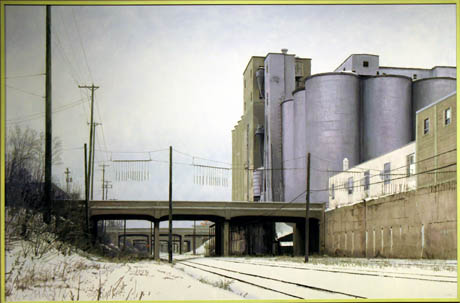
    Closer to the present and about as far from ab-ex as you can get is a large, satisfyingly bleak 1988 canvas by Minneapolis’ great master of what-you-see-is-what-you-get, Mike Lynch. The title is Elevator – 29th and Harriet. Features of this site still exist, but the scene as Lynch depicted it has since been transformed—it’s now a stretch of the Greenway. Stand on the same spot Lynch did on some cold, grey-blue day in February and, despite all that’s changed, you’ll appreciate the ethical and emotional precision of Lynch’s account of things as they are.

    Wandering in exile in its own city, occupying spaces like a hermit crab, the MMAA has had three homes since the nineties, first in the Art Deco Jemne Building, followed by a stay on the top floors of the Landmark Center, and, in the past few years, a provisional space in the old West Publishing Co. building on Kellogg Blvd, where with a shrinking staff they are valiantly continuing to produce exhibitions under tighter and tighter budgets. Too much of the museum’s collection sits in storage. No one can see it in the dark. Descending into the crypts, the curators have hauled out sculptures I never knew existed. Two of these (by Paul Manship) have the power to strike me mute, and among the rest are some that, though not great, nourish a hunger for something that’s lacking in so much recent art, something elementally human, something that doesn’t trade in irony and neurasthenic exhaustion and mistake that for cool.
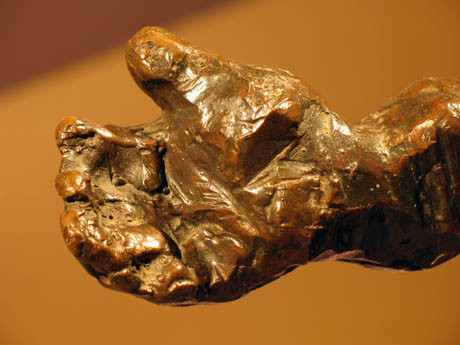
    One piece in Crate 1 of 2 that has this vitality is Jacques Lipchitz’s 1941 bronze, Arrival, a boisterous cluster of lumpy, exuberantly exaggerated human forms that pays homage to the groupings of figures in classical sculpture. At the same time, the sculptor throws off classicism’s tightassed restraint; the figures are unrepressed id, their hands meathooks, primal, like paws.

    In a similar spirit are two figure carvings in wood by John Rood, a self-taught artist, poet and
    musician who was a professor of sculpture at the University of Minnesota in the forties and fifties. One, carved from a single block, portrays a stolid and compact hardworking couple (1943) seated hunched and close together in a way that says they’re in it for the long haul. The other (1965) is a standing figure of a strongman, his muscles worn like slabs of armor. In both works, the direct, faceted carving makes you feel the force and conviction behind each stroke of the sculptor’s chisel.

    But what draws me back to this show again and again are two sculptures by Paul Manship. One of these is Briseis (1950), a work of the most naked and unaffected grace–a marble, of a whiteness and finish so soft that it is difficult to focus a lens on it. Briseis is a figure from the first book of the The Iliad, the widow of a slain Trojan. The introverted quality of her face speaks of her resignation to her fate, which is to be buffeted by the fierce contending wills of angry men. At the opening of The Iliad, Achilles is found brooding in his tent, refusing to return to battle. His king, Agamemnon, has claimed Briseis for himself. Achilles’ rage at having been made to relinquish her is the lit fuse that sets off the action. He is prevented from killing Agamemnon only by the intervention of the goddess Athena, who grabs him by the hair just as he’s about to draw his sword. Briseis is eventually restored to him. Run your eyes over this sculpture and you can see why Achilles, having been denied her, is driven nearly to murder. She is a lot to lose.

    Paul Manship was a son of St. Paul. He went on to bigger things elsewhere—the colossal, oddly awkward Prometheus that overlooks the skating rink at Rockefeller Center, for one–but he bequeathed a good number of his works to his hometown. Fourteen of them, including Briseis, are exhibited in this show. The other sculpture that gets to me at the core is his bronze, Europa and the Bull, dated 1924-1935.
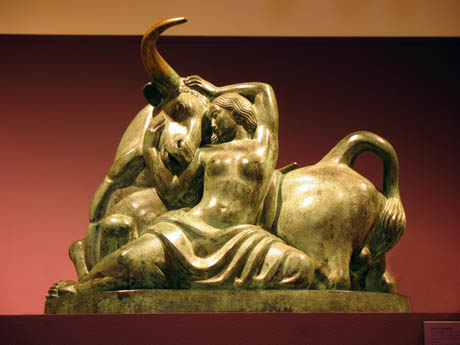
    Artists have painted and sculpted the story of Europa for thousands of years: Zeus, seeing Europa gathering flowers, is smitten. Deciding to ravish her, he assumes the form of a tame white bull, seduces her to get on his back, jumps with her into the sea and abducts her to Crete. Classically, painters like Titian and Rubens have staged the incident as a kind of water sport with a lot of accessory maidens and putti splashing about, but Manship took a different tack. He didn’t depict the scene by the shore of the sea, but the aftermath, the calm erotic satiety of the two as they rest against each other spent, pacified, content. Their quietly stylized faces, like Briseis’, are in keeping with a taste that developed in the Art Deco twenties for the symbolic devices of archaic sculpture: People are not sharply individuated, but given simplified, regular features, parallel waves of hair, the fabric of their garments draped in folds more neatly congruent than reality’s wrinkles allow. In a call-and-response of forms, the two figures in this sculpture encircle each other in love. Europa cradles the bull’s massive head—you can almost feel the gentleness of her hands on his forehead and jaw. His tongue lolls. His magnificent horns, in turn, all but embrace the gesture of her arms and protect her bared, open pose. He is on his knees, making himself smaller for her; she is splayed out, having given him all that she has. Throughout the sculpture are correspondences, the loop of his tail/the drape of her skirt; her arms/the curves of his horns; the parallel trunks of his neck and her torso, and so on, the more that you look. People go on about The Pieta, but the tenderness sculpted into the relation of the two beings in this sculpture–across species, no less—makes this the more compelling expression of love. For one thing, one figure’s not dead—they are both rudely alive. Driven by lust before lust got a bad name, I can see why Zeus carried her off. I can see why she let him.

    All photos by the author, shot with the kind permission of the MMAA.

  • "The Minnesota Moment"

    On a blustery Saturday night in January, one of the year’s most anticipated gallery shows opened in New York City. As winds off the Hudson River barreled eastward down the charmless streets of Chelsea, the haute monde of Manhattan and the wider world streamed in from the west, down to Gagosian, at the very end of Twenty-Fourth Street. They came to see Niagara, the new series of photographs by Alec Soth, who lives in Minneapolis and works in a studio just over the border in St. Paul.

    Gagosian anchors one end of what is acknowledged as the “power block” among galleries in Chelsea. There are other big names on this street, including Barbara Gladstone, Matthew Marks, Mary Boone, and Andrea Rosen, but Larry Gagosian, with his towering stature, silver hair, and tanned skin, looms largest. Less an art dealer than an art mogul, he’s a perennial figure on Art + Auction magazine’s annual “power list,” and the kind of man whom people fear, admire, and envy in equal measure. Chelsea is just one outpost of his empire, which includes galleries on the Upper East Side and in Beverly Hills and London.

    At thirty-thousand square feet, Gagosian is the size of a small museum, and it was mobbed for Soth’s opening. Plenty of people were glammed up in full-length minks, in gold leather jean jackets, in Gucci ascots. They pivoted expertly on glittering midnight-blue stilettos, flipped their expensively colored, perfectly ironed tresses—and also admired two dozen large-scale photographs that Soth made in and around a place that is a quintessentially American honeymoon destination. Throughout the reception, a clutch of people slowly drifted around the main gallery; at the center of these admirers, well-wishers, collectors, would-be collectors, onlookers, old and new friends, was the artist. He smiled, chatted amiably, shook a lot of hands, had people tug on his arm and whisper in his ear.

    As the reception wound down, 170 guests made their way to an honorary dinner party at nearby Bottino, the art world’s version of Elaine’s. It was modest compared with last year’s notorious to-do for Damien Hirst, another Gagosian artist of a slightly older vintage. Considering that Soth was virtually unknown four years ago, though, it was impressive—and not undue. A few weeks later, one of Gagosian’s directors reported that sales—more than four hundred prints were available, for between $5,500 and $20,000—were considered “very successful.” Soth had a pragmatic explanation for the ardor with which his work has been received. “It’s in fashion,” he said, with a modest shrug characteristic of someone who describes himself as a “conservative Midwestern boy.” “And I don’t think it’s going to last forever.”

    Soth’s success is uniquely dazzling, but he is not the only Minnesota artist to make a recent splash in New York. A few days after the Niagara opening, paintings by Jin Meyerson, who was born and raised in Atwater, Minnesota, were being installed at Zach Feuer Gallery, a few doors down the block. Roiling with swirls of disastrous imagery, these floor-to-ceiling canvases were intended to overwhelm the space, which is as tiny as Gagosian is massive. Yet the gallery’s size belies its influence; though he’s only been in the business for six years, twenty-seven-year-old Zach Feuer has quickly become a powerful arbiter of the gallery world, one who merits his own spreads in glossy magazines.

    As it happens, Feuer also represents Aaron Spangler. Spangler is a native of Park Rapids who, after graduating from the Minneapolis College of Art and Design, built himself a house outside his hometown. Last summer, he added a studio, reinvesting, in a sense, the earnings from his carved wood reliefs and sculptures, which fetch tens of thousands of dollars. (Many people are waiting to acquire work by both Spangler and Meyerson.) That same summer Rob Fischer, another Minnesota artist whose career has been taking off, built a studio and cabin nearby. Fischer too is an ex-Minneapolitan and MCAD graduate who now lives part-time in Brooklyn; a solo exhibition of his sculptures was on view this winter at the Whitney Museum of American Art’s midtown gallery. The week after it closed, a collector had asked for a private viewing of one of the pieces, a twisting form made up of battered hardwood flooring that might have been salvaged from an abandoned farmhouse.

  • Nature Lover

    Minnesota boasts no defining fine artist, no painter of universal renown. Alexis Fournier, Seth Eastman, Nicholas Brewer, Wanda Gag, Dewey Albinson, George Morrison—any of these names may ring a distant bell. But Minnesotans have no Albert Bierstadt or Winslow Homer, no Grant Wood, Georgia O’Keefe or Frederic Remington to lionize. The central Minnesota town of Aitkin, however, has made a bid to raise the profile of its most famous son, Francis Lee Jaques. In 1996, twenty-seven years after his death, it opened the Jaques Art Center; recently a new gallery was inaugurated with a major display of his work, including much of the collection from the University of Minnesota’s Bell Museum of Natural History. (Francis Lee Jaques: Master Artist of the North Country is on view through June.)

    As a wildlife artist, Francis Lee Jaques (pronounced “jay-queez”) wrung the last of the nineteenth century from the genre. A realist with a keen eye for avian, arboreal, and topographical form, he traveled all over the world, but his best work was inspired by the cliffs, moraines, and prairies of Minnesota and the creatures that inhabited them. In addition to the canvases that brought him national notoriety, Jaques was for decades one of the preeminent book illustrators in the world. And his ability to bend perspective into the curved walls of museum dioramas—the grand institutional illusions of their time—has never been surpassed.

    Though Jaques is still celebrated in the highest halls of ornithology and natural history, it’s possible that his broader renown has waned because of the genre in which he worked. Wildlife art is the bachelor uncle of culture, and sometimes you suspect he has been spending a little too much time alone. Modernity eclipsed the need for those skilled at vivid natural depiction; such talent seems quaint in a digital world. But few artists have ever rivaled Jaques and his level-headed mastery of the real, which was steeped in the boggy heart of Minnesota.

    Aitkin’s roots reach to the late nineteenth century, at the confluence of the Mississippi and the Mud River. This far upstream, the Mississippi shows little promise of its vastness below the Twin Cities. Old Man River is but a confused, pimply teen. Still, there was enough water at Aitkin to foster a bustling mill town and riverboat trade, ingesting the wealth of the pinelands upstream. That vitality drew Ephraim and Emma Jane Jaques and their four children in 1904, after failed endeavors in Illinois and Kansas.

    The Jaques family was a twentieth-century anachronism, traveling by wagon across a dozen westward-bound railroads. Their son Lee, an observant teenager, walked the entire distance with his father, following the oxcart over every prairie hill and marsh. If ever a journey ran perpendicular to progress, this would be the one. But the family trajectory predicted Lee’s temperament: never going against the grain, but never quite flowing with it, either. He began his artistic career relatively late in life, in his mid-thirties, and so his ability to capture the grace of a bird’s flight or the sway of a tree in the wind was rooted in experience. His childhood was full of the hard work of homesteading: squaring tree trunks, splitting cordwood, hunting fowl for the family table, bringing in hay; he cultivated his talent early in life via calloused hands handling feathers, bones, bark, and tools.

    The Jaques family carved a meager farmstead, which they called Seven Oaks, out of low country acreage seven miles north of Aitkin. The meandering Mississippi leaves oxbows (small curly ponds of abandoned riverbed that the locals call “logans”) on either side of its path through Aitkin County. Situated between one of these oxbows and the river itself, Seven Oaks beckoned ducks, coots, mergansers, and myriad other bird species. Jaques found time to ponder and sketch, and some of his early drawings were published in Field and Stream with stories written by his father.

    In his early twenties, Jaques took over the local taxidermy business from his employer in exchange for back wages. Years elapsed, but he eventually chafed at the bit of small-town isolation. One day, watching an idling locomotive pointed toward Duluth, he decided to leave town and find his place in the world. He found work on the Duluth and Iron Range Railroad, feeding ravenous coal-fired locomotives with a rapid shovel. When work permitted, he made time, at the end of the tracks beyond Ely, to dip a canoe in the boundary lakes. He produced portage maps of the region for the like-minded—those who would rather bring themselves to a lake than have it brought to them.

    Then World War I intervened. Jaques was drafted and sent to train at the Presidio in San Francisco. There he first beheld the wonders of a natural history museum, and his life’s ambition crystallized. His company eventually made it to France, but the war exhausted itself before Jaques saw action. He returned to Duluth, worked as an electrician, and served as a delegate for Eugene Debs during the election when the socialist labor activist ran for president from prison. All the while he cultivated the skills that could free him from drudgery. He worked in commercial art and created several covers for a Duluth magazine called The Zenith. Jaques also drew heavily upon the knowledge of a mentor, a transplanted artist from the East Coast named Clarence Rosenkranz, who taught him how to paint with oils. The war experience had broadened his horizons, and he sought a life suited to his skills.

    In 1924, Jaques sent several paintings to Dr. Frank Chapman, the curator of birds at the American Museum of Natural History (AMNH) in New York City. The museum, a vast compound overlooking Central Park in Manhattan, was and remains a colossal trove of taxonomy and a globally renowned institution. Jaques, the modest bachelor from Northern Minnesota, was hired into this elite community without an interview, for Chapman recognized in his work an eye for avian form. Specifically, Jaques properly portrayed the reverse coverts of an American black duck, a detail of plumage gathered only from patient observation, and Chapman took a chance based on this undeniable display of skill. Several years later, he would refer to Jaques as an heir to the mantle of John James Audubon and Louis Agassiz Fuertes, the demigods of American ornithological painting.

    “The museum employed an amazing team of artists and scientists at that time,” says Steve Quinn, who currently manages the art staff at the AMNH. “Yet Chapman detected an aesthetic and scientific skill in that Jaques painting. He also searched for artists capable of rendering a sense of place. Jaques always dealt with environment, and had an uncanny ability to portray birds in flight.”

    Jaques had achieved an incredible, improbable leap to the big leagues. As his train approached New York, it passed boxcar after boxcar of fresh produce on the sidings. “Must be quite a city that could eat a trainload of watermelons,” he noted in a journal entry. Jaques thrived in the disciplined, scholarly environment of the AMNH. The museum nurtured his artistic talents, and he rewarded it by becoming proficient in the creation of diorama backgrounds, the curved canvases that, together with stuffed fauna and lacquer-immortalized flora, create the illusion of a natural environment. Offering deceptively true depictions of faraway landscapes, dioramas were the IMAX and Discovery Channel of their time.

    “The Jaques dioramas stand the test of time,” says Quinn, who is writing a book on dioramas and recently supervised the AMNH’s restoration of a Jaques diorama depicting a Bahamas coral reef. A Bering Sea diorama, which portrays a shelf of beach on Little Diomede Island, is one of the best of the Jaques works in New York, according to Quinn, and is still a relevant and popular exhibit seventy years after its creation.

    Even though Jaques was now living in New York, he still painted from life. The AMNH often dispatched its artists to the sites that they would eventually depict for the museum. Jaques visited the Alaskan coast in 1928 aboard the vessel Morrissey, and spent time in Panama and the Bahamas sketching scenes that would end up on museum walls in New York. In 1934, he accompanied an expedition aboard the yacht Zaca through the South Pacific. They visited Pitcairn Island, and in his spare time Jaques, ever the tireless sketcher, drew a map of the island that was more faithful than any previously published. The Zaca also spent weeks at the Galapagos, the naturalist’s mecca. Jaques was granted several days ashore, sketching iguanas, penguins, tortoises, and the sere island landscape. This was the last stop on a long voyage, and he was eager to leave the Zaca and the strictures imposed by the expedition leader. But he was even more impatient to return to New York and rendezvous with the former Florence Page, the woman who had completed his transformation from northwoods bachelor to career artist.

    Lee and Florence had married in 1927, when both approached forty. She had returned to New York from Illinois to study poetry at Columbia University, and Lee had rented the apartment she had occupied in a duplex overlooking the Hudson during a previous sojourn. The landlords found other accommodations for Florence, but fostered a courtship between them. Marriage suited Lee: “This was the great turning point for me; life from here on was infinitely better,” he wrote in his memoirs. Not in the least because he and Florence launched a fertile and entertaining literary collaboration, in which Florence would recount their travels to remote North American destinations, with Lee’s drawings featured on every third or fourth page.

    One of the seven books the couple produced, Canoe Country, recounts their honeymoon, a three-week late-summer trip in the Boundary Waters out of Fall Lake to the cliffs of Lac La Croix and beyond to the Quetico. Lee had a deep fondness for the region, but on the eve of the trip, Florence became skeptical that she had the mettle for wilderness travel. “I’ve never been so cold in my life,” she wrote in Canoe Country. “I wear my fur coat all the time. If this is what Duluth is like in August what must it be in January? ‘Of course,’ people tell me cheerily, ‘you’ll be much colder camping out.’” But she turned out to be game, when not positively giddy, with the love of her life in the stern of the canoe. Lee, capable and patient, showed her the watery country he knew so well from canoe trips during his bachelor years. And if push came to shove with an early cold front, he could have resurrected his taxidermy skills and clothed her in endemic peltry.

    The early portages of that trip must have been brutal, as Lee and Florence packed a larder that included more than twelve pounds of meat. This was not a bannock-and-beans expedition: ten pounds of flour, five of brown sugar, and three cans of Crisco rounded out the major supplies. But their weather was the best of that season, the mosquito-free ides of September. “We climbed into the branches of a pine which hung far out over the water, and dangled our feet and read Millay to our hearts’ content. Then we swam in the ebony pool—so different from our usual sunny beaches—and tried picking water lilies under water.”

    One of Lee’s favorite spots was the pictographs beneath the granite cliffs on Crooked Lake, depicted in one of his few historical works and probably his most famous, Picture Rock at Crooked Lake, also known as Return of the Voyagers. Jaques’s scene painting is at its best; the non-animal elements are transcendent. The border-country bedrock looms geometrically at the picture’s center, and white pine—the species he must have loved best for their sinuous beauty in his rendering—crest the hillside above a mossy swale. Everything is awash in the blue of the sky and still water. A typical Jaques thunderhead towers to the south, a billowing echo of his pines, and a host of voyageurs pass below. Swarthy paddlers labor in each canoe, with one exception. Sitting rigid and luminous—and also paddle-less—is the company man, the bourgeois, wearing a red jacket, a flash of white plume jutting from his hat. Jaques was always the working man, from woodcutter to fireman to commercial etcher to museum artist, and it cannot be that he admires the idle captain of this endeavor.

    While it is true that Lee’s paintings are masterful, his scratchboard drawings are the key to understanding his genius. He did so much with the simple choice of black and white—the soft textures of a distant hill, the muscular movement of a moose—and one sees through his drawings that his mastery of form is what sustains the playful use of color in his paintings. In one scratchboard from Canoe Country, Jaques depicts the newlyweds in an open-water paddle, and Florence is idle, but in a much different manner than the bourgeois. She has her paddle at the ready as they roll down the lake with a heady wind at their backs before waves that could easily founder a canoe. Lee sits behind his wife, leaning into his J-stroke, keeping the canoe upright, and it looks like they are going the right way. Lee Jaques had himself a traveling companion.

    Roger Tory Peterson, the man whose name is synonymous with a field guide and whose drawings have undoubtedly verified millions of finch, wrote in Natural History magazine in 1983 that it was time for the art world to get over itself and accept that bird art was, indeed, art. While tradition had almost always required the inclusion of humans (or some detritus of human activity) for a work to be considered art, Peterson maintained that certain wildlife artists deserved a seat at the academy. He lauded Audubon and Fuertes as the Abraham and Moses of this march to the promised land. But he also singled out Jaques: “I can think of only one top-level bird artist of my acquaintance who was not influenced in the slightest by either Audubon or Fuertes—Francis Lee Jaques.”

    New York exposed Jaques to a wide world of artistic technique and proficiency. At the AMNH, he would bite his tongue while a crusty pedagogue measured the neck of a Jaques swan and pronounced it too short. The teacher, trapped in Audubon’s dimensions, failed to reconcile his textbook accuracy with the way in which Jaques’s birds did not simply move across your field of view—they came at you, or fled. He successfully crossed a threshold, converting the useful into something beautiful, like a scythe bent to the line of a haymower’s back.

    Aside from his collaborations with Florence, Lee’s most memorable illustrations feature in several collections of essays by Sigurd Olson, the legendary wilderness advocate. Olson and Jaques became friends, and the former trusted Lee’s ability to vitalize his ideas. In The Singing Wilderness, Olson emphasized a fundamental element of wild places—their potential for silence. Storms may noisily lash the pines, volleys of geese may trumpet upon the remotest bay, and sometimes the rush of distant rapids draws the ear. But wild places eventually fall back to a static aural imperceptibility. A difficult task for the artist, to depict silence. But Jaques was once praised by a friend for his ability to paint the wind, and Florence once exclaimed that a particular painting of her husband’s was the coldest she had ever seen. The drawing for Olson’s essay in which he recounts a last trip along the border from Lac la Croix to Saganaga (just before that lake was conceded forever to the two-stroke drone of Evinrude armadas) seems to radiate silence, with only the slow lake current for movement.

    In 1942, when Lee was fifty-five, he and Florence returned to Minnesota for good. They built a modest house between two ponds on James J. Hill’s subdivided farm, which eventually became the suburb of North Oaks. This would be the most productive period of his life. He drew and painted constantly, almost wearying from the talent that coursed through him; he was a river at flood, full of purpose, spilling over the banks. “I fondly recall an older couple who simply revered nature,” says John Fitzpatrick, recalling Lee and Florence. He grew up near them in North Oaks, and now directs the Cornell Lab of Ornithology, the country’s premiere institution of bird research and conservation. He freely credits Lee Jaques as a mentor; a 1968 painting by him hangs outside his office.

    Retired from the AMNH, Jaques painted the best of his dioramas under contract to the Bell Museum of Natural History at the University of Minnesota, creating nearly a dozen of the museum’s largest installations. The ornithological displays are stunning. In one, a platoon of sandhill cranes descends from the flyway, thick as dandelion seeds, and the ancient birds are remarkably individual for their sameness of plumage. Jaques always favored larger birds as subjects, once stating that “the difference between warblers and no warblers is very slight.” The sandhill crane diorama is a favorite place for docents to pause with a group of eight-year-olds and encourage their avian mimicry, for the cranes are just their size.

    For the Bell’s wolf diorama, Jaques created a brooding portrait of Shovel Point, at what is now Tettegouche State Park, as the North Shore backdrop. A tower of mist rises from the lake, as it will during January, and the icy waves roll up on a snow-rimmed cobble beach. It’s easy to linger on this display any time of the year, but it wears best on a steamy summer day.

    Officials at the Bell Museum recently announced plans to build a larger facility on the university’s St. Paul campus. As inert as the Jaques dioramas may seem to the casual visitor, they are vital to the Bell’s identity and will make the short journey east. According to Don Luce, the museum’s curator of exhibits and resident Jaques expert, entire walls will be moved to relocate these paintings.

    “Audubon had a great sense of design, and Fuertes was a master at making birds realistic,” Fitzpatrick says. “But Jaques was not simply a great bird painter. Because of his constant observation and sketching, he mastered the placement of his subjects into the landscape. This made him one of the great artists of the twentieth century.”

    Lee and Florence occasionally visited Aitkin during their Minnesota years. He would drop in at the local barbershop for a trim, and they would call on his elderly parents. His siblings, too, had remained in Aitkin for life, and raised a crop of salutatorians, according to Cherie Holm, a board member at the Jaques Art Center and an Aitkin native whose family’s farm was directly across the Mississippi from Seven Oaks. “Lee was always seen in Aitkin as loosely put together, sort of Ichabod Cranish,” Holm says. “When he returned later in life, he was never honored despite all of his success. We’d like to help correct that. The art center, if Lee were growing up here now, is where he would find his people.” Indeed, it’s not hard to imagine that he would have sought haven there, the lonely taxidermist who once couldn’t seem to find his way out of town.

    An influx of retirees to the upper Mississippi lake country over the past decade has created a demand for amenities, and Aitkin has cleverly sought to plant deep the Jaques legacy. The Friends of Jaques, a local group to which Holm and her husband belong, began to curate shows of his work in a local bank in the 1980s. When the group purchased the former Carnegie Library from the city for a dollar, it rescued a significant local building from oblivion; half of the libraries built by the Carnegie foundation in Minnesota have been demolished. Now restored as the Jaques Art Center, the building hosts various arts workshops, in addition to a rotating display of its namesake’s art.

    “There are plenty of Jaques paintings in private hands that we don’t know about,” says Holm, “and we would love an opportunity to share them with the world.” She recently learned of a home in the region that is filled with never-cataloged Jaques paintings.

    Lee died in 1969 at age eighty-one, a few months after a heart attack had slowed him down. Florence was devastated, yet endeavored to finish his biography. She had set out to edit his memoirs and ended up retelling his life story. Francis Lee Jaques: Artist of the Wilderness World gave him the due his diffident prose denied, and included dozens of color plates, excerpts from their other books, and passages from Lee’s journals. Lee had been concerned for years that it took too large a toll on her, but this project, in addition to securing the future home of so many of Lee’s works, was crucial to Florence.

    She told her confidantes that when the book was finished, she wanted her life to end. She died on New Year’s Eve in 1971. Her body was found in bed, clutching a red rose, according to Jaques biographer Patricia Condon Johnston. She had left several notes to her closest friends and relatives, stating that she could no longer endure without Lee.

    One of Lee’s most unique paintings—he may have thought it had only personal appeal, and Florence didn’t include in the biography—is an elegant 1940s portrayal of their global travels, both together and alone. His lines were blue, hers red, and purple traced their partnered journeys.

  • A Higher Power

    In America today, Jesus is pop culture’s King of Kings, a force in politics, film, music, and books. In the world of contemporary art, though, his presence is less established. While modern curators always seems to make room for dung-smeared Madonnas and crucifixes in urine, where are the works of genuine, unironic reverence? Not in Manhattan’s most influential galleries. Not in Artforum.

    But one Sunday last fall, at least, one such work made the cover of the New York Times Magazine. To illustrate a story about religion in the workplace, it featured an Alec Soth photo of an office in Riverview Community Bank, the Christ-centered financial institution in Otsego, Minnesota. The photo showed a curvilinear desk, a burgundy armchair, and—most prominently—a spectacular painting hanging on the plain white wall.

    The Senior Partner depicts a stately downtown office, where two clean-cut executives confer with Jesus over a laptop. Dressed in business casual robes, the Good Shepherd looks completely at home in this environment: confident, resolved, a rainmaker, ready to close the deal in enthusiastically ethical fashion. It is twilight in the picture, and the lights from nearby skyscrapers pour through a picture window to bathe him in a golden halo of big-city commerce.

    Even reprinted in godless fish wrap, The Senior Partner is instantly memorable. Remarkably, the Times didn’t even bother to mention the artist’s name. It was an oversight that might have driven a lesser man to despair, but Nathan Greene, the artist who painted The Senior Partner, doesn’t seem particularly interested in personal glory. Instead, the forty-four-year-old Seventh Day Adventist, who lives with his wife and children in rural Michigan, is mostly focused on spreading his vision of Christ as a compassionate, accessible presence in people’s everyday lives.

    Besides, Greene’s vision is becoming increasingly popular even without the acknowledgement of the Times. Senate Majority Leader Bill Frist, the Tennessee Republican, has a lithograph of a Greene painting in his office. So does the Senate’s chaplain, Barry Black. The evangelical television show, It Is Written, uses a Greene portrait of Jesus in its opening credits.

    For years, Greene painted in the basement of his house, but recently he bought thirteen acres of land and built a seventeen-hundred-square-foot artist’s studio on it. Today, a Greene original goes for $25,000 to $50,000, and there’s a two-year waiting list to get one. Greene is a painstaking craftsman. While composing The Introduction, which shows Jesus playing matchmaker to Adam and Eve, Greene painted and repainted Jesus’ face eight times. “He’s just passionate about every little detail,” said his agent, Dan Houghton. “In that particular case, he could not have the face of his creator less perfect than his creations.”

    Typically, Greene finishes only four or five new paintings each year. To make his work available to all who want it, Houghton runs a publishing venture called Hart Classic Editions, which reproduces selected paintings as lithographs. Sometimes, Greene depicts Jesus in traditional biblical scenes, but the definitive works in his oeuvre are those like The Senior Partner, in which Jesus appears in contemporary settings: offices, operating rooms, suburban homes.

    In depicting Jesus this way, Greene continues the tradition of one of his artistic heroes, Harry Anderson, a fellow Seventh Day Adventist and a popular mid-century artist whose illustrations used to appear in magazines like Colliers and the Saturday Evening Post. In 1945, an art director asked Anderson to paint something that showed Jesus in the contemporary world. He responded with What Happened to Your Hand?, which showed Jesus explaining his stigmata to a trio of curious, forties-era kids. Some found it blasphemous to portray Christ in this modern manner. Others reacted more favorably, and Anderson went on to create paintings like The Consultation (Jesus provides a second opinion at a patient’s bedside) and Christ in the City (a spectral, Godzilla-size Jesus hovers outside the U.N. Building in Manhattan).

    In 1977, while Greene was in high school, his art teacher introduced him to Anderson; the art teacher thought Greene would make a good assistant to the older painter. The apprenticeship never materialized, but in 1990, when an Adventist hospital asked the retired Anderson to create two portraits of Christ in contemporary settings, Anderson encouraged it to commission Greene instead. A freelance illustrator at the time, Greene jumped at the chance to create work of a more permanent nature.

    The first painting he completed, Chief of the Medical Staff, is one of his signature canvases. In a dramatic, tightly cropped composition that evokes the luminescent palette of Maxfield Parrish, Christ steadies a surgeon’s hand as he makes his initial incision. “We’ve taken that image and printed it on business cards and bookmarks,” said Todd Chobotar, director of mission development at Florida Hospital, where the original hangs in the main lobby. “We give one to every patient who goes through a procedure here. When they go into the operating room and are put under by the anesthesiologist, many are still holding their cards.”

    Greene’s work has obvious populist appeal, but is it truly important art? Or just evangelical kitsch, a technically superior version of those cheap plastic figurines of the Son of God playing football with schoolkids? “I really want to avoid anything that could be perceived as corny when I depict Christ,” Greene said. And even at its most sentimental, his work is never mere décor: While millions of Americans profess to have a close personal relationship with Jesus now, few artists working in any medium have documented this phenomenon as tellingly as Greene has.

    Also, Greene perfectly conjures the upbeat, have-it-all ethos of today’s evangelicals. Consider one of his most striking works, The Introduction, which depicts Adam and Eve in the Garden of Eden. Chaperoned by Jesus, the pair stare at each other like lovers on the cover of a romance novel. The surprisingly metrosexual Adam wears razor-cut sideburns, and bares a smoothly waxed chest. Eve has the serious, no-nonsense beauty of a female contestant on The Apprentice; she may be wearing just a touch of lipstick.

    Like many artists, Greene paints from live models (or more specifically, he takes photos of live models, then refers to those photos throughout the many months it takes him to finish a canvas). In real life, Adam is a fashion model from Miami, Eve a model from New York. So it’s possible the anachronistic facets are accidental. But whatever Greene’s intent, the end result is a brilliant synthesis of reverence and pop culture. Indeed, compare The Introduction to Michelangelo’s Temptation and Fall. In the latter, Adam and Eve are being chased out of Paradise by an angel with a sword, their faces contorted with fear and shame. In Greene’s painting, Eden looks like a fun, sexy place to spend eternity. There’s no serpent in sight, and no forbidden fruit, either. A placid tiger and a curious giraffe observe history’s first blind date. In the distance, there are leafy green palm trees, cascading waterfalls, a couple of flamingos. It looks like Hawaii, if Hawaii were a casino in Las Vegas.—Greg Beato

  • A Picture is Worth 5,000 Years

    “A photo is all I have left of her,” Chris Lang, the boyfriend of murdered college student Dru Sjodin, told a Judiciary Policy and Finance Committee at the Minnesota House of Representatives. His testimony culminated with a heated statement about Level Three sex offenders: “They’re not like normal people. I think they’re wired wrong. They’re like animals. They need to be treated like animals, and animals are kept in cages.” The committee, including freshman legislator Cy Thao, remained impassive. Lang stepped down, and discussion moved on to child abuse, crystal-meth addiction, and other problems.

    “We don’t have time to do all the emotional stuff,” said Thao later that day, by way of explaining how legislators can seem inured to the personal horrors their legislation is meant to address. Capitol business is often conducted at a safe remove from emotional issues at hand, but that doesn’t mean Thao, who was elected to office in 2002, sometimes finds the impersonal nature of policy and politics hard to take. A thirty-one-year-old Hmong-American whose round face is accentuated by a close-cropped haircut, Thao came to politics by an unusual route, as a painter and former arts organizer in St. Paul’s Frogtown district. “Artists have to be passionate and emotional,” he believes. “When I’m painting, I put my emotions into it. That’s what drives me. But as a legislator, you’ve got to contain your emotion and turn it into strategies. You just have to focus on the policy.”

    When I met Thao several years ago, he attributed his political views to his college internship experience at the state Capitol: “I saw a lot of people who would only pay attention to people with wealth and people who knew the system. They just didn’t pay attention to the little guy.” Thao’s frustration with the system led him to add an art double major to his political science major while at the University of Minnesota, Morris in the early nineties, and he’s swung between the two ever since—much to his advantage. His stint some years ago as an organizer at the Center for Hmong Arts and Talent, an arts center on University Avenue, gave him skills crucial for politics: raising money, maintaining a grassroots organization, and conducting community outreach, as well as publicly addressing social issues through the Center’s theatrical productions and mural projects.

    Meanwhile, Thao confronts issues through his art that are anything but small, addressing such horrors that would move even the most impassive of observers. Fifty of his paintings will be on display at the Minneapolis Institute of Arts beginning May 21 in The Hmong Migration, an exhibit that is part of the Minnesota Artists Exhibition Program. In this series, Thao creates a compressed visual record of the troubled history of his people and his family.

    Using a technique that is simple, raw, and unpolished, with quickly applied daubs of paint indicating simplified figures and forms, Thao draws from both Hmong folk-art quilting traditions and an interest in the work of Jacob Lawrence. Each work in the series depicts an episode in the history of the Hmong, starting with their creation myth and ancient history and continuing through the culture’s dispersion and its struggles against China in the late 1800s, the French in the mid-1900s, and Communists during the American war against Vietnam and Laos. Thao focuses heavily on the aftermath of that war in works featuring long lines of families fleeing through mountains, across fields and rivers, and corpses left behind on paths or floating in water. In one particularly gruesome image, a Communist leader directs his soldiers to open fire on Hmong approaching a bridge, the passage to freedom in Thailand. Other images poignantly depict life in Thai resettlement camps, conjured from Thao’s memories of the four years he lived in one; and still later the series conveys the difficult move and adjustment to Minnesota, where Thao arrived twenty years ago.

    Thao had proposed exhibiting The Hmong Migration at the MIA before he was elected to the Minnesota legislature; it was a time when he had not yet learned to consider how the public or peers might receive his work. “An artist just wants his work to be shown,” Thao says, adding that he probably wouldn’t apply for an MAEP show now because of his work’s emotionally raw nature. “I have some worries because in that art there was no holding back. I wanted to address every important issue. As a state representative, saying one word out of context or choosing one wrong word can result in different meanings and bring different outcomes. When I painted, I didn’t worry about that at all. I just painted how I wanted to… But I think I will let the art speak for itself. If it hurts me politically, then it just does.”

    At noon, Thao abruptly leaves the committee room. Though the discussion on amendments to the Sex Offender Judiciary/Finance Omnibus Bill is not finished, Thao is unconcerned. “The decision on the bill was made back in February when the chair met with the governor,” he says, and indeed, voting on the amendments had been running on strictly party lines. Thao makes his way to the steps of the Capitol, where Ann Bancroft, the polar explorer, is stirring up a crowd of several thousand at a rally protesting the amendment to ban gay marriage. “Laws that discriminate are just plain wrong,” she shouts. “One thousand benefits received by married couples are not available to me and my partner, Pam. This includes education, health care reform… a home, for God’s sake.” The crowd cheers at her rising pitch, and Thao leans toward me. “She’s got it right,” he says.

    Thao has his own early experience with discrimination and prejudice; among the most poignant of his paintings are those depicting the trials that his family and other Hmong faced upon arriving in Minnesota in the seventies and eighties. Parents visit the welfare office with kids in tow; an assembly line in a large colorless warehouse is manned entirely by Hmong immigrants, with the only hint of the outside world coming through a single small door; teenaged Hmong gang members fight in the streets. One painting depicts the projects in north Minneapolis as a zoo-like maze. Barred windows are the most prominent feature on the plain brick buildings, and on a wall someone has scrawled: “Chink go home.”

    Leaving the rally, Thao passes a tall, young legislator just arriving. Thao asks if he is going to make a speech. The lawmaker gives a gruff “no,” without breaking stride. Thao laughs, and explains, “He’s one of the most conservative members of the House.” He is nothing if not feisty, having earned a reputation for passionately expressing his side of an issue—despite how futile it may seem in the current legislative atmosphere. Thao got into politics during the brief antiestablishment frenzy of the Jesse Ventura era. He had been peripherally involved in Ventura’s 1998 campaign, and so was tapped by the governor to appeal to the Hmong community for the 2000 election. “I figured this would be the only chance that a governor would help out our community,” recalls Thao, “and since no one else wanted to do it, I did it.” He gained national attention for a TV commercial, filmed by two artist buddies, in which he chased prostitutes and criminals from Frogtown with a broom. He also tapped artist friends to run the campaign—going door to door, painting a van, silk-screening posters by hand. Though Thao lost that election (by a surprisingly small margin), the strategies he developed worked for him in 2002.

    After an almost two-year hiatus taken as he learned the ropes at his new day job, Thao hopes to return to painting later this year. After his MIA exhibit, and after the current legislative session, he plans to begin a new series about America. “I think it will be interesting to see the history of this country from the point of view of an immigrant who was a product of American policy.”

    Thao had expressed concerns about a negative reaction to his exhibit, but I asked if his paintings might actually help his political cause. “It could work both ways,” he says after a pause. “Especially during this time when the country is at war and has invaded another country and is imposing its will on people who have no clue about us. My paintings speak to that. Their imagery is critical of misguided policies, regardless of which president the policy comes from. We have a bad foreign policy in this country… But I’m an optimist. If we don’t win this year, we always have next year.”

  • Off the Wall

    Fucci is the nom de plume of Peter Bue, whose signature paintings can be found inside and outside stores, coffee haunts, and restaurants all over the Twin Cities, with the highest count in Uptown and Lyn-Lake. That painting of Pee-Wee on his cruiser outside Penn Cycle? That’s a Fucci. Woody Allen moping on the side of Specs, the glasses shop at 22nd and Hennepin? Fucci. The party scene from Breakfast at Tiffany’s on Via’s Vintage Wear? Fucci again. And there are many more. He’s been painting around town for 15 years, but only within the past few years has he been selling paintings and murals faster than you can say Holly Golightly.

    I went to see Bue last month at his studio in the Calhoun Arts Building on Lyndale and Lake. When I knocked on his door, the loud rock music that had been blasting was turned down and Bue, a forty-something guy with a long grey ponytail and a quick smile, appeared in the doorway. He waved me inside his dimly lit workspace, where a crowded jumble of paint cans dripped various shades of gray. In-progress paintings leaned seven-deep against the baseboards. There was a second-hand Victorian couch that’s been worked over by more than a few cats, and a fireplace Bue painted to look like marble. Among the finished paintings crowding the upper walls, Marlon Brando and Barbara “Jeannie” Eden smoldered and smirked down at us.

    This is the think-tank where Bue plans his big murals, and where he paints small stuff, like the “off-the-rack” 4×6-footers he’s been showing lately in the 34th and Hennepin Dunn Bros. “So what’s with the ‘Fucci’?” I asked. “Well, when I was getting started with the murals, I wanted to have a name that would go with my work. It was the 80s, and both Ferrucci jeans and Gucci were real popular, so I combined the two and got Fucci.” Even if you’re not close enough to see the distinctive signature, you can tell his work by the confident, heavy brushstrokes and pop-culture subject matter. Bue definitely has a thing for movie stars, particularly from the 1950s and 60s.

    He remembers watching Breakfast at Tiffany’s, James Bond movies, films by the Rat Pack, and Marlon Brando’s The Wild One on TV as a teen. “Painting this stuff is how I feel young again,” Bue said. He also sticks to the pop-culture material because he likes being able to pay rent every month. “I needed to make something that was saleable, and subject matter from film and television made sense because it’s already in people’s heads. It’s stuff people like, so they buy it.” And why are most of his paintings colorless? “I paint these people in black and white because that was how I first saw them, on my black-and-white TV. Plus it gives me my own niche,” he says. “Who else do you know who’s painting murals in black-and-white?”

    Typically, Bue’s work begins by taking snapshots of the film or TV moment he wishes to paint—he jogs the DVD in slow-mo until he gets the frame he wants, then takes a picture with a 35mm camera. Bue says that the great thing about taking stills out of films is that “the scene has already been set up and balanced, and the models are professional actors.” He blows up the picture at Kinko’s and has it color transparencied. He then projects this onto a large masonry board, traces the projection onto the surface, and begins painting in the details. Toward the end of the painting process, Bue stops looking at the original snapshot and focuses exclusively on the painting. “Nobody sees the original that I work from,” he said. “They only see the painting, so it needs to make sense on its own.” He then installs the Fuccified masonry board outside the store or restaurant that commissioned the work. (With some older work, Bue painted directly onto the brick or stucco.)