Tag: zinfandel

  • Hot Stupid Foreign Nannies

    It started like this:

    My 13-year-old daughter walked into a room where I was reading and my husband was opening a bottle of wine (which she would tell you is what we’re always doing, except when we’re working or yelling at her) and said, "You remember when I went to Karl and Julia’s when I was in third grade and their nanny let us slide down that huge dirt hill all afternoon and you got really mad because it was so dirty and dangerous?"

    "Yes," I said, without raising my head.

    "And you remember how you said she was stupid because we could have gotten trapped under the falling dirt and suffocated?"

    "Yes." This time I looked up at my daughter who is powerful and beautiful and full of metal: braces and piercings and rings.

    "She was from Iceland, right? The nanny?"

    "Yes." I was waiting for the point, which is almost always your best bet with a teenager. Assuming can be a minefield.

    "So, I don’t get it. What’s the deal with that?" She was looking perturbed, squinching up her nose.

    "What?" I asked.

    "Hot stupid foreign nannies. That’s what all men want: a hot, stupid, foreign nanny. Why is that?"

    I turned to my husband — poor guy — who was coming with the wine. "That’s what you want?" I said.

    "What?" He hadn’t been listening. He’d probably been pondering string theory or thinking about our taxes. Some ridiculous thing like that.

    "A hot stupid foreign nanny. All men want them. You’re a man. So by the transitive property. . . ." (He’s a mathematician, so I’ll often throw in some irrelevant proof and use it incorrectly, though he’s usually kind enough not to point this out.)

    "Women, too, Mom," my daughter broke in. "Now be fair. Older women just want hot, stupid, Brazilian pool boys."

    "But we don’t even have a pool," I said.

    "What was the question?" my husband asked, putting on his glasses as if this might help.

    "Never mind," the teenager said, rolling her eyes. "I’m going to bed."

    Which is too bad, because she brought up an important point. What is the deal with hot, stupid, foreign nannies and the men who love them? Also, what’s the deal with George Bush, whom I heard on the radio just the other day, talking about how we’re not in a recession — it’s a "slowdown" — when about a third of the people I know have lost their jobs, which feels pretty damn recessed to me?

    About that recession (sorry, "slowdown"), why is it that some of the restaurants and bars and coffeehouses I visit are like tombs, echoing and about to shut down for lack of human traffic, while others are booming — same as always, it seems — filled to bursting by people waving money who can’t wait to get in? It seems strange, but there are few places in the middle, only those on the verge of bankruptcy and those where a spontaneous late-planner still cannot get in.

    What’s the deal with Earl Grey Tea, which is full of overpowering, flowery bergamot, but ubiquitous? Why is the social service system hemorrhaging while we spend millions on a Middle Eastern war? How come we keep driving so much no matter how high the price of gas? And why aren’t more people excited (and thankful) that the writer’s union is back to work?

    Most important, what possessed anyone to bottle the swill called Old Moon Zinfandel? Granted, it was inexpensive — I bought it myself, for $6 — but a lot of good wines are these days. There are decent $5 Chiantis and passable $7 Bordeaux. This Zin, on the other hand, is vile stuff.

    It was just after my daughter departed that my husband handed me a glass. I took a sip and then another, because I couldn’t believe anything called "wine" could possibly taste so bad. It was not just flat, but sinister, containing a dead, clayey flavor I imagined turned my tongue a grayish-brown.

    So horrible was this wine, just those two swallows left me sickened for the rest of the night. I was up late, drinking lemon water, trying to get the stench out of my mouth and pondering the problem of Stupid Hot Foreign Nannies. The question, of course: What to tell the beautiful girl when she awakened. Because when you’re 13 — and when you’re 41, it seems — the world just makes no sense.

  • Ripeness Is All

    We all, they say, have one book in us. God knows what mine would be. How about Good Wine Needs No Bush: Political Maunderings of an Expatriate Oenophile? Or perhaps Latin Love in a Cold Climate: Memories of a Minnesota Classicist.

    These are merely titles in the mind. More intriguing are authors who produce one brilliant book and only one—vox et praeterea nihil. What fresh dragons of injustice did Harper Lee slay after she killed her mockingbird? Search me. Peter Beckford was a Georgian foxhunter of broad and elegant taste. He was partly responsible for introducing Clementi, the pianist, to polite English society, and yet his classic Thoughts on Hunting in a Series of Familiar Letters to a Friend are the only thoughts I know he committed to print.

    Until last week I had always thought of Rose Macaulay as another such auctor unius libri, all her unread early work leading to the great triumph of The Towers of Trebizond, the funniest book ever written about an Anglo-Catholic suffragette traveling around Eastern Turkey on a camel. Then I found, in a second-hand stall (in original dust jacket, some damp staining, slightly foxed), The World My Wilderness, the story, published in 1950, of Barbary, a farouche seventeen-year-old art student, allowed to run wild through the wasteland of ragwort and fireweed, ruined banks, and roofless Wren churches that was the Square Mile of the City, the historic and commercial heart of London, in the years following the Blitz.

    Barbary knows nothing about the centuries of commercial effort and bürgerlich devotion whose archaeology lies romantically at her feet, though she turns an honest penny painting watercolor postcards of the ruins to sell to rubber-necked tourists. She also turns several dishonest ones: shoplifting, stealing ration books (food and clothes were rationed in England for years following World War II), going with army deserters, and generally being the despair of her amiable if rather upright father, an eminent lawyer whose hair one imagines growing daily grayer beneath his barrister’s wig.

    In fact the only thing that would prevent a right-thinking person from wanting to apply a stout boot to Barbary’s bony little behind is the fact that she learnt her unusual manners in an excellent school and while struggling for a good cause. Before coming to London she had been brought up by her divorced mother, a louche lady who had settled in the Côtes du Roussillon, not far from the Franco-Spanish frontier, just before the War. She stayed there for the duration, so Barbary had spent her formative years as a runner for the Resistance, dodging the Gestapo, sleeping rough on the maquis. Her mother, an easy-going artist, keen on painting and a quiet life, had never interfered. It is Barbary’s mother, in fact, who remains in the mind as a character, what the French call un type. You can savor her in your mind’s eye, lolling pneumatically on a chaise longue, an amber cigarette holder in one hand, a glass in the other, well-read, seductive, lovely to look at, delightful to behold, but perhaps a little overripe. One wonders if perhaps she is what Rose Macaulay herself feared she might become as she grew older: delightful but directionless, sunk in sin. She need not have worried; the published letters of her later years suggest a formidably crisp old lady, whose daily ritual involved early-morning mass and a cold open-air swim in a London park, followed by copious correspondence, much of it concerned with the technicalities of mediaeval Latin verse.

    Overripe, though, is the word for the Pepperwood Grove Old Vine non-vintage zinfandel that sits in a glass beside me as I write. For all that (it comes from the big California firm of Don Sebastiani), this is wine with strong character—some of it the sort your mother warned you to avoid—per Yeats, caught in that sensual music all neglect monuments of un-aging intellect. The color recalls deep red lipstick, the kind that leaves an indelible mark on a shirt collar; the sweetness rising from the surface is redolent of the end of summer, the bubbling vats of black currants being boiled into jam. (How distant summer seems. Où sont les confitures d’antan?). The taste is chewy, like well-hung mutton (for which it would make a better mate than red-currant jelly). The grittiness that lingers on the palate is flecked with sensations of black pepper. Best of all, its percentage of alcohol by volume (13.5) exceeds its price in dollars. I shall pour myself another glass and take a long, hot bath.
  • Cosmic Connections

    There are things you don’t know, truths you have yet to understand. You may think what you’re experiencing is just a series of events, but there is no such thing as coincidence. The world has a plan for each of us and it’s all in the connections. To become englightened, simply take note.

    For instance, in winter 1991, I was a recent college graduate and the mother of two baby boys living in Duluth. My husband was a small contractor, there were three feet of snow on the ground by November, and we were going broke. So I called up the News-Tribune and offered to write for them from home. I’d give them humorous columns about what it was like to be young and impoverished and scrappy: the joys of shopping consignment and milling your own baby food. That kind of thing.

    Strangely, they bit. It must have been a slow news season. In any case, January ’92, my debut column appeared. It was about how we’d sold our home without using a Realtor before moving from Iowa to the Iron Range. I was paid $35 for this master work. Then all hell broke loose.

    The Realtors, it turned out, bought about a third of all the advertising in the Duluth News-Tribune. . . .up until the day of my column. That afternoon, they pulled all of it, every cent, and went to the local shopper with their business. The newspaper fired me (very publicly), and the editor ran an apology for my work, which he claimed had slipped through the editorial process unchecked. My husband mysteriously lost the part-time job he’d picked up. We got strange, threatening phone calls at all times of the day and night.

    The Columbia Journalism Review covered it. Then-Star Tribune staffer Doug Grow interviewed me. Everyone was on my side. It didn’t matter. Eventually, we went under. And then, of course, we couldn’t sell our house. It took us six months and cost us everything we had (and then some) before we finally got out of town.

    Years later, I would sit in a theater in late December [also winter, if you’ll notice], watching the Lemony Snicket movie A Series of Unfortunate Events, and hear Meryl Streep (as Aunt Josephine) confess her deathly fear of Realtors. I tell you, I had a little shiver of empathy right there in the Willow Creek 12.

    And just last night, I found myself around nine o’clock feeling a familiar possibly-paranoid-but-potentially-founded fear: of Scientologists. My article on the local Church of Scientology, the one in which I very much implied that it is a cult based on the cunning ravings of a pulp genre writer, had come out roughly seven hours before. This time, I trusted the publication completely and knew the editors would stand by me. But other elements of my situation were eerily similar to Duluth.

    Three readers had sent me the same news story in which a reporter told about how she wrote an article critical of Scientology and then was sued into ruin. There were several hang-up calls. Now, mind you, this could have been my daughter’s fellow 13-year-olds, bored with MySpace and looking for something to do. But every time the phone rang, my son would lock eyes with me and say in a Bela Lugosi-like voice, "Oh Jesus, it’s the Scientologists." (He is known for mixing his metaphors.)

    It unnerves a woman, you know? Like Realtors. So I opened a bottle of Bogle Old Vine Zinfandel. This is my comfort wine. It’s a tiny bit sweet and juicy and peppery; it tastes the way pot roast smells, not fine so much as homey. But it’s better than pot roast — even my Mom’s, which is awfully good — because it has 14.5% alcohol. And do you suppose it was just luck that I happened to have this wine on hand? I think not.

    So around ten, after a glass or two, I called my ex-husband, the former marine and hardcore addict who served a little time for some Robin Hood-like crimes and once stole my furniture back from the Israeli mob in Providence. "You’ll watch out for the kids?" I asked.

    "I’ll kill anyone who even comes near ’em," he said, and I felt even more comforted by the fact that he was 100 percent sincere.

    But I still haven’t gotten to the really freaky part — the part that makes me have faith. So here it is: Today, after a couple hours of answering e-mail that contained various things including threats and accusations of yellow journalism and one message from a very good friend with the subject line, "You are SO not a Thetan," I received a note from someone offering me tickets. . . .completely out of the blue. . . .to the Minnesota appearance this week of Daniel Handler, a.k.a. Lemony Snicket — the author of A Series of Unfortunate Events and creator of Aunt Josephine.

    And if that doesn’t make you believe in the cosmic connectedness of the universe, I just don’t know what will.

  • Gothic Wine

    I’m midway through a novel called We Need to Talk About Kevin, which is both the most riveting and the most grotesque book I’ve read in years. Published in 2003 by a New York writer (female) named Lionel Shriver, the manuscript was rejected by reams of American publishers for being too dark — about a subject too forbidden — for the mainstream. Eventually it found a British publisher and won the Orange Prize before it found its way back over the Atlantic.

    Kevin is the story of a Columbine-style high school shooter, narrated by his mother — a woman who, it comes out through her twisted and inconsistent narrative, never wanted him in the first place. She became pregnant on a whim, mostly to please her husband, but regretted it immediately. She felt trapped by the alien inside her while pregnant, went through 30+ hours of labor, then was handed a baby for whom she felt. . . .absolutely nothing. And then only a growing revulsion.

    I’ve given birth to three children. And each time I was handed a scrunched-up, waxy little baby in a hospital blanket, I immediately filled with an exhausted joy and loved my new creature in an absolutely fiery way. I cannot imagine feeling differently. Or rather, I couldn’t, ’til Shriver. Her brilliance is that for fleeting moments, while reading this wickedly mangled novel, I got a real glimpse of what it would be like.

    After a few chapters of this (and there have been more than a few, for I am so driven to read this book, I find myself cutting dinner short), I need to put it down and drink something strong and bracing. The sort of elixir one might be given after surviving a car accident and hiking through a snowstorm to call for help.


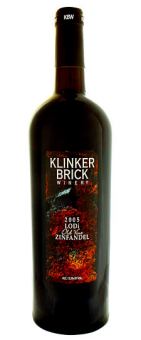
    So tonight, I opened a bottle of Klinker Brick Winery Lodi Old Vine Zinfandel 2005. With nearly 16 percent alcohol, it’s more like sherry or cognac than wine. And it’s strong, with a sulfurous scent of sweet cherry and oil. It’s heavy in the mouth — more like a Malbec than a Zin — and figgy in flavor, with blueberry, camphor, and a stinging finish that clears the sinuses and opens the nose.

    If you like a hot, jammy wine with the viscous consistency of blood, the Klinker Brick Zin may be worth a try. I, frankly, don’t care for it. My taste runs to woodier, drier, starker wines. But as I lift the book and return to the spiraling tale of Kevin — which I can’t stop reading though I know even now how badly it will end — I take very small sips. Because sometimes, a little pain feels right.