Year: 2006

  • Restaurant Decor

    Does anyone remember the House of Breakfast? It was this little counter-service joint run by two Eastern European women out of a house-front in South Minneapolis. The omelets were decent, the pancakes were fine, but that’s not why you went. It was the walls. Near the counter you could read the menu, which was scrawled on paper plates, but every other inch of wall space was covered in paintings: Pitiful puppies, sad harlequin clowns, waifish girls, and pathetic kittens—all with dark saucer eyes, rendered in the style of those kings of seventies kitsch, Walter and Margaret Keane—stood watch over your every cup of coffee. It remains the only restaurant that I’ve patronized specifically for the décor.

    Obviously, there are other places we go because of the buzz or to soak up a certain vibe, but often that has as much to do with the people attracted to the space as with how the space itself is put together. Would we still hang out at Chino Latino on a Saturday night if it were packed with nattering IRS auditors? The point is, décor and ambience are two distinctly different things. Case in point: The décor at Psycho Suzi’s, in Northeast Minneapolis, is a tacky tiki wonderland—but its patrons and cheeky staff give the place its edge.

    There’s no question that restaurant design—along with great food, service, and people-watching—is a crucial part of the magical and all-too-elusive formula that makes a restaurant successful. But there’s no template to follow, no style guide that ensures success. Note that I’m not including the theatrics employed by themed restaurants, as mechanical dinosaurs and timed thunderstorms are more than decoration; they’re more like a three-year-old’s chicken-finger-fueled acid trip. Those spectacles aside, you can basically define one end of the spectrum with casual-dining favorites like Applebees, which plaster their walls with flea-market finds (or impeccable imitations of flea-market finds). At the other end are fine-dining temples along the lines of 20.21, which artfully decline to put anything on the walls. The issue at hand isn’t whether one approach is superior. The question is: What does this all have to do with the dining experience?

    TGI Fridays, Applebees, Ruby Tuesdays, and the locally owned Famous Dave’s have become expert at the former approach. The collections of vintage photographs, battered musical instruments, wooden sleds, and all manner of other vaguely aged clutter serve to “localize” their restaurants, with the aim being to insinuate the place into the community. All that stuff on the walls is also supposed to grab our attention, make us feel at home, and incite conversation. But in some cases these heaping helpings of junk become a blur—a visual version of white noise that we’ve trained ourselves to ignore. Sensing a growing indifference, TGI Friday’s began reworking its design concept a few years ago, adding more contemporary objects like PeeWee Herman shoes, BMX bikes, and skateboards. The hope is that these things, more so than a Radio Flyer, will strike a chord of relevance with the younger consumers of mozzie-sticks.

    Moving up the scale in expense and prestige, the basic rule seems to be that the better the food, the less crap on the walls. Take the year-old Fugaise, in the East Hennepin neighborhood: an austere, windowless space with grayish walls and dark abstract art by a single artist, Daren Steneman. Some find the heavy color scheme severe, but when the food arrives, it’s clear that the focus is meant to be on the vivid squash soup set before us. As many of us can (and do) passionately argue, food is a conversation-worthy art form all on its own.

    Furnishing a restaurant can be a huge gamble if you’re looking to make a striking impression. Let’s not forget the ill-fated Rock Star restaurant and the first line Star Tribune restaurant critic Jeremy Iggers wrote in his 2002 review: “Loved the food. Hated the décor.” The room featured oversized black-and-white photos of pseudo-celebrities, harsh lighting and horrible acoustics, tacky carpeting that looked like it could have come from Elvis’ attic, and an unfortunate location in the Piper-Jaffray building. You couldn’t get comfortable, but neither did you quite feel glamorous (the only acceptable reason to sacrifice comfort). Not even the amazing dishes from Chef Steven Brown could overcome the drastic décor. But now that he’s at the warmer, friendlier Levain, which is tucked into a quiet neighborhood of South Minneapolis, Brown’s food is rewarded with a consistently packed restaurant.

    In response to an increased emphasis on interior design: Locally, restaurant design has become big business as Twin Cities-based entrepreneurs continue to test new concepts. When they demolished Nora’s just northwest of Lake Calhoun and rebuilt it as Tryg’s, the owners hired Shea Architects, a firm that has created a plethora of local restaurant spaces, from Solera to Famous Dave’s, to come up with something beautiful yet safe. (We might call it “Café Gabberts.”) Bucking this trend, the owners behind a newer Minneapolis venture, Five Restaurant and Street Lounge, hoped to strike upon something fresh by seeking out architects who’d never designed a restaurant before. The result is unexpectedly soft while maintaining a modern edge, keeping the diner at ease while introducing new ideas. Then there’s the much-anticipated Cue, the restaurant in the new Guthrie Theater. With a menu created by Lenny Russo (of St. Paul’s Heartland) and interior design by another well-known firm, the Durrant Group—all wrapped in a building by the vaunted French architect Jean Nouvel —it will be exciting to see whose influence leaves the most lasting impression.

    However, let’s not forget the middle of the restaurant-design spectrum. Call it a laid-back backlash against all the gloss and dough being shelled out for high-concept design, but there seems to be a trend toward a more organic approach to creating a dining room. The colors and artwork somehow tie in with the food (which is why some of us go to restaurants in the first place). The estate-sale finds, local artwork, and hand-carved furniture at Café Barbette in Uptown all work together to give the place its whimsical feel, and fit nicely with a menu that doesn’t take itself too seriously. Midtown’s new Town Talk Diner could have styled itself retro, but didn’t. Instead, the owners kept diner pastiche to a minimum, allowing the old, original counter to be reborn as their bar and evoke the spirit from which their snazzy menu draws. Restaurant Alma, in southeast Minneapolis, is another example. Its clean lines, modern maple tones, exposed brick, and birch branches give the dining room a fresh, natural feel, which makes sense given the menu’s focus on seasonal ingredients. Colors are easy and play well with candle light. Decoration is simple, timeless, and yet the minute we try to soak it all in, it fades to the back, allowing for the simple enjoyment of food and good company.

  • Rake Appeal { Object Lust

    It’s been a few years since Montblanc, the German jeweler, brought out the Meisterstück, the world’s grandest fountain pen. In fact, it was an old design going back to the early twentieth century, but through some kind of marketing alchemy, the pen suddenly became ubiquitous in American malls and upscale catalogs in about 1988. I received one, as a gift, upon graduating from college; it had been one of those presents I told my girlfriend to tell my parents about, and crossed my fingers. The silly thing was as big as a Cuban cigar, and probably the most spendy stock fountain pen one could ever hope to find. I put the price tag at about three hundred dollars. (There are limited-edition, precious-metal versions of the Meisterstück and its competitors, but I like to think that the standard jewelry-store versions top what is reasonable for a normal person.)

    It is, of course, the kind of pen you want to reserve for signing declarations of war and bilateral trade agreements. This is true of fountain pens in general, I suppose. They are a delight to write with, once you’ve mastered them, but they can be a pain to master. Fountain-pen ink has not yet been developed to the point where it will dry as fast as the ink from your typical ballpoint, felt-tip, or rolling-ball pen. This is both a weakness and a strength, because fine pen ink is silky, almost oily as it goes onto the page. It is a widespread fallacy that fountain pens are “scratchy.” They are only so when they have a cheap nib, or when the ink is inferior. Like vintages in wine, you can’t really go by brand. The finest bottle I ever had was an inexpensive, opaque black Platignum that flowed like my grandmother’s chocolate syrup poured over a sundae. I’ve never found another bottle like it, though a well of Pelikan turquoise came close. Also, you can tell a lot about a fountain pen’s owner by the ink color she chooses—blue-black and brown are especially eccentric and beautiful.

    The Montblanc’s main selling point is its nib, which contains both yellow and white gold, along with some dramatic filigree. Although I felt terribly self-conscious about using it to take notes in grad school, I quickly got over that, due to the pure sensual pleasure of using it. When I missed a lecture, I mostly regretted the missed opportunity to take notes that day. I believe I developed a kind of iron grip with my right hand that has—like my brain—atrophied considerably since then.

    A good fountain pen with real gold in the nib will quickly form to the hand of its owner. It will feel as if it intuitively knows the slope of your words. When people ask to borrow my pen, I know it will not work for them. When I first got my Montblanc, I thought it might become an heirloom, something I’d pass along to my children or grandchildren. Surely the price justified that sort of exaltation. But it will never quite write in anyone else’s hand, and that seems a shame.

    A pen like that you constantly worry about. I had several close calls when I left a book bag in a bathroom, or dropped the uncapped pen and watched in slo-mo horror as it pin-wheeled down to the floor, only to bounce off the safe end. Eventually, I retired the Montblanc to my home office; sadly, I don’t use it much anymore. I bought a cheaper and more modest Pelikan, and the truth is, it fits my hand better than that massive Meisterstück. Besides, the first and last peace treaty I’ll ever sign was my wedding license, fifteen years ago. Other than that, I’m not really in the business of signing Important State Papers. But it’s nice to know that I’d be well equipped when the next opportunity comes along.

  • Rake Appeal { Home

    The bathroom has long been a solitary place in which to hide out from family holiday gatherings and awkward dates. But only recently has it been elevated to the lofty status of “I-room” by high-end interior designers—a sanctuary where quotidian tasks become rituals and ablutions, where relieving oneself has metaphysical ramifications. No such shrine is complete without throne and font, and the latter has recently become an inspired installation for chic bathrooms the city over. Freestanding vessels are particularly popular these days. Gathering pools of water, these sinks invite bathroom-goers to linger over the water, like Narcissus. Those that are perched atop the vanity or countertop like some sculpture even facilitate the plunging of one’s visage directly into the H20. Designer cloisonné and carved onyx versions can run between one and five grand. But a few industrious ceramicists and glass artists are catching on, producing vessels that are equally beautiful but surprisingly less expensive—ranging between just two hundred and one thousand dollars.

  • Rake Appeal { Body

    I blame it on Beckham. While the average American doesn’t even know who Beckham is, and has no idea how to bend it like him, he was the first celebrity to sport the faux-hawk, back in 2002. Having moved on, Beckham’s hair is now shorn in the fashion of the photogenic inmates on Prison Break. Yet soccer-naïve Americans still stumble upon his old hairdo almost daily. Not since the ornamental kale craze of ’98 has something so absurd been so prevalent.

    The faux-hawk seems the tonsorial equivalent of heaping beer cans in the backyard—it’s lazy, unattractive, and does nothing to help the environment. But surprisingly, the style has a distinguished provenance. An article in the recent Style Issue of the New Yorker attributed the faux-hawk’s invention to Hedi Slimane, famed designer for the House of Dior. Perhaps that accounts for the appeal of the look, particularly among gay men. But, according to the article, Slimane himself abandoned the cockscomb coiffure after he “encountered one on a desk clerk at a hotel in Prague.”

    Dr. Frankenstein might have joined the village mob, but his monster survives. Gregory Slade, a young barber at the Hair Cuttery near Chicago’s gay village Boystown, said in an interview, “Mainly guys get their hair cut that way because they like how it can be worn in about three styles. You can wear it down, spike it, or wear it as a faux-hawk. I probably cut about three to five faux-hawks a week.”

    Closer to home, the trend shows no signs of fading. At Minneapolis’ Lyn-Lake Barbershop, where clients pay fifteen dollars for a no-nonsense buzz, Brian Preston says he gets asked to do them all the time. His pronouncement is surprising, coming as it does from the Twin Towns’ last bastion of butch. “It’s everywhere,” observed Preston. To prove his point, he went flipping through a copy of Details. Happening upon a Dolce & Gabbana ad, he said: “See, both these guys have little faux-hawks. Of course, most men will just focus on the naked torsos and never even notice the hair.”

    Both Slade and Preston note that the style is flexible and rather noncommittal. According to Slade, most clients who request the faux are “guys who are afraid to sport a more punk look.” In other words, this is a hairdo that can stand erect for the occasional night on the town, but go limp in time for tomorrow’s job interview.

    “It’s a cop-out,” said Preston. “A poor substitute for the real thing.”

    Speaking of the real thing: Remember when punks with real Mohawks and safety-pinned leather jackets hung out in front of the Uptown McDonald’s? Say what you will about them, but those folks had the courage of their convictions. A flaming-red Mohawk erupting from a shaved scalp makes a sure-fire statement—the kind that makes parents nervous and gives adolescents certain bad ideas. A faux-hawk, on the other hand, says nothing except, “Take away my pomade!” Or perhaps: “In the morning, I can help you start an IRA.” Can we—and by we, I mean all of us, but especially gay guys—please put the faux-hawk behind us? We have to get ready for the return of the mustache

  • St. Maarten

    Dear Rake,
    I was too excited when I saw the cover of the February Rake [“Exposed”]! It was right before I left on my first vacation at a naturalist resort. The experience was great and the magazine was a big hit at the manager’s cocktail party, among the many Minnesotans who “bare it all” at this great resort on St. Maarten.
    —Kathy from Minneapolis

    Kathy of Minneapolis

  • Support Your Local B-Movie

    phantom1.gif

    To wit: the Heights Theatre is giving everyone another opportunity to check out Christopher R. Mihm’s local B-Movie homage Monster of Phantom Lake. This time, the film will be even better than it was back in early March, only because we’re going to have the great early summer weather that these frightfests deserve. I use ‘fright’ loosely: Monster is a barrel of fun but hardly scary, which is just as it should be. And it is well served by stopping next door at the DQ for a malted with your bobby-sock sporting girlfriend or your duck-tailed boyfriend, if you’ve got either… or if you can convince your spouse to don that get-up, which I can’t, and we’re still arguing about that.

    Ahem. Once again, I lament the fact that our theaters are filled with Poseidon and Mission Impossible and the forthcoming Da Vinci Code but not this little gem. If there’s anyplace that should feature The Monster of Phantom Lake, it’s one of our endangered drive-in theaters, where you could groove to “A-Rockin’, A-Rollin’, All the Way A-Ramblin’”, which sounds pleasingly as if it were being broadcast from the local AM station between sounds of thunder.

    Check it out tonight only at The Heights. Or, you could purchase this thing on DVD and project it onto your garage one warm summer evening, and let the kids fall sleep in their backyard tents and dream of bug-eyed lake monsters.

    My original review is here, and contains adult language (the review, not the film, which is good for all ages).

  • Welcome to the Dolls' House

    Let’s just get last weekend’s art events taken care of, shall we?

    Go see the Ballet of the Dolls show! I don’t know a ton about dance, but I’d venture to say that this show is pretty terrific. I’m secretly a music-head, so the thing I liked best was how the music covered the gamut between Liberace and MC Solaire, with a whole lot of Randy Newman in-between. I enjoyed how the dancers–and especially the Dolls’ artistic director Myron Johnson, who’s getting up there in age–remained very conscious of and connected to the music they were dancing to. At times, they were even lipsyncing. It was almost like a series of rock videos, only the chicks were just barely less scantily clad, the dudes were drastically more scantily clad, and the dancing was a whole lot more interesting.

    The Ritz Theater is also impressive–especially if you happen to be one of the lucky few that toured the place sometime within the past five years. A whole gaggle of nordeast artists pitched in to give it arty fixtures and a new marquee. For heaven’s sake, go check the place out.

  • First Chapters: Chapter One

    meals and lunches.jpg

    He needed to get rid of some of this shit –the books and magazines, the photographs of his war and the places he’d been and the things he’d seen. He needed to get out from under that story; it kept things too fresh for him, even as what he had actually experienced became more unreal all the time.

    It had too long been a comfort to him to be able to say, Here, here is the document, this is my testimony, these are accounts of what my life once was and what it has never come all the way back from. It was a terrible thing –the thing itself, but also these other things that kept him paralyzed in a confusing series of moments and images– and had cost him friends and family.

    He couldn’t help himself, though; he would buy each new book as it came out, oddly thrilled to have one more corroboration, another opportunity to retrace those old memories.

    He now had literally hundreds of books on the war, thousands of images and accounts at his fingertips, and he had studied the thing backwards and forwards, from every imaginable vantage point, and he still couldn’t quite find whatever it was he had been and what the experience had done to him. It wasn’t –as some people tried to claim– that it was something he couldn’t bring himself to forget, but rather that the continued appearance of these books, films, and television programs somehow seemed to keep alive and acknowledge the one monstrous bit of history that he could call his own.

    He would spend hours scrutinizing each picture and frame, looking for familiar faces, recognizable terrain, some piece of information that rang true or jibed somehow with his own experiences. He was looking for the war he recognized, but also for the war he’d missed, looking, ultimately, for any little thing that could make sense of the experience, anything that might somehow explain it all away.

    He didn’t want justification. He’d never spent any time looking for that. From the beginning he’d taken it for granted that the thing would never make any sense. He was looking for something that would untangle the things that were all knotted up inside him. It had, though, long since reached a point where he could no longer really explain what he was looking for, or even what he was looking at.

    Some of the photographs could still stir up hot, dark things in him, could still leave him blinking in disbelief. He’d been in an ambush north of Saigon with the photographer Henri Huet, who was blown up in a helicopter several years later. They’d been trapped in high saw grass that morning, pinned down by AK-47 fire from the trees. Soldiers were dropping all around him by the dozens, and there was Huet, crawling around in the midst of the carnage, intently shooting away with his camera. For years he’d studied Huet’s images in books, but nothing ever looked even remotely familiar.

    That wasn’t my war, he’d think. That wasn’t the way it was. Frozen like that, those paralyzed black-and-white images couldn’t come close to capturing the terrifying jumble and blur and gulping stop-time panic of those moments of ferocious noise and chaos. The silence in the pictures was all wrong; he’d never known a single moment of such mute repose as he saw in photographs of even the most unimaginable horrors. The photos were too condensed; too much was lost in the cropping. For every one image of frozen suffering there were dozens, even hundreds, sprawled outside the frame, and worse, stretching backwards and forwards from that one moment seized from the larger nightmare. And each of those moments, fuzzed out to its furthest and most chaotic borders, had its own raging soundtrack, was blown over with the most fearsome, inconceivable, full shitstorm racket of war.

    Still, looking at those pictures got things running in him every time, summoned the old noise in his head and straightened him up wide-eyed and gulping.

    After his wife left him he sat around drinking and paging through books, listening to Sonny Rollins drill holes in the air around him. Or he would sit at his window –he lived in a small attic apartment, and had one window– looking out at what was on occasion a busy street. Yet sometimes he would sit there and not see anything moving for what seemed like hours at a time. It made things questionable, big things like consciousness. Was he awake? Was he dreaming? Was he even still alive, even real?

    He seldom ate. His appetite was like a very slight shadow that would surprise him from time to time. He suspected that there wasn’t a single one of his neighbors that could have picked him out of a lineup.

    Was it too much? Was it too hard? It could be, he supposed. It sometimes was.

    crushed velvet corny 2.JPG

  • Conversations Real and Imagined: Am I Franz Kafka? Am I Anthony Perkins?

    trial1.gif

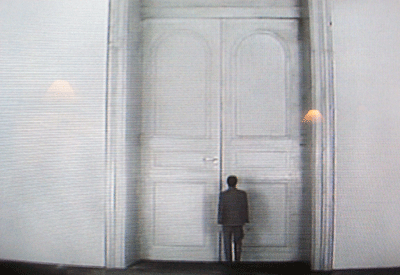
    Le Proces (The Trial), 1962. Written and directed by Orson Welles. Starring Anthony Perkins, Jeanne Moreau, Romy Schneider, Elsa Martinelli, Madeleine Robinson, Anoldo Foa and Billy Kearns as the inspectors, Suzanne Flon, Carl Studer, the lovely character actor (and Welles stalwart) Akim Tamiroff, the madman William Chappell, and Orson Welles himself, as the magistrate.

    Where did I find myself when I first saw The Trial? Frankly, I can’t remember, except to say that I was in some dilapidated movie house, and I think that there was even the sound of water dripping from behind the screen, it was that bad. Lots of steel beams and dust, I remember that much. You know I’m mad for Welles, how could I refuse? In fact, I barely remember who told me about this show, it seemed as if it was given to me in a whisper, in a cat-nap, by a young girl who frightened me.

    But this was Orson Welles, a The Trial is a minor film of his, a disaster according to some. Dry and sexless and ‘classic’–it would, if all went well, move me like his films always do, intellectually, leaving me amazed at what he could do with a camera. I had difficulty finding the place, it was showing in the basement of some run down train station. I couldn’t find it now if I wanted to.

    An attractive woman tore my ticket in half, at the same time pursing her lips as if that act was either quite pleasurable or a difficulty, I’m not sure. She was dressed in black and white and her hair was black, her skin a perfect white, so that she appears, in my memory, as if in monochrome. Her eyebrows were sharp curves over heavily made up eyes, eyes that were also gray, and she never smiled, but grinned as if in on a little secret. She escaped later to run the projector, and I could see her shadow in the glass of the projection booth. I swear she watched me the whole time.

    Troublesome. The Trial is–was, no, still is–troublesome. Shot in wasted cities, no, shot in Paris, in an abandoned train station and in Turkey–I knew it’s story, it was the same as all the rest. Fat old Welles, barely able to get financing, all the etc. of any late project. I was ready for the menace of an impersonal government, the accused trying desperately to get to the bottom of his so-called crime. Kafkaesque, perhaps even a bit Orwellian. But as it is quickly revealed, the picture is mired in… what? It’s not Freudian, I think… No, The Trial is not so easily reduced into a horror show of the past, a damning look at a long-ago beaurocricy. That would be easy to digest. But it’s about women. It’s sexuality. You don’t know this right away, but slowly, slowly, the terror creeps up on you, as it does on Josef K.

    In Josef’s apartment:

    INSPECTOR 1: What’s this thing?
    JOSEF: That’s my pornograph… er, my phonograph.
    INSPECTOR 2: What’s this?
    JOSEF: What’s what?
    INSPECTOR 2: A circular line with four holes.
    INSPECTOR 1: (Writing) Circular…
    INSPECTOR 2: It’s not really circular, it’s more ovular.
    JOSEF: Don’t write that down, for heaven’s sake!
    INSPECTOR 1: Ovular. Why not?
    JOSEF: (sarcastically) Ovular?
    INSPECTOR 1: We can’t not write it down just because you say we shouldn’t.
    JOSEF: Ovular isn’t even a word.
    INSPECTOR 2: You deny there’s an ovular shape concealed under this rug?
    INSPECTOR 1: He denies everything.

    Ovular. Ovular. What was it about ‘ovular’ that kept after me as I watched The Trial? And when Jeanne Moreau walks in, smoking, tired from a night of servicing men, and she lounges on the bed and her garter belt peeks out at us, it slowly dawns on you that this movie is not about Josef K. fighting with the state. Josef K. is wrestling with is his own sexuality.

    Nothing like that has any meaning in my life, I told myself, sinking down into my seat, which seemed more than willing to swallow me with a creaky groan. Turning, I saw there was no one in the cinema, just myself and the monochrome woman, staring out at me from her porthole, smoking, gesturning ever so slightly for me to turn and watch the film.

    HILDA: Look at my stockings. I’ll come back soon and then I’ll go with you wherever you want and you can do with me whatever you want.

    The Trial whispers its dialogue, whispers its allegations. Hilda shows off her stockings and then is carried away by a leather-clad thug who also works for the state. And while Hilda is a prize peach, while your heart thumps with anticipation, there is a palpable sense of dread. Josef cannot do anything other than barely kiss these women. I remind myself that Anthony Perkins was a gay man, that perhaps Welles found in Perkins the perfect actor to play this role, and all his films are somewhat autobiographical.

    But I know this is not true. Someone is pointing an accusing finger at me.

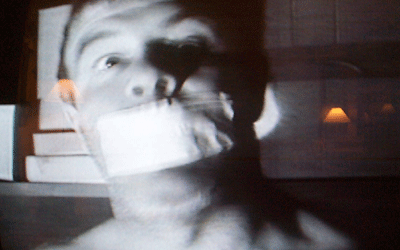
    Impotent men hide in shadows, fearful of Josef and the women who pursue him. Detectives who bothered him are later stripped to the waist, mouths taped, beaten and submissive. Why is it that the court archivist is the beautiful Paola Mori seen only briefly, enough to whet one’s appetite, but streaking your heart with fear?

    LENI: Will you spend the night with me?
    JOSEF: Your eggs are burning.

    Her eggs are burning, indeed.

    Dirty pictures spring out of the massive tomes in courtrooms, while Leni, the aide to the magistrate, with a sexy deformity of webbed fingers, tries to seduce our hero on a stack of legal documents. Josef is rarely pursued by the state, which seems fairly impotent in the face of these daunting females. Later, Josef tries to get assistance from William Chappell’s insane painter, and is pursued by a terrifying gaggle of young girls.

    As The Trial arrives at its climax, the women have vanished, like all dream women do. I don’t recall leaving the theater, don’t recall coming home, but I do recall seeing the monochrome woman again, in the lobby, smoking her cigarette and grinning at me. I wanted to talk with her and I wanted to flee. I fled. Later, feverishly, I read Kafka’s Trial, hoping to find something of what I’d seen in the book. But it was not there. Not that I could see.

    trial3.gif

  • Top Jello

    remote pop.jpg

    Tiffani is getting railroaded.

    I finally saw the “reunion” episode of Top Chef the other night, and I seriously couldn’t sleep afterward.

    Tiffani is being cast in the role of the villain. Don’t think for a minute that just because it’s Reality Television that there aren’t people behind the scenes working the events into “story lines” and pushing the players into “characters”. They are called editors and directors.

    I’m not saying Tiffani is a saint, if you’ve ever worked in a real pro kitchen, you know it aint stocked with saints. My problem is that they are taking some of her best attributes and by virtue of editing and bitter co-player assessment, turning them into unsavory qualities.

    Plus, the same people are trying to turn Dave into the Fair Princess. Poor Dave has been run over by Tiffani, poor Dave has had to endure being interrupted. Poor Dave needs to grow a pair.

    In a strange way it’s a bizarre sexism. The ballsy bitch is being beat down by the shemale. Huh?

    When you cut through all the dramatics, all the camera angles and created strained pauses, you come down to this: Who is more like Tom Colicchio and Hubert Keller and Charlie Trotter?

    Is it Dave who shows panic and flusters through a kitchen? Or is it Tiffani who is curt and focused and drives to get the job done, no matter what? Can you honestly see a legion of sous chefs and line-cooks responding to Dave with a respectful YES CHEF! while he twitches and mumbles to himself as the pressure mounts? It takes a strong person, someone to lead the battle that is dinner service in a top kitchen.

    What about Harold? I like Harold quite a bit, he reminds me of someone I know (I’m just a cook). But I worry that Harold doesn’t have the fire in the belly or the knowledge of the other side of a restaurant to really be a star.

    Who will win? Who knows. If Dave wins it will be Top Jello, pandering to the masses who want their winners to be sweet and palatable. If Tiffani wins it could be Top Bitch, which isn’t necessarily a bad thing in a real kitchen. If Harold wins, it will be because the other two started to believe their own press.