The Minnesota Zoo is excited to announce the arrival of two Lynx kittens. They are still getting used to their new exhibit, spending more time outside each day.
Month: September 2007
-
Somali Horror Flick
Beautiful! Beautiful! We have what is, as far as I know, our first local Somali horror flick coming next month. Check out the trailer.
And if I’m wrong about the first-ever-local-Somali-horror-flick claim, please educate me.
-
Conquering Maple Grove, Then the World

Here’s my theory: the brains behind Parasole Restaurant Holdings (owners of Manny’s, Chino Latino, Good Earth, Muffuletta, Figlio, Salut, and Pittsburgh Blue; and originators of Oceanaire and Buca di Beppo) have buried enormous, powerful magnets beneath all their restaurants. Then they abducted the entire citizenry of our state, one by one, and implanted corresponding metal chips in our necks.
Now maybe I’ve just watched too many old episodes of the X-Files. But you have to admit, it would explain a lot.
I was at Pittsburgh Blue, the newest Parasole creation, last Saturday. And it was mobbed: mobbed in that can’t-get-into-the-parking-lot, six-deep-at-the-bar sort of way. The food was good, tasty but definitely not arterial-cleansing. It was mammoth and meaty: salads heaped with bacon, huge hunks of beef, the best yellow corn I’ve ever tasted, though I’d bet my next paycheck it was swimming in heavy cream. People were — literally — eating it up.
The same thing happened when Salut opened in 2005: I remember walking in one night and asking for a table, to which the young host gave a snort. “How’s a week from Thursday?” she asked before disappearing again into the fray. It’s still packed every night. And now, Parasole is planning to open a second one next spring, in the Milton Mall, across from J Crew on Grand Avenue in St. Paul. The restaurant will be about the same size as the one in Edina, but Salut St. Paul will sport a large, secluded patio, rather than having its outdoor dining streetside.
And the partners at Parasole are already thinking about the next Pittsburgh Blue location, too; less than three weeks after opening, PB Maple Grove is looking at a “run rate” (that’s restaurant-speak for annual gross profit predictions, based on the average so far) of more than $7 million. It’s a potential gold mine.
Phil Roberts, co-founder of Parasole, says they’re scouting for locations like Maple Grove and Edina. “We’re talking about the Chicago suburbs,” Roberts told me. “Places like Northbrook. But Northbrook is just a metaphor for the kind of place we want: a high-income bedroom community.
In fact, Roberts is — even as I write — on his way to Honolulu, home to one of the biggest Buca di Beppos in the country (piles of pasta on the beach. . . .it doesn’t sound right to me, but that’s why I’m not a restaurant mogul) to shop for real estate. There’s talk that Parasole will start doing “communities” of restaurants in particularly favorable locations.
Imagine: a Manny’s, a Chino Latino, a Salut, and a Pittsburgh Blue all lined up like storefronts on Hawaii’s white sands. Mark my words. Tourists will begin disappearing for a couple hours at a time and when they come back, they’ll all have incisions just under the left ear and a rabid craving for bacon, steak, creamed corn, and red wine.
-
America's Next Hot Porn Star
I guess the next top chefs and models just weren’t enough. Now we’ve got a new cable pay-per-view show setting out to find America’s Next Hot Porn Star. Just what we’ve all been waiting for…
Porn invariably becomes the ultimate exploiter of every medium.
$$$$$$$$$$$$$$$$$$$$$$$$$$$$$$$$$$$ -
A Heavy Handed Pillowman
THEATER REVIEW by Danielle Kurtzleben

Everyone was excited for the opening of Frank Theater’s The Pillowman. The Star Tribune on Friday ran an article on lead actor Jim Lichtseidl: “Funnyman Jim Lichtseidl exercises his dark side with a meaty role,” read the subheader. The Pioneer Press also ran an interview with Lichtseidl and Luverne Seifert, another Pillowman star: “It’s almost guaranteed that sparks will fly,” the PiPress proclaimed. Expectations were high, and the show succeeds…sort of. Frank’s production of The Pillowman is good, but too overwrought to be much more.
Martin McDonagh’s The Pillowman focuses on Katurian (Lichtseidl), a writer of grisly tales in which children are tortured and killed. When a number of child murders resembling his stories take place, Katurian is detained for questioning by the totalitarian state in which he lives. He is interrogated by detectives Ariel (Chris Carlson) and Tupolski (Seifert), who have also detained Katurian’s mentally disabled brother, Michal (Grant Richey), as a way of baiting Katurian into confessing.
Katurian is on stage for the entire play, but is ironically forced into the background. Pillowman is about artistic responsibility, and Katurian and his art seem to be present only to generate a reaction from Tupolski, Ariel, and Michal. This is not to say that Lichtseidl disappoints; to the contrary, Lichtseidl gives Katurian what depth he can, and his big-brother relationship with Michal is sweet and sincere. But the plot itself gives Lichtseidl little to work with, and as a result he is underused. The role of Katurian proves that serious does not equal “meaty.” In this case, it just means the eye of the storm.
Fortunately, the rest of the storm is entertaining. Seifert and Carlson are wonderful as the good-cop/bad-cop team of Ariel and Tupolski. Carlson’s Ariel is high-strung and constantly enraged; Seifert’s Tupolski is docile but menacing — together they are mean and unfair and completely engrossing. Seifert is so deliciously nasty that you can’t help but laugh. Grant Richey also succeeds in the role of Michal, uttering even the most disturbing of lines with innocence and vulnerability.
Pillowman is heavy — it discusses child torture, for God’s sake. And furthermore, it’s about the importance of Art with a capital A. Sometimes it sounds more like a debate in a college literature course than a play. One can’t expect to feel uplifted, but Frank’s production can feel suffocating. There are periods of interrogation so uniformly intense that they drag and grow dull. Nearly every surface is a greenish, corroded metal. The compartment in which Katurian’s stories are acted out hulks over the small Dowling Studio stage, taking up considerable space but only used for about 20 minutes total. The between-scene music is loud and throbbing. Taken separately, these elements could be considered stylized and — especially in the case of the corroded set — kind of cool-looking. But taken together with McDonagh’s script (itself a bit heavy-handed) the whole thing screams “DISTURBING!” and doesn’t really let you think otherwise. It’s hard to see this genre-busting play as anything more than a psychological thriller in this environment, which is a shame. While entertaining, Frank’s Pillowman could use a lighter touch to create some sort of balance, or even a bit of breathing room.
-
Another Lost Winnable Game
The Kansas City Chiefs will be fortunate to win five games this season. And at the rate they are going, so will the Minnesota Vikings. Yesterday’s flop was the kind of tone-setter that evaporates a team’s fan base in a hurry. Other media folks who pay more attention, and are certainly more passionate, about the Vikes than I am, have already pointed out the silliness of keeping their only offensive weapon on the sidelines during their last possession. But where is the widespread umbrage over the absolutely pathetic performance of Bryant McKinnie, who was alternately manhandled and blown through by defensive end Jared Allen?
Allen’s line wasn’t too shabby–Eight tackles, two sacks, two pass deflections, three quarterback hurries and a forced fumble. He was without question the dominant player of the game, mostly at McKinnie’s expense. And when the Chiefs went to the primo pass rush late in the 4th quarter, Allen was moved inside, opposite Steve Hutchinson. Put simply, the Vikes once again got mashed at one of their precious few areas of supposed strength on offense. And, to bring this full circle, had McKinnie and Hutchinson not been so bedeviled by the heat (I’m offering up that excuse anyway), perhaps Coach Childress might have deigned to play Peterson even if he was a tad deficient in pass protection.
For the second week in a row, Cedric Griffin also got burned, once on the Chiefs touchdown and once when he missed a tackle that otherwise would have forced a punt and saved points. With Antoine Winfield having another strong game (even saving a potential touchdown by Drummond on a punt return), opponents will continue to flame Griffin until he improves or gets replaced.
I know this is beginning to sound like a rerun of my last Vikings diatribe, but that’s because the troubling problems are becoming chronic. To wit, the horrible, horrible receiving corps. Yes, the tight end Shiancoe had a really nice day, and caught that TD pass from Mewelde Moore plain as day. He’s got good hands and length–he’s no Kleinsasser. But the wideouts don’t get separation and don’t catch well in traffic–assuming the ballclub had a QB who could deliver the ball are the rate occasions they were open. And assuming the offensive line allowed the QB time to survey the field….
You get the drift. Brad Childress is threatening to become a trivia question destined to stump Vikings die-hards around about 2019. As in who was the coach in 2006 and 2007?
PS–for all you Wolves fans. I’ll throw something up sometime tomorrow or Wednesday after Tuesday afternoon luncheon with team officials.
-
Niggling with "The War"
Proving once again that if God himself arrived on Earth X% of the chattering classes would complain that his luminous vestments were not luminous enough, his beard had split ends, his diction was stilted and (for balance) Satan thought him intellectually lacking, the niggling over Ken Burns’ “The War” has begun.
OK, so we’re off to a shaky start comparing Burns to God, (some of his recent interviewers have come close), but come on, is anyone out there doing better stuff on this scale anywhere in this country? The answer to that is, “No”. Personally, I locked in from the first frame last night and see no purpose in niggling, other than to bait/engender an argument. I’m a fan of Burns’ “style”, the pace, the panning, the narration, the “fiddles”. Not only doesn’t it bother me, I regard the time in frame and hours spent overall as a valuable antidote to the ADHD-pacing and “money shot” structure of way too many feature films and network documentaries. (In my opinion, Burns’ “Lewis & Clark”, which he described as a “visual valentine to the American West” is the apex of this style. Gorgeous. Hypnotic. Plug it into a plasma set.)
I have not seen all of “The War”. (I am still trying to convince PBS that I am worthy of press screeners, even though my last name is no longer the prestigious “St. Paul Pioneer Press”). Burns has said that last night’s opener was essentially a full-length scene-setter, designed to establish the characters from the four towns he chose to build his story upon. But the nigglers are already complaining that Burns’ is treading on overly-familiar ground, hasn’t revealed anything new about WWII, or why humans fight, and is already resorting to visual cliches of repeated stock footage.
Among the less-than-thrilled … my new co-blogger, Ms. Rybak. She of course is so much younger than me she can be forgiven for not remembering WWII. Hell, she’s such a pup she barely remembers Duran Duran.
Since I haven’t seen the next 12 hours I’ll reserve judgment on whether Burns goes anywhere new, anywhere no filmmaker before him has ever gone, and whether he creates an epiphanic moment whereby the human affinity for war is laid bare, Dick Cheney is dragged out behind the barn and peace petals blanket the planet.
But the Burns’ “style”, even the 14 and a half hours, he commits to these epics has the effect of a deep immersion class from the best professor on campus. You absorb his films. You LIVE in them, and the hours you spend with the rhythms and characters, especially the ground level characters he’s chosen here instead of generals and historians, provide insights and qualities “ordinary” documentarians struggle to capture, condense, condense again and and contextualize in an hour, or even more laughably, a 12-minute, “20/20” piece.
What amuses me first is the insistence on … speed … even from middle-aged book readers, who you’d think would know better and appreciate comprehensiveness. The vibe is: WE already know about Guadalcanal, the battle of Midway and MacArthur’s screw-ups. So come on! Chop chop. Let’s get to something new or at least get to the end … faster.
Burns has told every interviewer that he was inspired to make “The War” after reading a poll that showed a shockingly high percentage of American school children so ignorant of who fought who and why in WWII they believed the United States and Germany were allies against the Russians. (Holy shit.)
Knowing that those people soon become voting age adults capable of being swayed by cheap demagoguery, you may, if you’re Ken Burns, decide to devote a year and a half to re-telling an oft-told tale in a different way, (going light on the politicians and admirals). But the nigglers are arguing that this is exactly what the Burns “style” is failing to engage — the imagination and attention of teenagers and twenty-somethings who have no interest in the background noise about wars of their own generation, much less their grandparents’.
Burns has hinted he may take on the Vietnam War somewhere down the line. If the nigglers are upset that “The War” isn’t ideologically-driven enough, THAT adventure may be more provocative.
Alessandra Stanley’s review in The New York Times hits on the notion that the film is too tightly focused on America. Really? I mean, I understand the need to find something to niggle about under deadline pressure, but this is clearly a film about the American experience of WWII. (I’d love to see a similar film from a Russian or Japanese filmmaker with access to their archives.)
Even in the scene-setter opening I sense that Burns’ decision to speak from the perspective of GIs, flyers, sailors, nurses and relatives at home offers valuable illumination about how little the average soldier then (and probably now) cared about or followed (or even had access to) world events that drew him into the maw of war. Only the Jewish guy from Waterbury, CT. recalled having followed the ravings and fascism of Hitler with any particular interest before enlisting. Most other young men, as Minnesotan (and soon to be folk hero) Sam Hynes, says, were simply swept up into the current, often with a cartoonish notion of war and the promise of instant adulthood and an adventure far more interesting than anything they’d find at home.
If all the “war” nigglers are really complaining about the lack of direct relation to the disaster in Iraq, I think they might be guilty of being too short-sighted and literal-minded. I’m guessing that by the time “The War” wraps next weekend, viewers who don’t demand some kind of Michael Bay-meets-Michael Moore hybrid, will have had a remarkably fulfilling experience, even without learning anything new about naval strategies at Midway.
-
Fortress Wine: Talk about focus!
Here’s a winery on Mt. Konocti in Napa Valley’s Lake County that produces exactly ONE wine: a Sauvignon Blanc made of 100% Musque clone grapes.
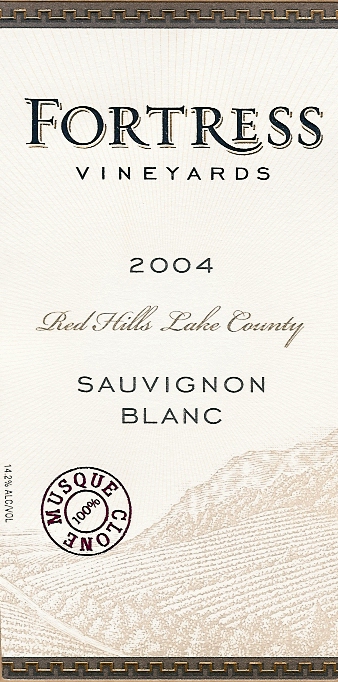
“My husband believes in doing one thing well before he moves on to something else,” said Barbara Snider, co-owner of Fortress Vineyards and — by the way — mother to Tim Snider, who happens to be vice president of the much larger Fess Parker Winery as well as the son-in-law of Fess himself. “We decided to focus on the Sauvignon Blanc until we got it just right.”
I’d say the Sniders (senior) can start experimenting with Pinot Noir.
Their Sauvignon Blanc 2004 is almost startlingly clean, with a nose of cucumber, citrus, and minerals, and a full flavor like a lime that’s been cut with a steel knife. The finish is bigger than you might expect; there’s even a tiny hint of vanilla in the wine’s wake. But the overall experience is one of clear, sparkling water, tart fruit, and flinty soil.
My husband and I split a bottle last night while sitting outside on what probably was the last sultry night of the year. A perfect way to punctuate the end of summer.
-
First Thoughts on The War
Ken Burns’ The War launched last evening. It was virtually impossible not to know this, as it had been advertised almost literally everywhere, and if you have any interest in anything that public radio or television broadcasts, you’ll have heard or seen tons of ads already. As usual, Burns is exceedingly earnest, and, as usual, The War–like The Civil War, Baseball, and Jazz before it–is being not-so-subtly billed as the definitive account of that incredible event. Unfortunately, the first episode is an unholy mess, weighed down with cliched narration and an irritating soundtrack, a confused narrative that lurches forward and stumbles back in time, and interviews that are both startling for their candor and startling for their tedium.
I had the very great pleasure to interview dozens of World War II vets for an unpublished (and unpublishable) first novel that I wrote many years ago. As in The War, the men I spoke with were gentlemanly and brave–it is no small feat to recount such horrors, not to mention to pause mid-sentence to try to keep oneself from weeping in front of a perfect stranger. But these were the fascinating interviews: in every conflict are the men and women whose lives only marginally touched the grinding machine of war. Some of the men I spoke with (they were all Navy combatants) had enlisted at the tail end of the war and the whole of their experience was tooling around the coast of America.
There’s nothing wrong with that–my own Grandfather Derr was drafted into the occupying Army that wandered the ruins of the far East in the wake of World War II. He had no horrors to recount, and I’m damn glad for that. My other Grandfather, Grandpa Schilling, was a medic who landed in Normandy two hours after the first soldier hit the beach on D-Day. He was haunted by that experience his whole life, and never spoke of it except to my Aunt Mary. I wish that he had seen only peace. But there were also countless people who remained at home, and many have great stories to tell about the trials of living at home during the war.
But Burns doesn’t seem to get that there’s also a lion’s share of people whose experiences were, well… they were boring. Perhaps because he limited himself and the scope of his film to the tribulations of the citizens of four small to smallish towns in America. (Those towns are Sacramento, California; Mobile, Alabama; Waterbury, Connecticut; and Luverne, Minnesota.) For instance, Burns gives us the testimony of the man who befriended a young English kid, and we’re told that this British boy lost his dad to a German submarine, and he (the narrator) felt just awful hearing about that. Well, Mr. Burns, it is probably much more potent to have interviewed someone who actually lost their father, rather than a second hand account. There are many such discussions, usually with the same people.
Even worse, Burns got into some trouble for initially excluding Hispanics and Native Americans from this story, which is a grievous error. So Burns tacks on a few interviews with Hispanic soldiers (after a heinous Norah Jones song that was obviously meant to close out part one.) This section is suddenly riveting, and makes it appear as if the protest were less about including Hispanics and more about making this thing actually entertaining.
Would it have been so awful to have included a major city in The War? Why only small towns? Including, say, either Los Angeles or Detroit would have given Burns myriad sources from various cultures and first hand accounts of two of the most famous riots in history: the Zoot Suit riots of ’42 or the Detroit race riots of ’43, both of speak volumes about race and the war at home.
The War is a diffuse effort, a film that juts and sways all over the historical map and can’t seem to find its footing. One minute you’re in Hawaii during Pearl Harbor, then you’re in Europe in 1939, then you’re back listening to an elderly woman recount how they really didn’t like Hitler in Mobile, Alabama, and you go “what?” Tom Hanks makes his appearance, narrating–they can’t make a movie about the Second World War without his participation. Too often, we get lofty speeches about what the war meant, in lieu of first hand accounts of the suffering. The old soldiers descriptions of Bataan and Pearl Harbor say so much more than you ever could, Mr. Burns.
What The War made me yearn for was some Studs Terkel and specifically his World War II masterpiece, The Good War. The Good War is a surprising work, and its people never boring, but often shocking to the extreme. Studs knew enough to find folks from every walk of life, in the small towns and the great cities, in the halls of Washington and the ghetto. He spoke to the men and women who felt the war was justified, the downtrodden who fought despite knowing that they had their own fight for freedom back home, and the few brave souls who objected to this war and sat out. It is a crazy book, and Burns could stand to have some of the real madness that accompanies war in his epic.
-
Roll out the Red Carpet
THEATER AWARDS
Local Theater Awards The third annual Ivey Awards — which aspires to be, roughly, something like a mini Minneapolis Tony Awards — gets underway this evening. If you’re a fan of local theater, you’ll relish the chance to see your favorite performers dressed to the nines. (Mondays are the bohemian Sundays, you know.) You’ll also get a glimpse of snippets from upcoming shows, one-minute plays, and, of course, a host of awards that recognize performers, as well as directors and designers of lighting, sets, and costumes. The theater community has regarded these young Ivey Awards with some skepticism, for certain. But now, three years later, very many theater-makers have been honored by the Iveys, and they’ve gotten the chance to bask in the limelight at this glamorous, high-production ceremony. Some have even gone so far as to give tearful speeches. And so, it seems, the actors are coming around. –Christy DeSmith
7:30 p.m., Historic State Theater, 805 Hennepin Ave., Minneapolis; 612-673-0404; $30-$125.
THEATER & PERFORMANCE
Strange Love This evening Skewed Visions presents its only Monday performance of Strange Love, a two-part exploration of contemporary and historical cultures of fear. Based on Stanley Kubrick’s Cold War satire, Dr. Strangelove or: How I Learned to Stop Worrying and Love the Bomb, this Theater All Year production features an an installation and multidisciplinary show by artists Charles Campbell and Sean Kelley-Pegg. Tonight’s guest artists will be The Body Cartography Project.
8 p.m., Casket Arts, 681 17th Ave. N.E. (1700 Madison St.), Minneapolis; 612-201-5727.
MUSIC
Peter Bjorn and John In an age of drum beats looped ad nauseam, of recycled and often misused samples, of really shameful overproduction, the modest melodies laid out by this Swedish trio feel almost revolutionary. Peter Bjorn and John have been together since 1999, but were little-known stateside until their 2005 release Falling Out, which won them substantial critical acclaim and a devoted indie following. With their latest album, Writer’s Block, they have landed a mainstream audience, propelled by two songs, “Amsterdam” and “Young Folks.” These tunes are catchy but not infectious — they strike that rare balance of introspection and optimism that compels any casual listener to hum along. Lyrically intricate, musically simple, their style is at once retro and progressive — a ’60s pop feeling, underscored by contemporary crises. –Max Ross
8 p.m., First Avenue, 701 First Ave. N., Minneapolis; 612-332-1775; $20.
Also playing tonight are Sinead O’Connor at the Pantages Theatre and
Loudon Wainwright III at the Cedar Cultural Center.FILM
Once, Full of Light Granted, this is a fairytale of a movie. There’s actually a scene in which the street busker and his rag-tag band are cutting a demo album while a two-year-old runs gleefully around the sound studio. I’ve had two-year-olds [three of them] and you can barely make toast when they’re around and upright. Nevertheless, this film is wonderful. It’s quirky and sad and nearly prayerful: everyone in it is visibly lifted, exalted, made more whole by the music. And, yes, the music is that good. On a strictly emotional level, Once is real. Its stars, playing simply “the guy” and “the girl” according to a script by director John Carney, are an Irish and a Czech musician (Glen Hansard and Marketa Irglova, respectively) whose voices simply light up our world. In the story, they sing together for the first time in an empty music shop and everyone — from the clerk, who is leaning on the counter eating a sandwich, to members of the theater audience — goes still. Listening. —Ann Bauer
5 and 7:10 p.m., Heights Theater, 3951 Central Ave. N.E., Minneapolis; 763-788-9079; $8 (matinees $6).