Author: Brad Zellar

  • Tarrare Bom-De-Ay!

    gluttony.jpg

    In the unsavoury annals of polyphagy, the worst glutton of all time was the Frenchman known as Tarrare. It is not known if Tarrare was his real name or a nickname, but it has survived in such expressions as “Bom-bom tarare!” and “Tarrare bom-de-ay!” referring to powerful explosions or fanfares and, by inference Tarrare’s own prodigious flatulence….

    For years, [Tarrare] wandered the French provinces in the company of robbers and whores and as an attention-getting act for an itinerant quack, swallowing stones, whole apples and live animals before the mountebank’s spiel about his wonder-drugs.

    In 1788, he reached Paris, to earn a perilous living by means of similar performances in the streets of the French capital. During the revolutionary wars in France, Tarrare joined the army but was driven to desperation by his raging hunger. Exhausted, despite quadruple rations and habitual foraging among dustbins and gutters, he came to the attention of the military surgeons. Among their experiments, Tarrare was given a live cat, which he devoured after tearing its abdomen with his teeth and drinking its blood. He later vomited the fur and the skin. The doctors also fed him live puppies, snakes, lizards and other animals, and Tarrare refused nothing. Contrary to the imagined stereotype of a glutton, Tarrare was pale, thin and of medium height, and of apathetic temperament. His fair hair was uncommonly soft; his mouth enormously wide; and the enamel of the teeth much stained. He sweated profusely and was always surrounded by a malodorous stench which got even worse after his nauseating feasts. Professor Percy wrote that the methods utilized by “this filthy glutton” to make his rations last were too disgusting to be described in detail and “dogs and cats fled in terror at his aspect” as if they knew what fate he was preparing for them.

    –from Jan Bondeson’s “The Cat Eaters,” the Fortean Times

  • Abecedarian

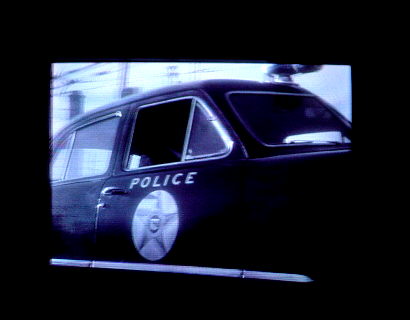
    asphalt-police.jpg

    A woman in a beret was in the kitchen making a giant sandwich following a long evening of drinking after work. By the time she finished constructing the sandwich (which she insisted on thinking of as a hoagie, which drove her husband mad) it was after midnight.

    Couldn’t you have made one for me?” her husband asked as he wandered in from the living room.

    Didn’t you see I was making a sandwich?” she said. “Everything is already put away.”

    Fine,” he said. “Goddamn if you don’t feel the need for one of those giant sandwiches every time you get a few drinks in you.”

    Hoagie,” she said, her mouth already full. “I really wish you would respect my desire to have the sandwiches I construct referred to as hoagies.”

    Jealous of his wife’s sandwich, and starving, he drove off in search of something to eat, settling on a 24-hour restaurant not far from his home. Klingon-costumed conventioneers, many clearly drunk, were occupying most of the tables and booths of the restaurant. Lest it appear he was avoiding the place because of the presence of the Star Trek geeks, he grudgingly proceeded to take a seat at a small table near the front window.

    Maybe, he thought, this wasn’t such a good idea. Now he was stuck trying to force food down his throat while he was surrounded by this irritating sideshow. Oh, fuck, he hated Star Trek. Perhaps, he hoped, a decent order of hash browns would salvage his utterly wasted night. Quests for food in the middle of the night, however, were inevitably regretable, at least in his experience.

    Ready to order?” asked a waitress who had suddenly appeared at his table. “Sorry, by the way, for the Invasion of the Body Snatchers. Tonight’s special, I suppose I should tell you, is the French Dip sandwich, but I can’t in good conscience recommend it to you after it’s been sitting back there under the heat lamps for going on fourteen hours.”

    Umm, no,” he said, momentarily distracted by an eruption of some sort at one of the Klingon tables. “Very sound advice, I’m sure.” Was it his imagination, or were these Star Trek characters starting to give him dirty looks, almost as if he had somehow trespassed on their private clubhouse? Xenophobic bastards, he thought, and made up his mind to leave at once.

    You don’t have to apologize,” the waitress said sympathetically when he attempted to explain his inability to spend another minute –let alone eat breakfast– in such disturbing and unruly company.

    Zig-zagging gracelessly amongst the tables as he made his way to the door were two drunken Klingons who were lunging at each other with some sort of plastic weapons, much to the loud amusement of their stunted comrades.

  • Moving Day: Same Old Nonsense, New Digs

    asphalt-railroad crossing.jpg

    Brave new world, but in actuality not terribly brave and hardly new. At any rate: welcome to my world. I’ve crawled into a new hole, a new little closet where I’ll play my out-of-tune piano for the wee beasties in the floor boards. And for you –whether you exist or not is really no sweat off my back. Nonetheless, I’d like to imagine that you do.
    Maybe, in fact, I’ve crawled from a hole into a ballroom. That remains to be seen. Everything remains to be seen, which is a fact that is as obvious as it is difficult to accept.
    What you need to know about me: I can’t sleep. I like to drive. I read books and listen to music, despite which I remain fundamentally illiterate. That fact won’t, however, stop me from yawping with the rest of the Barbarians.
    There are, I suppose, plenty of other things about me that you don’t need to know, and aren’t likely to learn.
    More anon.

  • The Ribbon Runs Dry

    One recent afternoon, I tried dialing up Fred Hribar, my old typewriter repairman. I got a busy signal, which I hoped for Fred’s sake was as promising as it was anachronistic. When I eventually managed to get him on the line I said, “How’s business?”

    “There ain’t none,” Fred said with a chuckle. You won’t find a more cheerful bunch of fatalists than the typewriter repairmen of the Twin Cities. Assuming, that is, that you could actually find a bunch of typewriter repairmen in the Twin Cities. (Maybe, in fact, bunch isn’t quite the right word; handful would perhaps be more like it, allowing for the loss of a finger or two to shop accidents.)

    “Everything’s pretty much died,” admitted Hribar, who has been servicing typewriters since 1961. “I’m one of the last dogs left—Friendly Freddie the Freeloader—and these days I’m more or less just putzing around the house. Stuff now is made to be obsolete; if it breaks down you just pitch it in the dumpster.” Hribar is sixty-nine, and he can remember when things were different. For decades he owned Gittins Typewriter on Chicago Avenue, and he was an authorized Brother technician, doing a quarter of a million dollars a year in sales and service.

    “I remember when the old IBM Selectric ball machine first came along, people thought that was the greatest thing in the world,” Hribar told me. “Then the daisy wheel models hit the streets and pretty much killed off the ball machines. Once computers became affordable, typewriter sales went to hell and the service followed. It got so bad that I rented out my building on Chicago—it’s a gun shop now.” Today he works out of his house in Hopkins.

    I hauled a portable Brother manual typewriter around with me for twenty years; it’s a beautiful little turquoise-enameled tank with a pop-off top, and the thing still works like a charm. Whenever I needed a new ribbon or a cleaning, Fred was my man. He can still spit out my machine’s specs off the top of his head. “Oh, hell yes, that thing’ll last forever,” he said. “Takes a T-5 ribbon, still being made by General Ribbon out of California.” I kvetched that since I started working mostly on computers eight years ago I’ve gone through three different machines. “That’s the story of the world,” he said with a shrug. “Everything’s changing all the time, and things go to hell in a hurry. So much of the stuff that’s out there now costs so much to fix that it’s cheaper to just go buy a new machine.”

    Hribar said, “If I make $100 a month I’m doing pretty good. It’s a dying racket, and I guess I’m dying right along with it. You watch it all disappear and there’s not a whole lot you can do about it. I live with reality, and I deal with it. What the hell, I’ll go fishing. And if I could find a rich woman to support me in my old age, I’d be doing just fine for myself.”

    Things aren’t quite so dire at Vale Typewriter, Inc., in Richfield, where owner Mark Soderbeck still keeps regular hours. Vale’s been in business since 1956, and Soderbeck has owned the place for twenty-eight years. On the afternoon I stopped by, Soderbeck was hanging around the backroom, shooting the breeze with Ted Schroeder, a retired typewriter tech who was with Royal and Metro Sales for forty-two years. It was immediately apparent that Soderbeck and Schroeder had spent more than a few hours telling old war stories and commiserating over beers. They recalled the days when there were upward of twenty-five different repair shops in the Twin Cities, and the state vocational schools (and Stillwater State Prison) offered programs for aspiring repairmen. A behemoth like IBM employed more than a hundred repair techs in the metro area alone, and Royal had twenty-two working out of its shop in Minneapolis. Today there are only two typewriter manufacturers left in the world, and most of the old fraternity of repairmen have died or retired.

    As office machinery evolved over the years, and electric typewriters gave way to electronic models with computerized components, Soderbeck took classes to stay abreast of changes in the industry. Though he now also services printers, fax machines, and copiers (and makes office calls), typewriter sales and repairs still account for seventy percent of his business. “Things just sort of keep plugging along,” Soderbeck said. “I’ll see quite a few of what I call heirloom machines, things people just want to restore. And I still pretty regularly sell manual typewriters to young people who apparently want to be writers and think it’ll give them some kind of edge. The old manuals just don’t break down. There are also still some things that are just plain easier to do with a typewriter—envelopes, labels, carbon copies where you need that impact; it’s quicker to roll something like that into a typewriter and bang it out. I suppose as soon as the government comes up with forms that you can fill out online, that’ll be the demise of the typewriter business.” Schroeder listened to this prediction, chuckled, and nodded his head in agreement. “Oh yeah,” he said. “We’re a dying breed. Ten years from now there won’t be any of us left.”—Brad Zellar

  • The Internist

    That afternoon, I remember, I’d attempted to perform back surgery on a dwarf who had gotten so stooped and hump-shouldered that she could barely walk. Neighborhood children had been throwing rocks at her for years. She was brilliant and very funny, but struggled with a terrible speech impediment, and was also cursed with a disastrous fashion sense that would have been merely amusing if the overall effect had not been so tragic. She would shrug the burden that was her shoulders and say, it is like trying to find clothing for a box, do you see?

    I had learned to converse with this woman, but only with great difficulty. Her original language was Portuguese, and she spoke the local tongue with a clipped, husky accent, embellished with a stutter. I’d been playing chess with her at the local café for years before I became her physician, and we had a shared passion for jazz and American rhythm and blues. She had, without a doubt, the best record collection in the entire town, and the only decent library of books in English.

    I was in a dark mood that day, as I made my way home through the tight and crowded streets. It was insufferably hot, and the rain was already moving in. The fat sun was sinking through dark clouds building in the western sky. The surgery hadn’t gone well; my skills in that arena are poor, and truth be told I am no great shakes as a doctor. Pity is a dangerous and useless quality in a physician, and I was troubled by my foolish involvement in an unnecessary procedure.

    Even with a capable young doctor from another city assisting, at my expense, the surgery had been a terrible failure. I had made arrangements to use a surgical theater in a local clinic, and these facilities were barely adequate. This is a bad case, the other surgeon, a Frenchman, had said. He kept repeating it, mumbling through his mask. Oh my, this is a very bad case. It is too risky.

    It was a very bad case indeed. It became apparent that there was nothing we could do to help the poor little woman, and I felt terrible surveying the mess we had made. Even our relatively simple exploratory operation would result in a long and painful recovery and rehabilitation. Medical facilities in that part of the country were primitive, and I knew that the patient’s only hope would involve a long and arduous trip to another city in the south, where there would be a better hospital and more capable physicians, a trip that I knew full well she could not afford and would never undertake.

    All that day I’d been looking forward to going home to my apartment and listening to jazz. A friend in the U.S. had recently sent me a couple of new Cecil Taylor reissues on CD, and I had planned to spend the evening sitting in my big green chair and drinking beer while I listened to them. I once spent a month alone in a friend’s cabin in upstate New York, and the entire time I did nothing but listen to six Lee Morgan records from his prime years on Blue Note. I played those records every day, over and over. It was all, really and honestly, I did. I sat on the couch and listened to Lee Morgan. I had made a careful study of the progression from Fats Navarro to Clifford Brown to Lee Morgan, and that month was the end of that particular road.

    Now, suddenly, I no longer felt like listening to Cecil Taylor. I needed something that required less concentration. I had a vision—a memory, really—of the humpbacked woman dancing awkwardly in her cluttered little apartment to a Wilson Pickett record.

    The next morning I had the unpleasant task of delivering the bad news to my little friend. Although saddened, she was expert in the art of resignation. I long ago accepted that I would never be beautiful, she said. I suppose I can accept that I will never walk upright.

    She asked if I would bring to the clinic her portable phonograph player and some records. That day’s mail brought me a live Sam Cooke record from the States, and I took it with me when I paid her a visit in the afternoon. I set up her phonograph and instructed the young nurse attendant in its use. I cued up the Sam Cooke record and handed the jacket to the poor woman. She was lying on her side, huddled beneath the terrible eminence at the top of her spine. She held the record jacket in her right hand, which was dangling from the bed, and she had to peer over the edge of the mattress toward the floor to scrutinize it. There was a lengthy Peter Guralnick essay on the reverse side, and she had to pull the jacket close to her face to make out the tiny print. I watched as she did this, as Sam Cooke and his band launched into “Chain Gang.” She was engrossed in the words on the record jacket, and I could see her toes wiggling beneath the bed sheet.

    I wish there were a way I could show you myself in that moment. I was standing there, helpless, a stranger even to myself. I no longer had any clear idea what it was that had brought me to that part of the world, the odd conflation of desperation and restlessness that had torn me—so long ago now—from all my old notions of what my life would be. I was stunned by the sad realization that this poor woman, lumped like a broken-down seal beneath the sheets, probably understood me better than anyone else on the planet. I felt as if my heart were breaking.

    I announced that I would be going. With a great effort my friend turned her head to find me standing at the foot of the bed, and she stuttered her thanks through an immense smile that was both painful and wondrous to behold.

    Brad Zellar lives in Minneapolis and writes the weblog Open All Night.