Author: Mason Riddle

  • In Review: Face of the World

    Michael Fallon on Anastylosis: Drawings by Mary Griep, at the Minneapolis Institute of Arts

    Mary Griep’s work begins with wishfulness. The title of this
    exhibition, "Anastylosis," is a reconstruction technique in which a ruined
    archeological monument is restored after careful study, using original
    architectural elements whenever possible as well as supposition and guesswork
    when necessary. No matter how rigorous the study, errors in reconstruction are
    inevitable and original components will be damaged.

    But I like the idea of anastylosis-the glorious and
    beautiful hubris of the attempt to reimagine and recreate-because it’s
    the only way we can even begin to realize unknowable mysteries.

    In Griep’s work, this wishfulness reveals itself in the
    impossible and highly obsessive-compulsive charting-brick by brick,
    cornice by cornice, mosaic tile by mosaic tile-of one version of the
    ruined sacred spaces, temples, cathedrals, and other monuments of the past. The
    finished works, inevitably flawed, proudly wrong, full of absolute humanness,
    are beautiful for the imperfection inherent in their execution. They are charts
    of futility, mapping through guesswork and supposition an entire world of
    possibility that simply cannot be known but we can’t help wonder about.

    These drawings are like the maps made in the late 1400s,
    after Columbus returned to Europe and rocked the collective understanding of
    the global layout. In some maps, for example, Florida is in a strange place in
    relation to Honduras-right at its shores, actually-and up until
    about 1540 mapmakers imagined a place they called Arabia Felix. Griep’s images
    are like Arabia Felix. There is something immensely poignant about such human
    mistakes.
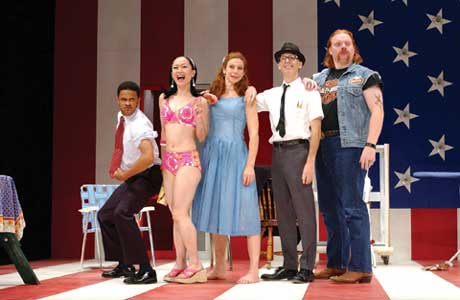


    bobrauschenbergamerica, a production by SITI Company

    Jaime Kleiman
    interviews Philip Bither, the William and Nadine McGuire Senior Curator
    of Performing Arts at Walker Art Center

    Do you see any fundamental differences in theater that is
    made in North America versus theater that’s being made in Europe? Are there
    similar themes, practices, or ideas threading through new work right now?

    Regarding differences, it’s very difficult to generalize,
    and this is a subject worthy of long essay or even a book. But here are a few
    thoughts: In Europe there is greater tolerance for conceptual (both in content
    and form) approaches and artists/producers feel less need to make performances
    "entertaining." While this is mostly good-artists have a tremendous
    freedom to experiment, even on the largest scale-at times it results in
    work that feels insular or academic.

    In the U.S. in recent years, ensemble and collective
    theater-making seems to be more dominant than in Europe, particularly in
    experimental and contemporary forms. Some of the ensembles that have emerged in
    the past decade in the U.S. represent a significant and exciting development.
    Our annual Out There Festival in January has, in particular, become a home for
    the rising contemporary ensemble theater movement in the States. Groups like
    Elevator Repair Service, Big Art Group, SITI Company, Riot Group, Richard
    Maxwell’s New York City Players, Universes, Big Dance Theater, and many others
    offer tremendous promise for the future of theater. They are willing to shake
    things up in a way that most of the traditional theater company structures in
    America don’t allow.

    A much more recent trend I’m noticing in the generation of
    theater/performance makers even younger than those mentioned above is what I
    might refer to "the new sincerity," a rejection of an ironic, distanced, more
    post-modern stance that has tended to define the work of their predecessors. We
    will see several examples of this direction in several of the companies
    appearing in this year’s Out There Festival.

    <--pagebreak->

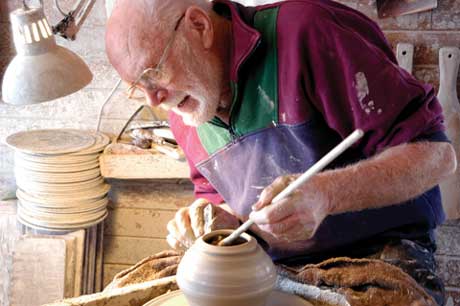
    Warren MacKenzie at work

    Mason Riddle interviews Warren MacKenzie in conjunction with his retrospective,
    Warren MacKenzie: Legacy of an American Potter, at Rochester Art Center

    Could you speak to the influences on your work?

    The first influence was when Alix and I apprenticed at
    Bernard Leach’s pottery in St. Ives, England. Because we stayed in his house,
    we were around his collection of pots. We saw pots from China and Japan. It is
    also where we met Shoji Hamada, the master Japanese potter who worked in the
    mingei tradition. Through Leach and his book, The Potter’s Book, pottery became
    more available. Hamada, who was influenced by Korean folk pottery, took a
    tradition and gave it new life. I gravitated to his philosophy and how he threw
    pots. It was a philosophy of "Don’t look at my work, but look at the influences
    of my work. These influences are stronger [than my pots] as they represent a
    culture." Koreans didn’t have a word for "good" or "bad," just mu, "it is."
    Hamada’s work had tremendous breadth-it was an attitude-carried out
    as well as possible.

    I like the historic pots of China and Japan and Korea, where
    the culture was more elemental when these pots were beginning to be made. Much
    of contemporary Japanese pottery has become all too clever but fantastic in
    terms of technical skill. The potters have gained incredible skills, but they
    have lost an emotional reason to express. But this is only my personal opinion.
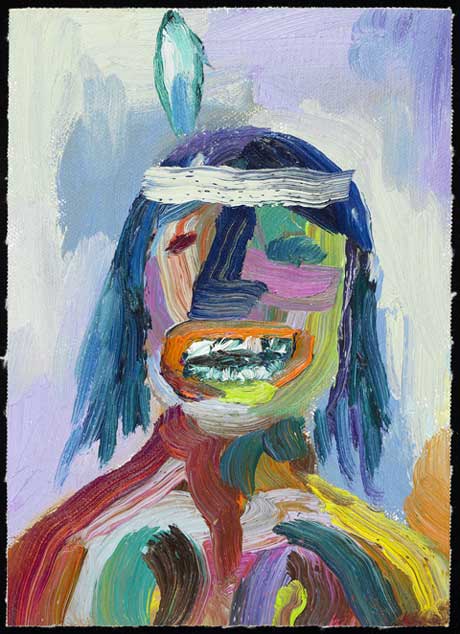
     

    Untitled, by Jim Denomie

    Ann Klefstad reviews the work of Jim Denomie and Andrea Carlson in New Skins, at the
    Minneapolis Institute of Arts

    New Skins is big, in all ways. It’s an ambitious show that’s
    highly successful. Jim Denomie and Andrea Carlson both use their positions
    inside and outside the standard art world to brilliant effect. The artists’
    work is very different, but the pairing works. Carlson and Denomie are both of
    Anishinaabe ancestry, but more than that, they are fine artists with academic
    training and fully developed personal styles. They use their media in
    sophisticated ways, working out of both Euro-American and Native cultural
    traditions.

    What was most instructive about this show to me was how rich
    the traditions of art are if they are approached not only from the inside, but
    with the perspective of someone who can both take a tradition and leave
    it-someone who can see it from inside and outside simultaneously. This
    eliminates stale strategies of quotation and irony, and opens up new potentials
    in the practice of painting. Both Carlson and Denomie are possessed of more
    than one tradition, and that seems to be a rich and liberating condition.
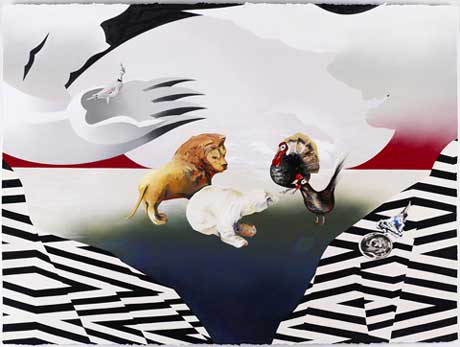
    False Flag, by Andrea Carlson

  • In Review: In the Realm of the Senses

    Fieldwork…

    What is it we want from fieldwork or a field of view? Beth Dow prunes the romantic notion of the artist-above-nature with the punctum of an enlightened gardener. Despite straightforward appearances, her work teems with history and philosophy in a comforting, meditative way, like gardens of the sublime domesticated and available for personal consultation.

    Nineteen or so sixteen-inch-square plots of palladium prints, with their large tonal range, show patterns not fully visible to our colored, roving eyes. Dow guides us through spaces that are not black and white, but suffused with gray hovering mists, and positions our field of view within them. Perhaps here we can find our simple wish: to wonder at the presence of infinity and singularity.

    Speaking of presence, Dow has said that Led Zeppelin IV was an early influence—“something ominous.” And it seems that mood is part of the existential drama at the roots of her work. The cover art for that album shows a country man hunched over by a large bundle of sticks on his back, propping himself up with another stick: a gesture of self-assertion. It’s an image that shows interdependency between humanity and nature, like many of the gestures recorded in Dow’s landscapes.

    — Sean Smuda, from “Complicated Grey Eyes,” a review of Fieldwork by Beth Dow at Franklin Art Works


    From the Environment of Invention exhibition at MMAA:
    Detail of Errant Ecosystem by Liz Miller; mixed media; 2007.

    Environments of Invention

    Paper icebergs; tree stumps made of cardboard; little cartoon woodland scenes in ceramic and felt; a biomorphic scatter of machine-made forms; a landscape of fully interchangeable smooth white parts; another landscape of giant bedclothes, limned delicately along a plaster wall.

    Nature still lends its forms to these artworks, but it’s experienced as mediation, as a made thing.

    This used to be news. Twenty years ago it was Baudrillard’s news, Lyotard’s news. These French thinkers wrote that we now live in a fully mediated world, that of the simulation, the world where there’s always a scrim of human culture between us and the big world that was here before humans existed. In fact, the scrim is so thick we can’t really even tell whether there’s anything else out there. The things that we take for granted as our environment—what you might call the ground of existence, the given—are all apparently human, now.

    From left, clockwise: Disengenuous Growth by Erika Olson, felt and mixed media, 2005; Stump 2 by David Lefkowitz, cardboard and Formica, 1998;
    Lady Luck Lotus by Holly Anderson Jorde, stoneware, glaze, paint, wood, 2004.


    At a panel discussion of the show, when one of the artists spoke of driving up the North Shore and seeing the environment of trees and scrub as being not very appealing and, well, “messy,” it became even more apparent that the art world is fully encased in a solipsistic universe, eating and creating culture.

    Artists, of course, haven’t created this situation, but they do report on it. The show is an affecting and effective report from the changing boundary between nature and human culture. It’s witty and amusing, and also, from the standpoint of this somewhat misanthropic treehugging critic, terribly sad.

    The world in which icebergs come from National Geographic photos and forest landscapes come from Disney cartoons, and where our closest contact with trees is through our use of their macerated flesh in cardboard cartons and printer paper, is very much the real one. We might wish it wasn’t, but the first step toward fulfilling that wish to realize that it is.

    — Ann Klefstad, from “Our Invented World(s)”: a review of Environments of Invention at the Minnesota Museum of American Art, featuring work from Holly Anderson Jorde, David Lefkowitz, Cherith Lundin, Liz Miller, Erika Olson, and Margaret Pezalla-Granlund


    Body by Anne E. Harris; graphite, colored pencil, pastel.

    Beyond Likeness

    I am particularly taken with Anne Harris’s drawings, a literal body of work. Harris has drawn her own body in studies “of gravity and inner space.” These are fleshy images, often in large formats, and succeed at showing the viewer the nature of the physicality of being a woman, compounded by a kind of transparency—that of never really being able to objectively evaluate oneself. Harris says, “I don’t know what I look like anyway,” and her grid of dozens of small portraits featuring only her face and head are testament to this impossibility.

    Women have consistently struggled with representation and in today’s world of digital manipulation, it is common for even Oprah, that paragon of “woman-ness,” to have her images digitally slimmed. Art in itself has become about fashion, and how the female artist looks sometimes competes with the content of her art. Harris’s heavy and sagging studies challenge this societal expectation of perfection. It is relieving to find her bodies more about a state of mind—how do I feel inside my body—than a statement of contemporary beauty.

    There is an obsessive quality to all the work in this show—whether writing endless lines with henna, paring the human form into basic shapes, creating meticulous reproductions or drawing lines of shifting human form—that gives the viewer an enormous amount to consider, with the eyes, heart, and mind. Laurel Reuter has put together a provocative exhibition that deserves to be seen by a wider audience. Which means, readers, we need to get out of our little worlds and get ourselves to the other side of the state. The best art no longer happens in the big cities—thanks to tenacious curators like Reuter.

    —Suz Szucs, from “Light Shed on the Body,” a review of Beyond Likeness, a show by Ann E. Harris, Elizabeth King, Jennifer Onofrio, and Lalla Essaydi at the North Dakota Museum of Art in Grand Forks


    Tangle #18 (Glare) by David Lefkowitz; oil on panel, 14" x 13".

    Unnatural Nature

    David Lefkowitz has long explored the topic of human intervention in nature. Tangle builds on his earlier series Flora: Introduced Species, which also took a microscope to the oil-and-water relationship between technology and nature. In Tangle Lefkowitz takes the expanding conflict one step further: Not content with his repurposed type of genre painting or the ongoing human-versus-nature wrestling match, Lefkowitz gives yet another twist of his critical knife. Unlike the Flora works, the backgrounds of the paintings in the Tangle series are no longer simply neutral fields for the conflict. Here, some have been painted to suggest an endless sea or a timeless, eternal space glowing with light and atmosphere (Heaven?). Others depict a grainy, out-of-focus background, as if the works were not paintings at all, but common photographic snapshots, legitimizing the conflict as real. And by painting weeds, plants known for their rampant growth, instead of more exotic flora, Lefkowitz constructs a parallel narrative to the out-of-control growth of technology.

    If initially these paintings seduce through their veneer of beauty and an offhand sense of humor, their dark side quickly subverts this appeal. “We may be beautiful and full of artifice,” they seem to suggest, “but this conflict is real.” It is no longer so easy to see where nature stops and human engineering begins.

    — Mason Riddle, from “Unnatural Nature,” a review of Tangle by David Lefkowitz at Thomas Barry Fine Arts