Author: Peter Schilling

  • What Does the Girl Want?

    marie1.gif

    Marie Antoinette, 2006. Written and directed by Sofia Coppola. Starring Kirsten Dunst, Jason Schwartzman, Judy Davis, Rip Torn, Shirley Henderson, Molly Shannon, Steve Coogan, Marianne Faithfull, Asia Argento, Jamie Dornan, and Danny Huston.

    Now showing at theaters around town.

    Sofia Coppola adores couches. Couches and beds. Also, she seems to enjoy the alluring look of young women draped on the same. Coppola likes shoes and cakes and champagne, pugs and pillows and handsome young men, too. Raised in considerable splendor, by a filmmaker father who turned much of his success into a duchy of fine wines and classic cars, Coppola is about as close to royalty as you’ll find in this country (and not be associated with grim politics). And yet, the girl feels trapped. Like Marie Antoinette, perhaps Coppola senses that she’s a young woman caught in the amber of wealth, waiting for history–or the fickle tastes of Hollywood–to slice her head clean off.

    There can be no doubt that Marie Antoinette continues the lonely saga of Sofia Coppola, who is gunning to become perhaps the most autobiographical filmmaker since Orson Welles ended his forty-year examination of his own destructive appetites with his death in the mid-80s. Knowing little about the real Marie Antoinette, I cannot speak to the historical accuracy of this film, except to say that I doubt there’s much interest, either by Coppola or her audience, in replicating Versailles in its exactitude. History, after all, can be a drag.

    Marie Antoinette is about Sofia Coppola and young women like her (which is to say, hardly anyone in a literal sense). It is a beautiful film, well acted by some of its principals, horribly by others. Antoinette is a film that is at turns funny and insightful and shallow and tedious. Like a dessert buffet, it manages to please the eye and the palate until the garish colors and the thick frostings begin to wear on the soul, and the body craves water and bread. In the end, it left me feeling odd, confused, with a bit of a headache, and still trying to grasp its deeper meaning… if there is a deeper meaning.

    Marie Antoinette is virtually without tension. In an attempt to forge an alliance betwixt Austria and France, Maria Teresa (Marianne Faithfull, doing her best Judi Dench impression), the ruling Empress of the former, weds her youngest daughter, Antonia (later to be dubbed Antoinette by the Frogs) to young Louis (Jason Schwartzmann), who would go on to become Louis XVI. In Austria, young Antoinette lives the life of simple royalty, in dark rooms with happy pugs and good friends to while away the hours. She is all of fourteen years old, and France is going to change her, big-time.

    At the border between the two countries, Antoinette is met by the Comtesse de Noailles who will instruct the young girl on etiquette and all things royal (in France). She is portrayed by Judy Davis, who at one time was one of the greatest actresses, a woman of startling range who could be terrifying, hilarious, and melancholy in a few breaths. Here she is an anal-retentive bitch, and the first sign of Coppola’s inability to rein in her actors, or to direct them in any way. The Comtesse is all pinched lips and irritated snuffs blasted through flared nostrils. Soon, Antoinette will be plunged headfirst into the court at Versailles, with the Comtesse at her elbow, trying to get the young girl to eat properly, to wait patiently (and buck naked) while subordinates vie to dress her, and, eventually, to conceive an heir to the throne.

    Here, then, is the tension: young Louis, for whatever reason, has no interest in making love to his young wife. How old is he? Is he too young and scared to touch this gorgeous young thing? Perhaps he’s gay. Maybe he’s got a lover on the side? Don’t know–aren’t meant to know. And Jason Schwartzmann, an astoundingly mediocre actor riding his role in Rushmore for yet another picture, plays Louis as if he were nothing more than a suburban teenager. Maybe Louis is just like all those fellows vying for Sofia’s attention as a young girl. Those wine country guys aren’t the most thrilling, I guess.

    For whatever reason, Antoinette does not dislike her husband, waiting patiently while he figures out what to do with himself in their wedding bed. In the meantime she shops, goes to parties, bats her eyes at a roguish Swede, and eats piles of cake. Eventually Louis comes around, they consummate their marriage, and she has a girl, who gives our eponymous hero buckets of joy.

    For the most part, Marie Antoinette is a blameless creature, a girl who tries to inject some life into the stuffed shirts and just wants to be happy. Coppola is a master at scenes of young girls pining for that elusive something, and the chores they create to fill bored afternoons. But Antoinette seems almost too close to the filmmaker’s heart, for she is sheltered in this film, never challenged, and key plot elements are dropped entirely. There’s never an argument between Louis and Antoinette; she has an affair that provokes no gossip (where up to this point a pair of shrewish aunts clicked their tongues mercilessly); Ben Franklin and Thomas Jefferson arrive in France, and there’s mention that they’re a crazy pair, but Antoinette never gigs with them. What a story! Instead, we get more and more parties, more and more shoes, and more and more cakes.

    Finally, the mob descends on Antoinette, and we all know the story: she’ll lose her head. The final half hour is tedious, its lighthearted characters forced into somber tones delivered with all the authority of a teenager admitting guilt to a hall monitor. Antoinette becomes a dutiful wife, Louis a responsible adult, and the fun drains right out of the picture. Personally, I was desperate for a dark and dirty mob, wide-eyed and full of violence, to purge this motion picture of its silks and sauces. But it was to no avail. Instead of chaos, Antoinette is taken away in a fancy carriage, muttering to herself. The final shot is a blue room, its chandelier busted and on the floor, the bright lights having fallen to darkness.

    Perhaps the mob are the critics growling at Sofia Coppola, the wrecked bedroom her own little world collapsing as adulthood (and these critics) begin to assert themselves. Marie Antoinette is close to being a great film, but it suffers for its inability to truly wonder about itself and to be totally honest. Coppola should never have even thought of tackling anything real, like the American revolution, when she’s most real being a sad young girl, surrounded by wealth. Dunst’s Antoinette is a pretty enigma, lacking self-reflection, lacking even anger and frustration, a beautiful zombie that leaves us frustrated and wondering. If she really said “Let them eat cake”, perhaps that’s because that was all that nourished that poor soul.

    marie2.gif

  • One Man’s Trash { Bring the Noise

    Norman Andersen flipped a switch on the side of a contraption that looks like a combination of a pipe organ and a china cabinet, albeit with a bright red Scandinavian door harp perched like a cherry on top. “This is called Valkommen!,” Andersen said. The thing began to wheeze and hum, then the pipes moaned out an uneven dirge. A bass drum started booming slowly from within while a mechanical arm strummed a shrill tune on the door harp, another tapped a handmade cymbal, and a pair of cheap red castanets clattered. After a few minutes, the whole thing folded back into itself with a gentle sigh. It was a mesmerizing performance. “Thing is, I just can’t sell these,” Andersen explained. “They’re like elephants. Everyone loves elephants, but no one wants to own one.”

    Andersen is a tidy man, with the impish look of a fellow who takes sheer pleasure in his work. He’s always been interested in music and art, in fashioning things from found objects, and in combining the two. Growing up in the suburbs of Chicago, the son of an architect father and a music teacher mother, Norman would enlist his pals to help him make spook houses and work with electricity and model airplanes. As a young man, he enrolled at the Kansas City Art Institute and eventually ended up at MCAD, where he also taught for some time. “At first, I thought I wanted to be a painter,” he said. “But then I discovered that I could make contraptions.”

    Andersen’s large house is filled with musical instruments, from a trombone to a drum set to a grand piano. All this competes for space with Valkommen! and other indoor sound sculptures that make countless types of noises when engaged but are often simply pleasant to look at. Some are as big as refrigerators, some as long as a Cadillac, while others fit snugly on top of a speaker or end table. Even Andersen’s doorbell is a sound sculpture. Hanging on a plank above the sink in his retro-style kitchen is a series of three plates with plastic fruit glued to them, a wine glass on its side, a carving knife, and a Bundt cake pan with blue stripes. When the front doorbell is rung, wooden balls strike the plates and butter knives, the wine glass spins, and the carving knife slices back and forth through the air. The back doorbell makes the Bundt pan spin and emit a ratcheting noise.

    Lately, Andersen has turned his attention from indoor sound sculptures to outdoor art objects that also make noise or simply twirl in place. These “self-composing” devices use wind and the elements to make all kinds of noises. Accord, commissioned by the City of Minneapolis, sits in the gateway of the Southeast Como neighborhood’s Van Cleve Park. Looking like one of Wilhelm Reich’s cloudbusters, it’s a giant cylinder surrounded by a spiral of rusty organ pipes pointing straight into the sky. Accord performs its kinetic concerts at noon, three, six, and nine o’clock each day. At these times, an electric blower pushes air through the pipes while a windmill controls the tempo, determining what you’ll hear on any given day—from one note, when the air is dead, to a whole chorus on a blustery day. “I like to work with technology,” Andersen explained, “but I don’t like the coldness and aloofness of machines by themselves. It’s a great transition to go from machine to wind. The capriciousness of nature—that’s what’s human.”

    Andersen’s garage and basement are filled with junk acquired during his travels, from bicycle rims to old organ pipes to metal bowls that, when struck, give off lovely, hollow sounds. A visit to his basement, with sawdust everywhere and windows made from Mrs. Butterworth’s bottles, is like stepping into the man’s brain. There’s a circular UHF antenna that, when plugged in and stroked with a violin bow, makes a melancholy moan. Tossed about this cramped dungeon—but undoubtedly in some sort of order—is a Flexicord (an Andersen-invented pedaled device with strings), pieces of bamboo, shell casings, bugles, cowbells, toy drums, and a pair of tiny, elf-like shoes that his aunt, a former CIA agent stationed in Vietnam, brought him years ago.

    Andersen’s pièce de résistance is Rainmaker’s Baggage, a thirty-two-foot sound sculpture on display at the Northwest Airlines baggage claim at Sea-Tac International Airport. Pink, red, yellow, and purple suitcases, guitar cases, makeup kits, and overnight bags are skewered on a long pole. When the sculpture is engaged, luggage begins to spill out along the conveyor belts, and the programmable-logic controller spins the kebabed bags around and around. These have been modified to rattle like rainsticks while acrylic sheets rumble below, approximating thunder.

    Andersen created Rainmaker’s Baggage at the behest of the Port of Seattle and had to scrounge around on eBay for some of the luggage. “Reaction to that piece is divided by the sexes,” he said with a laugh. “The men want to know how the thing works; the women want the luggage.”

  • Veterans in the Family

    flags1.gif

    Flags of Our Fathers, 2006. Directed by Clint Eastwood, written by William Broyles Jr. and Paul Haggis. Starring Ryan Phillippe, Jesse Bradford, Adam Beach, Barry Pepper, John Benjamin Hickey, Paul Walker, Jamie Bell, Neal McDonough, Harve Presnell, Judith Ivey, Myra Turley, and Thomas McCarthy.

    Now showing at theaters around town.

    A long time ago, when I was working in a library, an old gentleman who used to visit frequently noticed a display copy of Stud’s Terkel’s then-bestselling The Good War. The book stopped him in his tracks. For a moment he looked like he was going to throttle someone, hopefully not me. He grabbed the book and said: “‘Good War?’ What ‘good war’? There’s no such thing as a ‘good war’. My God…” Then he slammed it down and walked away.

    Veterans are an amazing collection of people, especially those who have experienced combat. Of the many veterans I’ve interviewed (some from my own family and for work I did for a pair of books) the ones who faced actual fighting were always the most open minded and emotional, and often times altogether silent about their experience. If you could get them to talk there were always long moments of tense reflection, as they tried to get past the myriad of emotions that were suddenly called up again, remembering a time of exuberant youth that was altered in the worst of all possible worlds. My own Grandfather was a medic in Normandy, and told his story to only one person, my aunt Mary. I never recall hearing him drone on about how great it is to fight in a war.

    On the other hand, there’s a relative who stayed safe on an island during Korea who brags whenever he can about his being a veteran of that war. He also lifted a glass at the beginning of this current conflict and crowed, “I’m happy. I’ve got my war.” This is in contrast to a guy I once worked with who was one of 16 men out of a unit of 200 who survived a Vietnamese assault. He takes the day off on that anniversary, because he cannot bear to face the world. And there’s my own father, who joined the Navy at the height of Vietnam. It occurred to me the other day that I’ve never heard him call himself a veteran. He just shrugged. “I’m not. I joined the Navy to avoid fighting. There’s nothing to be proud of.”

    This outlook is so contrary to what the hawks want to hear: a complex weave of emotions and opinions, instead of the necessary saber-rattling needed to keep the propaganda machine hot. Not necessarily peace-mongers, veterans who’ve seen combat typically hope others don’t go through what they endured. They don’t see war as fun, as a game, but see it as perhaps a necessity. Often, during these conversations, I have seen them look toward a picture of their own kids and wish, quietly, that another war would never be fought, to wreck the youth of their own children.

    Flags of Our Fathers is specifically the story of the men who raised the iconic World War II flag over the island of Iwo Jima. The flag was raised on the fifth day of fighting (there were thirty more to go) and three of the six survived the onslaught. James Bradley, the son of John “Doc” Bradley (one of the six), decided to interview many of the survivors and their colleagues and piece together their story. The three–his father John (Ryan Phillipe), Rene Gagnon (Jesse Bradford), and Ira Hayes (Adam Beach)–were brought home as soon as the government realized the appeal of the picture. Immediately, they were pressed into service to get people to buy bonds. Hauled around the country to various stadiums, they would wave or climb a papier-mache mountain and raise another flag (without the other three, of course, as they were killed), in an attempt to get people to participate in the 7th war bond drive. This nearly drove them crazy.

    Flags of Our Fathers is an odd film, filled with moments of horror, of black humor, of beautiful mystery, all of which is stitched together with some maudlin schmaltz. I say odd because it comes from the hands of Clint Eastwood, Steven Spielberg and Crash writer Paul Haggis–three filmmmakers who have been known not to be either subtle or complex. But unlike Spielberg’s overrated Private Ryan, Flags is not an exercise in technical verisimilitude: instead, it seeks, through three complex characters, to try and tell us, as best it can, what it means to be a soldier. In this way, it is brilliant.

    This lengthy PR tour affects the three men in vastly different ways: John cannot help but be reminded of his friend Iggy’s death, and the tremendous guilt that accompanies that memory; Rene loves the attention, and hopes to parlay his fame into financial success; while Ira is devastated, feeling as if this fame were more of a curse. There are various PR blunders–one of the men in the picture has been misidentified–a fact that disgusts the soldiers–and there’s some startling insensitivities, as when a dessert, molded into the shape of the image, is ladled with blood-red strawberry syrup, sending Ira into fits. A Pima Indian from Arizona, Ira gets run through the wringer here–he’s constantly insulted because he’s Native American, his patriotism questioned because he questions the motives of this publicity campaign, and is ostracized for his grief. The man drinks to forget what he’s seen, drinks to forget what he’s reminded of day after God-damn day, drinks because the pain is too great (and of course this drinking is attributed to his being Native American). All he wanted to do was remain with his unit. At one moment, he breaks down, weeping and holding the mother of one of his fallen comrades. It is a beautiful scene: for the rest of the men, simply crying is a luxury they are not to be afforded. They are heroes, not humans.

    Flags of Our Fathers doesn’t seek to damn the Government for making these poor fellows run around the country like trained bears–in fact, the movie makes a case that without the success of this fund drive, the war “would be over in a month” (a fact I personally believe is dubious). And Eastwood isn’t interested in making these men superheroes–they are all flawed, capable men who might be in over their heads. At times the film veers into solemn voice-over, summarizing the ‘point’ of the movie when it should just stop and allow the audience to soak in what we’ve just seen. Mercifully, there are very few of these scenes. Instead, the film captures, almost perfectly, the complexities of being a soldier, and especially a survivor.

    My own grandfather was a medic during World War II. I always liked that he was a medic, that he didn’t kill people, instead trying to save them. He landed in Normandy, a hundred and twenty minutes after the first shot was fired. His journals are sad. Grandpa was trying to sound upbeat, talking about the ‘Skipper’ upstairs looking after him, but he must have been scared shitless. I think about how, for a medic, battle is a different experience: while others run ahead firing their guns and ignoring the dead, he had to stop and see the results firsthand and hear what would often be final words. The shouting in pain, the praying, the remember me to so-n-so. When he was done administering triage to the worst casualties, dodging bullets himself, he then beat it back to a trench just before the German planes strafed the beach. And then, as night fell, he would hear the soldiers he had saved scream for help as the tides came in and drowned them, every one. That was a sound that would haunt him the rest of his life.

    Eastwood closes this film with a shot, from high up on the same mountain where the flag was raised, of the six men being allowed to swim in the ocean on a secured beach. This was a reward for raising the flag. For a moment, they are able to strip themselves of soldierhood, peeling off the clothes that define them at that time, and return to the land of boyhood. Screaming for joy for a change, they dive into the sea and play.

    Some brief conversations with veterans I’ve known or had the privilege to meet. In this case, all are real.

    flags2.gif

  • Conversations Real and Imagined: Brushes With Fame (Minnesota Stargazing Edition)!

    brushesdog.gif

    Detail from “Brushes With Fame!” by Steve Willis (scroll down link for bio).

    So I saw Donald Sutherland wandering down Lake Street one night, and I’m thinkin’, what the hell’s this guy doin’ wandering down whore alley? Get this, so I yell out “Hey Donald, lookin’ for Klute?” What? I thought the whore was the Klute? He’s Klute? Son of a bitch, man I sounded like an idiot…

    We bought this kitten, you see, this little thing, cute as a button, and my wife, she goes “Let’s name it Tippi!” And I said, “No way am I gonna name a kitten after a girl I dated.” And my wife goes, “What do you mean?” And I said, and not without some pride, “Well, you know I dated Tippi Hedren back when I was in Junior High.” And she goes, “No!” And I said, “You bet.”

    So the cat’s name is Boots.

    So I guess Meryl didn’t like our f—kin’ pizza. Sat right there and gave her and her whole f—king family a large pie for free. F—king ingrate.

    I was telling Matt, that’s Matt Damon you understand, that the only way to drink a boilermaker is to drop the shot glass into the beer. And I told him that Old Grand-Dad used to be the best, in part because it had that somewhat… astringent aftertaste that one associates with the art of making boilers. I’ve drunk my share of Old Grand-Dad, but never with someone like Damon, of course. You can tell celebrity, even in a darkened tavern, my boy. It’s the teeth. They glow. Like white inside a room lit by a black-light bulb. Their celebrity radiates off their teeth, no matter how awful they’re supposed to appear.

    Now, per our agreement: buy me a double of Maker’s Mark. It was worth it, no?

    Ned Beatty came in here to get a tuna sandwich. I was, like, my God, it’s Ned Beatty. And he was pretty cool. He was impressed that I liked him in Nashville. But then I lean forward and go, “So Ned, tell me–” And he cuts me off. “Don’t!” is all he said. “But I’m just curious,” I said.

    “Forget it,” he tells me. The guy’s old, but he’s lookin’ mean.

    But it’s the only time in my life when I’m going to talk with Ned Beatty, right, so I’m like, “Ned, just tell me about Deliverance, man. I mean–” And he walks right out, leaves his tuna sandwich behind, which he’s paid for. Crazy.

    I enjoyed that sandwich, let me tell you.

    I saw Amy Adams in “Brigadoon”, which I hate, and all I remember is that this guy said afterward, “Amy, you’re going to get an Oscar someday.” And I thought, oh, yeah, for what, “Brigadoon?” Well, technically, she still hasn’t won a damn Oscar.

    I knew a guy who was a sign-painter for North Country. Does that count?

  • Ouch…

    Good film criticism is hard to find in this world, but if you want to read a really great review of a really great film check out Anthony Lane’s awesome take on Infamous. My only complaint is that it–the review–is too short. Scroll down past his wacky look at Marie Antoinette, which I’ll be seeing this afternoon, no doubt with Lane’s marzipan prose weighing heavily on my mind…

  • Deep Calling To Deep

    Infamous and The Queen.

    infamous2.gif

    Infamous, 2006. Written and directed by Douglas McGrath. Starring Toby Jones, Daniel Craig, Sandra Bullock, Jeff Daniels, Sigourney Weaver, John Benjamin Hickey, Lee Pace, Peter Bogdanovich, Hope Davis, Isabella Rossellini, and, in a small but powerful role, Gwyneth Paltrow.

    Now playing at the Edina Cinema.

    If you were to look at some of the yellowing old Truman Capote paperbacks from the 50s & 60s, those slim volumes with the red stained pages and turgid covers, you’d discover two Capotes. In Other Voices, Other Rooms, his debut novel, there’s Truman in his notorious pose, lounging seductively on a couch, precocious as all hell. Turn, then, to In Cold Blood, and on the back you’ll find a photo of a man considerably sobered by his experiences, and looking very much like some sort of flatfoot with the Kansas Bureau of Investigation. One of the Trumans is vivacious and keen to take on anything and anyone; the other, suddenly not as outgoing (though certainly not introverted), colder, now, perhaps a bit afraid of the world he once commanded. He is a shell of himself.

    The magnificent and thoroughly entertaining Infamous is about the transformation of the one man to the other. The film opens with Truman Capote (Toby Jones), sitting in the front row of a swanky bar with his pal Babe Paley (Sigourney Weaver). They’re gossiping, smoking and drinking, soaking in the high life that insulates them. The singer Kitty Dean (Gwyneth Paltrow, in a short, sharp performance) comes up to warble “What is This Thing Called Love?” and then, halfway through, is struck down with melancholy, and barely able to continue for her pain. Clearly, a man has left her, hurt her, and the audience, especially Truman, is caught in the rapture of her emotions. After a long pause, she gathers herself with a few snaps of her fingers, the band starts up anew, and she finishes the song with a flourish.

    Truman will not be so lucky.

    There is, of course, an elephant in this review, as no doubt you might be wondering how Infamous compares to Capote, which covers essentially the same story. They were filmed simultaneously, and, fortunately for Philip Seymour Hoffman and the makers of Capote, Infamous was shelved for a year. For Infamous is a vastly superior film. Where Capote gave us a Truman that was all actor’s tricks (Hoffman’s eponymous character was easily last year’s most overrated performance), a calculating man, cruel, impassionate, contrasted sharply against a small town that doesn’t seem to have a breath of life in it at all, Infamous is warts and all… and the ‘all’ includes Capote’s sunny personality and tremendous charm. Infamous, though obviously stretching the truth, nonetheless taps into Capote the artist, the man who may have used his subjects, but produced a volume of such emotional intensity that you cannot help but wonder what it did to the man. Where Capote was shallow waters, Infamous’ depths are nearly fathomless.

    Infamous throws us headlong into the cosmopolitan life of Truman Capote, and Toby Jones’ performance as the writer is as startling as Roman candle in a crowded subway. With a tart Django Reinhart-style soundtrack, we hop from table to table as Truman gossips with his high-society friends, all the while keeping his introverted boyfriend at bay. One morning, while perusing the New York Times, he comes upon an item about the brutal murder of the Clutter family in Holcomb, Kansas. “This story has stuck in my teeth like a piece of pull candy,” he admits, and solicits the aid of his friend Harper Lee (Sandra Bullock) to accompany him there. Truman and Harper are close friends, and their chemistry is a joy to watch. She is, at first, reluctant, but later admits–in a series of onscreen interviews that add surprising poignancy to an already moving film–that she is interested in crime, and when Truman asked, it was “deep calling to deep”. With that, they’re off to Holcomb, Kansas. It is the beginning of a long and torturous end to Truman Capote.

    Truman charms the socks off everyone: his pals in New York, publishers, detractors, the people of Holcomb, Kansas, their police, the killers, and, best of all, the audience. For anyone who has ever read In Cold Blood, Capote must have seemed odd: that book is difficult to endure, a wrenching experience and a piece of writing that seems to have tapped into the pulses and fluttering emotional stability of everyone Capote encountered. How could the monster of Capote have written such a moving work? The short answer is that he couldn’t have–but Toby Jones’ Truman could. He alone could weave his manic tales of arm-wrestling Bogart and drinking with Sinatra to the point where staid KBI Agent Alvin Dewey becomes a friend. This Capote is a good listener, he is a gossip, can be cruel and manipulative, but you can’t take your eyes off him, and wish you could spend an evening drinking and laughing right along with him. Not actually sexy, Toby Jones’ Truman is a creature of startling attractiveness.

    All of which makes his inevitable downfall all the more profound. Infamous is almost two films, one of great humor and one of uncomfortable tragedy. When they mingle, and Truman returns to New York for his dinner parties, like Kitty Dean in the opening he has to pause to allow pain and grief to wash over him. He dances the twist with his high-society friends, but the shadow of his experiences in Kansas clouds his psyche. As time goes on and on, the executions are delayed, humor slowly drains from the film. At last, when Truman, later lying about the final words of Perry Smith (Daniel Craig), tries to return to his old life, he is wrecked. The wind-up toy has wound down.

    Infamous has a bundle of energy, an intelligent script, and some of the most winning performances you’ll see this year. Its director, Douglas McGrath, does not have an especially cunning camera style, but he wants us to understand this man, as best he is able, to try to get in touch with the sacrifice it took to create a work like In Cold Blood. No one–the people of Holcomb, the two men who killed the family, the New York intellectuals, and especially Truman–emerge unscathed… nor, though, do they emerge without anything but their dignity. Unwilling to demonize Truman, McGrath and Co. offer us a treatise on the joy of being an artist, and the often times treacherous path it takes us down. “You die a little,” Lee says about writing in one of the interviews, “getting it right.” Sometimes you die a lot.


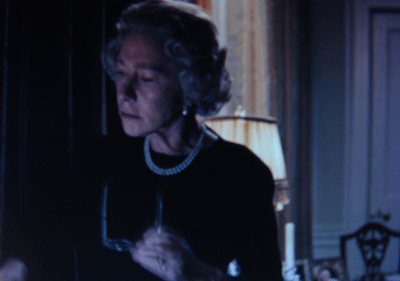
    The Queen, 2006. Directed by Stephen Frears, written by Peter Morgan. Starring Helen Mirren, Michael Sheen, James Cromwell, Sylvia Syms, Helen McCrory, Alex Jennings, Roger Allam, and Mark Bazeley.

    Now showing at the Uptown Theater.

    One day shortly after the death of Princess Diana, I was buying groceries at the Rainbow foods in Uptown. A young punk girl in front of me was being rung up, and when the cashier heard the young woman’s obviously British accent, asked where she hailed from. “London”, the punk said, very friendly. The cashier’s face fell. “I’m sorry for your loss,” she said with all earnestness. “Loss?” the girl answered, now irritated. “That fecking bitch can rot for all I care. You know what my country could do with the Royals money? It’s robbery, and she deserves a thieves burial.”

    Can you recall where you were when Diana died? I don’t, though it was probably on the street, overheard in a coffee shop or at work. Other than the punk’s exchange a few days later, what I do recall is that, for the next few weeks, I couldn’t help but think that Britain was one bat-shit crazy nation. The Queen does nothing to lessen this belief.

    The Queen is a very well made film, another feather in the cap of underrated (here) director Stephen Frears. It is funny, brilliantly acted by the lovely Helen Mirren, and a cast of top-notch actors. Taking place in the year 1997–which still seems too recent for one of the most powerful nations on earth to be wrestling with questions of monarchy–The Queen opens with the triumphant election of Labour Party leader Tony Blair. Blair–young, handsome, a savior–comes swooping in on the promise to modernize Britain and take her into the 21st Century. He is a man of the people, surely, and this is emphasized in a ridiculous scene in which his wife still bakes fish sticks for the family at 10 Downing Street.

    Blair and the Queen have an icy relationship. She is obviously conservative, very old school, and there’s a cheeky moment where Blair goes uncomfortably through the ceremony of the Queen asking him to run Parliament. At the end, Blair and his wife must walk out backwards–the Queen must not see their backs. Though funny, this is one of a few scenes that are meant to sum up the film’s themes, somewhat hamhandedly: we are to see the collision of this ‘modern new Britain’ and ‘traditionalist’ England.

    Things progress relatively smoothly until the night of Di’s death. Shock waves crash through Britain, but of course the crown is unmoved. The Queen does not believe that they should mourn in public, nor leave their summer home in Scotland. Blair scores major points especially as he dubs Diana “The People’s Princess”. The PR machine is now rolling. Blair will triumph. The crown will suffer.

    Certainly, the Diana situation was a tough one for millions of star-crossed Brits. But let’s call it like it was: the love of Princess Diana was certainly nothing more than celebrity worship. She was cute and liked to hold starving African children in an attempt to add some gravity to her shallow life. She was no different than, say, Bono, who at least has given us a catalogue of music that moves millions, and it is from that that he’s acquired his millions. Di got hers, like her ex-in-laws, from the public coffers.

    The Queen is an odd film, one that relishes making fun of these royals (the scene in which the Blairs walk out backwards) and acknowledging the above feeling (Blair’s wife is of the same mind-set as the punk in the grocery store), but one that feels as if Frears wants to have his cake and eat it too–he admires the monarchy as much as he thinks it’s outdated. As well made as The Queen is, as well acted and written, it could have used a Monty Python treatment. In his New Yorker review, Anthony Lane noted that when he went down to visit the giant crowds of mourners, there was definitely a sense that many people would have been glad to have done some bodily harm to the royals had they arrived. What a great sub-plot that would have been! Instead, the dull history of the 90s gets top-treatment here, and Diana’s death appears, to the filmmakers (and no doubt the people of Britain), to be one of the defining moments of the late 20th Century. Perhaps we need a few more years, and a new Python, to make the comedy this subject deserves.

    queen.gif

  • Smackdown: Tippi v. Birds

    boids.gif

    Ladeez and Gennulmen:

    Tonight, at the Bell Auditorium, as part of the distinguished Science on the Screen program, we have Hitchcock’s The Birds. Bring some popcorn of your own making, get a few glasses of cheap wine or fancy beer down your gullet, and a cardigan (the place is cold) and settle in for one of Hitch’s most acclaimed thrillers.

    I might be there, if only to try, again, to figure out what all the fuss is about. Many of my favorite critics think The Birds is up there with Vertigo and Rear Window, which seems like unbelievable bullshit to me. Maybe the big screen will open my eyes to something I’ve missed before.

    Anyway, since rep cinema in this town has gone the way of the Stanley Steamer, this is a good opportunity to check out a classic–by someone’s definition–on the big screen.

    The Birds shows tonight at 7:00pm, admission $7 for adults, $5 for members and students who ought to really graduate and get on with life. Directions here.

  • For Your Lunch Break: A Cavalcade of Trailers!

    The art of creating fascinating trailers has certainly improved since I was a kid. Back in the day, previews were nothing more than solemn voice-overs summarizing the coming attraction. Today, many of these pre-feature shorts are more intriguing than the movies themselves, and I don’t know how many times I’ve watched a preview only to sink into a funk and wish I were seeing one over the other. I probably spend way too much time checking out any preview that comes through the Apple Movie Trailers site, but what can you do?

    In the interest of keeping you entertained within, say, your lunchbreak, here’s some of the more fascinating previews (or fascinating coming attractions) on the net. No, you won’t find the new Bond here, nor will you find David Lynch’s Inland Empire, either (unfortunately).

    Little Children Whoa, sexy times: Kate Winslet and Jennifer Connelly duking it out in a searing drama? Be still my beating heart. I have to admit that I’m hoping the ‘R’ rating means some tasteful, though titillating, nudity. The trailer is awesome. Good use of the sound of speeding trains.

    13 Tzameti. Quite possibly the most intense trailer I’ve seen in years (though beware the awful voice-over at the end).

    Fast Food Nation. Look at this trailer: a perfect example of making an exciting short with difficult material. FFN looks good, sure, but its material is not typically the stuff of an exciting preview–talking, talking, talking. But the music here is awesome, and the editing is as sharp as a razor. Only two short moments of dialogue in a film without special effects and little violence (to humans, anyway).

    The Hoax. I have a soft spot in my heart for this story, having thought it would make a great movie for years (in fact, I first mistook Catch Me If You Can as being the film). This trailer is a great example of how to convey great comic performances in a short few minutes. And I’m really hoping that Richard Gere, who I believe has some great comic timing, finally gets his due in this flick.

    Marie Antoinette. Do I know why I have this here? No, I really don’t. Antoinette seems like a spoiled brat, but then again, Sofia Coppola seems like a spoiled brat. But the preview is mesmerizing: perhaps, like Lost in Translation, Coppola has managed to put the heart into brats and create a little bit of poetry. By the way, the teaser is much better, and more mysterious, than the trailer–essentially a music video of New Order’s “Age of Consent”.

    And two mediocre previews of films that look so bat-shit crazy I can’t help but plug them… and hope against hope they’ll find their way to the Twin Cities.

    Lunacy
    . Check out the dancing meat!

    and

    The Piano Tuner of Earthquakes
    . New, romantic, mysterious feature by The Brothers Quay.

  • When Worlds Collide

    encounter1.gif

    Brief Encounter, 1945. Directed by David Lean and written by Noel Coward. Starring Celia Johnson and Trevor Howard.

    Available at your public library.

    Sometimes it helps to escape a blue weekend with a mindless comedy, some blood and gore, or a spectacular adventure full of explosions. To wander into the local Cineplex with twenty bucks, grab your ticket, and check out from life for two hours. Look around you: every theater has its share of time-wasters, a brief moment in the darkness to distract you from the weight of the world. Sometimes, that is what movies are for.

    Then again, sometimes it is good to give in, to allow some subtle little movie, a forgotten gem that you’ll have to rent and drink cheap wine with, a piece of brutal honesty from a group of caring people, to worm its way into your heart and shake you to your core. Despite the pain, and perhaps the sleeplessness (definitely the sleeplessness), this is often a good thing. A perfect example: Brief Encounter.

    This is a simple film, about nothing more that two very good, very married people falling in love, deeply and passionately. It is from the hand of David Lean, notable for such Technicolor classics as Bridge on the River Kwai and Lawrence of Arabia, films that don’t have as much human emotion in their seven hours as this one does in one frame. Most likely it couldn’t have been made at any time other than 1945, and it couldn’t have been set anywhere but London. Part of its considerable tension lies in an old, British, don’t-rock-the-boat morality that was commonplace back then, when it was enough to make certain that your husband was well fed or your wife could get her cooking done in new pots and pans. Admire it for its deep respect of every character and the way it treats their feelings with utmost care. And then lay on your couch afterwards, close your eyes, and just stare out into dark space and feel for a moment. You’re alive.

    Brief Encounter is the story of a nice woman, Laura Jesson, who gets an ash caught in her eye one afternoon while waiting for a train. Laura is played by Celia Johnson, and she is an absolute beauty: an actress of great emotional range who was willing to look ugly, willing to be silly and laugh like a donkey, but a woman who transforms herself into a swan at a simple glance–utterly magnificent. Every Thursday Laura retreats to town from the suburbs to buy groceries, check out a book, eat lunch, and watch a movie before returning home to pleasant domesticity. When she is stricken by the ash, the plain Dr. Alec Harvey (Trevor Howard), a family practitioner, politely offers his assistance, and plucks the mote from her eye. With that, they bid one another adieu. But the next Thursday he runs into her outside the chemist’s shop. Later that same day, in a crowded restaurant, she sees the poor doctor looking for an empty seat: she offers him the last seat at her table. Easily, they drift into laughter, noticing a woman who abuses her cello, later chuckling over Donald Duck in a smoky theater. “Let’s do this again!” the doctor pleads, having had more fun than he’s enjoyed in God knows how long. The following week, they eat lunch again, and then, suddenly, without their knowing it (or even wanting it), they find that the hours of walking, of sharing observations of their staid world, after leaning forward hungrily during tea and discussing ideas they could never quite articulate in the past, they are in love. At one point, as Alec is talking, Laura is startled: he looks, to her, as energetic and beautiful as a small boy. It delights her. She doesn’t know why, only that it does, and with this enchantment, she is also quite terrified.

    She tries the usual tactic, talking about the doctor to her husband, hoping that this collision between the two worlds will jar her into a sense of duty, will kill this growing and uncontrollable feeling. And where it might have in the past, perhaps, this tactic utterly fails: she sees Alec again, and they have no choice but to be lovers.

    The film ends badly, cruelly. Brief Encounter seems, at times, to almost revel in the brutal emotional destruction of two kind and polite people. Their final meeting is thwarted by a local busybody, and as Alec leaves, forever from her life, all he can do is place a hand gently on her shoulder, unable even to kiss her good-bye, a kiss that every moviegoer longs for as much as Laura. Unable to stand the pain, she thinks to commit suicide by jumping in front of a train, but cannot. She has children, after all. Thank God for the children. What do we do if there are no children?

    That this minor masterpiece is narrated by Laura, trying to explain her actions (in her head–not out loud) to her crossword-loving husband, makes it all the more difficult to watch. Both people are surrounded by the innocent, and Lean and screenwriter Coward have no intention of marginalizing the families of the lovers. This is a film about a force of nature, as every bit dangerous as a hurricane, nearly as deadly. This couple knows better, but they also know that the moments together were some of the best they have ever known. This affair has honed their souls and made them diamond-bright. They cannot, under any circumstances, give that up. It will define their lives.

    As the train carries Laura away from Alec forever, she thinks–

    This misery cannot last.
    Nothing lasts really,
    Neither happiness or despair.
    Not even life lasts very long…

    Do not forget: It is because of that last line that her love for this man is so important, no matter the cost.

    Watch this film if you can, when your heart is sore and you feel silly and stupid and frustrated all the time for the things you want but worry you cannot have. The film is cathartic, to a degree: of course, nothing ever really works to salve melancholy and shame. Think then, as you witness the torment that confronts Alec and Laura, that these clandestine meetings actually push them towards a spectacular grace. Be grateful, to whatever god you worship, for the blessed relentlessness of emotions. For even guilt, as James Dickey once wrote, is magical.

    encounter2.gif

  • We Interrupt This Movie Blog to Bring You a Moment of Almost Inexpressible Joy

    TigersYanks.gif

    Detroit Tigers 8, New York Yankees 3. Detroit wins ALDS three games to one.

    Trust me, I understand your pain. But today, after nearly twenty years, New York City is Mudville and Detroit celebrates. Briefly, for of course it ain’t over ’til it’s over.