Author: Peter Schilling

  • What Magic Is; What Magic Isn't

    illusionist1.gif

    The Illusionist, 2006. Written and directed by Neil Burger. Starring Edward Norton, Paul Giamatti, Jessica Biel, Rufus Sewell, Eddie Marson, and Jake Wood.

    Nightmare Alley, 1947. Directed by Edmund Golding, written by Jules Furthman. Starring Tyrone Power, Joan Blondell, Coleen Gray (rrowr), Helen Walker, Ian Keith, George Beranger, Taylor Holmes and Mike Mazursky.

    The Illusionist is playing exclusively at the Uptown Theater; Nightmare Alley is available on DVD at Cinema Revolution.

    My father is–was–a magician, having set aside his practice for the time being to focus on teaching grade school. I tell you that in advance because watching him perform his slight of hand was always a source of deep wonderment for me as a child, and every time I hear there’s a film about a magician I’m ready to be awed again. For the longest time, I refused to listen to his explanations of how he was able to perform his tricks, like the fabulous sword through the card trick. With his back turned, my pop would ask his young assistant to pick a card, any card, and show it to the audience and don’t be shy. That’s good, now shove it back in the deck. And then, he would explain, the idea was to go presto! and find the card by impaling it on a sword. Only, he would say sheepishly, that was how it was supposed to go–he couldn’t afford a nice sword so he chose the next most dangerous thing you could get in Saginaw, Michigan: a model M150 Victor Model Rat Snap Trap, a nearly foot long instrument of death. So now the subject would take the deck, hold it up high and let the whole thing fall like leaves into a basket below. And then bang! there would be the card caught dead-to-rights like a rodent with its neck snapped. That was pretty damn cool.

    Thing is, over the years I came to understand that the magic isn’t in his being able to seemingly read your mind and make cards appear out of nowhere, but in the care he took to perfect the craft, the way that my dad would take old tricks (and any magician will tell you they’re all old) and make them new again, with a simple twist and turn in the story or a touch of personality. For great magicians are storytellers and comedians, singers and actors. They make you look at one hand while they’re doing what they need to do with the other. When they get it right, it’s magic.

    The Illusionist doesn’t get magic at all. It doesn’t get the craft, doesn’t get romance, simple storytelling, or acting, even. Like most films about conjurors, the filmmakers are so caught up in the wow! of a trick that they miss the performer and what he does. The Illusionist is a perfect example of a film that so deadens the art of legerdemain by turning it into a collection of CGI effects and giving us one of those surprise endings that have, as of late, become the bane of decent storytelling.

    On the other hand, there’s Nightmare Alley. I stumbled on this little gem once again at the local DVD store (I saw it originally at the beloved Oak Street). It is a movie that, despite its handicaps, understands what magic can be. And how a man who can master the art of slight of hand and mind-reading can get warped by it.

    To wit: Nightmare Alley is a beautiful and exciting picture, well told and decently acted; The Illusionist is garbage, and will be forgotten in a matter of months.

    The facts: The Illusionist is about a young man named Eisenheim (I’ll give them that that’s a great name) who tries to learn the ‘ancient arts’ of magic at a young age. He is a poor boy who falls in love with a beautiful and wealthy young girl named Sophie (Jessica Biel) of tremendous privilege. Because of the class difference, Eisenstein and Sophie are forcibly separated as teen-agers, with passionate vows between the two of them that they will reunite. And reunite they do, much later, when he has become a magician extraordinaire, able to make orange trees grow three feet in seconds.

    Well, the Illusionist isn’t too happy to see that now his love has hooked up with mad Crown Prince Leopold (Rufus Sewell), who is known to have beaten past lovers senseless and wants a quick path to the throne. Apparently, marrying the well-connected, pretty, but dull Sophie is the right way to become king. But Eisenstein gets in his way, thwarting the prince, stealing the girl, and in the end hoodwinking the respectable Chief Inspector Uhl (Paul Giamatti), who has been following Eisenstein around the whole picture, apparently because there are no other crimes in the kingdom.

    Edward Norton and Paul Giamatti are awful. Simply horrible. I have a suggestion to make, for anyone who cares to listen, but especially the director of this fraudulent film: you don’t have to set the movie in Russia just because the story takes place there. Especially when your actors cannot carry their accents without sounding like something from Monty Python. Even then, the Pythons were better.

    Aside from the silly accents, the acting is atrocious and the story is as boring as a children’s party clown who shows up forlorn from an impending divorce. Implausibility is piled atop implausibility, and Edward Norton and Jessica Biel have no chemistry whatsoever. The evil prince, played by Rufus Sewell (who is gaining prominence, God knows why), is wonderful because he gives you moments of much needed laughter in between the long stretches of boredom. That he does this unintentionally doesn’t matter much if you’re stuck looking for something to enjoy in a long, tedious movie.

    For a film that is ostensibly about a magician, there is no magic. True, there’s Ed Norton squinching his face at his hands while a ghost appears, although you could visit Disneyland’s Haunted Mansion and get better effects. You could also check out Woody Allen’s much-maligned Scoop and get better slight of hand. But even the scenes that bubble-over into full stage illusion, such as the orange tree bit and the ghost bit, have no personality from Eisenstein. He’s dead up there. And in magic, dead you just can’t be.

    Nightmare Alley, on the other hand, is a hoot. Stanton Carlisle (played by Tyrone Power, and barely credible) is a flunky who’s working the carnival circuit to make ends meet. He’s nothing more than a roustabout who wanders the grounds doing the dirty work, admiring the fetching Molly (the sexy Coleen Gray), and working on the sly with aging Zeena Krumbein (played by Joan Blondell, with great sympathy). Zeena’s married to the alcoholic Pete, and between them they have a dynamite mind-reading act. Zeena’s keen on Stanton; Stanton’s keen on Molly, but even more keen on the sawbucks he could rake in if he got hold of Zeena’s formula for mind-reading. Naturally, he sleeps with Zeena and then double-crosses her, and accidentally murders Pete along the way. He also steals good-hearted Molly from her lunkheaded strongman (Mike Mazurski, bless his soul). From there, he leaves the carnival behind and hits New York, where he begins to con the wealthy with his act, until his ambitions undermine his rise to the top, he is himself double-crossed by a bitch female-psychiatrist (!), and spirals to the bottom in one of the most harrowing finales ever.

    Nightmare Alley understands magic. That is, it doesn’t seek to make your eyes grow wide with wonder at the fabrications you’re seeing. Based on the incredible novel by nutty William Lindsay Gresham (who was at one time married to the doomed woman who would go on to wed C. S. Lewis, their story becoming Shadowlands), Nightmare Alley is concerned with the people who practice magic, who live to hone their art so well that they can fool anyone, even the authorities if need be. Eventually, they get so good at it they fool themselves into thinking they’re invincible. In the end, by avoiding soulless special effects, Nightmare Alley becomes a magical picture, in the sense that is awes you with its characters, and may make you even more intrigued by the art of these charlatans.

    nightmare.gif

  • The Hate That Love Produced

    clash1.gif

    Clash By Night, 1952. Directed by Fritz Lang, written by Alfred Hayes (from the play by Clifford Odets). Starring Barbara Stanwyck, Paul Douglas, Robert Ryan, Marilyn Monroe, J. Carrol Naish, Keith Andes, and Silvio Minciotti.

    Available on DVD locally at Cinema Revolution.

    San Xavier, location unknown. Probably it’s California, but it could be Washington, Oregon. A fishing town where the guys get up too early to snag fish and the girls stay on shore gutting the same and stuffing its rancid meat into cans. Afterwards they fight and drink and make love and maybe, just maybe, a drop of kindness squeaks out somewhere. Usually not.

    Clash By Night is a simple story, a love triangle, as blue-collar as it gets. At once a naturalistic film about first-generation American fishermen (ideally Italian and Irish, though none of them appear as such), it is really about what happens to people when they’re down and out and when love–or a lack of the stuff–warps them. And it warps them good.

    The facts: Enter Mae (Barbara Stanwyck). Back after ten years of chasing wealthy men around, with only a suitcase and a headache to show for it. She walks into the town of San Xavier and back to her brother’s home. This brother, Joe Doyle (played by TV stalwart and forgettable actor Keith Andres) isn’t happy. He’s a tough who just wants to fish and smack his girlfriend, Peggy (Monroe), around. Of course, Peggy’s often the one belting him across the chops, and can understand Mae’s urge to get out of this dump.

    Now enter Jerry, a big lunk with a heart of gold. He owns a fishing boat, lives with his father and his uncle, the latter of the two being probably the biggest asshole I’ve seen in a movie in a long time. Perhaps Fritz Lang thought it’d be beneficial if one of the audience had an urge to throttle someone themselves. Anyway, Jerry’s a nice guy who falls hard for Mae.

    Enter Earl (the great Robert Ryan). He’s something else. His wife is a burlesque dancer, on the road and spending his dough, ignoring him while she struts and sleeps her way across the country. In typical Odets fashion, Earl says he wants to “stick pins in her and see if she bleeds.” He likes Mae, and from the start it’s obvious that Mae likes him. After some awkward courtship, Jerry finally marries Mae, but not before the slimy Earl tries to get his meathooks into her.

    The film is truly about men and women clashing in the night, fighting and screwing, barking at one another and cornering each other in the cramped bars and kitchens of this backwater fishing town. And it’s beautiful. Beautiful because Fritz Lang knew enough to invest in his people, to cast wonderful actors who make every moment come alive. Paul Douglas is simply riveting as the shmuck who can’t grasp that his wife is wrong for him, and when he turns into a beast it’s as real the blasts of hot air bellowing from his nostrils. There are touching moments–the father, played by Silvio Minciotti (where the hell did this actor come from?), going from irritable and lonely to quiet and pensive as he plays his accordion in the shadows to his new granddaughter.

    And then there’s Stanwyck and Ryan. Two of the most pathetic creatures you’ll ever see mess up a good thing. When they’re together the lines just sizzle, exchanges like:

    “You’re the type of guy who needs a new suit of clothes or a new love affair. But he doesn’t know which…”

    or this one,

    “You can’t make me any smaller. I’m preshrunk.”

    All this under a full moon, drunk, cigarettes poking out of their mouths. But every actor resonates, they exist even when they’re not in the scene, so when we see Stanwyck and Ryan, we know that Paul Douglas is lurking in town, hurt, angry. And when he’s alone, we know his wife and her lover are out amusing themselves, and we want them to succeed, and hating ourselves for thinking such a thing.

    Clash By Night has its dull spots, most notably in the scenes with Marilyn Monroe and Keith Andes. It’s a bit long in the tooth. But it’s also a film they don’t make anymore–searing melodrama, shot through with noir-style camera angles, and filled with actors who seem to have shot up with hate and bile before the director yelled “action!” There are love stories today, weak, spineless things that don’t understand that everyone who loves also hates… at times with equal passion. This one doesn’t forget.

    clash2.gif

  • The Judy Holliday Experience

    adamrib.gif

    Adam’s Rib, showing tonight at the Walker’s Summer Music and Movies in Loring Park.

    Tonight, when you go see Adam’s Rib, pay close attention to Judy Holliday, would you? Judy Holliday, the not-so-bright blonde, butt of jokes, with the fluttery voice and look of kindness and near-despair. She’s a fool, no doubt about it. The dopey girl who has to quickly thumb through a manual to fire a gun at her no-good husband. Who talks like a Brooklynite in the worst way. Judy Holliday, playing the poor gal who seems lost on the witness stand, but firm in her love of her family. Judy Holliday, who picks up this fantastic film and hoists it on her narrow shoulders. Make no mistake about it: while Kate Hepburn and Spencer Tracy have never been better, while they’re the brains of this marvel, Judy Holliday is its beating heart, is its pained soul.

    Rumor has it that Kate and Rib director George Cukor and writer Garson Kanin conspired to cast Holliday in the role of the dopey blonde to show Columbia mogul Harry Cohn that she was just right to play the lead in the movie version of the play Born Yesterday. She won an Oscar for that role, which put her on the map. Unfortunately, the map was Ditzville, a role she couldn’t escape… for a time.

    But Holliday was smart. Compare her to Jean Hagen, the gal Holliday’s husband is running around on. Now I like Jean Hagen–she’s screechy and wicked and perfect in Singin’ in the Rain–but she’s one note, very simple. Holliday is simply brilliant. Watch her in the first interview with Kate Hepburn in Adam’s Rib, the way she is confused and yet confident within herself, correcting Hepburn on a number of occasions.

    When Hollywood, in its brilliance, thought to keep her pigeonholed as the ditz, Holliday went back to Broadway and started again, taking on more ambitious roles, flexing her muscles.

    Then breast cancer took her at age 43. So instead of a career that might have taken off in a variety of strange angles (who knows what the following decades and directors would have done for her?), Judy Holliday was gone. Too soon.

    So tonight, if you decide to visit Loring Park to watch this sweet little picture, pay attention to Judy Holliday. She is still staring at us, imploring us to pay attention to her character’s plight, still drawing our attention away from the circus in the courtroom, to the woman who has to go home to her kids each night.

  • Oliver Stone Feints and Falls

    wtc1.gif

    World Trade Center, 2006. Written by Andrea Berloff, directed by Oliver Stone. Starring Nicholas Cage, Michael Pena, Jay Hernandez, Maria Bello, Maggie Gyllenhaal, Michael Shannon, Armando Riesco, and Donna Murphy.

    When I first heard that Oliver Stone was directing a film called World Trade Center, I was actually quite excited, in a pugilistic sense. Why, the old guy’s dusting off the gloves, ready for a skirmish again, eh? Ol’ Stone hasn’t made a decent film in years, and maybe it would take a maniac like him to bring a oddball humanity to this story, to show us the utter madness of ground zero. True, I was hoping we weren’t going to have his usual conspiracy tales, a fictionalized Fahrenheit 9/11, with visions of President Bush ignoring warnings of impending doom, secret Pentagon meetings, jet fighters shooting United 93 out of the sky. Even if that were the case at least we’d get some of his usual bravado, or so I naively thought. JFK, Platoon, Salvador, Wall Street, even Nixon are brimming over with crackpots and their theories, and Stone manages to either cast nutcases in the lead (James Woods, Eric Bogosian, Tom Berenger and Willem Dafoe, Anthony Hopkins) or draw out edgy performances from actors who are normally dull as stale bread (Kevin Costner, Charlie Sheen, Michael Douglas). He is, or was, a filmmaker with tremendous passion, a man who seem consumed by whatever story he was wrestling with. Alas, this passion has faded. The pugilist is at rest.

    World Trade Center is an unbelievable bore. It is maudlin and feeble. It fails so miserably at understanding the odd nature of heroics, fails to come to grips with the strange horror of relatives who can only wait for their loved ones, fails to even do the simple task of making the events of that day terrifying and confusing. World Trade Center is an abject failure.

    The story is simple: two officers of the Port Authority Police Department, John McLoughlin (Nicholas Cage) and Will Jimeno (Michael Pena) are among a group of first responders to attend to the victims of the WTC attacks. We see, at first, them going about their day, the lazy commute to work on this gorgeous day, everyone all chummy and happy, New York a Guernica on the verge of destruction. For a few minutes the day unfolds and then the news begins to leak out that the towers were hit, and the action, such as it is, begins. The officers arrive at the scene, moving slowly through the chaos, amazed at what they’re seeing, reminded again and again that they have no plan for something like this. But bravery reigns and some of policemen and firefighters rush in. The towers collapse only two of their crew to survive, a good twenty feet below the surface of the rubble. The film details their conversations as they try to keep each other alive, a good two hours of hopes and hallucinations as they await rescue. In addition, Stone cuts away to the families struggling to cope with the possible loss of their loved ones.

    Forget for the moment that Stone has chosen an odd story to capture the whole of September 11. Odd, because although McLoughlin and Jimeno’s story is incredible, it is hardly surprising–these stories have been all the rage, in the news and on the bestseller lists for almost five years now. Give Paul Greengrass credit, in United 93, for having the bravery to attempt an original story, one that was riveting in part because we were seeing something had not seen or heard before.

    That aside, a good filmmaker might still have captured this day and all its visceral horror. If I seem a bit blase about the bravery of the two men, it’s only because Stone seems utterly freaked by his material and the need to honor the heroes of the day with hollow (and ultimately false) imagery. What happens on-screen did not occur that day: no police officers stood around, lips tight, nostrils flared, asking, in a solemn voice, if there are any volunteers to enter the buildings. No one paused, staring at the burning towers, eyes thinned, and then slowly respond, jaws tight with determination. Nor did McLaughlin then nod with pride and mumble “OK”. Cops don’t act that way, not in their daily routine and not when the tallest skyscraper in the city has a pair of jumbo jets buried deep inside them. In Platoon, Stone understood that bravery is a response to the sudden explosion of events, it is the need to become a part of this something larger, and doesn’t entail people standing around for cheap photo-ops. Has he lost the understanding that you glorify these men and women by simply showing them at their best, and not making statues of them?

    Nicholas Cage is utterly out of his league, which seems to be his modus operendi in half his flicks. Cage can’t seem to get his head screwed on straight. I’m not aware of a better actor who makes so many dunderheaded choices. But all the actors and actresses are wasted here, from Maria Bello’s uber-mom to Maggie Gyllenhaal’s sitcom-tragic wife. Grief and endurance are bizarre creatures, especially with children involved, but Oliver Stone treats the day’s suffering with slo-mo and soft focus, making World Trade Center appear as if it were an Irwin Allen film for the Hallmark Hall of Fame.

    Oliver Stone has been accused–rightly in some cases–of making propaganda, and World Trade Center is another exercise in propaganda. The stone-faced Marine (played by Michael Shannon, who is actually a very good character actor), who abandons his worthless job to pray over the book of Revelations and head off to ground zero (and then to two tours in Iraq), is one example of his bellowing nature. The guy is unreal, again slowly going about his response to this tragedy, muttering “we’re at war” and “we’ll need a few good men”. So, too, are the shots of the citizens of the world weeping over the footage of that day’s events. There’s no doubt that the world was with us that day, just as there can be no doubt that millions of people cried that day. But a filmmaker who relies on footage of people crying simply doesn’t trust his source material to elicit that response in us. And if Stone is trying to show the goodwill that we as a nation have squandered since 9/11, he is doing so with not a trace of the irony necessary to provoke such feelings.

    But his message is not what troubles me. As a piece of propaganda, World Trade Center is what it is. But WTC’s crime is that it is dull and tedious. Stone has never been a Leni Riefenstahl, but he’s not even his old entertaining self. Like most propagandists, Stone doesn’t want us to think, he wants us to feel. And yet, instead of provoking feelings, he bludgeons us with images so static–like soft-focus flashbacks of Cage sawing wood with his kid or laughing over pregnancy test results–that one can only emerge from the theater tired and cranky. The only thing he left out were saving dogs and cats in danger… a plot line that might actually make a better film than this one.

    World Trade Center is not worth watching on any level, unfortunately. If you’re serious about cinematically honoring the heroes of that day you have good fortune in the fact that United 93 has arrived the same year. Or watch Munich or Cache. One honors the victims of 9/11, the others are comments on terrorism, but above all, they won’t put you to sleep.

    wtc2.gif

  • The Joy of Hawks; Beautiful Cow in the Basement

    Parents, let me tell you, get out there and take your children to see some great kids’ movies at the Walker’s Summer Movies and Music. Bringing Up Baby? Undoubtedly a masterpiece of childlike humor. Our twelve-year old charge was thoroughly enthralled, giggling uncontrollably, and falling over herself over Baby, the leopard that bites at Cary Grant’s heels. Then there’s George, the dog who runs off with Grant’s precious dinosaur bone and… well, the laughs were never-ending. Then there were the little girls sitting behind us who kept imitating Kate Hepburn’s warbling “heh, heh, heh” and the soft way she sings “David, you can’t go anywhere without your clothes!”

    Same thing goes for the forthcoming Adam’s Rib and Philadelphia Story: to heck with Barnyard, Cars, and Pirates–take your kids to the park for some real movies. Please!

    Tonight at the fine Cinema Slop (in the basement tavern Dinkytowner): Poor Cow, the excellent 1967 Ken Loach film about a beleaguered mother fighting poverty and her deadbeat boyfriend. Look for the scenes with Terrence Stamp’s louse which were utilized in Stephen Soderbergh’s The Limey, also starring Stamp, as a flashback.

  • Madcap Monday in the Park

    Bringing-Up-Baby.gif

    Tonight is, of course, Summer Music and Movies, which is turning this wretched day into the best one of the week. By now my hyperactive thrill for this series should be well known by all half-dozen of my readers, so I’ll spare you the hyperbole, and boil it down :

    Perfect Weather + Perfect Movie + Loring Park + Whatever food and drinks and company you bring along = the ideal summer moviegoing experience. I know nothing of the band Stnnng, except that they play before the movie, and I trust the good folks at the Walker. Bringing Up Baby is a masterpiece, and if you haven’t seen it, you should.

  • From Hijinks to Horror

    sunshine1.gif

    Little Miss Sunshine and (briefly) Talladega Nights and The Descent.

    Little Miss Sunshine, 2006. Directed by Jonathan Dayton and Valerie Faris, written by Michael Arndt. Starring Abigail Breslin, Greg Kinnear, Steve Carell, Toni Collette, Paul Dano, and Alan Arkin.

    Now showing at the Uptown Theater.

    Greg Kinnear looks like a nice, square guy. He’s from Indiana, the nation’s suburb, is the son of a diplomat and has a brother who works for Billy Graham. The guy pledged a frat, speaks fluent Greek, donated money to Bill Bradley’s presidential campaign, and graduated from the University of Arizona. You couldn’t cast Greg as a villain, give him a role as a coal miner, or a salty dog on a whaling ship. Kinnear doesn’t have the ability to play a respectable president, what with his buggy-eyed way of responding to trouble and his aw-shucks method of tossing up his hands in frustration. It goes without saying that Kinnear is a limited actor.

    Jimmy Stewart was also a limited actor, but he remains, in my opinion, one of the finest in American history. Thing is, Stewart knew how to fit into the roles he was given and make them utterly his own. Most importantly, Jimmy had a stretch in the mid 1950s where he challenged himself and his public persona with some of the most bizarre roles in Hollywood’s golden age (most notably Vertigo and Winchester ’73). I mention this because Kinnear has become the closest approximation of Jimmy Stewart we have today, a respectable actor who works within his contexts and makes some startling movies. Kinnear is handsome, he can be wholesome, and he possesses the ability to show the everyman as a simmering, frustrated, yet friendly fellow. He has fabulous comic timing, and will take on films from Auto Focus to Little Miss Sunshine, a range of movies that probably won’t do to increase his appeal to middle America. Greg Kinnear could be our most underrated actor.

    He’s precisely what makes Little Miss Sunshine a success, limited though it is. Cram a VW van full of six wonderful actors working in tandem with one another, and you’ve got something. There’s Kinnear, Steve Carell (the heart of the movie), Alan Arkin (always a joy), the underrated Toni Collette, and newcomers Abigail Breslin and Paul Dano. While the direction is often workmanlike and the script a poor mix of moderately funny lines mixed with dead jokes and fish-in-a-barrel wisecracks, this ensemble works like the Minnesota Twins on a win-streak: unbeatable and fun to watch. Little Miss Sunhine will not garnish any awards for its cast, even though it could be the best acted film so far this year.

    The facts: Frank (Steve Carell) retreats to his sister Sheryl’s (Toni Collette) home after attempting to take his own life. His despondency peaked when his male graduate student, whom he was in love with, left Frank, the top U.S. Proust scholar, for he number two Proustian. Frank’s ill behavior in response to this crisis also cost him his job and nearly his life.

    Sheryl lives with husband Richard (Kinnear) and their family. Theirs is a suburban nightmare, a house whose interior looks last updated in 1987, messy, crowded with people who are tense and frustrated with life and one another. There’s Dwayne (Paul Dano), who is enduring a vow of silence because of his admiration for Nietzsche, and who longs to join the Air Force. Alan Arkin is Grandpa, addicted to heroin, kicked out of his nursing home, who teaches the titular Little Miss Sunshine, Olive (Abigail Breslin), her pageant moves. And Richard is struggling to sell a nine-step motivational program that he created. He is an abject failure, a goofy Willy Loman who is a giant pain in the ass to everyone. Collette’s Sheryl is just trying to keep the family together.

    Young Olive gets news that she has been given a spot in the Little Miss Sunshine pageant in Redondo Beach, California. Because Frank cannot be left alone, he is forced to come along, as is Dwayne, who is given the job of watching over his suicidal uncle. Grandpa has to tag along because he trained Olive. Because plane tickets are far too expensive, the family hits the road in a yellow VW bus. Along the way their clutch goes, the horn gets stuck, they run afoul of a porn-loving cop, and all hell breaks loose at the pageant.

    The screenwriter, Michael Arndt, does a ham-fisted job of getting this group into the van and driving across the country. The film is light on its feet and sharp when the family’s at home, but veers into every imaginable cliche on the road. Not to mention the implausibility and cruelty of the plot: every single dream that Little Miss Sunshine’s characters have is crushed in the course of the film. The only two who don’t have a dream–Grandpa and Sheryl–die or have no real personality. Perhaps the greatest weakness of this film is the latter: Toni Collette, another underrated actress with amazing range (she can be luscious in Japanese Story, poignant in Sixth Sense, and funny here) has no character, whatsoever. She seems to lose her focus after the first ten minutes.

    And Arendt takes cheap shots at an easy target in the pageant, giving us a Southern shrew in charge of the whole mess and a creepy pageant judge who seems a pale shadow of Fred Willard. Since the film isn’t even really about beauty pageants, this comes off as cruel and witless. As a screenwriter, Arendt is so unfocused you can hardly say that the film is about anything–the dad trying to be a success, the kid hungering for meaning, the suicidal uncle, all of these are merely conflicts to create resolution and a few knee-slappers. Little Miss Sunshine has an episodic, HBO TV feel about it, as every conflict is resolved in half hour increments, and the cathartic end is forced.

    This is a shame, because the actors are working these characters for all they’re worth. Kinnear is just golden, struggling to keep his smile pasted on, bringing real dignity to an inglorious character who is forced to eat shit all the way through the movie.

    It is the sheer joy these actors bring to this weak material that makes this film work, and work fairly well. Don’t come to this movie expecting to be floored or even to double over with laughter. But do come to watch six actors doing what they do best.

    Talladega Nights: The Ballad of Ricky Bobby, 2006. Directed by Adam McKay, written by McKay and Will Ferrell. Starring Ferrell, John C. Reilly, Sacha Baron Cohen, Jane Lynch, Gary Cole, and Amy Adams.

    Now playing everywhere.

    Talladega Nights is yet another feature-length skit-style flick with a former Saturday Night Live cast member, in this case Will Ferrell. It has moments of sometimes sublime laughter, most often those times when Ferrell has to match wits with Sacha Baron Cohen, playing a ridiculous gay French driver. Unfortunately, most of the jokes are awful; many, including what begins as a hilarious scene of Grace at the dinner table, labor on to cringe-inducing moments of painful unfunniness. Clearly, Ferrell and his director/co-writer Adam McKay wanted to skewer the NASCAR circuit–an easy target, in my opinion–but also felt that they needed NASCAR-lovin’ fans to turn out in droves. So the film, while steering clear of true skewering, eventually falls into the tar pit of actual caring, that awful moment in mainstream American comedy where the laughs are set aside and lessons are learned.

    Most egregious in this film is the fact that, once again, we get to see a pair of great comedienne’s talent wasted. Molly Shannon has been reduced to playing shrewish bit parts that undermine both her sexiness and her ability to toss out dialogue with wit and verve, and Jane Lynch, so well used in Christopher Guest’s mock-documentaries, has her style and grace smothered in a caricature of a Southern-fried Grammaw.

    Characters come and go, the plot is a mess, and probably eighty percent of the jokes are lame as the Jeff Gordon-is-a-homo types that NASCAR fans adore.

    The Descent, 2006. Written and directed by Neil Marshall. Starring Shauna Macdonald, Natalie Mendoza, Alex Reid, Saskia Mulder, Nora-Jane Noone, Molly Cayll, Oliver Milburne, and a cast of men and women who are the creepy crawlies.

    Now playing everywhere.

    While waiting in line for The Descent, a young man asked me what I was going to see. When I told him, he shuddered and said, “Oh, man, there’s no way I can see that shit. I live by myself, and those things scare me in the night!” He went, instead, to see Miami Vice, and although I admire his concern over his sleep and mental stability, he made the wrong decision.

    It’s nice to be scared again, and to the point where I was grabbing my wife’s arm and fighting to keep my eyes on the screen. The Descent is about a pack of six friends who meet in a remote cabin in North Carolina to go spelunking. There’s an important, though worthless, subplot in which the main character, Sarah (played by Shauna Macdonald), lost her husband and child a year earlier in a car accident scene reminiscent of Verhoven’s The Fourth Man. Sarah had been out white-water rafting with two friends, Juno and Beth (Natalie Mendoza and Alex Reid) who were with her at the hospital when she learned of her loss.

    Two years after the tragedy, Juno gathers Sarah and Beth and three others to go caving and try to pick up the pieces after the car accident. The early parts of the film, where usually horror films will waste with needless backstory and filler, seem like something written by Jon Krakauer, full of little clues, arrogance and ignorance meeting to create a disaster.

    I’ll thank my lucky stars for The Descent, a film that eschews the usual CGI garbage, and sex-starved teens and cheap scares for genuine frights. The frights are USDA Grade A because the director, Neil Marshall, understands that darkness and confusion, noises and only a dollop of actual violence are what make us frightened.

    Impressively, Marshall has assembled a group of seven young actresses whose job entails acting frightened but responding to their fears with intelligence and strength. There’s screaming, and I’ll say that references to Sigourney Weaver’s Ripley are somewhat unfounded: Ripley is not an extremely well-written character in much of the Alien films (all overrated but the first), whose mythical status and toughness are as subtle as a decapitation. The women in The Descent are people who are educated, who are fit, who work together at first, and who are allowed (unlike Weaver’s Ripley) to be genuinely terrified but not lose their smarts and bravery in the face of this. They have jealousies and rivalries and a plot twist that isn’t a mammoth surprise but is a welcome diversion from the direction the film is going.

    The Descent has a few rough spots, a couple of cheap scares that are unnecessary. But it is great because the dull spots are brief, there is no gaping implausibility (the bane of all horror films), and none of the characters is especially stupid, wandering into dark places just to check out a noise in a closet. Better still, unless you live in a cave, you don’t have to come home and wonder if creatures are hiding under your bed. But you might have a hard time sleeping.

    descent.gif

  • Shadows at the Varsity

    Cinema Revolution and the beautiful Varsity Theater have teamed up tonight to bring you John Cassavetes’ Shadows–a film that’s outside my miniscule experience, but one that I would love to see (National Night Out calls instead). The Varsity is a lovely place to watch a movie, in case you didn’t know. Couches, good food, beer in glasses (good beer, too!) and, once a month, a great movie like this one.

  • Friday on Monday

    His-Girl-Friday.gif

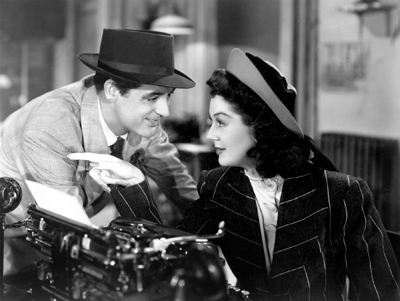
    The things I do for this job: contractual obligations force me to sit inside air-conditioning and watch the brainless Talladega Nights. But if you’re wise, you will wander down to Loring Park to endure brain-melting temperatures to enjoy Howard Hawks’ witty and wonderful His Girl Friday, part of the Walker’s Summer Movies and Music.

    I like heat and I love His Girl Friday. If I had my druthers, I’d bring a cooler and some wheat beer, beer glasses to drink them from, and my wife would have a armload of comestibles that would include her homemade chutney and summer corn relish.

    Now I sound like a poor-man’s Stephanie Marsh. His Girl Friday is simply the happiest, hippest film to come along this summer, and that’s saying a lot considering we’ve already seen Sullivan’s Travels. Girl Friday involves divorce, capital punishment, the press, slapstick, rekindled love affairs at the expense of witless sad-sacks, with the charming Cary Grant and the equally charming but much more sexy Rosalind Russell.

  • The Shriek of Silence

    “Our work is a subjective observation of sound,” said David Berg. As a scientist of sorts for the Acoustics and Audio Group at Orfield Laboratories in Minneapolis, Berg listens for a living. For instance, if you ever wondered what noise a cell phone’s seemingly silent display makes, he has the wherewithal to tell you. Not only that, but he can analyze the tiny purr and determine whether it can be improved upon. To do so, he would probably retreat to a room at the center of the Labs, a spot the Guinness Book of World Records has named the quietest place on earth.

    Berg is a tall fellow, a man with ears sensitive enough to catch sounds the rest of us miss. He is constantly listening, at one point bending his body like a dowsing rod to check the hum of a fridge. “Oh sure, I measured that,” he said, regarding the Kenmore. “It’s quiet. Stupidly quiet.” His office used to be the sound booth for Sound 80, the world’s first direct-to-digital studio, famous for capturing most of Bob Dylan’s Blood on the Tracks album and the song “Funkytown.” Another part of the former studio is now a training room where paying customers scrutinize various noises. Does the burp from a particular Harley’s tailpipe seem rugged? Does a vacuum cleaner’s screech inspire confidence in its sucking ability? Does an airplane’s engine whine assure passengers that it won’t plummet to earth? “It’s the quality of the sound, not the level,” Berg explained. “For instance, we dispensed with the notion that a vacuum has to sound annoying to be effective. It can be quiet and still sound as if it works.”

    Berg has had a love affair with sound for most of his life. He’s played in several bands, most recently an alt-country group called the Famous Volcanoes, and left the University of Wisconsin in Eau Claire years ago to pursue his love of audio and electronics, receiving most of his training on the job at Orfield.

    The quietest spot on earth is the Anechoic Chamber, a room within a room, a double-walled, fabricated steel structure on springs, padded on the interior with wedges of fiberglass. The chamber is dark and comfortable, as quiet as a bedroom in the middle of the night—well, obviously, quieter. As you enter, you walk on a tight grid of wires, allowing the sepia-colored wedges beneath to absorb every dollop of sound. Berg proved this by clapping and hollering. The noise died abruptly, the claps diminishing into strange, flat boings. You could hear every heartbeat in your ears, a subtle rhythm that eventually gave way to an annoying approximation of tinnitus.

    “This is the direct opposite, the Reverb Room,” he said, wandering into a place that looked like a box made of concrete block and echoed like a handball court. At the center of the room was a rotating microphone boom that captured every noise bouncing off the walls or the corrugated tin panels mounted in the corners. Berg whooped, and his voice caromed endlessly, mixing with the sound of footsteps to create a deafening roar. He pulled out what looked like a mechanical centipede, a tapper that hammers the floor of the Reverb Room. “You’d be surprised how many condos are built without adequate insulation!” he yelled, his voice amplifying the already painful cacophony. And in fact, this room soon would be used to test the insulating capabilities of drywall, windows, and doors.

    Berg’s iTunes collection features his favorite music as well as speeches, the din from vehicles, and the subtle grinds of an assortment of household appliances. He enjoys making and studying noise, and also showing off the gadgets at Orfield Labs. Besides the Head and Torso Simulator, which looks like a talking crash-test dummy, there were various small microphones in little wooden boxes, accelerometers to measure vibrations, and acoustic calibrators. Berg demonstrated the effectiveness of these instruments by clapping, stomping his feet, yelling, and whispering—anything to make noise that could be recorded and dissected.

    His skills and proclivities come in handy more often than you may think. Berg has recorded preachers giving sermons, manipulating three-dimensional computer models of their churches, in order to help them cut down on echoes. In one case, a church asked the folks at Orfield to leave room for a bit of fancy reverb so the organ could really drive home the point. The Labs are also assisting a company with a machine whose sole purpose is to create babble, thus masking conversations between work cubicles. Berg tests every device with a holler or a hiss, a burst of laughter, or an imitation of a foghorn. At one point he declared with a scowl, “Hard drive’s loud,” addressing a machine that seemed, to less discerning ears, completely silent. earth.