Jack Black and Mos Def team with director Michel Gondry (Eternal Sunshine of the Spotless Mind, Science of Sleep) to give us this oddball comedy about a man who becomes magnetized and erases the entire inventory of videotapes in his pal’s rental store. (The movie takes place in the ’80s.) They end up having to “swede” all the movies. What’s sweding, you ask? “Remaking something from scratch, using whatever you can get your hands on,” explains Black. Natch. So the boys take whatever junk they can find, grab a video recorder, and remake everything from RoboCop (with Black in tinfoil) to The Lion King to 2001: A Space Odyseey to Boyz n the Hood. Black even asserts: “Our version is better!” Undoubtedly.
Author: Peter Schilling
-
Big Hands in His Heart: An Interview with The Kite Runner's Homayoun Ershadi
In The Kite Runner (opening Friday in area theaters), actor Homayoun Ershadi plays Baba, an Afghani intellectual and father of the child Amir, whose friendship and eventual betrayal from the servant boy Hassan forms the crux of the story. Ershadi is a graceful actor, whose intelligence and dignity shines in this movie. Originally an architecht, he was literally plucked from his car to play a role in the Iranian film A Taste of Cherry. Mr. Ershadi was kind enough to speak to me on behalf of the film, based on the bestselling novel by Khaled Hossein.
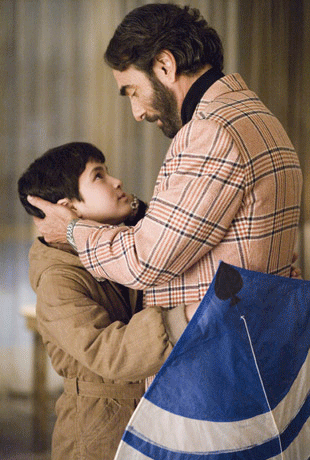
Rake: What brought you to this project? I know you enjoyed the novel…
Ershadi: I had finished reading The Kite Runner three months before they called me. Kate Dowd, the casting manager based in London, called to say that Mark Forster (the director) had seen my first film, A Taste of Cherry, and wanted to meet me. So I went to Kabul to see Forster and audition.
Rake: For the sake of authenticity, the characters speak Dari. Did you speak that language yourself?
Ershadi: No, but it’s very close to our language, to Iranian Farsi. The accents are different. Khalid Abdalla, who plays the older Amir, didn’t know one word of Dari so he stayed one month in Kabul and he learned. Now he speaks better than me and some people there. Before shooting we had a teacher who helped us learn Dari.
Rake: What was it like working with the children? You had a great rapport with both Zekeria Ebrahimi and Ahmad Khan Mahmidzada [who play the younger Amir and Hassan, respectively]. Not only were they children, but totally untrained as actors.
Ershadi: I had the experience before. I had a television show in Iran where I was a schoolteacher and had to work with kids. But these two kids—I can’t explain, I don’t have the words. They are so fantastic, so talented, diligent. They didn’t speak a word of English when they came to Beijing [where some of the production began]. It was very easy working with them.
Rake: Had you ever been to pre-invasion Kabul?
Ershadi: Never. This was my first time in Kabul.
Rake: What was it about The Kite Runner that especially intrigued you? Is your relationship with Iran similar to the relationship that Baba has to Afghanistan?
Ershadi: Yes, you can tell that. There’s some similarity to the story of Baba. I left Iran and went to Canada and returned in 1991. But you’re asking me why this book made me want to be part of the movie? When I read the book I couldn’t even imagine being a part of the movie. I was very proud when they called me. And I hope this brings out more Iranian actors. We have lots of talented actors and actresses. I hope this is a start for the movie industry in Iran.
But The Kite Runner is a story about friendship, guilt, forgiveness, redemption. These are the terms that people connect with. It is not just for Afghan people, it is very human, it crosses religion, culture, background. The story’s human.
Rake: What were some of the more interesting challenges filming The Kite Runner?
Ershadi: We never had a problem. Everything was very smooth. There was teamwork—everyone helped one another. It was a big crew, 200-300 people. I never worked with such a crew, but we all worked together.
Rake: The kite scenes were interesting. Did the kids actually fly the kites?
Ershadi: Yes! They knew, but had to learn a little bit before they came to Beijing. Kite flying, you know, is a part of their culture in Afghanistan. Still you go to Kabul you’ll see kites in the sky. But as you know, they can’t afford to buy kites, they make them from plastic bags you get for garbage or from stores.
Rake: You don’t physically resemble the character you play in The Kite Runner. He’s described as big, as someone who could wrestle a bear. But the director, Mark Forster, noticed that you "acted from the inside". What does that mean?
Ershadi: When they called me to go to Kabul I was surprised. Baba in the book is 6′ 8", big hands, etc. I saw Mark and I said, "Are you sure I’m the right person?" He asked why. I explained our differences, and he said, "Don’t worry about that. Read your lines." After that I realized that he saw the 6′ 8" and the big hands in my heart and my face and the way I read my lines. It was a big risk to cast a small guy as Baba.
Rake: Are you still in touch with a number of the actors?
Ershadi: Before The Kite Runner I had one son and one daughter. But with Khalid Abdalla, who plays the older Amir, I realized that I had two sons and one daughter. He became my son, too. Our relationship grows. Even now we talk every night on the phone, asking about each other’s day. The other actors I email and call.
Rake: Your performance is very touching, very impressive.
Ershadi: It was not acting. [Touches heart] It comes from here.
-
Cloverfield
It looks like producer J. J. Abrams (the man behind Lost and Alias) took a few cues from legendary horror-meister Val Lewton. In Cloverfield, Abrams’s Godzilla-like monster wreaks havoc on New York City—except he does so at night, and we can’t see a damn thing except shadows and fleeting images of the beast as things blow apart, casting flickers of light on the carnage. Abrams understands, as did Lewton when he made The Curse of the Cat People some sixty-five years earlier, that imagination is the best special effect—and it’s cheap. The web is already alive with anticipation for this one. If the trailer is any indication of Cloverfield’s thrill-a-minute qualities, this should be one helluva popcorn flick.
-
Las Momias de Guanajuato
This is arguably the greatest lucha libre horror film in history. Yes, friends, we know that’s like saying Evan Almighty is the greatest congressional ark-building comedy ever, but this entertaining schlock—starring those masked Mexican wrasslers—cost a hundredth as much, and looks to be ten times more amusing. In Las Momias de Guanajuato (1972), the wrestler/sorcerer Satan has been mummified for over a century and returns to wreak havoc on the peaceful city of Guanajuato. What’s to stop him? Why, those kindly masked wrestlers Santo, Blue Demon, and Mil Mascaras, that’s who! Marvel as this trio fights off a horde of rotting mummies in tights and those crazy masks. We challenge you to find a more memorable film to inaugurate your new year.
Parkway Theater, 4814 Chicago Ave. S., Minneapolis; 612-822-3030.
-
There Will Be Blood
The latest from director Paul Thomas Anderson (Boogie Nights, Magnolia) is rumored to be a frontrunner for the best-picture Oscar, but that’s highly unlikely. There Will Be Blood is magnificent, epic, and utterly bizarre; films this weird never win the big one. Based loosely on Upton Sinclair’s 1927 novel Oil!, There Will Be Blood features Daniel Day-Lewis and Paul Dano as an oil man and a preacher, respectively, at odds over money, faith, and oil rights. These actors perform like serpents fighting to swallow the film whole and there is vast pleasure in watching them coil around one another in mortal combat. With an equally audacious score by Radiohead guitarist Jonny Greenwood (he summoned Stravinsky’s screeching violins), an impressive cast, and startling direction, Blood is the boldest Western since Sam Peckinpah walked the earth.
Uptown Theatre, 612-825-6006.
-
Strike Anywhere
Not content as one of the world’s foremost cartoonists (don’t call her a graphic novelist—she loathes that designation), Marjane Satrapi has now made the leap into directing movies, starting with an animated adaptation of her highly acclaimed Persepolis. This modestly budgeted film is a brilliant hybrid of black-and-white and color, fable and memoir, at turns hilarious, deeply moving, and sad. (It is also France’s official selection for the Best Foreign Film Oscar.) The story concerns the young Marjane reminiscing about her childhood in Tehran during the transitional years between the Shah’s oppressive régime and the leadership of the equally oppressive Ayatollah Khomeini. Satrapi is gregarious and wonderfully opinionated, and also a proud smoker: the venue for our interview was changed so that she could puff away freely in her hotel room.
You had tremendous success with both Persepolis and its followup, Persepolis 2. What made you want to make a movie?
I always thought it was the worst idea in the world to turn Persepolis into a movie. That’s probably why we made a good one—we knew all the dangers. A friend of mine who is a producer wanted me to turn this into a picture, so I told him that I wanted it filmed in Paris, that I wanted Catherine Deneuve, I wanted it hand drawn and mostly in black and white, that I wanted this and I wanted that. And he said yes to everything! So I thought, “Shit, now I have to do it.” It was like diving into the water and realizing you can’t swim.
Now that the results are satisfactory, of course I can invent 256 good reasons to have made Persepolis. But the reality is that there was no good reason from the beginning.
If there’s any disappointment I had about Persepolis, it was realizing certain scenes in the book were absent from the film, great scenes. But obviously you’re not going to make a four-hour movie …
There’s sixteen years of my life to try and condense, and so you have to choose a focus. At the time we started writing the script I was feeling very nostalgic. I hadn’t been back to Iran for five years. That’s why the movie is based on the exile. If I made Persepolis today, I would be less nostalgic and the turning point would be something else and we would have focused on some other story. It’s a question of choice.
There was a great sequence where your father is telling a young Marjane the story of how the Shah came to power. The scene is reminiscent of puppetry …
Yes. We had to find ways to tell the story without it being a “historical” film. I don’t have the pretension to be the historian of Iran. Whatever is about history uses these puppet-like scenes. We wanted to use different narration to communicate different things.
You have mentioned that you are interested in the filmmaker F.W. Murnau and German Expressionism, and I noticed that some of the castles in your movie have that look of foreboding, as in Murnau’s Nosferatu.
I wanted to take from something that moved me, that was brilliant—like Nosferatu. I can still go and watch that and feel that it is so modern, it moves me today. That movie is from 1922! If they could watch my movie in eighty years and think it was still modern, I’d be happy.
Do you go back to Iran?
I could go back, but then I couldn’t get out. My parents are there, and they visit me in France. Me, myself, I’d have some problem. I am not a brave one—people say what I say in Iran and they end up in jail. They write articles, not comics, and they end up in prison and tortured. I’m in Paris …
Can you buy Persepolis in Iran?
Yes, especially the English version. Because of course in Iran if we speak a second language it’s English, not French anymore. English is the new Esperanto, which I really like. Some people complain “Oh, this is English culture,” but this is Esperanto. Everyone can speak this language, what does it matter. It’s a good thing whether it’s English or German or Japanese, if we all speak the same language it’s a good thing.
One of the scenes that impressed me, both in the film and the books, was where you were homeless in Vienna and calling your parents for help. You tell them, “I’ll come home but don’t ask any questions.” Obviously when they read Persepolis they found out about your sleeping in the park and almost dying—what was their reaction?
Well, they read it in 2004 and I had left Vienna in 1988. That was sixteen years. And my mother was having a heart attack and my father was crying from this! I said to myself “Thank God I didn’t tell them sixteen years ago, they would have died!”
This story is not just a story of your reaction to political events but a personal story of depression and heartbreak. Is this something addressed in Iran?
Yes, absolutely. I get letters from around the world and in Iran from people telling me that I gave them hope. Adolescents especially. Of course I get notes from people telling me that this never happened, that never happened, but of course it did.
What do you think about Iranian President Ahmadinejad claiming that there are no gays in Iran?
If homosexuals are a symbol of a weak society then we have no strong society, because gays are everywhere. The only thing is that in some countries they are persecuted and killed and in others they’re left alone. For me, the reason some people don’t like gays is because of religion. Religion doesn’t like sex. Between a man and a woman sex is OK because you can create babies. Between gays sex is only for pleasure. That’s the same reason why we don’t show the sexuality of women that are in menopause. It is not because they are not desirable. Today many women of fifty are very desirable. The thing is, after fifty you cannot get pregnant, so if you fuck only for pleasure that is a big “No, No, No, No!” Besides, how can you not like gays?
As a smoker, what will you do if the threatened ban in France on smoking in cafés comes through?
I agree not every place should be a smoking place, but I’m a grown-up, leave me alone. For me, smoking is the symbol for what is going on in the world. We are focusing on the small details and hiding the misery in the world. Look at the smoker and we miss global warming, war, and the shit we eat—not the bad guys but smoking. I smoke and they talk about cancer, I eat and they talk about cholesterol, I make love, it’s AIDS. Jesus Christ, before AIDS and cholesterol and cancer there’s the pleasure of making love and eating and smoking. I have to die someday, so if the thing that gave me pleasure all of my life kills me instead of [me] going under a truck, that’s fine. Besides, why should I live so that when I die I give fresh meat to the worms? I hope that I am rotted and they don’t want to eat me. Fuck the worms.
Speaking of gore, there’s a crazy sense of humor in your work. In the Persepolis book there’s a young man in a wheelchair who’s lost his arm and seen his friends blown to pieces, and yet he can tell a raunchy joke about a kid who was blown apart. Is this a cultural thing or just something that affects your friends and family?
People that complain—and you see this a lot in Western society, they go to the shrink and complain—do so to the level of your sadness. It becomes unbearable. Eventually you have to laugh or become consumed by it. You have to spit it out with laughter. That was our way of doing it. I am a serious person but I don’t take life seriously. How serious can it get? I was born stupid, and the day I have enough experience to live is the day I have to die. This is crap! So you see, life is a big joke!
Persepolis opens in the Twin Cities at the Uptown Theatre on January 18. -
Behold the Bull
The Pedro Infante film festival at the Parkway Theater. Beginning November 16 and running through the 29th.
Who is Pedro Infante and why should we care? Why should we brave cold November nights and wander through the city streets to an old theater and watch these Mexican melodramas? For the same old reason we see movies in theaters: to be touched, mesmerized, to laugh and perhaps cry, and to share these complex experiences with other strangers in the dark. And, in this case, to see something entirely new to American audiences. In this case, a series of strange and wonderful musical dramas starring Mexican crooner Pedro Infante.
You won’t get better than this. This is melodrama, sir, chest-thumping and tear-jerking stories originally meant to give you a pause from a life of endless toil. In the 1940s and 1950s, great waves of rural Mexicans emigrated into Mexico City to find work. The story’s the same everywhere: these lovely bumpkins found only crushing poverty and a society that was indifferent to their needs. Once living in the wide-open spaces, they were suddenly crushed on top of one another by the thousands. And so, director Ismael Rodríguez and singer Infante found inspiration there, and made a series of films about the poor and oppressed that have the scope and detail of Balzac mixed with the grace and affection of Rouben Mamoulian. In the process they made some movies that could make people look at the slums around them and think "Maybe I can sing, too."
Look at Nosotros Los Pobres, the first of a trilogy of movies featuring Infante as the carpenter Pepe the Bull. Here, the widower Pepe, a carpenter, is trying to raise his single daughter and fall in love again–something the daughter doesn’t want in the least. Poor Pepe! In the course of this film he’ll lose his girl, essentially lose his daughter, nearly ruin his hand (essential for his work), be accused of robbery and murder, lose his mother and sister, and still manage to sing a song or two. Pedro Almodovar couldn’t make this story any hotter.
There is no room for happiness in Nostros Los Pobres. Pepe tries to be affable, tries to maintain some pride in the squalor, raising his daughter to be a good and kind and hard-working. At first, it’s not even the wealthy who get to Pepe–the poor in Nostros are a strange bunch, an admixture of hard working, diligent people and drunken, disorderly louses eager to gossip and sell you down the river for a peso or a slug of cheap booze. Nostros, made in 1948, is free from the American restraints of the Hays’ Code–here are drunks and drug addicts, whores and consumptives, love in the streets, widows clinging to tombstones. Toothless biddies speak of drinking, gossip viciously, and hunger to fuck Pepe. The film is bizarre and beautiful: the girl washing clothes, praying to St. Dimas for the thieves. A shot of Pepe’s mom, confined to a wheelchair and mute, tormented by the gossipy drunks, is as bizarre and funny as anything David Lynch has conjured up.
Infante was called the Mexican Sinatra, no doubt by clueless gringos who barely paid attention to life south of the border. He was a master singer, and a very good actor, who brought his dashing good looks to these rough stories and yet never shone too brightly, never distracted us from his supporting actors, or from the pain and pleasure witnessed on screen. He sang, told jokes, made comedies and dramas, and could entertain a billionaire or a bum.
He did not live long, though he left a wealth of movies and music. A fan of aviation, Pedro Infante flew his Consolidated X B-24-D plane from Mérida, Yucatán and crashed it five minutes later. He died instantly at age 39.
-
The Cat Who Outlived Christ
“Baby” is thirty-seven years old. This is the claim of one Al Palusky, of Duluth, who considers the black, long-haired cat to be his best friend. This is not news to Al’s wife Mary. “When we were married Al’s priest told him that he couldn’t call Baby his best friend anymore,” she said. Al just shrugged and added, “It’s true, he’s still my best friend.”
It might be hard to argue with that, but some people have questioned the veracity of Palusky’s claim about the age of his cat. There’s actually no way to determine it, since there’s no such thing as feline birth certificates, and it’s not as if you can cut his tail and count the rings. Also, Baby only visited the local vet for the first time at age twenty-eight (if you believe he’s now thirty-seven), when he was declawed. “I had to do it,” Al said. “We were just married and had all new furniture, and Baby ran all over the house scratching everything.” Outside of eyewitness testimony, the only evidence Palusky can provide is a photo dated from June 1973, which ostensibly proves that the cat’s at least thirty-four years old. The cat in the photo, grainy and shown at a distance, does have a sloping snout that seems to match that of the aged feline. If that’s not enough evidence, well, Al simply doesn’t care.
Baby certainly looks old. There’s the matted coat streaked with gray, the milky white eyes, and the complaining, scratchy meow. Baby was adopted from an animal shelter by Al’s mother in 1970; her friend had rescued the poor kitty from the clutches of a gang of firecracker-tossing hooligans, who had him trapped in a garbage can. Baby was brought back to the modest two-story white clapboard home where he has spent his nearly four decades. In those early years, he had to put up with a pair of dogs and another cat, but as those animals passed on, Baby became the sole pet of the Palusky household.
The creature still has some pep, as evidenced by the way he struts around the house or squirms violently when held. He’ll still catch flies, too, according to Al. But he’s definitely showing his age, and spends most of his days asleep. In fact, “Baby will sleep so hard,” Al laments, “that he’ll wake up and suddenly just poop right there.”
There’s an upside to Baby’s age, however: It won him a contest held by Cat Fancy magazine to find the world’s oldest cat. Part of the $150 prize was spent on a new bed and some toys, and the rest was deposited in a savings account under the name “Baby Palusky.” Apparently, Baby will use the money for retirement.
How do the Paluskys account for Baby’s longevity? Mainly it’s his diet. “The vets and so-called ‘people in the know’ say don’t feed cats from the table,” Al scoffs. “But Baby eats what we eat.” When Al and Mary sit down to dinner, Baby gets his own little plate of food as well. He enjoys peas, green olives—“and olive juice!” Mary chimes in—steak, and even corn cut off the cob (without butter or salt). He munches on snacks of cheese several times a day, and has an ever-present supply of cat food next to his water bowl. It’s a diet that appears to work, and not just because he’s thirty-seven—the cat is svelte, for all the calories he takes in. Ultimately, Al believes that Baby has lived to a ripe old age due to consistency through the years. “Same diet, same house, same owner,” he notes. The cat, too, is reliable: Baby serves as Palusky’s alarm clock, waking him in time to get to work as a janitor at a local medical center.
Since winning the Cat Fancy contest earlier this year, Baby has been featured in a number of publications, on television stations as far away as Dallas and Los Angeles, and in chat rooms across the internet. Palusky is not much interested in all of this attention, though he would like to see his pet on Willard Scott’s Today Show segment honoring the aged—after all, the cat is 185 if you go by the five-cat-years-per-one-human-year-rule. The exposure has also led to a steady trickle of email from cat lovers challenging Palusky’s assertion. One of them, a lawyer, was sent a digital version of the documenting photo. Says Palusky, “The guy wrote back, ‘That would stand up in court!’”
Other pet owners write to share tales of their own aged and beloved companions. And then there are the lonely souls who want to pay a visit to Baby and befriend him. At this, Al rolls his eyes. “Sometimes I wish people would just get a life.”
-
Two-Lane Blacktop
This ’71 film could simply be described as an homage to guys behind the wheel. James Taylor plays the Driver. The Beach Boys’ Dennis Wilson is the Mechanic. Laurie Bird is the Girl. Together, they motor along Route 66 in their ’55 Chevy. Along the way they meet Warren Oates’s GTO and begin to race—with virtually no dialogue, no crazy editing to speed up the proceedings, and no danger or derring-do. Just driving, man. But Two-Lane Blacktop (and its makers) ran into a world of trouble. Although it was a critical favorite—Esquire even promoted it on the cover as its movie of the year—the film was a box-office bomb. Taylor and Wilson would never star in another movie. Bird defenestrated herself eight years later. And director Monte Hellman never made anything worth seeing again (e.g. Silent Night, Deadly Night 3).
-
Margot at the Wedding
Director Noah Baumbach’s follow-up to his magnificent The Squid and the Whale, Margot at the Wedding looks to be yet another biting examination of family. Here, the acid-tongued title character (Nicole Kidman, whose legacy desperately needs shoring up) visits her sister (Jennifer Jason Leigh—she also could stand a modest hit), who is about to be married to a fellow played by … Jack Black. Like Squid, the plot involves the emotional entanglement of a family in utter disarray, and the dialogue is undoubtedly witty and emotionally charged. But Squid didn’t have a star in the bunch; will Kidman’s celebrity—and Black’s buffoonery—undermine the delicate chemistry of the film?
Lagoon Cinema, 1320 Lagoon Ave., Minneapolis; 612-825-6006.