Author: Peter Schilling

  • The Ironic Plague?

    emily1.gif

    The Americanization of Emily, 1964. Directed by the hack Arthur Hiller, written by the decidedly unhackneyed Paddy Chayefsky. Starring James Garner, Julie Andrews, James Coburn, Melvyn Douglas, Joyce Grenfell and one of the great character actors, Keenan Wynn (most famous as Major Bat Guano in Dr. Strangelove).

    When Paddy Chayefsky died in 1981 of cancer (he was young, just 58), the world lost one of its greatest screenwriters, and certainly Hollywood’s foremost satirist. Chayefsky’s career was fascinating, moving from such chest-pounding dramas as Marty (a piece that works both as the searing television drama and the somewhat saccharine film version) to some mind-blowing comedies that skewer some of America’s favorite sacred cows: the military in Americanization, the medical establishment in The Hospital, and television news in Network. That last sentence is a horrible summary of that trinity, for The Americanization of Emily is not just about tripping up the stuffed shirts of the Navy–Chayefsky pokes fun at war widows, at the noble dead, at subjects that no one has been willing to touch since then. That The Americanization of Emily is a severly flawed and poorly cast film doesn’t take away from the fact that we live in an age that needs a Chayefsky… though I’m not sure we’re equipped to understand his films anymore. All we can do is laugh.

    The facts: James Garner plays Lt. Cmdr. Charles E. Madison, a ‘dog-runner’ for Admiral William ‘Jessie’ Jessup (played with gusto by now-underrated actor Melvyn Douglas). These ‘dog-runners’ procure all varieties of contraband for their leaders. In war-torn London, a city beseiged by Germans and the harshness of rationing, Charlie Madison has a hotel room filled with Hershey bars, fine liquor, dresses of silk and nylon, and avocados, among much, much more. To get what he needs, he’ll take on an Alabama accent, bribe officials with whiskey, and threaten others with deportment to the Antarctic if they fail to deliver, say, dry-aged steaks for Adm. Jessup.

    The film takes place in the month before D-Day, and Adm. Jessup is slowly going mad from the pressure and gets it into his mind to make a film about the Navy’s role in D-Day. Even better, he wants the first casualty of the invasion to be a Navy man, and in Washington they’ll erect a tomb of the Unknown sailor.

    Charlie doesn’t give a rip about any of this. A self-proclaimed coward, he works alongside Bus Cummings, securing food and drinks and girls for the brass. Bus is played with manic intensity by James Coburn, and he’s easily the best thing in this picture. Coburn is incredible, jumping around, trying to screw every English girl he can lay his hands on, and then veering wildly into patriotic fanaticism with the drop of a hat, and totally convincing. Charlie, on the other hand, slowly falls in love with Emily, played by Julie Andrews and doing her usual ice-queen schtick.

    Emily is a real casualty of war: her brother, father, and husband all died in World War II. She is priggish and unable to enjoy much of the bounty Charlie tries to deliver, but eventually they do fall in love. And along the way, Charlie gets wrapped up in making Jessup’s mad film about D-Day–an act that will eventually have serious repercussions for everyone.

    The Americanization of Emily was a turning point for Chayefsky, who, along with Charlie Kaufman, is the only screenwriter in Hollywood history whose work consistently overshadows the director. With Emily we can see the transition from a guy with a somewhat ham-fisted view of relationships–the courtship between Garner and Andrews veers on embarrassing–and into the edgy dialogue that would later typefy his work… although it took until The Hospital for Chayefsky to incorporate his barbs into a working script, as there are numerous speeches that bring Emily to a grinding halt, even if they are thought-provoking (such as the suggestion that cowardice is better for humanity than bravery). There’s also scene after scene of free-swingin’ early 60s humor, such as daffy girls who stand at attention buck-naked while Garner and Coburn yak on. It’s a man’s picture, certainly, offensive to intelligent women like so many of that era’s pictures.

    The Americanization of Emily, along with Preston Sturges’ Hail the Conquering Hero, are two films that I think everyone could stand to watch today, as they were brave commentaries on our response to soldiers and war, and our tendency to hero-worship (though if you had to choose one, definitely go with Hail, thus far tragically unavailable on DVD). These movies would also make lovely remakes–if you could find a decent screenwriter unwilling to yank their teeth. Though Emily ends on a soft note–Chayefsky wouldn’t pull out all the stops until a few years later–there is still enough barbed wire to leave an audience bloodied with humor we could stand to hear today.

    But I wonder: would we even care? Would we be shocked, alarmed? When Chayefsky wrote Emily, and The Hospital and Network, he did so to entertain, to make people laugh, to make them think. I believe it was David Thomson who argued that films in the 70s were cynical because we were still somewhat innocent. We could see Network and the Parallax View and still have some faith that our system would work, and our values prevail. In an era where we get The Onion each week, where “The Daily Show” is seen as a legitimate alternative to news, would a new Americanization of Emily move us? Or would it just be another comedy, a night at the suburban stadium theater, or a self-congratulatory evening at at the Lagoon? If we don’t get mad as hell anymore, what good is satire?

    emily2.gif

  • When Will We Look to the East?

    water1.gif

    “Water”, 2005. Written and directed by Deepa Mehta; music by Mychael Danna and the famous (and unbelievably prolific) A.R. Rahman. Starring Sarala, Lisa Ray, Seema Biswas, John Abraham, Manorama, Raghuveer Yadav, Vidula Javalgekar, Kulbhushan Kharbanda, and Bollywood stalwart Waheeda Rehman (in a small role).

    Now showing at the Uptown Theater.

    Once upon a time, in 1937, a young child named Chuyia rides on the back of a horse-drawn cart, indifferent to the world around her, absorbed in devouring a banana. A man lies next to her, riddled with fever, sweating, attended by a pair of women. Eventually this poor fellow dies of his illness. As night falls, Chuyia is brought to the edge of the great Ganges River and her hair is shorn, she is dressed in a flowing white robe, and brought to an ashram by her father. Though all of eight years old, Chuyia is expected to spend the rest of her life mourning the dead man, who was her husband. So begins the incredible story of Water.

    Here we are at the dawn of the summer blockbuster season, where Mission: Impossible competes with Poseidon which competes with Da Vinci Code which itself will fight the new Pixar film Cars and the Pirates of the Caribbean sequel (which is no match for the lovely Burt Lancaster vehicle The Crimson Pirate), and the list goes on and on and on. And yet, tucked modestly away for a pair of weeks (at most) at the enormous Uptown Theater, Deepa Mehta’s Water outshines them all. How could it not? The story of these widows, forced by society to mourn for eternity is the stuff of Dickens, of Mafouz, the clay of the greatest storytellers in history. That it has come to us after six long years of battle, banned in its home country and recast with a young girl who can’t even speak the language it’s written in, makes it that much more remarkable.

    The facts: Chuyia (played by Sarala, a wonderful actress we’ll probably never see again) begins her stay in the creaky ashram rebelling against the rules that she cannot comprehend. She scurries about fighting against the other widows, all of whom, for the most part, have given up any hope in their lives. There’s the head widow Madhumati (played by Manorma) who is addicted to ganja and loafs in her bed, a humble and devout widow named Shakuntula (Seema Biswas), and a gorgeous young woman who the ashram rents out as a prostitute to ease their financial burdens. This girl, Kalyani (Lisa Ray) is the center of the story. She will fall in love with a young man Narayan (John Abraham), a follower of Gandhi who does not care that Kalyani is a widow.

    First of all, you can’t keep your eye off this assembly of women–each one of the aforementioned actresses sank their teeth deep into these roles, filling even the worst character–Madhumati–with pathos and humor. The supporting characters, including a poor old woman named “Auntie” (Vidula Javalgekar) is equally wonderful, spinning tales of her childhood wedding over and over, licking her lips at the sweets she remembers enjoying decades back. There’s the gossiping Gulabi (Raghuvir Yadav), a hermaphrodite who also helps ferry the unfortunate Kalyani to the Brahmins across the Ganges and is good friends with the corrupt Madhumati. Many of these characters are cruel, but it is to Mehta’s considerable credit that they are never caricatures, and are often given scenes of great pity.

    Water is not a musical, in spite of pedigree of the songwriters (Rahman is one of the masters of the Bollywood musical, with over a hundred movies to his credit), at times simply slipping into a snappy tune that plays over a plot-advancing montage. The film chronicles, somewhat clumsily, the rise of Gandhi, and its not entirely clear how he would rid India of ashrams, especially since they exist to this day. But the romance, Chuyia’s struggles, and the spiritual conflict Shakuntula engages in makes for one hell of a fascinating–and entertaining–picture.

    Amazingly, Water raised the volcanic ire of fundamentalist Hindis, who destroyed sets and threatened the cast and crew with violence, so much so the film was cancelled in 2000. Surreptitiously, Mehta moved the production to Sri Lanka (from the original site of Varanasi) years later, and recast the film. For Chuyia, they discovered the young Sarala, who couldn’t speak Hindi or English and had to work with the crew via sign language. One conservative legislator has claimed that he would allow Water to come to India over his dead body.

    That jerk isn’t dead, and since the bright folks at the Academy leave the nominations of Best Foreign Film to each country, Water hasn’t a chance to win that Oscar, though it’s a perfect candidate. I suppose it doesn’t matter, though it’s always nice to see a deserving film get a spike in rentals thanks to the auspices of our Academy of Motion Picture Arts and Sciences.

    But I digress: Water is worth seeing, by God, if only because it’s a film that seeks to tell a story, a great story that has significant meaning, tells it well, and is filled with beautiful performances, with good music, and is directed with flair and an eye for all these elements. A note to the Muckity-Mucks who run the dream factory: if you’re having difficulty finding stories, finding directors and actors, look to the East. Between Water and the films at the Walker’s Global Film Initiative, you’ve got a dozen titles that put our output to shame. At the dawn of our own industry, we imported our filmmakers from Europe: Hitchcock, Lang, Billy Wilder, Lubitsch, to name but a few. Water is a great film, a movie with considerable meaning, that doesn’t wreck its story with its earnestness, nor ruin subtle performances with a heavy-handed script. Like the best classics, it is in the grandest Hollywood tradition, and if it had been American, everyone would see it.

    water2.gif

  • Cinema Slop!

    Question: what are you doing tonight? It’s Tuesday, it’s going to rain, the Twins are going to lose, there’s nothing on cable or at the theaters, and you don’t have tickets or money to go to the big shows in town, whatever they may be. Or perhaps you do. Doesn’t matter, because the best thing in the city tonight is Joel Stitzel’s Cinema Slop Extravaganza, featuring The Wicker Man. Descend dark stairs into The Dinkytowner, grab yourself a decent beer and perhaps some grub, and settle in to watch, first, one of Carl Sagan’s trippy Cosmos episodes–perhaps the best thing I’ve ever seen on the tube. In addition, there will be a screening of Cornell Wilde’s No Blade of Grass, which I’ve never seen nor heard of. However, according to David Thomson’s Biographical Dictionary of Film, Wilde’s films are “childish” and “primitive”, “like watching the first films ever made”. Hmmm…

    But the highlight is clearly The Wicker Man a wigged-out British flick from the early 70s, where the unfortunate inspector Edward Woodward ventures onto a weird little island to investigate a rumor that a young girl has disappeared. There, he discovers a whole island of pagan worshippers, conservative-looking Scots who screw in the open, most notably a buck-naked Britt Eklund, who does this weird fertility dance which involves gyrating and pounding on walls. The film isn’t so much sexy as it is creepy, it’s compelling and hugely entertaining. Especially with a hamburger and a beer in tow.

    The shindig begins at 8:00, with Cosmos and the features start around 9 in the pm.

  • Yet Another Dream from the Madman of Kenosha

    arkadin1.gif

    “Mr. Arkadin–the Comprehensive Version”, 1955 (restored and cobbled together from five different versions in 2005). Written and directed by Orson Welles. Starring Robert Arden, Orson Welles, Patricia Medina, Paola Mori, Akim Tamaroff, and Michael Redgrave.

    Mr. Arkadin is a bad film such as only a great and self-consciously wayward artist could make, and only then when he has achieved nihilism in which he needs to make decline his self-sufficient subject, and a warning to anyone who might entertain hope… Mr. Arkadin is tortured self-parody, the sure measure of how greatly, secretly, Welles was terrified at his own life and condition.” –David Thomson, Rosebud: The Story of Orson Welles (which is itself a tortured, bizarre masterpiece)

    Thomson had it right: Mr. Arkadin is a sad film, a film that was thrown together over the course of years, made on the cheap by a brilliant man with virtually no connection to financial reality. It stars one of the least charismatic men ever to hold down a picture, an equally charmless female lead (and Orson’s current love–how did the big boy do it?), and a plot that seems to confuse for its own sake. Welles claimed repeatedly that this movie was stolen from him (weren’t they all) and that it was his most promising, commercially. He was wrong. Nothing could have saved Mr. Arkadin from losing money. It was doomed to failure. And yet… and yet… Mr. Arkadin, like all of Welles’ wonderful films, is mesmerizing. I couldn’t take my eyes off it, and watched it again. And again. And again–like an addict.

    The picture opens with the naked body of a woman on a beach, moved every so slightly by the tide. Then, an airplane is shown flying without a pilot–and the movie begins. None of this makes any sense until much later, and even then it’s baffling.

    Mr. Arkadin is the story of a fool, a man named Guy van Stratten, who wanders into a ruined building to find Jakob Zouk, played with gruff elan by Akim Tamaroff. Zouk is going to die, van Stratten argues, and only Guy can save him from being killed. Zouk doesn’t believe this for a minute. It’s Christmas, he was in jail but too sick to stay, so he’s more than content to pass away right there on that bedbug-riddled couch beneath an upside-down picture of the Fuhrer. When asked why Zouk should leave and go anywhere, Guy begins the tale of Mr. Arkadin.

    Guy was a cigarette runner, a man with few scruples who was looking for an easy way to make a buck. As played by the greasy Robert Arden, who talks out of the side of his mouth in rapid-fire sentences, Guy is a character only a naive mother could love. At the docks one evening, he stumbles on a man who’s just been stabbed by a one-legged assailant. The assailant is shot by police, and the victim dies, but not before giving Guy a present of a name: Arkadin. Supposedly, that name connected with the dead man will get Guy untold riches.

    Guy and his then-girlfriend, the shrill Patricia Medina, are on the hunt to squeeze some dough out of the very rich Arkadin. In the process, Guy meets Arkadin’s fetching daughter, Paola Mori, and falls in love, though you wouldn’t know it to look at either Arden or Mori. Never in my memory have two leads have so little chemistry–they look as if they loathe one another.

    Arkadin doesn’t want anyone near his daughter–he fears that her suitors are only out for his money. Finally, when confronted with the fact that Guy got Arkadin’s name from this stiff, who apparently connects him to some nasty secret, he makes Guy an offer: Arkadin has had amnesia, and cannot remember anything prior to 1927. He has no idea how he made his fortune, and wants Guy to dig up his past to find out. In the course of doing so, Guy finds a number of horrible secrets, but everyone connected with Arkadin’s dark past is murdered. And so the story goes.

    This might, in fact, have been a profitable story in the hands of someone with an eye for crowd-pleasing scenery, bland actors, maybe even boisterous special effects and the like. In Orson Welles’ hands, however, it becomes a labyrinth into the brain of the big guy, a bizarre aggregate of strange camera angles, wonderfully eerie scenes, and oddball characters you won’t find even in David Lynch. Guy follows his trail, inexplicably, into the tent of a flea-circus ring-leader, displaying his charges’ talents, and then allowing them to feed off him. There’s a masquerade with costumes straight from Goya (literally, according to Welles, the master liar), and, in a stunning moment, a confrontation between Arkadin and Mily, Guy’s girl, on a swaying yacht, the camera moving about as if it were seasick, the actors stumbling about. As usual, Welles knows how to make his lesser characters shine–consider Michael Redgrave’s antique dealer, sniffing about, working his grift in the oppressive clutter his store; Amparo Rivelles, who went uncredited, as the Baroness, telling her tales of Arkadin while playing cards and recalling a painful past; or Mischa Auer, the Copenhagen Professor and lover of fleas…

    You can’t take your eyes off Mr. Arkadin, especially Welles, made up in his freaky wig and beard, looking like a golem, his booming voice commanding every scene. The story of the film is itself an odd one, there being five different versions, from two continents and four countries, one of which was only recently discovered. It began as a radio idea, was later turned into a novel sold only in Europe, supposedly by Welles, though he claims not to written one word of it. (That is, until someone says how great the book is, then he takes all the credit). The Criterion Collection’s version includes three different Arkadin’s in sparkling new prints, interviews with the friendly Germans who built the “comprehensive version” based on Welles’ notes, and much more.

    If I had my druthers I would have stumbled into this movie long ago, when it was released sporadically, at some tiny town theater on the main drag of a lakefront tourist town, and been blown away. Mr. Arkadin is a lesser work, for sure, but the work of a madman who knew how to make his ramblings entertaining, and peopled with crackpots who gave the performances of their lives. Mr. Arkadin is self-destructive, vain, ridiculous, confusing, and, ultimately, plot-wise, a disappointment. And you won’t see a more bizarre, more fascinating film this year.

    arkadin2.gif

  • Conversations Real and Imagined: The Proselytizer

    mission1.gif

    Mission: Impossible III, 2006. Directed by J. J. Abrams, written by Alex Kurtzman, Roberto Orci, and Abrams. Starring (and that’s all you can call it) Tom Cruise, Philip Seymour Hoffman, Ving Rhames, Laurence Fishburne, Billy Crudup, Jonathan Rhys Meyers, Maggie Q, Michelle Monaghan, Simon Pegg, future Dracula Michael Berry Jr., and Saginaw, Michigan’s own Ty Williams! (you can see that I’m already bored by this review).

    Now playing at far too many theaters around town.

    PLOT SPOLIERS BELOW (DO YOU CARE?)

    “Excuse me, excuse me–what are you going to see? Really? Do you mind if I ask why? You don’t really want to waste your time with Mission: Impossible III do you? Look at what else is playing! Uh, Hoot? No, no, I agree. Ice Age? Saw it? (Jeez, too bad). RV? Good Christ, why isn’t Robin Williams in jail? Well, Inside Man is Spike Lee… no good, huh? United 93? No interest? I can’t blame you, really it is a downer. Lucky Number Slevin… you want something new. Well how about this for new… why don’t you go out to dinner or see a play? Something challenging, something far from stupid…

    Listen, the film is without plot. OK, there’s a plot, but you’re not supposed to care about it or follow it one way or the other. Besides, it’s insane–something about the supreme biological weapon, bombs inside people’s heads, some traitor inside this fake spy organization. Hell, there’s a scene where the bad guys shoot missiles and fire machine guns into a bridge outside of Washington, D. C. in broad daylight! I know it’s Mission: Impossible, but for God’s sake, this is post 9/11–you can’t just fly a plane or helicopter around D.C. and start firing away. I mean, there’s even a point in which someone will die if Tom Cruise’s cell phone coverage cuts out, and another where these espionage experts toss baseballs at a skyscraper to distract the enemy, and…

    “You want to see this movie? You like Tom Cruise? Well, be my guest, I can’t stop you… Tom Cruise is hell itself!”

    “Hi guys, how are you? What are you going to see? Oh, Mission: Impossible! Why that movie? Sure, I’m a reporter, far as you know. Is it Tom Cruise? No? Ving Rhames, huh? I like Ving, too, he was great in Pulp Fiction. And you, you love Jonathan Rhys Meyers? Well, he was so good in that new Woody Allen movie. Um, Match Point–no, I’m aware that Allen is a creep, but Match Point was still pretty good. None of you are seeing this for the effects and violence? Interesting. And who do you like? Philip Seymour Hoffman? Really. Because of Capote you’re seeing this?

    “No, I’m not laughing, I have allergies, scratchy throat you know. Ah, say, you guys, listen, Philip Seymour Hoffman is awful in this movie. I mean, just terrible–he mumbles his way through it, it’s just a paycheck. Same goes for Rhames and Laurence Fishburn and Meyers and Billy Crudup and the woman who looks like Katie Holmes but isn’t. How do I know? Obviously I saw it, that’s how I know, and as you put it, I’m a member of the press, it’s my job to watch things like this. Don’t you get it, I spent two hours of my precious life to see a movie that’s not bad enough to make fun of and not good enough to remember. Don’t make the same mistake I did–you wouldn’t haul garbage, right? Leave that to people like me.

    “Where are you going?! Didn’t you just hear what I said? Hey, when the movie opens, Cruise’s wife is shot in the head. But get this–the girl lives at the end! His wife doesn’t die! Some other woman was wearing a mask, you know, like Scooby-Doo. Now you know the end–don’t make the same mistake I did!”

    “YOU THERE! Sorry, didn’t mean to scare you. Say, you look like a smart couple, tell me you’re not seeing… you are. Why? Look at your glasses–they’re too cool, you must’ve bought those in Uptown? Well, a girl like you should be checking out Drawing Restraint 9 or hanging out at Chino Latino and you, what are you doing taking your girlfriend for a date out here in the ‘burbs? What kind of a guy takes a girl to a mall for Mission: Impossible? What’d you go to the Cheesecake Factory, too? There isn’t anything better to do in Uptown? Jesus, clean your house, have group sex, join a cult, do anything but see this movie! Ah, for God’s sake, go see your damn movie. Capra had it right, youth is wasted on the wrong people…”

    “Me? Well, I’m glad you asked–got a minute? Less than a minute, then, I’ll walk with you. Look, I’m trying to get people to stay away from Mission: Impossible. Are you kidding? Look at it, I mean, look at it! Unbelievably, they try to brain-up this idiot-fest with references to Ralph Ellison and H. G. Wells’ Invisible Man. There’s a reference to the intelligence failings of the Bush Administration. The bad guy refers to affirmative action. Yes, it is amazing, as is Tom Cruise’s flexing his physics muscles later in the movie. I don’t know, he’s going to swing from one skyscraper to another, has to figure out angles and fulcrums, beats me, I failed that class. Anyway, best of all there’s this scene, right in the middle of the film, where Simon Pegg, who starred in and wrote Shaun of the Dead (a decent movie, pal) has this line–and Pegg’s the only good thing in this monumental waste–where he tells us about this Anti-God, which doesn’t make any sense even if you see the movie, because the weapon everyone’s after is called the Rabbit’s Foot. Anyway, the Anti-God, according to the character Pegg plays, is this theoretical device that incorporates so much technology that it lays waste to everything, cities, people, mountains, anything of beauty.

    “Don’t you see–Mission: Impossible is the Anti-God! This movie eats little movies like cotton candy. Look at all the people going in–it’s wasting everything! Think of how much business a little playhouse would make if these people went to watch real actors in some decent drama! Or play with their kids, have conversations, anything! In Hollywood, Paramount Pictures is choosing this over something with a real plot and real acting! Maybe even decent special effects. That’s why I’m trying to keep people away. Wait, what? I thought you were going to see… You’re going to see Mission: Impossible? After what I just told you? My God, they got to you, too…”

    “Ma’am, better think twice about taking junior, there–Mission: Impossible’s got soft porn in it. That’s right, the Katie Holmes look-alike starts shaking her bezungas and thrusting her hips over Cruise in slo-mo right at the end. It’s the money shot. Well, it’s supposed to be, like, she’s doing CPR on him, well I think it is supposed to be kind of hot, she’s wearing a skimpy tank top, sweating, mouth open… I’m telling you this ’cause you’re taking that kid in there. PG-13 or no, you’re going to expose your kid to some intense wet dream material. C’mon, go see Akeelah and the Bee, it’s a good movie, it’s fairly real. Or stay home, read your Bible, watch the stars come out. OK, whatever, you want to raise a sex offender, that’s your kid, not mine.”

    “Hold on, hold on, I got a right to be out here–public property. Wait a minute–do I really look like a threat? I couldn’t intimidate a sack of baby mice. Listen, officer, I get to talk if I want to, it’s a free country. It’s Mission: Impossible, officer, it’s evil! It’s the worst movie of the year so far… What? You agree? Jesus, you’re my hero…”

    mission2.gif

  • Rush Limbaugh Likes It

    Item: I received in my inbox (not the Rake email, but my personal address for friends and family) this little note from the folks at Motive Entertainment, the good people who helped make Mel Gibson’s S and M Undead Masterpiece The Passion of the Christ such a big hit. These folks have set up a website to give viewers of United 93 an opportunity to discuss the issues raised in the film. Such as why they (some Muslim groups) hate America, what we can do about it, and a forum for discussion.

    The last of which includes a link (from an individual, not Motive Entertainment) to a petition asking George W. to bomb Mecca and nuke Iran and Syria (and I’ll be damned if I’m going to link to them).

    Motive has gone to great lengths to try and fold Muslims and Jews and Christians into the campaign, and try to be nonpartisan. However, there’s a decidedly conservative bent to the email, which has three endorsements of United 93, the first from moderate thinker Rush Limbaugh (who wished this movie came out “two or three years ago”–why?), the second from Roger Ebert (Aren’t there better critics to quote? Christ, this guy likes everything…) and Dennis Praeger, whose own brand of Judaism doesn’t extend to loving gays, liberals, or Europeans, apparently (again, you can find his site on your own).

    So this movie, which seems on the surface to eschew any political leaning, is being co-opted, as all things 9/11 are, by the right wing. Which seems to me a greater insult to the memory of the victims of this tragic day more than anything else.

  • Real World Situation

    United 93 and Akeelah and the Bee

    united93.gif

    “United 93”, 2006. Written and Directed by Paul Greengrass. With a cast of unfamous actors and actresses and many of the grounds crew, air traffic control, and, perhaps the star, Ben Sliney.

    Now showing at theaters throughout town.

    Around the turn of the last century, the Coney Island amusement park called Dreamland staged thrilling recreations of the latest disasters to bustling and eager crowds. Patrons would be given firsthand accounts, involving real water and flame, of the Galveston flood, the Mount Pelee eruption, and, barely two months after the fact, the San Francisco earthquake of 1906. These were just a few among dozens of theatrical disasters, one of which, the Boer War of 1902, involved many of the soldiers and commanders who had fought. Oddly enough, this involved both the British and Boers–no one, it seemed, was immune from the spotlight.

    So, too, flies United 93 onto our screen. This is not necessarily a bad thing, but the connection between these past theatrics and this movie are obvious to me. In fact, the character who we come to know best is that of Ben Sliney, the Operations Manager at the FAA’s Command Center in Herndon, Virginia. Who plays himself. Along with many of the air traffic controllers and grounds crew.

    Whatever your feeling about this, United 93 is an amazing accomplishment. Director Paul Greengrass is to be given tremendous credit for shaping the performances of these nonprofessionals and barely-professionals; a look at some of the actors on IMDB reveals a cast with little experience, who are excellent–though they really don’t hold any one scene as we aren’t allowed to know them as characters. Only Sliney, a man thrust into action on his very first day, can offer what can really be called a centering performance. And he’s magnificent.

    United 93 opens with a profound melancholy. September 11 was an unbelievably perfect day. Sunny. Crisp, with a touch of autumn in the air. The leaves changing. A back-to-shool quiet in the neighborhoods. Watching this, I wished I could go back to this time, when the President was merely a buffoon, the 2000 election was the worst thing that happened to us, and we weren’t suspicious, hateful, weary of war and of partisanship. In these first minutes we see, ever so briefly, many of the passengers that come on board–a sleepy teenage girl listening to music, a pair of hiking pals who’re going to hit Yosemite, a businessman returning home with his cell phone fused to his ear, a young athlete dressed in his college colors. And the terrorists: some gawking forlornly at images of supermodels on the airport walls, nervous as all hell, whispering quietly ‘I love you’ to someone on the phone (yes, that was the terrorist). Greengrass captures this quiet minutiae, from the inane sounds of the weatherman yakking about sunshine in the background, to the lame attempts at airport security, to the sleepyheads reading on board the flight and ignoring the safety instructions that will ultimately do no one any good at all. And when the door to the aircraft are finally sealed, only we know that so, too, is their fate. And ours.

    As soon as United 93 is airborne, the film switches to real-time in a way that is not obtrusive or obvious. It’s hard enough to relive these moments, to watch the CNN coverage again and again, all the while ground control is baffled, utterly and completely, by what we now know is reality. Events move swiftly yet not swiftly enough: one plane stops responding to an air traffic controller’s calls, causing concern, then action, then panic–and then vanishes off the screen. The men and women in the ground control haven’t a clue what’s going on, as they have no windows to look out of, no television to distract them. Only we know the truth–only to have it yanked out from under us as well. We discover that the plane that vanished is not the one that smashed into the World Trade Center, that was another plane, observed by a different controller. This is the second one to hit the building–and we’re suddenly plunged into the same chaos. If you’re a connoisseur of editing pay close attention here, for the cuts between Virginia, New York, and the plane keep the tension at its highest without confusion. Although we know the results, we are as baffled as the military (who yell “This is a real world situation!” in frustration), the people who keep the planes up, and even the President.

    United 93 continues its symphony of fascinating little details–of Sliney wondering aloud how many planes are airborne while in the background a map is absolutely glowing over little dots representing the 4,000 flying aircraft, to the pilot of Flight 93 shaking his personal bottle of hot sauce onto his breakfast, to the passengers wasting their time on their last flight over maps, cheap novels, the Wall Street Journal. And by the time the terrorist reveal themselves and the violence follows, we are at the point of nearly unbearable tension.

    Unfortunately, the film begins to flag once we’re stuck on board. Clearly, Greengrass tried his best to piece together clues from the conversations between those on board and those on the ground and it’s a moot point, really, to wonder if he got it right. What he does, however, is inject certain plot points and sentimentality into the film that hadn’t existed up to this point. While it’s no doubt tragic that the passengers of United 93 were able to talk to loved ones just before their deaths, we get this en masse in conversation after conversation, an attempt to humanize characters that we do not ever get to know. It is as if Greengrass had lost faith in the fact that we know that these are real people, and this is powerful enough. According to press releases, Greengrass made certain to have his actors communicate with the survivors of the flight–what then does the family of one (and I believe it’s Alan Anthony Beaven, played by Simon Poland) think of his portrayal as an appeasing, European-accented man, who even goes so far as to try and warn the terrorists of the passenger rebellion? None of this necessary: United 93 is almost literally a white-knuckle film without having to rely on these mechanics.

    Still, United 93 is an impressive piece of work, even if I’m not certain that I understand why it was made, or why we would see it. It’s impossible to say, of course, but it also strikes me as the kind of film that dates badly, in part because the tension of the opening hour rests, I believe, on the back of our shared experience. Perhaps this is why the second half of the film is, in my mind, not so much an exercise in heroics but a cathartic revenge where we have not had any in real life.

    I’ve heard over and over that this is a great film no one will want to see. Frankly, my guess is that United 93 is going to shoot to number one and rake in tons of money and be seen quite often, probably even at some IMAX experience. To suggest that it’s important because we shouldn’t forget seems odd considering 9/11 happened less than five years ago and remains quite fresh in everyone’s mind. Unlike films about the holocaust–which were necessary to inform a gentile population of events they had little knowledge and didn’t see cinematic interpretation until nearly a generation had passed–United 93 comes almost on the heels of the event itself. Like the opening of Saving Private Ryan, the entirety of Black Hawk Down, and even, perhaps, like the staged disasters in Dreamland, maybe United 93 satisfies a deeper, more secret appeal–that hunger to be there, in a pretend disaster, of taking part in something larger and greater than we’re used to, even though it’s a fantasy. Is that wrong?

    “Akeelah and the Bee”, 2006. Written and directed by Doug Atichson. Starring Keke Palmer, Laurence Fishburne, Angela Bassett, Gilbert Gottfried look-alike Curtis Armstrong, J. R. Villarreal, Sean Michael, and Sahara Garey.

    Now playing in theaters around town. Though not that many theaters around town.

    God save Akeelah and the Bee. I can’t imagine that the studio and the folks at Starbucks Coffee, who produced this (and did not, to my utter amazement, have one of their coffee shops in the movie) figured they were going to open against the United 93 juggernaut. Which is somewhat of a shame because Akeelah is a fun movie–tense, exciting, funny, sad and uplifting. Yes, one must wade through tidepools of sentimentality and shake off tangled plot twists that make virtually no sense at all. And yet, it’s a movie I wish had when I was a kid, a movie I dream white suburban kids would watch along with inner-city kids with half a future.

    The plot is simple, going from straightforward and touching and eventually fraying into ludicrousness: Akeelah Anderson is a young girl, very smart, enrolled at an inner-city Los Angeles school that hasn’t got anywhere near the resources to engage a girl as sharp as her. Akeelah whips off tests like they’re Kleenex to be discarded, always gets her ‘A’, but is doing poorly because she skips school and ignores homework.

    Reluctantly, Akeelah enrolls in the school spelling bee and is discovered to have an amazing ability to spell anything, like ‘prospicience’–a word that’s not even in my computer’s spell-check. Along comes Laurence Fishburne, a professor with a mangled past, who decides to help both his pal running the school (Curtis Armstrong) and Akeelah by coaching her for the national spelling bee.

    Of course, there’s interference: Akeelah’s single mom wants her to stop, as the girl’s already ignoring her homework and mom can’t wrap her mind around the benefits of a spelling bee. Akeelah’s father’s dead, her sister’s got a baby already, and her brother’s falling into the hands of local gangs. There are bullies; the requisite scene where Akeelah might lose her best friend; Fishburne’s lost a child long ago and has so much pain he might have to stop coaching Akeelah–this last one, and many of the final climaxes, are clearly the work of a screenwriter who can’t find enough plot points within this simple story to engage us, and some of them become quite infuriating. But the end falls on a note of shared triumph, and I was surprised to find myself gulping with emotion.

    Akeelah and the Bee also has some moving scenes of poverty: like Akeelah trying to study while police helicopters fly overhead (a common occurrence in L.A.), taking an hour bus ride to a suburban school to work with a spelling club, and seeing out the window some wealthy white kids jamming to gangsta rap. The film doesn’t shy away from the concerns of the inner city, nor does it abandon the people there. It does tend to slip into an overzealous need to make everything shiny toward the end–having the neighborhood drunk helping Akeelah with her spelling is a bit much, as is the rapper who, it’s suggested earlier, might be engaged in drug dealing or robbery, but later is a frustrated poet and Akeelah’s champion.

    Keke Palmer, who plays Akeelah, is a great find–the film is worth seeing just for her performance, and I’ll tell you that it’s a joy to see young actors and actresses play their hearts out, and take on a role with such moxie. Hopefully we’ll see a lot of her. The rapport between Palmer and Laurence Fishburne is nice, I’ll always love Angela Bassett, and the music is well-used.

    The plot is often ham-handed, but then I have to say, so what? This is a children’s movie, and one that kids everywhere could stand to see, more so than any of the CGI crap that’s out there. Parents could do much worse than show their charges a film with people, with real troubles, and one that emphasizes hard work and studying.

    When I was young, my favorite book was a lovely little thing called The Snowy Day, by Ezra Jack Keats. It involved a young African-American child going wowsers over a good foot of snow that had been dumped in his neighborhood, and his adventures outside. I was jazzed by the fact that a) this took place in a dingy apartment building like I lived in, b) the kid was raised by a single mom, and c) we shared the same first name. The joy of the book was heightened by our similarities and made me feel like there were stories in my own little world, so unlike the norm I witnessed on TV. I’d like to think that there are children in the run down neighborhoods of Los Angeles, of Detroit, and of Minneapolis, who will see Akeelah and the Bee and sense that there’s a movie on their own block, and that by simply reading, by being there for friends and neighbors, they’re the star.

    akeelah.gif

  • Mysteries of Windsor

    lajetee2.gif

    “La Jetee”, 1962. Written and directed by Chris Marker. Starring Davos Hanich, Helene Chatelain, and Jacques Ledoux. Narrated by Jean Negroni.

    From the files of street critic Sandoth “Guy” Fresno, recorded on fourteen postcards that arrived in chronological order this January, waterstained (or so he claimed) from Hurricane Katrina. Each postcard was identical, of the Superdome, whose story, in Guy’s mind, “would make one fuck of a movie”.

    So for starters I couldn’t take my fuckin’ bike into Windsor. The bridge, that stinkin’ tunnel, it’s no good for bikes. The Ambassador freaks me out too much, you’re riding that high, anyone could just reach over and drop you five hundred feet into the Detroit River. No thanks.

    Anyway, so I hear on the street that there’s a show goin’ on in Windsor. At the Odeon, some crazy movie called The Jetty, or The Pier, La Jetee, only no one I talk to except that Woody Allen freak at the Maple, with his ridiculous beard and leather-patch jacket (it’s August, all right, lose the fuckin’ jacket), says it in French.

    What amazes me is that no one I talked to about it ended up making the trek to Windsor to see the thing. And they missed out, man, they missed out. Like sleepin’ through Halley’s Comet–you got another seventy something years to wait, and you won’t be no Mark Twain, either.

    Anyway, so I hop on one of our awful buses, reading some John D. MacDonald (the best in the summer, let me tell you) and found myself at the Odeon some two hours later. I got their early, thought I’d preach the gospel of Anthony Mann to the crowd, only there was no crowd. So I sat down and ate a pear and peanut butter sammich, and waited.

    Windsor’s a dead town, let me tell you. Creeps me out–it’s like something from a dead future. None of the empty buildings like we have in the Motor City, but downtown closes, and there’s no personality. While I’m waiting, a guy walks up in wrinkled shirt, with little round sunglasses and close-cropped hair. He looked like Thomas Merton, man. He asked, “You’re waiting. For La Jetee?” Spoke in a frog accent. I shrugged, said, “What’s it to you?”

    He just smiled and said, “Five minutes if you please.” And walked away.

    So finally I get to go inside, me and two other people, a young girl who looked nervous, like she just skipped out of her high school’s chess club to be here, and a fat guy with a bag of submarine sandwiches. That’s it. No one is in the theater, no ticket takers, no concessionaires, nothing. It was free. The Frenchman stood in the back of the auditorium, a calm look on his face. When the girl finally sat–she wandered around the theater taking photos on her digital camera–the lights dimmed, and La Jetee started up.

    What a movie. Only it’s not a movie. It’s a photo-roman. Whatever that is. A bunch of still photos cobbled together to tell a story. With narration. Frenchy in back, smoking for God’s sake, narrating with his beautiful accent a story that made me want to break down and cry. Which I did, later, on the bus. No music–though pals tell me the original has a score–just the guy, and I think it was Marker, narrating, smoking, the sound of the projector and, at one point, bird calls. Right at that magical moment, the only moving image in the film, the woman opening her eyes one melancholy morning, and he’s making the sounds of birds at dawn, perfectly. Unbelievable.

    That’s what made me cry. It was the most beautiful thing I’ve ever seen on film. And it made the mornings heartbreaking for a few days.

    Marker would narrate, and without ever clearing his throat, continue on the story of the man who jumps back and forth in time after World War III. They remade the movie in Twelve Monkeys, which was brutal, a violation, like painting tits on the Mona Lisa. Hideous.

    After the film ended, all three of us sat, stunned, until the film ran out and the screen filled with a blinding light. Marker was gone. I knew he would be; you can’t have a performance like that and not vanish mysteriously.

    Photo-roman? I kept telling myself I could make something like that–a bunch of photos, people in costume, a bombed out future. Detroit was made for a thing like that. So I dug up my old Kodak Retinette and began to take some black and white photos. I was going to do nothing more than a remake of La Jetee, on Woodward, in the abandoned train station, having the conclusion in the wrecked bleachers of Tiger Stadium, meeting by the tree that’s shooting up in the cracks above center field. A couple of pals did the acting, and I paid them in Coney dogs. They were great–we got them into some weird sunglasses from the Salvation Army, rebuilt a Buzz Lightyear doll into a crazy weapon, and made a post-apocalyptic world out of Detroit. Made the place seem like it was special, like it was on an even keel with the rest of the world. For once.

    But I never got around to putting the thing together–you gotta somehow get these pics onto film, you know? And record the narration. Or follow your movie around and do the yakking with it. And I never found the girl to blink in that pivotal scene. It had to be the right girl, the kind of girl Bernstein never forgets. You know what I mean? We’ve all known her. She breaks our hearts every lonely morning.

    I thought I’d try another shot at a photo-roman down here in New Orleans, maybe during the election. But it’s hard enough just trying to get the two-bits together for some buttertop bread. And people here don’t dig the movies like they do back home.

    I’ve never seen another of Marker’s films. I don’t even know why he was in Canada at the time. Actually, I don’t really know if it was him or not. Don’t want to know, really.

    I’ve still got the pictures from the Detroit experiment. If you’ve got any extra dough, send it along and I’ll credit you with producer. Won’t go to booze, except maybe for a six-pack of beer. Filmmaking isn’t without its hassles, man.

    lajetee3.gif

  • 2006: Year of the Weird?

    13oclockmovie.gif

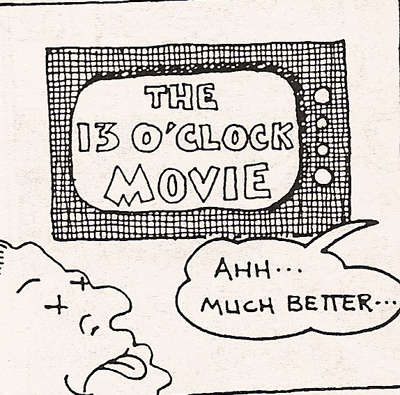
    Doodle by Steve Willis (scroll down link for bio).

    For a year that includes a new Mission: Impossible, a big-budget Robin Williams comedy, a remake of one of the 70s worst disaster films (Poseidon Adventure) and yet another slate of comic books flicks, it is with great pleasure that I am able to point you, dear reader, to the short list of this year’s oddballs. And by oddballs I mean the truly weird, the types of movies that twist your insides when you watch them, make you disgusted, angry even, and serve, in your advanced years, as a safer method of hallucination. Except for the last entry–that one just looks like fun.

    Inland Empire by David Lynch

    It’s been five years since Mulholland Drive, and finally David Lynch is back with its supposed sequel Inland Empire. Frankly, this could go either way: Lynch has made, in my mind, three great films–unbelievable, classic films that I’ll watch my whole life–in Eraserhead, Blue Velvet and the aforementioned Mulholland. That said, he’s also made some of the worst films I’ve ever seen in Wild at Heart, Twin Peaks: Fire Walk With Me (unbearable) and even The Straight Story. There’s no way of knowing if Lynch can build on Mulholland or if he’s just going to make yet another incomprehensible piece of trash.

    Supposedly in theaters late this summer or early autumn.

    Lunacy by Jan Svankmajer

    Hell if I know what brought me and a few friends to the Oak Street one summer night to see Little Otik years ago. But Jesus Christ, I haven’t been so freaked by a film since, well, since I took in Blue Velvet at the Goodrich Lansing Mall. Otik is a strong concoction of uber-Freudian fable, pedophile drama, and horror, involving a woman who adopts, and nurses, a tree stump. This stump, Little Otik, grows eyeballs, lips and a tongue, all of which is stop-motion animation using pig eyes and tongues for the effects. The stump eats cats and people. Bloody and creepy. Now my wife can’t think of soft-cooked eggs without flinching.

    Lunacy is Svankmajer’s first film since Otik, some six years ago. You can see a preview of Sileni (Czech for lunacy) here (it’s in Czech, and the version with English subtitles hasn’t been released yet). Supposedly it’s about a lunatic asylum, and has dancing pork tongues that also drink beer.

    Should hit our shores this fall or winter.

    The Piano Tuner of Earthquakes by the Brothers Quay

    I don’t know much about the Brother’s Quay except that their a pair of American weirdos who have relocated to Europe (don’t know where) and have made Svankmajer their personal hero and make surreal claymation cartoons. This is their second full-length feature, involving a beautiful diva who is killed and whisked away by a madman to a distant island, where she meets a poor soul who can piano tune anything, including earthquakes. If you can find the Sight and Sound from two months hence you’ll see the full page ad for the film, which is so painfully sexy I can’t imagine why anyone would fail to see this movie.

    Theoretically opening this fall.

    Drawing Restraint 9 by Matthew Barney and Bjork

    Frankly, I have no clue what this movie’s about. Something tells me that when I’m through watching it, my feeling will be the same. Barney’s films frighten me, and I have yet to see any of them. The Cremaster series, which I’ve missed in part due to scheudling conflicts and my own cowardice, look as bat-shit crazy as anything I’ve ever seen. Drawing Restraint 9 looks equally weird.

    Barney and Bjork board a Japanese whaler that also has a mold shaped like a tablet, filled with liquid petroleum jelly. As the ship plows into the arctic, the jelly cools and becomes a sculpture. I guess that Bjork and Barney engage in a number of Japanese ceremonies involving dancing, tea, the vomitous gunk that whales eat, and eventually cut their own legs off. Or something like that.

    Here are the links where Bjork and Barney try to explain themselves. And the preview.

    Premiering at the Walker May 5; opening later at the Lagoon.

    And finally Snakes on a Motherfucking Plane.

    This one doesn’t really fit, except to say that I can’t believe anyone came up with this thing. Snakes is high concept: for those of you not in the know, high concept means that you get an a movie based on a single idea, or concept. Twins is perhaps the best example–imagine the laughs with Danny DeVito and the Governor of California as twin brothers. That’s not a story, it’s an idea and a bad one. Most high concept films are worthless, but this one seems to write itself. Some goofball gets it into his head to assassinat some world leader or government lackey by bribing a member of airport security to unleash 400 poisonous snakes on an airplane. For Christ’s sake. Of course, the pilots have to die, a young woman will be in danger, you’ve got to save the damn target, and, on top of it all, Samuel L. Jackson is the star. I like snakes, my wife loves snakes, and my brother, well, he’s batty. And we’re all going to see this thing the day it opens.

    This thing isn’t going to be anything too weird, or complicated, or beautiful or intelligent. But pay attention when a people are having fun making something–often those are the best times in a darkened theater.

    Snakes has been the subject of a million gossipy conversations on the net; it opens this August.

    snakes.gif

  • Wandering Eye

    mulholland1.gif

    Kinky Boots, 2006. Directed by Julian Jarrold, written by Geoff Deane and Tim Firth. Starring Joel Edgerton, Chiwetel Ejiofor, Sarah-Jane Potts, Ewan Hooper, Linda Bassett, Nick Frost and Jemima Rooper.

    Now showing at the Uptown Theatre.

    The Notorious Bettie Page, 2006. Directed by Mary Harron, written by Harron and Guinevere Turner. Starring Gretchen Mol, Chris Bauer, Jared Harris, Sarah Paulson, Lili Taylor, and David Straithairn.

    Now showing at the Lagoon Cinema.

    Mulholland Drive, 2001. Directed and written by David Lynch. Starring Naomi Watts, Laura Elena Harring, Ann Miller (wonderful in “On the Town”), Dan Hedaya, Justin Theroux, and Lafayette Montgomery as the Cowboy.

    Looping continuously through my brain in moments of weakness.

    I love Mulholland Drive. There’s so few times when a movie will strap me down onto the electric chair and throw the switch with abandon. I can’t think of another flick that entertains on so many levels–it’s terrifying, funny, mysterious, creepy, and easily the sexiest picture I’ve ever seen. It’s the perfect movie.

    Sexy? Jesus H. Tapdancing Christ on a Popsicle Stick it’s sexy. The muckity-mucks at the Hollywood Citadel haven’t been able to match its allure, not with all the lingerie in Chicago (boring), all the toplessness in Showgirls (like a spike in the brain), nor Secretary or any other movie. It’s the plot, I’m telling you, the characters and the story that on numerous occasions culminates in a beast popping out from behind a dumpster, a spine-tingling cowboy suggesting we be ‘good’ or some of the most intense girl-on-girl lovemaking you’ll ever see. In Lynch’s world there’s that feeling of being trapped in a sinister place, trying your damndest to get a grip on everything and then, suddenly, finding yourself in bed with Naomi Watts and Laura Elena Harring. I’m catching my breath even now.

    There’s little connection between The Notorious Bettie Page, Kinky Boots and Mulholland Drive, other than I was thinking of the latter while being bored by the former pair. Comparing them would be like comparing a Playboy magazine to a dirty joke to that time you dropped two hits of acid and ended up with some woman with a poster from the Breeders Pod album above her bed and who interrupted everything to show you her ball python and who told you that you were like Iggy Pop except like a child with sideburns. In any case, one’s the real deal, the others are just pablum. Like those mystifying nights with a real human being, one movie haunts you for days. The others make you feel empty, if they make you feel at all.

    A confession: I walked out of Bettie Page. It’s boring. Gretchen Mol bears a striking resemblance to Page, has a gorgeous body, yet is thoroughly without charisma and therefore, sex appeal, emotionally or physically. The film is lit on the cheap, looking as though the action were shot under Wal-Mart fluorescents. There’s no story to speak of, except that we see the rise of Bettie Page as an S&M starlet, in flashback, as she awaits questioning at the hands of Estes Kefauver, who may be one of the goofiest Senators in history, and nothing like David Straithairn. Anyway, the movie is filled with scenes of Bettie posing, of being surprised by the male response to her nudity, and of her trying to break into pictures. Which, I remember thinking, was nothing like that moment in Mulholland Drive where Naomi Watts auditions for a part with that drunken creep, some overtanned has-been and that disturbing director who almost looks like an elder Eraserhead goading them on. And Watts suddenly slips into character, whispering and drawing nearer to the creep, pretending to have a knife in her hand, and when she kisses him ever so softly and you’re just mesmerized, melting inside, and you wish to God you were the old creep and then the Eraserhead director yells ‘Cut!’ and you’re shaken from your reverie and… whew. In any case, Bettie Page had none of that.

    For instance, there’s a scene where Bettie is gang raped, and it’s hollow, no fear, no tension, and Bettie seems to have rebounded nicely five minutes later. We know Page is a natural in front of the camera because everyone says so, not because we actually see it. For Mol is far from a natural, and hasn’t the warmth of a mannequin in a second hand clothing store.

    Supposedly, the film switches into garish color, but I didn’t get that far, having walked out to enjoy the sunshine and ponder the philosophy of Naomi and Laura Elena in bed together. And I’m glad–the black and white cinematography in Page was cheap and lifeless to go along with the acting. My own memories of Mulholland Drive had much more color and intensity.

    Kinky Boots also lacks sexiness, odd considering it’s ostensibly about, well, being kinky. The plot concerns a young guy whose father kicks the bucket, leaving the son with an old and respected shoe factory in a small blue collar English town. This is one of those bucolic factory burgs that seem to exist all over the British Isles, at least according to films like this and The Englishman Who Went Up A Hill and Came Down A Mountain, The Full Monty, Waking Ned Devine, etc. This little town, with all its crazy old characters, needs the shoe factory. But the poor owner, played by Joel Edgerton (and looking like a fifty-cent Dennis Quaid) can’t make ends meet, so our hero shuffles into London–where he and his shrew of a wife really want to live–and meets Lola, nee Simon, (Chiwetel Ejiofor) a cross dresser who works at a gay bar. Lola has the solution: make kinky thigh-high boots strong enough for a bloke as large as Ejiofor to wear without the heels giving out. Hijinks are theoretically supposed to ensue.

    Apparently, the effects of globalization in England has resulted in one economic boom in the guise of comedies like this–from Monty, a good film whose lessons went unheeded here, to Brassed Off, to this. Ejiofor seems to be following Philip Seymour Hoffman’s path to Oscar glory, taking on the requisite cross-dresser role and eating up scenes like he’s trying out for the school play. Joel Edgerton is lost in the main role and possesses no comic timing. As I said, the film lacks sexiness, but it also is malnourished in the humor department, and hasn’t even the sweetness of any story about people coming out of their shells. There’s just scene after scene of blue-collar innocents learning to love a jolly fellow like Ejiofor, who happens to wear a dress.

    If this film had been the least bit daring, it would have made Edgerton’s character fall for Ejiofor, but of course no one’s out to make a good movie, just a bucketful of money off the back of The Full Monty.

    Bored while watching Kinky Boots, I again flitted to Mulholland Drive, in part thinking how glad I was not to have seen either Watts or Harring in any of those boots. That’s just not sexy. This faux-Ealing comedy is nowhere in David Lynch’s interest range, and I should be glad for that–maybe he could have done something with a shoe factory, but it would probably involve pygmy chickens bubbling blood and midgets dribbling coffee down their shirts. And cowboys. Creepy, disturbing cowboys. All of which is endurable when Naomi Watts is coming down the line.

    In short: there’s lots to see and do this weekend, some good stuff at the Mpls/St. Paul International Film Festival, and perhaps even simply renting Mulholland Drive late one night.

    mulholland2.gif