Author: Peter Schilling

  • Cool Hand Lynch

    Inside a booth at the recent Back to the ’50s classic car show at the Minnesota State Fairgrounds, Sven Lynch labored in the sweltering heat over a slim stripe on the side of a black ’36 Ford coupe. Various gawkers had gathered, including a pair of corpulent, bearded twins clad in matching Twins shirts, a pock-marked kid wearing religious slogans, and a parade of purists dismayed that Lynch would dare to gild the lily of a classic auto. Lynch steadied one hand with the other, drawing a flawless canary-yellow line. His panache, not surprisingly, prompted one spectator to inquire about a custom job. “Sorry,” Lynch told the man without glancing up from his work. “By then I’ll be back in Stockholm.”

    The Twin Cities boasts not a few pinstripers, but none are as highly regarded as Mr. Lynch—or “Von Sven” as he’s known when behind the brush—who has become the reigning pinstripe king of Sweden. Unlike most of today’s custom painters, Von Sven, a Twin Cities native, is decidedly old-school. He eschews stencils, choosing instead to eyeball a particular hot rod before creating a complex and utterly wicked design on the fly. Each of his pinstripes is unique.

    Lynch looks very much like he stumbled out of a ’50s B-movie. He sports a haircut he describes as a “flat-top with fenders,” baggy jeans rolled up at the cuffs, and a black T-shirt that begs to have a pack of cigarettes tucked in the sleeve. The stepson of McKnight Fellow and acclaimed local painter Mike Lynch, Sven has always been drawn to painting, though he was discouraged at a young age from entering the competitive world of gallery artists. “So I got into lowrider bikes,” he said with a shrug. Exploring this second love, Lynch spent time between the old Missing Link bike shop and the Grease Pit, fixing lowriders, customizing banana seats with found upholstery, and creating mutant bikes with fellow members of the outlaw Black Label Bike Club.

    Then one day in 1995, Lynch was sipping coffee at Bob’s Java Hut in Minneapolis when he noticed a pattern of elaborate pinstriping on the café walls. Instantly, he was hooked. “I was lucky—a friend gave me some brushes, and other people let me practice on their bicycles,” he said. Over the years, he perfected his technique, and by 2003 he had found work at Classic Limo, a renter and restorer of custom automobiles. His first paying job involved applying a hard stripe to a Rolls-Royce. “God, that was nerve-racking,” he admitted. “I thought I was working on one of their restoration jobs, something that cost an individual tons of money. But it turns out it was just one of their rentals, so I could make mistakes.”

    It was obvious that Sven was a genius at pinstriping. He sized up each car like a sculptor inspecting a piece of granite, eyeing its shape and structure, moving with almost excruciating patience. He is taciturn, to say the least, and talking with him requires a tilted head to catch every quiet phrase. Yet Sven’s art spoke volumes and word spread throughout the classic car community, placing his skills in high demand. He took a job at Yesterday’s Auto in Minneapolis, which brought him an even more exacting clientele.

    Despite his celebrity, work in the Twin Cities didn’t earn him enough money to live on. So, like many artists before him, he set out for Europe, where less typical lifestyles are sometimes easier to sustain. At the urging of a friend in 2004 he hopped a plane to Sweden, where the citizenry has a legendary appetite for classic American cars. The Power Big Meet, which claims to be the world’s largest antique car show, is held in Västerås, a suburb of Stockholm.

    Sweden wasn’t entirely foreign to Sven, whose biological father owns an apartment there, and whose brother runs a vegetarian restaurant in the city. And Stockholm welcomed him with open arms. Lynch found an artistic home at a “rockabilly mall” called Sivletto, the ad for which features Marlon Brando in leather, leaning against his bike in The Wild One. To get there, patrons must trek to a side street and descend a flight of rickety spiral stairs. Then they enter a warehouse full of old cars, motorcycles, lowrider bicycles, Brando-esque clothing (for the guy, gal, or child), haircuts and pomade, and, of course, malts and Cokes.

    According to Sven, the customers are mostly rural Swedes, called raggare, and are typically more blue-collar and a bit more conservative than their countrymen. Perhaps that accounts for their American car lust. Some of the biggest draws for the raggare are the classes that Sven teaches out of his paint shop, which is called Von Sven Kustom DeLuxe. Students learn the time-consuming techniques of striping and lettering, and many of them return to their rural homes to complete their own work.

    As it stands, Sven is happy in Sweden. “Yeah, the winters are long—it gets dark around three in the afternoon, and the summer light’s pretty much on all day.” He returns to the states each June to “maintain connections,” working at the car shows and Yesterday’s Auto, before returning to Stockholm. At the Back to the ’50s booth, Lynch used the butt of his brush to apply a dot of yellow—the crowning touch to the ’36 Ford. The car’s owner beamed at Lynch and whistled. “Perfect,” the man sighed.
  • In the Valley of Elah

    Tommy Lee Jones and Josh Brolin are rugged men investigating the murder of a veteran who had just returned home from Iraq. The new Coen brothers’ film? No, that’s the eagerly-anticipated No Country for Old Men, which also stars this pair. Elah, on the other hand, is the first vehicle from director/screenwriter Paul Haggis since Crash. Haggis seems to have his hands in about four movies a year, either as a writer, producer, or director. So will Elah be overwrought garbage like the Best Picture-stealing Crash? Will it be exciting but ultimately ponderous popcorn fare like Casino Royale, on which he served as screenwriter? Or a heartfelt and often unsparing examination of the trials and tribulations returning soldiers face when coming home, as witnessed in Flags of Our Fathers?

  • The Threepenny Opera

    Kurt Weill and Bertolt Brecht may never have had it so good. G. W. Pabst, who brought Louise Brooks to fame in his silent (and seductive) 1929 masterpiece Pandora’s Box, this time took to sound production and dirtied up the silver screen like never before. The Threepenny Opera tells the story of Mackie Messer (a.k.a. Mack the Knife) and the beautiful Polly Peachum. It’s is a feast for the eyes, ears, and the soul, wallowing in the underworld and bringing the original’s characters to life as if they had wandered onscreen straight from the gutter. It will be interesting to see how or if Criterion can clean up this film, however, since the original 1931 prints were destroyed by the Nazis. Notwithstanding potentially scratchy images, Threepenny is perhaps the greatest study of poverty and corruption ever filmed, and, like Pabst’s other films, a delicious romp as well.

  • Manda Bala

    Let’s call this a hybrid of the fictional Brazilian exposé City of God and Errol Morris’s police procedure doc The Thin Blue Line—both tremendous entertainment. Manda Bala (Send A Bullet)is a bizarre documentary detailing the rise of corruption in Brazilian culture as well as the country’s kidnapping epidemic. “Men will steal with a gun or a pen,” says one talking head. The film boasts garish cinematography, a dynamite score, and perhaps best of all, a fearless director who can get even the worst, most hardened criminals to open up. Stories include money laundering through a frog farm, images of the booming plastic surgery trade (all the ears cut from kidnap victims need replacing), and kidnappers philosophizing about the meaning of life. 612-825-6006; www.landmarktheatres.com

  • Dans Paris

    This French comedy opens with two brothers in bed with a girl. One looks at the camera, apologizes for speaking directly to the audience, and then asks, “How would someone throw themselves off a bridge for love?” Rest assured, we’ll find out. Dans Paris (Inside Paris, not to be confused with One Night in Paris) unfolds over the course of a single day, when the would-be jumper, utterly despondent over the collapse of his marriage, returns home to live with his divorced father and hyperactive, sexed-up younger brother. .

    It is already being acclaimed as a brilliant character study, a love letter to Paris, and one of the sultriest, most complex comedies to hit our shores in many a year. 612-825-6006; www.landmarktheatres.com

  • They Live By Night

    Director Nicholas Ray’s first film (from 1948) has been called the most auspicious debut in American movies since Citizen Kane. Based on the dynamite Depression-era gangster novel Thieves Like Us, They Live by Night begins with the daring prison break of three men: a 23-year-old killer named Bowie and the aged, hardened criminals Chicamaw and T-Dub. Unlike the source material, Ray focuses on Bowie, who’s been jailed since he was sixteen, and his tormented relationship with the teenage girl Keechie. Ray’s instinct for troubled youth may not have been better expressed—even though he did go on to direct Rebel Without a Cause. Here, he perfectly captures the dangers of that delicate age when a person is thrust from childhood into a world where love and violence are suddenly fraught with (often deadly) significance.

  • The Simpsons Movie

    This could be the best episode ever and still not live up to the hype. After all, the movie is, what, nearly twenty years in the gestation? Give Matt Groening and company credit for assembling the best writers from seasons’ past and pulling in David Silverman, co-director from Pixar’s superior Monsters, Inc., to help them launch this behemoth. Already acclaimed by British critics as brilliant, the plot is ostensibly about the environment, but reports have it that Green Day, Al Gore, “President” Arnold Schwarzenegger, the religious right, and the New Age left are all skewered. Rumor has it that the story also includes a romance between Lisa and an angst-ridden Irishman, Bart skateboarding in the nude, and the end of the world as we know it.

  • Song of the South

    Disney’s long-hidden classic Song of the South hasn’t been seen in theaters (or on DVD) since its theatrical rerelease in 1986. If you’ll recall, this is the simple tale of a white boy who goes to visit his grandma’s plantation in the post-Civil War South while his folks consider splitting up. There, he is watched over by the lovable Uncle Remus and a covey of annoying little songbirds singing “Zip-a-Dee-Doo-Dah.” Part animated, part live action, arguably racist, and definitely patronizing, Song is filled with fabulous animation and crack storytelling—especially in the Tar Baby sequence. Disney’s suppression of the film raises myriad questions, not the least of which is the fact that the film’s African-American stars have, in the ensuing controversy, seen their hard work vanish from the cinematic landscape. 412 14th Ave. S.E., Minneapolis; 612-362-0437; www.dinkytowner.com

  • The Invasion

    What is it about Invasion of the Body Snatchers? Granted, this was one of the iconic B-movie masterpieces, a spine-tingling and all-too-real allegory of both ’50s conformity and the rise of Communism. But unlike other sci-fi films of the period, the remakes have boasted talent up the wazoo. The ’70s version brought acclaimed director Philip Kaufman onboard with Donald Sutherland (who was considered an A-list actor at the time).

    This latest version, simply titled The Invasion, is set in the present day and helmed by German director Oliver Hirschbiegel (Best Foreign Language Film nominee for The Downfall) and stars Oscar-winning actress Nicole Kidman and the new Bond, Daniel Craig, to boot. It could make for a dynamite drive-in feature and a thought-provoking night out.

  • This Is The Life

    remy.gif

    Ratatouille. Now showing in theaters everywhere.

    Directed and written by Brad Bird

    Someday, audiences and critics will wake up from their studio-induced stupor, rub their eyes and realize that Brad Bird is en par with the greatest filmmakers in the firmament. I mean, really, if you see enough movies at the Cineplex, taking in whatever the machine feeds you, you probably get a bit jaded, at the very least confused about what you’ve seen over time. In five years time do you really think you’ll remember your feelings coming out of Spider-Man or the forthcoming Transformers? But even though Bird’s Ratatouille benefits from the largess of the Disney promotional combine, it is a masterpiece–not a small masterpiece, but a classic to be regarded with the best work of Preston Sturges, Vincente Minnelli, Ernst Lubitsch, and Howard Hawks.

    This is so much quote-whoring, it’s true, but I think that modern critics all like to pat themselves on the back that they would have banged a loud drum had they been alive when The Shop Around the Corner hit the screens. Who, today, wouldn’t have acclaimed that the best film of an already strong year? (I’m sure we’d all argue over that film against His Girl Friday… still, neither was a Best Picture nominee.) Well, boys and girls, now’s your chance to say you appreciated a great movie when it was still fresh. Hop on board.

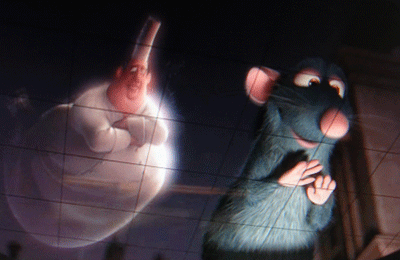
    Ratatouille is the story of Remy (voice by the very perfectly-cast Patton Oswalt,) a sewer rat who adores food. Good food. The runniest cheeses, harmonic pairings of cream and stock, the best cuts of meat and fresh vegetables and spices. He lives to try new things, to the extent that he’s willing to risk his life in the five-star kitchens of Paris. Spurred on by the his hero, master chef Gusteau (played by the greatest vocal man in Hollywood today, Brad Garrett), Remy learns the ins and outs of kitchen work, how to engage his sense and create fabulous dishes. And, best of all, how to live.

    Gusteau is actually dead. This robust man succumbed to the indignity of losing one of the five stars his eponymous restaurant has earned. But his ghost lives on, following our hero, Remy, trying to impart the wisdom of a lifetime of cooking. Gusteau is a chef from the Julia Child school–brimming with happiness, fat as a spinning planet, and eager to teach. Anyone. His restaurant is the pinnacle of French dining, and yet this man’s most famous, perhaps, for his cookbook, simply titled Anyone Can Cook. Amazingly, it is a rat that most perfectly exemplifies Gusteau’s philosophy.

    Poor Remy! On his chosen path he will suffer all manner of indignities, but perhaps most painful are the blows to his ego. In order for Remy to become a chef, naturally he needs a human ally. Vermin are not welcome anywhere but crushed under traps. So enters Linguini (voiced by the animator Lou Romano), an inept but goodhearted mop-handler. In a lovely twist of fate, one that sees Remy unable to escape to safety because he must repair some poorly made soup, our hero is captured by Linguini, who knows this rat can cook. So Remy climbs into the boy’s hat, yanking on tufts of hair and controlling our poor red-headed idiot as if he were a marionette. Eventually, Remy is going to be tested, making the titular dish for the most damning of culinary critics, the acidic Anton Ego (Peter O’Toole, who will not get yet another Oscar for this fine work).

    How does Brad Bird get to make these films? Like The Incredibles before it, Ratatouille does not rely on Hollywood in-jokes, scatological humor, or mediocre sitcom drama to chug its plot along. Instead, Ratatouille is infused with the spirit of Preston Sturges. In fact, Linguini could have been played in the past by Eddie Bracken, Sturges’ own bullied-upon, trembling, stuttering and stumbling muse. It’s magnificently written–Ratatouille delights in its own conceit, that anything with taste buds can experience this holy love of eating, and assumes the audience will hang on for the ride, one where your arm grips the side of a motorbike, the rest of the body flailing about with the elasticity of Gumby, and the resignation of Buster Keaton. Bird has given us a movie that asks us to pay attention–and pay close attention–not just to the humor, whose structure is perfect, jokes building for twenty to thirty minutes before payoff, but to the wealth of details, the likes of which have not been matched in animation since Pinocchio. The kitchen itself is a wonder, the marble steps worn away where footsteps have trod, the gleam and reflections off copper pots, the faces of the patrons like something from Mad Magazine in its 1950s prime (Bird also understands perfectly that computer animation has its limits, and only humans must be caricatured to look real).

    Better still is Remy’s life–these rats talk to each other, squeak around humans, listen to music. And yet the film is not obsessed with anthropomorphism as in past Disney efforts. These rats are still rats.

    Bird also assumes we know what it is to be shocked by a first bite of a perfectly cooked meal. And this is where Ratatouille takes its most surprising turn. When Mr. Waverly Root, journalist, adventurer, and perhaps best of all, devout eater, ventured to France, he discovered the following: As far back as records go, the people of the land now known as France have thought of food in terms of its taste more often than in terms of its nutritive qualities. It is one of the greatest of all of life’s pleasures to have that encounter, that awesome recognition that food isn’t there just to quell those gnawing pangs in the pit of the stomach. After our first bite of ice cream we understand perfectly that food is not just there to build teeth, muscle, brains and then waste. A good meal is there to inspire imagination, trigger memory, to encourage great conversation. It’s a part of most, if not all, religious lore. Very simply, it is fun. And sometimes, most complexly, it kindles love.

    A few, not too many, but a few movies have made clumsy attempts at capturing the meaning of eating, and what it does to us as thinking, feeling creatures. Thus far, most have failed–perhaps Ang Lee’s Eat Drink Man Woman is the lone picture to have found success (and I’m including the tedious Big Night). That delightful movie drew saliva by simply showing us amazing dinners, from their inception as simple ingredients to the alchemical creation of eye-popping dishes. Without dwelling too long on the meals, Lee gave us a tight, moving, and often-hilarious plot that functioned in addition to the characters gorging themselves.

    But that film couldn’t integrate our relationship food seamlessly into its plot. In Ratatouille, however, the titular meal both brings this plot to its moving denouement, but is a great visual essay on food and memory (and criticism). This part of the plot–the meeting of the food critic, the restaurant on its last legs, the fate of Remy–takes, I believe, a good forty minutes in the gestation, and when it hits, the results are moving beyond belief. Eventually the film, ostensibly a children’s picture, becomes a deeply felt meditation on the pleasures of hard work, friendship, eating (of course), and, surprisingly, the often cantankerous (and loving) relationship between artist and critic. The clash between the critic Ego and the chef Remy is not just exciting, not just hilarious, but moving, and might just leave you in tears. It did me.

    There has not been a better moment in film this year. But Ratatouille is filled with such moments. Like a Hawks film, you emerge from the theater disappointed a little bit, wishing that the camaraderie onscreen asserted itself in the sunny and disappointing life raging outside. And you wish that our disappointments, when overcome, had triumphs as great, and as real, as Remy’s. But then again, chomping into a crisp water cracker loaded with d’Affinois cheese and a drop of balsamic vinegar isn’t an experience for every meal. You have to appreciate it when you get it. So it is with Ratatouille–savor the film, delight in its pleasures, and work toward honing your palate. Brad Bird has shown us that it is worth every minute.