Author: Cristina Córdova

  • Cure for the Common Life

    Your job is a prison, gas is expensive, you’re in debt, and both your house and your SUV aren’t worth the money you chuck at them. During times like these, it’s hard to see the merits of the American way of life. If you’re desperate for some escapism, check out Surfwise, the story of a man and his wife who, with nine children in tow, lived a utopian existence, free of material trappings and full of surfing.

    A celebrated doctor and Stanford graduate, Dorian "Doc" Paskowitz upended his life after two devastating divorces and years of anxiety. Vowing to find a new standard of health and to avoid the trappings of wealth, he found his third wife, Juliette, and traveled the country in a 24-foot camper over several decades, surfing with his family. None of their children went to school, they never paid taxes, and they never stayed in one place for very long. The Paskowitz family rode the wave of surfing culture to stardom.

    It’s a fascinating story, but the occasionally lazy film making gets in the way. I really wanted to know the meat of the story; how they made it work financially, the consequences of the unusual lifestyle and how the sons and daughter fare after life in the camper. The film touches on those questions, but it isn’t as satisfying as I was hoping for. Beneath the cacophony of the Paskowitz family wisdom ("Wash your asshole!" "Live like the animals live!" "Don’t be lazy!") there are a few really great moments, but at a lightning fast 93 minutes, I wish Doug Pray did a few more interviews.

    The good news is, despite some problems, the film will leave you wanting to learn more. Desperate to look at life through a different lens? Give it a try, dude.

    Opens Friday, June 20th, at Landmark Lagoon Cinema

  • A Seemingly Unlikely Marriage

    The widely-discussed flamboyant personality of Irish playwright Oscar
    Wilde
    (1854 – 1900) is such that many often forget that Wilde was
    married and fathered two sons. It is his wife, the comparatively
    uncovered Constance Wilde, that gets the spotlight in Thomas Kilroy’s
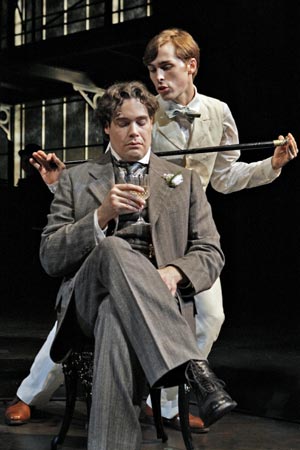
    The Secret Fall of Constance Wilde, which opened June 6 at the Guthrie
    Theater’s McGuire Proscenium Stage. Set in a turn-of-the-century
    British train station version of Limbo, the play speculates on the
    Wildes’ relationship, with input from Oscar Wilde’s lover,
    Lord Alfred Douglas. Anchored by a mesmerizing and heartbreaking
    performance by Sarah Agnew (from the Jungle Theater’s The Syringa
    Tree
    ), the complex humanity at the base of the Wildes’ marriage pulls
    the piece through some peculiar theatrics and an unfortunate third
    wheel in the cast.

    The play covers Constance’s marriage to Oscar Wilde in a disjointed,
    stream-of-consciousness manner, starting with an imaginary final
    meeting between the couple after Oscar’s release from prison in 1897, and before Constance’s death the following year. Every major incident in their
    relationship is covered from Constance’s perspective, from his
    relationship with Douglas, to his trial and the unnerving revelations
    that were made there. But to say the unfolding of events lies only with
    Constance would be a gross misstatement. Rather than victimizing
    Constance and turning Oscar into a villain-type, the play depicts the great poet just as terrified and confused as his wife.

    Agnew crafts a brilliant portrayal of Constance, a woman being torn in
    two by her own conflicting feelings and the injury that increasingly
    pains her body and mind. Constantly driven to desperation by a need to
    confess her deepest secrets, Constance is a strong force despite all
    the turmoil she hides inside. And Agnew pours that agony out to the
    audience with every pained step and every choked word. A picture of
    grace under Victorian pressure, Agnew’s Constance pushes herself to
    determined bravery, proving to herself with each new turn exactly what
    their marriage means and what purpose Oscar serves in her life. Her
    quietly conflicted face, always a moment away from tears, never betrays
    itself and glues the entire audience to her whenever visible.

    As the famous poet, Matthew Greer casts a very different light on the
    common conception of Oscar Wilde. All the sharp-tongued wit is there,
    but in a series of increasingly delirious monologues, the more serious
    side of Wilde’s personality is revealed — dark, confused and barely able
    to comprehend the forces surrounding against him. At the close of act
    one, when Wilde is cast into prison, all of his underlying fears are
    terrifyingly ripped into reality. In these moments, the violent and
    nightmarish conditions are vividly brought to life by Greer alone.


    The only misstep in the cast is recent BFA graduate Brandon Weinbrenner
    as Lord Alfred Douglas — affectionately called "Bosie." Weinbrenner
    seems to have believed that it was up to him to provide the comic
    relief in the show, but when one of the lead characters is Oscar Wilde,
    no comedic foil is really required. He plays Douglas as the most
    stereotypical homosexual British aristocrat around — with open-mouthed
    shock, plenty of foot stamps and lots of whiny shouting. With two
    such beautifully nuanced performances from Agnew and Greer,
    Weinbrenner’s subtlety-be-damned approach is even the more jarring. If
    there were a villain of the piece, Douglas would certainly be it. But in
    this case, anyone ignorant enough to be fooled by such a person for so
    long probably deserves at least a little bit of the ridicule and
    torment thrown his way.

    All the other characters in the piece, from Wilde’s jury, to passersby
    on the street, to Constance’s own children, are silent puppets and
    objects manipulated by a quartet of androgynous puppeteers who not only
    manipulate the surroundings but the three players themselves, trapping
    every character into a certain mode of action. They serve as a greater
    force exerting itself on the characters, whether they are fate
    intervening or the strict rules of turn-of-the-century society.
    Director Marcela Lorca stages the action as one large dance piece led
    and manipulated by the puppeteer ensemble; a sensible choice, given her
    extensive choreographic work. Several sequences are staged with an
    almost filmic fluidity — a mixed effect to be sure. While slow-motion
    movement can often be effective, here it seems present only to produce
    a cinematic feeling.

    But the bond between Constance and Oscar is undeniable, even with all
    its contraptions and complexities. Agnew and Greer are at once repulsed
    by each other and irresistibly drawn to each other, making every
    interaction they share undeniably intense and impossible to look away
    from. What would seem to be an unlikely marriage becomes a deep love
    story about two people who could only find completeness in each other
    and the secrets they kept all their lives.


    At the Guthrie through July 31st

  • The Extraordinary True Life of George Hogg

    It’s easy to understand the
    attraction of putting the extraordinary true life of George Hogg to
    film. An Englishman bearing witness to and working in war-torn
    1930s China, Hogg became the headmaster of a failing school and grew
    to succeed where his predecessors had not. Fearing the Japanese
    army’s advance, Hogg resolved to lead his students on a perilous 700-mile journey
    through the mountains to safety.

    Screenwriter James MacManus
    learned of Hogg’s
    story
    while on
    assignment in China for The Daily Telegraph, overhearing that
    a statue dedicated to Hogg was being erected in a remote town on the
    Mongolian border. Intrigued, MacManus investigated the story. He found and interviewed Rewi Alley, a New Zealander who had known and worked closely with Hogg. MacManus’s story appeared in newspapers
    around the world and compelled film producers to commission a screenplay.

    Director Roger Spottiswoode provides an agreeable old-Hollywood-style
    gloss, and high production values shine throughout. Hogg’s story
    is presented earnestly but not too cloyingly, and the film’s photography
    (shot on location across China) is beautiful, evocative, and easy to
    appreciate on the big screen.

    Less effective are some of
    the performances, saddled with clunky dialogue and the screenplay’s
    need to expedite the passage of time from sequence to sequence, and given
    little room to establish themselves beyond the stock purposes they serve.
    Jonathan Rhys Meyers (George Hogg), great fun to watch as Henry VIII
    on Showtime’s The Tudors, can’t seem to impart the different
    kind of passion this material asks for; and Radha Mitchell (Lee Pearson) is oddly vacant in her role as an
    American nurse Hogg falls in love with. The easy charisma of
    both Chow Yun-Fat (Chen Hansheng, a communist rebel who helps
    Hogg) and Michelle Yeoh, (also in Spottiswoode’s James Bond
    film Tomorrow Never Dies) as a deposed aristocrat, is stark in
    comparison, and they elevate each of their scenes accordingly.

    But for a few moments of startling
    violence, the movie feels content to create and ride a passable after-school-special
    vibe until the very en and through the credits sequence, which hints at the poignancy that is ultimately missing
    from the rest of the film.

     The Children of Huang Shi opens June 13 at Landmark’s
    Edina Cinema
    .


  • Here’s One for the Open Road

    Jason Shannon likes to think
    of his band as a car.

    "A car Steve McQueen drove,"
    he says. "An old ’60s or ’70s hot rod. Not a badass car. Just a car
    with good integrity. Something that’s built to last, but not showing
    itself off. A Classic.

    "Something like that,"
    he laughs.

    The car metaphor is appropriate.
    Shannon’s song "Maybe Mexico" begs for an old jalopy and a stiff
    breeze. Ever the storyteller, his prose often seems stuck in that fork
    in the road between Lover’s Lane and Heartbreak Hotel.

    Shannon and his band are playing
    in Dinkytown’s Kitty Cat Klub, a surprisingly romantic and chic diversion
    in a college town that is aching for the latest drink special. The band,
    complete with a keyboardist and a horn section, is spilling off the
    tiny stage huddled in between the venue’s swaths of exposed brick
    and collection of antique mirrors. It’s the perfect setting for Shannon’s
    love songs and tales of hope and hopelessness. Outside, the sky is gray
    with a brewing storm. Inside, it is equally as electric. The atmosphere
    sets nerves tingling with that introspective feeling everyone gets when
    looking at the world through a rain-streaked window, seeing only your
    reflection.

    The band plays a mix of blues,
    rock, and folk with a bit of twang. And though he may have mixed feelings
    about applying the term "soul" to his sound, Shannon’s crooning
    is full of emotion. A lot of these influences, he says, he gathered
    growing up.

    "I grew up in Texas and Louisiana,"
    he says. "So I think I was always around country music and blues music.
    But no one ever said, ‘This is what we’re listening to and this
    is what this is.’ I think it’s sort of a genealogy thing, where
    I had it in me somewhere, but I never consciously tried to have it in
    me."

    His love of music he gained
    through childhood osmosis.

    "My dad managed a cable company.
    We had MTV right when it came out," he says. "I grew up playing
    sports, but I loved MTV and I loved the videos and I loved the songs.
    I would watch it all the time. Robert Palmer. Duran Duran. Tom Petty.
    INXS. I would just watch it all day. My mom would say, ‘What is your
    problem.’"

    Shannon isn’t new to the
    music scene. He spent time in a hard rock band and, as a solo artist,
    he considered a future in indie rock.

    "I was kind of hoping I would
    adopt some of the values," he says of the genre, "but I can’t.
    I gave up trying to do it. I guess it’s not even values, but it’s
    sort of like… you hope to fit in. I’m an adult, but it’s an acceptance
    thing. I gave up trying to do it. And giving up has been really good
    for me creatively."

    In a city that can feel clogged
    with bands latching onto musical trends of the moment, Shannon’s classic
    Americana sounds fresh. His quality storytelling is even more refreshing.
    It’s his words, Shannon says, that move him onstage.

    "If I’m connecting with
    a particular lyric, I will feel the lyric," he says. "I try to pay
    attention to what I’m singing all the time. I’m paying attention
    to my voice. I never have to think about my guitar playing. So I’m
    listening to the band and I’m listening to what I’m singing. If
    the lyric has a certain emotion, I’ll feel it and when I do feel it,
    it’s inspiring."

    Tonight Shannon shakes like
    his head is filled with phantoms, former romances and memories of escape.
    Missing is his near-trademark top hat, but its absence allows onlookers
    to more clearly see his face twist as he is connecting to that emotion.
    The sound bellows and his voice is thundering. Just like the clouds
    above.


    Photos by Denis Jeong.
    View full slideshow

  • More June Book Releases

  • Yes … She Is among Us

    I walked outside The Cedar to wait for my ride after the Wendy Rule show last Wednesday night, when a group of passing guys stopped and one said, “I ‘aint neva’ seen no ass like that on a white girl befo’.” I expected them to break out into song and dance around me like Chris Brown in his music videos, but luck wasn’t with me, as it hadn’t been earlier that night. Holding back my laughter, and any possible sass-backs, I tried to conjure up some kind of protective force, and my brother soon rounded the corner. “Yeah, well, I bet you neva’ seen no witch in a tutu befo’, either.”

    There had been nothing at all typical about my experience that evening. I had stood at the wrong bus stop for 30 minutes. I had unknowingly gotten directions from a deaf man. And I had ended up in St. Paul—the wrong city—on a bus with a driver at the end of his shift.

    Luckily, before going home, the driver gave me a ride to my stop. I walked some blocks in my five-inch tall boots, stopping into two bars to ask for directions, and finally arrived at The Cedar an hour and a half late.

    I was sitting by the door, listening to the opening act, when a lady beside me threw me a smile. This was the coolest looking chick in the house — wearing a black tutu, boots, bustier, and a red blouse. It was bewitching sensation Wendy Rule.

    Having started her career in music many years ago, as a jazz vocalist, Rule has since gained notoriety for her amazingly broad vocal range, her visionary lyrics, and her use of ritual in her performances.

    As I waited for Rule to go on, I noticed a wide variety of audience members: a man resembling a lumberjack, a suburban housewife, geeky Goth kids who reminded me of a distant generation from The Smith days. Everyone was present — eager and excited.

    The presenter finally came on, with his plastic hair, kilt, and boots, and aptly introduced Australia’s own ubiquitous witch: “Yes … she is among us.” Everyone applauded and roared while Rule took the stage. With all eyes on her, she dusted a thick powder into the air with a fan while singing melodies and calling out to the East. She even evoked the energies of Earth, Air, Water, and Fire; and I waited for Captain Planet to fly in.

    As she grabbed her acoustic guitar and began to sing, Rule embodied the ideal witch with all her power, seductiveness, sex appeal, articulation, intelligence, and musical capabilities. With cute stories of kangaroo chasing, songs for ex-lovers, and references to the Australian Wolf Sky — topped off with charm and charisma — this was definitely the sweetest witch ever.

    To top off the evening — and cement her good-witch status — Rule ended her performance with a spell to help audience members move forward in life. She asked we consider this for a moment and seek help from the four energies. The crowd eagerly responded with foot stomping, which further excited Rule and extended her ritual. She said she felt a great heart connection to the Americas and loved coming here, and this reaction from the audience confirmed her feelings. Of course, I — having irresponsibly evoked a recent lot of misfortune — tried hard to deny my skepticism and avail myself of the moment. I almost walked up to the stage and asked her to lay hands on me.

    Despite how my night had unraveled, the show did not let me down. Rule’s voice sounded beautiful, and the performance was great. The audience awarded her with a standing ovation and zealous applause. Some left wanting to dress like her, be like her, or sleep with her, but everyone definitely left loving her — the siren-songed witch in the tutu.

  • Le Petit Mort

    All the ingredients for an experimental disaster are there: six characters on a non-elevated platform of white cardboard — a sterile space carved out in the corner of a dingy art gallery — all dressed in white, speaking in seemingly disjointed sentences, hugging the wall behind them, twisting, writhing, gasping. But Socktesting, however experimental, is no disaster. Somehow, creators Mark Abel Garcia and Megan Mayer — with the help of six very able actors — have pulled it off masterfully.

    In truth, it’s a simple story. Yes, there is a story. Thank goodness — for one of the dangers (my own frustration, perhaps) of experimental art is the lack of story. Socktesting has a story, and it’s about a baby. A baby. A baby, perhaps. More like a paper clip. I couldn’t see exactly. But a baby is a baby is a baby. And our projects are our babies. Our ideas are our babies. And we can care for them as such, or we can toss them away, neglected step-children, like dropping a load.

    I am only thinking about this now, as I write. As I sat and watched Socktesting, I thought only of masturbation, of life, of pregnancy. And while I knew there was a deeper level of meaning (layers, even), what moved me, what held me, was this. I am almost 40. I have no children. I have tried. Clearly, I may have been inordinately moved by the story. But I was indeed moved.
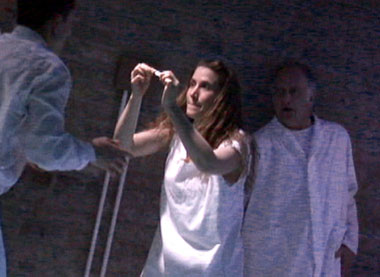
    The protagonists of this play are Lydia and Rupert. Lydia has a baby. She has a baby — something, anyhow — but she does not know if she can keep the baby. No one should know about the baby — not yet. And they must not get attached to the baby — or name it — because they may lose the baby. Everything is lost, isn’t it? Perhaps "it has a curiosity aspect we must dispose of."

    Another character, Darnelle, has lost her lover — perhaps her lover. Perhaps her baby. Bill. She cannot accept it, though. And she pretends he is still alive. Is Is Is. Bill Bill Bill. Baby.

    There is a rhythm in the writing. In the delivery. In every element of this play. An attention to rhythm. An attention to sound. A unusual and beautiful willingness to not just accept, but use, all the organic by-products of performance. Just as Garcia and Mayer compose their symphony of meaning, they conduct the actors in a symphony of sound and movement. The sound of feet dragging on cardboard. Steps. Coughing, snoring, hiccuping, releasing air. Perfect silence. There are no coincidences here. (Even when a band playing outside the Soap Factory invades the silence, they make it work. It simply joins the symphony.)


    The play is divided into four parts, four days over which the six characters asphyxiate. In between, they sleep. In between, they cough. In between, they lose air. They struggle. They die. Le petit mort, dropping the load. Unrealized potential.

    When three white-clad figures lift Lydia — the protagonist — into the air, prostrate, with back arched, flying, and bring her down to the ground, wresting from her the baby she has hidden in her womb, however, it’s the audience that experiences the asphyxiation. It’s the audience who gasp.

    Each of the four sections includes several scenes — interactions between Rupert and Mimi (the couple), interactions between Mimi and Darnelle (friends). Interactions between Rupert and Ethan (an over-sexed, under-satisfied co-worker of sorts), interactions with the doctor (who performs tests on the baby and determines whether it shall live or die). And the Shadow. The Shadow is always there, because even the Shadow plays it part. Nothing is left to chance.

    And each of the scenes includes a coming together of all of the characters — walking, ranting, clustering into a moving circle, chaos, shouting, screaming, bitching, moaning. And the most impressive thing about these scenes is, again, the symphony. Only in music (and perhaps in nature) have I heard sounds come together in perfect unison, to create an entirely new sound. It’s not easy to turn six voices into one indistinguishable sound — clearly composed of multiple elements. Somehow, they pull it off. You hear the chaos. You hear the shouting. You know it comes from multiple sources — though it sounds like many more than it is. But you hear no one voice over the others. They are using words, and you hear none, only chaos, shouting. Perhaps I make too much of this, but I am impressed.

    Though I am initially disturbed by the seemingly disjointed dialog between Lydia and Rupert — expecting them to begin hopping on one leg, repeating "fish sandwich, fish sandwich, fish sandwich" — this is not dada. Schizopolis, in fact, is what it brings to mind (and if you haven’t seen this Steven Soderbergh masterpiece, you must). It’s the perfect lack of affect in Mats Sexton’s delivery to which I am reacting. It’s the meaningless, stale interaction of day-to-day life, empty relations — a Stepford couple placed in an ascetic, sterile universe — a lab almost, where we can examine life through a microscope, an autopsy of sorts. It’s Andy Warhol’s version of Pleasantville, without the commodification.

    Lydia, played by Mimi Holland, is perfection, sweet. She is the mother. She is possibility. She is life, affect, genuine engagement — and entirely nonexistent in masturbation. Holland pulls off a superb performance, drawing you in with a childlike smile in the beginning, and paving the way for a most powerful ending with nothing but her silence and her gasps. While her face is turned away from me, I notice the streak of tears upon her cheek.
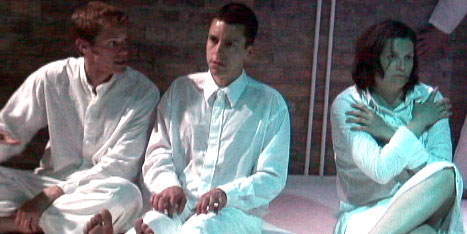
    Heather Stone, as Darnelle, is extraordinary, truly disturbed, jumping effortlessly from one emotional reaction to another without missing a beat. And Samuel Van Wyk, as Ethan, plays the perfect sex-crazed boy — who shines when he’s getting his dick sucked.

    Somewhere between metaphor and reality, Socktesting delivers a powerful commentary on… well… I could say masturbation (which the title alone declares the interpretive lens); but I’m going to say life, affect, potential, latency, even waste. What turns us on? What makes us engage, move forward? What breathes life into us and gets us out of the inherent inertia of day-to-day existence? Perhaps I’m reading too much into it. But any work of art that makes me think this much (while remaining entertaining), I say, is a success.

    Socktesting runs at the Soap Factory, June 5-8, 12, 13, and 15, 2008.
  • Tabloid Sludge

    Remember
    the prom mom? She was 18, it was her prom and nobody knew she
    was pregnant, so she went to the bathroom, hiked up her dress, had the
    kid, stuffed him in a trash can, and went back to the dance floor a
    half hour later. Stuck, directed by Stuart Gordon and starring
    Mena Suvari and Stephen Rea is one of those similar "like, this is
    going to mess up, like, MY ENTIRE LIFE; seriously, why does this have
    to happen to me?" kind of stories. The problem is, the tone
    careens from "cautionary tale" to "dead baby joke" in a way
    that leaves you feeling a bit unmoved.

    Based
    on the true story of Chante Mallard, a Texas woman who ran over a homeless
    man while driving home drunk. The man flew through her windshield
    and became lodged so Mallard, who apparently felt victimized through
    this whole debacle, drove home and left him in her garage still alive
    while she had sex with her boyfriend. The film is pretty faithful
    to the story, except it kind of sucks.

    It’s
    clear that Gordon chose the story for its black comedy, but it’s really
    mishandled. The boyfriend (Russell Hornsby) plays his character
    for cheap laughs instead of trying to match the tone of Mena Suvari
    and Stephen Rea, who apparently weren’t let in on the joke. The
    resulting mess of botched comedy, pondering drama, and squishy horror
    sound effects is a little boring. Like the prom mom, the story
    of Mallard is outrageous enough on its own.

    Opens June 6th, 2008, at the Landmark Lagoon Cinema.

  • Should America Inject Awesome Manliness?

    America is awesome. Remember in Independence Day when it turned out the president was an ex-fighter pilot? Or in Armageddon when we discovered that most of our problems can be solved by huge men with rippling muscles? We used to live in the era of the superlative, when people like Arnold Schwarzenegger, Hulk Hogan, and Sylvester Stallone seemed to be the embodiment of the American dream.

    Bigger Stronger Faster is a film about an identity crisis in America. Instead of fighting aliens, President Bush recently had to go beg Middle East dictators to give us a break at the pump. It also turns out there isn’t anything natural about Schwarzenegger or Hogan; both pumped up with steroids, not sheer manliness. There isn’t even anything American about Stallone; he imported his supplements. When our idols have to cheat to win (even our president), are there consequences?

    Through his exhaustive exploration of steroid use, filmmaker Chris Bell finds our collective pulse. Growing up near Gold’s Gym, where Arnold used to train, Chris and his brothers Mark and Mike followed in the footsteps of their idols by submerging themselves in "gym rat" culture. Pursuing football, lifting, and pro-wrestling, his brothers succumbed to the pressure to get bigger, and as a result started using anabolic steroids.

    Are steroids bad? It turns out to be a complicated question, and the film surprised me both in content and in even handed analysis. "Roid" rage? Questionable. Suicide? Doubtful. Side effects? Almost completely reversible. It seemed to me that as far as drugs go, you could do quite a bit worse. The film suggests that the demonization of steroids has far more to do about cheating in sports and political pandering than actual fact. But then what is cheating? In the muddy, multi-billion dollar, and almost completely unregulated arena of sports supplements, it’s clear that sportsmanship can be pretty darn flexible.

    As it should, the film doesn’t offer any simple answers. In sports, as in politics, we feel far more comfortable clinging to something that makes us feel better, even though it doesn’t have to be reality. We no longer live in the era of the superlative, but if we open a realistic dialog we won’t have to live in an era of consequences. Were Schwarzenegger, Hogan, and Stallone wrong? Who knows. Is this film worth your time? Absolutely.

    Opens June 6th at the Landmark Lagoon Cinema.

  • Signed, Sealed, and Delivered

    We deserve Barack Obama.

    That is tonight’s message.

    And Obama has arrived!

    The crowd roars — everyone on their feet, so many of them smiling, laughing, a few even silently crying. Is this the message of change?

    He can barely be heard above the din. For three whole minutes the crowd roars, only getting louder before they finally leave their voices in Obama’s care.

    "Thank you…"

    And the crowd roars again.

    He dedicates the evening to his grandmother.

    And the crowd roars again. MN for Change. Women 4 Change. Students for Obama. Aarp for Obama. Vets for Obama. Even Christians for Obama. They’re all here.

    "Our primaries season has finally come to an end," he declares.

    And, of course, the crowd roars again. We all know what this means.

    "I will be the Democratic nominee for president of the United States."

    There it is people. Yes you can.

    And I think I’m deaf now.

    Obama continues. He sings Hillary’s praises, claiming to be a better person because of her, from running against her.

    He addresses those that say the Democratic party is weaker now because of their campaign. He brings up the millions of Americans who have cast their first votes. Judging from the crowd in here, he is right about this. Sure, there are folks of all ages — but so many young ones. Folks of all races, ethnicities, cultures, even countries. Folks of all kinds. And I wonder how many of these — even I — might vote this year were it not for him. For this campaign. And I wonder how many other — who might not even vote for him — might vote because of him. And I can’t help but think that this is good. That this is something.

    Something is happening here. Oh, I hope — whatever it may be. Something is happening here.

    More applause.

    "We may call ourselves Democrats and Republicans, but we are Americans first."

    The crowd roards again, and a man, far back in a third-row seat, stares dumbfounded at the screen as we wipes his eyes.

    People believe this guy. They believe in him. And they believe that he believes in them.

    "America, this is our moment. This is our time to turn the page on the policies of the past."

    Do they really believe this is going to happen? That we will care for our sick? That we will provide jobs for all? That we will stop destroying our planet? They sure seem to. And I must say, it’s a beautiful, beauitful dream.

    Before he waves good-bye, he hugs his wife. And she says, "I love you." I’m pretty sure she’s not the only one.