Category: Blog Post

  • Freedom, Fireworks…and Fried Cheesecake?

    FAMILY

    A Taste of Minnesota


    Party with the masses at this annual blowout celebration of Minnesota
    in all it’s glory! The Taste of Minnesota is all about music, revelry,
    and most importantly, FOOD. This extravaganza almost (almost)
    puts the State Fair to shame with an endless list of delightfully
    unhealthy delicacies. While the Taste doesn’t have deep fried Spam like
    the Fair, it does boast fried cheesecake, fried apples, and fried ribs. Mmmm…heart-attacky! Once your arteries are comfortably clogged, take in tuneage
    by likes of R.E.O. Speedwagon, The Zombies, Seether, and Eddie Money –
    just to name a few. If you’re traveling with little ones, there’s
    plenty to keep them entertained;
    carnival rides, kid-friendly performances, paddleboat tours, dance
    parties, and even fireworks each night at 10:15. Just don’t forget the leash.


    Thurs., Sat., Sun. 1 p.m.-10:40 p.m., Friday 11 a.m. to 10:40 p.m., Harriet Island, Downtown St.Paul, Free


    ART

    First Thursdays in the Arts District


    Now that the Art-A-Whirl after-glow has worn off a bit, you ought to be
    primed and ready for another round of art-crawlin’ in Northeast. First
    Thursdays in The Arts District
    is the perfect chance to leisurely peruse open studios minus the
    throngs of tourists nipping at your heels. Stop into The Casket Arts
    Building, the Thorpe Building, The Q.arma Building, or any number of
    Arts District staples, then make a cameo at the Northrup King Building,
    the granddaddy of all art buildings, for tons of open studios AND a
    special "surprise" in the parking lot…Is it a dance routine? A pie
    eating contest? Bingo? You’ll have to come to find out.


    Thursday, 5-9 p.m., Northeast Arts District, Various locations, Free


    FILM

    10 Second Film Festival


    Is ten seconds long enough to spark real emotion? Put your reaction time to the test tonight at the Soap during this annual outdoor film festival!
    Over 100 ten-second film submissions will compete for best-of awards in
    such categories as "Under the Influence", "Arthouse", "Kubrick Award",
    "Most Disturbing" and more. The Soap makes this yearly tradition even
    more raucous with live bands, a beer truck, and a panel of fun
    celebrity judges. Get a bird’s-eye view of the Riverfront fireworks
    at 10 p.m., with the festival starting promptly at 10:15. Then, come back to the Soap Factory
    between noon on Saturday and noon on Sunday for a full 24 hours of
    performance and new media with Artery 24.


    Friday, 10 p.m., The Soap Factory, 518 2nd Street SE, Minneapolis, Free


    ART

    Freedom: Annual Juried Art Show & Resident Artists Show


    Altered Esthetics jumps on the patriotic bandwagon for the second year in a row with this "freedom" themed group show.
    Considering AE’s liberal nature, and considering that artists typically
    lean towards the radical rather than the conservative, it’s probably safe to say that this exhibit will have plenty of cool art with extra political
    undertone. If you’re not in the mood for heavy topics, however, don’t
    despair – This month AE puts on a double header show with work by their
    Resident Artists as well. One major highlight is the installation by
    mysterious local art duo "Pop Vomit",
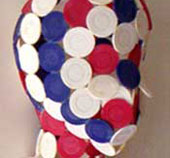
    which consists of a huge wall covered floor to ceiling with
    duplicated and vibrantly colored panels of Warhol-esque proportions –
    with a modern graphic twist. So, get yourself down to Altered Esthetics
    for this red-white-and-blue-inspired opening reception which will also feature a barbecue, live music
    and more. The perfect pre-fireworks activity if you want to keep your
    evening all-american! Runs through July 26th.


    Friday, 7-10 p.m., Altered Esthetics Gallery, 1224 Quincy Street NE, Northeast Minneapolis, Free


    MUSIC

    Roomful of Blues


    Being one of the classiest joints in town, the Dakota Jazz Club
    knows just how to create a mood with their alluring ambiance, cool,
    cool music, and decadent cuisine, and this weekends’ festivities will once again prove it. World-class ensemble Roomful of Blues rolls
    in for a full weekend of jazzy jump-blues, soul, swing and r&b.
    Singer Dave Howard, well known for his soulful vocals, adds a gritty and
    nostalgic charm to this engaging group of mega-talented musicians, lead
    by guitarist Chris Vachon. Make an exquisite evening of it by mixing
    your music with a meal – The Dakota shines in the dining department
    with gourmet fare
    such as Scallion Crusted American Kobe Beef Tenderloin, Star Prairie
    Trout Roulade, and Yucca Root Gnocchi, just to name a few. Or, just
    stick to vino – the Dakota’s got an amazing selection that will please wine snobs and booze-hounds alike.


    Saturday & Sunday, 7 p.m. or 9:30 p.m., The Dakota Jazz Club, 1010 Nicollet Mall, Downtown Minneapolis, $21-$27


    MUSIC

    Acoustic Sunrise Series: Larry Ravenswood


    Pop in to the Minneapolis Institute of Arts this bright and cheerful Sunday morning for some coffee and live music, then stick around for the art! Each Sunday, the MIA’s ArtsBreak Cafe
    hosts a different acoustic musician to entertain while you sip your
    latte and scarf down a scone. You’re especially in luck this time
    around because local silver-tounged smoothie Larry Ravenswood
    will treat you to a dose of his grooved-out, acoustic indie
    pop from 11am to 1pm. After you’ve got your fill of tunes and tea take
    a meander through the expansive galleries of the beautiful Minneapolis
    Institute of Arts, which if you ask me, is the perfect lazy Sunday afternoon
    experience. Acoustic Sunrise is sponsored by The Rake and Cities 97, so
    you know it’s good!


    Sunday, 11 a.m.-1 p.m., Minneapolis Institute of Arts, 2400 3rd Ave. S, Minneapolis, Free

  • The Citizens Speak – Reviewing the Citizen Cafe

    CitizenCafeThanks to everybody who responded to my call for citizen
    reviews of the Citizen Café. The results are in, and the results are, well,
    mixed. Some things you liked, some you didn’t.

    I’ll save my own comments for last, but that also sums up my
    own experience – I had a mediocre lunch, and a very satisfying dinner.

    Keep in mind – as many of the critics did – that the Citizen
    Café has only been open for three weeks – and is still going through its
    shakedown cruise.

    Is it fair to publish critical comments so early? Maybe not
    in the Star Tribune, where the impact could be devastating, but in this little
    ol’ blog, I think it can be helpful – sort of a wake-up call, before Rick or
    Kathie shows up.

    What you liked:

    "For my entree, I was pleased with a unique twist: a
    Caesar salad with scallops," wrote Carrie Obry. "A bit of a Caesar addict, I
    tend to rely on its distinctive taste as an indication of a restaurant’s
    ability to express itself. The scallops spoke to me like a perfectly fluffed
    bed of pillows. I dove in and enjoyed the soft taste of lemon complemented by
    the perfectly browned tops."

    The rest of the salad didn’t say Caesar to me much at all.
    The less-than-memorable dressing settled into a pool at the bottom of the plate
    and I had to work hard to reincorporate it. My friend also ordered a scallop
    salad, but with roasted tomatoes, bacon, and homemade creamy dill dressing. We
    both raved about the scallops and suspected that the restaurant was trying to
    woo us with their generosity. We each had five or six of the big guys."

    Jason Fritzel also liked his salad entree – roasted
    vegetables on spinach with walnuts. The vegetables included were of the
    root variety, a generous helping of carrots, parsnips, and rutabagas.
    The veggies were nicely roasted … al dente, but a bit under seasoned, could
    have used a bit more salt. This was quickly rectified with a quick dash
    from the salt shaker. The spinach was very fresh, bright green, and
    perfectly washed and dried. The walnuts were candied slightly and left a
    taste of cayenne lingering on the palate."

    Jason chose the warm bacon dressing on the side, which was a
    "nice balance of sweet and picante with a few large chunks of bacon
    included. It was indeed warm, was slightly on the thick side for my
    taste, but did add nice flavor and balance to the salad, playing off the walnuts
    very well. The portion was very generous for a dinner salad and sated a
    moderate appetite."

    He also had praise for his wife’s BLT sandwich, "made with
    brioche, thick house-made mayo, and one of the thickest portions of bacon I
    have ever witnessed. The toasted brioche was divine, fresh, thick and
    melt-in-your-mouth good. The thick mayo was portioned just right and the
    bacon took some time to chew because of its thickness. The tomatoes were
    fresh and romaine lettuce crisp and green. The only way to improve this
    sandwich would be to add bibb lettuce instead of romaine."

    Mary (no last name) gave a mixed but mostly positive
    verdict: The gravlax was "delicious," she said, and served in "very generous portion,
    but (with) only a few tiny toast points – I could easily have had twice as
    many, but I can’t complain, as the fish was wonderful."

    A reader named Ann Bauer, (who says she is not "the Ann Bauer"), also praised the look of the place: "great-looking
    interior and exterior makeover of what was the decor horror that was Sweet
    Lorraines (although their food and service were great)."


    What you didn’t like:

    The dinner rolls (reportedly homemade), and the pasta salad –
    Carrie called the bread "absolutely lifeless," and Jason described it as "a bit
    on the stale side." Jason described his wife’s side of pasta salad: "penne that
    was undercooked, under seasoned and overdressed with olive oil and hardly a
    hint of vinegar," while Mary described it as "undercooked" and "Cub
    Food-esque."

    Ann found the food "odd." "Maybe I’ve
    watched too much Top Chef, but it was almost like you wanted to ask the Chef if
    he’s tasted the things leaving the kitchen. For the first time ever, I
    picked up a salt shaker in a restaurant. And this was to season French Onion
    Soup! The rest of my party was underwhelmed with their offerings – soup,
    salad, sandwich, burger, especially after the menu sounded exciting and
    innovative, yet comforting. It’s puzzling."

    Fred Morris went for breakfast with his family, and was not
    impressed with the food or service. "When the food came, it was not above
    average. My scramble was rather pedestrian. The eggs were not
    hot … they were barely warm. The hash browns also were cool. My
    oldest son had the roasted veggies topped with an egg. The veggies were
    drowned in olive oil. There was a pool of olive oil in the bottom of the
    bowl. His egg was cool. The pork hash was not at all a hash.
    It consisted of large cubes of pork mixed in with the other
    ingredients … not a very good take off of beef hash. I’ve eaten breakfast
    at Victors, the Grand Cafe, Hot Plate, Maude’s, Hell’s Kitchen, Sunnyside Up,
    The Egg and I, Moose and Sadies, Birchwood, etc. and all were better."

    Service also got mixed reviews.

    "We sat for approximately 45 minutes before our food was
    served," wrote Fred. "We had to ask
    what had happened to our order before any explanation was given. The
    owner’s wife explained that it takes longer to prepare the food because it is
    done ‘from scratch.’ She didn’t apologize until I mentioned that it might
    be a good idea to give customers a sense of the status of their order after
    they have been sitting for a while."

    Carrie Obry was critical, too: "The service, while pleasant,
    was a little lacking. We didn’t have water, bread, or a knife for our
    bone-hugging appetizer until well after these items should have arrived."

    Ann had a much better experience: "The waitstaff was "present" in that you never felt ignored or
    dismissed, even though you could tell they were literally and figuratively
    sweating. Everyone was patient and personable." And Jason found the service "friendly and attentive. The food took a little while to come up, but we
    were not in a hurry and totally understand that this was day 2 for the young Citizen."

    As for my experience – on a lunchtime visit, service was extremely slow, and the food was uneven – the rolls were dry and flavorless, and the sandwich billed as corned beef didn’t look or taste like corned beef – it was just dry, brown meat. I appreciated the effort that went into making homemade sausage, but the pork sausage was much too lean and dry.

    On a dinner visit, we had a much better experience – service was prompt and attentive, and the food was very good to excellent, mostly. The house-made gravlax ($4) was delicious, and served in very generous portion, considering the price. The pickled veggies weren’t as tart as I would have liked, but still quite tasty.

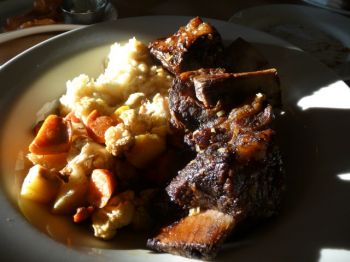
    The entrees were a big hit – Carol’s entree of shrimp and scallops was delightful – the scallops were sweet and succulent, and Carol marveled that the Cafe could serve three jumbo scallops and four large, tasty shrimp for such a reasonable price – $17. My portion of beef short-ribs ($17) was equally generous and satisfying – done to just the point where the meat is juicy and flavorful and tender, but not yet stringy. And the mashed potatoes and roasted root vegetables were the perfect accompaniments.

    I think the place has a lot of potential – this is very
    solid American cooking, unpretentious and reasonably priced. Service
    needs a little work, and better bread should be a priority. I will be
    eager to go back in August, after they have gotten their wine and beer
    license.

  • Dried Blood and Dandelion Wine

    (Header image credit: "Conversation with Death" by Gabriel Combs)

    In an effort to seek out and engage multiple voices and viewpoints from the local arts community, I will present in my space on The Thousandth Word occasional postings by “Vicious Guests” — that is, writings by various artists, curators, guest critics, journalists, art experts, art lovers, and other essential members of the arts community who have a story to tell. The first such story, by 36-year-old local artist Gabriel Combs, is presented here. If you would like to propose a future “Vicious Guest” post, please contact me (Michael Fallon) at: thousandthword(at)gmail(dot)com.


    Dried Blood and Dandelion Wine

    By Gabriel Combs, a "Vicious Guest" (edited by Michael Fallon)

    I GOT THIS IDEA THE OTHER DAY to do dandelion paintings.

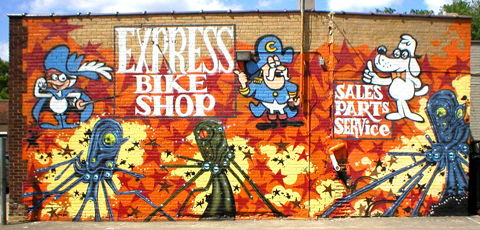
    I was waiting for the 21 bus to go from the K-Mart on Lake Street to Selby and Dale in Saint Paul, where I was supposed to pick up a check for a recently completed mural for a bike shop. Before leaving the studio, and probably because I’d been overly stressed of late about having no actual living space, I’d smoked a couple of onies of low-grade pot I’d found on the street (stuffed in the celophane of a cigarette pack). It had been raining while the sun was shining when I found the pot, and I witnessed a rainbow that day that no one else seemed to notice. The pot helps push back most things – other than art ideas, that is. It’s better medicine than most prescriptions.

    On the 21 bus, freshly high and scrubbed clean (as clean as one can get from a bucket; I hadn’t had a shower or bath in two months), I felt I was trapped in a video game, grabbing the subconscious shade of green through plastic. I pushed the bar on the back door of the bus and heard a Nintendo sound effect of achievement. The dandelion is a common wildflower that goes through an easily recognized metamorphosis. It’s often called a weed, though not by the National Audubon Society. It came to mind that I could do a mural-sized aerosol painting of a dandelion after it had turned white and was about to blow away in the wind so it could start its cycle over again. I’d find a decaying area of our lofted city and do several aerosol paintings on the big vertical walls of some urban squat or another. It would be a good job for me and would add something to the landscape.



    ("Canada Violets" by Gabriel Combs)


    In early June, I was sitting in the downtown Minneapolis jail for getting drunk and making a fool out of myself. I was being a little too honest and a little too much of an ass – probably from all of my recent despair and loneliness – so I ended up in a cell upstairs at the jail. I’d chosen isolation away from the general population of the jail, a choice that gave me only an hour of cell-free time a day. The cell hadn’t been cleaned, and some other man’s "possessions" were still there on the eating table, caked with his dried blood. I started sporadically reading a book of Sherlock Holmes stories and taking in my surroundings. In one spot there were some clumps of human hair. In another, there were some letters and jail papers. The last man appeared to have been reading and writing in Spanish, but he was listed as African-American on the papers. He was a couple years younger than I.

    I was wearing orange jail clothes. Since I didn’t know how long I’d be stuck in jail, I stashed two stub pencils in the only place they weren’t likely to look for them – in a space between a bar and the round seat at the table. This was the only design flaw in the cell, from a security standpoint. Everything else was simple geometrical shapes with no lips, overhangs, or ledges that could conceal as much as a cigarette. Nothing could conceal my mind and ideas, however. I had been analyzing the psychology of the cops – which was the good one, which was the bad – just from their passing words of weather small talk. Saving the pencils meant I could draw if I ended up in jail very long. I was interested in reading though, and I wished they’d switch the library cart. I must’ve seen three or four other carts on the handcuffed walk to this room. Last time, they had To Kill A Mockingbird, and I would’ve liked to read that.

     

    (Photo of Gabriel Combs taken on the night of one of his recent arrests.)


    Two baloney sandwiches and an apple came in a brown paper sack, but I couldn’t eat them because my jaw was fucked up from the night I mouthed back to three guys. They beat me up and then called the cops on me, probably because I got back on my feet and produced a pair of bolt cutters to chase them off. They left out the fact that they’d beaten me up to the cops. On my first day out of jail, I didn’t get my studio keys or wallet back for four days. They blamed a computer problem for this. The internal affairs forms were useless when they had a faulty machine. I also had a sketchbook that was in police custody from when I got arrested in May. They were throwing the book at me, I guess, ignoring their profit margin on crack dealers, because the sketchbook was supposedly a graffiti book. It isn’t graffiti, of course, but there was no arguing.

    On the outside, pressed to figure out how to get back to making art, I thought fast and remembered the owners were remodeling an apartment in the building where I rented my basement studio, so I could ask them for a key to copy. I then went to the hardware store to get keys remade. The guy looked pretty sideways at me, and I couldn’t blame him. I was unshaven and full of anxiety about the repercussions of going to jail twice within a few weeks. I was fortunate to find this place and rent it for just $190 a month, considering I had an eviction on my record. I’d found the space on Craigslist, and the owners seemed OK with the idea of my using it as a painting studio. I sometimes slept in the studio when I couldn’t find a friend’s couch to sleep on. It was pretty clean for a basement, though there were plenty of spiders, silverfish, and common house centipedes.

    I had a $30.25 check that the jail gave me, which their bank wouldn’t cash because I didn’t have an ID (it was in the wallet they couldn’t give back to me). Luckily, my regular bank is downtown, and they know me, so, despite my embarrassment, I went there to get my money. All was well now, because I had enough paint and art supplies for the time being – plus, some food, my phone, a toilet, and time to think.

    I stayed sober through most of June just because I couldn’t deal with the panic attacks. On the Internet at the library, with new keys in my pocket but still no identity, I saw a friend who was driving by, and I had a coke with him and talked about my situation. As an artist, he’d been close to the same situation on occasion. I told him I was feeling scarred and rejected by society, especially since I’d spent my entire life trying to make things better in the world by making art.

    A week later, I was back drinking, fighti
    ng the sense of impending doom because of the upcoming court date. I was probably facing further incarceration for long enough that I’d lose my studio, humble as it was. The studio isn’t a home, but it’s a place to make art and to keep my art stuff and slight private personal possessions safe. I’m burning the candle at both ends now – at least until I say to hell with it and throw the every damned thing in the fire.

    I sometimes can’t take the worrying about it all. So what, I think, if I lose two drawing tables, an easel, and various stashes of oil and latex paint? So what if I lose some sentimental objects I’ve kept safe from harm for thirty years? I’ve always lived just as chaotic a life as this, but it’s been securely enveloped in a series of locked doors. I’ve always had an official address, and I’ve embraced the trappings of society – a job, a social life, and a bank account that was refreshed every two weeks but always remained a few dollars short at month’s end. There were no frills, just a one-room efficiency, a bike for transport (until it got totaled), no cell phone but a stripped down landline, a little net access, and a bit of liquor every now and then.

    It wasn’t much, but it was more than I have now. Still, I make more art now.

    When I lost my last job two-and-a-half years ago and I was facing financial desolation despite a frugal lifestyle, to make ends meet I copied an idea from printmaking. I would make a complete series of paintings – each similar to, but different from, each other – whenever I had squeezed some paint and the colors and ideas were out and fresh. I’ve sold over 400 pieces of art since – for prices ranging from 99 cents up to, recently, just over four hundred dollars (my all-time record). I take endless dumpster-diving missions, and I pick up any scraps of real wood I can find, along with scrap-metal from discarded appliances. The tools for getting this metal – including the bolt cutters that maybe saved my life – resulted in a charge of "intent to commit a crime." One of my favorite things to find is dresser drawers, the dove-tailed kind especially — although they usually need to be sanded first. I make my paintings ready-to-hang by stringing them with copper wire from dead appliance motors and screws from everything I find. Masonite scraps, familiar to many artists, are another valuble find.

    Two-and-a-half years ago I simply decided to make a run at this artist thing, and I’ve been inventing it – rather than just talking about it – ever since. My old friends see me coming and treat me like I’m homeless, which I am, but at least I am fulfilling my dream. They’ve got the same old complaints, and I have as much apprehension about coming into contact with them as they do me. I also have callouses turned to blisters and back again from the struggle to make art, which they don’t.

    They’ll go back to their homes, partners, and steady incomes. They’ll drive to a nice vacation spot this summer, while either I sit in jail or I toil away at my art, working toward selling my one thousandth piece.
    (Bike shop mural by Gabriel Combs)

    At the bike shop on Selby and Dale in Saint Paul, the shop owner paid me more than the price we agreed upon, saying "I can’t possibly pay you enough for your time." The bike shop folk loved the mural, and so did the area residents, which is a confidence builder for someone who, despite the shit he talks, basically feels like everything he paints is shit.

    If I lose the last few items I own and my studio, I’ll remain as vital as before – if not more so – as that’s what this thing is. Being an artist is not a fashion statement that passes with the season; it’s not something that hinges on gas prices. Art is something that combines with the culture to establish roots that intertwine with and break up the cement of society so the wildflowers can grow.

    Art breaks up a false foundation and replaces it with dirt. I wonder if it’s really possible to make dandelion wine…


    Editor’s note, 7/12 — Gabriel Combs posted this message on a community forum board (in regards to his court hearing on 7/10):
    evidence proved sufficent for the
    judge. free, no fine, but if i get in trouble again i’ll go down for
    *all three* arrests. thanks for all the good energy i received going
    through this. i still have to do some work with the restoritive justice
    center, and get my black book out of jail along with some other
    possessions. the turtle thats in that book must be really pissed by
    now, wondering how come i have’nt busted him out yet.

  • The (Dave) Wolfe Howls Tonight!

    MUSIC

    Dave Wolfe & The Wolfmen with Sweet Mamma J


    There’s a hootenanny down at Lee’s tonight! You’re in for an old-timey treat with local Rockabilly legend Dave Wolfe
    (of Sci-Fi Western, The Vibro Champs, and Reverse Cowgirl fame) playing
    his infectious brand of moody country rock n’ roll along with his

    backup band, The Wolfmen. If Dave’s super sexy swagger isn’t enough for
    you, factor in the bluesy Tammy Wynette-esque stylings of Sweet Mamma J and The Lonesome Fugitives;
    a local roundup of talented country crooners who, for tonight, turn
    Lee’s into a small town roadhouse of the most nostalgic variety. Drink
    your whiskey straight up and grab your sweetheart for a dance – and if
    you’ve got two left feet, get to Lee’s early for free dance lessons
    with Shannon at 8pm!


    9pm, Lee’s Liquor Lounge, 101 Glenwood Avenue, Minneapolis, $5


    WINE

    Summer Wine Tasting


    If you’re a wine connoisseur in the Twin Cities, you’re most likely familiar with Sam’s Wine Shop.
    A quaint yet hip nook located in the trendy North Loop neighborhood,
    Sam’s is a delightful stop for any vino afficianado. This evening’s
    perfectly timed tasting is your opportunity to find out what’s cool to
    sip this summer, just in time for the 4th – if you’re not planning on
    going the icky hot dogs and cheap beer route, that is. Sample Sam’s
    latest selections of "crispy whites, pretty pinks, and light bodied
    tasty reds", chat with the in-the-know staff who can pair you up with
    complimentary wines for any occasion or meal, and maybe even meet some
    like-minded folks. Want to make it a date? Check out the wine tasting,
    then head over to nearby Bev’s Wine Bar for some yummy apps, conversation, and yes, more wine.


    5-8pm, Sam’s Wine Shop, 218 Washington Avenue North, North Loop, Free


    FAMILY

    Aveda Butterfly Garden


    I am obsessed with Aveda products.
    Not only do they work like a charm, but they smell wonderful as well. I
    burn Aveda candles, I wear Aveda perfume, use their shampoo, hair
    spray, lotions, etc…I love me some Aveda! So, naturally when I caught

    wind of this butterfly exhibit, the thought of it was especially
    charming. Is it possible these are special, pretty-smell producing
    butterflies that are drawn to good hair
    and want to nestle in as living accessories for a night on the town?
    Most likely not, but wouldn’t that be nice? Ok, back to reality; this exhibit
    is a fluttering flurry of delicate wings and vibrant colors, with over
    40 different species of North American butterflies and moths on
    display. Housed in an equally beautiful environment, which includes a
    trickling stream and a variety of plants, this educational exhibit
    fills you in on the life and times of the butterfly – from chrysalis to
    mating habits. Oh-la-la!


    10am-5pm Daily, Minnesota Zoo, 13000 Zoo Blvd, Apple Valley, Zoo Admission $14 Adult, $8 Children

  • A Rakish Interview with Darin Strauss — Part II

    Part II (To see the first part of this interview, click here)

    "If you don’t belong to a book club," Ron Charles wrote in The Washington Post last week, "Darin Strauss’s bitter and brilliant new novel is reason enough to start one." The novel – Strauss’s third – marks a departure from the author’s previous books, both of which were (somewhat incidentally) historical fiction. More Than It Hurts You sets us in über-modern Long Island, a place where George Clooney, Austin Powers, and "Everybody Loves Raymond" all figure into the collective consciousness (while Fitzgerald and Tolstoy hide in the shadows).


    The book finds its thematic center in a rare disease called Munchausen by proxy, in which a mother will harm her child to get attention forherself. Playing out the drama are three principal characters: Dori Goldin, the young mother accused of Munchausen; her unknowing husband Josh; and Dr. Darlene Stokes, an African American physician who suspects foul play when Dori brings her infant into the ER.


    As their lives tangle in the courtroom and in the press, morals are trumped by flashy headlines, and relationships become so clouded that Josh doesn’t know whether to trust the doctor or his wife. Before long, More Than It Hurts You transcends its storyline, as the syndrome becomes symptomatic of something larger – America’s masochistic obsession with attention in general, and the ramifications thereof.

    The Rake

    With all its references to pop culture, it’s clear you were aiming for a contemporary feel in this novel. Another aspect that makes it feel so contemporary is its use of dialect. Was this something you knew was vital to making the book current?

    Strauss

    I was really conscious with the Intelligent Muhammed stuff [Darlene Stokes’s father – a newly released ex-convict]. I wanted it to be authentic, but it’s always risky being a white guy writing a black guy’s voice. You don’t want to sound like a caricature. Actually I listened to a lot of hip-hop, and I went down to where the ex-cons are dropped off. It’s actually a place, where if you don’t have anyone to pick you up from jail, that’s where you go.

    The Rake

    Did your students unwittingly help out with some of the dialogue?


    Strauss

    Teaching definitely helps with keeping your ear fresh. There’s one point in the hospital, in the first chapter, where Josh comes across an email, and that comes I think from emails I get from my students.


    [The email goes like this: "what up kid im so sorry im not around for you but U will beat it lookemia is "BULLSHIT" I am here with Marisa who thinks I am SO into nice walks on the beach under the sunset lol"]


    But a lot of the speech came from a friend of mine who’sactually in ad sales, and had the job that Josh had. I was able to watch him interact, and see how that happened. Also I read a lot of Don Delillo – I think he has modern-speak down.


    The Rake

    Is listening to your characters talk a way for you to understand them?


    Strauss

    Yeah, going back, with Chang and Eng I was thinking, ‘How am I going to make characters from men that are so different from me?’ I thought their speech might be a decent way to do it. Then I found out neither spoke English, though, so that wasn’t going to help me. I had the thought that I should make one speak better than the other. Because if one speaks better, that can mean something: He’s more studious; he’s more serious. And so on. Pretty soon character begins to emerge.


    The Rake

    A book I hope you’ll riff on is Anna Karenina. You use the word ‘Happiness’ in the first sentence of the More Than It Hurts You, and happiness/unhappiness is a theme that recurs throughout the novel, which seems to be a sort of tip-of-the-cap to Tolstoy.


    Strauss

    Definitely I had that book in mind. I wanted Josh to be a bit like Stepan Oblonsky – just a very likeable guy, despite his infidelities.


    James Woods argues that Tolstoy’s characters are all symbolic of one thing, all have one primary element to their natures, but then they’ll often surprise themselves by going against that. I wanted to create Darlene in the same way. The way she walks gives her a false impression of weight. I tried to make her multi-dimensional by having her surprise us, like when she’s trying to figure out how to tell Leo she loves him, which is not very natural for her. Heaviness is her norm, but she tries to break through it. But then she always falls back into herself. Actually I was thinking of a bunchof Tolstoy books. The flashback of Darlene’s life is based on something from The Death of Ivan Ilyanich.

    The Rake

    You’ve said your method for dealing with historical fiction is to do as much writing with as little research as possible, and then when you’re done to go back and make sure the facts match. Were you able to use the same tactic here, with all the hospital content?


    Strauss

    I blew it in this. With Chang and Eng, I wasn’t sure if the manuscript would get published. So I think I was a little more relaxed with it- I wasn’t afraid of people going over it with a fine-toothed comb, because I wasn’t sure if anyone was actually going to read it or not.


    This one I knew would get published. Doctors would read it, and I didn’t want them to say, ‘No no no – this isn’t how it is.’ The first chapter, which is set in a hospital, took me a year to write, but then it was way too researched and jargon-heavy. It seemed like a bad episode of "ER." I ended up taking a lot out, and realized that so long as I knew what I was writing about, and had a sort of command over the material, I didn’t necessarily have to add every little thing in.


    The Rake

    You are not one half of a conjoined twin, nor are you a turn-of-the-century flim-flam artist/boxer. You are, however, an assimilated Jew who grew up in Long Island, and has spent time both at Tufts and NYU, much like the characters of this book. Was this a conscious decision to align your biography with theirs?


    Strauss

    I was thinking, as long as it’s set in contemporary America, I might as well set it in some place that I know. Actually it was partially so I wouldn’t have to do so much research, I could save myself some time.


    But even though I knew the setting, in a lot of ways this book was harder than Chang and Eng for me. People said it must be hard to write that one, from the perspective of a conjoined twin, but it was kind of easy. All I did was think about how I would act if I were attached to someone.


    But it was much harder to make Dori relatable andsympathetic. In my first draft I thought I was being subtle, but then I showed it to friends, and they all said, "Oh, so she’s crazy." I had to tone it down abit.


    I wanted to examine parenthood from different angles, and Dori’s was a difficult angle. How could I make her poison her kid and still be likable? It was tough to get inside her head. In any relationship there are alot
    of ambiguities, and that’s another thing I really wanted to examine, especially through Dori and her marriage to Josh. This book is very much about how you can never know someone fully, no matter how close you think you are to them.


    Part II (To see the first part of this interview, click here)

    Darin Strauss is the author of the international bestseller Chang and Eng and the New York Times Notable Book The Real McCoy. His work has been translated into fourteen languages. The recipient of a 2006 Guggenheim Fellowship in fiction writing, he lives in Brooklyn, and teaches writing at New York University.


  • Will Minnesota Go Beyond Thunderdome?

    Today marks the beginning of a new dark age for Minnesota. It is a time
    of injustice. A time in which brother turns on brother and LOLcats replace
    poetry and prose as the high art of the day. 
    Should the scales not be balanced in short order, the post-industrial
    wasteland depicted in the upcoming remake of Death Race may replace our bucolic
    Midwestern paradise.
     

    I speak, of course, of the pending cuts to the state’s
    public safety budget that took effect today. To make the fuzzy math of state
    government budgets work, nearly $5 million was trimmed from the district courts
    and public defense board. When you’re looking at the looming specter of a $1
    billion deficit, this seems like peanuts. A torrid night with Tara Reid would
    cost more, and at first glance, the long term
    ramifications
    seem far more dire. However, these cuts translate into a nightmarish
    reality that is far more frightening than even the desiccated visage of Cyndi Brucato,
    who, like Lord Voldemort, must feed nightly on the blood of unicorns and
    virgins to maintain her horrific
    unlife
    .

    I speak, of course, of the already overworked and understaffed
    courts. The average public defender currently operates under a caseload of
    between 70 and 130 cases. The budget cuts that went into effect today bring
    with them a reduction of 72 more positions – all attorneys. These cuts come as
    a combination of attrition and layoffs, some of which have already happened. And
    increasing the caseload further does not bode well for Minnesota’s justice system.

    Of course, the average Minnesotan might not believe these
    cuts will have any effect on their life. Content to continue on in their
    prosaic daily routine, these citizens are blithely unaware of the danger this
    situation poses. Most law-abiding people assume that, as long as they violate
    no statutes laid down by the duly elected authorities and follow the directions
    of the friendly Taser-wielding officers of the law, the pending failure of our
    courts of law will have no bearing on them. They are sadly mistaken.

    Not only will court dates take significantly longer to come
    by, since public defenders’ will be stretched to their limits, but the quality
    of representation will likely fall almost as fast as Verne Troyer’s romantic
    appeal upon his "partner’s" comment that he’s "…hung
    like a 2’8" man"
    . And because the accused will have less than ideal
    representation, many offenders who are actually guilty of the crimes they’re
    accused of will walk free on appeal, or as a result of mistrials, or any other
    of a multitude of procedural problems. To say nothing of the ongoing pain of
    victims’ just looking for justice and closure.

    The ongoing need for closure, increased rate of convictions
    overturned on appeal and longer wait for criminals to go behind bars as their day
    in court gets pushed farther and farther out will create a culture of lawlessness.
    Vigilante bands desperate for justice will roam the mean streets of Minneapolis and Saint
    Paul. The recent trend toward smaller, more fuel
    efficient cars will suddenly be reversed as bulletproof glass, steel plate and
    30 millimeter chainguns become the automotive accessories of choice. The
    highways will be battlefields as commuters jockey for position, desperate to
    make it to secured parking lots before scavengers claim their vehicles for
    scrap.

    On the other hand, many will save ridiculous amounts of
    money by telecommuting – thus conserving gas and ammunition for weekly supply
    runs to Walmart.

  • A Rakish Interview with Best-Selling Author Darin Strauss

    "If you don’t belong to a book club," Ron Charles wrote in The Washington Post last week, "Darin Strauss’s bitter and brilliant new novel is reason enough to start one." The novel – Strauss’s third – marks a departure from the author’s previous books, both of which were (somewhat incidentally) historical fiction. More Than It Hurts You sets us in über-modern Long Island, a place where George Clooney, Austin Powers, and "Everybody Loves Raymond" all figure into the collective consciousness (while Fitzgerald and Tolstoy hide in the shadows).

    The book finds its thematic center in a rare disease called Munchausen by Proxy, in which a mother will harm her child to get attention for herself. Playing out the drama are three principal characters: Dori Goldin, the young mother accused of Munchausen; her unknowing husband Josh; and Dr. Darlene Stokes, an African American physician who suspects foul play when Dori brings her infant into the ER.

    As their lives tangle in the courtroom and in the press, morals are trumped by flashy headlines, and relationships become so clouded that Josh doesn’t know whether to trust the doctor or his wife. Before long, More Than It Hurts You transcends its storyline, as the syndrome becomes symptomatic of something larger – America’s masochistic obsession with attention in general, and the ramifications thereof.

    The Rake: All your novels have a vital thematic resonance to them. In Chang and Eng, for example, Eng wants to physically detach himself from his brother; meanwhile it’s set during the American Civil War – two halves of the same country with one wanting to secede. More Than it Hurts You contains several of these resonant components…Are these ideas you develop before you start, or do they progress as you write?

    Strauss: I just sort of write, and then figure out what the book’s about. Typically I write a hundred pages, and then see what I’ve got, and throw out stuff that’s not useful. With this one, I was just grabbed by the story of Munchausen by Proxy. My first two books I just sort of ended up with historical fiction – I wasn’t planning to be a historical fiction author, though. I was just going after stories that could engage me for three hundred pages, for three years.

    If you pick a rich subject matter, the themes figure themselves out. You find resonances in the book you hadn’t planned on, and then in the second or third draft you can eke them out. Otherwise, if you try to plan them all out beforehand, you can seem like you’re theme-mongering.

    The Rake: What’s perhaps most remarkable about More Than It Hurts You – what a lot of critics are praising it for – is its mashing together of both highbrow and lowbrow styles. Was that your intent from the get-go?

    Strauss: I wanted to set out to prove that you could write a literary novel that’s also a page-turner. I didn’t want to make it a cheesy genre book, but you know, it can be literary and an enjoyable read at the same time. I remember this quote from Updike, where he said that, ever since Melville, writing’s been broken down into two camps. There’s the Dreiser camp, which has the plots, and there’s the Henry James camp, with the finely wrought prose, and Melville kind of joined those two streams, but nobody else really has since then. I was thinking a lot about that.

    Also, I was thinking a lot about Updike when I was writing this. I wanted to make it kind of like the Rabbit books, where you have a theme, or a hook, that keeps popping up. Like the second Rabbit book – Rabbit Redux – has the moon landing as this big news story, but Updike just uses that as a platform to study what’s going on in America. That’s what I was trying to do: To use this kind of page-turner-y condition – Munchausen – because it’s a standard story of a child in jeopardy.

    But then also it says a lot of interesting things about our culture, like about what people will do just to get attention. Munchausen really only happens in rich countries, like the U.S. and the U.K., and I don’t think it’s a coincidence that these are the countries with the ridiculous reality TV shows. And so I wanted to use that as the engine of the book. But I also wanted to examine bigger subjects of America like gender and race and class. Then I thought it would be interesting if the doctor was black and the family was white. I thought it would be interesting if the family went to the press, and the doctor couldn’t defend herself. And that’s when it started drawing me in.

    The Rake: The most apparent theme of the book is that of acting versus living, and I wonder if you’d speak a little bit about that, in terms of how you see it in the real world.

    Strauss: It’s just the culture now. I tried to be careful about not overwriting the point, but I wanted it in there. It was more of a vague idea than something I wanted to hit people over the head with. I remember this line from Saul Bellow, who said that it’s better for a writer to have a vague idea than a fully formed one.

    But yeah, I kind of thought that’s the way we go through life now, with crying for attention the way Dori does, and the whole reality TV culture, and always thinking you’re acting in some movie that other people are watching.

    The Rake: With all the pop-culture references – George Clooney, Kanye West, "Everybody Loves Raymond" – your intent was clearly to make this book as current as it could possibly be. Some of the observations, though, have turned out to be kind of prescient.

    Strauss: A couple reviewers have said that the character of Darlene Stokes personifies both Barack Obama’s campaign and Hillary Clinton’s campaign, because it deals with race and gender. So I got kind of lucky that this presidential season happened when the book was coming out. And in the novel Darlene is attacked for some group she may or may not have belonged to in college – and I saw something recently where people were going after Michele Obama for some African American organization she belonged to in college. And the Reverend Wright stuff reminded me of the way, in the book, they go after Darlene for having a father who’s got a shady past. So it’s been very interesting to watch all that play out.

    As I wrote the book, I felt these things bubbling under the surface in America, but by the time the book came out, they weren’t under the surface anymore. I turned it in before Obama was even ahead in the polls – he had actually just announced he was running.

    And I also wrote the media stuff before the Duke lacrosse case, which my wife, a journalist for Newsweek, covered. I went with her to a lot of TV things, and I got to see backstage how the race issue plays out in the press, which was interesting because it was exactly what I was writing about at the time. It was gratifying – I felt like I got it right.

    The Rake: And then there have been coincidences within your personal life, too.

    Strauss: There are a number of coincidences. I started writing this book four years ago, and I didn’t know I was even going to have kids. And Zach, the child in the book, is eight months old when the story starts, and my kids were eight months when it came out.

    The Rake: Oooooooooooh…

    Strauss: Ha. Yeah — and I wrote a book about twins and now I have twins…And our twins were premature, so I had to read the proofs of the book in the baby ICU. So I’m reading this chapter about the hospital, while I’m in the hospital, and that was very weird, because I was reading a description of a beeping hospital room filled with babies, and there I was sitting in a beeping hospital room filled with babies, and that was really just kind of incredible.

    [For a continuation of this interview, click here to see The Rake‘s "Cracking Spines" blog]

    Darin Strauss is the author of the international bestseller Chang and Eng and the New York Times Notable Book The Real McCoy. His work has been translated into fourteen languages. The recipient of a 2006 Guggenheim Fellowship in fiction writing, he lives in Brooklyn, and teaches writing at New York University.

  • Kid Dakota at Triple Rock

    One might think it is Sting or the second coming of KISS, I mean Christ, or some other hugely popular international act packing the Triple Rock this past Saturday night. The room is awash in colored patterns, setting the evening up for a fierce Stripes v. Plaids / Sharks v. Jets rock and roll rumble. But the cocktail-clutchers and the Pabst-proffers are anxiously awaiting four local bands. The Minneapolis music scene is geared for explosion, and it’s hard to believe one of the masterminds is a gentleman quietly hunched over an acoustic guitar.

    When Darren Jackson, better known as the leader of Kid Dakota, isn’t sending his emotionally raw songs lassoing through the air, he is perched behind his recording console, twisting knobs, fiddling with levels and crafting the sound of many of the city’s biggest shiners. He has produced 20 albums in the last year and a half, of the likes of Bella Koshka and Vicious Vicious. Since opening his studio, Jackson has been a catalyst to the scene, playing the role of the mysterious man behind the green curtain. But Jackson has held many roles, one being part-time musician, full-time office drone.

    "I was working at the University of Minnesota running reports, just office bullshit. It was a means to an end. It was me for six years," Jackson says. "And the whole time I was there I was acquiring studio gear to build a studio. So about 2006, I got my studio up and running and I quit my job and I started working on that record [A Winner’s Shadow] and then started recording other people… and then started recording other people."

    That was the obstacle, Jackson says. He spent so much time wiling away in the studio working on other bands’ music that he had to put his personal passions on the back burner.

    "Pretty soon I was just working every day recording other people. I had no time to work on my own record," he says. "I was working with five or six at a time. I started putting their interests over my own."

    This March Jackson finally finished his two-year effort, third album A Winner’s Shadow. It was, he says, "utter relief." But his focus has not been in vain, when considering his output and momentum as a producer. One such act he produced, Aviette, is celebrating its CD release at the show.

    Aviette is a slow-moving, deeply vibrating machine. Singer Holly Munoz’ smooth alto is sleek and flirty. Justin Hartke’s bass is deep and rumbling. Aviette can be powerful, but tends to enjoy the demure, with mid-tempo swooners lollygagging on the subject of heartbreak.

    Joining Aviette on the bill is The Alarmists, one of Minneapolis’ most hyped acts. Largely the band’s title is fitting. Their psych sound lobs one leg on each side of the pop/rock border and behaves like Brian Jonestown Massacre or The Warlocks riding high on a shot of candy-coated peppermints. Only, the pieces don’t quite yet fit together. Live, the vocals shudder with pop punk’s nasally intonations and stand in opposition to the music’s wave of psychedelia. But the keyboards save it. Jorge Raasch’s set-up consists of three keyboards, from which he elicits Motown ivory-pounding, church chorus chords and ultra-fuzz. With some fine-tuning, The Alarmists’ sound will only get better.

    And then comes Kid Dakota, playing to a hushed landscape of faces.

    "I think the quiet acoustic drove all the noisy people away," Jackson jokes to the thinned crowd. His bare acoustic filters out other distractions, sending the people who want beer-swilling party music in search of Cedar Avenue’s plethora of seedy bars.

    Jackson sings about what he knows, a sepia-tinted childhood in South Dakota, Minnesota, its ten thousand lakes and the Weather Channel. The haunting melodies and sparse guitar make listeners feel like they are pulled into his inner sanctum of pure thoughts and tones. This stripped down version of Jackson’s music is primitive and emotional. His baritone can be thunderous; it can also evaporate like whispers. Tonight he is just a man, not work-weary producer. He sits, just him and his guitar on a lonely, dark stage, a capo his only adornment. The curtain is drawn.