Category: Blog Post

  • Youneverknow

    That, of course, was purportedly legendary whack-job Joaquin Andujar’s favorite word, and it should be the mantra of every fan at this time of the year, when it’s easy to get carried away with the first optimistic rush of spring training.
    It’s hard, though, not to get carried away. The day pitchers and catchers report is the true Groundhog Day on any real baseball fan’s calendar. I’m not even sure what it means if the groundhog does or doesn’t see its shadow, and I don’t much care. I also don’t have any idea if a groundhog is the same thing as a woodchuck, or what God’s purpose is for either of them (if, in fact, they are different creatures –maybe somebody can enlighten me).

    At any rate, an animal coming up out of its hole must be some kind of sturdy, all-purpose metaphor for the triumph of the human spirit, or at least that’s the way I’m going to choose to spin it given the winter I’ve had.
    They’re playing catch and swinging bats in Arizona and Florida, and that’s all the assurance I need that spring in the Midwest is right around the corner.
    Every year about this time I start getting a hankering to head down to Florida myself, and if my track record is any indication I’d say there’s a 50/50 chance I’ll pull the trigger at some point in the next couple weeks and jump on a plane.
    In the meantime, I don’t expect any real surprises in the Twins’ camp, even though a number of pitchers have already come up with mostly gimpy injuries. Otherwise, though, this is about as locked in as the team’s roster has looked in years, but it really is true that youneverknow.
    I’ll go into full analysis and prognostication mode any day now, maybe even tomorrow. God knows, you won’t want to miss that, so check back.
    Also, I’ve been thinking about this all winter, and I’m curious what you might think: What’s the worst trade the Twins ever made? And how about the best?
    I have my own suspicions, but I’ll wait and see if anybody else has anything to say, or if there’s anybody else, period.

  • What This Is, And Isn't

    herd on the move.jpg herd on the move 2.jpg

    I don’t know, to be quite honest with you.

    There does, though, seem to be some confusion on that question, if the handful of puzzled emails I’ve received in the last week are any indication. I’m still trying to get a handle on who stumbles in here, into The Rake‘s little sidecar in cyberspace. I’m not even sure who reads The Rake, but I’m guessing I’ll get a general idea in due time.
    I should warn you right now, though, those of you who are unfamiliar with my previous stint of hard labor shoveling words into a hole: this is probably not the place for literalists, for people who are earnestly prepared to believe what they read. I am, as more than one of you has already observed, an unreliable narrator. And, yes, there are more important things in the world than the sort of nonsense you’re likely to find here, many more important things.
    It’s not that I don’t care about those things. I do care, and I already spend entirely too much time reading about them and railing about them until I’m blue in the face to my wife and friends. The thing, though, is that I’m not, unfortunately, a man who’s going to be able to shed any important light on any of the pressing issues of the day. My opinions on those important things and issues are pretty much the same as those held by tens of millions of other people, and every bit as impotent in the face of the opposing views held by tens of millions of my other fellow Americans (as if you can ever really say “my fellow Americans” with a straight face anymore, as if you could ever truly say “jury of one’s peers”).
    I’m not indifferent, and I’m not yet ready to throw up my hands, even when it appears that I am, quite literally, throwing up my hands. I plod my way glumly through the newspapers every morning, page by page and column by column. I do some of the things that I consider to be my duty as an American; I vote, write the occasional angry letter to public figures, and volunteer my time. I routinely give money to organizations or causes that seem worthy to me. Yet these gestures feel increasingly like inadequate acts of atonement or pathetic attempts at absolution –which they doubtless are– rather than meaningful forms of redress for the mess we’re in.
    “There will be much hope, but not for us,” Franz Kafka wrote in his diaries, and like so much else he wrote, those words could well serve as an epitaph for our time.
    If you’ve made it this far you’re likely thinking by now that I have, in fact, thrown up my hands. Like I said, though, I do throw up my hands, but I haven’t yet thrown up my hands, and I think there’s an important distinction in there somewhere.
    The problem at the bottom of all the other many problems right now is this: political discourse [sic] in this country is insufferable. I find politicans and the parasitic pundits who live off the beached and bloated host of the American political leviathan to be as uncompelling, unconvincing, and unattractive a group of characters as has ever been assembled in any one time and place in the history of mankind.
    They don’t move me. They don’t change my mind. And even given their now acknowledged place as part of the entertainment industry they fail to entertain me.
    And the American heart doesn’t really move much anymore, either. (William Merideth’s “great sloth heart” has never been more universally apt.) Oh, it wiggles a bit now and then, trembles or constricts (timidly, violently, almost imperceptibly), or shifts a few degrees to the left or right, but it doesn’t move. When the heart won’t move, the mind can’t be changed, and the wonderful thing about the lost art of real, stirring political oratory and strenuous debate was that it had the ability to both move hearts and change minds. Go to the library and check-out a volume of great speeches sometime, or, better yet, get your hands on a copy of Say it Plain: Live Recordings of the 20th Century’s Great African-American Speeches. That wonderful book and CD package is full of passionate, roaring orations that moved hearts, changed minds, and moved and changed the world.
    I’m sorry, but this thing –whatever it is– will never do that.

  • For The First and Last Time, With Feeling

    The Koufax awards were announced today, and you will be forgiven for having no idea what they are. They are the blogging world’s equivalent of the Oscars or the Grammys. And now it can be admitted that there is an award for every channel of human industry ever conceived and exercised. Can there be any doubt that there are now small gold statuettes on shelves somewhere celebrating the best stamp collection, sausage making, shoe tying, rope jumping, sign painting, phone answering, carpet cleaning, bottle washing, newsprint recycling, and commercial broadcasting? And the best new anonymous grafitti left with a pencil over the urinal in the men’s room goes to… the guy who keeps writing “BJ” wherever he micturates.

    We don’t want to dismiss the Koufax awards. But we do want to finally and conclusively clarify something, and we’re afraid we’re going to have to raise our voices a little to do it: BLOGGING IS NOT JOURNALISM. STOP EQUATING THE TWO, AND STOP GIVING THESE “BLOGGING” PEOPLE ACCESS TO THE “MSM” WHICH THEY ARE CONSTANTLY RAVING ABOUT. At the very least, make sure you permanently dismiss one pundit for every blogger you hire.

    And another thing: Get Frank Rich on the Op-Ed page, or fire him. We’re half convinced that global warming is a result of all the hot air being emitted by self-evident experts in all quarters. In a newspaper, particularly one that aspires to be the paper of recrod, opinion belongs on the opinion page. Even if we agree with Rich, which we do with alarming regularity, we still don’t much appreciate the ammunition he—and a hundred other professional soap-boxers—have given to all the belligerant wingnuts who have managed to spread skepticism about the world’s authoritative news sources because they cannot or will not see the difference between one person’s beliefs and another’s reported observations and sourced quotes. Ever noticed how National Public Radio does not broadcast any opinion—except as rare, carefully isolated, and identified “commentaries”?

    Blogging is criticism, it is cross-referencing and self-referencing, it is exegesis, and it is frequently a form of over-amplified soap-boxing. It does not typically involve any reporting, and if it does, it instantly stops being a blog and becomes a news dispatch. The only blogs that qualify even remotely as journalism are blogs that involve a writer getting off his or her duff, observing real-world incidents and interviewing real-world people, recording the results of this information gathering, and submitting the results to a skeptical editor whose job it is to make sure you’re not making any of it up or picking any private fights. Reading another persons’ news reports or blogs does not qualify as reporting. It qualifies as criticism and opinion, and in rare cases, entertainment.

    Okay, with that now clear, we can point you to some further refinements, from one of the big, deserving winners in this year’s Koufax awards, Digby. As he makes clear, people have been expressing themselves and their sordid opinions since they first started scratching burnt bones against blank cave walls. What is different and interesting and maddening about this modern medium is the spontaneous regeneration and retransmission of response and riposte from tens of thousands of readers. That is all. That is a big deal, relatively speaking, but that is all.

  • A Brief Primer On Insomnia, Along With Some Personal Anecdotes

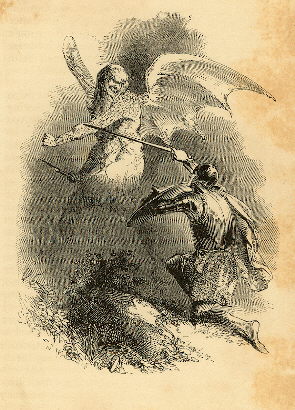
    angel attack.jpg

    Waking, by reason of their continual cares, fears, sorrows, and dry brains, is a symptom that much crucifies melancholy men.

    Robert Burton, The Anatomy of Melancholy

    All he could do was transcribe the interminable babbling voice of the night, the insinuating perverse voice of the demons.

    Pietro Citati, Kafka

    One time I was in south Florida, in the central part of the state, and I was staying in a roadside motel in a little swamp town. The desk clerk had sold me a six-pack of beer, and I sat around watching something called “The National Bird Dog Field Trials” on television until the local station went off the air. I couldn’t sleep so I went back out to my car and drove out to a truck stop diner at the edge of town and went in for coffee and hash browns. I sat in a booth near the window and eavesdropped on a conversation between two guys and a woman at an adjacent table.

    “They can finger you with nothing but bones,” I heard one of the men say.

    “Slivers,” the other guy said. “The fucking scientists can nail you with nothing but slivers. You have to be burning very hot to do it right, and they can still figure you.”

    “You can’t just toss a body on a plain wood fire and expect you heard the last of it,” said the first guy. “That won’t cut it. It wasn’t just teeth they found.”

    “And all that swamp out there,” the other guy said.

    “Gene wasn’t thinking,” the woman said. “He was crazy to burn her, that’s all. It wasn’t no thought at all.”

    “He still would have been wise to take a step back and bury what he had left,” one of the men said. “Bury it deep.”

    “Swamp it,” said the other. There was laughter around the table.

    “Gene just plain fucked up,” the woman said, and everyone nodded their heads and kept right on forking food into their faces.

    What if an individual is perceiving a daydream and a series of external sensory inputs at precisely the same time, and has lost the capacity to distinguish one from the other? What happens to his perceptual world? Clearly he will be peopling his universe of awareness with elements that are altogether private, presences generated from within which for him will be a genuine part of the real world; these are what he sees, or hears, or is otherwise sensing. And should he then be unable to differentiate these from his everyday perceptions, then indeed he may move into a haunted, nightmarish world, and be a very troubled human being.

    Joseph D. Noshpitz, “Reality Testing: A Neuropsychological Fantasy,” in Comprehensive Psychology

    A common notion about the relationship of sleep to mental health is that total sleep loss…deranges the mind and may result in some kind of breakdown….When serious sleep disturbances are present, as they almost always are in the mentally ill, the patient’s history often indicates that the sleep disturbance preceeded the actual break from reality.

    William C. Dement, Some Must Watch While Some Must Sleep –Exploring the World of Sleep

    Some nights you’d sit there tracking moonlight across the floor, or studying the garage roof next door as if it were a radar screen. Your mind on a very low flame, a few tired words alternately see-sawing in the silence or surfacing through the waves of static. You’d sit there barely conscious, but the moment you’d try to climb into bed and close your eyes the whole chorus would convene again with a vengeance. The variety show of hypnagogia. Channel surfing long before the advent of cable television and remote control. So random, stuttering, and relentless was your consciousness in those hours that you would make an exercise of trying to isolate a particular fragment, and then attempt to concentrate your mind on the fragment’s origin, trying to trace it back, if possible, to its original source. Sometimes it would be a line from a book or a television commercial, other times it might be something you’d overheard in school, or a snippet from a song or a random conversation. You would find yourself obsessing about an outrageous pair of shoes you had seen on a complete stranger in a grocery store, weeks earlier.

    Ultimately, towards dawn, you were always left with nothing but the barely-beating heart of the sleeping world. The under-hum and throb of its basic operating systems. The furnace. The ticking of the clock. The world on the back burner, as close as the modern world comes to stasis: You were left with only you and what was left of the night, the retreating darkness, shadows receding on the walls, the cruel pinch of exhaustion, the terrible reality that you were going to have to sleepwalk through another lost day. What was that they were saying about what?

    Eventually, every night you would reach a point where you could not fall asleep but you could nonetheless not be truly awake. You were reduced to fumbling around, grasping, in a dense and hazy subterrannean no man’s land, lost in the gauzy, impressionistic foothills of sleep. You would take a walk to try to resuscitate your sanity, to get clear thoughts moving again in your head. You moved in slow motion through a woozy, muslin-filtered border country, imagination and hallucination bleeding into reality. You heard what sounded like chanting. You heard the clanking of a cowbell. You heard the distant tolling of a clock, and a burst of faint music sucked from a car window somewhere out in the town. You heard a baby crying, then someone laughing, wretching, congested laughter. You heard a radio playing in a junkyard. You heard what sounded like a piano. You heard windchimes twisting in a backyard somewhere. You heard the barking of a dog, answered by another, in the next block. You thought of the men across town, in the slaughterhouse, exhausted on their feet in the slippery dead mess, blood bubbled everywhere, the tangy reek of animals being broken down into meat. You would go there from time to time to stand at the mouth of the tunnel that took the tired men to and from the slaughterhouse. You would stand there in the last of the darkness with a little collection can for UNICEF, and you would shake your can at the blood-soaked, broken-knuckled zombies as they plodded past blank-faced, clutching their empty lunchboxes, moving almost unconscious into the bruised light that was just then creeping into the eastern sky.

    Wakefulness during the time when one ought to be asleep is frequently a distressing condition, undermining the strength and incapacitating for active and efficient work. Insomnia or sleeplessness often afflicts those of active mental habits and lays the foundation of premature decay.

    When sleeplessness overtakes a brain-worker it is a sure indication that less intellectual work must be done, and that he ought to betake himself, if possible, to out-of-door exercise in the pure air of the country.

    Encyclopedia Brittanica, Ninth Edition. 1899

    The victim of insomnia, having seen the slowness of the dawn, arises with every nerve tattered and the capacity for happiness ruined. His morning is a desolation.

    Arnold Bennett, Things That Have Interested Me. Third Series. 1926

    Among the imposts which humanity pays for the true or imaginary advantages of what, for lack of a more consistent term, is denominated ‘civilization,’ there is not one whose tyrannical invasion of physiological law is so fraught with mental and physical bankruptcy as sleeplessness.

    J. Leonard Corning, Brain-Rest: A Disquisition on the Curative Properties of Prolonged Sleep. 1885

    Aristotle, On Sleep and Sleeplessness

    The BBC’s brief History of Insomnia

    The National Pain Foundation’s Insomnia Page

    When I lie down, I say, when shall I arise,

    and the night be gone? And I am full of tossing

    to and fro unto the dawning of the day.

    The Book of Job, chapter seven, verse four.

    This relentless repetition of the same illegible text….

    Yannis Ritsos, “Insomnia.”

    Melancholics are not so sleepless as maniacs, yet the want of sleep is often an early and prominent symptom. They do not readily sleep, and if they do, they awake soon to be tormented by the vilest misery that it is possible for human creatures to endure.

    Insomnia and its Therapeutics, A.W, MacFarlane, M.D. 1891.

    Want of refreshing sleep we believe to be the frequent origin of insanity, dependent upon moral causes.

    Psychological Medicine, John Charles Bucknill and Daniel H. Tuke. 1858.

    Those who pursue a desultory method of thinking are very often the victims of an obstinate and peculiarly distressing form of insomnia. During the day such persons are observed to apply themselves with apparent zeal to the regular vocations of life; but, if closely observed, there is often visible a certain absence of concentration and devotion to the particular matter in hand. When questioned upon this point, they admit that they are ‘absent-minded’; and, while only too willing to apply themselves, are frequently tormented by the intrusion of ideas totally foreign to the particular subject at hand….they carry their responsibilities to bed with them; and, while other minds are at rest, their own intellection is morbidly active. Midnight, and even the small hours of the morning, find such individuals speculating upon the pros and cons of the past and future with an intensity which often drives them to a state of positive desperation. The small ills of life assume alpine proportions, and even the most trivial circumstances are distorted and magnified a thousand-fold. When at last sleep actually does supervene, it is no longer psychological, but, on the contrary, perverted by dreams and unconscious cerebration to such a degree that these unhappy individuals can hardly be said to have slept in the ordinary sense of the word.

    Brain Rest, J. Leonard Corning. 1885.

    Under [insomnia’s] influence injurious changes are permitted by the patient to be made in his daily habits; pursuits which formerly engaged his attention no longer interest him; even important business concerns are sacrificed; and against such tendencies no pre-existing vigour of intellect will afford any defence; the strongest minds (intellectually considered) may sink into apathy and feebleness.

    James Russell, M.D., “On Sleeplessness.” British Medical Journal, November 16, 1861.

    After dinner, my friend drove me, in a carriage, some five miles back into the country –the greater part of the way, along the margin of Migunticook Lake, and under a terrific precipice, whose boulders every moment threaten destruction. In fact, the whole of a bright sunny day, cooled with healthful zephyrs, was spent in pleasurable excitement. Interesting conversation beguiled the evening; and, after family worship, I sunk to rest in a luxurious curtained bed. Ere long, I slept; and, about five o’clock next morning, was awakened by the crowing of the cock. This was the only night’s sleep I have had these last six years and seven months; so help me God. Since then, my nights have been tedious, as usual, without sleep, and some of them distressing.

    “An Example of Protracted Wakefulness,” Boston Medical and Surgical Journal. July 31, 1845.

    Experience in private practice, and extended observation in the wards of general and lunatic hospitals, have taught me that the ordinary hypnotics are frequently unreliable, and that in some instances their use is attended by results as bad as, if not of more serious consequence than, the conditions they were intended to remove. I do not wish by this somewhat sweeping assertion to be understood to condemn the ordinary hypnotics, or to doubt their efficacy in suitable cases; but it seems to me that we run great danger of becoming routinists in the matter of sleeping-draughts….Like most of my fellow practitioners, I constantly meet patients who have run through the whole gamut of sleep-producing drugs, and find their last condition, in many instances, worse than their first.

    Edward N. Brush, M.D., “Some Clinical Experiences With Insomnia,” The Practitioner, January 1889.

  • Byline Vs. Timeline

    For some reason our attempt to point you to Steve Gilliard’s compelling thoughts on “New Journalism” failed yesterday, so we’ll try again. I am envious of Gilliard’s broad-ranging feel for the middle-distance history of journalism—particularly as it was affected by the convulsions of the sixties and seventies. How could such intense social and political upheaval have NOT energized journalists and journalism? (How can it fail to do so today? And I am not talking about blogs.) In a free society, it is impossible for these sorts of phenomena to happen without the press taking notice, and once they do, the phenomena can kind of feed on themselves and develop in new trajectories. How much longer would Vietnam have lasted without television cameras in the field? How would the world be different today if Gerald Ford had never been president? (Uh… hmm…)

    But but but. Several issues to follow-up on from yesterday’s addendum. Gilliard’s lowest diss is to call someone or something “irrelevant” and we think this could bear a little unpacking. It is Gilliard’s paradigmatic assumption that journalism can and should change the world, right the wrongs, redress the complaints of the timid and weak, fix flat tires, and generally point in the right direction out of the slough of the present. We have no problems with this view of journalism—it is what the nation’s daily and weekly newspapers should be doing, and generally are doing, when they aren’t publishing the lifestyle tripe they believe is necessary to attract all those solipsistic, suburban TV addicts.

    We must confess that we took a moment to enjoy the sweet taste of schadenfreude in Gilliard’s funny and precise dismissal of Dave Eggers—”a silly, irrelevant man. ” We also couldn’t agree more that The Writing Program has done more violence to writing than a half-century of TV, radio, video games, and the web combined. Still, we think it is a little unfair to expect someone like Eggers to bear the cross of New, New Journalism. Yes, it would be nice to have a class of literature that embraced the world more directly and energetically, rather than turning inward, but why throw out with the bathwater anyone who has ever out pen to paper? Besides,Galliard is being selectively myopic when he carps about the state of literature today. I think, for example, that Franzen and Lethem are the spearhead of a new, new literature that synthesizes the introversion of young people today with a terra-stomping kind of allegorical quality. And what about the medium-old guard, folks like Margaret Atwood, Paul Auster, Nick Hornby, not to mention the old old guard like Philip Roth and John Updike? To see these writers as essentially hermetic is to read them in less than one dimension, while at the same time idolizing youth.

    Anyway, the whole point is this: Why expect literature to do journalism’s job? Good writing, no matter what the genre or category—whether you’re talking about first-edition hardcovers or cereal boxes—has only one obligation, and that is to the Truth. There are inward and outward truths, and presumably these can inform each other.

    The problem with workaday beat journalists is that they approach literature and the truth on a deadline, and they believe that great work is measured by the writer’s last byline. History moves in bigger circles than that. It is easy, today, to see that Hunter Thompson’s work transcends its time, transcends itself. It is not primarily about its outward marks—the stylistic departures, the lack of formalism, and it’s a fool’s errand looking for a contemporary equivalent. The reason there are no Thompsons today is not that there aren’t any; it’s that we won’t know about them for a decade or so.

  • Can't we all just get along?

    polly.jpg
    Please can I have some health insurance?

    Representative Jim Ramstad gave us a good chuckle this morning in his Strib op-ed piece, “Too much at stake for continued partisan warfare.”

    He rattles off a litany of the nation’s problems: social security, hungry children, crisis in public schools, out of control health care costs, national security, dependence on foreign oil, etc, and calls for a bipartisan effort to solve them. He goes on to say, “I’m not talking about singing “Kumbaya,” holding hands on the Capitol steps.”

    Well, Jim, that’s exactly what you are talking about. In case you haven’t noticed, your party now controls both houses of congress and the White House. If your party were really in power for the good of the people as you see it, they could do all these things.

    For example, they could raise the retirement age a squeak and eliminate the limit on the amount of income that is taxed for Social Security benefits. They could add to, rather than cut, poverty programs, especially for children. The party of Lincoln could establish a reasonable basic health care system for all Americans that would make our businesses more, not less, competitive internationally. You could put a tax on gasoline that would raise the price to somewhere near what the rest of the world pays, and use the income from that tax to repair roads and bridges and build a mass transit system that would use less gas. While you are at it, you could put a huge tax on gas guzzlers and require car manufacturers to increase their fleet mileage. You could pay for increased security measures where we really need it–around our ports and chemical plants–instead of sending seven times as much money per capita for increased security measures to Wyoming (home of Dick Cheney) than you do to New York.

    I could go on, but you get the point, Jim. It’s your party, firmly in the control of the DeLay wing, which is against all those things you say the country needs. They are the ones who want to cut taxes at the same time we’re at war in order to starve the government enough to effectively repeal the New Deal.

    Jim, if you really think these things need doing, you need to round up the few remaining moderates in your party and get together with some of the same from the Democratic side and get to work to wrest the power from those who simply want to destroy government.

    Writing a polyannaish letter to the Strib ain’t gonna cut it.

  • The Basic Drill

    Welcome to this thing, yet another old thing reconfigured as a new thing. It’ll be mostly about baseball, but I have a wandering mind, so it’ll likely occasionally stray pretty far afield –at some point, I suppose, I’ll feel compelled to talk about other random nonsense as well. Sometimes the random nonsense and the baseball will intersect in strange ways. I might, for instance, tell you about the time I saw Boxcar Willie throw out the first pitch in a Southern League game.

    Willie was wearing overalls, of course, and uncorked a wild pitch to the screen. I could then seque into the story about being present on another occasion when Boxcar Willie had a street named after him in Branson, Missouri (he was wearing overalls). Every time I see a celebrity of even the most forgotten, nearly-dead sort at a baseball game I’m for damn sure going to tell you about it. Like this: I once saw Don Knotts and Norman Fell at Kauffman Stadium in Kansas City on the night Paul Molitor got his 3000th hit.

    I might ask you to tell me the strangest person you’ve ever seen throw out the first pitch or sing the National Anthem at a baseball game. What the hell, as long as I’ve already mentioned it we may as well get that out of the way right now.

    Mostly, though, as I said, I’ll write about baseball, because baseball is one of the few things I’m passionate about in a world where the things I’m passionate about are diminishing by the day.
    I say this even though baseball has nearly destroyed my life, and may yet manage to finish me off. I think it was F. Scott Fitzgerald, talking about Ring Lardner, who once observed that baseball had ruined more good writers than alcohol. I’m not going to pretend to be a good writer, but I can tell you that I’ve done more than a little dabbling –dabbling is almost certainly not the right word– in both baseball and alcohol, and I’m pretty sure baseball has taken more years off my life.

    Perhaps not all truly obsessive baseball fans are stunted oafs, but a great number of them are, and I don’t suppose I’m any exception.
    I once ran away from home to work at a spring training ballpark (sure, I was 25 years old, but like I said, I was a stunted oaf). I’ve been to more baseball games than I could count, although I’ve scored every one of them, and the scorebooks are heaped in my basement along with several thousand baseball books, a couple hundred mitts, and scads of other baseball-related nonsense.

    I’ve tried to wean myself over the years, but to no avail. The overpaid, cheat-at-any-cost bastards and their cretinous overlords have got their hooks in me for good. If I were to wake up one morning in April and read in the newspaper that Derek Jeter had been arrested for having a freezer full of human body parts, dead cats, and growth hormones in his basement I’d immediately skip happily along to the boxscores and by six-thirty I’d be in my seat at the Metrodome with a scorebook in my lap.

    I have nothing whatsoever against complete monsters as long as they can swing the bat and make the necessary plays in the field. As soon as their production starts to slip, you’re welcome to lock them up for the rest of their lives as far as I’m concerned.

    I could tell you about all the reasons why I love baseball despite its many serious flaws and blemishes (unsightly steroid rash, most prominently, and Bud Selig), but people do that all that time, and you’ll surely have noticed by now that they’re always essentially the same reasons: the perfect accounting of the game, the absence of a clock, the rich history and repository of statistics, the easy and expert comparisons those statistics make possible for even the most casual fan, the lulls that allow time for plenty of idle conversation, the quirks and characters and long season.

    That’s all absolutely true, but Roger Angell and George Will and a host of others have been going on about that sort of thing forever, and sometimes it can almost make me resent the sheer perfection of the game. If it were a little less tidy and entrenched maybe most of the highbrows would go back to their chess boards and fat volumes of political philosophy and Civil War history.

    Mostly, I have to admit, I love baseball because it takes up so much time that would otherwise have to be taken up with something else, and I don’t have much in the way of something elses in my life. Spring training, 162 games, the postseason –that’s essentially eight months steeped in obsession, and over a lifetime that adds up to an awful lot of the most basic sort of prison subtraction.

    I like the way we’ve all come to take for granted the ridiculous uniforms of the sport. I love the fact that there are no cheerleaders. I love the suicide squeeze (and despise the sacrifice bunt) and the grand slam –or, as my wife calls it, the four-run thing. I love the various plot lines and dramas large and small that play out over the course of a season, the countless opportunities for pure joy and abject misery.

    I’m not sure baseball builds character, but I do know that it creates characters, and I adore characters. The game also doesn’t necessarily reward devotion, but it does reward attention, and for the attention deficient it’s like a daily Ritalin injection directly into the heart of the cerebrum. I can’t think of any other thing that can make me sit still for four hours at a time.

    And after four months of bouncing off the walls I can’t tell you how good it’s going to feel to be able to sit still again, even if I once more end up with my heart yanked out of my chest and kicked into the gutter with the last leaves of autumn.

    This, though, will be about those months when my heart will still be beating, hopefully like a man’s with a gun in his mouth. Seriously, that would be a good thing. That would be a seriously good thing.
    I’ll be here –and elsewhere– all year. Feel free to drop me a line any time. I’d be happy to hear from you.

  • Because We Care

    I’d still prefer to be riding the bike, of course, even in this beautful and deadly snow, but it’s a crazy week. We are shipping the new issue of the magazine today, uploading it to the website, there are school conferences for the kids (one of whom is having a cavity filled today), there is a birthday Thursday, and the week-long wind-up to the Birkebeiner is in full swing. So today I was on the Interstate behind a school bus. It had just come on the entry ramp. I drove in its wake, which was a dazzling wind-blown banner of snow flakes, a sort of glittery con-trail. I kept pace with the bus, trying to stay in its magical sphere. My daughters would have recognized it as a cloud of fairy dust. On the seat next to me, there was a print-out of David Carr’s thoughtful appreciation of Hunter S. Thompson in today’s Times.

    I read something yesterday that was striking, and I thought about it now: great writers–in fact, great artists of all kinds–are usually marked by their curiosity, their unquenchable desire to see new things, meet new people, go new places, find new ways to use the language and new facets of truth. I think of this as having “hungry eyes.”

    How do you know if a writer has “hungry eyes”? I think it shows in their work by a certain comfort level with leaving things unfinished, or at least unresolved, being OK with a sustained mystery, leaving questions unanswered intentionally (rather than accidentally, which just looks sloppy)–that, after all, is the human condition. Writing that I am not very interested in is usually stained by a kind of blind, self-assured arrogance that has no sympathy for the undecided, only pity and disgust. (Like, say, the me-first neo-cons over at Powerline.) Most people are undecided about most things, and to belittle them is to insure that your work will be instantly forgotten except by pedants and thugs.

    I am not sure whether Hunter S. Thompson was part of the problem, or part of the solution. I do know that he had deep reservoirs of courage and enterprise as a reporter, and these are rare enough nowadays. On the other hand, there is certainly no shortage today of righteous indignation across the political spectrum, nor the narcissistic compulsion to make every story revolve around its writer.

    By far the majority of editors I’ve ever dealt with are liars about this. In private moments, talking amongst themselves, they gripe bitterly about how Hunter Thompson and Lester Bangs ruined journalism and criticism (respectively) because they inspired legions of bad imitators. This is a little like blaming the Beatles for ruining pop music. What’s worse: in public, these same editors lament the passing Golden Age–where are the Thompsons and Bangs of today? Well, they are out there, but no one is willing to take the risk of cultivating them. They complain about the weather, but do nothing about it.

  • These Fragments I Have Shored Against My Ruin: A Collection Of Scraps From One More Sleepless Night

    man in wreckage.jpg

    How ashamed must be the loathsome models who wake up in the morning in bed with ZZ Top?

    In the old bar of my early days as an inebriate there was a mural there on the wall, a tableau of drunken trolls, a forest scene, I seem to remember, a vertitable sprawl of blasted trolls, collapsed among the trees. A dark woods, more darkness creeping through the trees. They’d come through there any day now with the heavy machinery, the chain saws and earth movers. They’d lay waste to everything the fucking trolls held dear. They’d plow their world right under, drive the plump little bastards into exile. No wonder the trolls did nothing but drink, no wonder all they ever did was lay around eating and drinking and gaining weight. There weren’t even any women trolls, so when they danced it was a sad spectacle, bachelor trolls self-consciously dancing with each other and doing their pathetic best to make merry. Still, they did dance, once upon a time. They used to. They used to be furtive and quick on their feet, used to cover all sorts of ground just for the hell of it. No more, though. They knew what was coming, and there was nothing left for them to do but wait.

    If you want to speak directly with a disc jockey, your best bet is to call in the middle of the night. It works for me every time.

    So many white men, taking turns pushing their tired white brains down a moonlit dirt road in a wheelbarrow.

    Please present a word with two w’s. Wheelbarrow. Willow. Wallflower. Window. It’s difficult to find such words that don’t start with w. Awkward.

    Dear Giant: Please put your lips to that little chimney and blow this frozen man out of his chair.

    The Giant’s prerogative: He can do whatever the hell He pleases.

    The backs of my eyeballs feel like a chalkboard on which some invisible hand is quietly scratching a descending series of numbers.

    We got a word for fellas like Clayton Eshelman where I come from, mister: pussy.

    I can’t seem to shake the memory of a little cross-eyed mudpuppy, crammed in a jar of formaldehyde in a high school science lab. When I was younger the eggs in the refrigerator would talk to me, telling me stories of long dead hens, nights in the country, the distant sawing of fiddles, crickets who giggled all night long, the gravel percussion of truck wheels coming up the driveway, the soft crooning of the old woman who came each morning to carry them away. I’m extremely grateful for this opportunity to present my side of the story. Thank you for your time.

    Now: Bushed. Shagged. Tuckered. Fagged. Fried. Beat. Shot. Sacked. Whooped. Whipped. Saddled. Socked. Weary. Worn out. Crapped. Crying Uncle. Exhausted. Tired as shit. Lights out. Now I lay me down to sleep. To sleep, perchance to dream. Nighty-night. Sayonara. Get a good night’s sleep. Don’t take any wooden nickels. Don’t let the bedbugs bite. I’ll see you in the morning. Good night. Sweet dreams.

  • Snow Emergency

    Due to some strange, unforeseen circumstances, I found myself driving several different cars in the last twenty-four hours. Yesterday, I finally got around to some domestic responsibilities that included tightening a hand rail that had loosened under the constant attack of children. These same children were being scalded by a leaky hot-water tap in the bathtub. I keep a small box of washers and springs and valve seats on a shelf in the basement. Each time there is some sort of plumbing job, I retrieve this, and within about twenty minutes of fiddling, I discover that I do not have any of the parts I need, so it’s off to the hardware store.

    I drove the wife’s car, and I happened to catch “On the Media,” NPR’s meta-media radio program that is often quite good, but not good enough to compel me to turn on the radio of a Sunday afternoon. Yesterday made me reconsider my weekend blackout on media. Though they had not yet heard of Hunter Thompson’s passing, Brooke Gladstone and Bob Garfield had a brilliant triangulation between Deep Throat, Woodward and Bernstein’s key anonymous source in their Watergate reporting, and “Inside Deep Throat,” the new behind-the-scenes movie about the first hardcore porno flick. I had not realized that the movie opened and the Watergate break-in happened in the same week, in 1972. To my slightly touched mind, these coincidences tend not to be coincidences at all, but representative moments. Now, thirty-three years later, we find ourselves at a similar moment. Who could have guessed, three decades ago, that we would find ourselves fighting the same battles as if they’d never happened—arguing, as those nitwits over at Powerline are wont to do, about whether Watergate was “no big deal, afterall” and giving the FCC wide-ranging power to put media companies out of business for perceived obscenity violations.

    We’ve been urging anyone who will listen to go back and either read “All the President’s Men” or see the film. It is an edifying thing to do for a number of reasons. First, as a palliative against the widespread suspicion that newspapers and reporters are “on the make” at all times, either literally or figuratively. As Gladstone and Garfield pointed out, the last thirty years have been hell for politics, government, and the social fabric in general—but they have been very good to the press, because it has been the press that has revealed the unpleasant truth about so much ugliness from Vietnam to Iraq. That process has now reversed; politicians and corporate marauders grow more comfortable and more arrogant as they “discredit” the press, or at least convince the general public that there can be no news without a liberal slant (unless it is owned by Rupert Murdoch). Nicholas Lehmann, in last week’s New Yorker, seems to have picked up on this irony—that neo-cons are, interestlingly enough, hardcore relativists when it comes to the news. It’s all a snow-job, unless its in the Bible.

    Today, we have snow emergencies around town. The deputy editor, who is on vacation in New York this week, put her car in my charge for just such an eventuality. It was safely parked in my driveway, but I got a call early this morning from my old friend DK, who happens to be in New York this week, too. He had two cars parked in the tow zone—so off I went, on an errand that would involve three different cars across two counties. And plenty of radio. So I learned that Hunter Thompson had died, and he too reminded me of how times have changed—but also stayed the same.

    While today there is plenty of raw material for a fearless writer like Thompson, I worry that our culture and our institutions have been stung too many times by great, insightful, truthful journalism, and that the reading public has grown innured to it. Great journalism is, in one of its modes anyway, supposed to “speak truth to power,” but power is presently winning the contest. It is doing this by cultivating a very sophisticated and cynical understanding of media, and manipulating it. By contrast, Hunter Thompson was a hero to all earnest and poetic truth-seekers who could tolerate his selfishness long enough to see the inner workings of whatever subject he trained his sights on, no matter how irreverent or unorthodox he wished to be in telling the story. I have no idea why he might have decided to commit suicide, but I do know that it comports with both his personality and the times he was now forced to live in. (It is telling, I think, that my favorite Thompson composition was this memorable obituary of Richard M. Nixon; it is a highly useful adjustment of focus for those of us whose view of those dark times has grown fuzzy or sepia-toned.)

    Anyway, there will be plenty of obituaries that are far more telling and eloquent than anything I could say about Thompson, but I did want to take this thing a little further in a different direction. “On the Media” had a long segment on the Watergate Deep Throat and efforts over the years to identify who that source may have been. A journalism professor named Bill Gaines conducted a class that asked its students to pore over all available information—primarily the books and articles of Woodward and Bernstein— from Watergate to determine, as scientifically as possible, who Deep Throat was. Gaines and his class believe that they have, beyond a doubt, identified who that anonymous source was. Bob Garfield pressed Gaines on the ethics of this exercise. As a journalism proferssor, shouldn’t he be teaching his students the sanctity of keeping a source anonymous? Gaines, in a most disngenuous way, said that Woodward and Bernstein had already identified the source by leaving all sorts of hints along the way. If they had been serious about protecting Deep Throat, they would have let him remain strictly on “deep background”—that is, not only anonymous, but entirely unsourced in print. But this is unfair and insincere. Watergate was the single biggest most celebrated triumph of investigative journalism of the last fifty years, and it would not have broken without Deep Throat. Woodward and Bernstein have been harrassed about the identity of their source from the day they begain investigating that “trivial little break-in.” The fact that they have managed to keep Deep Throat’s identity secret from everyone except the redoubtable Bill Gaines and his class is the only defense they need.

    And so, in honor of Hunter S. Thompson, we have to ask—is this what journalism is about today? Has it devolved so far that it must eat its own, to keep itself occupied? To speak truth only to the truth-seekers, even when it is an irrelevant and a counterproductive exercise in navel-gazing? How depressing. We hear there’s been a lot of snow in Aspen this year—or was that merely the ashes of Harold Ross floating lightly on the air?