Tag: art

  • RE: Generations, Legacy & Tradition

    Don’t
    let the title fool you. This exhibit showcases innovative, contemporary takes
    on traditional American Indian art forms. It’s a chance to see work by Kevin
    Pourier
    and Dwayne Wilcox, whose horn carvings and ledger drawings garnered
    attention at two earlier, similarly themed exhibits, Impacted Nations and
    Changing Hands II: Art Without Reservation
    ; included as well are newer names
    like beadwork artists Douglas Limon and Todd Bordeaux, quilter Gwen Griffin,
    and hide painter Alaina Buffalo Spirit.

    Gallery Hours: Wed.-Sat., 12 p.m.-6 p.m., Ancient Traders Gallery, 1113 E. Franklin Ave., Minneapolis;
    612-870-7555.

  • My First Rake Mea Culpa

    More like a mea maxima culpa. 

    In my very first guest post here, I used the Rachel Bliss show at Cliché as an illustration of art works on display in places other than galleries, something that happens more and more here in Minneapolis.

    And then I posted the work of the wrong Bliss.

    The artwork I posted — and have removed from this blog — came from Rachel Bliss in Pennsylvania and did not appear at Cliché.  We were informed that the images on the site, like many pieces on artist sites, are copyrighted and require permission to use. 

    I meant to use some pictures from the Minneapolis Rachael Bliss, who did in fact have an opening at the clothing store in Uptown.   You can now see her images in the original post. 

    My apologies to Rachel and Rachael and to Cliché for the confusion.


  • Tripping the Road Fantastic

    Soon you may be heading off on a thanksgiving vacation. The trip may be short or it may be long. Unless your relations live next door, however, you will have to make that journey in an automobile. These days that will likely mean a minivan or small European "touring wagon" (which Chrysler attempted to call its Pacifica with no luck).

    Alas, I can remember a time when my family made the journey in something closer to a submarine replete with paisley patterned vinyl seats. It was a bright yellow Pontiac Safari wagon. I truly believe it was the closest my parents ever came to experiencing the 60s. Yet for me those Thanksgiving rides always seemed like some kind of trip.

    The Pontiac Safari

    For starters, the Pontiac Safari (and its GM cousins) was the largest station wagon ever built. I found a reference that confirms this:

    "Most of the truly huge station wagons seem to have
    been built before 1982 ( in fact up until 1978). The station wagons with the greatest interior volume
    (passenger volume plus cargo volume) would seem to be the 1971-1976 full-size GM
    wagons with approximately 184 cubic feet of volume. Other leading wagons are the
    1974-1977 Chrysler Town and Country and Dodge Polara/Monaco (177 cubic feet), and the 1969-1978 full-size Ford and Mercury station wagons (169 cubic feet).

    Yet the preponderance of information suggests that the largest
    station wagons of all time were the 1971-1976 Buick Estate, Oldsmobile Custom
    Cruiser , and Pontiac Safari."

    Now I realize my timing is a little off. We owned a 1971 Pontiac Safari which would have placed my family trips safely out of the 60s. Still there was something about this wagon that made me lose my head.

    Was it all that space?

    Was it my sister spitting blue meanies (she kept blue scratch paper that she would chew up into little gross little projectiles) or scratching my forearms (still have scars) with her face flushed as red as Enzo at the racetrack?

    Or was it a little voice inside of me that said, "Someday Chris you will design things for a living. So know right now that these seats belong in a bathroom or a really ugly house. And cars, little boy, are never supposed to be yellow."

    That must have been it. Car seats were just NOT supposed to match the formica on the kitchen counter. And my sister be dammed.

  • Stranger in a Strange Land

    UrbanEye, a New York Times email newsletter, is meant to be a daily
    aid in deciding “what to see, eat, do and wear in New York City.” It is
    useful for the infrequent visitor to New York to know what he is
    missing when he isn’t there. Since discovering the newsletter, I’ve
    devoured the theater and art suggestions in particular, and made notes
    in my Moleskine of what to see when I make my semi-annual sojourns.

    I pay no attention, however, to the “what-to-wear” pretensions of
    UrbanEye. Those sartorial suggestions are infrequent—and only implied
    within the gallery, theater, and music listings. I should have perhaps
    taken the hint, though, by the very fact that fashion is mentioned in
    the “sell line” for the email sign up, that how you present yourself,
    even when at leisure, is more important in New York than here. (I could
    have also picked up that idea from my daughter, who was home from New
    York for a few days during a school break recently and brushed off her
    mother’s offer to pay for a haircut with, “Mom, I get my hair cut in
    Manhattan.”)

    This insensitivity to fashion is how I ended up at the Armory Show in
    ill-fitting Nautica jeans from Costco and a faded hemp shirt I once
    bought in Duluth because I was cold and had forgotten my jacket.

    The Armory Show is an annual assemblage of art galleries from around
    the world. Art is flown in from Tokyo, Vienna, Berlin, Paris, London,
    Milan, Madrid, Tel Aviv, and San Francisco and displayed in one place
    for New York collectors to be led around by experts and told what to
    buy. (At least that’s what happens according to the Times, which ran a
    recent front-page story about an arriviste collector from Florida who
    required “introductions” to the galleries in order for them to allow
    her to spend a quarter-million dollars of her money.)

    As I walked around the show, I realized that I was indeed dressed as if
    I had originally set off for a day in the swine barn at the Minnesota
    State Fair and had somehow gotten off at LaGuardia Airport instead of
    Larpenteur Avenue. As I browsed among stylish New York men in their
    draped Italian suits or five-hundred-dollar jeans, and the
    coiffed-and-coutured women on their arms, I unintentionally began to
    focus my gaze more on the attendees in the halls than the art on the
    walls. I pulled out my notebook and scrawled a reminder about my next
    visit: “In NY, wear BLACK jeans.” As I closed the book, I looked up and
    saw coming toward me an attenuated young man in pegged black jeans and
    a skin-tight black silk turtleneck. Setting off his wardrobe were his
    goatee and fringed hair—both of which had been bleached to a degree of
    whiteness only dreamt of by Gwen Stefani—and a set of platinum dog tags
    which seemed to mark him as a brand-new second lieutenant in some fey
    ninja army.

    I opened the notebook again and added, “Put The Devil Wears Prada on Netflix list.”

  • The Unexpected Pleasures of Art Shopping at the Farmers' Market

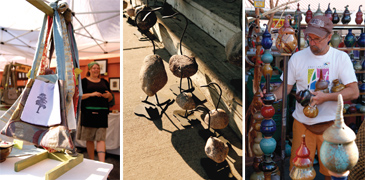
    Beyond the plethora of plants, produce, and flowers, one of the pleasures of an expedition to the Minneapolis Farmers Market is the prospect of more abiding goods: The vendors who populate the south end of this market are selling everything from cell phones and bumper stickers to fire pits and fine crafts—and yes, even art. I’m pretty sure I’ll never renew my phone plan here, but there’s a great time to be had browsing the booths of the artists and craftspeople in the sheds tucked in the shadow of the I-94 overpass.

    Several stalls offer ceramics, but only Phil “Pottery Dude” Echert stacks his pots atop one another and calls them “garden art.” These sculptures are deceptive—the pots look precariously balanced but are threaded on iron poles, so the whole structure is really quite sturdy. Aside from the topsy-turvy trickery, it’s the glazes on Phil’s pots that will lure you. These saturated primaries capture the cheery feeling of a garden in full summer bloom. The best part: You can pick the pots to be included in a custom sculpture that Phil creates on the spot.

    A few stalls down you’ll find Cheryl Fitzgerald’s Iron Gallery. Like many of the market’s artists, Fitzgerald shows a lot of outdoor sculpture. Her pergolas and arbors have the appeal of lovely old iron gates and will lend any garden an aura of mystery, as if promising entry to an otherworldly realm just beyond the vines intertwined on them. On a recent trip, I was also entranced by an oversized flower sculpture and a stand of giant iron cattails. For those focused on practical outdoor accessories, Fitzgerald offers stylish tall tables and chairs to create a backyard patio bistro.

    Beyond the monumental yard art, plenty of vendors appeal to the connoisseur of smaller wares. Jewelry and textiles abound, if you don’t mind strolling by tables of knock-off sunglasses and watches to find these homegrown crafts. Be sure to check out Kendra Gebbia’s handmade purses printed with charming, stylized botanical images, and her beaded necklaces, along with her intricate, nature-inspired wood-block prints. Across from Gebbia are two vendors—J&K Glass Expressions and Erika Royer of Glamorous Glass—that should be sought out by any chick with a glamorous event on her schedule. Erika’s fused-glass jewelry and hair clips are colorful and unique, and J&K’s knockout coasters and platters can serve as distinctive accessories for gifts or entertaining.

    Deeper within the market, near the guitarist belting out ’70s and ’80s soft-rock hits, you’ll run across the Art Andes stall. Owner Melanie Ebertz imports gorgeous flat-weave rugs and textiles from Peru, and on at least one trip to the market, a visiting artisan from South America was demonstrating weaving technique. Though the process is ancient, these vibrant rugs, with warm colors and geometric designs, would look equally at home in a cutting-edge loft space or a cozy Arts and Crafts hearth room.

    Evla Pottery entices the market-goer with “Berry Bowls,” decorative colanders that come with saucers to catch water from freshly rinsed berries. You can wash, drain, serve, and store your harvest in the same vessel. These rustic earthenware pots are an ingenious necessity for any well-equipped kitchen.

    After fortifying yourself with a couple of fish tacos from one of the market’s fantastic seafood stalls, turn your attention to Francis Metal Works, where Chuck Adams uses large fieldstones and iron tube stock to fashion all manner of birds native to Minnesota. These sculptures are not your grandmother’s kitschy yard art. I love a good pink flamingo as much as the next girl, but these birds are subtle, sophisticated, and lovely.

    In short, you can rely on the farmer’s market for one-stop shopping. Where else can you pick up Minnesota-grown spinach for your Sunday brunch along with trendy beaded earrings for the Saturday night before? Who knows—you may even drive away with a giant daisy sculpture in the trunk.


    From left: handbags by Kendra Gennia, birds from Chuck Adams, and Phil Echert’s stackable pottery.


    This article originally appeared in issue 19.1 of access+ENGAGE. Subscribe to this free arts e-magazine at mnartists.org/accessengage.

  • Short Timer

    Walker Art Center director Kathy Halbreich might be the most admired museum director in America,” wrote Tyler Green last year on his influential Modern Art Notes blog. He quoted some of Halbreich’s museum-director colleagues, one of whom said “I watch her from afar, kind of like a guru,” and another who said “Kathy is the model. She’s done incredible things.”

    Nevertheless, all incredible things must come to an end. After nearly seventeen years at the Walker, Halbreich will leave her post November 1. Her selection back in 1991 was seen as a radical, even shocking departure from the style of Martin Friedman, who’d been at the helm of the museum for more than three decades. But the Walker’s newest director—Olga Viso, who’s stepping down as director at the Hirshhorn Museum and Sculpture Garden in Washington, D.C. to come to the Twin Cities—has quite a bit in common with her soon-to-be predecessor. That would seem to be a strong testament to all Halbreich achieved.

    When you announced your departure last spring, you mentioned having taken a sabbatical the previous fall. What happened during that time?
    Professional life is just moving faster and faster, and the responsibilities don’t diminish. I had this remarkable luxury to take three months off. It reminded me how hard it is to program your own days when you’re used to being programmed by the job. I spent some time at a friend’s cabin on Martha’s Vineyard, and this place is magic … I began to return to a very sensory kind of living.

    I also went to New York. I wanted to see if I could really look at art, particularly young art, again. I saw about eighty exhibitions and came to the conclusion that I still had this lust for looking, and that was actually quite gratifying. I also at the same time was returning to a certain life. I grew up in New York … I actually was beginning to have a personal life, which has been very prescribed here [in the Twin Cities].

    I’ve always been inspired by the fact that you went to a liberal arts college, but did not go on to earn an advanced degree. Do you think there’s an over-emphasis on graduate education in the arts?
    Look, now you’re supposed to have MBAs to run these places. Anything you can do to develop your talent pool is worth doing. But there’s just plain old experience, and the fact that I have worked since I was thirteen has served me well. I’m envious of those who’ve had more education, but I’ve had a longer time to play in various jobs.

    Since 1991, when you started at the Walker, what’s changed at that institution and in the larger museum world?
    We have become bigger, and yes, that’s better, but there’s also peril to it. Bigger institutions require more resources. More resources require greater complexity. And what’s really remarkable about Walker in all of this is that it’s kept its soul.

    Another change has to do with being a multidisciplinary institution. The film/video and performing arts departments have been here since the ’70s, but I was able to create greater equality among the disciplines. And you’re going to see more of that. Now the Whitney is building a new building and they want it to include a theater. You look at the Guggenheim’s plans for whatever building they’re going to build and it’s … Walker. You have Wexner [Center for the Arts, in Columbus, Ohio] calling themselves “Baby Walker.” We just followed the artists sooner to this model.

    You said a few years ago that “we are realizing there are more creative giants operating across the globe than we were ever aware of before.” Who, or what, are we missing?
    The world is much smaller than when I began. The collection at Walker then was basically Euro-Canadian-U.S. It can’t be that anymore. With Hélio Oiticica, we were the only museum in the U.S. to show his retrospective in 1994; people thought I was absolutely crazy. But he is going to be considered one of the most important artists of the twentieth century. This country just didn’t understand because they didn’t know.

    What are the powerful countries of the future? Brazil, China, India. Brazil is an enormously fertile ground—that country and Japan have the longest history of really modern art, and the most interesting. China’s later, and India I would say even later still. But these places now are extremely alive.

    You’ve also said you don’t believe there are blockbuster names in the contemporary art world. What does that mean for the future of art, artists, exhibitions—for getting bodies into galleries?
    That’s a very complex and good question. It starts first with very serious questions about expectations, about what numbers mean and what they signify. Is it good enough for Walker to be one of the top five or six museums for modern or contemporary art, in terms of attendance? Those who get more are MoMA, the Hirshhorn, SFMoMA, the Whitney, and the Guggenheim. And that leaves out contemporary institutions in much bigger cities—L.A., Chicago, Philadelphia, Houston—that have much smaller numbers than Walker’s. Is that good? I don’t know. Should we have more people than the Minneapolis Institute of Arts? Is that better?

  • The Genie and His Decorative Light-Diffusing Novelty Lamp

    For a guy who spends all year thinking about Halloween, Will Niskanen could hardly be described as scary. Slight and soft-spoken, dressed in khakis and brown loafers, and exhibiting the good manners of a Boy Scout, Niskanen greets me at one of his favorite haunts, Mill City Cafe, pulling out a chair and offering to order a beverage. His studio is just upstairs, so the café is a great place to take a break from sketching skulls and spiders and tombstones.

    Like several of his neighbors in the California Building, Niskanen is a graduate of the Minneapolis College of Art and Design. What’s rare is the fact that, at age forty-two, after years of “farting around,” he’s gotten to that enviable place of doing exactly what he wants to do. He’s not selling artwork in galleries, however; instead, his creations have names like the Flickering Flame Genie Lamp, the Skull Wall Candle Sconce, and the Flaming Skull Sconce—the last, a popular seller at Spencer Gifts.

    So how did a nice Finnish boy, raised on a Carver County farm, wind up inventing glow-in-the-dark geegaws, light-up novelties, and flaming decorations? Or maybe the better question is, why?

    Part of the answer can be traced back to that rural childhood. Niskanen’s dad, who was a forester with the Minnesota Department of Natural Resources, bought a run-down dairy farm in 1964, when Niskanen was a one-year-old. “He was really into preservation,” Niskanen said. “I think he bought this farm to try out a bunch of his ideas. My parents went to work picking up all the trash and renovating the barn. We had a horse, we had tractors, eighty acres of corn and soybeans. We always bailed hay. You always have to do that in the middle of a hot, hot day.” The elder Niskanen was also “a real disciplinarian,” his son said. “When we were kids, we all had crew cuts. My dad had a very firm idea of right and wrong.” And on a nice day, said Niskanen, if the kids were inside watching television, “he’d come in and pull the plug and wrap it around the TV.”

    That’s how young Will came to spend a lot of his time tinkering in the barn, using the shop equipment and hand tools to build everything from birdhouses to an elaborate train set, which he assembled in the barn’s loft. Tucked away in the country and on a limited budget, Niskanen had to create all the model-train accessories other kids might buy at a craft store. “I wanted so bad to go into town for more track,” he laughed, “but I couldn’t, so I thought, well maybe I can make it myself. I got a book to learn how other people made their mountains, and I made the mountains out of plaster. Because I lacked a lot of the cool mechanical devices you could buy, it ended up being a lot more scenery. Lots of tunnels and trees made out of weeds,” he said. “I learned how to solder, cut wood, do some carpentry, paint a background.” All of this fostered in him “a sort of self-reliance,” said Niskanen. “My first response when my car breaks down is probably to fix it myself. Most things in my life are like that.”

    Which brings us back to the present, in Niskanen’s modest and currently cluttered studio, where self-reliance has inspired an entire series of odd, glowing contraptions. A purple tube that vaguely resembles a lava lamp is throwing light against a black backdrop. Next to it is a gray light that looks as if smoke is wafting through it. A smaller orange light nearby is meant to sit inside a pumpkin. These are all products born of Niskanen’s pride and joy: U.S. Utility Patent 6,955,440: Decorative Light-Diffusing Novelty Lamp and the mechanical process it employs. For someone accustomed to tinkering and inventing and dealing with a constant flow of new ideas, the patent-application process was a sort of Zen teacher, a lesson in patience and detachment.

    Showing off his official U.S. patent certificate, Niskanen clucks over it like a new parent whose offspring arrived after a difficult delivery. “The whole patent process is this back-and-forth thing of denial and rejection,” he said. Despite all of the labor involved, he said he hopes to have “six or eight of these things someday.” Sitting down at his desk, he read choice passages from the patent, which he finds amusing for their colorful, sometimes titillating language; the wording must be absolutely precise while also addressing the object’s unique contribution to the world of gadgetry.

    “‘Novelty lamps have been used for years to provide entertainment and relaxation to persons throughout the world,’” he read, nodding. “‘For example, many persons are familiar with lava lamps, which by heating blobs of material, induce the material to change buoyancy and thus float and sink within a liquid bath. Sometimes, the blobs are colored.’ Don’t you love it?” he pauses, looking up. “Blobs!” He continues reading.

    “‘Sometimes the blobs may have different colors. The appearance of the floating and sinking globs’—Ha! Now it’s globs!—‘may be further enhanced by the casting of light upon the blobs. In any event, novelty lamps such as lava lamps often induce dangers to the environment.’”

    The various hazards produced by hot and blobby lava lamps were key to Niskanen’s invention, which is seen as a safe alternative for dorm room and bedroom decor. The Decorative Light-Diffusing Novelty Lamp, stripped to its essential bits, consists of a stand, a lightweight fan, a plastic tube, and a piece of silk that Niskanen mentions is officially referred to in the patent language as the “flexible member,” one of those terms that cause him to chortle. It is scheduled for mass production and distribution in 2007, and Niskanen is already building out variations, such as the smaller lamp for jack o’ lanterns, a light-sword toy, and a “wave panel lamp junior” for nightstands. He also envisions a much larger version of the lamp, one that would wave light six or eight feet high and create a cool atmosphere at proms and nightclubs. And there are all sorts of other things in the works. Niskanen is developing “yard luminaries”—those sandwich-board-style decorations with a design cut into the panels, which are lit from within—for all seasons and occasions, including, of course, Halloween. Those versions have waving green, orange, and red lights behind cutouts of a spider’s web, or a witch, or a pumpkin. “For some reason right now, I’m into things that light up,” he said. “And things for parties.”

    Musing over how he came to be an inventor of Halloween novelties, Niskanen noted it’s not necessarily something that he always wanted to do. “It just happens to fit,” he said. “All of the things I’ve done have sort of led me to this place. I’m a late bloomer, I guess.” He received no encouragement from his high school art teacher, whom Niskanen describes as “a load, a real turd.” Luckily, the faculty at MCAD recognized his talent, and he received a first-year scholarship to attend. He particularly admires one teacher who, in Niskanen’s early years at the college, stressed craftsmanship. “He would say, ‘If you’re going to weld on that chair, you better make that weld nice. If you’re going to paint that chair, you better paint it right. If you’re going to do it, do it well.’ Old-fashioned stuff. Do it well; distinguish yourself.”

    That approach was a good fit for the self-reliant Niskanen, who was interested in art’s practical applications. “Even when I was going through MCAD, I knew I had this interest in industrial design, and I had kindergarten knowledge of mechanics, but I didn’t know how to join the two in the real world. I had a good basic drawing skill, but I didn’t know how to apply it.”

    After graduation, he worked for a time designing props for Minneapolis’ Minnefex studio. He lived in Des Moines and worked as an illustrator for a woodworking magazine. After a few years, he found himself in Litchfield, sketching cabs for a construction-equipment company. Then he joined Paper Magic Group, a company that specializes in seasonal decorations and set Niskanen to the task of sketching new Halloween products. “I became a pollinating honeybee for ideas, so to speak,” he says. Soon he began to deal more directly with the buyers, and after a time he noticed he was selling himself short. “They’ve done very well with a number of the things that I designed,” Niskanen said. “I was offering all of this energy and creativity to the company.” And that’s when he decided to pursue his own patents and license his own products.

    These days, Niskanen’s creative process usually begins with sketches for a product. Then he’ll go through a period where he roots around at garage sales and Salvation Army and Goodwill stores. He might browse craigslist for a while, looking for electronics (especially old hi-fi gear) and items under the garage-sale or “free stuff” categories that sound intriguing. Then he’ll go get a coffee or wander the seasonal-product aisles at Target. His studio is littered with spray-paint cans and boxes upon boxes of detritus from his foraging trips: plastic parts from computers, hair dryers, and abandoned kitchen gadgets. He uses all of these in building three-dimensional models of his ideas so that potential buyers and Steven Thrasher, his patent attorney, can better envision the finished product.

    “Will has this unique combination,” said Thrasher, “of combining engineering competence with artistic creativity. But the most interesting part of Will’s story, I think, is his persistence. My granddad once said he spent ten years becoming an overnight success, and Will’s like that—he’s an inspiration to people who are just beginning to follow their passion. And he’s an easy guy to root for.”

    In a sea of Spider-Man costumes, Styrofoam gravestones, and fake Dracula teeth—Halloween is second only to Christmas in terms of consumer purchases, generating several billion in sales each year—Niskanen has managed to carve out his own niche. Last spring, at Transworld’s 22nd International Halloween Costume & Party Show in Chicago, he was gratified by the excitement his pieces generated. “Each time I do a show, I walk around and there are few new ideas. I see a product sometimes and think, Well, that’s great, but they missed the cool thing, the cool thing they could have done with it. “I don’t look at Halloween the way a normal person does,”

    Niskanen said. “When Halloween actually comes, I don’t really participate.” Instead, you can probably find him browsing store displays, trying to figure out the next cool thing to do.

  • Hard Look, Tender Touch

    “One thing I would never photograph,” Diane Arbus once wrote, “is dogs lying in the mud.” 

    That’s an odd statement coming from a woman who looked so unflinchingly at the weird world around her. Technically there may not be any photographs of dogs lying in the mud in Revelations, the vast retrospective of the photographer’s work that is currently on display at Walker Art Center, but there are certainly scads of the portraits that many have long viewed as degraded human variants of Arbus’ one supposedly forbidden image.

    Celebrated and influential as her work has been, those critics contend that Arbus was a cold and exploitive stalker of human freaks and garden-variety ugliness, a photographer who prowled human peripheries in search of the sordid and the sensational, and kept probing until she exposed the vulnerabilities and flaws in her subjects.

    While Arbus was a master at exploring human fault lines, she also succeeded in demonstrating that the family of man is weirder, more wondrous, and multifarious than most of us can begin to imagine. Looking at her photographs, you often have the feeling that what we have all agreed to call human beings can’t possibly be a single species. Like so many other great artists, Arbus understood that we live both bundled in and surrounded by mysteries.

    Much of the blame for the misinterpretations and misapprehensions that have dogged Arbus’ work lies in the psychoanalytic evaluations that flourished in the wake of her 1971 suicide. The criticisms tend to focus on her portraits of sideshow performers, transvestites, and denizens of rundown nudist camps or mental institutions, as well as ordinary people at moments that always, as Arbus captures them, appear to convey unattractive discomfort or utter cluelessness. Her own term for many of her subjects—“singular people”—is both revealing and useful. Although these photos still cast a powerful spell, they have mostly lost their ability to truly shock, eclipsed as they have been by all manner of art (much of it influenced by Arbus) that has gone much further that Arbus ever did. Artists like Nan Goldin, Joel Peter Witkin, Stephen Shore, William Eggleston, and Alec Soth have carried on the quest for the ugliest American fringes of the strange and the purely mundane.

    What is not often explored is how Arbus’ working methods relied a great deal on trust and tenderness. Ample evidence of this is provided by the biographical and documentary thoroughness of the Revelations exhibition and its accompanying catalog. She cultivated relationships with the subjects of her photographs, and her fascination was virtually always balanced by real curiosity and compassion. Images like Santas at the Santa Claus School, Albion, N.Y. 1964, or A Jewish couple dancing, N.Y.C. 1963 show that Arbus also had a marvelous eye for quintessential American tableaus and moments. Some of the most striking and lovely works in the retrospective have little in common with Arbus’ well-publicized taxonomy of American freaks—other than an unerring feel for the archetypically forlorn. Check out, for instance, Xmas Tree in a Living Room, Levittown, L.I. 1963, A Castle in Disneyland, Cal. 1962, Clouds on a Screen at a Drive-in, N.J. 1960, or A House on a Hill, Hollywood, Cal. 1963.

    For a photographer who produced so many widely recognized images, Arbus’ huge body of work has been almost shamefully underexposed. Before Revelations, and the sprawling catalog that accompanies the exhibition, monographs and museum shows were few and far between. Revelations, whose Walker appearance is the last stop on a tour that began more than two years ago in San Francisco, is only Arbus’ second solo museum retrospective; the first, also posthumous, took place almost thirty-five years ago at the Museum of Modern Art in New York. During the photographer’s lifetime she had just one museum exhibition, New Documents, in 1967 (also at MoMA), which she shared with Garry Winogrand and Lee Friedlander. In the years since her death, there have been only three major published monographs of her work—1972’s Diane Arbus, the book that established the relatively small number of images for which she is most widely known; 1984’s Magazine Work; and 1995’s Untitled, her series of photographs taken at institutions for the mentally disabled.

    Similary, exhaustive biographical information has been even harder to come by. The only full-scale look at Arbus’ life was Patricia Bosworth’s sketchy and mostly unsatisfying Diane Arbus, the 1984 biography that was written without access to the photographer’s archives and without cooperation from her estate or many of her closest friends and family members.

    Revelations—both the show and the book—fills in the blanks, and then some. Featuring nearly two hundred photos (many of which have not been previously exhibited), contact sheets, notes, letters, source materials, an exhaustive chronology, and even some of the contents of the photographer’s library and studio, Revelations offers a sprawling look at the life and career of a woman who apparently knew from a very early age what she was looking for and, more importantly, what she was looking at. Reading her notes, diaries, and letters also leaves little doubt that Arbus understood exactly what she had gotten herself into.

    “There are and have been and will be an infinite number of things on earth,” she wrote in a high school paper on Plato. “Individuals all different, all wanting different things, all loving different things, all looking different. Everything that has been on earth has been different from any other thing. That is what I love: the differentness, the uniqueness of all things and the importance of life … I see something that seems wonderful; I see the divineness in ordinary things.”

    There, in the awkward, exuberant prose of a weird teenager, is the essential, unwavering mission statement that would guide Arbus’ career. She would also later claim, “I really believe there are things which nobody would see unless I photographed them.”

    She was absolutely right about that; most of us go through life looking through or around the sorts of things Arbus routinely sought out and scrutinized through the lens of her camera. She was a fearless gawker, a master of the hard stare, and there’s never anything furtive in her approach—no evasion, no flinching or turning away. It’s one thing, of course, to look unflinchingly at someone strange, but Arbus had a gift for getting her subjects to look back at her. In many of her photographs, in fact, you have the sense that these people saw right through her and knew exactly what she was looking for. “I don’t press the shutter,” Arbus once said. “The image does. And it’s like getting gently clobbered.” The photographs that make up Revelations are the afterlife and aftershocks of that clobbering. Everything about most of her photographs, you have to imagine, was difficult—the search, the logistics, the process and meticulous printing, and, most particularly, the moments themselves, which are never quite Cartier-Bresson’s Decisive Moment. They are something more slippery and incidental and subject to metamorphosis at shutter speed: brief encounters in that gray, expansive territory between fateful decisions and fate itself.

  • "We went crazy for a decade."

    On a chill December night last year, hundreds of artists and art lovers of a certain age poured into the Minneapolis Institute of Arts to view a departed friend’s art collection. Dressed in eclectic attire, including one necktie that had formerly been its wearer’s ponytail, they milled about, hugging and shouting and laughing. They seemed thrilled to see one another, to see their art on the walls, and to recall, loudly, the rare and raucous scene they had created two decades ago.


    Back then, in the mid-80s, the scene’s center was the New French Bar, where artists congregated and onlookers eavesdropped. On warm Friday afternoons, downtown workers who fancied themselves even halfway hip would take a late lunch there. They’d head down a long, dark, narrow hallway speckled with tattered posters, cross the creaky, worn wooden floor and sprawl on the slatted bench against the wall. They’d sip wine, eat crusty bread, and turn the crisp, green apple slices in the spinach salad into finger food. The lucky ones snagged a table on the loading dock where, across a vast, unobstructed expanse of rubble, they could watch the sun set and soak up arty vibes. The food was good, but the creative energy was better. And so far, no other bistro in town has managed to replace that intimate, funky ambience.

    In the 1980s, Minneapolis reveled in an unprecedented—and so far unrepeated—boom for artists, dealers, consultants, critics, publications—any entity that could attach itself to art. Featuring thronged art crawls, ambitious galleries, and legendary personalities, the scene was also an aberration, many believe, a charmed confluence of burgeoning trends and random circumstances. Nationally, art was hot everywhere, a sweeping trend fueled by media hype and easy money. Locally, the boom begat a memorable decade created by the combination of a geographic center, a strong community ethos, and substantial corporate, government, and philanthropic support.

    “I refer to it as the happy time,” said Scott Seekins, the bespectacled and head-banded figure best known for his distinctive dress code—summer whites, winter blacks. “I am art,” he has been known to say; perhaps more to the point, he is a strolling repository of local art history, one who observes social trends with a discerning eye.

    Seekins and others are quick to point out that the local 80s scene didn’t erupt from fallow ground. In the 60s, Andy Warhol visited here, as did famous empaqueteur Christo; Gordon Locksley and George Shea famously invited the latter to their Mount Curve mansion gallery, where he wrapped nude young women in cellophane to serve as centerpieces for an oft-recalled gala. Seekins remembers the crowd at the Black Forest Inn and a Twenty-sixth Street scene in full flower in the 70s (perhaps due to its proximity to the Minneapolis College of Art and Design), long before a downtown scene emerged. “The very first thing I remember downtown was the E. Floyd Paranoid gallery. It was very obscure, a tiny gallery in the Shinders basement in Block E. One guy—kind of strange—ran it,” Seekins recalled. “He’d go through the dumpsters at the Minneapolis College of Art and Design, then try to sell what he found.”

    On Nicollet Mall, Gallery 12 at what was then Dayton’s was going strong; Glen Hanson worked there before launching his own Hanson Cowles Gallery on Second Avenue North and Fourth Street, right near the New French, where the Urban Wildlife Bar recently closed. Hanson’s landlord was Robert Thomson, a Warehouse District pioneer who had spotted the dilapidated building’s potential in the mid-1970s and leased it; he opened an art-framing shop there, precursor to his Thomson Gallery. But first-gallery bragging rights went to the Women’s Art Registry of Minnesota in 1976, when this feminist collective of forty artists graduated from a collection of slides in a file drawer at St. Catherine’s College to a gallery in a former wholesale showroom in the Wyman Building, just down Fourth Street at First Avenue North.

    Other artists were also banding together. In 1975, Seekins, Dick Brewer, Leon Hushcha, Herb Grika, and others formed a cooperative called Fort Mango, which moved a couple of times during its eight-year run, eventually ending up above the Loon Bar on First Avenue. A couple dozen patrons supported them, paying studio rent and expenses in exchange for selecting art pieces once a year. “We had really good patrons, and we sold a lot of art,” recalls Brewer, who is known for his sculptures and relief paintings on Plexiglas.

  • "The Minnesota Moment"

    On a blustery Saturday night in January, one of the year’s most anticipated gallery shows opened in New York City. As winds off the Hudson River barreled eastward down the charmless streets of Chelsea, the haute monde of Manhattan and the wider world streamed in from the west, down to Gagosian, at the very end of Twenty-Fourth Street. They came to see Niagara, the new series of photographs by Alec Soth, who lives in Minneapolis and works in a studio just over the border in St. Paul.

    Gagosian anchors one end of what is acknowledged as the “power block” among galleries in Chelsea. There are other big names on this street, including Barbara Gladstone, Matthew Marks, Mary Boone, and Andrea Rosen, but Larry Gagosian, with his towering stature, silver hair, and tanned skin, looms largest. Less an art dealer than an art mogul, he’s a perennial figure on Art + Auction magazine’s annual “power list,” and the kind of man whom people fear, admire, and envy in equal measure. Chelsea is just one outpost of his empire, which includes galleries on the Upper East Side and in Beverly Hills and London.

    At thirty-thousand square feet, Gagosian is the size of a small museum, and it was mobbed for Soth’s opening. Plenty of people were glammed up in full-length minks, in gold leather jean jackets, in Gucci ascots. They pivoted expertly on glittering midnight-blue stilettos, flipped their expensively colored, perfectly ironed tresses—and also admired two dozen large-scale photographs that Soth made in and around a place that is a quintessentially American honeymoon destination. Throughout the reception, a clutch of people slowly drifted around the main gallery; at the center of these admirers, well-wishers, collectors, would-be collectors, onlookers, old and new friends, was the artist. He smiled, chatted amiably, shook a lot of hands, had people tug on his arm and whisper in his ear.

    As the reception wound down, 170 guests made their way to an honorary dinner party at nearby Bottino, the art world’s version of Elaine’s. It was modest compared with last year’s notorious to-do for Damien Hirst, another Gagosian artist of a slightly older vintage. Considering that Soth was virtually unknown four years ago, though, it was impressive—and not undue. A few weeks later, one of Gagosian’s directors reported that sales—more than four hundred prints were available, for between $5,500 and $20,000—were considered “very successful.” Soth had a pragmatic explanation for the ardor with which his work has been received. “It’s in fashion,” he said, with a modest shrug characteristic of someone who describes himself as a “conservative Midwestern boy.” “And I don’t think it’s going to last forever.”

    Soth’s success is uniquely dazzling, but he is not the only Minnesota artist to make a recent splash in New York. A few days after the Niagara opening, paintings by Jin Meyerson, who was born and raised in Atwater, Minnesota, were being installed at Zach Feuer Gallery, a few doors down the block. Roiling with swirls of disastrous imagery, these floor-to-ceiling canvases were intended to overwhelm the space, which is as tiny as Gagosian is massive. Yet the gallery’s size belies its influence; though he’s only been in the business for six years, twenty-seven-year-old Zach Feuer has quickly become a powerful arbiter of the gallery world, one who merits his own spreads in glossy magazines.

    As it happens, Feuer also represents Aaron Spangler. Spangler is a native of Park Rapids who, after graduating from the Minneapolis College of Art and Design, built himself a house outside his hometown. Last summer, he added a studio, reinvesting, in a sense, the earnings from his carved wood reliefs and sculptures, which fetch tens of thousands of dollars. (Many people are waiting to acquire work by both Spangler and Meyerson.) That same summer Rob Fischer, another Minnesota artist whose career has been taking off, built a studio and cabin nearby. Fischer too is an ex-Minneapolitan and MCAD graduate who now lives part-time in Brooklyn; a solo exhibition of his sculptures was on view this winter at the Whitney Museum of American Art’s midtown gallery. The week after it closed, a collector had asked for a private viewing of one of the pieces, a twisting form made up of battered hardwood flooring that might have been salvaged from an abandoned farmhouse.