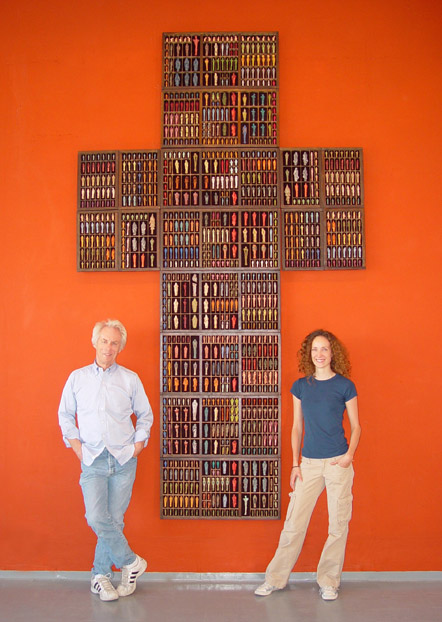
He looks like a waiter out of a New Yorker cartoon. Crisp shirt, ramrod straight back, tray held aloft on his fingertips. He wears reading glasses on a chain around his neck, makes the best wine recommendations, calls all the ladies “dear” no matter what their age, and sports a wild, white mane of hair. No wonder he’s the most popular server at La Belle Vie.
In fact, Mark Roberts may be one of the most popular, oft-requested servers in town. He is that quintessential pro. And very few of his regular customers know he’s also a nationally-known photographer and protégé of Ansel Adams; a former concert pianist; and the 1970s-era art gallery owner who helped Hollywood’s Steve Martin acquire his personal collection and gave Annie Leibowitz her first Twin Cities show.
They likely wouldn’t guess that he didn’t start waiting tables until he was well into his 40s, after he went broke because his string of one-hour photo labs in the Caribbean was wiped out by a freak hurricane. Or that he was fired from his first restaurant job for knowing absolutely nothing about food service.
Most of the people sitting in the dining room at La Belle Vie don’t even know that’s his art hanging on the wall.
I first met Roberts in the St. Anthony Village home of Jack Hunt, owner of Billman-Hunt, our region’s only remaining independent funeral home.
I was there to interview Hunt about his religious paintings and his audience in Rome with Pope John Paul II. We were standing in the living room, looking at a set of ancient triptychs, when Roberts sauntered through, shirtless and barefoot, still rumpled from bed, walking across a room crowded with statuary to the bathroom where he kept his favorite set of drums.
Hunt rolled his eyes. “It’s only Mark,” he said, as if that explained everything. Later, Roberts came out, midway through pulling a shirt over his head and sat down with us. The men explained to me that they were former business partners and friends, that Roberts had only just arrived back in town after a surfing hiatus in Miami, and that he was staying with Hunt while he started a job at the newly relocated La Belle Vie.
“So you used to be a mortician, too?” I asked. And they both laughed.
Roberts was born in Carmel some time during the World War II era — he won’t say how old he is now, only that he’s in his mid-60s, “leaning” toward 70. As a child, he was a gifted piano player, and by the age of 14, he was on the road, giving concerts all over the United States. Often, he would stop in Minneapolis on his way cross-country to visit his godparents. He loved music but hated performing.
“I would be sick for three or four days before every concert,” he says. “Even after I played, I’d still be throwing up.”
Around the same time, his next-door neighbor, a photographer named Ansel Adams, asked if Roberts would like to work with him. Thinking it might help their son become more adventuresome and get over his stage fright, Roberts’ parents agreed. So in what Roberts calls “the pivotal moment” of his life, he went to Yosemite as Adams’ assistant. And there, he fell in love with photography.
He was accepted to Stanford on a music scholarship, but he took a job there as a teaching assistant for Imogen Cunningham, and — despite earning his master’s in musical performance — went on to become a photographer. Also a surfer and a real party boy. . .
He lived high: traveling, driving sports cars, buying exotic hallucinogenic drugs. But despite his love for big cities and oceans, Roberts kept coming back to Minneapolis — the place where his godparents had lived and he’d always felt safe. On one trip through in 1972, a local art dealer called Roberts to ask if he’d be willing to photograph a funeral: some family members of the deceased couldn’t make it from the East coast to see their loved one buried, so they wanted pictures.
Roberts agreed, on the condition that he could take some portfolio shots for himself — stylized profiles of the dead. He thought it might help him make his mark. A couple hours later, Hunt picked him up in a long, dark hearse.
They talked on the way to the funeral, determining quickly that they were both into art. Before the evening was over, the men had decided to open a gallery called J Hunt.
They opened with a show devoted to the work of a prison guard and painter from Duluth.