Tag: sculpture

  • Crate 1 of 2 Opened

    It’s the middle of July and the melons on the fruit stands are sweet. I see a woman in a cotton dress, its translucence making visible the form of her body under the skirt. She is lovely. She isn’t stuffed into jeans; she’s wearing a dress of diaphanous cotton, compared to which denim is about as interesting, erotically, as sackcloth or sandpaper. The dress dances in the breeze. It dances around her, with her, because of her, and the extreme feminine grace of this gets to me in the pit of my stomach. Short of carrying her off on my bike, the only thing for it is to go cool out somewhere, so I do—I go to the Minnesota Museum of American Art to look at some art.
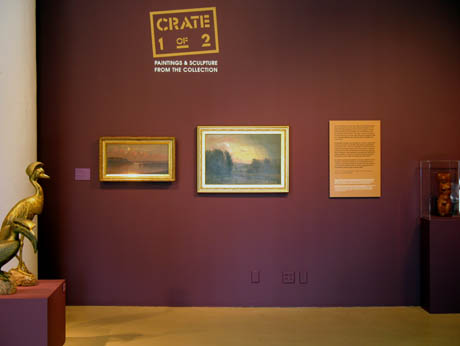
    The museum’s summer show is Crate 1 of 2, a selection of works from its permanent collection. The gallery walls have been painted a deep and luscious aubergine (that’s “eggplant” to you, pal) a color that for me evokes the vanished era of drawing rooms. I myself have never been in a drawing room, but from novels I know that they were peopled with brilliant conversationalists and beauties listening with heaving bosoms to pianists tossing off Chopin Etudes by heart. The aubergine of the MMAA’s galleries is tinged with nostalgia for that moment just before the crumbling of our civilization started picking up speed, say, a hundred years ago–before people took to saying “awesome,” and using the expression “closure” when talking about the death of their hamsters.

    Crate 1 of 2 is not a consistently great show, but it is a moving exposition of what it meant, not so long ago, to be a human making art in America. A good many of these painters and sculptors are no longer alive, and most of the works, exhumed from obscurity by the tender solicitude of the curators, are fated to return to oblivion at the close of the show. When the dead were alive, however—and this is easy to forget– they were as alive as you and I are right now, as driven by desire, as whipsawed by love and by hatred, hope and despair, innocent wonder and dreary ennui. The paint on their canvases has dried, but it was laid on wet by people not so different from us.

    Visitors to the museum sense this, I think, making their way from one work to the next like mourners slowly moving down a line to offer condolences; except that here it’s with unhurried pleasure, the way they lean in to look at a work, enfolding it into themselves, to sleep on it later. They take it in. Something is transacted across spans of time between them and the artists.

    Periods of art come as a succession of breaking waves. If you’re a full-immersion total hipster, each new wave obliterates all traces of the last. But as your own history lengthens, you see not only the next new thing and the next, you also see further back in time. One day, idly flipping through a magazine, you find yourself awestruck by pictures showing the images on the walls of the caves at Altamira and Lascaux. The past that you blew off as dead turns out to be not only not dead but more vitally alive than all the crap that’s on TV tonight. “The past is never dead,” wrote Faulkner. “It’s not even past,” a line often quoted when the present feels shaky. It keeps coming at you, each wave different but all essentially and eternally the same.
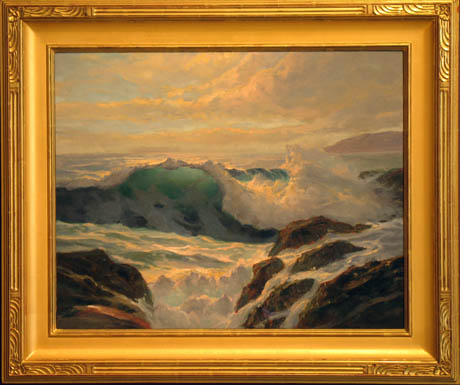
    One of the earliest and most beautiful paintings uncrated for Crate 1 of 2 is a seascape. Its focal point is a cresting wave, backlit and transcendentally translucent. The artist, Frederick J. Waugh, was so obsessed with capturing the form and movement of the ocean’s heaving swells and waves that in his long life he did something like 2500 seascapes. A photograph can nail the sea down with a click, but I don’t think Waugh painted to pull off quick raids on phenomena. I think he kept painting the ocean’s massive, surging volumes not to make the restless sea stand still but because, like his mind, it never would.
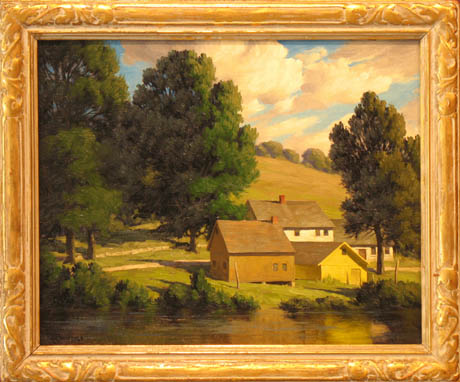
    Another early 20th century painting with the feeling of nature closely studied and absorbed before it is expressed is a farmstead scene by Bertram G. Bruestle. The light, somewhat like Edward Hopper’s, uncannily evokes an acutely particular moment of the day, not five minutes before or five minutes after. The painting is meticulous but not strangulated. Its fleeting light inflicts you with the ache of the ephemeral, the knowledge that an evanescent moment is dying even as it lives.

    A few mid-20th century abstractions are included in the exhibition, but the most interesting paintings in the show are more representational than not. William Meritt Chase’s society Portrait of a Lady,1914, might easily be mistaken for a work by his friend and contemporary John Singer Sargent. Right nearby, from 1906 and not quite so lofty, is a full-length portrait, conceivably the lady’s dressmaker, Modiste of Madrid, by one of the Ashcan school, Robert Henri.
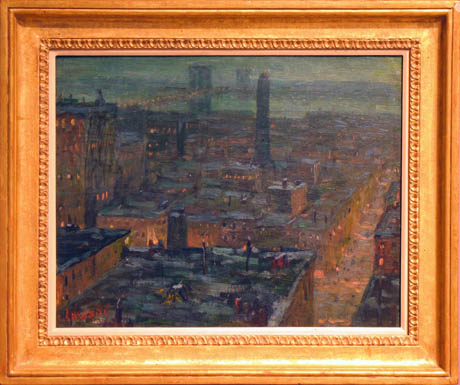
    From about the same time, but grittier, is a vivid aerial nightscape of Brooklyn by Earnest Lawson, another of the painters of the Ashcan group.
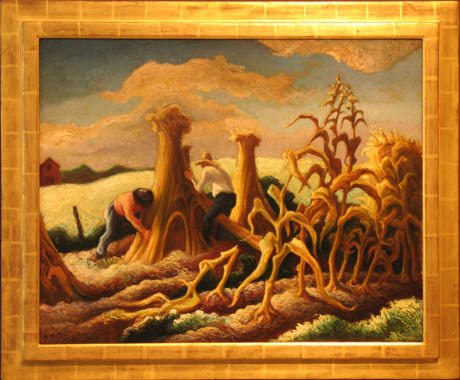
    Thomas Hart Benton is represented with a work done in his characteristically torqued perspective, 1945’s Shocking Corn, the cornstalks writhing in a way that strangely foretells the work, hardly more than ten years later, of his student Jackson Pollock.
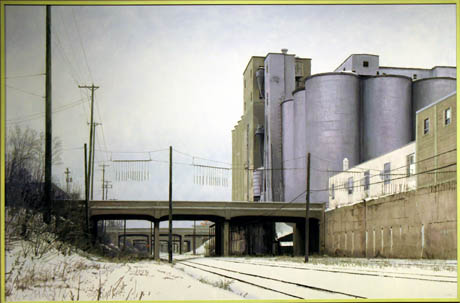
    Closer to the present and about as far from ab-ex as you can get is a large, satisfyingly bleak 1988 canvas by Minneapolis’ great master of what-you-see-is-what-you-get, Mike Lynch. The title is Elevator – 29th and Harriet. Features of this site still exist, but the scene as Lynch depicted it has since been transformed—it’s now a stretch of the Greenway. Stand on the same spot Lynch did on some cold, grey-blue day in February and, despite all that’s changed, you’ll appreciate the ethical and emotional precision of Lynch’s account of things as they are.

    Wandering in exile in its own city, occupying spaces like a hermit crab, the MMAA has had three homes since the nineties, first in the Art Deco Jemne Building, followed by a stay on the top floors of the Landmark Center, and, in the past few years, a provisional space in the old West Publishing Co. building on Kellogg Blvd, where with a shrinking staff they are valiantly continuing to produce exhibitions under tighter and tighter budgets. Too much of the museum’s collection sits in storage. No one can see it in the dark. Descending into the crypts, the curators have hauled out sculptures I never knew existed. Two of these (by Paul Manship) have the power to strike me mute, and among the rest are some that, though not great, nourish a hunger for something that’s lacking in so much recent art, something elementally human, something that doesn’t trade in irony and neurasthenic exhaustion and mistake that for cool.
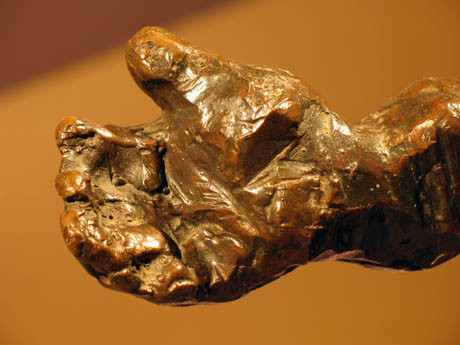
    One piece in Crate 1 of 2 that has this vitality is Jacques Lipchitz’s 1941 bronze, Arrival, a boisterous cluster of lumpy, exuberantly exaggerated human forms that pays homage to the groupings of figures in classical sculpture. At the same time, the sculptor throws off classicism’s tightassed restraint; the figures are unrepressed id, their hands meathooks, primal, like paws.

    In a similar spirit are two figure carvings in wood by John Rood, a self-taught artist, poet and
    musician who was a professor of sculpture at the University of Minnesota in the forties and fifties. One, carved from a single block, portrays a stolid and compact hardworking couple (1943) seated hunched and close together in a way that says they’re in it for the long haul. The other (1965) is a standing figure of a strongman, his muscles worn like slabs of armor. In both works, the direct, faceted carving makes you feel the force and conviction behind each stroke of the sculptor’s chisel.

    But what draws me back to this show again and again are two sculptures by Paul Manship. One of these is Briseis (1950), a work of the most naked and unaffected grace–a marble, of a whiteness and finish so soft that it is difficult to focus a lens on it. Briseis is a figure from the first book of the The Iliad, the widow of a slain Trojan. The introverted quality of her face speaks of her resignation to her fate, which is to be buffeted by the fierce contending wills of angry men. At the opening of The Iliad, Achilles is found brooding in his tent, refusing to return to battle. His king, Agamemnon, has claimed Briseis for himself. Achilles’ rage at having been made to relinquish her is the lit fuse that sets off the action. He is prevented from killing Agamemnon only by the intervention of the goddess Athena, who grabs him by the hair just as he’s about to draw his sword. Briseis is eventually restored to him. Run your eyes over this sculpture and you can see why Achilles, having been denied her, is driven nearly to murder. She is a lot to lose.

    Paul Manship was a son of St. Paul. He went on to bigger things elsewhere—the colossal, oddly awkward Prometheus that overlooks the skating rink at Rockefeller Center, for one–but he bequeathed a good number of his works to his hometown. Fourteen of them, including Briseis, are exhibited in this show. The other sculpture that gets to me at the core is his bronze, Europa and the Bull, dated 1924-1935.
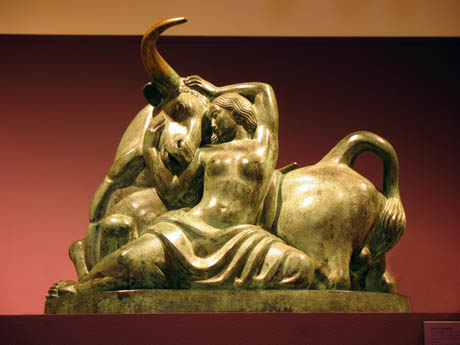
    Artists have painted and sculpted the story of Europa for thousands of years: Zeus, seeing Europa gathering flowers, is smitten. Deciding to ravish her, he assumes the form of a tame white bull, seduces her to get on his back, jumps with her into the sea and abducts her to Crete. Classically, painters like Titian and Rubens have staged the incident as a kind of water sport with a lot of accessory maidens and putti splashing about, but Manship took a different tack. He didn’t depict the scene by the shore of the sea, but the aftermath, the calm erotic satiety of the two as they rest against each other spent, pacified, content. Their quietly stylized faces, like Briseis’, are in keeping with a taste that developed in the Art Deco twenties for the symbolic devices of archaic sculpture: People are not sharply individuated, but given simplified, regular features, parallel waves of hair, the fabric of their garments draped in folds more neatly congruent than reality’s wrinkles allow. In a call-and-response of forms, the two figures in this sculpture encircle each other in love. Europa cradles the bull’s massive head—you can almost feel the gentleness of her hands on his forehead and jaw. His tongue lolls. His magnificent horns, in turn, all but embrace the gesture of her arms and protect her bared, open pose. He is on his knees, making himself smaller for her; she is splayed out, having given him all that she has. Throughout the sculpture are correspondences, the loop of his tail/the drape of her skirt; her arms/the curves of his horns; the parallel trunks of his neck and her torso, and so on, the more that you look. People go on about The Pieta, but the tenderness sculpted into the relation of the two beings in this sculpture–across species, no less—makes this the more compelling expression of love. For one thing, one figure’s not dead—they are both rudely alive. Driven by lust before lust got a bad name, I can see why Zeus carried her off. I can see why she let him.

    All photos by the author, shot with the kind permission of the MMAA.
  • Lyre

    There are certain works of art the body wholly understands before the mind kicks in with its distancing powers of disembodied detachment and analysis. In the Twin Cities, there is very little art in the public realm — in what we now call "the commons"– that does this. Most public art, strained through the cheesecloth of three or four bureaucracies, is earnestly mediocre, almost by necessity. Much of what wins competitions is "plop art," dutifully commissioned to meet the tithing requirement for one-percent-for-art public building projects.

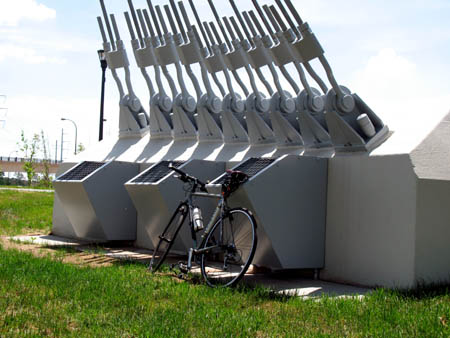
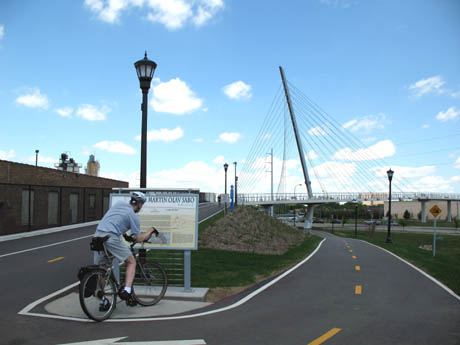
    I can think of a few exceptions –not many– where viscerally beautiful works have come to see the light of day as public art despite the pitfalls of the commissioning process. One of them is the Heilmaier Memorial Bandstand, by the artist and architect James Carpenter, the bandshell with the saddle-shaped roof of glass on Raspberry Island in the river off downtown St. Paul. Another (right nearby, actually) is the powerful "Floodwaters," the roiling torrents of cast bronze flanking the southern gateway to Harriet Island Park, by Jeffrey Kalstrom and Ann Klefstad. Yet another, a work beautiful against all odds, is one that was never primarily intended as sculpture but turned out to be more compelling to the senses than many things currently called that. It is the new Martin Olav Sabo Bike and Pedestrian Bridge that spans Hiawatha Avenue and the light rail tracks adjacent to it, just north of 26th Street in south Minneapolis.

    The Sabo Bridge, named in honor of the congressman who secured federal funding for the project, is of a type known as a "cable-stayed bridge." Although they employ cables, the mechanics of cable-stayed designs are different from those of suspension bridges like the Brooklyn or the Golden Gate. A display panel on the bike path’s western approach to the bridge explains the design principle. From an engineering standpoint, a cable-stayed design presented the most elegant solution to the problem of spanning six lanes of traffic and two sets of light rail tracks without having to resort to intermediate support pillars in the middle of the road. The design wasn’t imposed on the site; it was inspired by the site’s constraints.

    The first time I saw the bridge was when I drove under it one evening at dusk a few months before it was completed. Its structural logic made itself understood on first sight. I felt it right away in my bones, sensing the forces working through and upon it the way people sense the rightness of the lines of a boat. Every one of the elements, the incredible back-bent mast, the deck, the fanned-out cables, the backstays converging onto bulwarks rooted deep in the ground, gave expression to the insight of the biologist D’Arcy Thompson that "structure is a diagram of forces." The bridge’s structure correlates with something internal, with one’s felt understanding of the structural mechanics of one’s own body. The sensation of it being in some way analogous to the way you yourself are put together tempts me to call the bridge a work of figurative sculpture-abstract, but nonetheless a human-figural representation of the forces and counterforces; metaphorically, of a tug-of-war; a stevedore hoisting a pallet aloft with a block and tackle, a puppeteer, a fisherman casting a fly. It is what it is –a bridge– but it triggers a chain of associations. It arouses the imagination in ways that few works of public art seem able to do, inert with virtue as most of them are.

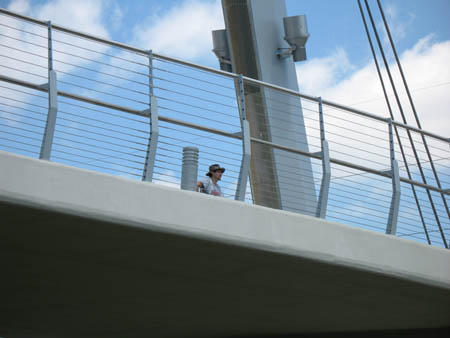
    Call it a bridge or call it a sculpture, the new Sabo bridge is an inspired work, a piece of lyric engineering in the tradition of such masters of structural music as Santiago Calatrava, Pier Luigi Nervi, Eero Saarinen, and Frei Otto. Its elegantly tapered steel mast, backbent at an angle almost equal and opposite to the angle of its massive, similarly tapered concrete footing below the bridge deck, is a form sprung from the soul of Brancusi. The bridge is a stirring sight as you approach and go under the deck by car or light rail, and it doesn’t disappoint up close, when you walk or ride a bike over it. It is lovingly detailed: the workmanship in the steel and concrete is rigorous and clean, the care of the contractors readable in the panoply of the hardware, in the tensioning turnbuckles, tie rods, and railing cables, in the dramatizing spotlights mounted alongside the protective rubber boots on the ends of the bridge cables where they connect to the deck, in the backstay cables as their sinews converge in massive connectors to the concrete footings on the ground below.


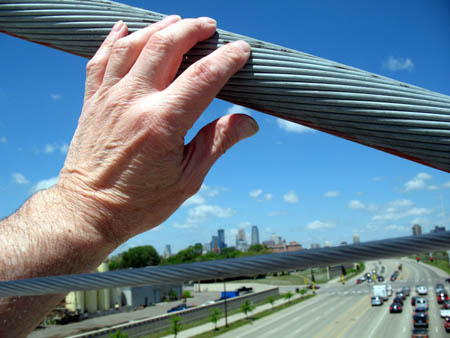
    Cyclists in colorful gear flash across the bridge like shuttles of a loom. The balusters of the bridge railings are shaped with a bend like the mast’s. The railings themselves—the thin tension cables that pass through the balusters–are like the lines of a musical staff. They make the balusters read like the bars on a musical score, and a little like the frets on a stringed instrument, which in a way this whole construct is. The bridge is a lyre, a harp strummed by the wind. Reach over the railing and touch one of the cables that hold up the span. You can feel it thrum.

  • Pavane for a Dead Sculptor

    The melancholy in the eyes of the gorilla imprisoned in the zoo, I think it is real. He is confounded by the loss of his freedom. He sorrows at what his captors have evolved into.

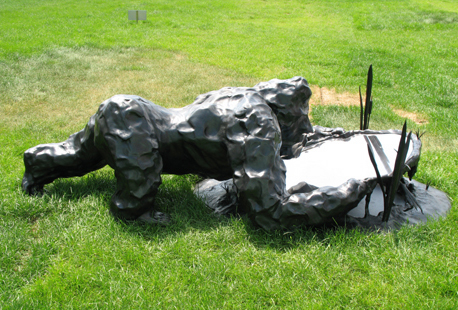
    Minneapolis has two life-size bronze sculptures of gorillas by the late British artist Angus Fairhurst, who this past March committed suicide by hanging himself from a tree in a forest in England at the age of 41. One of them is in the courtyard of the Chambers Hotel at Ninth and Hennepin; the other is sited on the green outside the west window of the Walker Art Center.

    Fairhurst had a gift for imparting a brusque and powerful animality to clay, pressing life into it with his palms and his thumbs, building the figures in a way that I think gorillas themselves might do it if only they could. The bronzes are empathic. They make me feel what it is to be a gorilla, thickly stupid in some ways, surprisingly intelligent in others–not that different, in other words, from the condition of being a man. Now they are husks, all that’s left of Fairhurst’s struggle to inhabit his own body, a beast that in the end he could only subdue by choosing to kill it. No one can presume to say why.


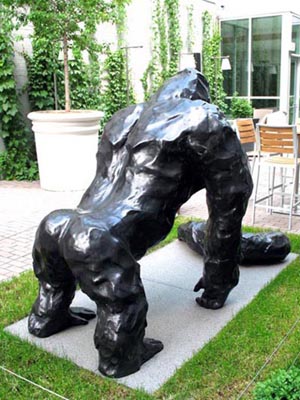
    The gorilla in the Chambers courtyard is cordoned off and hemmed in by chairs and tables on all four sides. Fairhurst titled it, "A Couple of Differences Between Thinking and Feeling." The figure stands gorilla-style, the weight of its massive torso supported on the knuckles of its right hand as it gazes down upon its left arm, which–it is a shock to see–lies severed on the ground before him, lopped off like the limb of a tree. Looking at the gorilla’s face, it’s impossible to plumb what he’s thinking or feeling as he contemplates this part of himself that is no longer part of himself: Unspeakable pain? Detachment? Perplexity? Incomprehension? It’s hard to say, and, unable to cross the threshold of speech, he can’t tell us either. He isn’t even a faithful replication of a gorilla. The way the clay was worked, kneaded and pressed, formed into lumps and concavities, the surface doesn’t look anything like the hirsute coat of a gorilla. It’s closer to something like scar tissue or wads of putty, melted wax or clumps of tar. Every passage in the sculpting of it is evidence of an impassioned and playful hand, but the piece, in tragic retrospect, speaks of a man amputated from his own hope of connecting, the discounted instrument of his grasp lying inert on the ground.

    Crouched low on the lawn outside the Walker is Fairhurst’s other gorilla, this one rapt by the reflection of its face in a pool. His monumental hands grip the edges of the simulated pool of mirror-polished stainless steel as if to prevent the image from escaping his grasp. Every vector of his body says that his eyes cannot drink enough of what they see. Avid for the image, his body is tensed and alert-parallel to the ground but hovering over it like its lover, his whole force straining towards the object of its fascination, one leg advancing as though thinking of entering the pool.

    What does he see? His head is so close to the mirror that unless you get down on the grass to look up into his face you cannot see his eyes, only their reflection in the mirror facing the sky. The gorilla in the Chambers courtyard has no eyes to speak of; just sockets, almost as though he is too dim to have a pair to see out of. But this one, titled "The Birth of Consistency," sees, and is transfixed-it could be with horror, it could be he’s seeing the birth of Comedy, we cannot be sure. He is in the throes of the revelation of what is to follow, the next stage, the stage that will lead to us. Narcissus puts his lips to the pool; the image trembles, dissolves. Before he left this life, Angus Fairhurst cast in bronze all his longing to be one with it. It is a pity he is dead; until he stared into one too long, he was a mirror to the world.

  • First Place Winner for Most Original Sculpture

    1st place winner for most original sculpture:— 2007 Minnesota Celebrity Butter Carving Contest:

    Every year I participate in a week’s worth of events at the Minnesota State Fair, and granted, the Fair is not until August, BUT I figured this year I should get a jump start honing my skills so I can shoot for the Gold in the AGRI-OLYMPICS.

    It started several years ago when I was a sidekick on KS95’s morning show. My two partners at the time, Rob and Mark, thought it would be fun to nominate me to participate in the Celebrity Cow Milking Contest. "Yeah, let’s get Princess Melinda to walk through the fair in her fancy shoes and see if she can Milk a Cow in front of a live audience."

    "No problem, GUYS. I am up for the challenge," I thought to myself, "but first I am going to require some practice." So I went into the Moo Booth and asked a very cute dairy farmer if he would help me learn how to milk a cow.

    Two hours, people! I spent two hours with my new best friend (Steve) from Albert Lea, learning the proper techniques to milk a cow.

    Lights, TV cameras, and a few drunks in the audience all focused on me for one whole minute (on the official clock), and my lessons paid off. I filled that bucket almost right up to the top, even though my cow decided to use my pretty shoes as the perfect spot to relieve herself.

    Unbelievable! All the D-LIST celebrities took their turns, one by one, squeezing their cows to get more milk in their buckets, but nobody was going to beat me.

    All of us Media types got so competitive, that Rusty Gatenby and Joe Schmidt actually starting using their cow’s teats as weapons
    against each other.

    Had everyone stopped yanking and squeezing the teats so hard and taken the time to learn the proper way to milk a cow (making an OK sign with one hand and massaging the milk down), perhaps they, too, would have had a shot.

    Long story short… For six years straight I was the crowned champion
    of the Celebrity Cow Milking Contest.

    Last year, though, I was off my game and came in third, so I did what any person would do to regain the admiration and respect of my peers: I entered the 2007 Celebrity Butter Carving Contest, using my good buddy TONE FLY as my inspiration.

    Let’s see… How do I carve a work of art — a portrait of T, as I call him — with a plastic knife?

    After studying his bald head and facial features, I had the perfect idea.
    I went to Walgreens and picked up a Mr. Potato Head kit, grabbed a pair of my diamond hoop earrings, cut off a chunk of hair from my Hair Extensions, threw in one of my old sets of fake lashes,
    found a little airplane from one of my son’s old boxes of junk, and created the 1st place award-winning butter sculpture of 2007.

    Well, actually, I got first place in the most original category.
    The real winner was Princess Kay of the Milky Way, whose creation got a standing ovation.

    For the next three months I will be working on butter sculpting techniques in hopes that I can both redeem myself in the Cow Milking Contest and sculpt something that will earn me the title of not just "Most Original Butter Sculpture" but also "Hardest Working
    D-list Celebrity in the 2008 Minnesota State Fair Agri-Olympics."

  • Cherry on a Spoon

    What she didn’t understand, Miriam thought, what she really didn’t understand was this stupid cherry on a spoon. The huge sculpture sat there in its lake, its bright red cherry poised happily on the grey spoon-bowl’s ridge, a symbol of Minneapolis. What about it excited people? What, exactly, was the point? She sat on the grass by the pond, head tilted upward, mulling it.

    Miriam was a museum studies major, although she had started college doing studio art. During that long first year, she spent more time in the art supply store than actually making art. She loved to touch the taught canvases and read the names of all the colors of paints. Ochre seemed to promise sex, cerulean undiscovered planets-every object was expectant, waiting. But when she set up an easel in her room or in class, the brush made primitive, directionless marks, unresponsive to her oblique desire to paint something. In the hours just before an assignment was due, she would chew on the dead ends of her long brown hair or the handles of her wooden brushes. Finally, she understood why someone might throw a bucket of paint over herself and then run hard into a wall one hundred times.

    But self-abuse wasn’t art.

    When she expressed that opinion in her art history seminar-having by then cut her hair into a blunt bob and changed her major-the professor shook his head. “What, then, is art, Miriam?” Allowing a short pause, he then pressed the forward button on the rickety slide machine with greater than usual verve, as if having made his point.

    If self abuse was art, Miriam had thought, freshman year of college had been a post-modernist masterpiece of cheap keg beer and dubious sexuality, encapsulated in the nickname that still made some of her old friends laugh. Before learning about “Black-out Sniper,” Miriam had never thought about her liaisons buffered by alcohol and darkness as being anything but normal-at least normal within the realm of freshman year. At parties everyone was drunk and looking, scanning dimly lit, crowded rooms with hopeful and later glazed eyes for another pair of eyes with the same idea. Every tasteless poster on her guy friends’ walls validated that practice. Beer Goggles, one read, getting ugly people laid for fifty years! She was under no illusions about her appearance, and was in fact more critical of herself than anyone else.

    She reminded herself of a painting by Goya; her face pale, eyes big, chin receding just a little, like those inbreed Spanish aristocrats. Arrested by her face, people were often surprised by the solid, almost voluptuous frame that contrasted sharply with the fragile tint of purple under her eyes.

    The cartoon man on the poster gave her the thumbs up and smiled, holding his frothing pint out in a gesture of toast. Go for it, he seemed to say. So how could she be doing the wrong thing when, drunk at a party, if she met someone she liked, she stuck with him until the party was dying down, and, if he was willing, took him back to her dorm room? It was true, the guys she picked up usually turned out to be way more intoxicated than her, having proven their manliness by doing beer bongs and 40’s, and they rarely remembered her the next day. But that suited Miriam just fine-they had both gotten what they wanted, after all, and it wasn’t like anyone was watching.

    Or that was what she had thought. As she was leaving a party one Saturday night, a drunk friend grabbed her elbow and whispered, “‘Black-out Sniper.’ Get it?” For a moment, she didn’t get it. She looked around her, trying to figure out what her friend was talking about. The she turned to look at the boy she was with-his drunkenness was suddenly far more apparent. Miriam felt nauseous as the heat of embarrassment mixed with the alcohol in her stomach. She left the boy standing by the door and fled to her empty dorm room, her eyes burning and itchy from tears she wasn’t yet shedding. In the silence of that night, as the alcohol wore off, Miriam’s emotions moved from shock and embarrassment to shame to anger and indignation, then back to shame that felt like anger until the emotions couldn’t be distinguished. That she should have to feel this shame was more than a betrayal of privacy. It was a betrayal of the mantra, the promise, that had helped her, helped them all, get through high school. The promise that when they got to college, the holding back, the fear of discovery, the claustrophobic family dinner table at which nothing could really be hidden, would be gone. No one would be watching them anymore.

    But people were still watching.

    Exhausted and still awake as the sun came into her dorm room window, Miriam decided that she was done. Done with college boys who couldn’t handle a woman taking what she wanted without becoming a needy mess afterwards; done with girls who called you a whore if you tried. After that party, Miriam stopped hooking up with guys and stopped drinking anything except for good wine. After all, she reasoned, she couldn’t be in the art community without learning to like good wine and despise the swill served at openings.

    Miriam had left freshman year and the Black-out Sniper behind her, but she was still of the opinion that if you waited for a man to make the move, you would end up watching hundreds of fucking piano concerts and contracting cancer from second hand smoke in shady music venues. That was why she had sat down on Jason’s piano bench, and why she had held his hand in the light rail, and why she had finally suggested that they move from the couch to the bed.

    Jason. He was probably still sitting in the coffee shop with a stupid look on his face, his forgetful fingers clutching his coffee mug.

    Her eyes filled with angry tears and she was back in the sculpture garden.