Year: 2005

  • There Was Nothing Wrong With His Life, Really

    hand wi 11.JPG

    He’d sit up in the darkness staring across the inlet at the lighthouse on its pile of rocks, tossing its feeble light out into the fog rolling in off the lake. It was a ridiculous and hokey metaphor for exactly where he was in his life, but, what the hell, it was oddly comforting.

    The Charley Patton, the Robert Johnson, the Skip James records, they sort of cancelled out the lighthouse, but that was the way he lived in the world; that was how he did things and tried to keep the darkness and light of the world in proper proportion.

    For at least twenty years, since the first from his ever shrinking circle of friends and acquaintances started dropping dead from cancer, he fretted his way to the butt-end of every cigarette. Something was growing in his lungs; there was some persistent corrosion in his throat, a tightness in his chest. That nonetheless didn’t stop him from working nervously through his pack a day.

    There was nothing wrong with his life, really. The things that had happened to him and the things that would happen to his body were things that happened to all sorts of people all the time. Plenty of people had it a whole lot worse, he knew that.

    Yet it was an American’s particular prerogative to be miserable when there was really not that much to be miserable about. There was no form of self-pity that could not be romanticized, justified, and otherwise celebrated. That was why he loved the blues; it was so thoroughly American. European music might be tragic, might be romantically tragic, but the blues were full of the vaguest, most saturated sorrow, full of fear and pure, plain, fucked-up self-pity. They made that lighthouse feel like nothing more than the sad, distant metaphor it was, and most nights he could imagine himself crawling through the darkness for days, for months, fumbling his way toward that light, or praying for that light to find him, but somehow never quite managing to get there.

    And there was no getting around it: he loved that warm, woozy feeling of drifting in the darkness, just as he loved knowing that the light was out there across the way, vigilant, there not as welcome but warning, a beacon whose job was to push him further out to sea.

    hand wi 3.JPG

  • Bees, Chanting, Etc.

    holy ghost 10-2.jpg

    Ruckert lived across a pasture from an order of monks who were famous for their gingerbread, their honey, and their singing. They’d supposedly sung at the White House once upon a time, and had made a few records. The had an orchard out behind the monastery, where they kept their bees, and Ruckert often saw the monks over there wandering around in slow motion in their bee outfits.

    Summer evenings Ruckert would sit out on his porch drinking beer and watching fireflies drifting around out in his pasture. On many such evenings the monks would throw open their doors and windows and the sound of their singing would travel for great distances in the countryside.

    Tormented as he routinely was in those days, the singing of the monks experienced in this manner never failed to give Ruckert a warm burst of uncommon pleasure.

    The autumn changing of his storm windows was always a harbinger of Ruckert’s annual onslaught of severe melancholy. He knew that from that day forward, until traditionally the first warm day of spring, he would be locked away from the music of the monks and their languid dance with the bees.

    On very rare occasions in the dead of winter, however, Ruckert would hear the faint murmur of the singing monks as he dashed back and forth from his car in the driveway.

    In the almost ten years he had lived across the pasture from the monks, Ruckert had never exchanged so much as a word with a single one of them, even as he lived with the constant fear that one of them would someday escape from the monastery and show up at his door seeking asylum.

    holy ghost 15-2.jpg

  • Off-Season's Greetings

    I’m trying to crawl back into baseball, which essentially means crawling from the wreckage of last season, when various nagging injuries cut the year short for me and led to disappointment and then flat-out indifference.

    I’ve never in my years as a fan had a season like 2005, and I’m hoping that it was nothing but one of those inexplicable mid-career hiccups that you see so commonly in the statistical line on the back of so many baseball cards.

    The ruptured spleen that finally shut me down for good in August appears to be fully healed, and the doctors have given me the go-ahead to resume rehabilitation in earnest.

    Warning Track Power has long been the engine that drives Rake Media Worldwide, and I deeply regret the toll my absence has taken on my co-workers, many of whom have lost their jobs or been saddled with extra responsibilities as the advertising revenues generated by my labors have slowly evaporated. Back in late October, the company health club and juice bar was temporarily closed, and let’s just say that I wasn’t exactly unaware of all the fingers pointed squarely in my direction.

    I’m not making excuses, but, frankly, that’s created a lot of pressure on me during my long hiatus, and I’ve no doubt there’s been a great deal of grumbling behind my back about my work habits and desire. I certainly can’t blame anybody for thinking that I’m a malingerer on the level of a Juan Gonzalez.

    I’m not, though, I swear to you. I’ve just had a few bad breaks of late. I honestly feel like I’ve still got a few good years left in me, and if I have to go to Japan –or even the Northern League– to resurrect my career, so be it.

    For now, though, here I am, trying to climb back on a slow moving mule.

    I know that an awful lot has happened while I’ve been gone, and I regret to say that I have only the vaguest of ideas of what that “awful lot” might mean.

    Since I’ve emerged however tentatively from my hibernation, though, I did notice that the Yankees signed Johnny Damon, which was an unpleasant and disheartening bit of news. I don’t tend to like grown men whose names are Johnny, unless their last names are Carson or Cash, but Damon was a fun player to watch during his time in Boston. He’s also, though, always been something of an enigma to me. I have a hard time understanding how a guy with a career on base percentage of .353 scores so many freaking runs and has a reputation for being such a terrific leadoff hitter. Damon will be thirty-two this season, and his career numbers across the board (a BA of .290 and slugging average of .431) are nothing really special. I suspect that now that his hair is gone and he’s no longer playing half his games at Fenway Park –with Manny Ramirez and David Ortiz batting behind him– he’ll become the latest Yankee free agent bust.

    I also noticed that the Twins went on their traditional spending spree and added Luis Castillo, Tony Batista, and Rondell White. Each of those guys could fill some holes or, given their histories and the recent good fortune of the Twins, create some holes.

    I like Castillo quite a lot. He’s a terrific defensive player (with three Gold Gloves), but his primary offensive value is his OBP (.391 last year in 122 games; .370 for his career). He’d score a boatload of runs batting in front of Manny Ramirez and David Ortiz, I’d bet that much. The main problem with Castillo is that he was gimped up for a big chunk of last year and apparently no longer runs well. The guy has hit .300 four of the last six seasons, yet he hasn’t managed to leg out twenty doubles in any of those seasons, and he has almost no power. Given the Twins’ success in driving in base runners last year, I’d have to say that the value of a singles hitter who plays good defense is somewhat questionable, at least until the team develops some real run producers from the 3-5 spots in the batting order.

    Rondell White could be one of those run producers, I suppose. White’s a good hitter, but he’s been injury prone. The Twins will try to keep him on the field by using him as the DH, but he’s not a particularly fearsome designated hitter. In his thirteen seasons in the Major Leagues, White has never driven in or scored 100 runs. He’s never even driven in ninety runs, in fact, and he’s never hit thirty homeruns. He’s averaged something like 120 games a season over his career, and played in a total of 218 over his last two seasons in Detroit. They guy has played for six teams in the last five years, and I always assume there’s some good reason for that.

    Tony Batista might be the acquisition that’s led to the most rolling of eyes among fans, but I’m not entirely sure why that is. Batista played last year in Japan, but in the preceding seasons he was the closest thing to an offensive lock that the Twins have had in years. His track record says he’ll stay healthy (in the five years before heading to Japan he played in 157, 161, 161, 156, and 154 games and averaged over thirty homers a season). He’s still only 32 years old, and in his last season in the majors, with Montreal, he hit thirty-two homeruns and had 110 RBI. Batista isn’t going to hit for average (he’s a career .251 hitter) and he’ll get on base as infrequently as Luis Rivas, but he’s at the very least proved that he can hit the ball out of the park and drive in runs, and I’d think that would be plenty of cause for optimism among Twins fans.

    The moves that the White Sox have made should not, however, be cause for much optimism among Twins fans. I’ll admit that I don’t even know all the moves the White Sox have made, but I do know they signed Jim Thome (and re-signed Paul Konerko), and that is dispiriting news.

    The only silver lining there is that Rick Reed is no longer occupying a place in Minnesota’s rotation, so we will at the very least be spared the spectacle of watching Thome launching Reed’s pitches off the tarps in the upper deck.

  • On (Off) the Air

    I’m away from the desk this week. In all the sturm und drang of Christmas–I understand there’s a war on it–I failed to mention last week that I had a local radio appointment you might have been interested in. Anyway, I had a delightful time yesterday hanging out with the gifted and gorgeous Kerri Miller at MPR’s midmorning program. I was the local lightweight on an otherwise auspicious panel of commentators. The subject was the year in media–which of course is a huge subject that got boiled down to the Valerie Plame/Judy Miller story, the Times phone-tapping story (why’d they hold it for a year?), the Post’s “black sites” story (why’d they decline to locate any?), and Kurt Eichenwald’s putative Pulitzer for his Times story about online child pornography (why’d Jack Shafer have a problem with it, and why won’t anyone be his friend at this vulnerable time of the year?).

    So much to cover, so little time. Anyway, you can listen to us barely scratch the surface here. I’d direct you to pay special attention to the comments of Alex Jones, who has some eloquent old-school things to say in these complex times, especially about “competing values systems” (confidentiality versus truth; impartiality versus justice; personal interest versus national interest).

    Also, watch the Minnesota Wild. They are ripping up the ice, and finally getting the bounces they deserve. See you next week.

    Also, new issue out today in the real world. We hope you enjoy it.

  • Listen Up, You Little Nippers

    There was a time, believe me or don’t, when machines didn’t have memories. They opened cans, maybe, or suctioned dirt from carpets, and that was plenty wonderful. We were happy as fucking clams when we no longer had to trudge out to a shed in the backyard to relieve ourselves.

    And put this in your pipe and smoke it: There was a day in the not so distant past when there were no malls in all the world, children.

    Every year they still let Mary go into any school in America to give birth to the Christ child, and I can for damn sure tell you that no teacher ever told us that it was possible to have sex standing up.

    There was none of this nonsense then. Oh, there was plenty of monkey business that could get a fella’s goat, sure, but there wasn’t this wall-to-wall horse hooey that you run into everywhere you turn today.

    The Sears holiday catalog represented desire’s vanishing point, the place beyond which no child would dare dream, the last frontier for Christmas wishes. Whatever a kid could want or imagine was in that catalog, and there was no point in getting greedy. Santa Claus would bring you whatever the hell he damn well pleased, and you were lucky if he bowed to a single one of your true desires.

    The Sears catalog was nothing, really, but a fat book of pornography for children, and the holiday was about desire and anticipation and disappointment. That was just the way the world worked, like it or lump it.

    It’s still the way the world works, of course, but plenty of you greedy little bastards apparently don’t get it. I can assure you that your version of disappointment is a trip to Disney World compared to the version experienced and felt so keenly by the elders you treat with such disrespect and ingratitude.

    Good lord, most of us didn’t get squat for Christmas.

    One year I got some socks, a pair of underwear, a little felt bag of marbles, some pencils with my name stamped on them in gold lettering, and a candy cane. Those pencils, now that was thrilling. Seriously, they were quite the treat.

    I’ll ask you to think about that for awhile.

    I’ll ask you to imagine that.

    ponygirl.jpg

  • Easter On Christmas Eve: The Return Of Uncle Jumbo's Playground

    uncle jumbo-7.jpg

    –Illustration by James Dankert

    Here’s a new wrinkle in the gray, clanging days before Christmas: Uncle Jumbo has been playing miserable pet store Santa Claus, wrestling squirming cats and dogs and even the occasional bird or lizard in my lap while a wrinkled and alcoholic little temp-pool elf tries to snap photos for somebody’s sad little Christmas card. Pity the poor bastard who finds himself on one of these people’s mailing lists.

    What a way to ruin somebody’s holiday season. Last weekend I spent forty-five minutes trying to balance two very confused greyhounds on my lap. Try it sometime.

    It’s all a sad story, but here’s the short version: I got fired from my hotel van gig for general off-season misery and an attitude unbecoming of a shuttle stooge. It’s the third time I’ve been canned from the same job, and they’ll eventually come calling again when they realize once more that this world is not exactly full of people who A) have a valid drivers license, B) a clean driving record, and C) actually want to drive a hotel van. Ninety-nine out of a hundred applicants cannot put an honest check in any of those boxes, and I will eventually get my job back, attitude or no attitude.

    Meanwhile, I toil and suffer through the baseball off-season, muttering through every day and nurturing a tator tot addiction that has reached alarming proportions. Or maybe that should be portions. I am putting away a pound of tator tots a day, and last weekend found myself driving to the Rainbow at two in the morning for a new bag. I’m not proud of myself.

    The Santa Claus thing is of course a very temporary mistake, but I have very little patience for job hunting, involving as it does initiative and ambition, qualities of which I am in very short supply. Until of course it reaches the point where it involves desperation, something which I can generally muster in spades, and at which point I will very reluctantly agree to wash dishes at Old Country Buffet.

    I would love to be a different person, I really would.

    God don’t make no junk, my mother likes to say, which is of course nonsense.

    Oh well. One of my goals for this off-season was to find a bowling alley I can depend on, which is not as easy as it might seem. I enjoy bowling, but the problem is that I don’t like to have people watching me while I bowl. That, and the fact that I like to have access to a good hamburger while I bowl, has made it difficult to find an alley suitable to my needs. Plenty of the bowling alleys around town serve up a good hamburger, but most of them are crowded with people who are either good bowlers or loud bowlers. I can’t stand either type, and because I pose something of a spectacle when I do bowl and attract gawkers, I am forced to either stay home, or to venture out to one of the mammoth lanes in the middle of the night when the kitchen is closed, and I am unable to get a hamburger. The only thing I ever envied about Elvis Presley was that he had his own bowling alley and a cook at his disposal.

    This morning I’ll be going down to Blooming Void to spend Christmas with my mother, staring at her creepy little fake tree bleached blue by the years and strung with patchy tinsel. My brother has a family now, and every year they find something better to do, so it’ll once again just be me sitting there on the couch eating peanut brittle and listening to my mother wheezing through Christmas carols on her Lowry Genie organ. When she goes to bed I’ll sit up half the night watching videos and beach volleyball and horror movies and whatever else the third-rate little cable system they have down there manages to suck out of space.

    Down there in Blooming Void they still show David Lee Roth and Billy Idol videos late at night. “David Lee Roth,” I’ll think to myself while nursing an egg nog, “The kind of guy who wears a silk scarf swimming in the ocean, that lucky, shitty bastard.” If tradition holds I’ll fall asleep on the couch and drift into a recurring winter dream: I’m in a large abandoned office building, standing at a urinal in the dark, my forehead resting against the cool tiles on the wall.

    Through the giant windows on all sides of me a city stretches away in darkness, punctuated here and there with random displays of blue Christmas lights. Stringers of blue lights dully glowing from the eaves of dark houses and the skeletal trees along the boulevard. Hardly a moon over the world, and not a star in the sky. Nothing moving anywhere. Clouds of gray heat boiling from chimneys and squatting on the neighborhoods.

    Then, from somewhere far below me, I hear a large choir singing “Take Me Out to the Ballgame,” the most mournful version I have ever heard, or ever hope to hear. The singers sound like people trapped in the bowels of a sinking ship, holding hands, waiting for the water to find them.

    And when I wake up it will be Christmas morning, and the world will have made its first turn out of winter, and my heart will begin its real straining out of the darkness, jogging towards the light, toward Spring Training.

    And that, to me, is the real meaning of Christmas.

  • Christmas Eve

    christmasgreetings.jpg

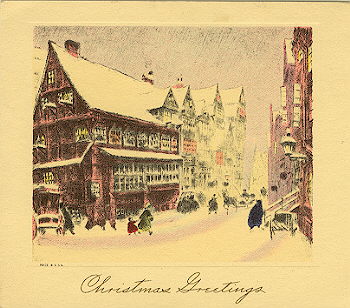
    Those soft, colored lights that make such a comfortable compromise –almost a real peace– with the darkness. The shiny glass bulbs and talismans that have the power to both cradle light and build tiny fires from memories that are almost lost.

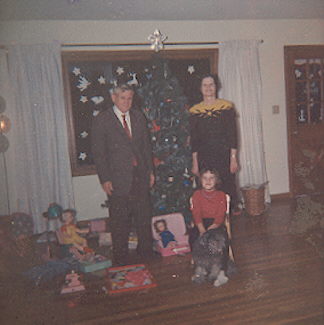
    The warmth from those fires is powerful out of all proportion: a window, a door, a looking glass through which you can catch glimpses of the child you once were, rising each morning of this season, alive with wonder and anticipation.

    The smell of that tree is another gift from and to your memory, one more reminder of how keenly you could once hope (and can still hope) and how much you were once willing (and are still willing) to invest in that hope. A happy smell that’s hard-wired and tangled up in your skull with all the damage and darkness and bands of still startling light.

    There’s an empty corner now where that tree should be, yet it stands there glimmering all the same when you turn out the lights, and in the morning you could almost swear you can smell it. After forty-four years your head can still manufacture that smell, can still produce an almost comforting composite of all the predecessors of your invisible tree.

    The stockings that are not hung from the mantle are still hanging from the mantle. The dog that is not curled up near the bottom of the tree is still paddling in his sleep near the bottom of the tree, under which there are still presents waiting to be opened. There is still a carton of eggnog in the empty refrigerator. There are Christmas cards in the mailbox that has received no Christmas cards.

    All those church bells that no longer exist and no longer ring, tonight you will hear them ringing in the darkness, ringing out all over town. In your dreams, at least, the animals will still kneel, will still speak. A promise will be made and a gift acknowledged. In the darkness outside of town, along gravel roads beside snow-covered fields, you will still see stars tumbling down the sky.

    And if there is no cake at midnight, so be it. You will still have your frosting, and still recognize it with gratitude.

    You will eat your frosting out of a can, with a plastic spoon if need be, or with your fingers, and through some miracle that is as much a miracle as any other your heart will still feel full to the point of bursting.

    christmasfamily2.jpg

  • The Santa On Sixth Street

    christmasnorling.jpg

    Irwin Norling

    My grandfather played Santa Claus for more than twenty years, purely, I liked to believe, out of the goodness of his heart. His annual ritual was completely a volunteer effort and a solo undertaking.

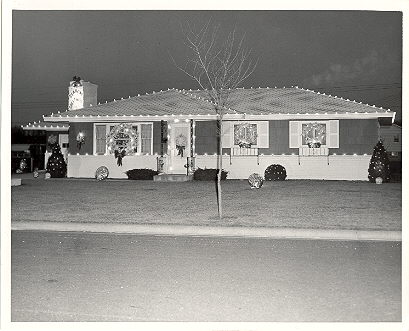
    This was in a small town in the Midwest, and every November my grandfather would build a tiny candy-striped cottage in his front yard. In the evenings in December he’d sit out there after dinner waiting for the neighborhood children to stop by.

    My grandmother played a plump and largely unenthusiastic elf for the first several years of her husband’s long run as Santa Claus, but she eventually expressed the opinion that the experience was depressing and ruined a perfectly good holiday. My grandfather soldiered gamely on without her. He was a rail-thin Kentucky native with a pronounced twang and eccentric habits (including a crackpot streak that compelled him to write regular, not entirely coherent letters to the local paper) that had long made him an arms-length stranger to most of the people in town.

    He was working from a pretty serious handicap, then, right from the beginning, but in the early years of this annual undertaking neighborhood families seemed to get a kick out of the whole thing. There wasn’t another Santa in town in those days, so my grandfather actually managed to become something of a holiday tradition for a number of years.

    Then the neighborhood got older, and those kids who might have had fond memories of the Santa on Sixth Street grew up and moved away, and my grandfather found himself being increasingly rejected by subsequent generations. Every year there were still a few visitors, but it became more discouraging each December, and for years local teenagers had been spreading the rumor that my grandfather was a pervert.

    In reaction to this increasing indifference, every year my grandfather built larger and more elaborate Christmas displays in his front yard, hoping to capture the attention of the town’s dwindling number of youngsters. He’d actually work the entire summer building a hill right in the middle of the yard. He trucked in tons of dirt and terraced the thing carefully to avoid erosion, and the hill was eventually so large that it literally obscured much of the house behind it.

    My grandfather had a fierce and constantly evolving vision of his Santa Shack (he called it the "Castle"; it was always "Santa’s Castle" to him) that was perched atop this hill. He also imagined scores of local children, walking hand-in-hand with their parents and winding their way up the long path –"Candy Cane Lane"– to visit Santa Claus.

    Loudspeakers mounted on the roof of the shack blasted Christmas carols out over the neighborhood.

    It was this hill (and this music) that eventually turned much of the neighborhood against my grandfather, and one year the city council actually deliberated shutting him down. A young and smirking local newspaper reporter took my grandfather’s side –"Santa Claus vs. Joyless City Council"– and the story was picked up by news services and television stations all over the state.

    The town was inundated with mail, virtually all of it supporting the beleaguered local Santa Claus, and my grandfather was eventually allowed to carry on his increasingly escalating holiday spectacle. All this new attention ultimately succeeded in making the Christmas Village on Sixth Street a destination for road-tripping young ironists from all over the area.

    These teenagers –many of them clearly stoned– would drive in from towns all around, and were alleged to leave beer cans in the street and urinate in yards up and down the block. My grandfather was so caught up in this new and unexpected wave of attention that he was apparently oblivious to the streak of ridicule that was predominant in these young visitors.

    The last year I went home for Christmas I was appalled by the marked decline in my grandfather’s original, pure vision. The place looked almost perverse, part third-rate theme park, part used car lot spectacle. The actual house was now completely hidden behind the huge hill and the outrageously festooned shack that sat upon it.

    My grandfather had by this time spent several years working –or eating– toward what he considered the proper level of obesity for his annual turn at Santa Claus. There was, however, nothing proper at all about his arrived-upon corpulence. He became monstrous; his naturally thin frame was obviously ill equipped to carry so much excess weight, and he now walked with a pronounced, staggering limp and sweated profusely. I was horrified to see my grandfather in such a clear and dangerous state of mania. He must have weighed in excess of three hundred pounds, and eventually had to be assisted on his painfully labored trek up the path to "Santa’s Castle."

    That year, I noticed, two, and even three, drunken teenagers would pile onto his lap while he gasped out his congested ho-ho-hos.

    Eventually, of course, even the young ironists abandoned the old Santa Claus, and my grandfather was left with his unreliable memories and lingering fantasies.

    My grandmother had inherited a considerable sum of money some years earlier, and she reluctantly –ever more reluctantly as the years went by– allowed her husband to appropriate increasingly unconscionable sums of this money to subsidize his annual Christmas displays. The utility bills were almost too much to be believed, and as my grandfather’s morbid obesity and mounting health problems no longer allowed him to contribute anything in the way of actual physical labor to the elaborate and protracted set-up procedures, all the work had to be contracted out to local laborers.

    The city had also become increasingly tough in enforcing any and all pertinent codes, and there were constant battles with the inspectors and neighbors.

    The visitors to my grandfather’s Christmas Castle finally trickled to a very few annual regulars, mostly the confused or frightened children of the occasional local who still retained some fond memories of their own childhood visits to the eccentric small-town Santa.

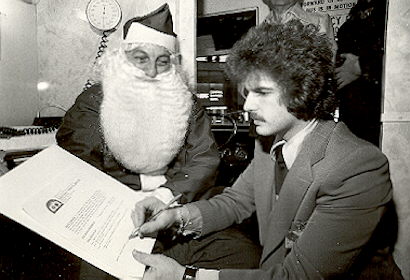
    Most evenings in December my grandfather would sit alone in his shabby Santa suit in his little shack on the hill, listening to Andy Williams or Robert Goulet or the New Christy Minstrels drifting out over the neighborhood from the speakers on the roof. He would read tabloid newspapers and drink straight from two-liter bottles of RC Cola.

    That last year I visited I could see that a sad ending was taking shape for my grandfather, a sad ending for the whole family, really. He had worn us all out, and what had started as a sort-of cheesy, harmless, and charming holiday tradition had spiraled out of control. The rest of us weren’t really properly equipped to understand the fierceness of my grandfather’s vision, or his motives.

    Perhaps I alone actually made some attempt to figure out what drove my grandfather to such extremes of fantasy. My grandfather had always been an oddball and interloper, and had long had a reputation in the family as something of shiftless character. He’d had a checkered job history and was a pack rat. It seemed clear enough that my grandfather wanted desperately to fit in, to have his neighbors like him and accept his children. He had grown up poor, and I suppose there was something generous and magical in the image of Santa Claus that appealed to his lingering sense of insecurity. He had been in the military for a number of years before he married my grandmother and settled in the small town in Illinois, and this long part of his life had always been a mystery to everyone in the family. It was something he resolutely refused to discuss.

    At any rate, the Santa Claus suit, I had come to believe, was a disguise for a man who desperately wanted to be disguised. What more puzzling outsider was there than Santa, the exotic yet entirely benevolent other, eccentric but completely non-threatening? I think my grandfather hoped he could get to the parents –win their approval– through their children. And the whole thing worked –sort of– for years, but eventually, when it morphed into a full-blown and ultimately destructive obsession it negated all the good will and largely turned the town, and even his family, against him.

    The year after I made my last visit my grandfather’s health declined. He was in and out of the hospital, and was eventually moved into an assisted living facility. My uncles finally got around to bulldozing the hill and restoring my grandmother’s front yard to a proper lawn.

    If you visit that town now and can manage to locate the local historical society (which is located in a Quonset hut at the county fairgrounds) you can see my grandfather’s fully recreated Christmas Castle hidden away in a back room. They also, I am told, have a number of vintage photographs from the archives of the town’s newspaper.

    Though I’ve been back there several times in the intervening years, I haven’t yet been able to bring myself to pay a visit. I’m not quite ready –I fear it would break my heart– but I’m sure I’ll eventually get around to it, by which time I’m hoping it will flood me with appropriately happy memories.

    santasignsacontract.jpg

  • Vulcanized Rubber: Nine Lives of Modano

    I seem to have worked out the losing streak, in that I can watch the Wild now and they can win. But I don’t seem to be able to see it through to the end. Three games in a row now–Boston, Montreal, and Dallas–have had quirks of one kind or another. In the middle of the first period against Boston, the screen suddenly blazed like full sunlight on a glacial field of snow.

    This condition persisted through the commercials, although I could make out the brand names and logos. I got disgusted and did not watch the end of the game, which was a loss. This same televisual malady occurred during the Montreal game, this time in the third period. It was a win that I could not enjoy. And last night, the Dallas Stars. It was a delightful and much deserved and long overdue win–a win I missed because my TiVo ended the game on time, whereas the game did not end on time. The reason for the divergence was the apparently unscheduled announcement, at the head of the game, of the 2006 U.S. Olympic hockey team. All of the players on the national team are now pro hockey players who come from Michigan, which I find vaguely depressing. Being the site of the announcement of the roster for the Feb Olympics in Italy is a mild honor, I suppose, but not worth confounding the TiVo, in my view. But one notable fact is that Mike Modano, longtime Star, was named yet again to the team, for like the fifth time. Modano back in the day never struck me as a franchise player of any kind. He was skilled and young and seemed to get himself, Phil Esposito style, in the right place at the right time, but struck me as the kind of guy who would follow a dislocated franchise rather than honor any kind of loyalty to the trunk community that had established and supported that franchise. In other words, a sort of mercenary player whose loyalty to management has certainly endured the test of time, though he has never been all that lovable to fans, it seems to me. And, to be charitable, I have to say that he has aged gracefully–which in modern sports is more or less the equivalent of aging without serious injury, and thus winning the war of accretion in a contact sport. But he was given a moment to speak publicly on the PA, after beiong named to the olympic squad, and made a pleasant and gracious though kinda clumsy thankee to the good local folks of Minnesota whose memory might run back all those years to the ruddy-faced rookie that defacto became the sole survivor of the Minnesota North Stars in its next lifetime as a formidible but irritating sun-belt franchise in a city that wouldn’t know a Zamboni from a salt lick. Plus, Modano has grown into his uniform, and he wears a light beard and his nose has filled out, undoubtedly thanks to the elbows and forearms of the league’s defensemen, and the prcocious poise he had on the ice has become such a habit that it looks like it actually belongs to him and was not borrowed. Nothing against the guy, but frankly nothing for him either–which, being a goddam Dallas Star, puts him slightly to the side of the good, even though he is now the enemy, and he earns his keep with elegant assists and venomous top-o-the-circle wrist-rockets. So it was triply awesome that the Wild were able to hammer home the win, at home, in the third, against a team with such an ugly origin, and an ugly uniform to match, the shame of Norm Greene. I count the Stars very near the bottom for bad taste in unis, in the running with the godawful Ducks and that team from Florida, the whosie-whatsits. (Incidentally, the best hockey uniforms are almost always red–Detroit, the CCCP, Chicago, Wisconsin, Boston College. Or maybe it’s because those teams cling to classic stylings. I’ve always hated the Wild logo–what is it, a rabid hamster?–but like the color palette. As I mentioned last week, I think the Wild’s retro sweater is one for the ages, if it ever loses the whiff of faux.)

  • A horse is a horse, of course, of course

    mule.JPG
    This is a mule
    swiggum.jpg
    This is an ass. Know the difference.

    Not that Pawlenty’s screed against illegal immigrants left much doubt about the Republican position on what to do with them, but in case there was any lingering uncertainty, State House Speaker Steve (The Hammer) Swiggum weighed in today on the matter in an op-ed piece in the Strib.

    Swiggum takes Strib columnist Nick Coleman and Attorney General Mike Hatch to task for calling the Mexican swine who are shitting all over our country “undocumented aliens” instead of “illegal sons of bitches.” He bolsters his point admirably with the following syllogism: “Calling illegal immigrants “undocumented” is like calling a burglar an uninvited houseguest.”

    Think about that. Those wetbacks are here to steal from us. THEY ARE BURGLARS, dammit. That’s a profession they must be pursuing while taking a break from washing our dishes, cleaning our houses, working in our slaughterhouses, and picking our vegetables.

    On top of being theives, they are drug dealers, too, according to Steve (The Righteous) Swiggum. Need evidence? Here you go, from Steve (The Just) Swiggum’s own typewriter: “For example, after successfully curbing the production of methamphetamine in Minnesota this year, we’re now battling the importation of meth from Mexico. Fifteen people were arrested recently in central Minnesota in one of the largest meth investigations in the state. Law enforcement described the suspects as a mix of legal and illegal immigrants.”

    First, it’s preposterous to say we’ve “successfully” curbed the production of meth in Minnesota. That will happen about the same time we “successfully” curb the production of bullshit in the Legislature.

    Second, people who bring drugs into the U.S. are not immigrants, they are “mules.” And we’ll get rid of mules about the same time we get rid of fear-mongering asses like Swiggum and Pawlenty–the sooner the better in my opinion.