Month: April 2005

  • Liza Featherstone

    It’s not just the prices that are low at Wal-Mart. Journalist Liza Featherstone has written extensively about the world’s largest retailer, exposing its many abuses of its employees and the effect its labor practices have had on the culture of work in the United States. Her new book, Selling Women Short: The Landmark Battle for Workers’ Rights at Wal-Mart, chronicles the injustices faced by female employees at Wallyworld and the overseas factories that keep the big box chock full of cheap junk. In the tradition of Upton Sinclair, Featherstone’s work doesn’t just record labor history, it inspires a cry for change.

    THE RAKE: What inspired you to make Wal-Mart the center of your work?

    FEATHERSTONE: I write a lot about labor issues and women’s issues. When the Duke v. Wal-Mart sex discrimination lawsuit was filed in 2001, I was very curious about the women who would stand up to such a powerful retailer. I also got interested in what it means for our society to have so many people working in these low-wage jobs.

    You’ve reported on labor violations that are almost beyond belief.

    Some of the things really are like the Shirtwaist Triangle factory days. Locking workers into the stores, not letting them leave. The extreme disregard for worker safety, child labor. A lot of the stories in the sex discrimination lawsuit really evoke the 1950s or pre-feminist America.

    What do you make of the fact that so many people so passionately defend Wal-Mart?

    Wal-Mart markets itself as a friend to the common person. There are a lot of parallels to the Republican Party, but one difference is that Wal-Mart actually does deliver something to its low-income constituents–low prices. This enables Wal-Mart to say, “Hey, we’re helping poor people.” People don’t see a connection between the working conditions of others and their own work. But the fact is, if you’re letting the world’s largest private employer get away with these abuses, then you’re opening the door for other employers to behave the same way.

    Do you think Wal-Mart is too powerful to feel any repercussions?

    They do get away with things, and people continue to shop there despite their abuses. But recently, they’ve become very concerned about their public image. They’ve hired Hill & Knowlton, a famous public relations firm that companies go to when they’re in trouble. Why? The stock price has been rather lackluster for a number of years; the way people feel about a company affects the price. Also, sales have not been as impressive as they have been in the past. And they are encountering an enormous amount of opposition as they expand into new areas, especially cities. They need to expand in urban areas because they are running out of space in the rest of the country–their stores are beginning to cannibalize each other. Which I always find quite funny.

    People of color seem especially opposed to Wal-Mart. Why?

    In some places, they’ve welcomed it because they want the low prices; and they’ve taken the pessimistic attitude that Wal-Mart jobs are better than no jobs. But in many places, people of color have rejected that. They want economic development that will provide decent jobs that people can support families on. They find it very racist that they’ve been asked to accept this kind of lowest-common-denominator development. Also, Wal-Mart is the biggest gun dealer in the country, and black communities often feel under threat by gun violence. And the fact that Wal-Mart tries to circumvent local laws in many places and build a store regardless of how the community feels–this strikes people as tremendously arrogant, and violates their basic need for respect.

    What do you mean when you describe Wal-Mart as having a “plantation mentality”?

    African-Americans are suspicious about Wal-Mart because it’s a Southern company. They see people accepting extreme violations from bosses who claim to be working in their best interests. It’s not accidental that a company like that originated in the South, because that kind of thinking goes back to slavery: “We’re going to commit these outrageous abuses against you, but we’re all family. We’re looking out for you.” That kind of paternalistic and abusive attitude goes back a very long way in those regions. I went to the Wal-Mart Visitor’s Center in Bentonville, Arkansas, which is the site of the first Wal-Mart store, and there’s a Confederate memorial right across the street.

    Have you ever experienced any threatening or retaliatory behavior from Wal-Mart?

    Never. When I was working on the book, sometimes workers would ask me, “Aren’t you scared? Wal-Mart’s really powerful.” And I’d think, yeah, it makes me a little nervous. But the provisions for journalists and free speech in this country are actually quite good. They haven’t taken any legal action against me. I haven’t gotten any anonymous calls in the middle of the night.

    Liza Featherstone will appear May 5 as part of the Friends of the Saint Paul Public Library’s Untold Stories series about labor history; Weyerhaeuser Chapel at Macalester College, 1600 Grand Ave., St. Paul; 651-222-3242; www.thefriends.org.
  • An uncharacteristic pessimism

    The tone of Paul Krugman in this morning’s NY Times was the first in a long time in which Krugman seemed to give in to his pessimism that the current administration will ever do the right thing–economically or otherwise. As his colleague Bob Herbert so aptly described it today, we’re ruled by “small men committed to the concentration of big bucks in the hands of the fortunate few.” Krugman usually, in his editorials, manages to offer some constructive remedy. Today, he seems to have come to the conclusion that it’s too late. Sort of like W. H. Auden must have felt in 1939.

    For the historically impaired, September 1, 1939 was the first day of World War II.

    September 1, 1939
    W. H. Auden

    I sit in one of the dives
    On Fifty-second Street
    Uncertain and afraid
    As the clever hopes expire
    Of a low dishonest decade:
    Waves of anger and fear
    Circulate over the bright
    And darkened lands of the earth,
    Obsessing our private lives;
    The unmentionable odour of death
    Offends the September night.

    Accurate scholarship can
    Unearth the whole offence
    From Luther until now
    That has driven a culture mad,
    Find what occurred at Linz,
    What huge imago made
    A psychopathic god:
    I and the public know
    What all schoolchildren learn,
    Those to whom evil is done
    Do evil in return.

    Exiled Thucydides knew
    All that a speech can say
    About Democracy,
    And what dictators do,
    The elderly rubbish they talk
    To an apathetic grave;
    Analysed all in his book,
    The enlightenment driven away,
    The habit-forming pain,
    Mismanagement and grief:
    We must suffer them all again.

    Into this neutral air
    Where blind skyscrapers use
    Their full height to proclaim
    The strength of Collective Man,
    Each language pours its vain
    Competitive excuse:
    But who can live for long
    In an euphoric dream;
    Out of the mirror they stare,
    Imperialism’s face
    And the international wrong.

    Faces along the bar
    Cling to their average day:
    The lights must never go out,
    The music must always play,
    All the conventions conspire
    To make this fort assume
    The furniture of home;
    Lest we should see where we are,
    Lost in a haunted wood,
    Children afraid of the night
    Who have never been happy or good.

    The windiest militant trash
    Important Persons shout
    Is not so crude as our wish:
    What mad Nijinsky wrote
    About Diaghilev
    Is true of the normal heart;
    For the error bred in the bone
    Of each woman and each man
    Craves what it cannot have,
    Not universal love
    But to be loved alone.

    From the conservative dark
    Into the ethical life
    The dense commuters come,
    Repeating their morning vow;
    “I will be true to the wife,
    I’ll concentrate more on my work,”
    And helpless governors wake
    To resume their compulsory game:
    Who can release them now,
    Who can reach the deaf,
    Who can speak for the dumb?

    All I have is a voice
    To undo the folded lie,
    The romantic lie in the brain
    Of the sensual man-in-the-street
    And the lie of Authority
    Whose buildings grope the sky:
    There is no such thing as the State
    And no one exists alone;
    Hunger allows no choice
    To the citizen or the police;
    We must love one another or die.

    Defenceless under the night
    Our world in stupor lies;
    Yet, dotted everywhere,
    Ironic points of light
    Flash out wherever the Just
    Exchange their messages:
    May I, composed like them
    Of Eros and of dust,
    Beleaguered by the same
    Negation and despair,
    Show an affirming flame.

  • Art Pour L'Art

    This past weekend, it was hard to escape the feeling that most of the art world showed up on our doorstep to help celebrate the gala reopening of the Walker Art Center. This had the feeling of a truly remarkable moment—an acknowledged world-class art center turns its operating volume up to eleven.

    It is not enough, in these loud times, to merely toot your own horn to achieve this kind of harmonic convergence. You must call in your markers, and judging from the guest lists, the turn-out, the general commotion emanating from Vineland Place, the Walker people could not be better connected. This morning, we are counting ourselves lucky to associate ourselves with them. (Together with the Minnesota Book Awards—where our own Jennifer Vogel received heavy metal in the memoir category for “Flim-Flam Man,” hurray!—we feel mighty proud to be so close to the center of the universe.)

    It’s important for patrons of the arts to celebrate their besieged communities. And if we occasionally seem immodest about it, well—you only get a fifty million dollar art-center addition once a generation. On the other hand, we found this story about the return of legendary graffiti artist “Revs” a very interesting counterpoint indeed. Speaking with friends here from New York, we ran through the paces of our usual arguments about the tension between, say, the paintings of Sigmar Polke (so good to see again!) and the sculpture of Claes Oldenberg (uh…)—the latter showing many signs of incipient childishness, commercialism, and general superficiality for several decades now. So few successful artists actually have the courage to continue to evolve, even after they’ve become the art world’s equivalent of rock stars. It’s not clear why this must always be the case—although we now have a pet theory that says artists are lousy money-handlers, and desperation is the single biggest ingredient in the recastable mold.

    Anyway, the point of the Times piece on Revs resurgence is that it is very refreshing to transcend the normal boundaries of media-PR-self-promotion, and discover an honest-to-god outsider artist who relishes his outsider status, uses it to resist the corrupting influence of money and celebrity. Perhaps the answer is as simple as unionizing all visual artists (after teaching them how to work steel). We have no truck with the romanticism of the “starving artist,” but we also don’t have a lot of patience with the overfed artist, either.

  • Little Help, Partners

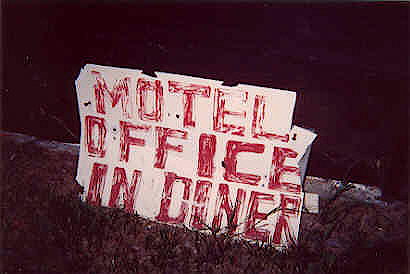
    moteloffice001.jpg

    As I was driving around town today I was writing this country song in my head. I had the whole damn thing worked out –verses, chorus, tune, the whole shebang– and it was shaping up to be a real humdinger of drunken regret, a first-class jukebox classic, and something of a comeback record for me.

    I’ve written quite a few deathless country tunes in my day, as any number of my fans could attest, and back in 1978 I recorded an album (“Rodeo Clown”) under the name Buck Warden that you’ll still see around in thrift store bins from time to time. That’s me on the cover in the hayseed clown costume, trying to break up the feuding lovers and taking a jug of moonshine upside the head for my trouble. (Sample lyric from the single: “Oh, baby, you get so wild/and you get so crazy/that I think sometimes maybe/I oughtta go out and get me/a rodeo clown.” You might remember the way I rode those last five syllables down the scale. People in the roadhouses used to really love to sing along with that one.)

    At any rate, like I was saying, I had this killer song all ready to roll the minute I could get home and sing it into my phonemail at work (I lost my old tape recorder somewhere along the line). Yet when I pulled up to the curb in front of my house I realized the tune was almost completely gone. Somewhere in less than ten blocks the darn thing had just evaporated on me. Maybe this has happened to you when you’ve been working on a new country song in the car. It happens to me all the time anymore, and the missus likes to joke that I must be coming down with Old-Timer’s disease.

    Honey, I tell her, for a tremendous number of pitiable Americans that is no laughing matter.

    I ended up sitting there on the couch all afternoon, drinking and feeling more miserable by the hour as I tried without success to summon that tune. The closest I’ve been able to come is the first line, and I thought maybe if I tossed the line out there, you kind folks could collaborate with me on finishing the damn thing to my satisfaction. I swear to the dear Lord my mama raised me to believe in that I’ll share all subsequent proceeds with anybody who makes a positive contribution.

    Here’s the first line, as best I can remember it right this moment:

    I’ve been crawling around/and painting the town/with a brush/that I hold/in my toes.

    Go ahead and see what you can do with it. You’d be doing an old boy a kind turn, and I’d be mighty appreciative for the help.

  • Good Luck With The Girls, Stay Just The Way You Are, Etc.

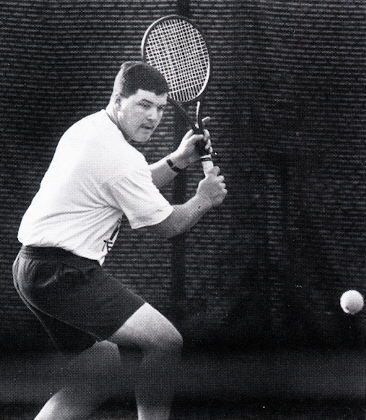
    From the pages of Matthew LeCroy’s 1993 Belton-Honea Path, South Carolina high school yearbook:

    lecroy tennis.jpg

    lecroy tennis cutline.jpg

    Damn, Dave Gassner was a lot of fun to watch today. He sure looked like one of those cool, crafty lefthanders who could have a nice, long career. Whenever the build-up on a guy places so much emphasis on the fact that he doesn’t have “overpowering stuff,” it always seems like the people doing the building up are trying to downplay expectations. At the very least that phrase is the worst sort of backhanded compliment.

    It’s weird to see a guy making his major league debut display such poise and such a relaxed delivery. Weirder still to see him take such an aggressive approach to attacking the strike zone. Gassner already seems to be a pitcher, and I suppose he’s had to learn to pitch his ass off precisely because he doesn’t have that classic overpowering stuff. The beautiful thing about his performance against the Indians today was that he mixed his pitches so well and everything in his arsenal seems to have nice movement. I’d love to see the chart on today’s game to get some idea of the breakdown on what he was throwing. I’d wager, though, that pitching coach Rick Anderson will be going over that chart with guys like Joe Mays and Kyle Lohse.

    It sounds like we’ll get one more look at Gassner before Carlos Silva come off the DL, but, holy shit, isn’t it a beautiful thing to know that if somebody else goes down the Twins have guys like Gassner and Scott Baker (and J.D. Durbin, etc.) in the pipeline?

    Peter Schilling has another fabulous edition of his Mudville Magazine up online. Peter’s digest has long been one of my favorite things on the internet, and it’s gotten better (and broader) every year since I first discovered it. The great thing about websites is the extent to which they can be a reflection of the obsessions and personalities of their creators, and Mudville is clearly the work of a smart, funny, and fascinating guy whose curiosity runs far beyond the baseball field. It is, though, primarily a baseball site, and Peter always has a nice mix of historical and contemporary essays, rants, and proposals. He also has perhaps the finest and most eclectic collection of links of any site out there.

    Check out the latest issue, which contains a modest proposal of sorts regarding Ron Gardenhire and the expectations regarding this year’s team. Also be sure to explore the archives, investigate some of those links, and spend some time with Peter’s other labor of love, Loafer’s Magazine. It’s all good, and Peter’s one of the best people I’ve met in the years I’ve been writing about baseball.

    Also, just in case you’ve been living in a hole for the last month or so, go immediately to Batgirl Juggernaut Inc. and watch Oh Five! The Musical. Watch it a dozen times; I have. Better yet, buy the DVD. I’ve been pimping this work of mad inspiration all over town, but I’ve been remiss in not crowing about it here (primarily because I’m still not convinced there’s any here here).

  • Uncle Jumbo's Playground

    uncle jumbo 2.jpg
    illustration: James Dankert

    All day I was looking forward to hustling home from my job as a lobby gnome at an office building downtown so I could settle into the couch to watch the Twins and Indians. Friday nights –like most other nights– are usually a clear, blank radar screen at Jumbo’s posh hovel, but that generally changes during the baseball season. I even stopped on my way home for some Taco Bell, a bag of red licorice, and a six-pack of Grain Belt.

    But I’ll be good and damned if the TV bastards didn’t take the night off. Where’s Victory Sports when you need ’em? And where the hell does that leave me? I’ll tell you where it leaves me: pissed off and desperately in need of another six-pack (and another bag of licorice) by the end of the third inning.

    I had to dust off the old man’s trusty Philco transistor radio; the tubes take a while to get warmed up, but once the thing gets crackling it’s like listening to a ballgame that’s being broadcast from a doomed spacecraft. Or, in this particular case, a ballgame being broadcast from a doomed spacecraft piloted by two raving idiots.

    After hibernating all winter, joining the yahoo convergence at the Dome for the home opener was a difficult, if necessary, excursion. Thank God for Xanax, 3.2 beer, and the obsessive diversion of a scorecard. It takes me longer every year to get used to the sort of forced and wholly artificial camaraderie that exists at the ballpark. As far as I’m concerned 12,000 is a nice, comfortable attendance number; I like to be able to stake out a piece of private territory in left field, and the big crowds wear me out.

    When the team’s going pretty good it’s hard to find things to bitch about. Actually, of course, it’s never really hard to find things to bitch about, but so far the Twins haven’t done a whole lot to chap my ass. All those first inning runs made me rant and rave like Charlie Callas, but if an opposing team’s going to score I’d rather have it happen in the early innings when the Twins still have a chance to recover. The runs in the eighth and ninth inning are the ones that kill you; those are the ones you carry home and take to bed with you, the ones that linger right into the next day like a hangover.

    The damage baseball does over a long season is cumulative. When it comes in dribs and drabs like it has so far this year I can generally forget all about it. Granted, beer is mighty helpful in this regard. But as I’ve gotten older every victory is a salve that allows me to flush the defeats out of my system more quickly. I guess it’s that one-game-at-a-time business. I can’t hold grudges like I used to, at least during the season. I can, however, nurse a grudge –even a series of festering grudges– through the entire off-season.

    I guess what I’m saying is: so far, so good, and those words don’t come easily to a guy like me. This early in the season, though, the damage hasn’t yet had a chance to do its steady, corrosive work. I’m still getting a feel for this team, and trying to be optimistic about how good they can be. We’re still in the honeymoon period. I’m just grateful to have that chunk of time accounted for every day. Even a night like this, a night that began in disappointment, is better than any single Friday night in mid-winter.

    I’m fully aware, believe me, that there’s still a very good chance this team will have my ‘nads in a vise before the year is out, but it’s too early to start fretting about the perhaps inevitable pain that’s waiting for all of us down the road. For now, at least, even I can cling to something that feels almost like hope, if not outright optimism.

    As I’ve been listening to the game –and it’s been a decent game so far– I’ve been intermittently standing before the mirror in my living room, fine-tuning my Whiffleball swing. I’m nothing to look at, I know that, particularly in my boxer shorts and Hudson Hawk tee-shirt, but I’m not looking at myself. I’m looking at my swing, analyzing it closely and with the utmost wonder and disembodied appreciation; I’m nursing a modest buzz, but even so, I’ll be damned if that swing isn’t still a pretty picture, a very pretty picture indeed.

  • The Unkindest Cut

    Well, it’s tax day, and in deference to all those people cavorting around the capital, hoping to catch a glimpse of their heroes David Strom and Michele Bachmann, here’s the most painful poem I know. It must be what it feels like for all of them today, for which I can’t really say I’m sorry.

    Cut
    by Sylvia Plath

    What a thrill–
    My thumb instead of an onion,
    The top quite gone
    Except for a sort of a hinge

    Of skin,
    A flap like a hat,
    Dead white.
    Then that red plush.

    Little pilgrim,
    The Indian’s axed your scalp.
    Your turkey wattle
    Carpet rolls

    Straight from the heart.
    I step on it,
    Clutching my bottle
    Of pink fizz.

    A celebration, this is.
    Out of a gap
    A million soldiers run,
    Redcoats, every one.

    Whose side are they on?
    O my
    Homunculus, I am ill.
    I have taken a pill to kill

    The thin
    Papery feeling.
    Saboteur,
    Kamikaze man —

    The stain on your
    Gauze Ku Klux Klan
    Babushka
    Darkens and tarnishes and when

    The balled
    Pulp of your heart
    Confronts its small
    Mill of silence

    How you jump —
    Trepanned veteran,
    Dirty girl,
    Thumb stump.

  • Yackety Yack…

    Have you noticed over the last several seasons how every time a Central Division foe has tried to talk trash about the Twins in the media it’s seemed to result in an immediate upsurge in the quality of play from Ron Gardenhire’s charges?

    Granted, what qualifies as bulletin-board grade trash-talking in baseball is generally pretty innocuous stuff. Detroit’s Dmitri Young’s statements about the Central race essentially being a two team contest between the Tigers and the Indians was certainly foolhardy, particularly coming as it did in the season’s first week; and I suppose the Twins, after pretty much dominating the division over the last few years, are at the very least deserving of a bit of modest respect from their rivals.

    Young’s comments likely had little to do with the spanking the Twins administered in sweeping the Tigers, but the timing was nothing if not psychologically convenient. This first month will give the Twins every opportunity to send the strongest of possible messages to the rest of the Central, and the Detroit series will certainly go a long way towards insuring silence from the Tiger clubhouse the rest of the season.

    No doubt it’s still way too early to draw any real conclusions, and the Twins aren’t going to break anybody’s backs in April. They can, though, raise the stakes for everybody else, build their own confidence, and clearly establish their right to the respect that has already been given them (and in spades) by the national press. You could persuasively argue that they’ve already earned that respect by virtue of their domination in the division over the last three seasons, but it’s funny how quickly the perception of the Central has changed in so many people’s minds. And you really do have to wonder: on the basis of what? Nine games? Some radically overhauled rosters? Wishful thinking?

    I have no idea, to be quite honest with you. And I say this with the full knowledge that I’ve previously proclaimed the division much improved myself. But after watching the Twins dominate the Tigers, I’m as convinced as ever that Minnesota is much better and much more confident than anybody else in the Central, and I wouldn’t be at all surprised to see them run away with the thing once again.

    The one team I was discounting almost entirely two weeks ago, the White Sox, actually does seem to be a tighter, better, and more balanced team than last year, but I still don’t think they have enough depth to compete with the Twins over the long haul. My guess is that they’ll spend the summer playing rock ’em, sock ’em robots with the Indians and Tigers while Minnesota just keeps racking up series wins and pulling away from the pack.

    There’s no rational explanation for the funny business in the first inning so far this year, at least so far as a team-wide phenomenon goes. Where Brad Radke is concerned, however, it goes back a lot further than this year, and is pretty easily explained by the kind of pitcher he is. Radke prides himself on throwing strikes, and isn’t a guy who ever seems comfortable wasting a pitch. He’s a deeply conservative operator, and at this point in his career isn’t going to change much. That said, he’s never had a single truly dominating pitch that allows him to get away with mistakes, and opposing teams know by now what he has, and that he’s pretty much always going to be around the plate. It seems like everybody he’s faced over the last couple years knows the book on Radke backwards and forwards, and they’re clearly being proactive in the early going and taking aggressive cuts. Hitting is incredibly difficult, but you give the other team a huge advantage when they know damn well you’re going to throw it somewhere over the plate and have a fairly limited bag of tricks at your disposal.

    Radke’s a smart pitcher, and he generally does a good job of making little adjustments and settling in as the game goes along, but it sure seems like if he’d take a more unpredictable and even erratic approach right out of the gate he’d save himself the trouble of having to make those adjustments in the first place.

  • From Studs Terkel's 'Working': The Uncut Edition

    atlas.jpg

    I figured out pretty quick that I didn’t have the goods to be any kind of a proper accountant, despite pissing away God knows how much money on what some fools would call an education. Maybe, actually, I should have said ‘real accountant.’ I lacked the discipline and the attention (and, frankly, the interest) to make it at any of the big firms –or, for that matter, any of the small firms, at least the legitimate ones. I couldn’t handle the hours or the office bureaucracy, and the math just seemed to get more complicated all the time. Every couple months or so somebody was dumping some fat book full of new regulations on my desk, and I couldn’t make head nor tails of any of it. When you shove numbers around for a living, after a certain point they stop adding up. That’s been my experience, at any rate.

    I don’t know what I was thinking, to be honest with you. If I think hard enough I guess I could blame it on a lazy high school guidance counselor, who probably just pulled the suggestion out of his ass without any real consideration of aptitude. I can still picture the old troll, hair coming out of his ears and a can of Diet Shasta perched on his belly as he sat behind his desk peering over his spectacles at me like I was a chess move. He was clearly just waiting for somebody to tell him he could finally hang it up and go home to die.

    After I got laid off –okay, fired– from my first job out of college I was unemployed for a long time. I choose to blame it on the economy even though I know damn well things were booming then. At one point during this period of extreme indolence I went to see a career counselor, who actually did go to the trouble of giving me some kind of aptitude test. The problem was –and I’m not shitting you– the woman told me the results indicated that I’d probably be happiest in “some kind of itinerant trade.” What does that mean? I asked her.

    “Oh, you know,” she said, “something like a truck driver or carnival worker.”

    Let me assure you: that’s exactly the sort of encouraging thing you want to hear when you’re twenty-six years old and absolutely clueless about what your next step in life is going to be.

    Out of pure laziness I ended up taking a series of temporary accounting gigs, generally as a tax preparer for one of these joints that gives people an advance on their returns in exchange for some ridiculous piece of the action. The last several years I worked for this outfit that did your taxes while you wait. Our customers were almost all service sector employees, students, and poor people.

    Two years ago they started making us wear Uncle Sam costumes while we did people’s taxes. It was a brutal, ridiculous gig, but I was desperate, and I’d pretty much parted ways with my dignity years ago.

    The guy who owned this racket had like fifty of these places, and he’d rake in the cash for three months of the year and then spend the rest of his time on a boat in Miami banging stewardesses.

    The final straw came this year, when I showed up for work and discovered that everyday one of us –the fucking tax preparers, for God’s sake– would have to go out front in our Uncle Sam costumes with a sandwich board and wander up and down the sidewalk trying to drum up business. There was a rotating schedule and I got stuck out there skulking around like a jackass the very first day. It was cold as shit, and people –go figure– would shout insults and throw stuff at me.

    When it came time for my lunch break I ditched the sandwich board in an alley behind the Super America and walked the three miles home in the Uncle Sam outfit. I’ve got the damn thing for sale on eBay this very moment. It’s a pretty elaborate get-up, and with any luck I figure I might get a hundred bucks out of the deal.

    Then I’m thinking I’ll start looking around for something in the itinerant trade.

  • View from the Stone Arch Bridge

    William Wordsworth – Composed Upon Westminster Bridge

    Earth has not anything to show more fair:
    Dull would he be of soul who could pass by
    A sight so touching in its majesty:
    This City now doth like a garment wear
    The beauty of the morning; silent, bare,
    Ships, towers, domes, theatres, and temples lie
    Open unto the fields, and to the sky,
    All bright and glittering in the smokeless air.
    Never did the sun more beautifully steep
    In his first splendour, valley, rock, or hill;
    Ne’er saw I, never felt a calm so deep!
    The river glideth at his own sweet will:
    Dear God! the very houses seem asleep;
    And all that mighty heart is lying still!

    If you’ve ever got up early enough to take a walk along the river as the morning sun hits the Minneapolis skyline, you might have written something like this. That is, if you got up that early, took that walk, and had Wordsworth’s talent.