Month: April 2005

  • The Depression Deepens

    Well, we’ve been following Kiefer Sutherland’s “24” each week, and last night they really stepped in it. The usual disclaimer at the beginning of the show might have warned not only that the show would be too violent for viewers without discretion, but that it would depict Americans committing odious, unamerican acts. See, here’s the problem—after the first few episodes, we mentioned that the show felt like a suicide note from a nation on a steep depressive decline. What we meant was this: You are either against torture, or you are for it. This is not an area that admits a lot of gray area. The cliff-hanger structure of the show has allowed the writers and producers to suggest over and over again that the ends justify the means. Well, I mean, really—if your choice is between breaking a (guilty) terrorist’s thumbs or a nuclear warhead being set off in a major American city, it’s pretty obvious what should be done, no?

    Last night, though, the show went one step further and made “Global Amnesty”—a transparent stand-in for Amnesty Internation, duh—the dupes of Marwan Habib, the evil overlord of terrorism on the show. (When one ofhis operative is caught, he calls Amnesty and dispatches a lawyer and federal marshall to prevent any, um, aggressive questioning.) We appreciated the gesture toward that yellowing old rag we call the Constituion, when the president sided with the lawyers and suggested that due process was in order—and which instantly puts Jack Bauer outside the law. But by now, we all know who the hero of this story is, and any moral qualms we might have about his M.O. evaporate in the overwhelming evidence against his nemeses.

    Now, one can feel slightly propped up by the realization that this show is really just a high-grade motion-picture comic book on steroids. But if there is something to be even more troubled about than the implication that due-rpocess, civili-rights—lovin’, glue-sniffin liberals are nothing but an impediment to justice—it is a certain aspect of the show’s intense realism.

    What we mean by that is the relative ease with which terrorists on the show have arranged just about every major attack its writers and producers could conceive after what must have been several potfuls of strong coffee. It was not enough to kidnap the Secretary of Defense and his daughter. That was a plot designed merely to overload the Internet, to allow the covert transfer of information allowing Marwan to gain access to every nuclear power plant in the country. But that was just a diversion to allow Marwan to hijack a stealth bomber to shoot down Airforce One. But that was just a convenient way to get his hands on “the football”—the president’s briefcase with all nuclear ballistics codes and locations.

    See, now taken as a quick synopsis, doesn’t that seem ridiculous? Problem is, we wonder just how unrealistic it really is. In last Sunday’s Times magazine, former CIA agent Melissa Boyle Mahle comments on the crossroads of intelligence and politics. She poses the interesting question: What if we caught Osama bin Laden and didn’t tell anyone? If we were really worried about security in a concrete way—preventing terrorist attacks with or without taking public credit, you know, speaking quietly and carrying a big stick— the most brilliant move would be to hold him in secrecy and let the rest of al-Qaida come looking for him. But political expediency would absolutely demand that the sitting administration crow from the highest tree in its loudest voice. We hate to be cynical about it, but it’s not hard to believe that some of the adminstration’s more enthused partisans would put the GOP ahead of the safety of Americans—half of whom are godless John Kerry lovers, after all.

    As Tom Friedman makes clear in this recent column, we should not assume that just because there has been no terrorist attack in the US since September 11th that it’s because of anything we might have done to shore up security. The present administration seems far more interested in the politics of security than the realities of security, and we sincerely hope that Friedman is wrong about the dark days ahead.

  • That Hauntingly Familiar Ugly Math

    gardenhire 8.jpg

    –Ralph’s Barber Shop, Okmulgee, Oklahoma

    gardenhire 3.jpg

    –Bateman Park, Okmulgee, OK

    gardenhire 6.jpg

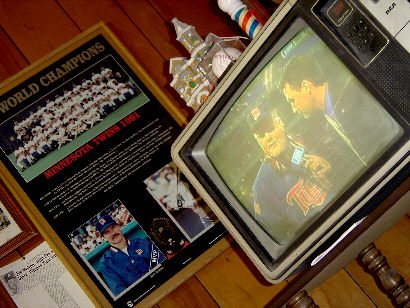
    On the tube in Ralph’s Barber Shop, Okmulgee, OK: Twins clinch 2004 Central Division title

    It shouldn’t be possible for nine hits, seven walks, and a hit batter to add up to four runs. That’s the sort of line the Twins regularly threw up last year when they were scuffling to score runs.

    Compare the runners left on base for the White Sox tonight (one) with the number of stranded Twins (ten) and you pretty much have the story of the game. It didn’t help, of course, that Kyle Lohse gave up a couple of two-run homers and a solo shot.

    It’s actually more frustrating for me to watch Lohse right now then it was last year, when he was so clearly battling himself and his coaching staff. This year I think we’re seeing a guy who’s doing his damnedest to get with the program and really learn to pitch, but after years of refusing to see himself as anything but a fastball/slider power pitcher, Lohse’s attempts at an on-the-job transformation to a four-pitch guy are probably going to hit some pockets of turbulence in the early going.

    Lohse was obviously trying to mix in his curveball and change-up tonight, but you can tell the confidence isn’t quite there with either pitch yet. As Bert Blyleven could tell him (and Carl Everett, for that matter), the curveball can be a very effective pitch, but if you hang one it’s generally going to get mashed. You’ve got to learn to forget those mistakes in a hurry. Late last season, those hanging curveballs that got knocked out of the park made a pretty dark impression on Lohse, and he went through an angry stretch where he was stubbornly resisting Rick Anderson’s attempts to get him to alter the approach that had helped him to win 27 games between 2002-03.

    One of the things Anderson talks about a lot is what a challenge it is to get guys who’ve gotten attention since they were in high school for being able to throw ninety miles-an-hour to recognize how effective a 75- to 83-mph offspeed pitch can be. Why should a guy who can throw 93 serve up a 75-mph breaking ball to a major league hitter?

    Lohse is learning, it seems to me, and though he’s getting punished for his mistakes you’re not seeing guys just sitting on his fastball and racking up huge innings like we saw so often last year. He still needs to figure out the best situations to throw that offspeed stuff, and to which batters. His book on hitters for the last four years is being essentially re-written series by series, and if he’s going to stick to this new approach and not get frustrated (which so far, anyway, all indications are that he hasn’t), he’s also going to have to recognize that in many ways he’s starting over –or at the very least making some major adjustments and trying to alter the type of pitcher he’s going to be from here on out. The encouraging note so far is that he’s only walked two batters in his first three starts of the year, this after issuing 76 free passes last year. His strikeout totals are also down from 2004, but that’s to be expected as he dicks around with his repertoire.

    I still believe Lohse’s going to end up pitching close to 200 innings for the Twins this year, and I just predicted to somebody today that he’ll finish second on the staff with sixteen victories.

    During the last homestand Lohse talked about his need to be patient, and I just hope the Twins’ staff will be patient with him in return. At the very least, he continues to have real value to the organization. If some of the arms in Rochester prove to be ready later this summer, Lohse would almost certainly generate trade interest from any number of teams.

  • The Grounded Man

    Editor’s Note: In May 2005, The Rake ran a story by former KSTP-TV reporter Dean
    Staley about Clancy Prevost, the man whose suspicions about his flight
    student Zacharias Moussaui led to the apprehension of the “twentieth
    hijacker” behind the 9/11 attacks. Before our story hit the street in
    print, but after it was posted on our website, the
    StarTribune, in an
    attempt to discredit us and Prevost, (and to take credit themselves for
    the story of who caught Moussaui) ran a front page story the day before
    our story hit the streets crediting the tip that led to Moussaui to Tim
    Nelson and Hugh Sims, colleagues of Prevost at the Pan Am Flight
    Academy.

    As noted in a Strib story today (January 25, 2008), the State and Justice
    Departments gave a $5 million reward for the Moussaui tip to Clancy
    Prevost, not to Nelson and Sims. It seems the State and Justice
    Departments thought
    The Rake story had it right, and the Strib had it
    wrong. Our story is below.

    —Tom Bartel

    He wraps his long fingers around his coffee cup, measures me with steady pale blue eyes, the eyes of an airline pilot. He smiles at the absurdity of his story. We are just a few miles down the road from the Eagan flight school where, one month before the September 11th attacks, he tried to teach Zacarias Moussaoui how to fly a Boeing 747.

    His name is Clancy Prevost. He is sixty-eight years old, a retired pilot for Northwest Airlines, a lapsed Catholic, and a recovering alcoholic. He shakes his head as he recalls his story publicly for the first time.

    The morning of August 13, 2001, was warm and humid, the Minnesota summer nearing its peak. Clancy Prevost left his room at the Spring Hill Suites, his local lodging when he commutes from the East Coast. He jumped on the hotel shuttle and headed for the nearby offices of the Pan-Am International Flight Academy. He wore a blue polo shirt, khakis, and red Converse sneakers.

    At 10:30 that morning, Prevost walked into the air-conditioned lobby of the Northwest Aerospace Training Corporation, Northwest Airlines’ affiliated training facility. Here his employer, Pan Am Flight Academy, leases time on a range of multimillion-dollar simulators, including the 747-400 model, which realistically mimics the flight deck of a Boeing 747. There, thirty days before September 11th, he shook hands with the man the government would later call “the twentieth hijacker.”

    ”He was pleasant, but I expected him to be better dressed. He just was wearing Dockers and they didn’t fit real well, he was a little overweight, and he had this baseball hat, and growth of beard,” Prevost recalls. There was nothing remarkable about Moussaoui. In fact, Prevost’s first impressions of Moussaoui barely registered at all.

    Prevost expects young pilots to arrive with energy, even nervousness, but from Moussaui, he got nothing. “I guess I wanted him to be a little more alive and comin’ at ya. But there wasn’t much comin’ at ya. It was just, ‘Hello.’”

    Prevost wrote off Moussaoui’s timidity to first-day jitters. “It’s understandable since it’s all new. It’s daunting even to the experienced pilots that show up, let alone this guy who’s wandering in to supposedly kill everybody.

    Moussaoui’s demeanor may have helped him go unnoticed during the five and a half months leading up to his arrest. He arrived in Chicago from London on February 23 and declared at least thirty-five thousand dollars in cash on his customs form. He traveled to Oklahoma City, and later to Minnesota. Along the way, Moussaoui bought knives and flight-training videos and inquired about starting a crop-dusting company. Not once did he draw the attention of authorities. Not even when he walked into the Pan Am flight school, counted out sixty-eight one-hundred dollar bills, and signed up to learn how to fly a 747. His luck ended the day he met his flight instructor, Clancy Prevost.

    At first glance, Moussaoui was the kind of client Prevost had seen before: a wealthy civilian with no ties to the airline industry who wanted to learn how to fly a commercial jetliner. One might be surprised to learn how many “vanity clients” come to flight school, men of means with lots of free time, whose ultimate hope is apparently to impress women with a 747-type rating—bragging rights worth thousands of dollars. (Normally, most of Pan Am’s students are working, commercial pilots who are training to upgrade their ratings from smaller passenger jets. Maybe two or three vanity students turn up each year.) But that first day, Moussaoui would prove unlike any other student Prevost had known.

    At 10:45, Prevost and Moussaoui took a shuttle van a mile and a half to the Pan-Am classroom building to start ground school. Michael Guess, a twenty-one-year-old support worker, met them at the reception desk. Guess set them up in a room with a projector and a PowerPoint presentation on the systems of the 747-400. (Guess, an aspiring pilot himself, would die a year later copiloting the flight that crashed and killed Senator Paul Wellstone in the woods of Northern Minnesota.)

    The room was not much bigger than a large office. Moussaoui sat down. Prevost drew the blinds. Standing, he projected the PowerPoint presentation onto the white wall. Prevost paged his way through the schematics of the 747-400. Using color-coded charts and graphics, he described the hydraulic systems that power the flight control surfaces: the rudder, flaps, and horizontal elevator at the rear of the aircraft.

    Moussaoui repeated some of the technical phrases and asked a few questions. Prevost, who flew 747s for Northwest Airlines, smiles and says, “I knew he wasn’t pilot material, because he’d actually read his manuals and he didn’t talk about pussy.” But over the course of the lesson, an odd pattern emerged. Moussaoui used the correct jargon, but his questions often didn’t make sense or were out of context.

    Prevost tried to explain to Moussaoui the complex backup systems that in an emergency mean the difference between life and death. “There are two parts each. You have your engine-driven pumps and the backups to the engine-driven pumps, which are the man (manual) pumps. Two of them are electric. Two of them are air-driven. One and four are air-driven. Two and three are electric. The EDPs (engine driven pumps) are the main pumps and floor systems.”

    Moussaoui was plainly bewildered. “So you say stuff like that and he’s sitting there like…” Prevost drops his jaw, gives a blank look. “It’s useless. He doesn’t have any knowledge on anything.” Moussaoui’s reaction exposed him as a man profoundly out of his depth trying to learn to fly a 747. Frustrated, looking for a break, Prevost suggested they get lunch. By 11:30, they were back at the NATCO building.

    They sat down to lunch in the cafeteria. Prevost asked Moussaoui what he did for a living. Moussaoui said he worked in the import/export business, that his family was covering for him while he was gone. Though Moussaoui is a French national of Moroccan descent, he never said specifically where he was from. Moussaoui told Prevost he had to get his training done as soon as possible, because there was only so much time his family would cover for him.

    Prevost remembers trying to stall, because the training seemed pointless with such an unpromising student. “We’re sitting up there in the cafeteria and I’m thinking, I’m going to stay here for two or three hours because I don’t want to go back to the classroom building and try to teach him something, because you can’t. There’s no awareness of anything.” Moussaoui seemed equally discouraged. He had good reason.

  • Tolls for Thee

    In just a matter of days, the new toll lanes on Interstate 394 will open, giving thousands of commuters in the western suburbs the option of paying to escape the bonds of gridlock as they make their busy way to and from downtown Minneapolis. The last time we drove west on I-394 it was not rush hour. It was a Saturday afternoon in October, not long after President Bush had held his “victory rally” at the Target Center. We were taking the children to a Halloween party in Golden Valley, and we were beset by scrubbed suburban teenagers too young to vote but old enough to drive—and honk and point and make lewd gestures when we did not show a sufficient level of enthusiasm for their candidate. Anyway, the traffic was terrible, and we waited for what seemed like hours just to reach the HOV lane. We were demoralized to see it was closed.

    In theory, then, we should be very pleased, along with our westerly friends, that we now have this high-tech option. It is called MNPass. For a deposit of around forty dollars, you can receive a small antenna and computer chip to be glued inside your windshield. This transponder will be recognized by overhead chip readers, which will be indirectly connected to your bank account (and, by the way, directly to the State Highway Patrol—you didn’t think this was going to be on the honor system, did you?). Your MNPass account will authorize you to use a special lane shared only by other toll payers or car-poolers. The technology for MNPass looks much like that for EZPass, New York City’s celebrated system used on countless toll roads around the Big Apple.

    There is one important difference, though. Everyone must pay to use the Garden State Parkway, or the New York Thruway, or the Tappan Zee Bridge—there are no special lanes, no special dispensations. (There are different tolls for commercial vehicles and for trailers; also, you are allowed to pay with hard cash.) Back East, all are equal under the electronic eye of God. But our own pay-to-play toll road rankles for a couple of reasons.

    While it’s nice to see that car-poolers will still be able to use the lanes unharrassed, the idea that you can substitute money for socially agreeable behavior is repugnant to us. MNPass may appear to embody the libertarian ideal of point-of-service fees, whereby those who use are those who pay. But we’ve seen how this ideal works before, particularly in our public parks. We never liked it, and now we know why. While besieged taxpayers are supposedly getting “relief,” they are expected to pay higher fees for many of the things their taxes formerly paid for. There is a subtle moral violation of the public trust in this. Forty dollars may not seem like much money—indeed, it is merely a deposit against tolls you will be paying when you use your pass, and the monthly cost of the transponder is just $1.50—but the system inherently excludes people who don’t have forty dollars to deposit. (Another telling example: You need to reserve your account with a credit card number; if you have no plastic, you are not welcome.) We think the punishment of sitting in traffic fits the venal sin of insisting on driving your own automobile alone, every day. Money should not be the lowest common denominator dictating our behavior. Morality should be.

    But if you insist, then let’s consider this matter strictly on a financial basis. The high price of gas is already putting a pinch on drivers, and in a rational world, it should lead to more car-pooling, more public transit, and more long-term solutions in which we all participate. Opting out, or rather paying what amounts to an indulgence, in order to have the law not apply to you, in order to be exempted from uncomfortable realities—is that any way to act? MNPass calls to mind recent efforts to allow industrial corporations to buy and sell pollution credits. In our bizarre, delusional state, we seem to believe that social and civic responsibility is optional, that morality is a commodity that can be traded in the open marketplace. We seem to believe that responsible behavior is something that takes place in the aggregate, not at the individual level. Someone else will take care of it; let’s just make sure I got mine.

  • The Minnesota Cell?

    SHEIK OMAR ABDEL RAHMAN—THE BLIND SHEIK
    One of fundamentalist Islam’s most exalted spiritual leaders; resided in Rochester between 1998 and 2002 at the Federal Medical Center prison. He was sentenced to life in prison in 1996 for conspiring to blow up the United Nations, New York’s FBI office, and all the bridges and tunnels going into New York City. After September 11th, Osama bin Laden threatened to free Rahman, using whatever force necessary. Rep. Gil Gutknecht began raising questions regarding the city’s (and state’s) security, and Rahman was soon moved to another federal prison.

    JANE TURNER—DID NOT ADMIRE THE FINE CRYSTAL
    Jane Turner, a twenty-five-year special agent, noticed a Tiffany globe on a secretary’s desk in the Minneapolis FBI office in August 2002. After learning it came from the World Trade Center, she brought the globe to the attention of the inspector general. No FBI agents were reprimanded or indicted. Instead, Turner received a “notice of proposed removal,” according to her attorney, Stephen Kohn. She retired on November 21, 2002.

    COLLEEN ROWLEY—CELEBRATED BLOWER OF THE WHISTLE
    In May of 2002, Minneapolis FBI agent Colleen Rowley sent a caustic, thirteen-page email to FBI director Robert Mueller, claiming that certain facts regarding the investigation of Moussaoui were omitted and downplayed. Minneapolis agents in August 2001 had taken Moussaoui into custody and wanted to search his computer. However, personnel at FBI headquarters disputed with the Minneapolis agents the existence of probable cause to believe that a criminal violation had occurred or was occurring. However, agents were given a warrant after September 11th.

    MOHAND ALSHEHRI—MUSCLE MAN IN ROCHESTER
    Was on United Airlines flight 175, the plane that hit the south tower on September 11th. He was a “muscle hijacker” who apparently had flight training (though his training was never documented) but was designated to help take control of the cockpit and keep it. Nancy Hanlon, a cardiac ward secretary at St. Mary’s Hospital in Rochester, claimed she met him at a local bar in August of 2001. He called himself Khalid, and they had a lengthy conversation where he informed her that he was going to die soon, and it was predetermined.

    ABDEL-ILAH ELMARDOUDI—DR. DOCUMENT
    A Moroccan who lived in Minneapolis. In August 2002, was indicted and later convicted of conspiring to provide material support or resources to terrorists, of fraud, and of misusing documents. Convicted last year in a Michigan court of conspiring to provide material support (including forged identity documents) to terrorists.

    ILYAS ALI—DRUGS, GUNS, AND TALIBAN
    In November 2002, indictment unsealed against him. Born in India and lived in St. Paul. He pleaded guilty to charges that he conspired to supply weapons to terrorists through the sale of drugs. Apparently planned to sell five tons of hashish and a half-ton of Pakistani heroin in exchange for cash and four shoulder-fired Stinger missiles, which he intended to sell to the Taliban.

    MOHAMMED A. WARSAME—THE UNBANK?
    A Canadian man born in Somalia who lived in Minneapolis. Warsame was arrested in the Twin Cities in December 2003. He has been charged with conspiring to provide aid to al-Qaida, and federal prosecutors allege he fought with the Taliban in Afghanistan. Was charged in January 2004 with wiring money to Pakistan for alleged al-Qaida conspirators.

    MOHAMAD ELZAHABI—COMMUNICATION BREAKDOWN
    In April 2004, agents began questioning Mohamad Elzahabi, a Lebanese man living in Minneapolis. Later charged with lying to federal agents after saying he didn’t send walkie-talkies to Pakistan. Also charged with lying about his role in helping a man fraudulently obtain a Massachusetts driver’s license. An FBI affidavit says he admitted to participating in an al-Qaida training camp.—Brian Voerding

  • Discomfort Food

    My dad loved a buffet, or, as we used to call them growing up in Minnesota, a smorgasbord. These giant, mind-blowing restaurant spreads were still something of a novelty for a Midwestern kid in the 1960s, even if the basic concept wasn’t that far removed from those familiar church basement potluck suppers and extended family gatherings where everybody brought dishes to share. Still, dining out was a special experience in our family, and as kids we marveled at the sheer excess, variety, and freedom of choice afforded by the all-you-can-eat buffet. We looked forward to our infrequent trips to the Twin Cities, when we would often be treated to a local smorgasbord. There was something so exotic and decadent about these meals, which were almost ridiculously copious in comparison with the more modest and even spartan fare we were accustomed to at home. The basic components of the Midwestern buffet haven’t changed much in thirty years: a selection of meats, tubs of congealing condiments, mystery casseroles, and the kinds of frothy and fluorescent fruit salads that might plausibly be classified as plebian exotica.

    My father never did get tired of buffets, but for the rest of us, I think, our enjoyment of the experience was forever ruined the day my brother threw up in the serving line at the old Jolly Troll Smorgasbord in Golden Valley. There were plenty of painless potlucks and trips through even the most unappetizing of buffet lines in the years that followed my brother’s humiliation; but at some point I acquired a profound fear of anything suggestive of a buffet. For a number of years now, the gag reflex has been my helpless reaction to such mass assembly-line productions of food prepared by an army of strangers and displayed like exhibits in a criminal trial. Even a stolen glance at the mounded plates of my table neighbors can summon a wave of nausea.

    I am not exaggerating, nor am I being a snob. My misery is very real. And I know from unscientific research and purely anecdotal experience that I am not alone. I’m going to make the brazen and perhaps crazy assumption that there are thousands, if not millions, of others out there who share my pain, although, as far as I’m aware, this affliction—let’s call it Buffet Syndrome—has never been properly diagnosed or understood.

    Perhaps this fear is psychosomatic, a manifestation of my soul sickness with general American sprawl and our culture of conspicuous consumption. For what, really, is an all-you-can-eat buffet but a sort of culinary strip mall, an arcade of debased appetites, and a microcosm of the culture’s infatuation with the gargantuan?

    Like so many other things that repulse me, buffets are a personal fascination. I am eager to understand why it is that something that obviously gives pleasure to so many other Americans causes me such distress. It would be easy enough to see in my revulsion some instinctive class reaction. Buffets, after all, seem like solidly proletarian feeding grounds. But those are my people; I come from that world, and I’m an otherwise entirely undiscriminating eater. I’m almost as uncomfortable dining in a fine restaurant as I am standing in a buffet line—although my discomfort there is a product of class, fueled almost entirely by feelings of being an interloper. And certainly the displays of gluttony you occasionally see in, say, the Four Seasons are every bit as offensive as the scrums that can occur at an all-you-can-eat buffet.

    Whatever its origins, I resolved to conquer this fear of the buffet, and to tackle the problem by adopting the G. Gordon Liddy approach. Liddy, you may recall, tried to overcome a childhood fear of rats by capturing one, and cooking and eating it. My own strategy would not be quite so drastic. I would dine at the Old Country Buffet.

    It took quite a long time to actually carry through this decision, however. I procrastinated for many months, then spent several more weeks trying to talk myself into driving to an Old Country Buffet near my home. I also lobbied my wife, numerous friends, acquaintances, and food experts to accompany me, with no success. Even the prospect of a free dinner, not to mention the additional “all-you-can-eat” enticement, wasn’t enough to persuade even my most undiscriminating friends. I would, I realized with growing trepidation, have to go it alone.

    “Certainly it is now unfashionable to overeat in public,” M.F.K. Fisher observed in An Alphabet for Gourmets. “It is safe to say, I think, that never again in our civilization will gluttony be condoned, much less socially accepted, as it was at the height of Roman decadence, when a vomitorium was as necessary a part of any well-appointed home as a powder room is today, and throat ticklers were as common as our Kleenex.”

    Fisher was writing those words in the wake of the privations brought about as a result of the Great Depression and the Second World War, and one can only wonder what she would make of gluttony’s triumphant comeback in America.

    These days, of course, the buffet is a staple feature of many tourist towns, cruise ships, and restaurants, from those offering standard cafeteria-style cooking to neighborhood and strip-mall establishments serving up luncheon troughs of all manner of ethnic fare. For those averse to the steam tables with their crusted and curdled offerings, the lumpen grotesqueries of the serving line, and the small comfort of the sneeze guard, these ubiquitous monuments to American appetite and excess are an unavoidable horror. God help any of them who might venture to this country’s playgrounds of the lowest common denominator—Las Vegas, Branson, the Wisconsin Dells. In such places it’s appallingly clear that the buffet is the prototypical intersection of natural human gluttony and American vulgarity.

    I don’t much enjoy the experience of watching other people eat, yet I’m nonetheless a helpless voyeur in restaurants. People are so vulnerable when they’re shoveling food into their faces, so exposed; eating is raw psychology in one of its purest forms, and it can make for a shocking, even bruising spectacle. Perhaps, however, I’m projecting. After watching people eat for so many years I’ve become a self-conscious eater myself, uncomfortable dining in a room full of strangers. The buffet, of course, ups the ante all around. Its atavistic, herds-and-hordes approach elevates eating to the level of a Darwinian competition and a grotesque spectator sport. As a dining experience, a buffet can be social to the point of bacchanalian (large, loud groups) and yet also almost heartbreakingly lonely (solitary diners alone with their hunger). There are additional aggravations: the forced camaraderie of the serving line, the ogling and probing of the selections, the shared utensils and hands of strangers shoveling divots in the vats of mashed potatoes and creamed corn.

    Then, of course, there are the old mysteries, the sense in which the buffet, as a throwback to those church basement potlucks and family gatherings, is an archive of food memories and appetites: mounds of pastel fluff, gelatin cubes the color of ox blood, some frenzied-looking concoction of raisins and shredded carrots, casseroles concealed beneath a crust of what appears to be baked sawdust and laminated cheese, and meatballs that look as if they have been boiled in formaldehyde. And finally, there are the participants (there seems to be no other word for the buffet habitué): the true gluttons who gracelessly negotiate the aisles with impossibly loaded plates; the timid spinsters with their tiny portions of cottage cheese and fruit salad; the feral children making ugly collages on their plates.

    Naturally, this whole phenomenon terrifies most nutritionists. In a culture where rampant obesity and all manner of unchecked appetites war constantly with the mixed messages from the health and beauty industries and the harsh, guilt-tripping realities of global starvation, the all-you-can-eat ethos is a powerful and malleable metaphor for American
    immodesty, disproportion, solipsism, and insecurity. When you’re on deck in a buffet line, staring down the lineup of food stretching away before you, do you feel a sense of weakness or power? What, really, does “all you can eat” mean to you? While on the one hand those words are a generous invitation of sorts, there’s also no doubt that the phrase poses an open challenge for many. It also stokes the average American’s fierce desire to get the biggest possible bang for their buck. For some people, the basic convenience and economy of the buffet make it an easy and affordable dining choice, particularly for senior citizens and families with children. For others, it represents a grim expedition of pure endurance eating, a sort of unofficial arena for culinary gladiators.

    There certainly seem to be a number of biblical injunctions against the various sins and indiscretions that might be committed at the buffet. Gluttony is, after all, a deadly sin, the violation of which, according to Dante, carries a harsher punishment in the afterlife than unchecked sexual appetites. It is also, as Francine Prose has noted, the only sin whose effects are prominently written on the body. And a buffet can be a terrible temptation to even the most restrained of omnivores. I don’t doubt that it is possible to violate all seven of the deadly sins at, say, one of those free (and free-for-all) steam-table spreads laid out at company holiday parties or media events or casinos. It could be that the feat has already been accomplished, perhaps on countless occasions. I have often enough witnessed the riot of appetite, the cutthroat competition in the serving line, the heaping plates of mismatched food, the anger over missed opportunities, and the post-buffet torpor. I have seen sated buffet vultures splayed at tables amid the ruins of their repast, looking for all the world like bleary-eyed Yanomamo tribesmen in a stupor brought on by the snorting of powerful jungle hallucinogens.

    In March 2004, there was a much-publicized buffet melee at a senior citizens’ home in Winter Haven, Florida. An eighty-six-year-old resident took umbrage at another man’s handling of salad bar offerings with his fingers. Words were exchanged, punches were thrown, someone was eventually bitten, and three seniors were taken to a hospital for treatment. I’m sure it was only the advanced age of the combatants that elevated this otherwise surely not uncommon story to the status of national news. I imagine that it’s only a matter of time until the phrase “buffet melee” becomes a staple of the American vernacular, and trips as comfortably from the tongue as “road rage.”

    Some people credit a man named Herb McDonald with creating America’s first all-you-can-eat buffet. This was in Las Vegas in the late 1940s, and McDonald, a legendary publicist and civic booster, introduced his innovation at El Rancho, the first hotel on the Vegas Strip. El Rancho’s One Dollar Chuckwagon Midnight Buffet, or the Buckaroo Chuck as it came to be known, was immensely popular and widely imitated. It promised “every possible variety of hot and cold entrees to appease the howling coyote in your innards in the late night-predawn hours … everything you can eat, and you’ll want it all.” There are those who would challenge Herb McDonald’s claim as America’s pioneer buffeteer, however, giving the honor instead to Norman Asing, who was the proprietor of the first Chinese restaurant in the country, Macao and Woosung. That establishment opened in 1849 in California. Almost one hundred years before the El Rancho launched its Buckaroo Chuck, Asing is said to have offered his customers an all-you-can-eat Chinese buffet, also for a buck a pop.

    Today, the undisputed king of the all-you-can-eat concept is Buffets Inc., the Eagan-based behemoth that operates 376 restaurants in thirty-seven states, including 176 Old Country Buffets. Roe Hatlen and C. Dennis Scott, veterans of the buffet business, founded the company in 1983, and it is now the thirteenth largest restaurant chain in America.

    The original Old Country Buffet, the company’s flagship restaurant, is still located in Richfield, in the middle of a warren of typical suburban development. I eventually summoned the courage to venture out to Richfield on a Thursday night. The parking lot was packed, which served only to increase my anxiety. Inside the restaurant, I discovered that the cashier’s station is situated at the end of a long hallway, which is separated from the dining area by a sort of retaining wall. One gains admission to Old Country Buffet by paying the cashier in advance (an adult dinner costs $9.57) and receiving a ticket, after which you pretty much have the run of the place.

    I took a small booth along a divider in the middle of the room, and immediately assumed what I felt was the appropriately abject posture for someone who dines alone at an all-you-can-eat buffet. A giant bee was wandering the dining room, dispensing balloons to children. This, it turned out, was O-C-Bee, the company mascot, and it was family night at Old Country Buffet. A woman was painting children’s faces and applying temporary tattoos—dragons, tigers, that sort of thing—to tiny hands and arms. I was struck by the astonishing diversity of the clientele; in fact, I’ve never encountered such a broad cross section of melting-pot demographics anyplace in Minnesota. Virtually every ethnic group in the Twin Cities was represented, often by large, double-digit gatherings that spilled across random clusters of tables.

    There were also couples of all ages, most prominently seniors, and small parties of younger men, as well as a surprising number of solo diners like me. These were mostly male, and many of them gave off a distinct Travis Bickel vibe. One guy who was seated at a table adjacent to mine wore camouflage pants and an oversized vinyl parka with a fur-lined hood, and when one of the restaurant employees stopped by to gather up some of his empty plates, I heard him remark, “The pain takes all my energy.”

    Surely for many of the immigrants and seniors, the excesses of Old Country Buffet are all the more impressive given shared memories of privations endured and whatever conflated version of the American Dream they might have once harbored. It’s sort of a modern version of Cockaigne, the mythical land of plenty that provided a vision of abundance and leisure for exhausted, overworked peasants in the Middle Ages. In Cockaigne, every day was a festival of idleness and satiety, with mountains of cheese, cooked geese falling from the sky, and roasted pigs wandering the village begging to be eaten.

    The décor at Old Country Buffet is deliberately low-key, down-home Americana, with lots of wood veneer, muted colors, and Norman Rockwell prints on the walls. The large dining room is broken up by low, unobtrusive partitions that allow smaller parties to have a modicum of privacy. Even on a crowded night the din of the place was as muted as the color scheme.

    I had deliberately avoided the serving stations when I came in. I needed to get acclimated, to study the lay of the land and steel myself for my first tentative sortie to the actual buffet.

    Thankfully, OCB had a sort of buffet counselor on hand, in the form of Cathy Milota, the Richfield restaurant’s Community Representative. After I got settled in my booth, I noticed her, an attractive and amiable older woman who was working the room, chatting up the patrons at their tables. It was apparent that many of them were on familiar terms with Milota, and it didn’t take her long to zoom in on the novice in her midst.

    It turns out that every Old Country Buffet has its own Community Representative, whose job is to serve as an educational and marketing goodwill ambassador for the restaurant. It was plenty clear that Milota is good at her job and relishes the opportunity to provide support and guidance to even the most buffet-phobic of customers. Though she spends much of her time actually out in the community, s
    hepherding the company’s literacy programs and spreading the OCB gospel, family nights are Milota’s baby, and it is she who handles the face painting (and the face-to-face table interactions) on Thursdays.

    Milota and service manager Leslie Lozano took turns sitting at my table, attempting to ease my fears and correct my apparently common misconceptions regarding the Old Country Buffet experience. They work hard, they assured me, to provide customers with nutritional information and education on healthy food combinations, and each restaurant strives to provide the broadest possible array of foods so that there will be, as Milota said, “just about anything for anybody, or at least something for everybody.” Lozano was as no-nonsense as Milota was charismatic, and made it clear that she has no qualms about cutting off customers who might get carried away with the whole idea of all-you-can-eat. This is apparently the buffet manager’s version of the bartender’s prerogative, and Lozano clearly intends to run an orderly ship. If she has anything to say about it, there will be no records for endurance eating broken on her watch.

    Both of these women struck me as the best sort of non-threatening true believers. Buoyed by their enthusiasm and the seemingly orderly spectacle at the tables around me, I finally felt emboldened to approach the actual buffet.

    And there, at the front of the restaurant, is where the true compassionate genius of Old Country Buffet is most in evidence. Rather than simply heaping the various offerings along a seemingly endless serving line (with meat carvers waiting at the end, when the plates of customers are already overloaded), OCB has instituted what it calls a “scatter bar” system. What this essentially means is that on even the busiest nights, patrons are spared the discomfiting jostling-at-the-troughs atmosphere that characterizes so many of the more nightmarish buffets. Instead, there are six stations—two salad bars, a carving board, separate islands for hot entrees and vegetables, and a dessert bar. The claustrophobia of the usual buffet experience is abated by a judicious use of space, and each of the offerings is prepared continuously throughout the day and put out in small, controlled batches to prevent waste and the kind of degradation that can make for enduringly unpleasant associations for the buffet-phobic.

    I was most pleased to discover that, despite the crowded dining room, I never found myself in any sort of real line at any of the stations, which allowed me to ogle the food at my leisure. Admittedly, some of the things I saw there gave me pause. The sight of chicken fried steak, for instance, never fails to induce a queasiness that is rooted somewhere in a childhood food trauma, and the tubs of macaroni and cheese and baked beans also put a dent in my already shaky appetite. There was a raisin and marshmallow salad that was frankly terrifying, and several versions of the sort of whipped gelatin creation that gives me the heebie-jeebies.

    That said, I was proud of my persistence. I made four halfhearted but relatively pain-free tours of the stations. The salad bar had plenty of tasty offerings, and I made easy work of a plate of fresh fruit. I also enjoyed a small portion of spaghetti with a vegetarian tomato sauce, and a slice of the pork loin from the carving station. Nothing, however, made me quite so happy as the miniature corn dogs. They were so good that I went back for seconds, and could easily envision a future visit during which I would eat nothing else. In fact, had I been able to convince anyone with a sadistic or competitive bent to join me at the OCB, I might easily have been goaded to gorge myself on mini corn dogs to the point of actual sickness.

    While that revelation troubled me, it was also a triumph. I don’t imagine I’ll be champing at the bit at any future potluck suppers, or make a habit of patronizing buffet restaurants. But I do believe that it was only my long-cultivated reserve—a resistance I sensed was eroding with each subsequent and emboldening trip to the buffet stations—that ultimately kept the beast in me from running amok.

  • The Athletic Voice

    Opera is not for entry-level art patrons. Generally, it’s something you dabble in only after mastering theater, orchestra concerts, show tunes, music videos, and punk rock. When you finally arrive at the altar of a 225-pound operatic Valkyrie, well, it’s sort of like what Richard Gere said to Julia Roberts in Pretty Woman: “Those who love it will always love it. Those who hate it might come to appreciate it, but they’ll never truly love it.”

    Years after seeing Pretty Woman—and, thank heavens, listening to La Bohème on my bedroom stereo (I knew Mimi had tuberculosis, but I didn’t expect her to sound like a calf at the slaughterhouse), I now know that Gere’s line is only half-true. Sure, operatic singing immediately grabs some and repels others, but there are built-in obstacles to appreciating this art form. Pre-recorded and portable music, for one, reigns in our era; and as I learned with Mimi, the acoustic power of opera doesn’t translate well to recordings. One cannot fall in love with Puccini via MP3.

    Above all, would-be opera lovers need to feel welcomed to their seats. As it is, opera is snobby. It’s expensive. If the music doesn’t put you off, the ticket price and pageantry just might. The story of how American opera got so plumped up with pomp is a hundred-plus-year-old tale, peopled by nouveau riche who liked the idea of an exclusionary art form. No doubt, their hoity-toity traditions carry on in many ways; the pie charts for Minnesota Opera’s current audience demographics, for example, paint a picture of a rich, mostly white crowd with graduate degrees.

    But elsewhere, there are hints that opera’s bodice is about to burst into populism. For starters, recent smaller, more intimate productions like Theatre de la Jeune Lune’s Maria de Buenos Aires or Theater Latté Da’s La Boheme drew sell-out crowds of casual theatergoers and avant-garde types wearing obscure denim labels. I recently watched a young man with a red mohawk bound up the stairs at Jeune Lune to get a good seat, his wallet chain jingling against his pocket change (no one seemed surprised about him but me). Outside the theaters, bars are hosting opera recitals; a duo known as “Opera Babes” is making hit records; a gargantuan production of Carmina Burana is on a nationwide stadium tour; and—my favorite—classically trained singers are performing “hip-hopera,” operatic odes to Eminem and Ol’ Dirty Bastard. (Here’s hoping a Twin Cities station will pick up this trend, which currently flourishes on a hip-hop station in New York City).

    It’s hard to pinpoint when this opera boom began, but the first leap toward the form’s democratization came in the 1980s and 1990s, with the advent of supertitles, which are much like foreign-film subtitles, but projected above the stage in huge type. For the first time, American audiences had a play-by-play translation of French, German, and Italian librettos—and thus an understanding of how truly sensational, even downright trashy, most opera stories are.
    Then, in 1997, a National Endowment for the Arts study made a shocking discovery: Opera fans aren’t dying. In fact, the median age of an opera patron was on par with the fashionable theatergoing set and slightly younger than classical music concertgoers (all of whom hover in their mid-forties). Looking more closely at their forty-, thirty-, even twentysomething audience base, many opera companies “rebranded” themselves with sexy ad campaigns and edgier productions. Minnesota Opera even spawned a “Young Professionals Group,” which is just an urbane thing to call a singles club.

    During this same time, small-scale opera productions started cropping up across the country. They were—and continue to be—revolutionary in many ways, but their key value is that they get people up close and personal with the noisemakers, which is essential to falling in love with the form. (Here, folks of modest means can afford the front-row seats.) Minnesota is home to one of the nation’s sexiest mini-opera booms, thanks in large part to Theatre de la Jeune Lune artistic director Dominique Serrand and his preferred troupe: a dashing baritone named Bradley Greenwald and the beautiful, crooning Baldwin sisters; but credit is also due to North Star Opera and Theater Latté Da.

    Anecdotally, attendance at traditional theater productions appears to be flat, but opera shows, both big and small, are making bank. Both Jeune Lune’s Maria de Buenos Aires and Latté Da’s La Bohème had extended, sold-out runs; on the more traditional end of the spectrum, Minnesota Opera sells upward of ninety percent of its seats available in an average season. Of course, opera performances are not nearly as abundant as those for theater, but clearly arts patrons are flocking to the few opera options available to them.

    For many Americans, operatic singing sounds as unnatural as Italian bluegrass or French rap. In the U.S., our ear for music is inevitably shaped by our own rich vocal traditions, spanning rock, country, blues, jazz, and hip-hop. Tying these disparate, homegrown forms together are vocal techniques that tend toward intimacy and “throatiness.” Operatic singing, on the contrary, originates from places deeper in the body. Quite literally, young girls training as opera singers are told to sing from their vaginas (look closely and you occasionally will see a soprano holding herself there during her highest Cs). Aside from that gendered extreme, most musicians would agree that opera vocals originate in the abdomen, as opposed to rock music, which is more from the throat or the head.
    These techniques can make opera sound inflated and piercing, especially to those who came of age listening to pop. So why are legions of younger Americans cozying up to that blaring sound now? The folks I know in the opera biz are effusive about the “heightened emotion” that colors opera, referring to the unrestrained, full-body effort operatic singing requires. Those of us with broader musical palates, however, usually find that operatic singing sounds no more or less emotional than, say, Johnny Rotten snarling his way through “God Save the Queen.”

    However, once I found myself five hundred feet from Bradley Greenwald as he sang the “Flower Song,” during Jeune Lune’s Carmen, it hit me: Operatic singing is vastly more athletic than other forms. It involves—and exhausts—every muscle, every nerve of the body. As Greenwald’s voice overtook him, his jaw trembled; his chest vibrated; his knees quivered. That’s not to say that a good punk-rock frontman doesn’t work up an honest sweat, but an opera tenor, for example, stands at the edge of what human bodies can do. His effort is poured exclusively into his voice. For a male singer to maintain that high vocal range for three hours while also cutting through an eighty-five-piece orchestra unamplified is nothing short of Olympic.

    That sort of endurance singing certainly can be emotionally over the top, but it’s not the sort of passion easily recognized by an ear tuned to pop. Whether a fortissimo communicates anger or lust, for example, we opera converts may never discern from our third-tier balcony seats. We just know it’s loud—and that’s good. In fact, what we greenhorns love in our opera, what keeps us going back for more, are those earsplitting arias and muscular, triple-axel staccatos. Here in Minnesota, those with a penchant for aural flashiness are particularly blessed with Minnesota Opera, an organization that entertains a rare fascination with bel canto, an eighteenth-century Italian opera style with vocal arrangements so dense and so busy, they’d make Beyoncé dizzy.

    Some opera directors credit the so-called MTV generation, which grew up watching visual representations of music, with rediscovering opera. While, in my mind, watching a four-minute Whitesnake video doesn’t exactly lend itself to an appreciation for a four-hour Wagner production, there does seem to be some kind of
    correlation. The ADD generation, as I prefer to call it, needs total sensory stimulation. We’re bored with singer-songwriters who stand onstage like a sack of potatoes, seemingly as unimpressed with their music as we are. We’ve exhausted our tolerance for text-heavy theater in which actors holler at each other without ever bringing so much as a slouch to their mannered, ramrod postures. If we’re going to be entertained for two, three, even four hours, there had better be something in it for the eyes and ears. Opera offers that: The singing is electric. The costumes and sets are awe-inspiring. The passions burn hot. (Yes, there have been opera productions in which women do a version of the bump and grind on or near the hoods of automobiles, as in those classic Whitesnake videos.)

    There’s also a novelty, a throwback anti-hipness about opera. The singers are burly. The stage directions are shameful, basically just variations on shuffling the fifty-man chorus on and off stage. And the antiquated stories—let’s be frank here, since the operas we like best predate our grandparents—are unburdened with the concern for subtly that plagues contemporary art. Fathers lose their minds over their daughters’ lost virginities. Husbands in disguise madly track down wandering wives. Lovers belt out hardcore finales just seconds before dropping dead. It’s grand, indeed—no wonder the rich folks have been hoarding this stuff.

  • Control Freaks

    The past few years have seen an outpouring of books that deconstruct, describe, and frequently denounce contemporary maternity. Recent celebrated titles reveal much of the genre’s slant: Faulkner Fox’s Dispatches from a Not-So-Perfect Life: Or How I Learned to Love the House, the Man, the Child and the ever-quotable The Bitch in The House: 26 Women Tell the Truth About Sex, Solitude, Work, Motherhood, and Marriage. These books involve serious self-scrutiny; each author agonizes over minutia and pounds her fists against Ideals, asking how (and why) she fell down this rabbit hole in the first place. Lighter versions include Confessions of a Slacker Mom by Muffy Mead-Ferro and the cottage industry of “hip mama” books by Ariel Gore. No agonizing here. Motherhood rocks, with an “I’m so cool I barely notice I’m breastfeeding” edge. These books offer lots of witty repartee (even between toddlers!) and thoughtful indifference to expectations that other memoirists deconstruct.

    “Momoirs,” as they’re called, are not the only hot motherhood books. There’s also a plethora of more analytical tomes with quite shocking subtitles, like The Price of Motherhood: Why the Most Important Job in the World Is Still the Least Valued, by Ann Crittenden, or The Mommy Myth: The Idealization of Motherhood and How It Has Undermined Women, by Susan Douglas and Meredith Michaels. These take on issues of public policy and trace trends for clues about how contemporary “mothering” has come to be. The most recent book in this subgenre, Judith Warner’s Perfect Madness: Motherhood in the Age of Anxiety, may be the most controversial.

    The author sets herself up for some brouhaha by likening her work to Betty Friedan’s The Feminine Mystique; there’s no better way to defend the canonical than to fault the contender. Yet, despite all the buzz (the well-connected Warner got her book onto the covers of Newsweek and the New York Times Book Review; she’s been on Today, Nightline, and Fresh Air), the book’s main points are straightforward and, on the surface, not so startling.

    Perfect Madness is fueled by the assumption that mothers are discontent; dissatisfaction and anxiety underlie our lives. Juxtaposing American mothers to our more contented French counterparts, Warner argues that we’re unhappy because of a gendered impetus for control and an American emphasis on individualism. The control axis of her argument hinges on interviews with the middle- to upper-middle-class women who inhabit Warner’s suburban Washington, D.C., milieu. Actually, the author admits, “it is very hard to write about the middle class in America without excessively focusing on the upper middle class.”

    For this privileged, post-baby boom “generation of control freaks” that Warner describes, identity as a mother supersedes all else. These women learn sign language to communicate with the preverbal. They schedule “quality time” and family meetings; start children late in school so they have a leg up on the first-grade competition; and offer them a thoughtful mix of private lessons in sports, chess, and second languages. The testimonials Warner uses to build her argument about control—such as the series of expensive private tests and weeks of maternal despair resulting from a toddler’s delayed speech (eighteen months and mumbling!), or the woman who falls down an escalator in a frenzy to buy her kid Yu-Gi-Oh! cards—have been blood in the ocean for her critics.
    On Slate, Ann Hulbert shook her finger: “just how representative a constituency is it, anyway?” In the Washington Post, Hanna Rosin was dismissive: “Over the past century the type—the privileged suburban mother, looking perfect but feeling hollow—has emerged every generation or so asking for understanding, for what she’s lost, for all the work she does.” Faulkner Fox fumes against Warner’s claim that “the ways of the upper middle class affect everybody.” They all cry: class bias!

    They’re right. Warner’s pretty, rich prose is about pretty, rich, white women. Even her sighing apology that writing about working-class women was “beyond the scope” of her capabilities rings hollow. But this point is easy to seize upon, and it’s unfortunate the sharks have stopped there, sated.
    An astute reader gives weight to Warner’s intent: to unpack a set of white, upper-middle-class ideals and anxieties that have become normative. Let’s pull out a historical example. Pre-Civil War Southern white women, with their tiny waists and alabaster skin, were the gold standard for femininity; these girls knew how to flutter and faint. From academic treatises to the trashy romance novel, we now know that this frail femininity was not only emulated by the poor (and dark), but also deemed a moral goal. Warner is not interested in Everywoman; she is intrigued by the Ideal.

    And today’s gold standard doesn’t store the offspring at KinderCare, toil in a factory, or lunch at Mickey D’s—no, she’s the yoga-trim professional who can bring home the organic bacon with baby on hip and parenting tome in hand. When Warner is deconstructing these standard-bearers of control and perfection (and consumption), she is at her best. She compellingly links contemporary mothering to the sociopolitical dynamics of the 1980s, contending that the tightly controlled sexual/worker-bee body of the eighties has morphed into the tightly wound maternal body of the twenty-first century. She nails her argument.

    Yet Warner’s ambitious theories haven’t registered with the kind of impact they warrant. Why? Mothering books are successful precisely because they portend to speak to Everywoman, and (surprise) the authors populating this genre have been the first to jump up and squeal about Warner’s elitism and narrow constituencies. Nervous, girls? Second, exposing the psychological economies of what is normal or pathological—while we’re living out these traits ourselves—is notoriously difficult. Unfortunately, Warner isn’t quite up to the task. Her theoretical voice is too muted, and so the testimonials of the privileged are allowed to sound like one big, inadequately framed whine.

    But remember the other ace in the author’s hand, the American emphasis on individualism? Mothers on this continent are in a funk not just because we’re compelled to control the tiniest domestic detail (wheat or oat in Baby’s granola?), but because we’re oh, so utterly alone. Mom’s on her own at home: Dad may do diapering duty but (as throughout history) primary child-rearing responsibilities are women’s work. Mom’s also alone in the world: institutions (public and private) not only fail to support her, but work against her needs.

    Warner does an admirable job of winding through politics and policy to show us how high the deck is stacked against mothers. Universal day care, accessible contraceptives, support for poor mothers, medical leaves, and other parachutes? Uh, sure, and sign me up for that luxury time-share on Jupiter, too. As long as we insist that Everywoman pull herself up by her bootstraps, especially if she doesn’t have boots, mothers will not be the beneficiaries of “institutions that can help us take care of our children so that we don’t have to do everything on our own.” With no help in sight, today’s mother can’t release her tight grip. There’s no net. Our impetus for control has sound sociological, as well as symbolic and psychological, grounding.

    Warner tosses up her hands over this issue; it’s too late for this generation, she concedes. She doesn’t offer concrete recommendations for the future, either—just paints her picture of civic gloom. Privatization is being bandied about as the next great idea. If we reel in public programs, the upper class will simply pull those reins tighter and purchase what might have been, or used to be, the civic entitlement of all: education, health care, and access to art, athletics, music, and more. Just as we ne
    ed greater systemic support for mothers, the institutions in place are being drained or dismantled.

    In the end, Perfect Madness trips on its ambition. Warner takes on the task of deconstructing amorphous cultural concepts, and also treads the more pedestrian path of public policy. She doesn’t stretch far enough in either direction. Her greater successes can be found in her first concern, in her critique of today’s rigid maternal body. Warner may be less a daughter of Friedan than a sister of philosopher Susan Bordo, who tackled the normative female body in 1995 with Unbearable Weight: Feminism, Western Culture and the Body. Bordo’s concern with Western values of “self-mastery and self-transcendence” place female anxieties within a larger philosophical context of embodiment in general. Or: what does it mean to be human? After all, critics haven’t complained about Warner’s central assumption, that mothers are yearning for meaning and a better life. Isn’t that part and parcel of being alive, regardless of reproductive proclivities?

    Ultimately, the significant contribution of Perfect Madness is that we close the book with a sense of civic urgency. If we need another book on mothering, let’s expand the second half of Warner’s analysis and put together a great big volume on public policy. If all goes well, the next spate of mothering books should have shocking subtitles like How Hedge Funds Finance Universal Day Care or A Blueprint For Vesting Mothers in Social Security. There we’d have some page-turners!

  • Nature Lover

    Minnesota boasts no defining fine artist, no painter of universal renown. Alexis Fournier, Seth Eastman, Nicholas Brewer, Wanda Gag, Dewey Albinson, George Morrison—any of these names may ring a distant bell. But Minnesotans have no Albert Bierstadt or Winslow Homer, no Grant Wood, Georgia O’Keefe or Frederic Remington to lionize. The central Minnesota town of Aitkin, however, has made a bid to raise the profile of its most famous son, Francis Lee Jaques. In 1996, twenty-seven years after his death, it opened the Jaques Art Center; recently a new gallery was inaugurated with a major display of his work, including much of the collection from the University of Minnesota’s Bell Museum of Natural History. (Francis Lee Jaques: Master Artist of the North Country is on view through June.)

    As a wildlife artist, Francis Lee Jaques (pronounced “jay-queez”) wrung the last of the nineteenth century from the genre. A realist with a keen eye for avian, arboreal, and topographical form, he traveled all over the world, but his best work was inspired by the cliffs, moraines, and prairies of Minnesota and the creatures that inhabited them. In addition to the canvases that brought him national notoriety, Jaques was for decades one of the preeminent book illustrators in the world. And his ability to bend perspective into the curved walls of museum dioramas—the grand institutional illusions of their time—has never been surpassed.

    Though Jaques is still celebrated in the highest halls of ornithology and natural history, it’s possible that his broader renown has waned because of the genre in which he worked. Wildlife art is the bachelor uncle of culture, and sometimes you suspect he has been spending a little too much time alone. Modernity eclipsed the need for those skilled at vivid natural depiction; such talent seems quaint in a digital world. But few artists have ever rivaled Jaques and his level-headed mastery of the real, which was steeped in the boggy heart of Minnesota.

    Aitkin’s roots reach to the late nineteenth century, at the confluence of the Mississippi and the Mud River. This far upstream, the Mississippi shows little promise of its vastness below the Twin Cities. Old Man River is but a confused, pimply teen. Still, there was enough water at Aitkin to foster a bustling mill town and riverboat trade, ingesting the wealth of the pinelands upstream. That vitality drew Ephraim and Emma Jane Jaques and their four children in 1904, after failed endeavors in Illinois and Kansas.

    The Jaques family was a twentieth-century anachronism, traveling by wagon across a dozen westward-bound railroads. Their son Lee, an observant teenager, walked the entire distance with his father, following the oxcart over every prairie hill and marsh. If ever a journey ran perpendicular to progress, this would be the one. But the family trajectory predicted Lee’s temperament: never going against the grain, but never quite flowing with it, either. He began his artistic career relatively late in life, in his mid-thirties, and so his ability to capture the grace of a bird’s flight or the sway of a tree in the wind was rooted in experience. His childhood was full of the hard work of homesteading: squaring tree trunks, splitting cordwood, hunting fowl for the family table, bringing in hay; he cultivated his talent early in life via calloused hands handling feathers, bones, bark, and tools.

    The Jaques family carved a meager farmstead, which they called Seven Oaks, out of low country acreage seven miles north of Aitkin. The meandering Mississippi leaves oxbows (small curly ponds of abandoned riverbed that the locals call “logans”) on either side of its path through Aitkin County. Situated between one of these oxbows and the river itself, Seven Oaks beckoned ducks, coots, mergansers, and myriad other bird species. Jaques found time to ponder and sketch, and some of his early drawings were published in Field and Stream with stories written by his father.

    In his early twenties, Jaques took over the local taxidermy business from his employer in exchange for back wages. Years elapsed, but he eventually chafed at the bit of small-town isolation. One day, watching an idling locomotive pointed toward Duluth, he decided to leave town and find his place in the world. He found work on the Duluth and Iron Range Railroad, feeding ravenous coal-fired locomotives with a rapid shovel. When work permitted, he made time, at the end of the tracks beyond Ely, to dip a canoe in the boundary lakes. He produced portage maps of the region for the like-minded—those who would rather bring themselves to a lake than have it brought to them.

    Then World War I intervened. Jaques was drafted and sent to train at the Presidio in San Francisco. There he first beheld the wonders of a natural history museum, and his life’s ambition crystallized. His company eventually made it to France, but the war exhausted itself before Jaques saw action. He returned to Duluth, worked as an electrician, and served as a delegate for Eugene Debs during the election when the socialist labor activist ran for president from prison. All the while he cultivated the skills that could free him from drudgery. He worked in commercial art and created several covers for a Duluth magazine called The Zenith. Jaques also drew heavily upon the knowledge of a mentor, a transplanted artist from the East Coast named Clarence Rosenkranz, who taught him how to paint with oils. The war experience had broadened his horizons, and he sought a life suited to his skills.

    In 1924, Jaques sent several paintings to Dr. Frank Chapman, the curator of birds at the American Museum of Natural History (AMNH) in New York City. The museum, a vast compound overlooking Central Park in Manhattan, was and remains a colossal trove of taxonomy and a globally renowned institution. Jaques, the modest bachelor from Northern Minnesota, was hired into this elite community without an interview, for Chapman recognized in his work an eye for avian form. Specifically, Jaques properly portrayed the reverse coverts of an American black duck, a detail of plumage gathered only from patient observation, and Chapman took a chance based on this undeniable display of skill. Several years later, he would refer to Jaques as an heir to the mantle of John James Audubon and Louis Agassiz Fuertes, the demigods of American ornithological painting.

    “The museum employed an amazing team of artists and scientists at that time,” says Steve Quinn, who currently manages the art staff at the AMNH. “Yet Chapman detected an aesthetic and scientific skill in that Jaques painting. He also searched for artists capable of rendering a sense of place. Jaques always dealt with environment, and had an uncanny ability to portray birds in flight.”

    Jaques had achieved an incredible, improbable leap to the big leagues. As his train approached New York, it passed boxcar after boxcar of fresh produce on the sidings. “Must be quite a city that could eat a trainload of watermelons,” he noted in a journal entry. Jaques thrived in the disciplined, scholarly environment of the AMNH. The museum nurtured his artistic talents, and he rewarded it by becoming proficient in the creation of diorama backgrounds, the curved canvases that, together with stuffed fauna and lacquer-immortalized flora, create the illusion of a natural environment. Offering deceptively true depictions of faraway landscapes, dioramas were the IMAX and Discovery Channel of their time.

    “The Jaques dioramas stand the test of time,” says Quinn, who is writing a book on dioramas and recently supervised the AMNH’s restoration of a Jaques diorama depicting a Bahamas coral reef. A Bering Sea diorama, which portrays a shelf of beach on Little Diomede Island, is one of the best of the Jaques works in New York, according to Quinn, and is still a relevant and popular exhibit seventy years after its creation.

    Even though Jaques was now living in New York, he still painted from life. The AMNH often dispatched its artists to the sites that they would eventually depict for the museum. Jaques visited the Alaskan coast in 1928 aboard the vessel Morrissey, and spent time in Panama and the Bahamas sketching scenes that would end up on museum walls in New York. In 1934, he accompanied an expedition aboard the yacht Zaca through the South Pacific. They visited Pitcairn Island, and in his spare time Jaques, ever the tireless sketcher, drew a map of the island that was more faithful than any previously published. The Zaca also spent weeks at the Galapagos, the naturalist’s mecca. Jaques was granted several days ashore, sketching iguanas, penguins, tortoises, and the sere island landscape. This was the last stop on a long voyage, and he was eager to leave the Zaca and the strictures imposed by the expedition leader. But he was even more impatient to return to New York and rendezvous with the former Florence Page, the woman who had completed his transformation from northwoods bachelor to career artist.

    Lee and Florence had married in 1927, when both approached forty. She had returned to New York from Illinois to study poetry at Columbia University, and Lee had rented the apartment she had occupied in a duplex overlooking the Hudson during a previous sojourn. The landlords found other accommodations for Florence, but fostered a courtship between them. Marriage suited Lee: “This was the great turning point for me; life from here on was infinitely better,” he wrote in his memoirs. Not in the least because he and Florence launched a fertile and entertaining literary collaboration, in which Florence would recount their travels to remote North American destinations, with Lee’s drawings featured on every third or fourth page.

    One of the seven books the couple produced, Canoe Country, recounts their honeymoon, a three-week late-summer trip in the Boundary Waters out of Fall Lake to the cliffs of Lac La Croix and beyond to the Quetico. Lee had a deep fondness for the region, but on the eve of the trip, Florence became skeptical that she had the mettle for wilderness travel. “I’ve never been so cold in my life,” she wrote in Canoe Country. “I wear my fur coat all the time. If this is what Duluth is like in August what must it be in January? ‘Of course,’ people tell me cheerily, ‘you’ll be much colder camping out.’” But she turned out to be game, when not positively giddy, with the love of her life in the stern of the canoe. Lee, capable and patient, showed her the watery country he knew so well from canoe trips during his bachelor years. And if push came to shove with an early cold front, he could have resurrected his taxidermy skills and clothed her in endemic peltry.

    The early portages of that trip must have been brutal, as Lee and Florence packed a larder that included more than twelve pounds of meat. This was not a bannock-and-beans expedition: ten pounds of flour, five of brown sugar, and three cans of Crisco rounded out the major supplies. But their weather was the best of that season, the mosquito-free ides of September. “We climbed into the branches of a pine which hung far out over the water, and dangled our feet and read Millay to our hearts’ content. Then we swam in the ebony pool—so different from our usual sunny beaches—and tried picking water lilies under water.”

    One of Lee’s favorite spots was the pictographs beneath the granite cliffs on Crooked Lake, depicted in one of his few historical works and probably his most famous, Picture Rock at Crooked Lake, also known as Return of the Voyagers. Jaques’s scene painting is at its best; the non-animal elements are transcendent. The border-country bedrock looms geometrically at the picture’s center, and white pine—the species he must have loved best for their sinuous beauty in his rendering—crest the hillside above a mossy swale. Everything is awash in the blue of the sky and still water. A typical Jaques thunderhead towers to the south, a billowing echo of his pines, and a host of voyageurs pass below. Swarthy paddlers labor in each canoe, with one exception. Sitting rigid and luminous—and also paddle-less—is the company man, the bourgeois, wearing a red jacket, a flash of white plume jutting from his hat. Jaques was always the working man, from woodcutter to fireman to commercial etcher to museum artist, and it cannot be that he admires the idle captain of this endeavor.

    While it is true that Lee’s paintings are masterful, his scratchboard drawings are the key to understanding his genius. He did so much with the simple choice of black and white—the soft textures of a distant hill, the muscular movement of a moose—and one sees through his drawings that his mastery of form is what sustains the playful use of color in his paintings. In one scratchboard from Canoe Country, Jaques depicts the newlyweds in an open-water paddle, and Florence is idle, but in a much different manner than the bourgeois. She has her paddle at the ready as they roll down the lake with a heady wind at their backs before waves that could easily founder a canoe. Lee sits behind his wife, leaning into his J-stroke, keeping the canoe upright, and it looks like they are going the right way. Lee Jaques had himself a traveling companion.

    Roger Tory Peterson, the man whose name is synonymous with a field guide and whose drawings have undoubtedly verified millions of finch, wrote in Natural History magazine in 1983 that it was time for the art world to get over itself and accept that bird art was, indeed, art. While tradition had almost always required the inclusion of humans (or some detritus of human activity) for a work to be considered art, Peterson maintained that certain wildlife artists deserved a seat at the academy. He lauded Audubon and Fuertes as the Abraham and Moses of this march to the promised land. But he also singled out Jaques: “I can think of only one top-level bird artist of my acquaintance who was not influenced in the slightest by either Audubon or Fuertes—Francis Lee Jaques.”

    New York exposed Jaques to a wide world of artistic technique and proficiency. At the AMNH, he would bite his tongue while a crusty pedagogue measured the neck of a Jaques swan and pronounced it too short. The teacher, trapped in Audubon’s dimensions, failed to reconcile his textbook accuracy with the way in which Jaques’s birds did not simply move across your field of view—they came at you, or fled. He successfully crossed a threshold, converting the useful into something beautiful, like a scythe bent to the line of a haymower’s back.

    Aside from his collaborations with Florence, Lee’s most memorable illustrations feature in several collections of essays by Sigurd Olson, the legendary wilderness advocate. Olson and Jaques became friends, and the former trusted Lee’s ability to vitalize his ideas. In The Singing Wilderness, Olson emphasized a fundamental element of wild places—their potential for silence. Storms may noisily lash the pines, volleys of geese may trumpet upon the remotest bay, and sometimes the rush of distant rapids draws the ear. But wild places eventually fall back to a static aural imperceptibility. A difficult task for the artist, to depict silence. But Jaques was once praised by a friend for his ability to paint the wind, and Florence once exclaimed that a particular painting of her husband’s was the coldest she had ever seen. The drawing for Olson’s essay in which he recounts a last trip along the border from Lac la Croix to Saganaga (just before that lake was conceded forever to the two-stroke drone of Evinrude armadas) seems to radiate silence, with only the slow lake current for movement.

    In 1942, when Lee was fifty-five, he and Florence returned to Minnesota for good. They built a modest house between two ponds on James J. Hill’s subdivided farm, which eventually became the suburb of North Oaks. This would be the most productive period of his life. He drew and painted constantly, almost wearying from the talent that coursed through him; he was a river at flood, full of purpose, spilling over the banks. “I fondly recall an older couple who simply revered nature,” says John Fitzpatrick, recalling Lee and Florence. He grew up near them in North Oaks, and now directs the Cornell Lab of Ornithology, the country’s premiere institution of bird research and conservation. He freely credits Lee Jaques as a mentor; a 1968 painting by him hangs outside his office.

    Retired from the AMNH, Jaques painted the best of his dioramas under contract to the Bell Museum of Natural History at the University of Minnesota, creating nearly a dozen of the museum’s largest installations. The ornithological displays are stunning. In one, a platoon of sandhill cranes descends from the flyway, thick as dandelion seeds, and the ancient birds are remarkably individual for their sameness of plumage. Jaques always favored larger birds as subjects, once stating that “the difference between warblers and no warblers is very slight.” The sandhill crane diorama is a favorite place for docents to pause with a group of eight-year-olds and encourage their avian mimicry, for the cranes are just their size.

    For the Bell’s wolf diorama, Jaques created a brooding portrait of Shovel Point, at what is now Tettegouche State Park, as the North Shore backdrop. A tower of mist rises from the lake, as it will during January, and the icy waves roll up on a snow-rimmed cobble beach. It’s easy to linger on this display any time of the year, but it wears best on a steamy summer day.

    Officials at the Bell Museum recently announced plans to build a larger facility on the university’s St. Paul campus. As inert as the Jaques dioramas may seem to the casual visitor, they are vital to the Bell’s identity and will make the short journey east. According to Don Luce, the museum’s curator of exhibits and resident Jaques expert, entire walls will be moved to relocate these paintings.

    “Audubon had a great sense of design, and Fuertes was a master at making birds realistic,” Fitzpatrick says. “But Jaques was not simply a great bird painter. Because of his constant observation and sketching, he mastered the placement of his subjects into the landscape. This made him one of the great artists of the twentieth century.”

    Lee and Florence occasionally visited Aitkin during their Minnesota years. He would drop in at the local barbershop for a trim, and they would call on his elderly parents. His siblings, too, had remained in Aitkin for life, and raised a crop of salutatorians, according to Cherie Holm, a board member at the Jaques Art Center and an Aitkin native whose family’s farm was directly across the Mississippi from Seven Oaks. “Lee was always seen in Aitkin as loosely put together, sort of Ichabod Cranish,” Holm says. “When he returned later in life, he was never honored despite all of his success. We’d like to help correct that. The art center, if Lee were growing up here now, is where he would find his people.” Indeed, it’s not hard to imagine that he would have sought haven there, the lonely taxidermist who once couldn’t seem to find his way out of town.

    An influx of retirees to the upper Mississippi lake country over the past decade has created a demand for amenities, and Aitkin has cleverly sought to plant deep the Jaques legacy. The Friends of Jaques, a local group to which Holm and her husband belong, began to curate shows of his work in a local bank in the 1980s. When the group purchased the former Carnegie Library from the city for a dollar, it rescued a significant local building from oblivion; half of the libraries built by the Carnegie foundation in Minnesota have been demolished. Now restored as the Jaques Art Center, the building hosts various arts workshops, in addition to a rotating display of its namesake’s art.

    “There are plenty of Jaques paintings in private hands that we don’t know about,” says Holm, “and we would love an opportunity to share them with the world.” She recently learned of a home in the region that is filled with never-cataloged Jaques paintings.

    Lee died in 1969 at age eighty-one, a few months after a heart attack had slowed him down. Florence was devastated, yet endeavored to finish his biography. She had set out to edit his memoirs and ended up retelling his life story. Francis Lee Jaques: Artist of the Wilderness World gave him the due his diffident prose denied, and included dozens of color plates, excerpts from their other books, and passages from Lee’s journals. Lee had been concerned for years that it took too large a toll on her, but this project, in addition to securing the future home of so many of Lee’s works, was crucial to Florence.

    She told her confidantes that when the book was finished, she wanted her life to end. She died on New Year’s Eve in 1971. Her body was found in bed, clutching a red rose, according to Jaques biographer Patricia Condon Johnston. She had left several notes to her closest friends and relatives, stating that she could no longer endure without Lee.

    One of Lee’s most unique paintings—he may have thought it had only personal appeal, and Florence didn’t include in the biography—is an elegant 1940s portrayal of their global travels, both together and alone. His lines were blue, hers red, and purple traced their partnered journeys.
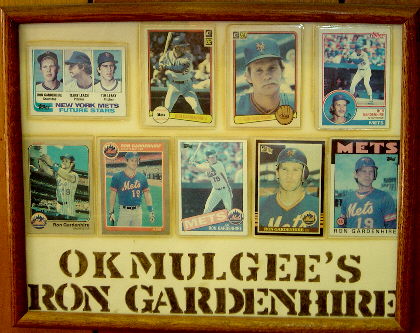
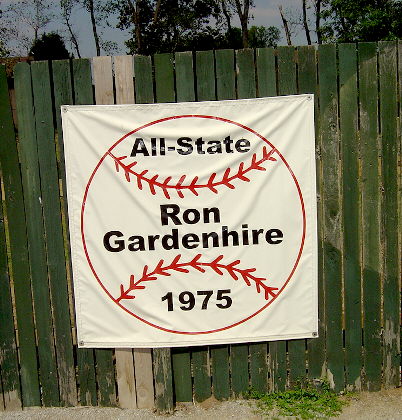
  • Jason Moran

    In the forty-eight years that Playboy has run an annual music poll, can you believe that only this year did it begin including a best jazz artist? That seems like a big oversight, considering that jazz makes an excellent backdrop for a little boot-knocking (as Playboy itself put it, the genre “holds a special spot in the Playboy lifestyle”). Naming Jason Moran to its top spot is a fine way to set things right. His restlessly innovative piano compositions combine technical virtuosity and a by-heart understanding of the jazz canon with motifs borrowed from hip-hop, funk, and electronic music. This month at Walker Art Center, Moran and his Bandwagon trio debut Milestone, a theatrical jazz suite inspired by art from the museum: works from Ellsworth Kelly, Robert Motherwell, Alice Neel, Louise Nevelson, and Adrian Piper. In particular, Piper’s photo-based The Mythic Being: I/You (Her) informs Moran’s composition, pushing his eclectic sound to new levels of experimentation. “There’s a lot of audio introduced in my music. The tape plays as another member of the band,” he says. “But it all works. We want people to take their seat belts off and trust that we’re gonna drive them to a safe place.” As for our little game, what if that place, for Moran, just happened to be a deserted island? As long as he could pack an extra-big pile of music–and fashion a generator from a coconut–it sounds like he’d do just fine.

    1. I’d have to bring my piano–the upright that I began on. My parents bought it when I was seven. My brother and I came home one day and there was this shiny new black Kawai piano with a red bow on it.

    2. Some pots–for cooking.

    3. A stereo, with speakers and amplifier.

    4. Music. Any Bach box set would last me til I died. That’s the root of a lot of music. I really don’t know Bach that well, so I think I could spend the rest of my life jumping in there. As far as jazz goes, I’ve listened to Thelonius Monk for so long that I can hear him playing in my head, so I don’t know that I’d bring his records. There’s this really obscure guy, Oscar Denard–I really don’t know how he’s doing what he’s does on piano. He has a genius way of combining traditional jazz piano chordal playing with phrases that are out of the ordinary. It gives you a great feeling of comfort and discomfort at the same time. I could get that sound into my brain for a few years. For hip-hop, I’d bring De La Soul, or something so lyrically potent that I could listen to it repeatedly, like Eric B Rakim’s Paid in Full. Or Public Enemy. Slum Village has beats and production that are just as rich as Count Basie’s music. In fact, I’d also get a box of just the beats or production by the producer J.D. from Detroit. That would give me someone to play with.

    5. I don’t know anything about this, but Adrian Piper is heavy, heavy, heavy into yoga. She’s the artist that I’ve based a lot of this work on for the Walker. If I could get a lesson before I left, and a couple of books, then my mind could get buff, and my body.

    Jason Moran and Bandwagon appear at Walker Art Center May 20 and 21 (www.walkerart.org; 612-375-7600).