Year: 2005

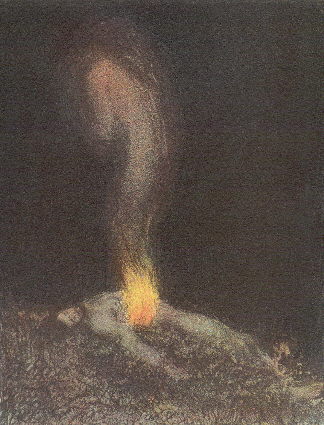
  • Some Things You Know About Your Heart, Some Others You Don't

    abelpann.jpg

    Abel Pann

    You know how your heart moves, how it lurches and staggers and sways like a beaten bell in your chest.

    You know how it sounds: That sound. Those noises. That familiar music. The rattle of a cold slate shingle banging up against your ribs. The squeak of its eraser at work somewhere just behind your sternum. Its fractured song.

    You know its strange language, all its clipped dialects and speech defects, the things it can and cannot say. The things it will not say.

    You know when it’s reaching for something outside its grasp, when it is straining to become a heart more human than any heart can ever be.

    You know the relentless rhythm of its shovel at work in the orchard at night. In the morning you can see where it has been foraging in the garden, the glistening scarlet trail in the dew where it has dragged itself to the river’s edge.

    You’re familiar with its murmurs and lullabies, its myriad prayers and laments, its low, protracted moans.

    You know when it has been looking at this world through the wrong end of a telescope and when it has bundled itself in burlap or nestled deep in shavings to protect itself from the cold.

    You know when it’s gone feral on you, when it is limping down off the mountain under a January moon, in search of companionship and sustenance from needy things and dead things preserved by the snow. You love and fear its animal moments, its wild spasms of longing and lust and unspeakable loneliness.

    You know that it does not live by breaking, that nothing truly broken can ever again be made fully whole.

    You see it in the space behind your closed eyes, a dark crimson planet wobbling through its slow, liquid orbit of the soul.

    You know what it looks like in a masked man’s hands; how it looks when it’s laid out and all alone on a stainless steel table, and when it’s simmering in a soup pot, and turning black at the bottom of a bucket on a hot dock. You know what it looks like projected on a giant screen and impaled at the end of a sharp stick.

    You know its heaves and hesitations, and how it learns, longs, wishes, and crawls for miles along dark roads following one dim, diminishing star on the distant horizon. You know how it holds on, gives out, gives in, and gives itself up, and over. How it gives up.

    How it goes on, and lives by beating, lives by bleeding.

    You still don’t know, though, still don’t understand, what your heart is. You still don’t know what it wants. This is one of those things it will not say. You only know that it belongs to you and you’ll never let it go.

    And when it grows weary you cradle it in your arms and talk to it through the long, dark hours. Together you keep your vigil, waiting for a sign. You plead and sing and whisper old, familiar stories and lies to it, until the beating stops, until at last you are carried off together into deep sleep, merciful sleep, into silence, into a safe place far beyond the terrifying world of dreams, and need.
    forsaken 2.jpg forsaken 2.jpg

    forsaken 2.jpg forsaken 2.jpg

  • What?

    What do you want from me? Answers? I’m out of answers, brothers and sisters. In fact, I’m completely out of questions. I’ve got a head full of nothing, and whatever nonsense or wisdom I might cough up isn’t going to be of any use to a baseball team that right now couldn’t find its way out of the belly of a sawdust whale if you supplied it with a can of gasoline and a box of strike-anywhere matches.

    Say what, Minnesota Twins organization? You want an apology? For what? What the hell did I ever do to you? You want me to apologize for that time I threw your Boy Scout Day promotional giveaway canteen in Turtle Creek when I was nine years old? Really? Is that what this is all about? Would that make you happy?

    Fine, then, I’m sorry. How about if I tell you I’ve been waking up sorry every morning since that disgraceful and uncharacteristic episode, and that I’m sorrier now than I ever was? How about if I tell you that that one youthful indiscretion completely ruined my life, and made my parents curse the day I was born?

    There. Does that make you feel better? Can we please shake hands and forget it ever happened and get on with more important matters now? Because, seriously, if you don’t get your act together by August 3rd, when the Lutherans invade the Dome, you’re going to be one sorry organization. If you give those people a performance that in any way, shape, or form resembles your performances of the last week, mark my words, or at least mark the words of my old friend Mick Garry, who knows only too well the havok Lutherans can wreak: those people will tear that Teflon Dump right down to the studs.

  • Kieran's Letter of the Month

    Paul Harstad is quoted [Red-Handed, July], “Egypt is a very interesting place… but why on Earth would they spend all that time, energy, and resources to build monuments to dead people?” To which a Rake editor has appended the comment “They should have built more libraries!” As a librarian myself, I applaud the sentiment, but feel obligated to point out that Egyptians built the greatest library of the ancient world—the Great Library of Alexandria. Likely if they’d built more, they would subsequently have been burned by invaders and other more practical people, like the one at Alexandria. Stone pyramids at least have the advantage of being rather less inflammable.
    Dennis Lien
    Minneapolis


  • Coming Up Fast

    On a recent Friday afternoon, a silver Porsche 993 Turbo emerged from the maw of the IDS Center parking ramp into the sun. The driver was Peter Kitchak. “Look,” he said to his passenger as he maneuvered the nimble two-seater through downtown Minneapolis, “the last thing anyone needs is for you to write about how we went one hundred miles per hour in my Porsche.”

    “Of course,” I said. “I’m not looking to get anyone in trouble.”

    “The truth is,” he said as we headed toward I-94, “I do all my fast driving on the race track.” I nodded.
    Kitchak is an intense, compact, silver-haired sixty-four-year-old whom you’ve never heard of. But that’s only because you aren’t an insider in the national real-estate scene or the international world of auto racing.
    In 1983, Duluth-born Kitchak founded Keewaydin Real Estate Advisors. He has brokered and managed real estate deals in New York City and many other U.S. cities, though most of his work is in Minnesota. He and his wife, Patricia, have lived in the same house in Excelsior, on Lake Minnetonka, for thirty years. Right now, he is orchestrating what he calls one of the most important projects ever in Minneapolis—the construction of the new Guthrie Theater. Kitchak and Keewaydin have managed the Guthrie project from the start, including the selection of French architect Jean Nouvel.

    Kitchak also races cars—in particular, Porsches that are a lot like his everyday ride. Back in the early 1970s, Kitchak raced on the club-car circuit—what he refers to as “parking lot Grand Prix racing.” But then he gave it up to concentrate on other things, like work and family. In 1990, though, Kitchak bought a high-performance, limited-production, historic Porsche. “I was thinking about racing,” he told me, “but I was suspicious that at almost fifty, I wouldn’t have the reactions and so forth to be able to race a car effectively.” He needn’t have worried.

    In 1992, he formed his own race team, Toad Hall Motor Racing. He started improving at the club-car level and by 1996 was driving well enough to enter his first professional race—the Minneapolis Grand Prix. His top-ten finish got him noticed. The following year he won the Minneapolis race and was invited to race in the Twenty-Four Hours of LeMans, the most famous endurance road race in the world. Only forty-eight cars are allowed to compete, each with three drivers. Driving on a French team, with Keewaydin as a minor sponsor, Kitchak, was the second oldest driver there—Mario Andretti was the oldest. (Andretti crashed that year at LeMans; Kitchak didn’t.)

    In 1998, as part of a five-man team driving for a team sponsored by Germany’s Konrad Motorsport, Kitchak hit the high point of his racing career. Driving a Porsche 911 Turbo, his team won the GT2 division of the Twenty-four Hours of Daytona, and placed fourth overall. In 1999, Toad Hall and Kitchak competed in the Speedvision World Challenge GT, a pro series. He came in second place, losing the championship by a single point. Today, Kitchak and Toad Hall aren’t in the big pro races anymore, but they still dominate in the smaller historic race-car events.
    Naturally, Kitchak knows what he’s doing behind the wheel, even when the wheel’s attached to a four-hundred-horsepower Porsche 993 Turbo capable of accelerating from 0 to 60 in 3.8 seconds and hitting two hundred miles per hour.

    Of our drive together, I can only say that for about thirty seconds, Kitchak drove very, very fast, that he accelerated with such swift and stunning power that I was forced back into my seat, ripples of adrenaline and something like euphoria coursing through my blood. I couldn’t move my head very effectively, but when I did manage to glance over at the driver, he wore a broad grin.
    —Bill Clements

  • Back Against the Wall Street

    These days at the complicated intersection of Washington and Broadway, the downtrodden God-Bless-You gang works in shifts along the stoplight medians. There’s a steady stream of traffic, and the location offers proximity to plenty of bars, fast food, and, perhaps most conveniently, the Jug liquor store across the street. There’s a guy with a cardboard sign on every island and corner at the intersection, some days six guys holding down every possible point of access to motorists. There’s also a gaggle of characters waiting on the sidelines, so to speak, sitting along the concrete freeway barrier and on the bus stop benches. It’s like pick-up basketball.

    You tend to see the same panhandlers every day. They appear to use each other’s signs. “Stranded,” one says, and nothing else. There’s the standard, “Homeless. Please Help. God Bless.” And “Homeless Veteran. God Bless America.” I also saw this virtuous variant recently: “I’m Trying to Get Back on My Feet.”

    “Three Children in Texas” seemed to strike an odd note, and I was uncertain whether the appropriate reaction was sympathy or scorn. I do feel sympathy, or rather compassion, for all of them, especially now that there seem to be more of them every day. My guiding principle is that if I encounter one of them at a red light, I give him some spare change or a buck, and each one has been unfailingly polite.

    These characters have become a fixture at street corners all over the city in recent years, of course, and some local authorities aren’t terribly happy about the situation. In April, Minneapolis Police Chief William McManus, in an effort to curb and manage aggressive begging, floated the idea of licensing panhandlers. The idea, which has already been enacted in such cities as Cincinnati and Dayton in Ohio, would require panhandlers to apply for a license at the government center and wear a photo ID at all times when working the sidewalks and intersections of the city.

    The regulars at Washington and Broadway didn’t seem terribly concerned when informed about McManus’ proposal. Most of them are veterans of the streets and downtown homeless shelters, and they’re inured to all manner of hassles and inconveniences. Scrutinizing the nuts and bolts of city code isn’t much of a priority to them. Finding a place to crash and rustling up enough cash to maintain their nomadic existence is challenging enough.

    I walked down there one sweltering afternoon. As usual, a handful of sign-wielding men was spread out at various corners of the intersection. A stocky, middle-aged guy was holding down the prime piece of real estate on the stoplight median at northbound Washington. He was wearing a heavy U.S. Army camouflage jacket with the sleeves cut off and a matching hat, and it was clear from his attitude and the apparent deference with which he was treated by the other regulars that he occupied a position of seniority. His name, “John,” was tattooed prominently on one of his forearms.

    “What the hell am I going to do with a damn license?” John asked. “They’re just looking for another way to waste taxpayers’ money. I already got a green book downtown that’s thicker than the Bible. I’ve been out here since ’96, and I don’t care if it’s raining or its twenty below, I’m out here every day monkeying around. This is how I live. I’m not gonna lie to you; I get drunk and eat, eat and get drunk, and then I look for someplace to pass out for the night. Sometimes it’s comfortable, sometimes it’s miserable, but I don’t have any use anymore for the bullshit shelters.”

    There is, apparently, a sort of unspoken code among the panhandlers at Broadway and Washington. A guy is given an opportunity to hold down a spot and make some cash, but everybody seems to have a clear concept of when enough is enough; when somebody’s obviously wearing out his welcome, the others who are waiting around won’t hesitate to let him know. I heard one guy haranguing a panhandler who was slumped against a light pole with an attitude of supreme indifference. “Come on, man,” the guy said with obvious exasperation. “You’re not even working it.”

    There’s also a weird sort of camaraderie among the panhandlers. Many of them have known each for years. “I can’t stand most of these assholes,” John told me. “But we eat and drink and get drunk together, and a lot of us will pool our money when we get low.” On the day I stopped by to talk, he had a modest goal. “Maybe some of these people come out here thinking they’re gonna get rich,” he said. “Plenty of them don’t have any damn sense. If I get $6.50, that’s enough to get me through the day. Some days I do a lot better than others. People aren’t all bad, I can tell you that. There are lots of good ones out there.”

    One day in July, in the rain, I saw a motorist hand one familiar member of the God-Bless-You gang a pizza box through a car window, and a few days later, as I waited at the stoplight, there was a guy who was holding an entirely blank piece of cardboard. “What’s your sign say?” I asked. “You know what it says,” he said, without the slightest hint of hostility. He was, of course, absolutely right.—Brad Zellar

  • The Sweet Taste of Liberty

    Until June 14, Camp Gitmo, the U.S. military detention center at Guantanamo Bay, Cuba, was a controversial prison—to some, a necessary response to the war on terror; to others, a Bermuda Triangle of legal rights where suspected terrorists serve indeterminate sentences—but still, in pretty much everyone’s mind, a prison. Then, Senator Dick Durbin, a Democrat from Illinois, likened the interrogation techniques that Guantanamo’s proprietors sometimes employ to those used “by Nazis, Soviets in their gulags, or some mad regime.” Critics of this assessment responded quickly, emphatically, and with a surprising degree of culinary discernment. Not only was Guantanamo not a gulag, they insisted, it was actually a world-class vacation resort and a great place to eat.

    Rush Limbaugh dubbed it Club Gitmo, “a one-of-a-kind resort on the west coast of Cuba overlooking the bay” that served as a “tropical retreat from the stress of Jihad.” Dick Cheney took his cues from Limbaugh, claiming that the prison’s detainees were “living in the tropics” with “everything they could possibly want.” Duncan Hunter, a Republican congressman from California, lauded Gitmo’s spa-caliber cuisine and the kitchen staff’s free hand with portions. Detainees get “double vegetables and two types of fruit,” he boasted. “The inmates in Guantanamo have never eaten better, they’ve never been treated better, and they’ve never been more comfortable in their lives than in this situation.”

    Throw in two fifteen-minute showers a week, spacious eight-foot-by-eight-foot detention suites, and some relaxing enforced solitude, and, well, you can see why the editors at Condé Nast Traveler are kicking themselves for ranking this suicide-optional luxury hideaway so low on their 2005 Hot List. If anything, though, even Gitmo’s most avid boosters have been selling the place short. Why? Because along with the sumptuous chow and the breezy island ambiance, there’s also enough booze at Gitmo to drown the French Quarter. “On average, people will increase their alcohol consumption by three hundred percent when they come here,” explained combat stress control specialist Sgt. Michelle Olson in an article recently published by the American Forces Press Service.

    The prisoners’ favorite drink? The Gitmojito, of course. A refreshing twist on one of Cuba’s signature cocktails, it’s made with fresh spearmint leaves, limes, sugar, rum, and a generous splash of urine. Okay, just kidding there. Guantanamo detainees are sometimes rewarded with candy and ice cream, but alcohol is strictly reserved for U.S. military personnel. Why are the guards so thirsty? Not because of stress, that’s for sure. Instead, as Rush Limbaugh or Dick Cheney could tell you, it’s because this parched, semi-arid paradise, with its lush bowers of razor wire and acres of pristine land mines, is even more fun when you’re not chained to the floor and forced to crap on yourself. Still, an important question remains: Are Gitmo’s bartenders using premium rum, like Bambu or 10 Cane? If not, then somebody call Amnesty International! Plain old Bacardi Superior is torture.

    —Greg Beato

  • Shimmering Surfaces

    The three best reasons for being an academic, as is well known, are June, July, and August. Especially on the occasions when the University of Minnesota conspires with the McKnight Foundation to allow one to spend those months reading and writing about a really genial poet for instance, a character from the Later Roman Empire called Ausonius.

    There is a serious side to this enterprise, of course. Ausonius is a wonderful case study of an intelligent Roman who went Christian at around the time most Romans were going Christian, during the fourth century A.D. Watching him integrate ancient science (astrology, for instance) into Christian cosmology is as interesting as considering the relationships between religion and Darwinism. (Am I alone in wanting one of each kind of fish symbol to stick on the back of my car?)
    But there is also a fun side to old Ausonius, something agreeably fin de sircle. Sometimes I fancy I can hear him calling to posterity in the way that James Elroy Flecker appealed to a poet a thousand years hence:

    But have you wine and music still,
    And statues and a bright-eyed love,
    And foolish thoughts of good and ill
    And prayers to them that sit above?

    On one level, then, a poet who promises a summer of roses and wine. Which is as it should be. Roman emperors in those late days lived not at Rome, but on the frontiers of Empire, where they could face down their Germanic neighbors, folk who spoke limited amounts of Latin and smeared butter in their hair instead of scented olive oil (a little dab will do ya). Ausonius was tutor to the son of one such emperor and so spent much of his adult life at Trier on the Moselle, then as now famous for its vineyards. His roots, however, were in Bordeaux, and to this day a well-known wine chateau in Saint-Emilion on the right bank of the Gironde is named Chateau Ausone in his honor (but you know what they say about the wines of Bordeaux—if you have heard of a claret, you can’t afford it).

    For a poet so associated with wine, Ausonius was singularly fascinated with water. Icarus falls into it and Christ walks on it. Ausonius enjoyed looking through and across its shifting, shimmering surfaces since, like many a poet, he was interested in fishing; he was amazed, too, at the speed and ease with which a boat could carry him back and forth between his country villa and the city of Bordeaux. In fact, his longest poem is a dreamy description of the Moselle: The river cuts a canyon through the landscape, barges pass up and down, the bargees exchange badinage with men cultivating the hillsides. And in a contemplative passage, the poet wonders at the way fish cannot breathe out of water, while fishermen cannot breathe in it. I have a theory that Ausonius’ interest in water has to do with his shifting sense of himself, and so with the sort of Christian prayer that formed in his heart as he stood before the Most High God of the philosophers.

    But that is another story. More immediate is the fact that he would certainly recognize the modern Moselle, its vertiginous hillsides still planted with lines of vines and crowned with country mansions. And I feel sure he would enjoy, as I did the other night, a white wine made from the Riesling grape, available locally in the characteristic slim green Moselle bottles at around twelve dollars. (I do not know the exchange rate for denarii, but I do know a good story about a long-haired barbarian chieftain exchanging his daughter for an amphora of Roman wine.)

    This Riesling is the 2001 vintage of Robert Eymael’s Mönchhof estate. The name Mönchhof (monk court) comes from the Cistercians who owned this vineyard from the twelfth till the beginning of the nineteenth century, when Napoleon annexed all of this border region for France and the Eymael family acquired the vineyard. The result of this long history of cultivation is a wine that is on the sweet side, but would be pleasant with many sorts of cheese, fish, or poultry. The color is a consistent pale yellow, but each sip recalled a fresh sort of fruit. I thought I had it down as reminding me of pineapple juice when the next mouthful recalled apples.

    Plus ça change, shimmering surfaces indeed. There is also a clear, uncloying aftertaste. What is it about this grape that makes it so infinitely various in its flavors? There’s a question to talk over with Ausonius on an August afternoon.

  • It's Not The Size of Your Skyscraper…

    Has Minneapolis gone crazy for cantilevers? We humbly submit proposals for other buildings that could benefit from this glamorous architectural amenity.

    1. Keep an eye on rising gas prices while enjoying your double-dip cone—inside the new Loon grocery/gas station/ice cream parlor at 28th and Lyndale.

    2. In 1967, the Yippies wanted to levitate the Pentagon. If they’d only had an engineer and a cantilever!

    3. Safety solutions at Ground Zero. Why not turn the Freedom Tower on its side? Voila—the Freedom Walkway to New Jersey.

    4. Putting a stop to needless, hurtful speculation.

    5. The next phase of Cedar Lake’s Flatpak House eliminates double-decker bikes from the gene pool—or at least from Kenilworth Bike Path.

    6. Sex World’s “West Schwing” arouses envy. It is not allowed, however, to actually touch Choice Gentleman’s Club, across the street.

  • Rough Hewn

    Are you over flip-flops, baseball caps, and gauzy summer skirts? Well, it’s high time you left your 50th & France or Grand & Victoria turf. That was our realization, after we got an eyeful of downtown Minneapolis nightlife recently. There, we found bold bicep tattoos, curvy chrome two-wheelers both motorized and human-powered, and heads wearing the most daring of chapeaux! But what is the requisite tough-on-the-town fashion statement? No, it’s not the gang-inspired “I’m down with the Midwest!” sign, as flashed by the blond bicyclist cutie here. It’s sunglasses. After all, as Petula said of downtown, “The lights are much brighter there.”

  • Naming in Vain

    If you casually mention at a social gathering that you think little boys are more destructive than little girls, most people will probably agree. Even those who do not will probably give scant notice to the fact that you were making assumptions about behavior based on a physical attribute—a practice more commonly known as stereotyping. Now, what if you said something like, “There’s a new boy in my kid’s class named Da’Quan—I bet he’s poor and black.” Assuming you run in a politically correct crowd, you will be called a stereotyper, a racial profiler, or worse.

    Yet whether we openly admit it or not, we do conjure certain images for certain names. I admit that when I hear “Demetrius” or “Marquis,” I do not expect to see a kid with blond hair and blue eyes.

    What’s in a name? Plenty, according to economists Steven Levitt, who is white, and Roland Fryer, who is black. They decided to see if African-Americans with distinctively “black” names like DeShawn or Precious had harder lives than others. The researchers used birth certificate data from the sixteen million children born in California since 1961, including name and gender, along with the parents’ marital status, ZIP code, and education. They discovered that in the early sixties, blacks and whites drew names from the same general pool. With the advent of the black power movement, that quickly changed. In 1970, girls born in black neighborhoods received names that were twice as common among blacks than whites. Today, four out of every ten black girls born in California receive a name that none of a hundred thousand white girls receives. And a third of the black girls born there have a unique name.

    Levitt and Fryer concluded that a person with a distinctively “black” name does indeed have a worse life outcome than a Claire or a Luke. They reasoned that the demographic profile of the parents of uniquely named children—who themselves are unmarried, poor, undereducated teenage mothers with distinctive black names—doomed these kids to lives of poverty. However, they blithely attributed the mothers’ willingness to bestow “black” names as an attempt to show “solidarity” with the black community.

    That may be true, but there is perhaps another factor at play. These young, single mothers cannot give their children the security, education, and material comfort of more successful families. Perhaps bestowing a unique name on their children is a naïve attempt to leave a legacy—an asset, if you will—to kids to whom they can give little else.

    As far as I know, no one has yet analyzed the kinds of names that relatively affluent, educated black parents give their children. Among my family and close African-American friends, there is a Joseph, two Alexanders, and a Quinn, a Brooke, a Carson, a Colin, a Melanie, a Mitchell, and a Johnny. None of their names makes the California top twenty “blackest boy” or “blackest girl” name lists. And, though it may make me sound like an assimilationist, I take comfort in that. I thought long and hard about how my sons’ names would play when they were adults. In fact, I used to joke that they would make a great impression on letterhead, or being read aloud at a college graduation. I did not want their names to broadcast their ethnicity to the world—or camouflage it. I also did not want them to be unfairly judged before they ever recited their first alphabet in class.

    Another study, from the University of Florida researcher David Figlio, confirms what African-American parents have long suspected—that teachers’ expectations of their students are based in part on names. According to Figlio, black students with unusual (i.e. “black”) names are less likely to be placed in gifted programs than black students with more mainstream (read “white”) names. He also found that students with Asian names were more often placed in gifted programs than siblings with similar test scores and common American names.

    In other words, there is an academic pecking order in our schools that appears to be linked to students’ first names, but is really tied to expectations. What self-respecting teacher would admit to doing this? Can you imagine an employer conceding that it screens prospective employees based on their names? There is empirical proof that it does happen—both in education and, according to several resume-screening studies, on the job.

    I think stereotyping based on names is wrong. I also think we all do it. Given that reality, the efforts of poor, single mothers to leave a legacy by giving their children “black” names are sadly misguided. Unwittingly, they are making an already tough road for their kids tougher yet.