Month: May 2006

  • And at its Center, A Confused Man

    thirdman1.gif

    The Third Man, 1949. Directed by Carol Reed, written by Graham Greene (with uncredited help from Alexander Korda and Orson Welles). Starring Joseph Cotten, Alida Valli, Trevor Howard, Bernard Lee, Paul Horbiger, Ernst Deutsch, Siegfried Breuer, Erich Ponto, Wilfrid Hyde-White, Hedwig Bleibtreu, and Orson Welles.

    With the person of Holly Martins, Graham Greene created a character I can relate to more than anyone else on the silver screen. Holly is:

    Lonely,
    Confused, and
    In Over His Head.

    Just like I am on most days. That’s one of the reasons why I love The Third Man more than any other movie.

    Just look at Joseph Cotten as Holly Martins. His loping gait, sour mug, his desire to come to the bottom of a mystery while at the same time failing to realize he will never get to the bottom of any mystery, ever. Look at him drinking, trying to bully those people who will not be bullied by the likes of him. Holly Martins: a fellow lost in his dime store novels who can’t do the right thing if was written on a bank note, locked into a safe and rolled over on him. Holly Martins: split into a million pieces, loyal to a friend he barely knows, just as easily in love with a woman he’s just met, ready to turn the world upside-down for a secret he doesn’t even come close to knowing.

    Holly came to Vienna to get hooked up with a job. Vienna is a lovely wreck, quartered in the wake of the Second World War, run by the Americans, Brits, French and Russians. It’s a city of great secrets, a city desperately trying to keep its head above water. Holly doesn’t know any of this, nor does he care. His old pal from school–Harry Lime, you know, the guy who could get away with anything–wants old Holly, the dime store novelist, to write propaganda for his medical organization. There goes Holly, full of spit ‘n’ vinegar, fresh off the train, walking under ladders, and then, whoops, dumbfounded when he hears his pal is dead, struck down by a car and carried to the side of the road by two men.

    The Porter of Lime’s apartment, informing Martins of Harry’s death: “He is,” says the Porter, pointing up, “how do you say, in hell?” Pointing down. “In heaven?”

    That’s bad. Holly has no money, no prospects, and since he dropped everything to come to Vienna, why, now what’s he going to do? Look at him, right there, standing at the funeral service, eyebrows furrowed, looking like the lovely dimwit that he is. Who can’t feel for this noble dope? He sees Lime’s girl Anna for the first time, falls in love with her in an instant. Major Calloway of the British forces is also at the funeral, feels sorry for the poor Holly, and asks him along for a ride to town and a free drink.

    Holly will drink all right. And then, when Major Calloway informs him that it’s probably to the world’s benefit that a rogue like Harry Lime is dead, Holly tries to punch the captain. And fails. In fact, Holly gets punched, shot at, chased, and bitten by a parrot. Worst of all, he falls as deeply in love as he is capable. All the while he can’t protect himself, can’t do anything but shadow box. And lose.

    Amidst the ruins of this once-great city, Holly bumbles around trying to get to the bottom of his friend’s death, which he believes was a murder. Government officials and evil henchmen in rabbit-fur coats and bow ties ignore him for the most part, both suggesting he should leave, but both realizing he probably won’t amount to much whatever his choice. Holly can stay or leave for all they care.

    He’s a hack writer who’s so oblivious he’s unable even to lecture a group of bookworms about “The Crisis of Faith”, even though that title sums up his situation perfectly.

    Like a hero from the cheap Westerns he’s moderately famous for, Holly goes in search of Lime’s murderer without bothering to consider who might get hurt or even destroyed. The more involved he becomes, the more trouble Anna gets into (for the fake passport Lime created for her). It takes hours of discussion and piles of evidence to convince Holly that Harry Lime was a monster, selling diluted penicillin for an outrageous price, a practice which maims or kills the young children to whom it is administered. When he’s convinced, he’s fully convinced… until the next day. Holly’s a weathervane, unable to see Vienna, unable to see Anna, unable to grasp anything. Look at him stumbling through the ruins of Vienna, her wet cobblestone streets filled with abandoned cars, half her buildings blasted apart. Notice the bent old woman straining to push an abandoned Merry-Go-Round for her child, who sits atop the plastic horse looking bored. The old man selling balloons–to whom? We see this and are moved; Holly can’t see past the end of his nose. And yet we’re still moved.

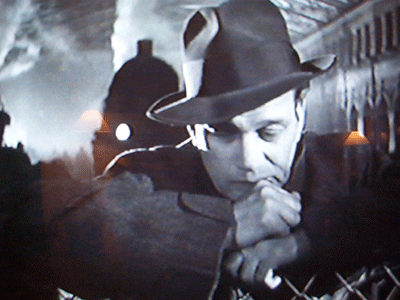
    Look at Holly there, leaning against a fence at the train station. He can’t save his girl from the forces of evil, from the lugubrious forces of bureaucracy, from the whims of her damned heart. “I could stand on my head and make all sorts of comic faces, and I wouldn’t stand a chance, would I?” he asks Anna. Of course not. For that’s Holly all over–a collection of parlor tricks, and when the shit hits the fan he’s bewildered and helpless. She loves an evil man, why can’t she love him? But Holly isn’t a good man or an evil man. Nothing he does in this film on his own works out; nothing he’s prompted to do does either. He gets his man, but at what cost? The reality is that Holly doesn’t even know himself.

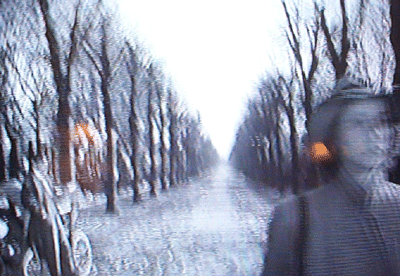
    In the end, virtually no one was saved. In the final shot, Alida Valli marches toward the camera with a melancholy determination, right past Cotten, as the leaves tumble slowly around her. The black market still operates, children will live and die, Anna will grieve forever, and Holly’s work is as meaningful as those dead leaves. Holly just watches her go, and does nothing. After all, there’s nothing he can do.

    thirdman2.gif

  • Pine Eyes

    I’ve reserved a special place in my heart for the St. Paul-based Zeitgeist new music ensemble, probably because cultivating new classical and chamber music seems like such a long row to hoe. Have I mentioned how I hate the term ‘classical music,’ by the way? Probably. The folks at Zeitgeist prefer “new music” or alternately, “the music of our time” (get the name Zeitgeist). But popular music listeners hear new music all the time, of course. It’s just not as often that we hear it performed by a woodwind, piano, and two-percussionist quartet.

    I was quite pleased last summer, when I first learned that Walker Art Center would be co-presenting a new Zeitgeist-mastered piece. Happy to see our hometown players reprezent on the largely international Walker stage. Trend Alert: This is going to be another one of those “evening-length, multimedia” pieces that the Zeitgeist troupe is so fond of, with something for the eyes, something for the ears. Full sensory immersion. Nothing gets bored–except, perhaps, for the sniffer. (And I’ll decline to note which theaterhouses smell…. But you know who you are!)

    Whatever the intentions of Zeitgeist, the evening-length, multimedia pieces I’ve seen have been nothing short of fabulous. Mary Ellen Child’s Dream House and Zeitgeist’s own Shape Shifting come to mind. This newest one, Pine Eyes, is based on Pinocchio, and it features music composed by Martin Bresnick and video by Puppetsweat. Zeitgeist, of course, plays the tunes. There’s a behind-the-scenes look called “The Making of Pine Eyes” that’s happening tonight at the Zeitgeist home studio in lowertown, Studio Z. Northwestern Building – 275 E. 4th Street, St. Paul; five bucks; 651-755-1600.

    Pine Eyes then plays June 3.

  • No, Truly, It Breaks Your Heart

    garage-stars-2.jpg

    Never quite the bottom, and still rising. That old mystery: buoyancy. The body’s ability to float, the mind similarly gifted.

    Emerging in a green world, seemingly intent on growing ever greener. The clear, bright splendor of other blooming and glistening things. The furtive kingdom, underworld, underfoot, moving in the shadows at midnight, creeping in the wet grass.

    How much around us is ignorant of all the stuff that hardly matters? What do you care? How much? Show me, please. Catalog your cares. Defend your carelessness.

    When the sun goes missing, gets overrun, falls, sinks –what becomes of your heart? Can you see in the dark, sense the things still moving, growing, settling, quietly disappearing? How would you characterize your retreat?

    Go ahead, keep it to yourself, hold it all close. You’ll be carried along nonetheless; you’ll go somewhere whether you like it or not.

    Older, you start to recognize the obvious and unavoidable things that have been there in you all along. You aren’t what you once were. The seasons startle you like never before. You can’t sleep through the sun.

    And every morning you open the closet and confront your stories. Your old shoes –there seem to be more of them by the year– are your most reliable historians, prompts, the scrapbook of who and where you’ve been and what you’ve allowed yourself to love.

    And the thing is, it doesn’t make you sad at all anymore, or barely.

    garage-ghost.jpg

  • A Miscellany After a Busy Weekend

    A long weekend and I’m still tired. Guests on the horizon–four adults, two children, and a pair of eight-month old twins–and I haven’t yet mowed the lawn, cleaned the house, or etc. Had the movies I sat through this weekend warranted discussion, you’d have a pair of reviews. However, they stank, so I’ll spare you the titles, and the details.

    What I have for you is a few links to other sites that have actually done their work lately:

    WellesNet, the Orson Welles web resource. Frankly, the guy who runs this amazes me–how he manages to post something new about the big boy (my favorite filmmaker in case you hadn’t guessed) nearly every day is baffling. Yet he does. Today’s entry is OW’s wonderful speech for receiving the American Film Institute’s Lifetime Achievement Award. The guy was eloquent, you have to admit.

    From one of my addictions, the New York Times Obits: Paul Gleason (Paul Xavier Gleason, to be exact) died, famed for playing Principal Richard Vernon in The Breakfast Club; as did Ted Berkman, who wrote Ronald Reagan’s fabulous Bedtime for Bonzo.

    In July I’ll be reviewing two of Preston Sturges’ great films, Sullivan’s Travels and The Lady Eve, which the Walker will screen in Loring Park this July. Check out the Sturges website in the mean time.

    That’s all for today. Over and out.

  • Is Biking, Is Not Canoeing

    Maybe it’s because I spent the better part of my holiday weekend cooking on the Namekagen River–where I slept under the stars but also encountered various flotillas of holidaying drunks who hollered “Whooooo!,” seemingly out of nowhere. (At the sight of me?) Well, whatever this feeling is, what’s clear to me is that I don’t feel entirely ready to reenter the civilized world. Not just yet anyhow.

    Here’s something that teeters on the edge: Altered Aesthetics is hosting a bike-themed art show. On the AA homepage, there’s a beautiful image of what I think is the Midtown Greenway at dawn, taken just after the Dean Parkway exit but well before coming upon Lake Calhoun. Now, I’m not necessarily venturing a claim against cycling here. I’m an enthusiastic one m’self. All I’m saying is that there’s something about riding down that trail in the morning, and then turning north onto Cedar, that, however fleetingly, delivers me out of this city. In any case, the AA show features one hundred bike-themed works by forty-some artists. They should do the same thing for canoes sometime.

  • Picnic Love

    foodiePotatoSalad.jpg

    It’s all about the Potato Salad.

    This is sort of an anti-pasto potato salad.

    This one is herby and light.

    This one, made with french fries, won a Food Network contest.

    Martha’s All American version.

    Ach du lieber, wir essen Kartoffelsalat. Sehr gut, ja?

  • Uncle Jumbo's Playground

    uncle jumbo-7.jpg

    –Illustration by James Dankert

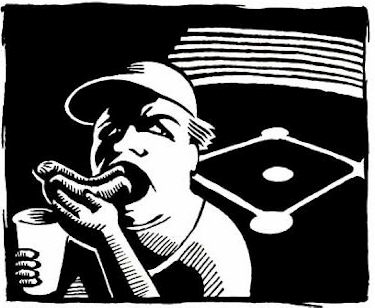
    The things a guy will do for a free burrito. It’s humiliating, but a deal’s a deal, even when it’s not much of a deal. A couple weeks ago I insisted I wouldn’t write a damn word until the Twins clawed their way to .500. When it became apparent that that wasn’t likely to happen anytime in the next, oh, four months, I said that I’d cough something up when they managed to sweep a series.

    So now, since Zeller seems to have entirely lost interest in the greatest game ever invented, a game that he can never forgive for being so difficult for him to master and so damn easy for a fat guy like me, I guess I’ll finally step into the breach.

    I’ll say this much for myself: I can fill a breach like nobody’s business. And at a time when my weight, thirst for cheap beer, penchant for public urination, and economic status (such as it is) should have driven me into the greasy and indiscriminate arms of NASCAR Nation, I’m still a baseball fan. And I’m still a Twins fan, even though there are increasingly days when I curse the team with every labored breath left in my lungs.

    I don’t understand how a team can play like a bunch of slow-pitch softball hogs one day, and like a World Cup soccer team with a sieve for a goaltender the next. It makes no sense to me, and it drives me into raging fits of bellowing public (and private) spectacle. If you want to really ruin your Memorial Day picnic, go ahead and try to imagine Jumbo alone in his sweltering attic apartment in his ample white Jockey shorts, stomping around and howling and looking sort of like a red, sweating sausage that’s spent too much time on the hot dog spinner at the SuperAmerica and is just about ready to explode.

    There you have it. Welcome to my sad little world. The people who live below me spend a good deal of time banging on the ceiling with what sounds like a broomstick.

    To make things even worse, my old friend Junie “Boneyard” Sandoval was crashing with me for a couple months after his battleaxe of a wife threw him out of their place in Fridley. He was in a bad way, but I was none too happy to have him in my private space, of which I occupy plenty all by my lonesome. It was hard to watch baseball games when my house guest insisted on listening to the Steve Miller Band’s Greatest Hits over and over at maximum volume. I also don’t like to watch anybody play air guitar, particularly another fat guy without a shirt on. I’ve known Junie since grade school, but I discovered that that’s unfortunately not a good enough excuse to still be friends with anybody more than thirty years down the road. I realized that we had absolutely nothing in common other than that we were both thrilled to see Dennys Reyes, a guy almost as fat as either of us, pitching in the Major Leagues, and we both shopped at the Big and Tall Men’s clothing store. Neither of us is what you would call tall, but I suppose we fit pretty much any reasonable definition of big.

    Things finally came to a head –or, rather, to blows– when I walked into my apartment the other night and found Junie wearing my clothes, eating my Captain Crunch with my spoon, out of my plastic ice cream pail. I also discovered that he’d apparently spent the day drinking his way through the last of my chocolate milk and beer. I always have plenty of beer on hand, which would explain Junie’s extreme state of inebriation.

    I kicked his drunk ass out of my apartment and sat down for the first time in weeks to watch a baseball game in peace. I was pretty uptight and regrettably stone-cold sober, but the Twins lit up Milwaukee for sixteen runs (and coughed up ten: the softball hogs and the sieve goaltender were in the house). It was a beautiful night, my apartment hadn’t yet been transformed into an inferno, and I was mercifully reminded that I’m still capable of experiencing something approaching serenity on an occasional basis.

    The Twins are 6-2 since I sent Junie packing, and though I’m sure as hell not stupid enough to get truly excited by that fact, I still have to admit that the basic math of the the last week would have me breathing a little bit easier if it wasn’t a hundred degrees in my apartment, if I wasn’t in such lousy shape, and if I was, in fact, actually capable of breathing a little bit easier. Which –tough luck for me, I suppose– I’m unfortunately not.

  • Messengers

    laughter.jpg

    There were three of them, crowded into the front seat of a Volvo station wagon that had 150,000 miles on the odometer. They were angels, and they liked to drive with the windows down and the music loud.

    They seldom had disagreements about the music; all of them shared a taste for early Elvis Costello, the Pogues, and Buddy Guy, among others. They covered a lot of miles in that Volvo, and had a huge collection of tapes.

    They’d been chosen for their stoic, no-nonsense demeanors. They weren’t happy to be dead, and they’d all been taken quickly, violently, and much too young. None of them were much for conversation, but they found things to say to each other as they drove to and from assignments.

    It never failed to irritate them that people seemed to think that angels were supposed to be comely. In truth, most angels of their acquaintance were unattractive and ungainly, and there was generally something downright terrifying about the very best and most effective ones. They certainly didn’t look anything like what the gift shop loonies and inspirational quacks liked to imagine.

    Angels –the real ones– were expected only to be efficient and to deliver their message loud and clear. That message tended to be relatively simple and blunt.

    They would get their human assignments trussed and blindfolded in the backseat of the Volvo, and then drive them into dark places, where they would release them into a patch of intense and paralyzing light.

    They were epiphanic messengers, the sternest of the angels, and were assigned the hard luck cases and squanderers. Their advice, such as it was, was pretty much boilerplate by this time:

    Straighten up and fly right.

    Wake up and smell the coffee.

    Get your shit together.

    Pull your head out of your ass.

    And: Live, you lucky bastards.

    anarchy.jpg

  • Cry Me a River

    The weekend planner: Not so easy this weekend, since I’m subjecting myself to an under-planned canoeing excursion, as not even half-baked by the rather impulsive boyfriend.

    But if I were to be sticking around town this weekend, here’s what I’d probably be up to:

    The Fusion Fashion Event, featuring work by many-a local clothing designers at the Varsity Theater.
    And speaking of local designers, The Design Collective is having a big Memorial Day Weekend Sale.

    HowWasTheShow.com‘s fourth anniversary show featuring Alva Star, The Alarmists, White Light Riot, and our dear friend, the ever-optimistic, photo-snapping David DeYoung–or, as the man himself likes to say, the “best-paid man in local music journalism,” since he makes his living doing something else.

    Flaming Film Festival–especially all that B-Boy shit, yo.
    Speaking of which, there’s also the Homocore Minneapolis Show, on Sunday, featuring an evening of “Homo-hop.” Ha! Actually, I’m expected to have had my fill of river water by this late date in the weekend, and so I might actually catch this one.

  • Guns and Flies

    proposition1.gif

    The Proposition, 2005. Directed by John Hillcoat, written by Nick Cave. Starring Guy Pierce, Ray Winstone, Emily Watson, Danny Huston, the foppish David Wenham, Richard Wilson, and the woefully underutilized John Hurt, and two of Australia’s greatest aboriginal actors: David Gulpilil (famous for Walkabout) and Tommy Lewis (from The Chant of Jimmy Blacksmith).

    Now playing at the Lagoon, instead of the Uptown, where they’re screening The Celestine Prophecy. Apparently, the finest films in the world don’t have a home at this Landmark Theatre.

    For those of us who love westerns–and I count myself amongst that forlorn group–The Proposition is as welcome as, well, as welcome as a the ghost of Sam Peckinpah in a lonely Montana hotel on a cold evening. Like old Sam’s best movies, this one is dirty, has vile characters, bucketloads of extreme violence, a morally compromised society, and gorgeous photography. Not to mention a decent script that sometimes falters but nevertheless serves its masters well. Like the films of Sam Peckinpah, this one’s being criminally neglected, shuffled off to the shoeboxes at the Lagoon theater, waiting to vanish like a bad dream.

    Even better, The Proposition doesn’t soak itself in Peckinpah’s drunken machismo, has a sharp female character who is not simply a whore or a saint.

    The facts: Captain Stanley (played by Ray Winstone, whose tense performance almost gave me a headache) and his scurrilous crew blast apart a brothel in order to apprehend half of the infamous Burns gang. After killing scores of prostitutes, the captain gets his men, Charlie and Mike Burns (Guy Pearce and the angel-faced Richard Wilson). Stanley makes a deal with the intelligent Charlie: if you go into the outback and murder your brother Arthur, the maniacal leader of the wicked clan, then the baby, Mike, won’t die at the hangman’s noose. Charlie accepts, is given a gun and a horse, and makes his way into the unforgivable desert.

    Nothing, of course, can go right. The Proposition cuts between the two societies, that of the criminal in the desert and the face of law and order in the town. But the Captain has troubles: his men, as rotten as the criminals they pursue and nearly genocidal in their attempts to rid Australia of aborigines, don’t trust him; his wife (played by Emily Watson, a beacon of cleanliness and clear morality in this wasted land) seeks justice for the murder and rape of her best friend (at the hands of the Burns gang); his superior Eden Fletcher (played by David Wenham, whose lispy performance is ridiculous, the only weak spot in this fine film) is after him to get results, and eventually disrupts this proposition by having the feeble Mike Burns flogged to death.

    Nick Cave’s screenplay is nice, even as it threatens to slog into Cormac McCarthy’s He-Man Spiritual Territory. I might also add that Cave’s soundtrack is astounding, and should be required for future westerns. But I digress: the menacing Arthur burns, played with one of the great slow-burners in Danny Huston (John’s grandson) is simply fabulous–a philosophizing bastard who stares at sunsets and ruminates on love and family. John Hurt is along for the ride, acting with the subtlety of John Lovitz in his Subway ads, but it’s great to see the old coot brandishing a gun, snot dripping from the end of his nose. The film is relentlessly dirty, and insects are everywhere, crawling on men and women, biting and buzzing.

    One could argue that The Proposition is a study of the madness of society versus the madness of family. For the Burns’ clan is, indeed, a close-knit family who might even be said to love one another. Captain Stanley’s little town in the middle of nowhere is a civilized place, where no one trusts one another and deceit is the first order of business, as long as everything is in its place. But the Burns’ are vile creatures, rapists, murderers, and in the final analysis, no one emerges clean and clear and unwounded.

    The Proposition is a film you could analyze until the dingoes come home, and in doing so find scores of little contradictions, mistakes, and etc. It’s not a perfect film, but for the lover of the western, it is perfectly entertaining, provided you can stomach some its violence. I could, and would see it again.

    proposition2_.gif