Month: July 2006

  • Friday on Monday

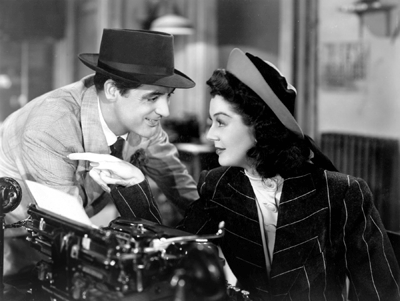
    His-Girl-Friday.gif

    The things I do for this job: contractual obligations force me to sit inside air-conditioning and watch the brainless Talladega Nights. But if you’re wise, you will wander down to Loring Park to endure brain-melting temperatures to enjoy Howard Hawks’ witty and wonderful His Girl Friday, part of the Walker’s Summer Movies and Music.

    I like heat and I love His Girl Friday. If I had my druthers, I’d bring a cooler and some wheat beer, beer glasses to drink them from, and my wife would have a armload of comestibles that would include her homemade chutney and summer corn relish.

    Now I sound like a poor-man’s Stephanie Marsh. His Girl Friday is simply the happiest, hippest film to come along this summer, and that’s saying a lot considering we’ve already seen Sullivan’s Travels. Girl Friday involves divorce, capital punishment, the press, slapstick, rekindled love affairs at the expense of witless sad-sacks, with the charming Cary Grant and the equally charming but much more sexy Rosalind Russell.

  • Gimme Grain!

    At 9:28 a.m. thirty-one grain traders are milling around a trading pit—an octagon about the size of a pontoon boat, recessed into the hardwood floor—at the Minneapolis Grain Exchange. Steps are wide and lazy, chests are thrust outward. Several of the men (and they are all men) discuss the price of downtown real estate; a few ruminate on Gophers football; nearly everyone chews gum, frantically. Then, at five seconds before 9:30, voices trail off, order books open, and feet are squared. A deep breath passes over the assembly and there’s a brief silence as attention focuses on the flutter of international commodity values changing on the price board above.
    At 9:30, exactly, a bell rings.

    “Half! Half! Half!” screams a muscular trader. His face is three inches from that of a man ten years his senior, who calmly scribbles something into a notebook. Nearby, a man in a red-and-black-checked coat bellows “Quarter!” as four traders crash toward him at the edge of the pit. Others collapse into scrums of shoving, screaming, raised arms, and pointed fingers—despite the fact that the trading floor surrounding them is a third of an acre of mostly empty, silent space. Things continue like this for roughly ten minutes, during which time approximately ten million dollars in business is done. Then, almost as suddenly as the action erupted, it subsides, and the traders mostly just stand around, watching the price fluctuations in Kansas City and Chicago, and occasionally calling out offers. By the end of a four-hour trading day, an average of a hundred million dollars has been transacted this way.

    For nearly as long as there has been a City of Minneapolis, the trading floor of the Minneapolis Grain Exchange (known as MGEX) has been located just blocks from the Mississippi River and its flour mills. But unlike the mills, which now function largely as shells for high-end lofts, MGEX has continued to thrive as a grain-based business. In fiscal 2005, alone, nearly twenty-five billion dollars in business was transacted there, most of it centered on the spring wheat that has been grown and milled in the Midwest since farmers began homesteading here in the mid-nineteenth century. And despite the advent of electronic trading and international commodity markets, most of that twenty-five billion dollars was shouted out by a few dozen Minnesotans who regularly show up to use methods and rules first devised when the exchange was founded 125 years ago.

    During the 1870s, when Minneapolis mills became the primary destination for the burgeoning Midwest wheat harvest, the Minneapolis Millers Association colluded to fix the price of the grain. Enforcement was efficient and brutal: Member mills simply refused to buy grain from any trader competing with an association agent. Enter Colonel George D. Rogers, a young grain trader from Calmar, Iowa, who arrived in Minneapolis in 1873. Determined to compete, Rogers skillfully undercut the Millers association’s pricing and thus established himself as a rare independent Minneapolis grain trader. Nevertheless, Rogers knew that he could never fully defeat the Millers unless there was a centralized Minneapolis grain market and exchange where business was conducted in the open, out of the backrooms favored by the Millers.

    During the summer of 1881, Rogers recruited a group of Minneapolis businessmen to organize an exchange, and on October 6 that year, twenty-one men signed the articles of incorporation establishing the Minneapolis Chamber of Commerce (the name was changed to the Minneapolis Grain Exchange in 1947). Within six months the chamber had 538 members—and enough money to build a headquarters, which was completed in 1884. The Exchange moved into a larger and quite lavish new building at Fourth Avenue and Fourth Street in 1902, which cost $700,000 and included interiors by John Bradstreet, the renowned local arts and crafts designer. The Chamber was justly proud of its edifice, and sang its praises in a commemorative booklet. “Its lines are beautiful, its proportions unassailable, its detail highly attractive,” claimed the author. “In fact it is, architecturally, a constantly increasing pleasure.” Pleasures aside, the building was also designed to be practical, modern, and masculine: “There is a stairway, but it is inconspicuous and little used—only fast elevators are equal to the demands of the grain men.”

    Early photos of the Chamber show dozens of traders in stiff collars and bowler hats crowded among rows of massive, altar-like wooden tables piled with samples of Midwestern grain that was in transit to Minneapolis. “The old-time buyers used to look at the actual grades,” said Randy Narloch, a trader with Archer Daniels Midland Company and a board member of MGEX. “They’d see it, smell it, even taste it.” Today, MGEX’s cash trading tables still cover more than half of the trading floor, but even when the action in the trading pits is loudest, the tables are almost completely empty. “Well, you can get a lab report on a sample faxed or emailed to your office,” Narloch sighed. “There just isn’t much reason to go down there anymore.” No surprise, General Mills and Pillsbury trust lab reports more than they do the senses of their grain traders, however experienced.

    Economic trends, too, have contributed to the decline of the rather quaint practices of the cash traders: With the advent of agricultural giants like ADM and Cargill, the small-scale, independent grain-trading company has become a thing of the past. “We lost a lot of companies to consolidation over the last twenty years,” Narloch pointed out. “Pillsbury, International Multifoods, Kellogg. Now we have maybe ten players.” Of them, “five or six” account for ninety percent of the business at MGEX’s once-crowded cash trading tables, their conversations occasionally pierced by a cry from the futures trading pits at the other end of the trading floor.

    Indeed, if MGEX merely served as a clearing house for grain shipments negotiated at cash trading tables, it would have disappeared long before the agricultural consolidations of the last twenty-five years. But grain traders and farmers are always looking for ways to manage the risk of price fluctuations between, say, planting and harvest, or shipping and delivery. As a result, in 1883, only a few years after its founding, the Chamber of Commerce authorized the trading of “futures”—essentially, a contract to buy or sell something in the future—as a hedge against the risk of price changes. Thus, a farmer concerned that the price of wheat will fall between planting and harvest can buy a contract to sell wheat at the current price before planting the crop (this is one kind of hedge; textbooks have been written about others). MGEX has marvelous archive photos dating back to the early twentieth century, and in them the blurry hands and frantic faces suggest that the business has always been loud, fast, and bruising, despite the stiff collars and Midwestern stoicism exhibited by the earliest onlookers leaning over the visitors’ balcony. A hundred years later it’s still more NYSE—New York Stock Exchange—than Minnesota Nice, with “fisticuffs every three years,” according to Mark Bagan, president of MGEX and a former floor trader.

    Every weekday, from 9:30 a.m. to 1:00 p.m., MGEX’s spring wheat futures contract is bought and sold by floor traders on behalf of themselves and clients worldwide. The futures is also popular among speculators, who trade it with little concern for their underlying commodity content. In fact, only around one percent of the contracts traded at MGEX actually result in the delivery of a train car full of wheat, and that’s because most traders regard a futures contract as merely something to trade. “It’s definitely a Type-A environment,” said Bagan. “But I don’t like to call it gambling. I call it risk management.” Whatever it is, speculators assume the risk that others hedge, and Bagan is quite clear that risk has its downside. “For every dollar made, a dollar is lost,” he said. “For every guy that makes it big, three don’t. That’s why you don’t want to get too close to anyone: You don’t know if he’ll be here tomorrow.” And if he’s not there tomorrow, members of the Exchange will be more than happy to bid-up his membership: In the last twelve months, a seat at the Exchange (they are fixed at 391) has more than doubled in price to fifty-five thousand dollars. Some members have more than one, and many never even set foot on the floor. “It’s a good investment,” Bagan said, by way of explanation.

    For a guy who was once in the trading fray himself, Bagan, who is forty-one, cuts a dashing figure: He wears good suits, his goatee is meticulously groomed, and he is soft-spoken and unfailingly polite. Nevertheless, he is an unabashed booster of the “open outcry” trading that occurs in the Grain Exchange’s futures pits, even as electronic trading overtakes the international commodities markets. In fact, ninety percent of the business done at MGEX is open outcry, despite the fact that the MGEX futures contract is available to trade electronically, worldwide. “If you know that a guy works for Cargill and you can look him in the eye—” Bagan shrugged. “That’s the sort of information you just can’t get sitting at home, trading on your PC.” He leaned against the rail of the visitor’s balcony and looked down at the trading pit. “Change isn’t always good,” he concluded with a smile.

  • Corrections

    An article in the July issue about Robyn Waters [“The Lap of Paradox”] stated that she worked at Target for thirty years. In fact, she worked there for ten and a half years. (She worked in the retail business for thirty years.) We regret the error.

    August 2006 cover illustrator Kyle Webster can be reached at www.kyletwebster.com. Note the addition of the T in the URL. www.kyletwebster.com

  • The Real Thing

    Often regarded as Tom Stoppard’s best play, this production is a—perhaps the—high point in the Guthrie’s 2006-07 season. A masterpiece of wit that also grapples with romantic love and the havoc wrought by extramarital affairs, the story centers around Henry, a successful playwright often thought to be a stand-in for Stoppard. Henry has just penned a play about infidelity—and, no surprise, there is certainly a “play within a play” dynamic about this. But it is his real-life circumstances that leave him wondering whether he has finally found the “real thing” in his new mistress and in his life’s work as a writer—which he must now crank out in short order to fund alimony payments to the wife he betrayed. 612-377-2224; www.guthrietheater.org

  • “The Only Other Job I’d Like”

    The candidate was running late, of course. So, on a sweltering June morning, I was left to wander the third-floor headquarters of Peter Hutchinson’s gubernatorial campaign and consider its architect. Two floors above a coffee shop and the funky Architectural Antiques, someone erected temporary walls to form a couple of small offices, and in one large, sunny room, staffers at desks went about the business of furthering the prospects of this unlikely endeavor. An unruly collection of signs—“Not Left. Not Right. Forward.”—leaned against the far wall, which is decorated with the painted handprints of campaign volunteers. The large air conditioner stuck in the window above the empty receptionist’s desk was not doing its job.

    This is what a long-shot third-party campaign looks like: plenty of energy and innovation; not a lot of money. But politics is the art of the possible, and ever since Jesse Ventura “shocked the world” by winning the governor’s race in 1998, third-party dreamers, like those in Hutchinson’s Independence Party, have been drawing inspiration from that bizarre campaign and throwing themselves into the electoral fray. That’s part of the reason why Hutchinson had driven down to Owatonna early that morning to talk with a bunch of people who don’t know him from Adam. The rest of the situation, however, still seems puzzling.

    Even the most obvious questions are worth asking: Why would somebody who’s built a successful public-policy career (head of the Dayton-Hudson Foundation, finance commissioner under former Governor Rudy Perpich, Minneapolis schools superintendent) into a very lucrative consulting business want to run for public office for the first time at age fifty-six? Especially in a year when the DFL Party is all spit and vinegar, sensing as it does its first opportunity since 1986 to climb back into the governor’s office, and when the Republicans are firing away at all comers with both barrels (at least when Cheney visits)?

    Furthermore, why disrupt a family, one that has not been without challenges already, at a time when most middle-aged fathers are looking for more time on the golf course or awaiting the arrival of the first grandchildren? In other words, what’s wrong with stability and maybe a little anonymity, rather than the pressure cooker of media attention that comes with a high-profile statewide race? Especially when your toolbox of personality traits has been so ill-equipped to help you on the stump?

    Two years ago, when I interviewed Hutchinson for a piece in the Minneapolis Observer, he said he was seriously considering a run. At the time, it was hard to take him seriously without grilling him in a way that seemed inappropriate. Of course, now he had become a serious candidate, so I was eager to have a serious conversation. If he would ever show up …

    Just then, the door opened and Hutchinson strode in with a couple of campaign staffers. Clean-shaven for the first time in some thirty years (a nod to political reality if ever there was one), and sporting a crisp cotton shirt and slacks, he looked none the worse for his early-morning campaign jaunt. In fact, he was downright ebullient, crowing about how folks outstate “really get it” when he talks about changing the way the state needs to be governed. He was smiling broadly and fairly bouncing out of his shoes.

    “Is there any coffee?”

    As much as his close friends are supporting his campaign, they have to be a bit astounded that he would even consider such a thing. But Hutchinson claimed he’s long thought about pursuing the governor’s job. He recalled talking with his wife, Karla Ekdahl, about it almost twenty years ago. “We were walking on the beach on Cape Cod, talking about the future, and she asked me, ‘What would you really, really like to do?’ ”

    “I told her, ‘The only other job I’d like is to be governor.’ ”

    “ ‘The problem is, you’d have to run,’ she said.”

    She was no doubt referring to the unconventional aspects of her husband’s nature. At the time he was running the Dayton-Hudson Foundation, after a stint as Mayor Al Hofstede’s deputy mayor, and though he was by all accounts a well-connected politico and an effective, innovative administrator, he was also an introvert.

    “He had this Zoot suit and Earth shoes, and showed up every morning with a thermos bottle full of tea,” Ekdahl recalled. “He never turned on the lights in his office.”

    During the 1970s, Hutchinson was a committed vegetarian who didn’t touch alcohol, and when they were courting, Ekdahl noted, he didn’t even own a car. Even today, she calls him something of an ascetic—“the least conspicuous consumer on the planet.”

    None of those idiosyncrasies seemed to matter to Governor Rudy Perpich, who came calling in 1989 when he needed a new commissioner of finance. There was just one hitch, Hutchinson told the governor: He wasn’t a Democrat.

    “ ‘Well, what are you?’ ” he recalled Perpich asking.

    “ ‘I’m an independent.’ ”

    “The governor thought for a minute. ‘Well, that’s OK. You take care of the finances. I’ll take care of the politics.’ ”

    Hutchinson took the job, despite the seventy-five-percent cut in pay from his foundation gig (and a discount at Dayton’s): It was, he said, “the closest thing to being appointed to governor that you can have.”

    His tenure in the Perpich administration was not without its rocky moments. He was roundly criticized for claiming the state had a budget shortfall in 1990 when it turned out there was a surplus. When Perpich lost his re-election bid, Hutchinson was once again looking for something to do.

    The following year, Hutchinson and Babak Armajani, a longtime friend, created Public Strategies Group, a public policy consulting firm. In 1993, the firm took on the task of running the Minneapolis Public Schools.

    The arrangement—a private, for-profit consulting firm operating a large urban school district—made national headlines and thrust the reticent Hutchinson into the maw of one of the state’s most vicious political machines. The results were predictably mixed. Hutchinson claims the district saw improved academic achievement and better financial management. Critics contend it was a failed experiment made more bizarre by Hutchinson’s abrupt and mysterious departure four years into the contract.

    But it’s not the relative assets or liabilities of his résumé that most concerned Hutchinson as he contemplated his run. As an Independence candidate, he figures he has the right mix of public-sector service and private-sector experience to connect with increasing numbers of voters who are disgusted with the polarization of the major political parties. And he has no qualms about defending his record—or his market-based approach to government, which engages citizens as “consumers of government” (he’s even co-authored a book about it, The Price of Government). He was just a little shaky about transforming himself into a politician—and taking his family along for the ride.

    “It’s a big deal. It changes the family. It rearranges everyone’s plan,” he said. “It wasn’t Karla’s plan.”

    Neither he nor his wife recalled the schools superintendent’s years with great fondness, and even though their two daughters—Julia, twenty-one, and Emily, twenty-three—were both away at school, they knew the campaign had the potential to create some chaos, at best.

    “Karla knew we had to choose to do this,” he said. “It was too big a deal.”

    Hutchinson threw himself into the campaign full time last October, and eventually the whole family came on board, even though Ekdahl had concerns about her daughters coming home to work on the campaign through November. “I never in my life heard him sound so energized and enthusiastic,” said Julia.

    For Emily, it’s a “chance to effect some change.”

    There was just this little problem of going out on the stump and actually talking with strangers.

    “I’m not afraid of hard work,” Hutchinson said. “The scariest part was standing up in front of people you don’t know and telling them what you think.”

    To his great surprise, he quickly discovered that the people of Minnesota were “nowhere as mean as the politicians” and soon found he was a natural stump speaker. “Nobody would imagine that I’m an introvert now.”

    Emily agrees. “He was always standing in the corner at parties and he was always the one who was asking Mom when they could leave. Now it’s been a complete one-eighty. Now it’s Mom who says, ‘Peter, we have to go.’ ”

    An hour after he arrived from his Owatonna jaunt, Hutchinson was reporting on another small-town victory. Campaign workers gathered around him in a broad half-circle as he described an earlier junket to Fergus Falls, where he spoke to a group of county commissioners.

    The response, he said, was nothing short of exhilarating. “They all signed up for our campaign”—there was a roar of approval—“We just flew home from there.” (It’s an ironic metaphor, since Hutchinson—unlike his counterparts in the major parties—does not actually fly from city to city.)

    “The dots are being connected,” he continued. “We keep exceeding expectations. It’s a hoot and it’s going to get better. And now we even have air conditioning.”

    A staffer reported that a recent radio show brought up Hutchinson’s controversial tenure as schools superintendent; he wondered how campaign workers should respond to that criticism.

    Things got better in the district during his term, Hutchinson said, and the campaign will stress those results. “Leadership is about changing things and making them better. When we got there, school achievement was going down. When we left, student achievement was going up,” he said.

    And his abrupt departure from the job?

    That was about family, he explained, going on to describe how his daughter Emily had been admitted to the hospital with severe anorexia. He was in a bad way himself, stressed to the point of debilitation—he could barely lift his arms. A leave of absence was the right thing to do, he said. After two months away from the job, he knew it was time to move on.

    “The lesson is that taking care of family is the number-one thing you have to do.”

    The same staffer pointed out that two out of three Hutchinson campaign volunteers are teachers or principals, a note that generates a warm round of applause.

    Later, Hutchinson went into more detail about his comments. He had gone many years without talking publicly about the crisis that precipitated his departure from the school district. He knew it would come up in the campaign, though, and talked specifically with Emily about how to address it; she gave him permission to go public.

    Still, Hutchinson’s own difficulties at that time were more difficult to unearth. His father, an aeronautical engineer, died of a heart attack at forty-seven after a life spent urgently devoted to getting things done. It’s a trait he passed on to his ambitious second son. “It’s like schlepping the canoe on the longest portage in the Boundary Waters,” he said. “You never put the canoe down.”

    And those final months running the school district represented a nearly tragic convergence of his workaholism, his daughter’s illness, and his long-running fear that he wouldn’t outlive his father.

    “It was a billion hours a day,” he said of his superintendent job. And with Emily hospitalized for a second time and close to death, he finally dropped the canoe. “I couldn’t do it anymore.”

    He took two months off and returned to work for barely a week before a stormy school board meeting sent him and Public Strategies Group on their way. Six months later, he celebrated his forty-eighth birthday. “I still remember from that day to this I have felt completely free,” he said.

    Now he takes vacations, spends ten minutes most mornings meditating with his wife, works out regularly, and sees his future as separate from his past. “These are my years, years to do stuff that is not predetermined,” he said. “I don’t have that apprehension anymore.”

    Later that day, before an overflow audience at the Theater Garage in Minneapolis, Hutchinson seemed to be fumbling his entrance. As one of his young campaign workers introduced him, he could be seen in the window of the cheesy set onstage. He was supposed to come through the door of the set, but couldn’t seem to open it. It was an awkward moment until the emcee noticed the problem and opened the door.

    Hutchinson walked on stage, appearing a bit shaken. But then he launched into what was obviously a planned piece of political shtick. “I couldn’t get through the damn door,” he said, to scattered laughter. “That’s what politics is about: You can’t crack the party.”

    This was Hutchinson, the stand-up guy. He went on about getting calls from his Democrat friends who are worried he’s going to throw the election to Pawlenty and calls from his Republican friends who are peeved that his campaign is going to elect Mike Hatch. There’s a third possibility, he told the mostly youthful crowd: “We’re going to take so many votes away from the Democrats and so many votes away from the Republicans and unite the Independents that we’re going to get elected.”

    It was a good turnout for a muggy night that threatened rain. And while the crowd was not what you’d call raucous (“All this alcohol and no questions?” Hutchinson quipped at one point during the Q&A), it was clearly curious about this campaign.

    As he has done at every campaign stop, Hutchinson trotted out his four key issues—health care, education, transportation, and the environment—all the while explaining why the two major parties never seem to get around to dealing with the “main things.”

    The problem, he said, is that the “five G’s: gays, guns, god, gambling, and gynecology” tend to take precedence over the real issues at the Legislature. “And now we’ve got two more,” he added. “Green cards and stadiums for gladiators.”

    Health care will be his top priority, Hutchinson told the crowd, because it’s draining all the resources from the other three priorities. But he’s not a fan of single-payer health care. He’d devise a way to get HMOs to cut the thirty percent of each health-care dollar that gets sucked into administration. He believes they should all use standardized databases, forms, and other administrative systems—and then focus on prevention. “The state can do that,” he argued.

    On education, he would focus on four issues: improving early childhood education, demanding student and teacher accountability, establishing higher standards for high school graduation, and increasing access to a college education.

    With Minnesota ranking as the nation’s leading importer of electricity, Hutchinson wants more attention paid to developing alternative sources of energy. He favors voluntary industry compliance whenever possible, but would enforce pollution-control regulations when necessary.

    And why have other political leaders failed to make progress on these issues in recent years? Because the political system in this state is on life support, he said. “And a Native American friend of mine gave me the best advice: When you’re riding a dead horse, the best thing to do is to dismount.”

    The line got a good laugh, but Hutchinson was already moving on, explaining why he’s challenging the status quo. “People look at this campaign and say, ‘Is he drunk on power and ambition, or does he not have anything to do with his life?’ ”

    He paused for effect. “Well, that last thing may be true …”

    The crowd was warming up to him now, and Hutchinson drove home his main point: He can win if young people vote. “The two parties are counting on you to stay home,” he said. “This is your chance to have your voice heard, to change the outcome.”

    It’s the Jesse Ventura formula, and someone in the crowd got the connection. He asked Hutchinson how he’s going to get anything done as a third-party governor.

    The governor sets the agenda, Hutchinson replied, and once that agenda is set all it takes is a certain kind of leadership. “Politics is about hoarding credit and spreading blame,” he explained. “I’m fifty-six years old. I’m not going anywhere. I don’t need the credit. Let’s get the work done.”

    Later, as the Band of Northern Aggression took the stage, Hutchinson was buttonholed by gaggles of young people. He appeared totally at ease, patiently detailing his approach to running government. Nearby, Ekdahl was hugging everyone in sight. According to campaign staff, 120 people showed up and contributed about seven hundred dollars.

    Those results certainly pleased the party’s Fifth District chair, Peter Tharaldson, who was standing outside the theater, surveying the scene. I asked him how Hutchinson’s campaign differs from Tim Penny’s run in 2002, and what he thinks about some pundits’ speculation that this may be the last stand for the Independence Party. “He makes a much more concerted effort at talking to people and meeting people” than Penny did, Tharaldson said. He also claimed that because Hutchinson was “removing some of the barriers” to his party’s prospects, he will attract a larger crossover vote (Penny polled sixteen percent, finishing third behind Tim Pawlenty and DFLer Roger Moe).

    The other difference between today and four years ago has much to do with the gridlock that occurs every year at the Capitol, Tharaldson concluded. “The other two parties can’t do a better job of selling him.”

    Three days later, Hutchinson attended a candidate’s forum on the St. Paul campus of the University of Minnesota. He was on the dais with DFL gubernatorial hopefuls Steve Kelley and Becky Lourey. Hatch and Pawlenty have chosen to ignore the forum, which was sponsored by the Minnesota Chapter of the National Association of Social Workers.

    It was evident early on that this was a Lourey crowd, as her every utterance was greeted with a surge of applause. But Hutchinson loosened them up with his “five G’s” line, drove home his commitment to changing the health care system, and slapped the current regime’s education agenda by pointing out that the state’s high education ratings (twenty-three percent of Minnesota high-schoolers get college diplomas, tops in the nation) may not be worth bragging about: “That might be the best in the country, but that’s like having a first-class ticket on the Titanic,” he said. “The view is great, but it’s going to be pretty cold when you hit the water.”

    But when asked about two of his five G’s, he headed for higher ground: “Minnesotans agree that fewer abortions are better than more,” he allowed. And on gay marriage, he was similarly noncommittal: “Let’s strengthen the things that make marriage stronger.”

    In other words, it’s the pragmatic middle where he would reside as governor, rather than the ideological extremes that his opponents occupy. “This is the one thing that independents get to do that other people don’t,” he said.

    That got a rise out of the otherwise cherubic Kelley. “I disagree with Peter that other people don’t get to do something about this,” he said. “The seeds for bipartisan solutions are already there.”

    That resulted in a nice round of applause, but then Hutchinson came back with the “dead horse” line in his closing remarks, which hit home with Lourey’s crowd—and with the ever-diplomatic Lourey herself. “Can you see that any one of us would make a better governor than Tim Pawlenty?” she asked.

    Afterward, in a crowded hallway outside the auditorium, a young woman approached Hutchinson. “I’m a Kelley supporter, but I’m going to check you out. I really like what you have to say,” she told him.

    Hutchinson thanked her, and after she departed said, “That’s the way it’s been everywhere.”

    He was headed up to Princeton later that day to tour a farm that’s run on methane fuel cells. “It’s completely off the grid,” he marveled.

    It wasn’t the first time this candidate had admitted how much he was learning during this campaign—not just about politics (though that certainly is true), but also about immigration, transportation, agriculture, and other rural issues. When he was reminded that he wouldn’t be doing that if he were stuck in some office earning a living, he smiled. “Yeah, my family’s been wondering about that.”

    Candidates like Hutchinson are blessed in some ways by their lack of political credentials. In the same way that Ventura’s brief tenure as a council member and mayor in Brooklyn Park offered little indication of how he would govern, Hutchinson’s résumé gives his opponents a fairly small target. But voters are similarly ill equipped to render a judgment.

    And while Hutchinson’s work in the Perpich administration offers some clues as to how he would operate as an administrator, his tumultuous years at the helm of the Minneapolis schools may offer the best portrait of him as a leader.

    At the time, the response from some school board members and other education advocates was not favorable. Longtime public school advocate Dennis Schapiro wrote several stories in his Jola Education Monthly criticizing the board’s decision to hire PSG, as well as Hutchinson’s decision to hire consultants who had connections to his firm. Schapiro also raised questions about how funds were allocated to pay those consultants. “By circumventing normal channels, obscuring the sources of funding, serving cronies well, and leaving staff development people to take criticism, the cure may be as bad as the sickness,” he wrote in September 1994. Nearly two years later, Bill Green, now the district’s interim superintendent, gave Hutchinson and PSG a failing grade as part of the board’s 1996 year-end evaluation.

    Yet Schapiro says today that Hutchinson “probably did the best job of managing the financial end of Minneapolis schools of anyone in the past twenty years.” And longtime school board member (and DFL loyalist) Judy Farmer contends that the Hutchinson/PSG experiment was largely a success. She credits him with getting the district to focus on student achievement while helping to reshape the culture of the organization from one burdened by fear to one inspired by hope.

    “He’s a very frank and open person, and he’s an optimist—an incurable optimist,” she said. “His general buoyancy does a lot to make people feel it’s OK to talk.”

    Still, even though Hutchinson surrounded himself with competent people who strengthened the organization in areas where he had less expertise, his inclination to believe all things are possible sometimes hurt the operation. He didn’t want the district to be run by a single person, for instance, so he created a “superintendent’s team” with his colleagues at PSG.

    “He really thought that a team could do the superintendent’s job,” Farmer recalled. “Some of that worked, but then he took a few days’ vacation and when he returned, he said, ‘I can’t believe it. I come back and there’s a huge stack of stuff on my desk, and I can’t believe someone else couldn’t take care of it.’ ”

    When I asked Hutchinson about this a few days later, he happily embraced the optimist label. “If you don’t aspire to big things, big things don’t happen,” he said.

    A few days later, on June 15, Hutchinson was set to announce his running mate at a St. Paul press conference. A half-hour before the event, I met with former congressman Tim Penny, a high-level Hutchinson adviser, in a coffee shop around the corner from Metropolitan State University’s St. Paul campus. In his blue suit and tie, he looked the part of the veteran political sage—though he confessed that he’s more excited these days about playing guitar in his rock band than talking politics.

    He’s optimistic about Hutchinson’s campaign, though. “He wants this job for all the right reasons,” he said.

    And you didn’t? I ventured.

    “I had a weak image,” Penny replied. “He’s all you’d ever want in a guy who understands policy, and he does have some of the Ventura pizzazz.”

    We headed over to the press conference, where Hutchinson sprang his latest surprise: He introduced not only his lieutenant governor, Maureen Reed, but an entire slate of constitutional officers, including attorney general (John James), secretary of state (Joel Spoonheim), and state auditor (Lucy Gerold). He called it “Team Minnesota.”

    Nine days later, Penny was nowhere to be seen at the Independence Party state convention at Midway Stadium in St. Paul. Nearly three hundred IP delegates were in the bleachers behind home plate, while on the field below, St. Paul Saints players loosened up for a game against the Sioux City Explorers. It was a package deal: The IP faithful got to endorse their slate of candidates, chow down on beans and brats in the nearby picnic grounds, and cap it all off with a ballgame under the lights.

    Outside the stadium, a lethargic bison, the IP’s mascot, drooled on the sidewalk, signaling that this was something other than politics as usual. So it’s not surprising to learn that party leaders had given the chore of organizing the convention to the Hutchinson campaign—more specifically Ekdahl, Hutchinson’s wife (she had also ensured that every delegate received an orange scarf to wave when they voted). And while that may seem a bit odd, it also seems a bit unfair, given that Hutchinson actually had an opponent for the IP endorsement: Pam Ellison, a St. Paul education activist.

    When asked about the challenge, Hutchinson noted that the only significant difference between Ellison’s platform and his is her ardent support for single-payer health care. It’s not part of the IP platform, he noted. “I don’t think Minnesotans are quite ready for that.”

    Interestingly, Ellison didn’t mention the issue in her speech, which was received with polite applause as the sky began to darken. A party loyalist was monitoring the approaching thunderstorm on his cell phone and giving IP officials regular updates. “It’s holding steady out in Chaska for now,” he reported. Julia Hutchinson and other campaign volunteers gathered near a large box filled with orange and yellow ponchos.

    Ekdahl scurried by. “We had to go to ten Target stores to get five hundred of them,” she said.

    Karen Anderson, the former Republican mayor of Minnetonka, introduced Hutchinson, who thanked everyone, including Wally the Beerman, for coming. He had said earlier that he doesn’t like to read from prepared speeches, but he had one in front of him at the podium. The lines were by now familiar, the issues the same as he’d been addressing for the better part of the past year. But at the end, he threw in a twist: He got the crowd—his crowd—to chant the mantra that will accompany Hutchinson and his dream throughout the state over the next three months: “Not left. Not right. Forward!”

    When the results came in (Hutchinson 250, Ellison 27) nobody seemed particularly moved—just relieved that they might still have time to get under a roof somewhere. The endorsee remounted the podium, the small brass band played, and the sky, as if under orders from Pawlenty and Hatch themselves, began to spit.


    Craig Cox is editor of the Minneapolis Observer

    (www.mplsobserver.com) and the Twin Cities Daily

    Planet (www.tcdailyplanet.net).
  • Old-Fashioned New Bohemian

    The picture windows beneath the Jerabek’s New Bohemian awning gave a good feel for what was being sold inside. One window showcased the stock of vintage dresses—from satin gowns to housedresses bursting with floral prints. Metallic shoes, two or three cycles since they’ve been in fashion, lined the window’s ledge, tossed in with an oversized pink clutch and a milk glass lamp.

    Inside, a spread of vintage tableware was laid out alongside unread copies of Rachel Ray’s cookbooks. (“Add to your set of Blue Heaven,” read one price tag.) Before long, the wafting smells of sugary baked goods and freshly brewed coffee led one’s nose to the deli case, to a beautiful display of brownies and lemon bars; a salad of greens, blue cheese, fresh pears, and raspberries; and vegetarian and meat pasties.

    Mellissa Deyo, who owns Jerabek’s, hurried in from the back kitchen, wiping her hands on a pink apron speckled with daisies—she both uses and sells these confections of yesteryear. Her tall, strong frame and broad smile greeted me before she extended a hand. Large strawberry-blond curls rested close to her head, fifties-style, and given her youthful energy, it was surprising to learn that she is a grandmother. It’s as if she, as well as this place, are waffling in time between vintage and modern eras.

    When asked about her favorite piece in the store, she joked, “Does it have to fit?” Scanning the room, her eyes skimmed past a paisley button-down shirt, embroidered handkerchiefs, and a red polyester suit before settling on an avocado dress and a matching, scallop-trimmed jacket. “I guess it reminds me of a simpler time. Or something,” she said.

    While Jerabek’s celebrated its hundredth anniversary in June, it wasn’t until Deyo took over from her parents in 1994 that the retail bakery became something more. It began with one rack of clothes in the corner. “I never thought I’d expand beyond that,” said Deyo, but her patrons’ enthusiastic responses told her otherwise. She set up a “purple room” dedicated to vintage clothing after a florist vacated the space next door. “I pick up a lot of things from estate sales or the occasional thrift store,” she said. “But most places mark up their prices too much. I think there’s a limit to what people will spend. And because I’m cheap, I don’t charge a lot.”

    Tucked away on an inconspicuous residential street on St. Paul’s west side, Jerabek’s is thoroughly enmeshed in its neighborhood and adheres to an old-fashioned business model. Old-timers gather on Wednesdays for senior discount day. During the summer, hipsters and young families congregate for a monthly garage sale and barbecue (this month, it’s on August 12). Another important tradition began in 1999: When the city was repairing the street, the lawn in front of the shop got torn up. Instead of new grass, Deyo planted a community garden. Neighbors donated plants and soon she had more than she knew what to do with. Before long, a Jerabek’s regular offered to weed the garden. “And pretty soon he moved in,” she said, explaining how she met her boyfriend. “We’ve been together seven years.”

  • Merrill Markoe

    An old-fashioned version of this whole desert-island charade would have had author, television writer, and occasional standup comic Merrill Markoe bringing along her “collected works of Robert Benchley,” because “his silly rage at minutiae combined with great word usage is both a comfort and a reminder to have perspective.” But nowadays, the people who play our desert-island game usually assume their iBook is a given. So, in that spirit, here’s what Markoe would bring:

    1. A DVD with all the contents of the National Library on it.

    2. And I’d have access to all the music (via downloads) and literature and news in the world. Making me think: To hell with Benchley. I’m going ahead with the Mac and the library instead. I should add at this point that my boyfriend accuses me of wrecking hypothetical scenarios with my literal-mindedness. He may have a point. I am sick with worry that I will wake up on my first desert-island night and realize I wasted two of my five items on a useless piece of equipment because I can’t recharge the battery or plug the damn thing in. That is why I have no choice but to make item number three …

    3. A Costco store. Just one container of Costco seasoned salt can last for up to three generations. My friend Elayne Boosler said that the first time she unpacked her groceries from Costco, she started to cry because it hit her she would never live long enough to use up all that ketchup. Of course, I could get a Costco but what if there is no one paying the bills—will there be no electricity? Or does my Costco arrive complete with employees who come over on their own boat and leave at the end of the day? And do I need to put my Costco card on this list? See. My boyfriend is right. And you know what? The last thing I need in stressful circumstances is for someone to make me feel bad about myself. That is why he will not make this list. But now that I don’t have a boyfriend, and I don’t know if my Costco comes with employees, I am going to need some companionship. So …

    4. A pregnant shepherd/lab/border collie mix. Because if I am going to populate the island with dogs (and I can—there’s plenty of dog food at Costco), I don’t want purebreds. I want big happy smart dogs who will continually look at me with those buoyant expressions that indicate they think everything is going not just great, but even better than we expected!

    5. One thing I don’t think they have at Costco: A computer animation program that comes with a tutorial. Now I will finally have the time to not only learn computer animation, but I will be able to draw and paint and save my work from the mold and moisture in sea air and the fading of that cruel desert-island sun.

  • Scotland

    Linda Hempel writes from Edinburgh, Scotland: “After an exhausting day of golf at
    St. Andrews, walking across that enormous bridge at the 17th, this vacant crypt at the ruins of the local cathedral was irresistible so I decided to take a break to read my favorite publication, The Rake.”

    Linda Hempel

  • The Shriek of Silence

    “Our work is a subjective observation of sound,” said David Berg. As a scientist of sorts for the Acoustics and Audio Group at Orfield Laboratories in Minneapolis, Berg listens for a living. For instance, if you ever wondered what noise a cell phone’s seemingly silent display makes, he has the wherewithal to tell you. Not only that, but he can analyze the tiny purr and determine whether it can be improved upon. To do so, he would probably retreat to a room at the center of the Labs, a spot the Guinness Book of World Records has named the quietest place on earth.

    Berg is a tall fellow, a man with ears sensitive enough to catch sounds the rest of us miss. He is constantly listening, at one point bending his body like a dowsing rod to check the hum of a fridge. “Oh sure, I measured that,” he said, regarding the Kenmore. “It’s quiet. Stupidly quiet.” His office used to be the sound booth for Sound 80, the world’s first direct-to-digital studio, famous for capturing most of Bob Dylan’s Blood on the Tracks album and the song “Funkytown.” Another part of the former studio is now a training room where paying customers scrutinize various noises. Does the burp from a particular Harley’s tailpipe seem rugged? Does a vacuum cleaner’s screech inspire confidence in its sucking ability? Does an airplane’s engine whine assure passengers that it won’t plummet to earth? “It’s the quality of the sound, not the level,” Berg explained. “For instance, we dispensed with the notion that a vacuum has to sound annoying to be effective. It can be quiet and still sound as if it works.”

    Berg has had a love affair with sound for most of his life. He’s played in several bands, most recently an alt-country group called the Famous Volcanoes, and left the University of Wisconsin in Eau Claire years ago to pursue his love of audio and electronics, receiving most of his training on the job at Orfield.

    The quietest spot on earth is the Anechoic Chamber, a room within a room, a double-walled, fabricated steel structure on springs, padded on the interior with wedges of fiberglass. The chamber is dark and comfortable, as quiet as a bedroom in the middle of the night—well, obviously, quieter. As you enter, you walk on a tight grid of wires, allowing the sepia-colored wedges beneath to absorb every dollop of sound. Berg proved this by clapping and hollering. The noise died abruptly, the claps diminishing into strange, flat boings. You could hear every heartbeat in your ears, a subtle rhythm that eventually gave way to an annoying approximation of tinnitus.

    “This is the direct opposite, the Reverb Room,” he said, wandering into a place that looked like a box made of concrete block and echoed like a handball court. At the center of the room was a rotating microphone boom that captured every noise bouncing off the walls or the corrugated tin panels mounted in the corners. Berg whooped, and his voice caromed endlessly, mixing with the sound of footsteps to create a deafening roar. He pulled out what looked like a mechanical centipede, a tapper that hammers the floor of the Reverb Room. “You’d be surprised how many condos are built without adequate insulation!” he yelled, his voice amplifying the already painful cacophony. And in fact, this room soon would be used to test the insulating capabilities of drywall, windows, and doors.

    Berg’s iTunes collection features his favorite music as well as speeches, the din from vehicles, and the subtle grinds of an assortment of household appliances. He enjoys making and studying noise, and also showing off the gadgets at Orfield Labs. Besides the Head and Torso Simulator, which looks like a talking crash-test dummy, there were various small microphones in little wooden boxes, accelerometers to measure vibrations, and acoustic calibrators. Berg demonstrated the effectiveness of these instruments by clapping, stomping his feet, yelling, and whispering—anything to make noise that could be recorded and dissected.

    His skills and proclivities come in handy more often than you may think. Berg has recorded preachers giving sermons, manipulating three-dimensional computer models of their churches, in order to help them cut down on echoes. In one case, a church asked the folks at Orfield to leave room for a bit of fancy reverb so the organ could really drive home the point. The Labs are also assisting a company with a machine whose sole purpose is to create babble, thus masking conversations between work cubicles. Berg tests every device with a holler or a hiss, a burst of laughter, or an imitation of a foghorn. At one point he declared with a scowl, “Hard drive’s loud,” addressing a machine that seemed, to less discerning ears, completely silent. earth.

  • Who Needs the Brooklyn Bridge?

    People sell all kinds of oddities on Craigslist, but if you’re looking for really weird stuff you might want to sign up for an email list generated by the University of Minnesota. That’s how Ben Awes, Bob Ganser, and Christian Dean, who together make up the architecture firm Citydeskstudio, found their skyway.

    “We signed up for the U’s Bid Information Service to get RFPs for work,” said Awes, referring to the request-for-proposals that institutions send out when they need contract work. “But one email sent in June had an item about a skyway going up for auction.” Mildly curious, the trio clicked onto a University website to see the pictures. “We almost fell off our chairs–we thought, ‘There’s no way they’re actually selling this!’” That’s because “this” was no brassy-tacky 80s skyway, nor some context-sensitive postmodern 90s model–it was of 70s vintage, when skyways were still young and cool and futuristic. Even better, it came with a pedigree, having been designed by Edward F. Baker & Associates, the firm whose namesake designed the Cities’ first two skyways in the early 60s.

    An elegant glass rectangle encased in a painted steel frame, including seven diagonal bars that run across its long sides, the skyway definitely has retro-modern appeal. At just 1,300 square feet, it’s also invitingly cozy, recalling the new generation of prefab homes (like the Flat Pack House and the Weehouse, both also designed right here in the Twin Cities), which have been all the rage in design magazines of late.

    But the Citydeskstudio architects would hate to see their prize wind up as a private home. “One priority is to have a public use,” said Ganser. “We’d like it to stay in the public eye, to keep that connection to its history as public space. Given how much skyways mean to the Twin Cities, it’s an icon in a way.” Sitting isolated on a vacant lot at the University, the 140-ton structure does appear oddly monumental. It once hung unremarkably over Fifth Street in downtown Minneapolis, where it connected the old JC Penney and Powers department stores, but the city took it down to make way for the new light rail line. Then the U acquired it, but plans to use it on campus didn’t come to fruition. When the U’s stadium deal went through, the dirt lot where the skyway had been stored became needed for (surprise) a parking lot. Thus the auction.

    The architects declined to specify their winning bid for the skyway, but did note that they were the only party that submitted one. Ganser said that they’re comfortable with what they paid. “We took a chance‹we didn’t want to lose it, but we had limits.” One thing to consider, said Awes, was that “there was no guarantee this was a feasible project. And we had less than two weeks to decide whether to go for it.” They also had to factor in the cost of relocating the skyway from the future parking lot to another nearby parcel of land, where the U would allow it to remain until the end of the year.

    So it was that, on a hot, windy morning last month, a crew from Stubbs Building and House Movers–which famously lugged the Shubert Theater to its Hennepin Avenue location a few years back–arrived at the lot on Twenty-fifth Avenue Southeast and Fourth Street Southeast. In amazingly short order, they had the skyway propped up on four sets of wheels, one at each corner, and a hydraulic system rigged to keep it level once it was in motion. Cables were hooked to a metal plate on one end of the skyway that ran to a pair of extra-burly tow trucks. Then the trucks began inching up and over a hill. It all took considerably less than a day’s work.

    Now the challenge is to create a plan–and find the partners–to make the erstwhile aerial passage into a bona fide building: “A main event,” as Christian Dean put it. He and his partners have no shortage of ideas regarding new uses for an old skyway. In the Cities, they envision it as a bar or restaurant, a gallery, a warming house in a park, or a yoga studio.

    Out in the country (they have the wherewithal to move it up to 150 miles away), it could become an interpretive center, a chapel, or even a rentable cabin or retreat. “It’s not hard to get the motivation to think about a project like this,” said Awes. “This is our baby now–our bouncing baby skyway.”