Year: 2006

  • Real World Situation

    United 93 and Akeelah and the Bee
    united93.gif

    “United 93”, 2006. Written and Directed by Paul Greengrass. With a cast of unfamous actors and actresses and many of the grounds crew, air traffic control, and, perhaps the star, Ben Sliney.

    Now showing at theaters throughout town.

    Around the turn of the last century, the Coney Island amusement park called Dreamland staged thrilling recreations of the latest disasters to bustling and eager crowds. Patrons would be given firsthand accounts, involving real water and flame, of the Galveston flood, the Mount Pelee eruption, and, barely two months after the fact, the San Francisco earthquake of 1906. These were just a few among dozens of theatrical disasters, one of which, the Boer War of 1902, involved many of the soldiers and commanders who had fought. Oddly enough, this involved both the British and Boers–no one, it seemed, was immune from the spotlight.

    So, too, flies United 93 onto our screen. This is not necessarily a bad thing, but the connection between these past theatrics and this movie are obvious to me. In fact, the character who we come to know best is that of Ben Sliney, the Operations Manager at the FAA’s Command Center in Herndon, Virginia. Who plays himself. Along with many of the air traffic controllers and grounds crew.

    Whatever your feeling about this, United 93 is an amazing accomplishment. Director Paul Greengrass is to be given tremendous credit for shaping the performances of these nonprofessionals and barely-professionals; a look at some of the actors on IMDB reveals a cast with little experience, who are excellent–though they really don’t hold any one scene as we aren’t allowed to know them as characters. Only Sliney, a man thrust into action on his very first day, can offer what can really be called a centering performance. And he’s magnificent.

    United 93 opens with a profound melancholy. September 11 was an unbelievably perfect day. Sunny. Crisp, with a touch of autumn in the air. The leaves changing. A back-to-shool quiet in the neighborhoods. Watching this, I wished I could go back to this time, when the President was merely a buffoon, the 2000 election was the worst thing that happened to us, and we weren’t suspicious, hateful, weary of war and of partisanship. In these first minutes we see, ever so briefly, many of the passengers that come on board–a sleepy teenage girl listening to music, a pair of hiking pals who’re going to hit Yosemite, a businessman returning home with his cell phone fused to his ear, a young athlete dressed in his college colors. And the terrorists: some gawking forlornly at images of supermodels on the airport walls, nervous as all hell, whispering quietly ‘I love you’ to someone on the phone (yes, that was the terrorist). Greengrass captures this quiet minutiae, from the inane sounds of the weatherman yakking about sunshine in the background, to the lame attempts at airport security, to the sleepyheads reading on board the flight and ignoring the safety instructions that will ultimately do no one any good at all. And when the door to the aircraft are finally sealed, only we know that so, too, is their fate. And ours.

    As soon as United 93 is airborne, the film switches to real-time in a way that is not obtrusive or obvious. It’s hard enough to relive these moments, to watch the CNN coverage again and again, all the while ground control is baffled, utterly and completely, by what we now know is reality. Events move swiftly yet not swiftly enough: one plane stops responding to an air traffic controller’s calls, causing concern, then action, then panic–and then vanishes off the screen. The men and women in the ground control haven’t a clue what’s going on, as they have no windows to look out of, no television to distract them. Only we know the truth–only to have it yanked out from under us as well. We discover that the plane that vanished is not the one that smashed into the World Trade Center, that was another plane, observed by a different controller. This is the second one to hit the building–and we’re suddenly plunged into the same chaos. If you’re a connoisseur of editing pay close attention here, for the cuts between Virginia, New York, and the plane keep the tension at its highest without confusion. Although we know the results, we are as baffled as the military (who yell “This is a real world situation!” in frustration), the people who keep the planes up, and even the President.

    United 93 continues its symphony of fascinating little details–of Sliney wondering aloud how many planes are airborne while in the background a map is absolutely glowing over little dots representing the 4,000 flying aircraft, to the pilot of Flight 93 shaking his personal bottle of hot sauce onto his breakfast, to the passengers wasting their time on their last flight over maps, cheap novels, the Wall Street Journal. And by the time the terrorist reveal themselves and the violence follows, we are at the point of nearly unbearable tension.

    Unfortunately, the film begins to flag once we’re stuck on board. Clearly, Greengrass tried his best to piece together clues from the conversations between those on board and those on the ground and it’s a moot point, really, to wonder if he got it right. What he does, however, is inject certain plot points and sentimentality into the film that hadn’t existed up to this point. While it’s no doubt tragic that the passengers of United 93 were able to talk to loved ones just before their deaths, we get this en masse in conversation after conversation, an attempt to humanize characters that we do not ever get to know. It is as if Greengrass had lost faith in the fact that we know that these are real people, and this is powerful enough. According to press releases, Greengrass made certain to have his actors communicate with the survivors of the flight–what then does the family of one (and I believe it’s Alan Anthony Beaven, played by Simon Poland) think of his portrayal as an appeasing, European-accented man, who even goes so far as to try and warn the terrorists of the passenger rebellion? None of this necessary: United 93 is almost literally a white-knuckle film without having to rely on these mechanics.

    Still, United 93 is an impressive piece of work, even if I’m not certain that I understand why it was made, or why we would see it. It’s impossible to say, of course, but it also strikes me as the kind of film that dates badly, in part because the tension of the opening hour rests, I believe, on the back of our shared experience. Perhaps this is why the second half of the film is, in my mind, not so much an exercise in heroics but a cathartic revenge where we have not had any in real life.

    I’ve heard over and over that this is a great film no one will want to see. Frankly, my guess is that United 93 is going to shoot to number one and rake in tons of money and be seen quite often, probably even at some IMAX experience. To suggest that it’s important because we shouldn’t forget seems odd considering 9/11 happened less than five years ago and remains quite fresh in everyone’s mind. Unlike films about the holocaust–which were necessary to inform a gentile population of events they had little knowledge and didn’t see cinematic interpretation until nearly a generation had passed–United 93 comes almost on the heels of the event itself. Like the opening of Saving Private Ryan, the entirety of Black Hawk Down, and even, perhaps, like the staged disasters in Dreamland, maybe United 93 satisfies a deeper, more secret appeal–that hunger to be there, in a pretend disaster, of taking part in something larger and greater than we’re used to, even though it’s a fantasy. Is that wrong?

    “Akeelah and the Bee”, 2006. Written and directed by Doug Atichson. Starring Keke Palmer, Laurence Fishburne, Angela Bassett, Gilbert Gottfried look-alike Curtis Armstrong, J. R. Villarreal, Sean Michael, and Sahara Garey.

    Now playing in theaters around town. Though not that many theaters around town.

    God save Akeelah and the Bee. I can’t imagine that the studio and the folks at Starbucks Coffee, who produced this (and did not, to my utter amazement, have one of their coffee shops in the movie) figured they were going to open against the United 93 juggernaut. Which is somewhat of a shame because Akeelah is a fun movie–tense, exciting, funny, sad and uplifting. Yes, one must wade through tidepools of sentimentality and shake off tangled plot twists that make virtually no sense at all. And yet, it’s a movie I wish had when I was a kid, a movie I dream white suburban kids would watch along with inner-city kids with half a future.

    The plot is simple, going from straightforward and touching and eventually fraying into ludicrousness: Akeelah Anderson is a young girl, very smart, enrolled at an inner-city Los Angeles school that hasn’t got anywhere near the resources to engage a girl as sharp as her. Akeelah whips off tests like they’re Kleenex to be discarded, always gets her ‘A’, but is doing poorly because she skips school and ignores homework.

    Reluctantly, Akeelah enrolls in the school spelling bee and is discovered to have an amazing ability to spell anything, like ‘prospicience’–a word that’s not even in my computer’s spell-check. Along comes Laurence Fishburne, a professor with a mangled past, who decides to help both his pal running the school (Curtis Armstrong) and Akeelah by coaching her for the national spelling bee.

    Of course, there’s interference: Akeelah’s single mom wants her to stop, as the girl’s already ignoring her homework and mom can’t wrap her mind around the benefits of a spelling bee. Akeelah’s father’s dead, her sister’s got a baby already, and her brother’s falling into the hands of local gangs. There are bullies; the requisite scene where Akeelah might lose her best friend; Fishburne’s lost a child long ago and has so much pain he might have to stop coaching Akeelah–this last one, and many of the final climaxes, are clearly the work of a screenwriter who can’t find enough plot points within this simple story to engage us, and some of them become quite infuriating. But the end falls on a note of shared triumph, and I was surprised to find myself gulping with emotion.

    Akeelah and the Bee also has some moving scenes of poverty: like Akeelah trying to study while police helicopters fly overhead (a common occurrence in L.A.), taking an hour bus ride to a suburban school to work with a spelling club, and seeing out the window some wealthy white kids jamming to gangsta rap. The film doesn’t shy away from the concerns of the inner city, nor does it abandon the people there. It does tend to slip into an overzealous need to make everything shiny toward the end–having the neighborhood drunk helping Akeelah with her spelling is a bit much, as is the rapper who, it’s suggested earlier, might be engaged in drug dealing or robbery, but later is a frustrated poet and Akeelah’s champion.

    Keke Palmer, who plays Akeelah, is a great find–the film is worth seeing just for her performance, and I’ll tell you that it’s a joy to see young actors and actresses play their hearts out, and take on a role with such moxie. Hopefully we’ll see a lot of her. The rapport between Palmer and Laurence Fishburne is nice, I’ll always love Angela Bassett, and the music is well-used.

    The plot is often ham-handed, but then I have to say, so what? This is a children’s movie, and one that kids everywhere could stand to see, more so than any of the CGI crap that’s out there. Parents could do much worse than show their charges a film with people, with real troubles, and one that emphasizes hard work and studying.

    When I was young, my favorite book was a lovely little thing called The Snowy Day, by Ezra Jack Keats. It involved a young African-American child going wowsers over a good foot of snow that had been dumped in his neighborhood, and his adventures outside. I was jazzed by the fact that a) this took place in a dingy apartment building like I lived in, b) the kid was raised by a single mom, and c) we shared the same first name. The joy of the book was heightened by our similarities and made me feel like there were stories in my own little world, so unlike the norm I witnessed on TV. I’d like to think that there are children in the run down neighborhoods of Los Angeles, of Detroit, and of Minneapolis, who will see Akeelah and the Bee and sense that there’s a movie on their own block, and that by simply reading, by being there for friends and neighbors, they’re the star.
    akeelah.gif

  • Look out weekend here I come

    Ah, the weekend lineup. They just about write themselves. I’ve been looking forward to it all week…

    There’s yet ANOTHER Minnesota Book Awards reading tonight, and this will be the last since the official awards are being handed out tomorrow. Guess who’s “moderating” tonight’s reading? Tha’s right. Me. (Sorry Tex!) But with a lineup that includes over a dozen famous writers, including karaoke king Ed Bok-Lee, my appearance promises to be short.

    Shutka Book of Records: A seriously funny mockumentary/documentary about the various local legends inhabiting a Macedonian town–supposedly the world’s most populous Roma settlement. See today’s Strib for the 3.5 star review. The one and only screening happens tomorrow evening as part of the Film Festival, although, admittedly, this is part of the small campaign I’m waging to get this film reprised in the festival’s best-of retrospective. (Are they even doing that this year?) In any case, show’s at Bell Auditorium, 7:15 p.m. But not until tomorrow.

    And introducing a new feature, The Teaser (truth be told, this might be the one and only time I tease anything): Here are some things I either forgot to write about and/or have yet to experience: The Museum of Russian Art‘s new exhibition, Soviet Dis-Union, which I saw last Saturday; the Brave New Workshop and its fast-on-his-feet leader, Caleb McEwan, who I’ll be enjoying tomorrow evening (no book awards for me, d’Oh!); the Soap Factory‘s opening, which I may or may not have the time to catch; Coyote on a Fence, Theatre in the Round‘s new play about death row; the physical fitness/running ability (or lack thereof) of a certain smack-talkin’ Minnesota Orchestra percussionist named Kevin Watkins, whose ass I’m going to kick this Sunday a.m.

    watk.jpg
    There he is. He’s toast!

  • Hacking, Ineffectually

    Here’s the frustrating and telling thing about last night’s half-assed performance in Kansas City: Sure, the Twins scored just one run off Runelvys Hernandez, but it’s what they did –or didn’t do– when they weren’t scoring that one run that was so pathetic.

    Hernandez was making his first 2006 start, this after going 8-14 with a 5.52 ERA last season, a year in which he walked almost as many batters (70) as he struck out (88). He also gave up 172 hits in 159 and-two-thirds innings –172 hits and 70 walks. You do the math.

    Yet the Twins managed two lousy hits off Hernandez in seven innings, and didn’t draw a walk all night. They struck out three times (twice against relievers).

    What does that mean?

    It means they don’t seem to have any freaking idea what they’re doing. It means they’re going up there and getting cheated or guessing wrong against a garbage-spitter like Runelvys Hernandez. It means they’re swinging the bats and making outs, lots and lots of outs.

    It means they’re clueless, and it means –even if the pitching gets straightened out, or when it gets straightened out (Lohse and Baker were both just fine)– they’re in trouble.

    But I’m a positive thinker, dammit, or at least I’m still willing to nurse my delusions. So I’m going to say that maybe the recent offensive embarrassments just mean that the Twins need to get April in their rearview mirror.

  • Oh, My Stars

    white leopard.jpg

    I know these things about my barber:

    He refers to his wife as “the battle-ax.” Or, alternately, as “the fucking battle-ax.”

    Though uncommonly foul-mouthed, even by my debased standards, his favored exclamation remains the sturdy and old-fashioned, “Oh, my stars!”

    The project of his old age is reading all thirteen volumes of the Lewis and Clark Expedition journals.

    When he was in the army in Korea he got more tail than a dickweed like me could even dream about, and he never paid any woman a red cent.

    And: Oh, my stars, has he ever heard some stories. He should write a book. He really should.

    The other day, as I sat waiting for my haircut, the old fellow in the chair said, “I don’t know who to believe anymore.”

    “I don’t believe anybody,” the barber said.

    “Not even me?” the customer asked.

    “Fuck. Are you shitting me? How long have I been cutting your hair? I’d have to be an even bigger fool than I am to believe a word that comes out of your mouth.”

  • Nobody knows in America…

    Seems I’ve become a fan of the Westminster Town Hall Forums. You probably already know about the Forums, but if you don’t: These are series of speakers, sponsored by our favorite Presbyterian church on the mall, that tackle all manner of contemporary subjects. Last year Westminster embroiled itself in the arts, inviting such heavy-hitters as Edward Albee and (Pfft!) Salman Rushdie.

    Now they’re tackling the heady subject of America, and what it means to be an American. Interesting topic, no? Still, I was a little under-whelmed by last month’s speaker Jacob Needleman, a philosopher who wrote a book called The American Soul. Not knowing anything about the book, I had hoped he would tackle such issues as, you know, are Americans collectively going to hell? Or: just what the heck is the American Dream anyhow? But alas, the fellow had gone reading the Federalist Papers and was more interested in the ideals of early Americans–which, of course, we have strayed far, far from. There was some talk of how we Americans are still connected to such revolutionary thought, but I thought he mostly wimped out in this section, instead hiding in the relative safety of oblique language.

    Today’s speaker, David Halberstam, a journalist accustomed to shaping language that hovers at about the fourth-grade level (that’s how they tell us to write at J-skool, ya’all) (except this guy went to Harvard so maybe not), is slated to cover the future and recent past. This is the guy who wrote The Best and the Brightest, a seminal book that, published in 1972, swayed much public opinion about the American course in Vietnam. Now here’s someone with something interesting to say about the meaning of America.

    It’s really cool to be there at these Forums, which start at noon. But they’re also broadcast and re-broadcast on MPR. Hope you catch it one way or another.

  • Big Noise In Kansas City

    Sure, the Twins scored two runs against a lousy Royals team, but look on the bright side: Last year they would have given up three.

    Good news: The Twins are now 4-1 in one-run games.

    Bad news: They’ve now scored three or fewer runs ten times, and are 1-9 in those games.

    There, I’ve posted. Now get off my back; the 800-pound gorilla’s starting to feel a little bit crowded.

  • Measuring eternity in waves

    All right, oldsters. Indulge me for a sec by turning down The Current or, for all you true contrarians, the Jazz 88. Today’s offering comes in the form of a love letter to dear, little Radio K. Remember when?

    Remember the dreary radio days of post-REV 105, when there was no such thing as The Current or even Zone or Drive 105? We were younger then. And the indie kids all directed their ears (and hearts) to Radio K. Cosmic Slop? Hell yes I grooved out to plenty of Helen Reddy! The Beat Box? Thanks to that show’s theme song, the K’s request line shall forever be burned into memory: “Call 626-477-Oh / We’ll try our best to pump it through your sterrey-sterrey-Oh.” This was a sun-up to sun-down affair, and it burned brightest in the summer months, particularly in June, when the sun stayed up long past the workday and kept our ears filled with “the K” until as late as 9 p.m. Radio K, we loved you despite your puny transmitter.

    In any case, as part of their annual Power Surge fund drive, Radio K is boosting tonight’s cool-sounding Ink’d and Amp’d concert. One-part fundraiser, one-part DEMO (Diverse Emerging Music Organization) happening, the event is somehow supposed to combine live music by Mel Gibson and the Pants, These Modern Socks, and such with tattoo art–or something like that.

    And speaking of tattoos, if I had to choose a line of text to have permanently etched into my flesh (see The Rake’s Literary Supplement for the reference), it’d be this from Theodore Roethke: “When small birds sighed she would sigh back at them.”

  • Jumping: Goodbye To All That

    cowboy-flag 2.jpg

    He wasn’t even sure anymore if he could jump, could get his fat ass off the ground. One more pathetic little milestone on his way down the drain.

    Still, he could always find consolations. There were people out there who couldn’t get out of bed, people for whom showering was an adventure worthy of Indiana Jones. When you got as big as he was you had to budget extra time for all sorts of average things. Use your imagination: great weight makes unreasonable demands on the human body.

    He woke up one morning and noticed that his feet looked like snakes that had swallowed cantaloupes (knock, knock, he thought. Who’s there? Cantaloupe. Cantaloupe who? Cantaloupe tonight, dad has the car…). He had to wear plastic sacks for socks and endure the embarrassment of wearing down booties to work. Horrible experience, as you might well imagine.

    He discovered himself naked at times, puzzling before the mirror at the new and exotic contours of his body, the folds and bulges. He couldn’t deny that there was something fascinating about it. He’d been a little slip of a boy once upon a time.

    He wondered: could he still dance? He didn’t care to find out. He didn’t much feel like dancing.

    He recognized that he had no one to blame but himself. He’d let himself go. Any athletic endeavor –however generously defined– was out of the question. He didn’t have any interest in offering himself up as a spectacle.

    So maybe his jumping days were behind him. Big deal. How important was that? What did he need to reach? Why would he want to leave the earth behind?

    He was still capable of sitting still, though, and that had always been the one truly important thing he expected from his body. From what he had seen there were plenty of people who didn’t have that gift, and these poor souls seemed to him to be the truly cursed among the living.

    figurine-boy.jpg

  • Mysteries of Windsor

    lajetee2.gif

    “La Jetee”, 1962. Written and directed by Chris Marker. Starring Davos Hanich, Helene Chatelain, and Jacques Ledoux. Narrated by Jean Negroni.

    From the files of street critic Sandoth “Guy” Fresno, recorded on fourteen postcards that arrived in chronological order this January, waterstained (or so he claimed) from Hurricane Katrina. Each postcard was identical, of the Superdome, whose story, in Guy’s mind, “would make one fuck of a movie”.

    So for starters I couldn’t take my fuckin’ bike into Windsor. The bridge, that stinkin’ tunnel, it’s no good for bikes. The Ambassador freaks me out too much, you’re riding that high, anyone could just reach over and drop you five hundred feet into the Detroit River. No thanks.

    Anyway, so I hear on the street that there’s a show goin’ on in Windsor. At the Odeon, some crazy movie called The Jetty, or The Pier, La Jetee, only no one I talk to except that Woody Allen freak at the Maple, with his ridiculous beard and leather-patch jacket (it’s August, all right, lose the fuckin’ jacket), says it in French.

    What amazes me is that no one I talked to about it ended up making the trek to Windsor to see the thing. And they missed out, man, they missed out. Like sleepin’ through Halley’s Comet–you got another seventy something years to wait, and you won’t be no Mark Twain, either.

    Anyway, so I hop on one of our awful buses, reading some John D. MacDonald (the best in the summer, let me tell you) and found myself at the Odeon some two hours later. I got their early, thought I’d preach the gospel of Anthony Mann to the crowd, only there was no crowd. So I sat down and ate a pear and peanut butter sammich, and waited.

    Windsor’s a dead town, let me tell you. Creeps me out–it’s like something from a dead future. None of the empty buildings like we have in the Motor City, but downtown closes, and there’s no personality. While I’m waiting, a guy walks up in wrinkled shirt, with little round sunglasses and close-cropped hair. He looked like Thomas Merton, man. He asked, “You’re waiting. For La Jetee?” Spoke in a frog accent. I shrugged, said, “What’s it to you?”

    He just smiled and said, “Five minutes if you please.” And walked away.

    So finally I get to go inside, me and two other people, a young girl who looked nervous, like she just skipped out of her high school’s chess club to be here, and a fat guy with a bag of submarine sandwiches. That’s it. No one is in the theater, no ticket takers, no concessionaires, nothing. It was free. The Frenchman stood in the back of the auditorium, a calm look on his face. When the girl finally sat–she wandered around the theater taking photos on her digital camera–the lights dimmed, and La Jetee started up.

    What a movie. Only it’s not a movie. It’s a photo-roman. Whatever that is. A bunch of still photos cobbled together to tell a story. With narration. Frenchy in back, smoking for God’s sake, narrating with his beautiful accent a story that made me want to break down and cry. Which I did, later, on the bus. No music–though pals tell me the original has a score–just the guy, and I think it was Marker, narrating, smoking, the sound of the projector and, at one point, bird calls. Right at that magical moment, the only moving image in the film, the woman opening her eyes one melancholy morning, and he’s making the sounds of birds at dawn, perfectly. Unbelievable.

    That’s what made me cry. It was the most beautiful thing I’ve ever seen on film. And it made the mornings heartbreaking for a few days.

    Marker would narrate, and without ever clearing his throat, continue on the story of the man who jumps back and forth in time after World War III. They remade the movie in Twelve Monkeys, which was brutal, a violation, like painting tits on the Mona Lisa. Hideous.

    After the film ended, all three of us sat, stunned, until the film ran out and the screen filled with a blinding light. Marker was gone. I knew he would be; you can’t have a performance like that and not vanish mysteriously.

    Photo-roman? I kept telling myself I could make something like that–a bunch of photos, people in costume, a bombed out future. Detroit was made for a thing like that. So I dug up my old Kodak Retinette and began to take some black and white photos. I was going to do nothing more than a remake of La Jetee, on Woodward, in the abandoned train station, having the conclusion in the wrecked bleachers of Tiger Stadium, meeting by the tree that’s shooting up in the cracks above center field. A couple of pals did the acting, and I paid them in Coney dogs. They were great–we got them into some weird sunglasses from the Salvation Army, rebuilt a Buzz Lightyear doll into a crazy weapon, and made a post-apocalyptic world out of Detroit. Made the place seem like it was special, like it was on an even keel with the rest of the world. For once.

    But I never got around to putting the thing together–you gotta somehow get these pics onto film, you know? And record the narration. Or follow your movie around and do the yakking with it. And I never found the girl to blink in that pivotal scene. It had to be the right girl, the kind of girl Bernstein never forgets. You know what I mean? We’ve all known her. She breaks our hearts every lonely morning.

    I thought I’d try another shot at a photo-roman down here in New Orleans, maybe during the election. But it’s hard enough just trying to get the two-bits together for some buttertop bread. And people here don’t dig the movies like they do back home.

    I’ve never seen another of Marker’s films. I don’t even know why he was in Canada at the time. Actually, I don’t really know if it was him or not. Don’t want to know, really.

    I’ve still got the pictures from the Detroit experiment. If you’ve got any extra dough, send it along and I’ll credit you with producer. Won’t go to booze, except maybe for a six-pack of beer. Filmmaking isn’t without its hassles, man.

    lajetee3.gif

  • Pound of Flesh

    ouch.jpg

    I committed the cardinal sin of the kitchen last night. I let my attention stray while chopping garlic.

    Slice.

    My zucchini was a-sizzlin’ in the pan, someone had The Simpsons on way too loud, and I was thinking about my window of opportunity to get some potatoes in with the roasting chicken. I was slicing faster than I should have been and I didn’t have the requisite finger curl working for me.

    When you hold something you’re cutting, your fingers should be curled under so the blade of the knife can slide against the flat middle section of your fingers. It’s Knife Handling 101 in a professional kitchen.

    But garlic is so small and wiley, it doesn’t like to be pinned clumsily under fat, curled fingers. It prefers to skit around the chopping block. I tend to use my finger nails to hold it.

    First clove down and pushed aside, I was in the middle of the second clove when I looked up at the clock to calculate my timing.

    Slice.

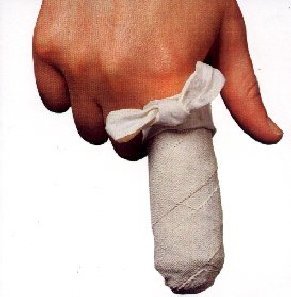
    My favorite knife took a slight chunk of my left index finger, including a sweet section of fingernail. Any time I thought I was saving by rushing was squandered by trying to find a clean towel and cursing myself under my breath.

    Worse yet, I had to toss the already chopped garlic and start fresh, with a throbbing, thickly wrapped finger. With a little help, I managed to get the whole dinner to table in good time, nothing scorched except my ego. I’m supposed to be smarter than the knife.

    I’ve seen all sorts of line cooks chop sections of their hands or burn swaths of skin, most of them pissed they have to leave the line. It is rather surprising when some of the gnarlier ones get the woozy sway going at the sight of their own blood.

    Typing this entry with my cartoon-sized gauzed finger hasn’t been the most fun. I don’t mind kitchen scars, they don’t handicap me, but they do humble me. Tonight dinner may be late.