Partners in the Sample Room announced today that they have promoted Peter Macaroni to executive chef. Macaroni worked at La Bec Fin in Philadelphia and Barlays in Atlanta, before coming west to serve as executive chef at Tiburon. He’s been sous chef at the Sample Room for a few months now — which, so far as I’m concerned, is the most important squib on Macaroni’s CV. I happen to have taken a group of people there on Father’s Day: bottles of wine were half-price (as they are every Sunday and Monday night), the service was spot-on, and our food was fantastic. I had a roasted vegetable salad with Stickney Hill goat cheese that managed to be simultaneously light, earthy, and filling. And I recall that night commmenting to my friends that the Sample Room — long one of my favorite spots in the Twin Cities — just keeps getting better. Maybe that’s Macaroni’s influence and the upswing will only continue. . . .Boaters should know that the restaurant is opening the Rockway Docks in mid-July. Forget Highway 94. Soon, you’ll be able to ride the Mississippi directly to the Sample Room, walk up the bluff, and claim your table.
Month: June 2007
-
The Poetry of Summer — Get Outdoors!
The historical musical 1776 starts at the Guthrie this evening, and Tool is playing at the Xcel Energy Center, but that’s no secret. What can I tell you that you don’t already know?
POETRY
The Dead Poetry SlamGrab your best poetry and take it on down to Keiran’s for their twice-a-month poetry slam — 12 poets, 3 minutes, 3 rounds, 1 winner; you be the judge. Don’t sit around idly. Those who participate don’t have to pay the cover, and the top three poets win prizes ($75, $50, $25). Sign up by 7:30. It’s first come, first serve. And be as creative as you like. Remember, some of us will just be sitting back and watching, so keep us amused, eh? While I can’t seem to find anything about it on their website, I understand that tonight will actually be a dead poetry slam. What does this mean? It means you don’t even have to bring your own poetry. Bring a three-minute poem by a dead poet, and prepare to win.
7:30 p.m., Kieran’s Irish Pub, 330 2nd Ave S. (Towle Building), Minneapolis; 612.339.4499; $5 (to watch), free to perform.
MUSIC AND A MOVIE
If Only They Had Some Bug Spray If poetry doesn’t exactly get you going, you might be in the mood for something a bit less heady. How does a screening of Starship Troopers sound? Watch as the beautiful, white-teethed Americans fight against villainous stick insects, cockroaches, and giant maggots. It’s time for another Holland neighborhood music and a movie night. Head on over with your blanket in hand, and chill to the music of B.C. Lucy before the 1997 sci-fi movie.
8 p.m., Edison High School Amphitheater, 22nd Ave N.E. and Quincy St., Minneapolis; 612-781-2299; free.
FILM by Peter Schilling
La Jetée and Sans Soleil At least one critic has dubbed Chris Marker a “cosmonaut” — this in apparent admiration of the French documentary filmmaker’s ability to make other cultures look like products of distant planets. Marker’s documentaries jettison conventional narrative, instead telling stories by way of letter-writing and striking imagery. Sadly, his fascinating oeuvre has rarely, if ever, been seen in this country. But the good folks at Criterion are now trying to remedy this problem by releasing Marker’s two most popular films on DVD. Sans Soleil (1983) involves odd footage of Africa and Japan — images of people and their ceremonies paired with poetic observation. La Jetée (1962), Marker’s sole fictional work, is a thirty-minute photo-roman — that is, a variety of stills culled together — with narration. The movie is a short and stunning science fiction work and noted in this country as the inspiration for the inferior 12 Monkeys. With its striking imagery and haunting story of time travel, love, and the trap of memory, you can watch La Jetée in the time it takes you to sit through an episode of My Name Is Earl, and be moved in ways you never imagined. DVD available today.
MUSIC (with no movie)
Traditional Jazz Music Born and raised in Minnesota, Doc Evans was among the most celebrated dixieland and traditional jazz cornet players in the ’40s and ’50s. For years, he played sold-out shows at the Walker and added to our rich musical heritage. Today, the Bill Evans New Orleans Jazz Band carries on the jazz tradition born in New Orleans and brought to Minnesota by local legends such as Doc Evans and the Hall Brothers. The Bill Evans New Orleans Jazz Band honors the traditional sound and repertoire, anchored in the nearly 50-year musical partnership of trombonist Bill Evans, cornetist Charlie DeVore and drummer Don “Doggie” Berg.
7 p.m., Bennett’s Chop Railhouse, 1305 W. Seventh St., St. Paul; 651 228-1408.
American Gypsy
 You have to love a motorcycle babe with a guitar. And this one can really sing. American Gypsy sings the blues, and this woman — actually Jodi Jarchow — has something to sing about. Her lyrics are real, and powerful, often exposing her personal hardships, including the loss of her husband, partner, and lifeline. The name, American Gypsy, given to her by her late husband, was in fact the name of his tribe, those that follow the way of the White Buffalo.
9:30 p.m., Half Time Rec, 1013 Front Ave, St. Paul; 651-488-8245; free.
More Freebees
As will be the case throughout the next month or two, there’s loads of free outdoor music to enjoy. Put your wallet away and pull out the picnic basket.
Enjoy lunch with the Kurt Jorgensen Band. 12-1 p.m., Northrop Plaza, 84 Church St. S.E., Minneapolis; 612-624-2345; free.
Head over to Peavey Plaza right after work for a music happy hour. The Alive After Five Concert Series presents rhythm and blues by Armadillo Jump. 5 p.m., Peavey Plaza, 11th St. and Nicollet Mall, Minneapolis; 651-338-3807; free.
Or grab a blanket and enjoy a full picnic in the park. What do you prefer — an evening of classic jazz favorites, or a little something new?
Why don’t you do right and go see the Bend in the River Big Band at the Lake Harriet Bandshell? 7:30 p.m., Lake Harriet Bandshell, 4135 W. Lake Harriet Pkwy., Minneapolis; 612-661-4785; free.
Or broaden your horizons at the Minnehaha Falls Outdoor Concert Series with Chile Sin Fronteras. You can even bypass the picnic and enjoy some fresh oysters and wine at the Sea Salt Eatery. 7 p.m., Minnehaha Park, 50th St. and Minnehaha Ave., Minneapolis; 612-673-2489; free.
ART by Ann Klefstad
Angela Strassheim Photographs Local artist Strassheim is a former forensic photographer who now shoots her own family in disturbing tableaux. Her reputation has been growing ever since her work was featured in the last Whitney Biennial. Small wonder, then, that she has a beautiful show at the Burnet Gallery in the Chambers Hotel — which, of course, has built its own reputation on both overweening hipness and an abundance of adventurous art. Since good art is rarely served in close proximity to good cocktails, don’t miss this chance to take in both.
 Through August 4, Chambers Hotel Burnet Gallery, 901 Hennepin Ave., Minneapolis; 612-767-6900.
-
Vitus
by Peter Schilling
When it all boils down, Vitus is nothing more than a story about a child prodigy who seeks to be a normal boy. But in the hands of director Fredi M. Murer, the simple tale becomes a small but complex masterpiece about the universal difficulties of childhood. Murer, who is unknown in this country but considered Switzerland’s greatest director, obsessively captures the details of youth, including the rich interactions between child and adult. You will not find a movie that better addresses the pains and frustrations of childhood. Vitus is a must-see for parents seeking to challenge their children. Something tells us Mom and Dad will be moved, as well. July 13, Edina Cinema, 651-649-4416.
-
Par in Court: This is (Will Be) Expensive.
As I watched close to a dozen attorneys negotiate out the last few details before opening the temporary injunction hearing against Par Ridder in the Ramsey County Courthouse this morning, I couldn’t help but run numbers and wonder how many friendly telephone switchboard ladies you could buy for the amount of cash that was being hemorrhaged in just the first day of these proceedings.
I mean, in addition to Ridder, the embattled Star Tribune publisher in court to defend himself against charges of outrageous executive incompetence, perfidy or outright fraud, take your pick, the hearing brought an impressive gathering of some very well-compensated media executives. Everyone in sight was burning up hyper-compensated hours as Ridder faced legal music in public for the first time. That low roar we all heard as the courtroom filled? It was the combination of multiple billing meters spinning at very dangerous RPMs for the dozen or so $500 per hr. attorneys milling about, as well as the big-time executive overhead idling in their seats.
The assembled cast included, Par Ridder, who maintained a stiff, deer-in-the-headlights look throughout the first few hours, and who engaged in almost no collegial bonhomie with his Avista employers, OhSang Kwan and Chris Harte. In contrast, there was his/their adversary, Media News tycoon Dean Singleton, oozing confidence, cordially shaking hands with Kwan, who sat behind him, and joking with veteran newspaper biz analyst John Morton, (flown in to testify as an expert witness). For a time Harte, seated next to me in the back row, nodded rapidly, maybe even frantically at anything that sounded even vaguely exculpatory of his boy Par. But as the morning wore on and the damage piled up, first by Ridder’s own admissions and then from former Knight-Ridder Sr. VP Art Brisbane, Harte spent more time with his head down texting on his Blackberry.
The reasons for Singleton’s confidence didn’t take long to become evident. His attorneys opened with an hour-long, edited video of Ridder’s June 5-6 deposition. Lacking any real legal expertise beyond what I’ve seen on Law and Order and my half dozen trips to small claims court, (four wins, two losses), I’m no expert. But it is almost impossible to see how Ridder skates on this one. If it this opening round were a prize fight young Par would be in the ring alone and still losing by a knock out.
What Ridder personally concedes is rather amazing, if only for the fact that his family is so deeply steeped in the business of newspapers. By my assessment he seems to have broken just about all of the basic rules you’d assume the Ridders discussed around the breakfast table.
Here are the highlights from Day #1:
* Ridder signed a non-compete agreement with the St. Paul Pioneer Press on April 19, 2004, but says he never read it. He says he signed it because he was concerned, “What [other members of the Pioneer Press operating committee] might say behind my back if they found out I didn’t have a non-compete and they did.”
* He said, “I signed it so I was bound by it,” and adds, “if this document is valid, it is binding.”
* He says — and this is critical — the non-compete agreements applying to himself and as many as a dozen other Pioneer Press executives were invalidated in late 2005 in a phone call he had with Brisbane, one of a quartet of executives at the very top of the Knight Ridder corporation. (Brisbane and the others were reporting to Ridder’s father, Tony, the family and company patriarch.) Ridder says he requested the non-competes be waived and Brisbane said either, “Yes”, or “OK”, Ridder can’t recall which.
* Unfortunately for Ridder, no written record exists of Brisbane waiving the non-competes, nor does Brisbane “really recall” ever discussing such a waiver with Par. For that reason there was no discussion ever with the rest of the Knight-Ridder executive quartet, their in-house lawyers, or daddy Tony.
* Moreover, Brisbane, who also appeared in an edited video deposition, thinks it would have been highly unlikely he or anyone at Knight Ridder corporate would have agreed to such an extraordinary waiver in the last quarter of 2005, because that was the same period they were trying to lock in all their publishers, CEOs and top executives as they prepared to sell the company, which they did to McClatchy the following spring.
* On March 1 of this year Ridder disclosed to his secretary/assistant, Barb Cartalucca, that he is leaving to join the Star Tribune. He asked about the location of the actual non-compete documents, for himself and other Pioneer Press executives, and is surprised to learn that she has kept them in her desk. Cartalucca offered to retrieve them and go immediately home and shred them. (A legal question here: Assuming paper shredders were still in the Pioneer Press budget in 2007 — which is not a certainty — why couldn’t the non-competes have been shredded at the Pioneer Press? Was Ridder concerned that Singleton’s people would come in and paste the slivered strips back together a la the Iranian revolutionaries at the U.S. Embassy in Tehran? Somebody fill me in.)
* While Cartalucca gathered up the paperwork and headed for the parking ramp and her car, Ridder called … daddy. Tony Ridder advised his son that it’d be a far better idea to take personal possession of the non-competes. This sets up the amusing image, as Ridder described it, of him trying to figure out in which ramp Cartalucca had parked her car and “running”, (as Cartalucca described it), to overtake her in the garage elevator.
* “I told (Cartalucca) she shouldn’t be involved in this,” said Ridder, “and she handed the non-competes back to me.”
* Ridder says, “I don’t ever recall directing Cartalucca to destroy those documents.” Overall, his “I don’t recall” quota didn’t approach Alberto Gonzales, but considering the legal talent and fees preparing him for this deposition you’d think someone could have coached him in some less unfortunate verbiage.
* He did say that, “I was concerned those documents could impede my progress to the Star Tribune. I wanted those non-competes with me.”
* On Sept. 26, 2006, about the time he was drafting his still odd-to-mysterious good-bye/hello speech in expectation (?) of leaving St. Paul for Minneapolis, Ridder signed MediaNews’ Ethics Statement, which details what may and may not leave the building with you in the event of separation. Again, Ridder says he didn’t actually read the document.
* On Feb. 23, 2007 he makes a trip to New York City for a more-or-less final meeting with Avista’s main players. Ridder has prepared a list of 14 names of Strib executives and editors he would like to replace, including editorial editor, Susan Albright. Under questioning he concedes that he has tentatively inked in the names of 10 Pioneer Press executives to bring with him, eight of whom he knows have non-competes.
* On March 2 at 4 p.m. Ridder telephones MediaNews Executive VP and COO, Steve Rossi to tell him he is leaving and moving to the Star Tribune. He tells Rossi, “I will not be taking anyone with me.” Ridder then says in his deposition that what he meant was that he was not taking anyone with him, “as I left the building that day.”
* Ridder concedes virtually every accusation leveled at him with regards to the confidential, highly proprietary information he first took with him on Pioneer Press laptop(s) and a USB drive. This includes information about custom ad rates and other vital contractual information for 3890 separate customers, according to Mark Lanterman of Computer Forensics of Minnetonka, whose company, he said in his live testimony, has spent 2000 hours scanning 3300 files in 30 terabytes of data from all the Pioneer Press computers, jump drives and discs that fell into Star Tribune hands. Lanterman places the time of the “migration” of data from Ridder’s Pioneer Press laptop, etc. to his Star Tribune computer at about 8 pm on March 6th, or at least a full day after the Pioneer Press had asked for all that material to be returned.
* When asked by former Star Tribune reporter-turned-attorney, Dan Oberdorfer, how confident he was that he knew exactly how many Star Tribune executives received the Pioneer Press data Ridder e-mailed out, Lanterman replied that he had, “No confidence at all” that his company had yet identified everyone.
* Asked if his new bosses at Avista “admonished” him for violating so basic a tenet of corporate ethics as taking and distributing confidential financial records, Ridder paused for a moment in his deposition before asking, “Can you define ‘admonish’?”
* Cartalucca testified that Ridder told her, “I spoke to a lawyer and those non-competes are no longer valid.”
* In his videotaped testimony, OhSang Kwan says that Ridder assured them he could “represent” to them that he was not bound by any non-compete agreement.
* Another Avista partner, James Finkelstein, in his videotaped deposition, echoes Kwan, saying simply that since Ridder did “represent” that he was able to work for Avista, the question of non-competes never came up.
* Ridder concedes that one of the Pioneer Press executives he attempted to bring with him, Jennifer Parratt, continued to work at the Pioneer Press for a week after agreeing to terms at the Star Tribune, unbeknownst of course to MediaNews.
* Ridder admits that when the Pioneer Press asked for the USB drive back, the one with all the confidential, downloaded sales and advertising data, he sent over instead a new, still-in-the-box $40 jump drive, thinking it was the hardware they were concerned about.
As I say, I have no legal expertise whatsoever, but I would not like to put a happy face on this litany of incompetence, hubris or worse.
During a break midway through the proceedings, I stopped Dean Singleton in the hallway and asked, “Have these guys [referring to Avista] offered to settle this thing? Because based on what I’ve just seen I’d be astonished if they haven’t.”
Singleton, who walks with a cane, pivoted and looked at me. “I can’t say anything about that. But if you’re astonished you’d be right.”
-
Paris Minnesota
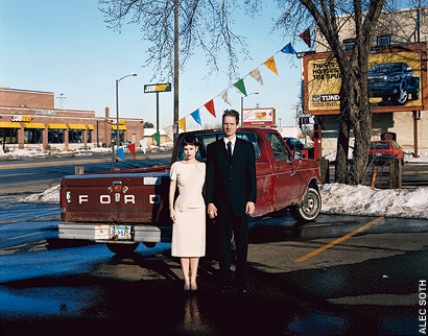
As you may or may not know, the internationally acclaimed, Minnesota-based photographer Alec Soth runs a fairly fabulous blog. And his latest post should appeal to the sensibilities of readers of this blog — I like to think of you all as tasteful and yet substantive folks with deep inner lives (you also happen to be Minnesotans).
Paris Minnesota is the fashion magazine Soth shot in a mere four weeks. He did it for Magnum, a photographers’ cooperative that commissions a single photographer to complete one of these hefty things annually. In Soth’s instance, the result pairs images of Paris couture with that of Minnesotans dressed up in their Sunday bests.
In other words, Minnesota is the counterpoint to, and perhaps the very opposite of, Parisian haute couture. Brothers and sisters, I thought you might like to know …
One final thing: It’s worth noting that Soth hasn’t always been the most popular of fashion photographers. Check this dispatch from one of his earlier posts. Still, his status as an artist is well solidified. Oh, how I want to feel this magazine in my hot little hands!
-
Bouncing Around: Sid, Stadia, KG and the Draft
Most of the time I either ignore or mock Sid Hartman’s ravings–it’s better on the blood pressure. But this morning’s Strib column, entitled “Minneapolis City Council could step up, but it won’t,” hit a nerve and continues to aggravate. So I guess today is the day to call out this asshole.
The thrust of the piece is that the City of Minneapolis won’t step up and throw more money at the beleaguered new Twins stadium to bail out the inadequate planning done by Hennepin County Commissioner Mike Opat when financing the deal. Sid starts by recalling a meeting from 1995, when NHL Commissioner Gary Bettman was trying to move hockey’s Winnipeg Jets into the Target Center.
Wheelock Whitney, one of the great civic leaders here, made a speech pointing out that Metropolitan Stadium, Met Center, Target Center and the Metrodome had been built without taxing the public. The Metrodome was funded on a liquor tax.
And maybe this was the time for the city of Minneapolis to step up and provide some funding so the North Stars could be replaced.
But the city council did nothing. And the Jets went to Phoenix and became the Coyotes. And though the NHL eventually returned with the Wild, Xcel Energy Center and Target Center continue to compete for big shows and lose money.Leaving aside Sid’s quaint notion that a liquor tax isn’t a tax on the public, he conveniently forgets that 1995 was also the year the Minneapolis City Council agreed to purchase Target Center from original Wolves owners Marv Wolfenson and Harvey Ratner for $85 million. Without that purchase, Glen Taylor wouldn’t have bought the team and patrons in another city would have been watching Kevin Garnett for the past dozen years.
Sid continues:
Well today, court hearings will be held on the condemnation situation of the land that will be home for the new Twins stadium. The price could come out a lot higher than the $13.5 million the space has been taxed on. The Pohlad family has agreed to pay an additional amount to help Hennepin Country [sic] when and if the condemnation comes out higher.
But Hennepin County Commissioner Mike Opat points out that a lot of the infrastructure connected with the ballpark will have to be eliminated if the condemnation figure comes out high.
Here would be a chance for Barbara Johnson, Lisa Goodman and other geniuses in the city council to say, “If that happens, we will contribute.”Again, it is difficult to know if Sid has been rendered stupid by his blatant, all-consuming self-interest or his advancing years; either way, he doesn’t seem to understand the most fundamental aspects of the way the new Twins stadium is being funded. I’ll make it as simple as possible. Johnson, Goodman, and every other member of the Minneapolis City Council represent people who live in Minneapolis. People who live in Minneapolis also live in Hennepin County, and thus quite understandably make the overwhelming bulk of their purchases within Hennepin County. The largest single source of funding for the new Twins stadium–far more than the contribution made by the team’s billionaire owner, the wealthiest of all baseball owners, by the way–comes from an increase in the Hennepin County sales tax.
Memo to Sid: Johnson, Goodman and, more importantly, all the people they represent, are already contributing far more than their fair share of the stadium cost. Not only that, but after repeatedly voicing their opposition to funding new playgrounds for sports billionaires, and passing an citywide amendment to limit the City’s contribution to any such boondoggle to $10 million, they had this burden unilaterally placed upon them by Governor Pawlenty and the Minnesota State Legislature, who had to pass and sign a bill specifically overruling a provision in state law that stipulated voter approval of projects like the Twins stadium through a democratic referendum. It is not the fault of Johnson, Goodman or the people of Minneapolis that one of the landowners on the proposed Twins stadium site has shrewdly bargained for the best deal he can get, a factor that somehow wasn’t planned for when the Twins deal was being railroaded through the general public.
A minute ago I mentioned blatant self-interest on Sid’s part. Most people are acquainted with his biography: How he grew up poor selling the paper he now writes for on the streetcorners; and how he is now worth millions and millions of dollars. Now very very few people work as hard as Sid Hartman, even in his mid-80s, and he has invested the money he has earned from his journalistic labors wisely. But the plain fact is that sports in Minnesota have been very very good to Sid. One might even suggest that before he belittles the representatives of Minneapolis taxpayers for not forking over more public dollars to enhance the entertainment experience of endeavors he just happens to make his living covering, he might want to consider his own lucrative and longstanding conflicts of interest on the subject. Maybe he could even rough out a personal profit/loss statement with respect to how ballparks have eased his existence, and make appropriate amends. Put up or shut up, I think it’s called.
And because I don’t plan on ever writing about Sid again, one parting shot. This is a guy who in the decades I have observed and read him, turns the feisty journalistic axiom on its head: He comforts the comfortable and afflicts the afflicted. He is a slave to power, especially if the one wielding it has bullying tendencies, crawling furthest up the ass of people like Bob Knight and George Steinbrenner. And he is rude, mean and disparaging to those he considers beneath him in the social pecking order, especially but not exclusively with respect to media and communications assistants earning comparative peanuts trying to facilitate communication between petulant atheletes and team executives and journalists like me and Sid. Sid Hartman enables fascistic tendencies in human beings more than anyone I’ve ever met. Thank god he has devoted his boundless energy and passion to sports instead of politics.
Okay, end of rant. On an equally unpleasant subject, there are some who suggested over the weekend that Kevin Garnett’s agent, Andy Miller, had either not consulted with his client or was merely posturing for a better contract down the road when he claimed Garnett would definitely opt out of his contract if traded to the Boston Celtics. In any event, now that both sides have simultaneously acknowledged that KG is on the trading block and, with conditions, amenable to being traded, it is probably impossible to stuff the genie back in the bottle. If a deal is contingent on a renegotiation of Garnett’s contract after his opt-out year, that can’t happen with another team until I believe July 1, but certainly after the draft, meaning that teams with earlier picks such as Atlanta or Boston, may be covertly doing the Wolves’ bidding. At least that is the way one source explained it to me, and I hope I have portrayed it accurately.
David Brauer points out that a deal could be structured that gives the Wolves the package from the Celtics they supposedly wanted, and gets KG to Phoenix, where he wants to go. Here’s how he pitches it:
The Celtics would get: Amare Stoudamire, James Jones, Boris Diaw, Marcus Banks and Troy Hudson. The Wolves would get Al Jefferson, the #5 overall draft pick, Wally Szczerbiak, Gerald Green, Sebastian Telfair and Theo Ratliff’s expiring contract. Phoenix would get Kevin Garnett paired with Steve Nash and Shawn Marion, and, here’s the rub, a huge hit on their salary cap, involving luxury tax dollars that Suns ownership says it doesn’t want to pay.The point is, the KG speculation game is almost certainly not going to end with Garnett staying in Minnesota; not after this much blood has been put in the water by both sides. As might be expected, the best clearinghouse for KG-related information around the net is at I Heart KG, which you can get to by hitting the link at the side of the page.
Finally, with the draft now just three days away, my tolerance for speculation is higher, to the point where I will throw up an open thread on Thursday morning for any and all who want to comment–the usual cavaet applies, however: no one-line ejaculations, or other stupidity. Keep it smart and original. Relying simply on what I have been told or inferred from sources I respect, some within the team, I think Minnesota will draft either Corey Brewer or Jeff Green at #7. I think Brewer will be gone by then (maybe to a team picking on the Wolves’ behalf). I’m lousy at this sort of thing, but I’m guessing Green is the guy who gets announced on Thursday night.
-
Par and Paris: only a syllable separates them

OK, it’s a little premature, but I couldn’t help laughing at the first reports out of the Par Ridder hearings today.
Question: what’s the difference between a little rich girl driving while drunk and a little rich boy driving a newspaper while drunk on power?
UPDATE: Mnspeak’s worth a look on this. Lots of funny people there.
-
Class in a Glass
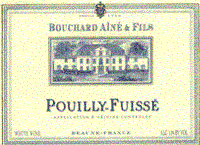
I attended a wedding over the weekend — one of the loveliest I’ve ever seen, with a rose petal-strewn Japanese garden and a chuppa-like arbor under which the couple was joined. Topping off this perfect event was an exquisite wine: a delicate, slightly dry Pouilly-Fuissé from the house of Bouchard Aînés & Fils. If you think of Chardonnay as a bland, butter-colored liquid that went out of style in the ’90’s, give this a try. Pouilly-Fuissé is made from 100% Chardonnay grapes but takes its name from the Burgundy region in which they are grown. The Bouchard Aînés & Fils 2003 is a balance of gentle fruit — apricot, apple, and lemon — and mineral qualities, plus just a touch of honey. It was an ideal summer wedding wine: refined, light, and, from what I heard, universally liked. Also, it received 90 points from Wine News. I’ve searched the big wine vendors in town and found few that carry it, but it is available at Lakeside Fine Wines & Spirits, in Long Lake; and according to the distributor’s website, it can be sourced through Paustis & Sons in Plymouth. (13% alcohol)
-
Heart, Spirit, and Gut-Wrenching Laughter
FILM
Dysfunctional Love in New York City If you agree with Brad Zellar’s assessment (The Rake, June 2007) that Woody Allen “hasn’t made a truly great — or at least consistently funny — film” in a long time. Then tonight is your night. Certainly, Zellar wouldn’t argue against two Allen classics: Manhattan and Annie Hall. Tonight, you have a rare opportunity to see these jewels on the large screen. Enjoy Allen’s sarcastic and self-depracating humor as he explores human relationships in both films. Manhattan is beautifully shot — probably the first film in which Allen truly explored his artistic sensibility on a visual scale, paying full homage to the city he loves so dearly. And, as always, the dialog doesn’t get left behind. In fact, I’d venture to say it’s among his best, as is the dialog in Annie Hall, which won Allen an Academy Award for Best Picture. Minnesotans will particularly enjoy the film’s sharp contrast between New York culture and Annie’s midwest culture.
 7 p.m. (Manhattan), 9 p.m. with a Sat. & Sun. matinee at 5 p.m. (Annie Hall), Oak Street Cinema, 309 Oak Street SE, Minneapolis; 612-331-3134; $8 (seniors $6, students $5).
MUSIC
Fervor and Soul We could all use a little spiritual uplifting from time to time. And tonight, you can get some in the way of music. The Blind Boys of Alabama have been spreading the spirit and energy of pure soul gospel music since 1939, when the first version of the group formed at the Alabama Institute for the Negro Blind. Today, founding members Clarence Fountain and Jimmy Carter are joined by Bishop Billy Bowers, Joey Williams, Ricky McKinnie, Bobby Butler, and Tracy Pierce on a mission to expand the audience for traditional soul-gospel singing while incorporating contemporary songs and innovative arrangements into their hallowed style. Their latest album, Atom Bomb, even features loops, raps and roaring blues riffs.
7:30 p.m., Fitzgerald Theater, 10 E Exchange St., St. Paul; 651-290-1200; $39.00.
The Best in Trombone
 If gospel is not your thing, you can still nurture the soul with the jazz offerings of the United Trombone Summit, featuring Slide Hampton, Steve Turre, and Wycliffe Gordon. While, the Summit has featured various master trombonists throughout the years, American trombonist, composer and arranger Slide Hampton has always remained at the core. Steve Turre, another frequent Summit player, is one of the world’s preeminent jazz innovators, trombonist and seashellist. He has consistently won both the readers’ and critics’ polls in JazzTimes, Downbeat, and Jazziz for best trombone and for best miscellaneous instrumentalist (shells). In addition to performing as a member of the Saturday Night Live Band since 1984, Turre leads several different ensembles. And last, but certainly not least, is Wycliffe Gordon, probably the most versatile trombonist around these days. This is a master performance. You don’t want to miss it.
7 p.m. and 9 p.m., Dakota Jazz Club and Restaurant, 1010 Nicollet Ave., Minneapolis; 612-332-1010;$35 and $20.
A Couple of Freebees
Also on the agenda for this evening are a couple interesting, free, outdoor concerts. Head straight from work to Peavey Plaza to catch Neale & Haberman, and the Ali Gray Band. 5 p.m., Peavey Plaza, 11th St. and Nicollet Mall, Minneapolis; 651-338-3807; free.
Or head to Minnehaha Falls for a performance of the Indonesian Performing Arts Association essembles. 7 p.m., Minnehaha Falls, 50th St. and Minnehaha Ave., Minnespolis; 612-673-2489.
BOOKS AND AUTHORS
Author! Author! Eric Dregni If you’ve read our July issue, then perhaps Eric Dregni has already piqued your interest. He has a wonderful piece this month on the Minnesota Futurists. Want to hear some more of his crazy ideas? They’re not so crazy really. In fact, he can help you find fun and unusual things to do with your summer. Extrapolating the future isn’t his only talent, Dregni has also authored numerous books, including Weird Minnesota and Midwest Marvels. Tonight he’ll be discussing these two books and showing slides of one-of-a-kind tourist destinations from the Midwest. It should be great fun.
 7 p.m., Brooklyn Park Library, 8600 Zane Ave N, Brooklyn Park; 763-424-8002; free.
ON THE NET
Practical JokesIt’s only funny until someone loses an eye… or dies.
Pant Trick
Naked Diner
Spoon Tap
Skunk Prank
Gun Boy
Puddles
Mailbox -
David Fhima at A Rebours
There’s something about talking over a meal that makes people loosen up. It’s the proximity of your knees under the table, the intimacy of sharing food, the lubrication of a little wine. This is not a set-up for drunken confessions. It is a method for coaxing the truth out of public figures used to communicating mostly in talking points. Ultimately, I want On The Table to show my guests the way they really are.
But I may have set myself up by asking David Fhima — the smooth, accented restaurateur whose empire crumbled last year amid rumors he was roughly a million dollars in debt — to be my first.
The truth is that I’ve known David for more than four years: I’ve interviewed him twice before and talked with him personally more than a dozen times. But even after sitting down to a meal with him recently, I still have no idea who he really is.
Ask around town and you’ll hear that David is a master chef, a hack, a thrill seeker, and a dreamer. You’ll learn he grew up in Morocco, London, or maybe Provence. He had as many as 17 siblings and got kicked out of two or four or possibly seven different boarding schools. He was once a minority partner in L’Orangerie in Los Angeles, or, more likely, one of their top maitre d’s. He’s a good guy who got in over his head, or a con man who’s been running a shell game, transporting unpaid liquor from one restaurant to another in the back seat of his car.
In "Without Reservations" — a terrific profile by Steve Marsh that appeared in the September 2004 edition of Minneapolis/St. Paul magazine — Fhima admitted to being a “bullshitter” and a control freak. He skewered local food critics for panning Louis XIII, talked about opening versions of his eponymous Fhima’s restaurant in Chicago and Wayzata, raved about the imminent opening of Lo-To, and claimed to be in negotiations to host a show on the Food Network.
Two years later, there was neither a Food Network show, nor a Fhima’s in Chicago. Lo-To had launched but then closed its doors for a short time, due to unpaid utility bills. Louis XIII was shuttered so quietly, Edina socialites kept showing up for lunches and finding the doors locked. News of his financial troubles was far more widespread, however. In June 2006, the St. Paul Pioneer Press reported that Fhima owed more than $900,000, including $39,000 to his fish vendor, and at least $180,000 to the IRS.
Over the intervening year, there have been rumblings of continuing problems, such as bounced paychecks at Fhima’s.
But the people who’ve worked with him — even the ones who’ve been burned — tend to be forgiving. Scott Mayer, local public relations legend and the founder of the Ivey Awards, worked with Fhima until near the end.
“The thing about David is, no matter what happens, you just can’t get mad,” Mayer says. “Because at the heart of things, he’s just a genuinely nice person.”
And I have to admit that despite everything I know, I feel the same way. Having lunch with David Fhima is restorative in a strange way. However vain and quixotic he may be, he’s also authentically kind and interested in the people around him. He reminds me, in this way, of a very smart and naughty nine-year-old who dreams of being king.
Perhaps this is why people keep throwing money at him.
We meet in May at A Rebours, the bistro that shares a block with Fhima’s. David arrives precisely at noon, dressed all in black, wearing dark glasses and carrying nothing but a small European satchel.
“This is the earliest lunch I’ve had in years,” he announces as he sits. “At my age [46], I’ve tried to change. But no way. I’m a night person, and I’ll always be a night person. I think my DNA is made up for the restaurant business.”
He has just returned from three days in North Carolina, where he was doing business for Bahram Akradi, founder of Life Time Fitness and Fhima’s new employer-slash-savior.
In the aftermath of his financial woes, Fhima tells me, Akradi — a longtime acquaintance — stepped in to propose a deal: He would take over LoTo and rebrand it LoTo Life Cafe, then turn around and use the concept in Life Time facilities throughout the country. Fhima would join Life Time as executive chef in charge of more than 50 cafés around the country, and develop a fine dining concept for the higher end clubs.Fhima is understandably grateful. “Life Time is a company that if you walk into any club, no matter how incredible they are, it doesn’t do justice to Rahm’s vision,” he raves.
He’s landed on his feet, yes. But when we begin talking about Louis XIII, Fhima’s mood becomes more sober. And he is ardently philosophical when he describes the past year: “Whether or not it’s true, I’ll always believe that challenges are like magnets. I think they’re like these little animals that walk and pick a place where they can’t knock people down. There’s so much to be learned from a failed dish, a failed relationship, a failed financial experience. More than to be learned from success. If you keep getting up and getting up and getting up, challenges become fun.”Say what you will about David Fhima, he does keep getting up.
After giving me many of the same quotes he’s given other reporters about the closure of Louis XIII — including that it was misunderstood; that it was too good for the Southdale mall; and that it suffered from his being split between kitchen and front of the house — he hunkers down abruptly and looks me straight in the eyes.
“Looking back, I don’t have any regrets except for one. When I knew it wasn’t working, I should have cut my losses. And I knew within three to four months. I should have cut my losses and owed ten times less than I do now.” He shrugs then, and his face changes, becoming tough again.
“But I was trying to stick by my concept and make it work, employing people, and staying true to what I believed. What sends me is that some people try to put my financial failure on the same level with my talent as a chef. I know a lot of very talented chefs who have not been able to make a go of it. But there are a lot of successful ones I wouldn’t trust to butter my bread.”
Wait for the long pause at the beginning.
