
Year: 2007

  • Screw It

    90088l.jpg

    Don’t get me wrong. I’m as caught up in the romantic rituals of wine drinking as anyone: the instruments, shining and nearly surgical; the bottle long stored at a tilt; the small effort required to remove the cork; the serious sniff, the careful pour, the sip. But there are times I’m just not in the mood for the whole production. It seems there’s always a bottle of corked wine sitting on my countertop, waiting to be taken back. And I’m tired of my corkscrews being confiscated at the airport.

    The solution to all this: screwcap closure. Good for the industry, which loses a substantial amount of cash on the roughly 7 percent of wine bottles (according to a recent Wine Spectator study) containing TCA — a bacteria whose scientific name is 2,4,6-trichloroanisole — that are returned after purchase. Cork taint causes a wine to smell musty, like wet dog, and taste both rancid and "flat." The incidence of corkedness may be on the rise because some pollutants catalyze TCA. Also, in my opinion, we’re getting more discriminating about wine, rejecting the ever-so-slightly tainted bottles our parents might have drunk.

    We’re also an active generation, drinking wine wherever we go. My husband and I, for instance, are bikers who take long road trips by motorcycle, stopping along the way in inexpensive roadside motels, buying a bottle to share in our room after the day’s riding is done. At least one trip in three, we forget to pack the corkscrew, which means either buying one or picking up a screwcap wine. In a lot of small towns, this limits us to a couple sweet, dull, bottled-yesterday varieties. But happily, better wine stores now carry a range of no-cork wines from reputable vintners including Beringer, Hogue Cellars, and Beam Wine Estates.

    Haskell’s, the largest purveyor of fine wines in the five-state area, carries dozens of screwcap options. Today, Mitch Spencer, wine director for Haskell’s, says most of the screwcap wines he sells go for less than $15. But that’s changing. "Two years from now, I’ll have a full line of more expensive wines under screwcap," Spencer predicts. "The winemakers in Oregon, California, and Washington are all going in that direction."

    Luckily, though, the affordable screwcap wines he has available right now run the gamut from adequate to amazingly tasty. Here are some you might want to try:

    Gazela Vinho Verde 2006 (Portugal) — this is a sweet, frothy, nearly sparkling white with a melony aroma, effervescent mouth feel, and a clean, complete, finish; a beautiful label (which I’m told is important to the majority of female buyers) featuring artistic renderings of flowers and rain, 9% alcohol

    d’Arenberg Stump Jump White 2006 (Australia) — conjured out of Riesling, Sauvignon Blanc, Russanne, and Marsanne grapes, this blend is lemon-yellow and clear; mildly citrusy with a little chalk; and mellow but with a surprisingly musky finish; simply nice and a great accompaniment for a meal of pasta or white fish, 13% alcohol

    Domaine de Pouy 2005 (Cotes de Gascogne) — a clear, sun-filled white so clean it tastes diamond-cut; an aroma of wet rocks, hay, and field, with a full, assertive grassy flavor that lingers on the back of the tongue; excellent for drinking alone, 11.5% alcohol

    Bonterra Sauvignon Blanc 2006 (Mendocino and Lake counties) — so startlingly redolent of cantaloupe, drinking this wine is like eating a slice of fresh fruit; secondary notes of wildflowers and tart fruit; a full-bodied wine that can be paired with everything from shellfish to pork, 13.3% alcohol

    Newhaven Sauvignon Blanc 2006 (New Zealand) — a bewildering blend of sharp green pepper and pink grapefruit, this is an aggressive wine with complex layers of flavor and a full, flinty finish; a big taste that may not be for everyone but will provide ballast for a hearty vegetarian meal, 13.5% alcohol

    Le Grand Pinot Noir 2006 (Southern France, vineyard not specified) — truth, I detested this wine, but it’s one of Haskell’s top sellers, so others must disagree; flavors include soft plum, licorice, and — to my palate — a stale bit of shoe leather; light with no finish to speak of, 13% alcohol

    Laurel Glen Reds 2005 (Lodi, CA) — a blend of Zinfandel, Carignane, and Petite Sirah, this is a big, nearly heavy table wine with plenty of fruit; nice, if slightly off balance, it tastes of oak, cherry, and cassis; best served with burgers or brats, 14.5% alcohol

    d’Arenberg Stump Jump Red 2005 (Australia) — the first cousin of Stump Jump White is equally as drinkable, with an ultra-smooth blend of Grenache, Shiraz, and Mourvedre; woody, with notes of perfume and black cherry; big flavor with a dazzling finish; a great choice for a picnic: bread, cheese, fruit and wine, 14.5% alcohol

    Fess Parker Lot 71 Frontier Red (California) — this is a brand-new wine from a new vintner, and it’s phenomenal; earthy and ever-so-slightly meaty with generous touches of blackberry, cherry, violet, sandalwood, cinnamon and cassis; it’s a colossal taste that’s overtly sexy; drink this alone or with food, just drink it, 15.5% alcohol
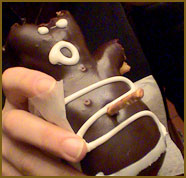
  • Who do that voodoo?

    voodoo_doll.jpg

    Voodoo Doughnut, that’s who.

    Not only is this possibly the coolest doughnut shop on the planet, it’s a lesson.

    It’s a lesson about quitting your job and finding your life … about putting out a great and attention grabbing product … about having fun.

    Do you have a voodoo dougnut in you?

  • StribTV

    It says something about the quality and value of TV news, local TV news in particular, when a guy suggests a big city newspaper like the Star Tribune demonstrate a hipness to the coming convergence of internet and television and smart people react like he’s suggesting polluting Perrier with dioxin.

    In the previous post I argued that if Strib publisher, Par Ridder, and his Avista overseers had any inclination to invest in the paper’s future — and I see no evidence that they do — they could begin by dipping a toe in the “televisionation” of the paper’s best assets. “Television” being a loaded word, fraught with connotations of nit-wits, blowhards and pop effluvia, several of my regular readers reacted quite loudly.

    There was this from, “jimmy”:

    “Great strategy. Cut staff and then give those who survive a new medium they’ve had no experience with to feed every day. Both the paper and the website are bound to get better. It just makes so much sense. Can’t wait for the Bloomington City Planning pieces to hit the web.”

    And this from the, “frogman of grant”:

    “No thanks. I’ll see your numbing prospect of Katherine Kersten and James Lileks in high-def and raise you Lou Dobbs, Joe Scarborough, and Tucker Carlson. I mean, enough already.

    Worse, it seems that if I want to send you a snotty message like this three years hence I’ll have to somehow manage it via my TV.

    Maybe I’ll just read a book instead.”

    If the concept here were to repeat all the witless, dime-deep marketing spin and journalistic irrelevancies of local TV news and cable, I wouldn’t bother, and I certainly wouldn’t disagree with either gentleman’s concerns. But the whole point is a ready and relatively cheap opportunity to offer something far better. We’re talking an interactive and on-demand website from which you the reader/viewer not only gets all the printed copy of the present Strib but also a video component built around writers and reporters with established reputations. It would never be “all TV”, and there would be no reason outside of basic editorial judgment to limit “reports” to something less than the time it takes to tell the story — and maybe offer analysis.

    More to the point, unlike today’s TV news, where you’re held hostage by six minutes of redundant sports or the sight of Lou Dobbs once again blowing a feeder tube over immigration “amnesty”, you have total command over the menu of options. You can ignore sports or the opinion page entirely, or click away to literally anything else that is in the paper that day — or has been in it for months or years back.

    My underlying point is that newspapers — ironically — are better equipped to deal with the “televisionated” future than local TV newsrooms are. The latter have long ago been reduced to skeletal operations selling cornball “glamour” more than anything of depth in order to supply the 30%-40% profit margins THEIR owners have demanded. (Newspapers really are just arriving late to the game of strip-mining news operations for short-term profit.)

    As far as the “look” of StribTV, think more C-SPAN than a gorgeously shot KARE-11 sweeps piece on migrating ducks, at least at the start.

    Here are a couple examples of what is already being done. First, Dana Milbank of the Washington Post providing some interesting background and context for Al Gore testifying on Capitol Hill before Oklahoma flat-Earther, James Inhofe.

    And then, as an example of the consumer/sales possibilities, here’s consumer tech writer, David Pogue of the New York Times.

    Or, (just to annoy him), my old pal, David Carr from the Times doing a ditty on the New York Auto Show. (Carr vows this was a one time only deal. But I liked it.)

    No individual reader reads the entire newspaper. “Consumers” cherry pick the subjects and writers they’re interested in. What could and should come next is a way to give those cherry pickers more of what they already like, and at no significant new cost in terms of hardware.

    (In the comments, “TV Guy” correctly points out that Hi-Def cameras and editing decks are cheap and not particularly difficult to learn, certainly not by professional shooters already on staff at most papers. And hell, Ridder and Avista have already covered the cost of a dozen cameras and editing decks by firing the sweet old ladies at the switchboard.)

    Can’t stand Nick Coleman? Experience the thrill of cutting Nick off in mid-sentence and clicking over to Katherine Kersten. No interest in Billy Friedkin’s director’s comments on the latest re-release of, “The French Connection”? To hell with Randy Salas’ DVD review, hit up the Strib’s Capitol Hill reporters grilling Minority Leader Marty Seifert.

    Would a stray newspaper wonk go nutty with prolonged exposure to a TV camera and turn into a spittle-flinging caricature of Chris Matthews? Oh, probably. But in an interactive world, he disappears at the click of the button and instead you’re sitting in on the editorial board’s discussions over who to endorse in the next election. The potential for features — with architecture coverage, TV and music reviews, etc. are obvious. Likewise for sports, think of the possibilities for Pat Reusse to goad AJ Pierzynski the next time the Sox are in town.

    Could say, WCCO-TV, do something like this … and with better looking people, (I mean, they’ve already got Pat Kessler …)? Sure. But no local TV station is ever going to make the investment in staff to approach the size of a major newspaper — at least not a paper like the Star Tribune of today, before it’s gutted by Ridder and Avista.

    Obviously, there are technological advances required here beyond just digital TVs and higher-powered servers. Not far over the horizon, for example, are highly portable, flexible/”foldable” ergonomically appealing screens for downloading all internet content, including that from major newspapers. (Considering the carbon footprint of forests leveled for newsprint and fleets of trucks and cars to deliver the paper version of the paper, there’s even more to said for “televisionating” ASAP. And hell, if you’re so hopelessly old school you have to feel paper in your hands you can always download the damn thing.)

  • The Horror

    FILM
    Hearts of Darkness

    Francis-Ford-Coppola-a-cautat-o-strada-din-proza-lui-Eliade-2.jpgIn preparation for Francis Ford Coppola’s sold-out presentation tomorrow night, the Walker is featuring Hearts of Darkness this evening. If you have somehow managed to miss this documentary about the making of Coppola’s Apocalypse Now until now, go, go, go! The production of Apocalypse Now is infamous for its scope, tension, and excess. Remember the opening scene in which Martin Sheen loses his shit and punches a mirror? Rumor has it that Sheen was really losing his shit here and Coppola just kept filming. Follow Coppola as he risks his sanity and professional career to craft his masterpiece.

    7:30 p.m., Walker Art Center Cinema, 1750 Hennepin Ave., Minneapolis; 612-375-7600; $8 ($6 Walker members; free for students with ID).

    SOCIAL
    Girls’ Night Out

    Fondue chocolat.jpgLet’s face it, girls, it behooves us to leave the men at home now and then and hit the town in search of a pleasant all-girls evening. To this end, The Melting Pot is hosting its first-ever Girls’ Night Out this evening — an event they hope to continue on the fourth Tuesday of each month. Sample the restaurant’s specialty cheese and chocolate fondues, salad, and a glass of wine or a specialty cocktail. Plus, they’re trying to arrange onsite spa treatments, including chair massages and paraffin dips, courtesy of New Reflections Salon. All this sans men. What could be more relaxing?

    5:30 to 9 p.m., The Melting Pot, 80 S. 9th St., Minneapolis; 612-338-9900; $35.

    POETRY
    Go Light the World

    GLTW2007_small.jpgHonor our young Quest for the Voice poets as they leave for the Brave New Voice International Youth Poetry Slam Festival in San Jose, CA. This amazing group of multi-cultural writers and performers give voice to the spoken word art form that honors the individual and brings forward the many stories, experiences, dreams, convictions, and perspectives of urban youth that all too often go unheard. The poets will also pay tribute to the great 20th-century American poet, novelist, and playwright Langston Hughes on the 40th anniversary of his passing. The evening will feature the Quest for the Voice poets, Robert Robinson and the Twin Cities Community Gospel Choir, and messages from author Julia Dinsore, Minneapolis Mayor R.T. Rybak, and Minneapolis City Council Member Rev. Don Samuels. Free parking is available in the underground garage at Wells Fargo Bank and in the surface lot on Marquette Avenue.

    7 p.m., Westminster Presbyterian Church, 1200 Marquette Ave., Minneapolis; 612-965-9446; free.

    Listen to Quest for the Voice readings.

    ART AND HISTORY
    Ojibwe Life in Minnesota

    main_cameraojibwa02.jpgCelebrate the opening of Camera Ojibwe: Photos of Ojibwe Life with a blessing by Mille Lacs Band member and spiritual advisor Herb Sam, traditional Ojibwe songs, and remarks by author Bruce White. Based on White’s book We Are At Home: Pictures of the Ojibwe People, the exhibit features photographs from the first 100 years of photography — ranging from daguerreotypes to studio portraits to postcards to snapshots. “The result is a thought-provoking exploration of the complex circumstances behind the creation of different photographs, the meanings hidden beneath common stereotypes and the actual stories of the people pictured, their names, their lives, their families and communities.”

    7 p.m., Minnesota History Center, 345 W. Kellogg Blvd., St. Paul; 651-259-3015; $8 ($6 seniors and students, $4 children).

    COMMUNITY
    Hands On Twin Cities Volunteer Cafe

    volunteer cafe button.jpgLooking for interesting new ways to help your community? Hands On Twin Cities helps individuals and groups find meaningful volunteer work. During this informal event, you will find out how you can get involved in a way that matches your skills and interests with a community need. You will also hear from several local nonprofit organizations about the work they do and ways you can help.

    6 p.m., Loring Park Dunn. Bros., 329 West 15th St., Minneapolis; 612-872-4410; free.

  • Pistons-Cavs Preview

    Cleveland Cavaliers (2) vs. Detroit Pistons (1)

    If I had any guts, I’d call the Cavs in 6 or 7. That is what my gut tells me–the same gut that said the Bulls would need no more than 5 or 6 games to knock off these same Pistons. Obviously, there is something about Detroit–the overwhelming consensual favorite to reach the NBA Finals–that I disrespect. Naturally I’ve thought about it a fair bit during the Bulls series–having your analysis turned into foolishness will do that–and I think it has to do with believing the Pistons have bought into Flip Saunders’ multi-pass, high jumper, low turnover, low free throw offense. It is a marvelous thing to behold, and the Pistons play it superbly. But missed shots are nearly as injurious as turnovers, and sometimes those jumpers won’t fall. If and when that happens, do the Pistons have enough resourcefulness via their defense and their one-on-one capabilities to gut it out? And if not, do the Cavs have sufficient offensive firepower to make them pay?

    There are two ways to look at the Bulls series. One, the Pistons hauled off and belted Chicago in the mouth twice with a pair of absolutely sublime efforts at both ends of the court. Having gone up 2-0, they had no respect left, especially when they just flipped a switch in the second half of Game Three and won going away, on the road. The next two tilts were the product of overconfidence and the Bulls playing for pride under a feisty coach.

    Another way to look at it is that the youthful Bulls came out both a little nervous and a tad overconfident after sweeping Miami. Detroit was more experienced and better prepared and just undressed Chicago, twice. The Bulls team that ran and shot so well all season and then steamrolled Miami thus never really found their footing in this series until it was too late. When Chicago did settle into what was previously a normal groove, they proved capable of hanging with Detroit and extending them to the limit if not winning outright.

    I subscribe to the second theory–that the real Bulls never showed up, and that guys like Nocioni and Ben Gordon were exposed mentally as well as physically. But if the Pistons dismantle the Cavs the way they did Chicago, even a stubborn skeptic like me has to cop to their worthiness to battle San Antonio (and lose, but that’s another story).

    This will be a good test for Detroit because Cleveland presents a different challenge than did the Bulls. I thought Chicago would simply be too quick for Detroit up and down the court. That may have been accurate, had we seen the regular 2006-07 Bulls. But what isn’t true is that Detroit lacked Chicago’s bench. Jason Maxiell and Lindsay Hunter and of course Antonio McDyess, who is a bench player the way Ginobili is a bench player, all had very good games versus the Bulls. But what they don’t do is shoot lights out. The starters, especially Hamilton-Billup-Prince, are the key to Saunders’ ball movement, jump-shooting game, because when any of those three are open, you expect the ball to go through the net. The other key is that Saunders’ offense divides up shots among different players, and having that trio all be reliable is a huge boon to the system. And no, I’m not forgetting ‘Sheed, who is less midrange and more paint-or-trey and thus the flexible one of the quartet that scores.

    So, why are the Cavs a challenging matchup? Because ever since Pavlovic was inserted into the starting lineup, Cleveland can defend the midrange jumper better than anyone this side of San Antonio. Their quickness is less about running up and down 94 feet, like the Bulls, and more lateral and quick-bursting while defending in the half-court. And that kind of quickness and length may be more troubling to Detroit.

    Two other factors make the Cavs an intriguing opponent for the Pistons. The first, of course, is LeBron, who is second only to Kobe Bryant is being a guy to just explode seven different ways and destroy a team (occasionally his own). LeBron was if anything too share-oriented with his teammates against New Jersey, and will probably need to do less driving and kicking and more penetrating against the Pistons. But the greater point is, this is really the litmus test for Cleveland, who have played a couple of mediocre opponents thus far and really have no identity with even loyal NBA fans outside of northern Ohio. This is where LeBron can make his statement, in other words, after a fitful season that saw him mail it in for much of the early months, and only occasionally turn it on in the past six to eight weeks. I don’t think he should be a ball hog, and if he wants to devote more energy to clamping down Detroit’s shooters beside Larry Hughes and Pavlovic, that makes sense. But he has to make a superstar’s impact on some level if the Cavs are to pull the upset.

    The second intriguing factor is Z Ilgauskas. Detroit really has no good matchup for him, but then again neither did Washington and New Jersey, and Z was hardly the force he could and should have been in those rounds. He shot a very mediocre 48 percent and got just 11 points and 9 rebounds in 33 minutes against the Nets. More disturbing, he shot fewer field goals than anyone in the starting lineup, including Pavlovic; half as many FGA as Hughes, and ten fewer shots per game than LeBron. He also averaged only 4 free throws per game, and was outrebounded for the series by teammate Drew Gooden. For the Cavs to topple Detroit, unless LeBron pulls a Kobe, Z must give them about 18 and 12, and Mike Brown is crazy if he doesn’t explore ways of making it happen. No more shrinking violet in the paint. The Pistons are vulnerable in precious few places, and getting it to the big man when the superstar is double and triple teamed in one way for that to happen.

    Detroit has been very successful at running the 3-2 matchup zone that Saunders perfected in Minnesota. It was by far his best defensive allignment with the Wolves, but it also taxed the hell out of KG, the man at the top of the key in what occasionally was a 1-2-2 instead of a 3-2. The Pistons are deadly with it because Tayshaun Prince is one of the most underrated players in the NBA, an indefatigable defender with a seven-foot wingspan who just happens to also be one of their best clutch shooters (better than Billups and Rip, in my book). If Detroit’s zone is clicking, expect Lebron to try and take over by himself more often, and for either many points or many turnovers to ensue. James vs. The Zone is one of the great subplots.

    The question becomes, who guards Hamilton? Pavlovic had a marvelous series against Vince Carter and is a little too balky to guard Billups. LeBron and Prince will match up on each other. But Pavlovic is going to discover that stopping Rip Hamilton in the playoffs is tougher than stopping Vince Carter, for reasons of mental toughness and a better supporting cast, for starters. Hughes vs. Billups is a great matchup, as Hughes is a gambler and Billups likes to make gamblers pay. Again, if Cleveland can force nearly as many turnovers as they commit, this will be a tight series. And the turnovers, if they happen, will be on the perimeter.

    For the Bulls series, I predicted that Rasheed Wallace wouldn’t be able to handle the banging of PJ Brown and the gritty annoyance of Nocioni. But neither PJ nor Nocioni was able to do too much and part of the credit goes to ‘Sheed (the rest to Saunders’ system). Also, ‘Sheed kept his head. That said, if I was entering a pool on most likely combatants for a playoffs setto, ‘Sheed and Gooden would come in just a hair behind Harpring and Bowen as my pick to duke it out.

    This will be a tough, physical series–duh, it’s the conference finals, and the unphysical teams have gone home. But again, my gut tells me that Detroit is the least physical of the four remaining squads. Will that matter in this round?

    Hamilton, Prince and Billups are, in the end, very tough to pick against when you are staying inside the Eastern Conference. Of the variables Cleveland needs, I think LeBron will explode once or twice, that Hughes will embarrass Billups once or twice, and that Z might even get off once or twice. Cleveland will even win twice or thrice as a result. The gut says the Cavs, the head overrules and chooses Detroit in 6 or 7.

  • Two ultra-hip retailers join Minnie's flock

    Look_6.jpgamerican_apparel.jpg

    In shoppers’ news: Both West Elm and American Apparel are set to open local posts, in Edina and Minneapolis, respectively. If you’re not familiar, here are some quick bios on these bizes: West Elm is a Williams-Sonoma-owned (related to Pottery Barn, therefore) retailer of furniture and housewares of the clean, modernist, neo-Ikea sort. Think platform beds, bamboo sushi platters, graphic rugs, and the like. American Apparel is another story entirely, and the TC fashion media could have endless fun with this retailer of basic cotton/Lycra-blended socks, rompers, leotards, boy-briefs, and tees. On one hand, the LA-based company is lauded for selling sweat shop-free frocks, offering employees fair compensation packages, and using recycled cotton in much of its clothing. It’s therefore a favorite brand (even though it calls itself “brand-free”) among the urban hipster set–the fact that AA sells ’70s- and ’80s-inspired duds, such as thigh-high tube socks, doesn’t hurt matters either. On the other hand, however, the CEO is a total perv. Gross!

  • Strib Vision: Forward to the Past

    As foul as the air is over the Star Tribune these days, (and it isn’t any better across the river), the soon-to-be-“right-sized” staff might feel the slightest bit better if they were being given any reason — ANY REASON — to believe the end result of all the slashing, cutting, out-sourcing, etc. was going to be a better product. They aren’t being given such reason for optimism. And if there is someone who believes they have, I haven’t met them.

    One story has a member of the sports department interrupting a presentation from editors Nancy Barnes and Scott Gillespie recently to tell them, “You know, you’re insulting our intelligence here,” with the by now long-since-stale talking points of adjusting to demanding times, properly orienting resources, blah, blah, blah.

    It would have been far better for Strib managers to have told their staff, i.e. the professional skeptics whose respect is vital to a cohesive, productive newsroom, that, “None of this has a damn thing to do with creating a better newspaper. We know it and you know it. Yes, classified advertising is down, and kids aren’t reading the paper. But this whole thing wouldn’t be nearly as bad as it is if we didn’t have to guarantee investors who don’t give a damn about any of us, the quality of this paper, or even the Twin Cities for that matter, implausibly fat profits for the three or four years they’re paying any attention to us at all.”

    If the Strib’s new “plan”, which is really a forced march to the past, before the Star Tribune acquired regional and national influence, included even one concept that signaled “investment” by Avista Capital Partners, the grumbling wretches would be marginally less wretched.

    Last week former Strib publisher, Roger Parkinson, took a quick stroll through the building, saying hello to old employees and compadres. I finally got him on the phone this morning, before he flew off to Vienna to meet up with his book club. (They read a book, in this case something about Sigmund Freud, and then gather in the appropriate location to soak up the vibe. “The Brothers Karamazov” took them to St. Petersburg. Dante and Galileo to Italy. Meanwhile, my book club makes it no further than Stillwater.)

    Parkinson, a bona fide curious intellect – unlike “the current occupant”, as Garrison Keillor says of George W. Bush — had a ready litany of the pressures creating turbulence around his old industry. (Parkinson is currently chairman of the board of the University of Toronto Press, which probably means he gets his book club books at a discount.) He pointedly declined to criticize current Strib management, but has a significantly more forward-looking view of journalism than anything coming out of the Strib’s executive suites today.

    I’ll tuck away most of what Parkinson had to say for another time and move to one specific point of agreement, namely that ownership genuinely interested in investing in its product and maneuvering for survival into the on-line, post-print world would get serious right now about creating television out its abundant assets.

    Certainly within three years the union of the television screen and the internet will be a fact of American life, and considering the boggling range of material available on the ‘net, the steady drop in the price of digital televisions and the February 17, 2009 deadline for fully converting to all-digital transmission, this union of TV and internet will likely come at us a lot faster than anyone is expecting now. But when it does, StarTribune.com, (or StribTV), instantly becomes a video competitor to WCCO-TV, KSTP-TV, KARE-TV and everything else offering “news” and infotainment.

    The difference between TV news as it exists and a newspaper, in terms of value as a news source, is obvious. Even after the forced attrition going on now, the Star Tribune will still have seven or eight times the staff of a major affiliate TV newsroom like KARE. Moreover, when you factor in how much of TV news is sports and weather, and how much of TV news has been acquired after reading the morning newspaper and sending a truck across town for pictures and 30 seconds of “reportage”, there’s a looming “no-contest” to a head-to-head competition. Anything TV news can do newspapers can do as well and with several times the breadth.

    Were Avista in the newspaper game for any reason other than to strip present assets as close to the bone as possible and still make claim to being a daily newspaper, they, like the New York Times, the Washington Post and several others, would have already commenced the “television-ation” of the Strib newsroom.

    This of course would require a personnel strategy radically different from the one Par Ridder and Avista are currently following. For better and for worse TV runs on personalities and character. The upside to the Star Tribune is that while their personalities may not exactly sport consultant-approved haircuts and orthodontia, the best known of them are authoritative, deeply-sourced, know what they are talking about and, assuming they are allowed to be themselves, long ago acquired an internet-ready attitudes.

    Whether it were field pieces with say, Nick Coleman, talking up witnesses and cops at the scene of the latest shooting, a Linda Mack feature on the new MacPhail building, Randy Salas spinning through off-beat new web sites or special features on the latest DVDs, Dan Browning and super-intern Brady Averill discussing and taking viewer questions on the US Attorneys scandal, Katherine Kersten slashing away again at the Flying Imams, Mark Brunswick, Pat Doyle and Pat Lopez giving updates from the legislative session, Sara Glassman showing and explaining fashion trends, or even, hell, James Lileks “quirk”-ing from a Linden Hills coffee shop, all the elements are there in terms of both established brand and abundance that TV stations — with their own “right-sized” newsrooms and rapacious, short-sighted ownership groups– can’t/won’t be able to approach.

    And that’s all before you even get to the daily grit of covering fires, sports and the Op-Ed page.

    Parkinson jokes that in his experience, first in newspapers and later in academia, “Newspapers and faculties are the least susceptible to change of any cultures I’ve ever known. But, as loathe as newspaper journalists often are to doing television, once they try it they realize they enjoy it.”

    Among the many consequences of Ridder and Avista not giving one goddam about investing in a truly vital news source large and sufficiently connected to both cover and explain the Twin Cities is that their current attrition process is shoving out and/or marginalizing exactly the sort of next generation-ready journalists the Star Tribune needs most.

  • Random Stuff From The Weekend In Milwaukee

    You’d sure like to see your team hold a 4-0 lead, particularly since the Twins have had so few early leads of late. And, yeah, Dennys Reyes is the lefthanded specialist out of the bullpen –or was– but he hasn’t done much of anything to justify that position thus far in ’07, and his stellar 2006 is looking more and more like an aberration. It was supposedly a big surprise that his shoulder was bothering him even before he entered yesterday’s game with the score tied at five, but why was it such a surprise?

    The Reyes situation is pretty much Jesse Crain all over again. Both guys signed extensions in the off-season, sucked early on, were sidelined with ‘tenderness’ but somehow managed to avoid the DL, and came back only to endure more suckiness, this suckiness apparently attributable to injuries, the severity of which went unrecognized by the team’s medical staff.

    I don’t quite understand how a guy whose arm was aching a few weeks ago is supposed to get better by pitching to Major League hitters, but what the hell do I know?

    It also seems to me that the Twins have had a number of eerily similar situations in recent years (Liriano last season, for example), situations where the team’s doctors clearly failed to recognize the severity of a pitcher’s injury until it was too late.

    The loss of Reyes and Crain does put a strain on the Twins’ bullpen, but at this point, considering the way they’ve pitched, it’s sort of a case of addition by subtraction. Given Minnesota’s history of nurturing reliable and unsung middle relievers –there’s a long list by now, the most recent examples being Matt Guerrier and Pat Neshek– you always kind of figure they’ll find a way to patch something together. The way things have been going, though, this season figures to be a test of the club’s scouting and coaching resources.

    Is Ramon Ortiz
    headed the way of Sidney Ponson? How much rope do the Twins give him with Garza and Slowey waiting for a shot at Rochester? Consider that Ortiz was 3-1 with a 2.57 ERA on April 27. Here’s his ERA after his last four starts: 3.23, 3.80. 4.89, 5.36. I’m guessing that impressive start is going to give him a considerably longer leash than Ponson had, especially given that the Twins are on the hook for his $3.1 million salary.

    How much have
    the Twins missed Joe Mauer? They’d started their slide before he went on the DL –they were 15-14 at the time– but they’ve gone 5-9 without him in the lineup.

    Scott Baker’s quotes
    following his Saturday start in Milwaukee were even more refreshing than his performance. It’s hard to root against a guy who says stuff like this: “It’s supposed to be fun. If it’s not fun, why are we doing this? I think a lot of times we’re too result oriented and this game is such a result oriented, stat game. There’s too much emphasis on that. It’s about the process, it’s about enjoying this time.”

  • Dust off the Records

    MUSIC
    B.Y.O.V.

    1916448619.jpgBring your own vinyl, folks. How often do you get to do that? Tonight, MinnieIndie.com will be spinning vinyl all night at the Uptown Bar and Cafe. Stop by and listen to a sampling of indie, glam, punk, psych, Motown, 80’s kitsch, 70’s AM hits, and whatever else people bring to the table. Not only is the event free, you can get Grainbelt Premium for $1.75, PBR and Highlife for $2.50.

    10 p.m., Uptown Bar and Cafe, 3018 Hennepin Ave. S., Minneapolis; 612-823-4719; free.

    From Wall Street to the Mic

    2743993715.jpgAfter being named Collegiate Jazz Vocalist of the Year by Downbeat Magazine in 1999, Sachal Vasandani left Michigan and moved to New York. One year later, he quit his job on Wall Street to begin his career as a singer, since then wooing us with that perfectly-stated voice of his. In 2004, Vasandani was a semi-finalist in the 2004 Thelonious Monk Institute Competition. Today, he continues to adeptly put his own contemporary stamp on traditional jazz without shattering its integrity or over-poppifying it.

    7 p.m. and 9 p.m.., Dakota Jazz Club & Restaurant; 1010 Nicollet, Minneapolis; 612-332-1010; $17.

    Listen to Sachal Vasandani.

    BOOKS & AUTHORS
    Dead Sexy Vampire Witch Chick

    tate copy.jpg“A Scorpio with a Leo Rising, Tate Hallaway is an amateur astrologer and practicing Witch,” reads her bio. Tate Hallaway is the author of vampire chick-lit novels Dead Sexy and Tall, Dark, and Dead. In her secret identity as Lyda Morehouse, she has also published futuristic fantasy novels Archangel Protocol, Fallen Host, Messiah Node, and Apocalypse Array, as well as short fiction. She is a member of the Wyrdsmiths writing group.

    6:30 p.m., DreamHaven, 912 W Lake Street, Minneapolis; 612-721-5959.

    Read an excerpt of Dead Sexy.

    FILM
    Never Deny the Power of Soccer

    The Great Match.jpgSoccer has finally made it’s way into the United States, yet we have little idea of just how significant it has been in the lives of others across the world. Few capture this as well as documentarian Gerardo Olivares in his film The Great Match. What an interesting premise for a movie. Three men from three different far-off corners of the world journey to the closest television for the 2002 World Cup final between Germany and Brazil. By far-off corner, I don’t mean Mankato. The protagonists in this global comedy are: a family of Mongolian nomads, a camel caravan of Tuareg in the Sahara, and a group of Indios in the Amazon. They all live about 500 kilometres away from the next town — and the next television.

    7 p.m., The Oak Street Cinema, 309 Oak Street SE, Minneapolis; $8.

    ON THE NET
    What’s New in Minnesota

    Who are we?

    We’re a sexy people.

    This weekend, while many of us frolicked around the Northeast Art-A-Whirl enjoying a rather frivolous day, thousands gathered in North Minneapolis in support of peace.

    There was a big commotion in South Minneapolis on Saturday when people witnessed Minneapolis Police officials facilitating an ICE (U.S. Immigration and Customs Enforcement) operation. The videos don’t add much to the story, but here they are anyhow.
    Why are Minneapolis Police working with ICE
    Who are the Minneapolis Police working with ICE?
    More Police ICE
    ICE Agents Use Racial Profiling
    ICE Unlawfully Uses Church Parling Lot

    This one certainly isn’t new, but a little local history never hurts. Remember when they moved the Schubert Theatre?

    I really can’t recommend this one, but it’s great to see that people are already practicing for the 48-Hour Film Project in June. (Registration was just last week.) Hell, if these guys keep practicing they might even take the prize. No joke — at least they’re putting something out there.

    Maybe I’m just weird, but I really enjoyed this video of Gregory Euclid drawing. In fact, you should check out some of this other stuff. He’s got some trippy stuff.

    Does anybody know what this is all about? Or this? I love this stuff. It just gets more and more interesting. What is this whacked out woman doing? I like it.

    You’re just never in high school again.

  • Spurs-Jazz Preview

    San Antonio Spurs (3) vs. Utah Jazz (5)

    This will be a war, very physical, but don’t for a moment believe it will be boring. Neither the Spurs nor the Jazz are a plodding team, both feature creatively intelligent big men and freakishly athletic ‘tweeners. The war will be in two places: on penetration and pick-and-rolls in the half-court, where the Spurs’ defense doesn’t give an inch and the Spurs penetrators are especially fearless; and under the boards, where the Jazz battle for position and gang-bang on the glass better than any NBA team. But there was also be some gorgeous ballet, both in transition and in the synergistic execution displayed by teams doing the bidding of the league’s two most demanding coaches, Gregg Popovich and Jerry Sloan. Tim Duncan is playing the best basketball of his Hall of Fame career.

    Let’s get to the keys, beginning with Andrei Kirilenko’s ability to guard Manu Ginobili. Yes, Tim Duncan killed the Suns in the second round, but that was expected. How well the Spurs played when Duncan sat and the keys to the offense were flipped to Manu was the more stealthy dagger. Ginobili possesses one of the most cherished virtues in sports, the ability to elevate his game in pressure situations. Those who claim players don’t get better under pressure so much as maintain their composure and not get worse have never watched Ginobili for an extended period of time. This is a player who lives for the biggest stage, and now has the confidence of knowing he has consistently delivered. His career, internationally and in the NBA, lacks the extreme drama of Big Shot Rob Horry’s game-winning jumpers, but has actually been more influential to his team’s winning–the window on his crunchtime prowess extends long before the last five seconds of play. The Spurs don’t win a ring in 2005 without him, and I don’t think they beat the Suns this postseason either.

    But assuming Sloan is smart enough to devote his best perimeter defender to stopping Ginobili, Manu will have his hands full with Kirilenko, who snuffed Stephen Jackson pretty thoroughly in the Golden State series. What’s easy to forget about Ginobili is that he’s 6-6, larger than most guys who try to contain him on the perimeter. He is also physically very wiry, without fear, and a superb physical improviser, all of which make him one of the premiere penetrators in the game. Watch Ginobili compared to Parker, a pretty fair penetrator in his own right. But watch how vertical Parker is; it is all speed, and his finishes are almost always banks off the glass right at the baseline. Ginobili is a wender, continually feinting, crossover dribbling, cutting across the lane, and varying his approach from pullback to clear his shot to barge into his opponent to draw the foul. You don’t know if the conclusion will be a banker, a finger-roll, a teardrop, or a melodramatic crashing into the photographers along the baseline as he gets “crushed” goading the foul. How do you defend that? How about with a lightning-quick, 6-9 gazelle with a seven-footer’s wingspan who prides himself on defense, loves to block shots and has a pretty fair sense of timing and intuitive intelligence? That’s Kirilenko. If he can stay out of foul trouble (and Ginobili is a master at drawing them) and make the Spurs pay for sitting Duncan–preventing the Big Fundamental from regenerating after taking the multi-faceted pounding he’ll get in constant small doses that are far more taxing than anything he received versus Denver or Phoenix–than the Jazz have a shot.

    Two other keys for Utah to make this competitive: Their two clutch outside shooters, Mehmet Okur and Derek Fisher, have to come through. I’m guessing that when it matters, Horry will be on Okur and Tony Parker will be guarding Fisher. Both are underrated defenders, but both can be beaten. Horry is a step slow and undersized in the paint, so if Okur can have some success down low and then move outside, he could create problems. Parker used to be a real liability on D, but his play on Allen Iverson was a bit of a revelation. I’m guessing Bruce Bowen guards Deron Williams though, putting Parker on Fisher, who will pick and choose his spots better than Iverson, lulling Parker, who is prone to mental lapses on D more than any other Spur starter, into freeing him up for crucial treys. If Fisher and/or Okur can get off from outside, once again the Jazz have a shot.

    And why, otherwise, do they have no shot? Well, one reason is because
    Tim Duncan is playing the best basketball of his career. I mean, 9 blocks in Game Six the other night, not to mention all the defensive rotations and quality rebounds. Duncan had David Robinson beside him in the paint for his first two rings, and the third one owed as much to his caped crusaders in the backcourt, Parker and Ginobili, as he hobbled around at about 80 percent. The Duncan we are seeing now may be a step slower, but he is tougher and wiser, and playing like the classic centers of yore, back in the days of Wilt and Russell and Nate Thurmond and Wes Unseld. He’s got a little of all those guys in him now. In fact it is absurd that Amare Stoudamire was an All-NBA center this season when it was obvious to anyone watching that Duncan is really a center instead of a power forward, and the best center in the game at that.

    Remember when most of Duncan’s points came on those 15-footers off the glass? Now, TD is much more of a back-to-the-basket guy, still using the glass but mostly as a culmination of the spin moves. He can still face up and then deliver facials, as Kurt Thomas discovered in the third quarter of Game Five, the unfortunate suspension game. But more often than not now, Duncan is the low post way-station and Oberto or Elson is a bit part in the whole drama.

    It is hard not to admire Carlos Boozer’s emergence this season, and his ability to score over Yao was the determining factor in Utah’s first round victory. But Duncan is a very tough matchup for Boozer, who will also see some of Oberto, and unless he gets some calls from the refs and gets Duncan in foul trouble, I don’t foresee him being a positive factor for the Jazz.

    That leaves us with Bowen and Deron Williams. I count myself as one of Bill Simmons’ biggest fans, but the “Sports Guy”‘s calling out Bowen as a manifestly dirtier player than other NBA enforcers was in my opinion itself a cheap shot. Simmons made a big deal out of Bowen being a nonentity in the league before deciding he had to do whatever it takes to stay in the league. Hmmm, sounds a lot like the Suns Raja Bell to me. In fact there are a lot of guys like that in the NBA, although most don’t play with the ferocity of a Bowen or a Bell. Are both of them punishing, physical defenders? Yup. Dirty players? Yeah, I guess sometimes, if you want to talk about needing to get in guys’ heads with niggling little cheap shots and bullshit ploys. And for Bowen it certainly worked with Steve Nash, the normally kind and unflappable competitor who in the last two games was hollering about being fouled by Bowen when most of the time he wasn’t. Was Bowen’s knee to Nash’s groin a cheap shot? Yup. Was Simmons right to compare it to Amare and Diaw getting suspended to prove the rule about leaving the bench is bullshit? Yes, he was. But to single out Bowen as being somehow much dirtier and worse than others–anybody remember Sam Mitchell playing D for the Wolves? How about John Stockton, Mr. Clutch and Grab, who wasn’t above raising his knee when someone was coming into his pick?–was off base.

    One thing for sure, you won’t hear Jerry Sloan bitching about Bowen (un less he’s getting desperate or knows it might work in psychological warfare), because that is exactly the way Sloan played, and his has molded the Jazz in that image. You want t6 watch a physical, borderline dirty player, check out Matt Harpring, who, guaranteed, will receive at least one flagrant foul during this series.

    So, what does it all add up to? I can pretty much repeat what I said at the end of my Suns-Spurs preview. (The Suns are a better team than the Jazz, but don’t match up quite as well with the Spurs so it evens out.) If the Jazz play their absolute A game it will be a hell of a series that could go 7 games and swing either way, with a slight advantage to the Spurs. But I am guessing that the Spurs will force the Jazz into their A- game and thus the series will result in San Antonio taking it in 5 or 6 games.