Year: 2007

  • Window on the World

    Brave New Worlds, up through February 17 at the Walker Art
    Center, considers "the present state of political consciousness, expressed
    through the questions of how to live, experience, and dream." The seventy works
    by twenty-four artists from seventeen countries were organized by Walker
    curators Doryun Chong and Yasmil Raymond; 10,000 arts spoke to Chong about the
    exhibition:

    How did the idea for this show come about?

    Almost all of us in the field are feeling a certain kind of
    urgency. Exhibitions dealing with the topic of wars, the topic of America, are
    turning up in Europe. We wanted to blow it up into something more encompassing
    … this work seems different in how it strives to be responsible to the world.

    With such a broad topic, relatively speaking, how did you
    narrow the field to just two dozen artists?

    We didn’t "discover" these artists. We’re looking at a range
    of practices to see what’s out there. We went to places like Poland or Romania,
    where there isn’t really an arts infrastructure, but many of the artists were
    very savvy anyway. The most interesting ideas are from these kinds of places,
    because you have to know the "First World" but also deal with your own world.

    For instance, Artur Zmijewski, a Polish artist, followed
    three working-class women around for twenty-four hours to show a portrait of
    life, of labor in Warsaw at this moment. Cao Fei, a Chinese artist, did a
    project with workers in a German-owned lightbulb factory in southern China,
    about their dreams and aspirations. They go from this assembly-line documentary
    to full-blown fantasy sequences with music and costumes.

    What was important to us was that all these artists are
    anchored in specific locations and specific locales.

    There’s also a lot of sculpture in the show that has specific
    concrete relations to place, is made of substances specific to place. So the
    show is a map of current art practices but not a totalizing map; it shows
    important threads of what artists in the world are doing.

  • In Review: Face of the World

    Michael Fallon on Anastylosis: Drawings by Mary Griep, at the Minneapolis Institute of Arts

    Mary Griep’s work begins with wishfulness. The title of this
    exhibition, "Anastylosis," is a reconstruction technique in which a ruined
    archeological monument is restored after careful study, using original
    architectural elements whenever possible as well as supposition and guesswork
    when necessary. No matter how rigorous the study, errors in reconstruction are
    inevitable and original components will be damaged.

    But I like the idea of anastylosis-the glorious and
    beautiful hubris of the attempt to reimagine and recreate-because it’s
    the only way we can even begin to realize unknowable mysteries.

    In Griep’s work, this wishfulness reveals itself in the
    impossible and highly obsessive-compulsive charting-brick by brick,
    cornice by cornice, mosaic tile by mosaic tile-of one version of the
    ruined sacred spaces, temples, cathedrals, and other monuments of the past. The
    finished works, inevitably flawed, proudly wrong, full of absolute humanness,
    are beautiful for the imperfection inherent in their execution. They are charts
    of futility, mapping through guesswork and supposition an entire world of
    possibility that simply cannot be known but we can’t help wonder about.

    These drawings are like the maps made in the late 1400s,
    after Columbus returned to Europe and rocked the collective understanding of
    the global layout. In some maps, for example, Florida is in a strange place in
    relation to Honduras-right at its shores, actually-and up until
    about 1540 mapmakers imagined a place they called Arabia Felix. Griep’s images
    are like Arabia Felix. There is something immensely poignant about such human
    mistakes.
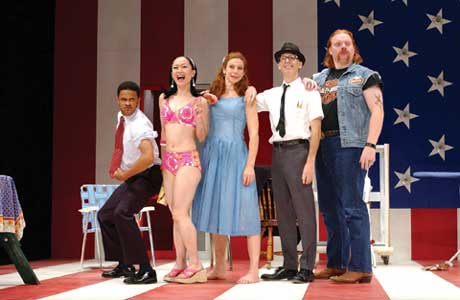


    bobrauschenbergamerica, a production by SITI Company

    Jaime Kleiman
    interviews Philip Bither, the William and Nadine McGuire Senior Curator
    of Performing Arts at Walker Art Center

    Do you see any fundamental differences in theater that is
    made in North America versus theater that’s being made in Europe? Are there
    similar themes, practices, or ideas threading through new work right now?

    Regarding differences, it’s very difficult to generalize,
    and this is a subject worthy of long essay or even a book. But here are a few
    thoughts: In Europe there is greater tolerance for conceptual (both in content
    and form) approaches and artists/producers feel less need to make performances
    "entertaining." While this is mostly good-artists have a tremendous
    freedom to experiment, even on the largest scale-at times it results in
    work that feels insular or academic.

    In the U.S. in recent years, ensemble and collective
    theater-making seems to be more dominant than in Europe, particularly in
    experimental and contemporary forms. Some of the ensembles that have emerged in
    the past decade in the U.S. represent a significant and exciting development.
    Our annual Out There Festival in January has, in particular, become a home for
    the rising contemporary ensemble theater movement in the States. Groups like
    Elevator Repair Service, Big Art Group, SITI Company, Riot Group, Richard
    Maxwell’s New York City Players, Universes, Big Dance Theater, and many others
    offer tremendous promise for the future of theater. They are willing to shake
    things up in a way that most of the traditional theater company structures in
    America don’t allow.

    A much more recent trend I’m noticing in the generation of
    theater/performance makers even younger than those mentioned above is what I
    might refer to "the new sincerity," a rejection of an ironic, distanced, more
    post-modern stance that has tended to define the work of their predecessors. We
    will see several examples of this direction in several of the companies
    appearing in this year’s Out There Festival.

    <--pagebreak->

    Warren MacKenzie at work

    Mason Riddle interviews Warren MacKenzie in conjunction with his retrospective,
    Warren MacKenzie: Legacy of an American Potter, at Rochester Art Center

    Could you speak to the influences on your work?

    The first influence was when Alix and I apprenticed at
    Bernard Leach’s pottery in St. Ives, England. Because we stayed in his house,
    we were around his collection of pots. We saw pots from China and Japan. It is
    also where we met Shoji Hamada, the master Japanese potter who worked in the
    mingei tradition. Through Leach and his book, The Potter’s Book, pottery became
    more available. Hamada, who was influenced by Korean folk pottery, took a
    tradition and gave it new life. I gravitated to his philosophy and how he threw
    pots. It was a philosophy of "Don’t look at my work, but look at the influences
    of my work. These influences are stronger [than my pots] as they represent a
    culture." Koreans didn’t have a word for "good" or "bad," just mu, "it is."
    Hamada’s work had tremendous breadth-it was an attitude-carried out
    as well as possible.

    I like the historic pots of China and Japan and Korea, where
    the culture was more elemental when these pots were beginning to be made. Much
    of contemporary Japanese pottery has become all too clever but fantastic in
    terms of technical skill. The potters have gained incredible skills, but they
    have lost an emotional reason to express. But this is only my personal opinion.
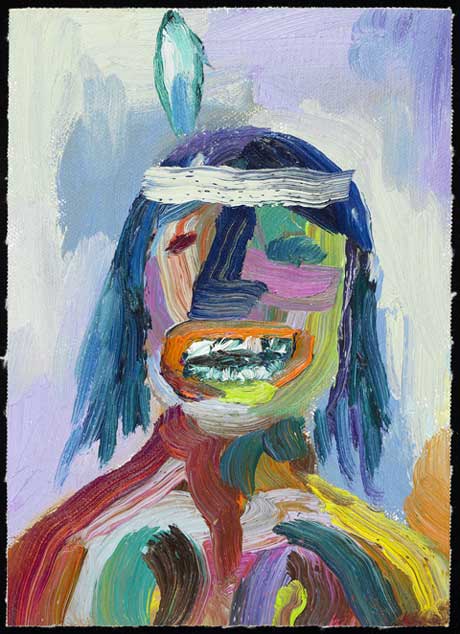
     

    Untitled, by Jim Denomie

    Ann Klefstad reviews the work of Jim Denomie and Andrea Carlson in New Skins, at the
    Minneapolis Institute of Arts

    New Skins is big, in all ways. It’s an ambitious show that’s
    highly successful. Jim Denomie and Andrea Carlson both use their positions
    inside and outside the standard art world to brilliant effect. The artists’
    work is very different, but the pairing works. Carlson and Denomie are both of
    Anishinaabe ancestry, but more than that, they are fine artists with academic
    training and fully developed personal styles. They use their media in
    sophisticated ways, working out of both Euro-American and Native cultural
    traditions.

    What was most instructive about this show to me was how rich
    the traditions of art are if they are approached not only from the inside, but
    with the perspective of someone who can both take a tradition and leave
    it-someone who can see it from inside and outside simultaneously. This
    eliminates stale strategies of quotation and irony, and opens up new potentials
    in the practice of painting. Both Carlson and Denomie are possessed of more
    than one tradition, and that seems to be a rich and liberating condition.
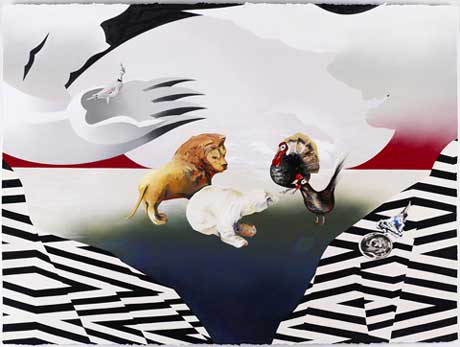
    False Flag, by Andrea Carlson
  • Losing Oak

    To lose an oak
    is no heartbreak.
    —No,
    but to see them go
    by the acre,
    at a stroke,
    is enough to
    crack a man open,
    the heart not broken
    so much as stricken,
    torqued at the root
    and left in a thick
    choke of ache.
    Just so,
    a whole forest’s
    felling will take
    faith’s poorest
    dwelling down and
    leave the chimney—
    stark
    in an open space
    —like a brick
    marker indicating
    a once good place.


  • The Man from Hamburg

    As you walk down the narrow hallway into Frank Sander’s
    sunlit studio in Lowertown you’re greeted by an entryway table piled with
    cables, cast-off camera bits, miscellaneous video equipment, and a couple of
    discarded microphone heads.

    On the walls are personal treasures the German-born artist
    has picked up during his twenty-odd years of travel. He takes down a recent
    prize from a wall near the galley kitchen: a weathered, conical straw hat he
    bartered from a farmer on a recent trip to China’s Yunnan province. "Can you
    see the sweat stains along the strap here? Look at the fine weaving work; the
    swirls and patterning in the straw are just stunning. I love that this bears
    the evidence of his labor, the time he spent in the fields," Sander said. "I
    think it’s just beautiful, it’s so human."

    Sander studied carpentry and architecture, along with visual
    art, in Germany; it’s clear he’s an itchy sort of artist, resistant to the
    fetters of just one discipline. Finding carpentry and architecture too precise
    and measured, he turned to sculpture and painting. He’s also noodled around
    with filmmaking and photography since childhood, experimenting early on with
    Super 8 cameras, and graduating over time to videography and digital
    photography.

    In his twenties Sander wandered throughout Europe, living in
    Spain for a time, then the Netherlands and Denmark. On a trip home to Hamburg
    in 1979, his train was caught in a week-long blizzard. "After a couple of days,
    I started to look around for ways to pass the time." He recalls wryly, "I kept
    thinking, surely there’s a young woman around here who needs some company."

    You can guess the rest: a fellow passenger was an attractive
    American. They hit it off and Sander followed her home to Minnesota, where they
    were married. That relationship eventually fizzled but his affair with the
    North Star State did not.

    In fact, Minnesota’s landscapes, especially the wilds of the
    Boundary Waters, have indelibly marked his artwork. Sander may be best known
    for his critically hailed installation, Human Nature, which premiered at the
    Minneapolis Institute of Arts in 1999 and also showed at the Daum Museum of
    Contemporary Art outside Kansas City. In Sander’s landscape, fish enrobed in
    resin hang from the frame of an upturned fishing boat; and scores of beaver
    skulls sit in government-issue file boxes in witness to the destruction of
    their habitat. The entire work was a sort of sculptural reliquary for Upper
    Midwest wildlife displaced by industrialization and sprawl.

    Sander, however, now has mixed feelings about large-scale
    public art. "It takes so much time and money, and so much time applying for
    grants, to put something like that together. No one really buys work that
    large, so in the case of Human Nature it sat around on my property deteriorating
    for years, just getting in the way. I’m more interested in actually making
    artwork than in shopping my artwork around."

    His current passion, videography and film, marries well with
    his wanderlust. Currently he is documenting the tribal minorities and austere
    beauty of Yunnan Province, in the mountains near the Tibetan border. Typically
    for Sander, he arrived at this latest work through both luck and a Zen-like
    acquiescence to the vicissitudes of his curiosity. He stumbled on these insular
    enclaves last year while sightseeing in China, and, intrigued by their singular
    cultural histories, struck up a friendship with a local university professor
    who introduced him to some locals.

    Sander was smitten with the people and their communities,
    poised between agrarian life and industrial modernity. Armed with just a
    camera, he returns every chance he gets. Sander’s video footage is immediate
    and intimate. There’s over-the-shoulder access to the mountaintop homes of
    boisterous young dancers, and walks along narrow village streets on festival
    night.

    With the ongoing collaboration of his Chinese partner, He
    Lujiang, Sander is working to raise money for an ambitious film project that
    would chronicle these peoples’ fast-disappearing stories.

    "We have the opportunity to preserve something of this way
    of life before it’s gone," he says. "Imagine if we’d been able to do something
    similar to capture Native American life before the days of reservations. These
    are communities on the cusp of modern life, and every day they lose a bit of
    their heritage to the conveniences of new technologies. If I can document their
    way of life, I’d like to post the whole film for free online. He Lujiang and I
    want their chronicle to be our small contribution to the world."

    The medium may vary, but Sander’s consistent theme is
    preservation. His is the proverbial (and literal) voice in the wilderness
    urging us not to forget who we were and to be mindful of the natural wonders
    being sacrificed for the manufactured comforts of modernity.

  • Zoom In: Amy Jo Hendrickson

    Hendrickson’s handiwork is a mélange of burlesque camp,
    cowgirl grit, and Victorian flourish. She’s undeniably influenced by ’70s pop
    design and ’80s album covers, but this North Dakota girl also mixes in a
    frontier spirit straight out of a nineteenth-century Sears, Roebuck catalog.
    But make no mistake, the work has some bite: Hendrickson’s all-American blonde
    pigtails are more Minnesota RollerGirl than Little House on the Prairie.

    If you go to rock shows around Minnesota, you’ve seen
    Hendrickson’s posters on the walls around you; she’s been at it for years.
    Since she moved to Minneapolis and set up shop at First Amendment Gallery with
    some other artists, her sly grrrl-power designs have been garnering more and
    more notice. And no wonder-with all the elements she unabashedly draws
    from, Hendrickson’s design savvy has the hook of a catchy pop song, tweaking
    familiar styles with unexpected juxtapositions and cheeky flair.

    Looking back, she says it makes sense that she was drawn to
    this kind of work. "When I was a kid, I loved flipping through the images in
    catalogs. I always noticed album covers and ad designs and movie posters," she
    remembers. "There’s all kinds of inspiration out there if you know how to
    look."


    Originally appeared in issue 18.1 of access+ENGAGE.

  • Point of Entry


    All artists come from a foreign country, in some sense.
    Where “originality” is essential, each artist becomes a world in him- or
    herself, with zealously guarded borders. But what’s it like to be an artist who
    makes a home in a distant land? The answers to this and a thousand other
    questions are different for each of the artists interviewed below. It turns out
    that “émigré artist” is not a category, only a door into a very large world.


    Manjunan Gnanaratnam

    Sri Lanka’s civil war drove Manjunan from home at
    twenty-one, in 1983. He arrived in New York to study music, saw Merce
    Cunningham perform, and found his calling as a composer for dance. His current
    projects include plans for a 2008 performance that includes dance projected on
    the walls at the Weisman Art Museum; he’s also recreating composer Karlheinz
    Stockhausen’s work Ceylon.

    Manjunan never spoke publicly about leaving Sri Lanka until
    recently: “I couldn’t talk about the effects of war until war came here—you
    can see wounded young people in the airports now. I can speak now about the
    innocence that was lost and people will understand.” He feared that if people
    knew of his exile, it would overshadow his work—which is not about exile
    or nationality, but the relation of human bodies and sound.

    “In some ways,”
    remarked Manjunan, “I’m more at home musically here than in Sri Lanka; the
    avant-garde music community here understands what I do. I have a home inside my
    music, inside my relationship to dance, to the optimal performance environment
    … that is, in some ways, my true home.”

    However, on returning to his home country after twenty
    years, he realized he had missed “the vibrations of the society that produced
    me. Sri Lanka has five hundred years of colonization, by India, England,
    Holland. The music contains all these traditions, church music, Hindu music,
    Buddhist, rock ’n’ roll—and so in some sense everything’s allowed. My
    physical home is in Minnesota, but my emotional home will always be Sri Lanka.”

    “My work as a composer for modern and postmodern dance and
    performance art is easily accepted in the East and West coasts and
    internationally,” he noted; “however, I would say Minnesota lags on this.”

    So when asked what he feels he brings to the mix of the arts
    in Minnesota, Manjunan responded with a smile and another question:
    “Adventure?”


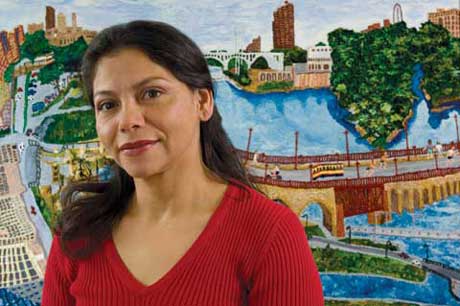
    Gladys Beltran

    A painter who arrived here in 1993 from Colombia, Beltran
    has a BFA from the University of Antioquia in Medellín, and won a McKnight
    Fellowship in 2006. It took her several years to learn English and feel at
    home, but now, she says, “the process of growing old and the hope of growing in
    the spirit through my work is taking place here.” But she misses her sisters,
    her parents—their faces, how they change over time, their jokes and
    laughter. “The absence of our loved ones is a temporal death. It is horrible
    when you can’t hug them.”

    But there is freedom even in this sorrow. “As a painter it
    is liberating not to be with some members of my family who love me, I know, but
    who cannot understand why I have to paint. Being away, I do not have to explain
    over and over why: I have to paint if I want to breathe in peace. I have to
    paint because I do love to exist.” She says it’s too soon to know people’s
    reactions to her work: “My work is like a baby, and people always like babies.
    I haven’t done 1/30th of my project.”

    Artists, she believes, are similar everywhere. “I brought my
    hungry soul. I can say it is more what I took from you than what I brought,
    because I am taking your cities to paint them, I am taking your spaces to
    navigate in them with my paintbrushes over the canvas. In other words I will be
    taking over your country to paint it, to love it.”

  • MinnPost vs. The Daily Mole

    Personally, I don’t think of it as much of a competition. But by virtue of both former Star Tribune editor and publisher Joel Kramer and former City Pages editor Steve Perry being inspired pretty much simultaneously by the collapse of print journalism in the Twin Cities and then deciding to bust sod for a credible alternative, the two men find themselves launching their much-anticipated websites within days of each other.

    Kramer, who has received far more attention, recently announced that MinnPost.com will open for business on November 8. Perry, in a conversation this morning, believes there’s a chance the full public debut of The Daily Mole can match or beat that. Not that there is any direct head-to-head competition, you understand.

    For those of you who have not been hanging on every cyber-whisper in this duel, if they were cars, MinnPost would be the Oldsmobile sedan with a box of Kleenex in the rear window to Perry’s tricked out ScionB, with the neon ground effect lighting and Borla exhaust. Plenty of style with not much horsepower. MinnPost has signed up something like four dozen local journalists, some stars, some solid veterans, some head-slappers and some unknowns. Perry, who says he has only recently begun to seriously work his network for money, will rely heavily on himself, his wife Cecily Marcus, and a handful of trusted wits like Jimmy Gaines and John Busey-Hunt, for the launch and (hopefully) build his cast of characters incrementally.

    The Daily Mole has been in private, behind-password, beta mode for a couple weeks now, and, granting the common sensibility of those invited to look in, the reviews have been pretty good. If the real thing can deliver more of the same … with a boost in substance/value … it’ll be a must read, or must see, since Perry’s interest in original, funky, comic video is high.

    Says Perry, “What I told Kramer at the outset when we had coffee, is that it is in our interests that both succeed.”

    His point being that traditional advertisers can see as well as you and me that print newspapers are sorry, struggling beasts, shedding content and readability as fast as profit margins. What advertisers are waiting for is something credible to take their place. “With both of us out there trying to tell advertisers that online sites are for real we each get a boost. I think we’ll complement each other.”

    Kramer, caught on the way to a luncheon speech of some sort, says MinnPost’s beta phase will begin very soon and run for about a week prior to launch. “We don’t expect things to be perfect at launch, but we hope readers understand and bear with us.”

    The chattering class take on this duo is that Kramer must avoid recreating old school ink journalism on the web, adjust his “filter” properly to provide a genuine alternative to what is still being published in print and build a revenue stream rapidly enough — within the next six months — to take full advantage of his “staff” of freelancers before their severance checks from the Star Tribune and Pioneer Press have been lost to casinos, booze and mortgages. Perry’s challenge is to quickly develop a steady flow of bona fide content to match his video and audio cleverness … and find significant investors to keep him afloat for the year or more it’ll take to bring The Mole to some level of maturity.

    As has been reported previously, Kramer’s freelance cast will be earning marginal compensation at best for their contributions. (The sliding scale for blog-type posts up to “featured” news pieces is a little confusing, but it is safe to say no one will be buying into a hedge fund with their MinnPost earnings.)

    Kramer acknowledges the “ticking clock” of the severance checks on his Strib and PiPress staffers indirectly, saying, “What is a concern to us is the concern of trying to do daily journalism with a freelance staff.” Most of his writers are veteran and experienced enough to self-edit. But given their need to diversify their work loads with other endeavors, there’s no guarantee Kramer and MinnPost will have their full concentration when he needs it most.

    Kramer hints that compensation may very well change over the first year as some of his contributors prove themselves to be more valuable than others.

    MinnPost’s editing “filters” are another point of curiosity. Everything will be run through his full-time editors, with posts getting less of a work-over. His chosen filters are all experienced, meticulous and cautious. Maybe too cautious. It seems to me a vital quality of the new media is the willingness to take at least one step, (and probably a half dozen steps) further than a daily newspaper in terms of “reporters” offering what they believe to be true. (Along with clearly distinguishing what is “true” from what is bullshit “balance”.)

    “Edgy” is a very tired word. But none of Kramer’s editors have ever been accused of “edginess”.

    I asked Kramer if he worried about getting tagged with the “old school” label?

    “No. Our primary goal is quality. We think we’ll have some elements that will be entertaining. But ‘edgy’ is not a priority. Quality comes first.” He adds that a lot of people think of the Internet in generalities — “edgy”, etc. — but that there are sites, he mentioned Salon and Slate, where solid journalism regularly trumps snark and cool. He wants a slice of that crowd.

    Kramer did assure me that video and audio production will be a facet of MinnPost … at launch. And that this is not going to be the cheap version, with reporter/writers toting camcorders. “This will be professional video shot by professionals. I’m not saying on every story. But it will be there at the launch.”

    The MinnPost vs. Daily Mole “battle” is not a zero sum game. There is no reason both can’t succeed … or fail. Kramer is carrying much more overhead, something close to $1 million a year, while Perry is playing a variation on the “low expectation game”, as in, “Hey, look what we did with squat and duct tape.”

  • My favorite place to fantasize


    I wrote a piece on Scandinavian furniture/design a while back and, unfortunately, it came off as slighting one of the finest sellers of Scandinavian wares in all the TC land: none other than Danish Teak Classics. This is the place where your visions of a stylish, modern living area can come into focus. Sure, the prices aren’t in line with what you’ll find at cheap-and-cheerful (and chintzy) Ikea. For starters, their stock of furniture has already seen a good fifty years. And from the looks of things, the average DTC piece will enjoy a healthy hundred more. The Rake’s promotions depot is hosting one of its fabulous Gallery Grooves events at Danish Teak Classics on Thursday eve. Check it: Marinade your decorating ideas in a showroom full of vintage-modern chairs, desks, tables, and lighting fixtures. And the event comes replete with fine wine, food, visual art, and jazz to boot. But no vin rouge on the lounge chairs, please. I heart the pink one at left.

  • Cosmetic Dentistry: An Aside

    For more than fifteen years, the gap between my two front teeth has been a source of self-loathing. This is usually how that went: I pore over women’s magazines, never pausing at the pencil-thin thighs but rather marveling at the models’ perfect smiles. Next, I stare at my reflection, puzzling over whether my gap makes me look European (Vanessa Paradis), lusty (Lauren Hutton, Madonna), punk-rock (Mick Jones of The Clash), or just plain hideous. When I see photos of myself, I fix upon the gap-toothed grin rather than, say, the double chins. Call me superficial if you must, but believe you me: Diastema can cramp a girl’s style.

    In 1997, an unfortunate accident involving sangria, polka, and a good-looking Brit left me with a deadened front tooth. One root canal, a crown (which left the gap intact), and ten years later, the Chiclet started to show signs of wear. So, I figured, how harmless would it be to finally close the gap, since I would be replacing my crown anyway? My only complaint is that food sticks to my smile nowadays, whereas I certainly didn’t have that problem before. In any case, je vous presente me and my new, improved front teeth:

    smile.jpg

  • Craig Finn’s Playlist


    The Hold Steady
    are well known for tossing hosannas to the Twin Cities’ landscape and music scene, past and present—from name-checking the “Grain Belt bridge” and Payne Avenue to sonic nods to all manner of local bands. Never mind that frontman Craig Finn, a native of Edina, decamped to Brooklyn some seven years ago—the Twin Towns (and their suburbs) remain a key inspiration. Of course, influences outside our city limits also filter into Finn’s songs: hints of Jersey boy Bruce Springsteen (OK, maybe not just hints) or Ohio’s Guided By Voices, not to mention shout-outs to dive bars and shopping malls stumbled across on countless and lengthy tours. So we asked Finn what he’s listening to these days, now that his geographical horizons are wide open.

    1. “Enjoying Myself,” The 1990s
    We are taking this band on our upcoming tour. Their live show backs up the claim of the song, that they like enjoying themselves. One line I particularly like: “I’m glad we had the party at your place.”


    2. “Shirin,” Jens Lekman

    I read a negative review of his new record that said Lekman was “condescending,” which might be true. But if it is, it might be one of his best traits.

    3. “I’ll Be Your Bird,” M. Ward
    This song is an older one, but it’s perfectly creepy and beautiful, and sounds rooted in no particular decade, which is a songwriting feat.

    4. “4% Pantomime,” The Band
    Every few months I get stuck on the Band. The version I am loving right now is a demo, where Van Morrison stops midway through, offers some advice to the group and tries it again, with Rick Danko taking the first verse this time.

    5. “Crazy For Leaving,” Catfish Haven
    George Hunter has one of my favorite voices in indie rock. These guys are soulful in the way that Creedence was. We took them on tour and would hear this song every night, and I would wake up singing it every morning.

    6. “Thrash Unreal,” Against Me!
    It seems that every article I read about this band is about punk-scene politics, but no one seems to want to talk about how massive these songs sound, especially with a chorus of a few thousand excited kids singing along.

    7. “Fear and Whiskey,” The Mekons
    My friend told me that the Mekons’ live show is “even better than The Replacements.” A big claim, to be sure, but the Mekons sure delivered.

    8. “Louisiana 1927,” Randy Newman
    Newman is tender and humorous here in a way that almost no one else can be. His songs are often more like character studies, and stunning in their depth.

    9. “Elvis Cadillac,” Rickie Lee Jones
    Her record this year knocked me on my ear, not only its droney, Velvet Underground-style backing band, but also its confessional tone. I think this is the record I listened to the most this year, and this is the most charming song on the record.

    10. “Knock ’Em Out,” Lily Allen
    After seeing every “important” band in the world on the European summer festival circuit, I saw Lily Allen on my last night in London. Her live show beat everyone I had seen all year, just by the sheer fun of it. She even did two Specials covers. In this song she coolly turns down potential pick-up artists as quick as they arrive.