Month: January 2008

  • Not Just for Breakfast Anymore

    For the Bible Tells Me So, Daniel Karslake’s 2007 documentary on the history of the religious right’s hate-hate affair with the gay community, begins with news footage of a celebrity who was once a household name, but is now long forgotten … and yet, thanks to Minnesota 6th District Congresswoman Michele Bachmann, she is not at all unfamiliar to us. The fallen idol is Anita Bryant, singer of “Paper Roses,” “Til There Was You,” and other hits from that bleak era in popular music between Buddy Holly’s death and the arrival of The Beatles (who, ironically, did an equally bleak cover of “Til There Was You”). In the seventies, Anita would become even more famous for her TV pitches for the Florida Citrus Commission, exhorting Americans to drink orange juice, with everything from toast to cheeseburgers to caviar, with the words: “It’s not just for breakfast anymore!” But, by 1977, the year of the footage featured in Karslake’s film, Bryant’s name became synonymous with one thing: homophobia.

    That year, Bryant founded and became the spokesperson for a grassroots campaign called Save Our Children. She had begun SOC in response to a movement by the Commission for Dade (later Miami-Dade) County, in her home state of Florida, to amend a human rights ordinance so that discrimination on the basis of sexual orientation would be outlawed. The amendment was slated for a vote in June, 1977, and Bryant, who belonged to the Northwest Baptist Church, a virulently conservative congregation that also fought against school desegregation, was not about to let gays and lesbians be given the same rights as those minorities her confederates failed to keep out of their schools.

    With the help of her husband, Miami DJ Bob Green, and a little known pastor named Jerry Falwell, Bryant and SOC quickly gained support via petitions, direct-mailings, and phone drives. She also sought support, and gained nationwide notoriety, with public appearances in which she snarled statements like: “If gays are granted rights, next we’ll have to give rights to prostitutes and to people who sleep with St. Bernards and to nail biters.”

    These words, of course, were echoed in 1998 by recently retired senate minority whip Trent Lott, who said that gays should be put in the same class as shoplifters and drunks (and who, according to the blogosphere, at least, might have left office out of concern for being outed by a rent boy). But the whiff of familiarity does not apply only to Lott. In fact, Anita Bryant bears so much resemblance, in terms of personal, spiritual and professional philosophy — not to mention physical appearance — to Michele Bachmann, that it’s enough to make one, well, bite one’s nails.

    Back in 1977, Bryant launched her SOC campaign with this fearful declaration: “As a mother, I know that homosexuals cannot biologically
    reproduce children; therefore, they must recruit our children." When Bachmann was serving as Minnesota state senator in 2004, she reacted to Massachusetts’ legalization of same-sex marriage with this eerily similar preoccupation in a radio interview: “Little children will be forced to learn that homosexuality is normal and natural and perhaps they should try it.”

    Unlike the juicer, who made no bones to the mainstream press about her notion that gay people love nothing more than to get their greasy little hands into kids’ pockets, the congresswoman, like most other current anti-gay fundamentalists, insists that she merely wishes to protect the sanctity of marriage. But, as her own personal and professional pursuits have shown, this is a diversionary tact to distract from her and her cronies’ determination to purge society of any gay person who doesn’t want to be “cured.” It’s just that Michele, like others of this peculiar mindset, has learned to be more careful in her language — at least that which she deploys in secular, mainstream settings — thanks, in no small part, to the woman who would be the homophobes’ first celebrity mascot.

    Turning back the clock again to the year that disco — up to then the province of bars and clubs catering to all those sweating, pulsating gay men — took over the world, Bryant and Save Our Children did shore up significant support for repeal of the amendment. She not only became a darling of the religious right, helping to shine the spotlight on Falwell, as well as Phyllis Schlafley and Pat Robertson, but even enjoyed support from the conventional media, including Time Magazine and The New York Times.

    At the same time, she inadvertently galvanized the gay rights movement, increasing its numbers several-fold, and sparking record-setting attendance for pride parades in major cities, most of which used her as an emblem of hate (in fact, here in Minneapolis, an Anita look-alike contest was part of the festivities). A nationwide boycott of Florida oranges began, and the Citrus Commission was inundated with phone calls urging them to dump the woman who so sweetly chirped, “A day without orange juice is like a day without sunshine!”

    Barbara Streisand, Ed Asner, and other celebrities spoke out against Bryant, as did former U.S. Attorney General Ramsey Clark and President Carter. By the time the Dade County Commission voted in favor of repealing the anti-gay discrimination amendment, Anita and her people had won their political victory. But they also, as The Nation aptly put it, became “the best thing that ever happened to homosexuals.” This was largely due to the hateful one-liners the chanteuse (who, despite a high singing voice, had an intimidatingly low speaking one) would spit out before cameras and microphones, such as: “If homosexuality were the normal way, God would have made Adam and Bruce.”

    The gaining strength of the gay community, and the beginning of the end of her crusade, is symbolized by the footage featured in For the Bible Tells Me So. At a press conference in Des Moines, one of several cities where discrimination ordinance amendments were to be voted on, Bryant discusses the protests and harassment she has received from the people she regards as pedophiles. As she does, a gay activist named Aron Kay rushes up to her and rams a pie in her face. While gasps fill the room, and Bryant’s husband implores attendees not to apprehend the assailant — whose specialty was sending the pastries into rightwing enemies’ kissers — but to pray for him, the singer growled, “At least, it was a fruit pie.” (For the record, it was just cream.)

    Within months, Save Our Children would collapse, and Bryant’s performing and pitching career would come to a screeching, terminal halt. The Citrus Commission, and the many corporations for which she was a spokesperson, refused to renew her contracts. By the early ’80s, she was making pathetic attempts to renounce her hate-mongering, insisting the whole campaign was the idea of husband Bob, whom she divorced in 1980. This rapid fall taught many, if not all, antigay crusaders to be more careful in how they spoke to those outside their inner circles (Falwell and Robertson would continue to have a problem with this, especially after 9-11).

    Thus, Michele Bachmann, who began her life as a “fool for Christ” around the time of Anita Bryant’s brief tenure as chief fool, made sure, by the time she ran for national office in 2006, to focus on the preservation of marriage and deny any links to homophobic institutions — even if those links were very much a part of her adult life.

  • The Three Pointer: Squandering Development Capital

    Game #32, Home Game #16: Denver118, Minnesota 107

    Game #33, Home Game #17: Dallas 101, Minnesota 78

    1. Beating A Dead Horse

    Al Jefferson and Craig Smith took the floor for the opening tap Friday night so you knew the Timberwolves would fall behind early. And, why, yes, Denver scored the first 12 points of the game and was up 12-2 when coach Randy Wittman mercifully subbed in Chris Richard for Smith with just 3:24 gone in the game. By the time Smith returned alongside Antoine Walker for Richard and Jefferson seven minutes and three seconds later, the score was 28-21, meaning the Wolves had outscored the Mavs 19-16 during that stretch. Nevertheless, to begin the second half, it was again Jefferson and Smith matched against  Marcus Camby and Kenyon Martin. And again Denver jumped out, this time 5-1 to go up 66-53 before Wittman gave Smith the hook, in favor of Walker.

    When I asked Wittman after the game why Smith was yanked twice, he said because the Rhino wasn’t getting back quickly enough on defense. Okay, got it.

    The Dallas Mavericks came to town this afternoon. They started a front line of DeSagana Diop, Dirk Nowitzki and Josh Howard. The tricky matchup, of course, is Nowitzki. Ah, but not for Randy Wittman. He goes with the old tried and untrue, Jefferson at center, Smith at power forward and Ryan Gomes at small forward.

    Listen folks, I really would like to be more original in my criticism of this ballclub. But when a squad is losing 29 of its first 33 games, including the last 8 in a row, and is getting demonstrably worse, not better, I feel it is important to point out the main reasons why this seems to be happening. And with precious few exceptions, it has to be said that when Jefferson plays center and Smith plays power forward, the Timberwolves get their ass kicked.

    You have a wealth of stats to back this up, and I won’t go back and get them (scroll back on previous posts if you want). Let’s just focus on this afternoon. By what logic do you send out a beefy undersized former second round draft pick, who was twice benched in the last game for not getting back on defense, and who has trouble guarding players outside the paint, as the one to match up against the reigning league MVP, who just happens to be a half-foot taller, quicker, and a deadly outside shooter? Do we really need a manual with the words Craig Smith vs. Dirk Nowitzki = bad matchup in bold print to prevent this from happening? Apparently so, because when Smith went to the bench with 2 fouls in the first 3:35 of the game, Nowitzki already had 7 points and the Mavs were up 7, 11-4.

    Now without question Nowitzki is a brutal matchup problem for most every team–that’s a main reason why he’s MVP. But there were at least three better options for Wittman than Craig Smith. One would have been to play Jefferson at center, Gomes at the power forward opposite Nowitzki, and Corey Brewer at small forward on Josh Howard. Or kick Marko Jaric up to the small forward slot and slide Rashad McCants–he of the 34 points the previous game–in at shooting guard. Or go big, with Chris Richard or Mark Madsen (Michael Doleac didn’t dress) at center beside Jefferson at the power forward and Gomes at the small forward. Or throw a front line of Jefferson at center, Walker at the power forward guarding Nowitzki, and Gomes on Howard. Because Gomes, Jefferson, Walker, Jaric, Madsen, and Richard are all better matchup options on Dirk Notwitzki than Craig Smith.

    And indeed, all but Richard got a chance to guard Nowitzki at some point in the game. For the most part, Nowitzki burned them all, finishing with 30 points on 12-20 FG and 5-5 FT. But Walker and Gomes took away his easy looks from three-point range, and it was good to see Jefferson reach down and get feisty with Nowitzki in the 3rd and early 4th quarters, bodying him up and making it a personal battle. Jefferson lost that struggle but the notion that he waged it, wagered a little of his personal identity on trying to stop someone for a change, was one of the few silver linings in this nasty 23-point spanking that wasn’t even that close.

    Again, I understand I’ve said all of this before and am "beating a dead horse" as they say (unfortunately a very fitting analogy for this Wolves team right now). But Al Jefferson and the Minnesota Timberwovles play much much better with a legitimate center on the floor. Today, Richard and Madsen played center for a combined 21:08. During that time, Dallas outscored Minnesota by 2 points. In the 26:52 Madsen or Richard was not playing center, Dallas outscored Minnesota by 21 points.

    This continues a year-long pattern that surely has been noticed by *someone* in the organization by now. The only logical explanation is that Wittman and the front office stubbornly see some benefit in perpetuating a consistently bad lineup. Yeah, one coujld argue that Dallas’s first quarter blowout quickly made the Madsen/Richard minutes in the second half garbage time, negating the plus/minus emphasis. (A full six minutes into the game, the Wolves had 1 rebound, 1 assist, 3 turnovers and were allowing the Mavs to shoot 78% (7-9FG).) But then how to explain Richard going plus +3 in the first quarter against Denver the other night–when the game theoretically was still in reach–only to never again see action during the other three quarters? No, the Jefferson-Smith pairly has been willfully rammed down the throat of Wolves fans by this coaching and front office staff. Wittman has occasionally justified it as providing better front court offense, but the awful defense from duo more than negates that supposed advantage.

    Wittman stalked away and cut off his press conference early today, once again vowing to make "changes," and once again callign forth all kinds of fighting analogies to say that the Wolves lack heart. Well, yes, it appears that way. Certainly less heart than they showed in November, and slightly less than they showed in December. But what the coach needs to remember is that the hearts of players grow, like their confidence, when they are put in a position to succeed.


    2. Make McCants Prove Himself

    Ironically, pairing Jefferson and Smith on the front line is one of the precious few things Wittman has done consistently for most of the season. Another, by default, is playing Sebastian Telfair at the point. What consistent Wolves watcher doesn’t have a very clear idea of what Jefferson, Smith and Telfair can and can’t do?

    But if Wolves fans are to endure an epically horrible season, they deserve that management, A) Identify which key players need to evaluated, and B) Get as large a sample size as possible by which to evaluate them. Put simply, there are certain players that need to prove or disprove themselves this season. And I’d put Rashad McCants at the top of the list.

    Why? Because McCants is the team’s premiere scoring threat on the perimeter. Because he has undergone microfracture surgery and needs to be physically vetted. And because McCants is a player of great virtues and vices, and the Wolves need to see if the virtues can be maintained with more consistency, and if the vices are a product of simple immaturity of something more fundamental.

    For all you McCants doubters out there, I understand. I see the scowls, the reach-in fouls, the neglect to penetrate and simply jack up jumpers, the bushels of points that don’t matter and the paucity of key hoops that could swing a game or two Minnesota’s way. But I also saw him get a career-high 34 in the flow of the offense Friday night. And I saw him get to the line 17 times in 55:24 over the past two games. The McCants supporters can appropriately note that if Al Jefferson goes off for 34 and 21 and shoots 17 FTs, we are all more apt to overlook his shakey defense, lack of passing and other deficiencies.

    Besides, what are your backcourt options, folks? Sebastian Telfair looks fried, Corey Brewer can’t stick a J, Marko Jaric is approximately as
    inconsistent as McCants, and Gerald Green is earning a C- in Basketball 101. Yes, perhaps McCants is a perpetual tease and a toxic head case destined to be more trouble than he’s worth. If the Wolves believe they know that to be true already, then they ought to be force feeding Corey Brewer in the backcourt rotation with Telfair and Jaric and given the vet Greg Buckner a little more burn to try and pull out a win or two. I think McCants remains an enigma. After awhile, that ceases to become a teasing mystery and turns into an deadly flaw–call it strangely willful inconsistency. But isn’t this lost season supposed to be about getting to the bottom of enigmas, and tossing away the bad apples and priming and then accelerating the development of those who seem to be getting a clue?

    Stick Shaddy in the starting lineup for 30 minutes per game, minimum. State that this will continue at least until Randy Foye returns, and quite possibly beyond. Take some of it out of Telfair’s minutes, some of it out of Jaric, and some of it out of Gomes–Telfair needs a breather (psychologically if not physically), we know the Jaric rollercoaster intimately already, and Gomes is hardly a sure bet to stick around once his contract expires. The notion of a Foye-Jefferson-McCants triad on offense remains the rosiest point-scoring scenario before the next NBA Draft.

    3. Quick Hits

    Remember all that talk about how much this team pulls for each other and how tight and enthusiastic they are? It has been true and it has been remarkable. But it can’t last much longer without some good news, like a win or two or Foye’s imminent return and a lineup shift that suddenly pays big dividends. Al Jefferson in particular is starting to get surly, McCants is a couple of weeks from blowing, especially if his minutes continue to yo-yo, and Randy Wittman’s post-game snits are already running out of juice.

    Also, remember all that talk about what a brutal schedule the Wolves had in December, and how things would improve in January? This was almost totally based on home games versus road games. For the record, the January schedule is if anything tougher than December’s. Portland, Denver and Dallas were all correctly figured to be losses. Miami at home without Wade and Shaq looks to be a golden opporunity to bag the squad’s first W since the Winter Solstice, but after that they have Houston and San Antonio on the road, Golden State at home, then Phoenix and Denver on the road before going to Golden State and Boston on either side of playing Phoenix here. If you’re wondering at what point the Wolves’ winning percentage falls behind Philadelphia’s NBA worst-ever percentage of .110 (9-73) from 1972-73, it would be 4-33.

    Kevin McHale, quoted in Wolftracks magazine: "Another solid veteran for us is Antoine Walker. He gives us a different look at the four spot and also can play the three spot. He can shoot and help spread the floor– and he understands the game very well." All true. And ‘Toine at the 3–what a concept.

  • We Are, After All, Defined by the Cold

    As the cold weather digs in its claws to take hold for the next four
    months, we must keep things in perspective by remembering one key fact:
    This city’s greatness depends largely on the cold. Sounds strange; I
    know. But can you imagine a city as great as this one with decent
    weather? It’d be unbearable! For one, this frozen tundra of ours keeps our lakes and man-made lagoons of ice fully solid and ideal for some serious skating. Go to Winterskate Park or The Depot to experience the fine indoor and outdoor skating venues the cities has to offer. If the weather outside gets too frightful surrender to the indoor push and let your guard down for the local open mic nights. Our state boasts some mad public speaking and performance skills. Try Acme Comedy Club to tickle your funny bone or The Terminal Bar for a musical treat.

    MUSIC
    Another Local Legend?

    The fabulous Minnesota weather — or perhaps the chaos it prevents — has also made the Twin Cities home to many a music legend. The talent with which we’re surrounded on a regular basis here — the talent we so often take for granted — is enough to make any non-native music lover squeal with delight. Take local blues pianist Willie Murphy: His 1969 collaboration with folk/blues legend "Spider" John Koerner (Running, Jumping, Standing Still) has achieved all-time folk/blues classic status. He has continued to perform and impress for 30 years. And he was named as one of the three charter members of the Minnesota Music Hall of Fame, along with Bob Dylan and Prince. Bob Dylan and Prince! This is not just a local blues pianist, folks. And this is not just a West Bank icon. This is a blues icon. Period! You have eight straight Monday nights to see him, so start tonight.
    8 p.m., Minneapolis Eagles Club, 2507 E. 25th St., Seward, Minneapolis; 612-729-4469.

    WORKSHOP
    The Textures of Your Life

    What’s your favorite winter fabric texture? And can it heal you? Apparently, this afternoon’s Well Within art and support group will show you how. The Textures of Your Life: Healing through Art will help you explore the rough and smooth parts of your life through work in textiles and other media in this three-hour workshop. Bring on the polyester! —Kate McDonald

    12:30 p.m., Well Within, 1880 Livingston Ave., Suite 103, West St. Paul; 651-451-3113; $15.

  • Cue's Second Act

    Remember Cue at the Guthrie?

    The press release from the Guthrie Theater touting a January
    three-course prix fixe menu for $29.95 took me by surprise. This isn’t just a
    prix-theater early bird special – it’s available any time, and includes a free
    self-guided iPod tour of the theater and complimentary glass of wine or cup of coffee after dinner.

    Back when Cue opened in the summer of 2006, a table at the
    new Guthrie Theater’s sleek dining room was the hottest ticket in town. Cue had
    snagged a local celebrity chef, Lenny Russo, and all the buzz that came with
    the opening of a major new landmark, designed by superstar architect Jean
    Nouvel.

    Russo’s opening menu, assembled with the help of a network
    of Midwestern producers made the concept of Midwestern haute cuisine seem like
    more than an oxymoron: Rick Nelson’s review in the Star Tribune praised the
    wild boar pate with pickled vegetables; sliced elk with wild rice and
    blueberries; and a salad of grilled quail with summer squash and poached
    tomatoes, among other dishes.

    Russo left about a year ago, to return to his own Midwestern
    haute cuisine restaurant, Heartland, and I hadn’t been back since. The buzz and the crowds
    have evidently died down – when we visited at 8:30 on a Saturday night, the
    dining room was about three-quarters empty. The theaters were empty last night,
    which may explain the sparse crowd, but Cue had ambitions to be a top
    destination restaurant.

    The new Cue menu is still very stylish, but not nearly as
    inventive or adventurous as it was in Russo’s day. The elk, quail and wild boar
    are gone, though the menu does offer a cassoulet made with pheasant confit. (I
    was puzzled enough by this description to ask the chef: duck confit is duck
    cooked in its own abundant fat. How do you confit a bird as lean as pheasant?
    Turns out, you cook the pheasant in duck fat. Which makes sense, but must make
    the pheasant taste like duck.) A lot of the usual suspects show up, including
    artic char, ahi tuna, mussels, filet of beef with wild mushroom sauce;
    free-range chicken breast with whipped potatoes.

    The prix fixe menu varies a bit from day to day, but the
    basic format seems to include a choice of soup or salad; a choice of fish,
    chicken or pork chop, and a choice of desserts from a list. In strictly
    economic terms, the $29.95 special is a good deal: the pork chop costs $29.00 a
    la carte, and if you add the cost of soup or salad (8-$9) and dessert ($8),
    plus the price of the audio tour (5), and the complimentary glass of Pinot Noir
    or Chardonnay (or coffee) that accompanies the audio tour, the savings are
    substantial. But this still isn’t bargain dining: with tax, tip, and
    three glasses of wine between the two of us, our tab still came to $115.

    We had a pleasant dining experience in striking
    surroundings, with friendly and attentive service and food that was
    well-prepared but not exactly exciting. My winter squash soup was a low-calorie
    puree with diced cubes of roasted potato and just a hint of sweetness (pear, as
    I recall), and my grilled pork chop was thick and juicy, nicely complemented by
    whipped sweet potatoes, roasted golden beets and a chutney of walnuts and
    raisins. Carol’s menu started with a rather bland fennel salad, followed by
    grilled coho salmon served over Israeli couscous and baby zucchini with a hint
    of a citrus sauce. I thought the salmon was a bit dry; Carol didn’t. Neither of
    us was very impressed by our desserts – a cranberry upside down cake with a
    citrus sorbet, and an almond, apple, and crystallized ginger cake with almond cream and cream cheese ice cream.

    Bottom line: an enjoyable evening, and the self-guided iPod audio tour, narrated by director Joe
    Dowling and several Guthrie actors, was a fun little bonus at the end. But I am
    glad I didn’t pay full a la carte prices. When it opened, Cue was vying for a spot on the short list of top
    Twin Cities destination restaurants. Now it seems more like a convenient but
    pricy place to dine before the show.

  • Woman of the House

    It’s
    January and I’m ecstatic. Well, ecstatic like someone who has crossed a
    marathon finish line and can finally stop running. I love the holidays.
    But I loved them lots more before I knew the whole damn show was
    powered by one frenzied woman on a gerbil wheel – and she’s me.

    This year there were a few new wrinkles to Christmas beyond finding
    the perfect gift, getting the kids to smile in the Christmas picture
    and keeping the artichoke dip warm at the party. Now that my children
    are a bit older at the esteemed ages of 4 and 6, they’re starting to
    ask questions that are, well… hard. And the balancing act of Santa vs. Nativity Story has officially begun. Or as I call it, “the pink Jesus in the room.”

    Our vague “Do Unto Others” philosophy that we’ve taught our
    un-baptized children works all right most of the year. But then there’s
    Christmas and the Christmas Story (not the one with the BB Gun – the
    other one) and it’s non-stop Jesus talk. Once my daughter came home
    from preschool in tears because a child told her that “when you love
    Santa it makes baby Jesus cry.” We couldn’t ignore it any longer.

    It’s not that I’m against Jesus, I have even found myself describing
    him to my children as “a really nice guy.” I understand that’s short
    shrift for the man that inspired the Christianity movement, but
    honestly, I feel like he’s been co-opted as the spokes-deity for a
    political movement I’d rather not be associated with.

    So to avoid completely resigning the Season to a red-suited man
    driving a Norelco shaver across the snow (shout-out to anyone who
    watched any TV in the 80’s), I went on-line and researched Advent.
    Every December Sunday, we lit a candle, read a story with the theme of
    generosity and talked about how we could each be a light in the world
    like Jesus – and hey, his birthday happens to be coming up!

    I’m not claiming it was perfect, but the kids liked the ceremony,
    the story or at least the flames. It spurred many interesting
    conversations and we even “adopted” a family in need on our quest to be
    that light our world desperately needs. It helped cast Jesus as less of
    a red-state politico and more of an actual “nice guy.”

    All in all, it was a satisfying experiment and I’m even trying to
    carry it on the 11-months when the Nativity is packed away. Most
    surprisingly, I feel common ground with religious conservatives who
    pull their kids from public schools because, for now anyway, when it
    comes to spirituality we’re home schoolers.

    Lucie B. Amundsen is a writer and editor in the Twin Cities. Her
    family oriented essays have been heard the podcast, Mombo and Minnesota
    Public Radio’s "All Things Considered” and “In The Loop."

  • A Bad Movie and a Fine Hungarian Wine

    Here’s how we end up at Gusto Cafe & Wine Bar in Hopkins:

    It’s Saturday evening and we have nothing to do because the party we thought we were attending actually is next week (someone — that would be me — put it on the wrong space in the calendar) and all the kids are occupied elsewhere and it’s too late to make dinner reservations. So we decide to hit a cheap movie.

    We intend to see American Gangster, which has Russell Crowe, so how bad can it be? But we get to the theater two minutes too late and walk in at the end of what looks like a pivotal opening scene involving bloodshed, then sit down next to three young boys who proceed to giggle and text message one another. After 20 minutes, I admit to my husband in a whisper that I have no idea what’s going on. So we get up and walk down the hall.

    If we wait 20 minutes the ticket taker tells us, we can see Dan in Real LIfe instead, which has Steve Carell, Juliette Binoche, and Dianne Wiest, so how bad can it be? Well! Where to begin?

    Bad, bad, bad, bad, bad, bad. . . .

    This is a film that manages to be both tedious and irritating, with just enough cloying drama to keep you from thinking about something more compelling — say, tomorrow’s grocery list; or what you might want said at your own funeral — but nothing that will lift or transport or even amuse you into forgetting you’re sitting on a scratchy theater seat in Hopkins.

    It’s about two brothers (Carell is one; a comedian named Dane Cook the other) who fall for the same woman (Binoche) for reasons that remain murky. She’s got a sexy bottom — this is demonstrated in a looonnnngg aerobics workout scene — but no personality to speak of and she crashes into the film’s opening segment expressing some breathy angst that you assume will be central to the plot but it never becomes really clear.

    Yet we wait out the entire movie — and I know you’ve been here — thinking it will get better or maybe even worse but different in some way that’s interesting. Besides, it’s our second attempt of the evening and the adjoining seats are full of old people, so no one is text messaging. Plus, we paid only $2.50 apiece for our tickets, which is the great thing about going to the Hopkins Cinema, but still, that’s $5 and there’s nothing else going on and the party is next week and what are we going to do if we end up leaving anyway?

    So we grit our teeth through exactly one hour and 39 minutes and after the movie’s denouement, involving the obligatory fistfight between brothers and a touching scene with three vapid, wide-eyed children and a raucous wedding where everyone dances, we walk down the street because at this point, we’re both really craving alcohol.

    Also, we’ve been meaning to try Gusto.

    It turns out to be a warm, twinkly little storefront bistro on Mainstreet Hopkins, just down the block from the antique shop and directly across from the tattoo parlor. We walk in and take two stools at the 4-seat bar. They are, by the way, the cushiest, most comfortable barstools I’ve ever occupied — with thick padding and high backs — putting those theater seats to shame.

    The wine menu is pretty ordinary, for the most part: McManis Viognier and Avalon Cab. But it also offers both the blanc and rouge varieties of the M. Chapoutier Cotes-du-Rhone that I’m forever crowing about. And on the very tail of the white list is a wine I’ve never even heard of: Oremus Tokaji 2004, from Hungary.

    So we order it because, I mean, how bad can it be?

    And it isn’t! In fact, it’s surprisingly terrific: full and complex and smooth, like the whites of southern France, but limned with the flavor of something entirely foreign. The scent is intensely citrusy, a twist of lemon and lime, but the taste is orchard-like: pear, apple, a little kiwi and green pepper. Then it settles on the roof of the mouth — almost as if it gravitates upward — with a lingering finish of burnt sugar or caramel. The alcohol content is 13% and you can feel it, a nice low burn like vodka on mute.

    Turns out Hungary is now an emerging fine wine exporter, thanks to the fall of communism (which opened up winemaking as a commercial enterprise), a recent surge in tourism, and a boatload of French investors. Tokaj, a city in the northern part of the country, has been famous for its vineyards since around 1067. Think swords and shields and storming Huns.

    But back to Hopkins:

    Chuck Venables, a Parasole ex-pat (he worked in various roles, both chef and front-of-the-house, at Blue Point, Buca, and Manny’s) and former manager at the Graves 601 Hotel, opened Gusto in April 2006. He wanted something closer to his house, he says; also, he believes in the way the city is changing.

    "I wouldn’t have done this five years ago," Venables tells me. "Hopkins wasn’t ready. But today. . . ."

    Indeed. It appears Hopkins IS ready, because the place is full. Every table in the tiny dining room is occupied and a well-dressed couple has claimed the other two seats at the bar. The food going by on its way out of the kitchen looks wonderful, and the used plates going back in are uniformly scraped clean.

    There’s a happy mix of voices in the room and a faint scent of garlic, bacon, and cream hanging in the air. Prices are on the high end for this part of the metro: our three glasses of wine (one each and one to share) come to $39 without tip. But the place is so pleasant, with its suede-colored walls and black wrought-iron chandeliers, this is fairly easy to forgive.

    We sit for a while and consider dinner but decide ultimately that it’s been a long evening already, we’re just recovered from the aggressive mediocrity of the movie, have thoroughly enjoyed our wine and, frankly, don’t feel like pushing our luck.

    So we leave and walk through the still, quaint streets of downtown Hopkins to our car. Snow crunches beneath our feet. And across the street, the dim glow of the tattoo parlor lights our way through an iridescent low-hanging fog.

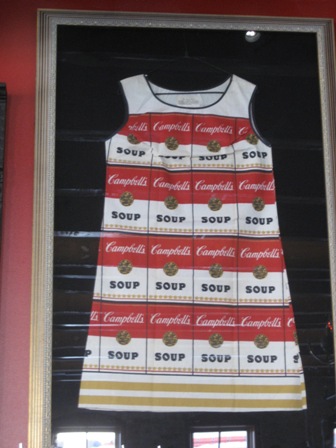
  • The dress is souper!

    Today, I did more sleuthing for the coming February fashion
    feature and uncovered this treasure: Kim Bartmann, owner of Bryant Lake Bowl and Barbette as well as a lover of all
    things vintage, has an original "Souper Dress" on display at her new-ish Red Stag
    Supper Club
    (see my mediocre snapshot below). This paper dress, inspired by the
    work of Andy Warhol, was issued by the Campbell’s Soup Company in 1967. Shoppers could
    get one sent directly to them, via US Mail, in exchange for one dollar and two Campbell’s soup labels. Unfortunately,
    however, because the dresses were advertised as disposable (per the trend of the time), most didn’t
    survive until now. This one belonged to – and was lovingly preserved by – Bartmann’s mother. Other Souper dresses
    have recently sold for as much as $5,000.


  • First Stop: Stephanie’s

    So, yesterday I started working on the February fashion
    feature, for which men and women pick fashions for their sweethearts. (Check the
    crappily laid-out online version from last year.) First stop was Stephanie’s in
    Highland Park
    with WCCO-TV reporter Jason DeRusha, who picked out a darling dress for his
    darlin’ wife. That dress, however, shall remain unseen until the Feb issue hits
    stands. But I can tell you this: As it turns out, DeRusha actually likes
    shopping for his wife, so we had a pretty good time. Here’s a snap of DeRusha and
    shop owner Stephanie Morrissey hangin’ out in the back of the store, near the
    sale section.


    "Oh, I know Ted Baker!" said DeRusha upon noticing the label on the beautiful
    steel-gray dress below. "I like his ties." But of course, Stephanie’s doesn’t
    carry the ties. (You’ll need to head to Len Druskin to find those.) However, Stephanie’s is
    the exclusive Twin Cities carrier of Baker’s women’s line. Alert! Occupational
    hazard! Yes, that is my very own bathroom in the background you see there. If
    you have already gleaned this fact, I’ll lay it out for you: I bought the damn thing.

  • Eating Japanese, I Think We're Eating Japanese

    And if you’re not eating Japanese yet, what exactly are you waiting for?

    First, there was a minor surge in the opening of small sushi and bento box places over the past year. Then, last week, in roughly the time it took for 2007 to become 2008, we went from an urban core with shamefully slim Nipponese offerings to — poof! — practically overnight, Sushi Central on the upper side of Hennepin Ave.

    Now, I’ll admit, this particular stretch of Minneapolis has its problems. Block E is the kind of urban planning debacle a city never really gets over: a mismatched monstrosity with the exquisite Graves Hotel on one end, an Applebee’s on the other, and miles of corridors in between that reek of urine and peach-mango Jamba Juice.

    But the good news is that Randy Norman and several unnamed partners have arrived to spruce up the corner of Hennepin and Seventh with two new restaurants: r. Norman, a steakhouse, and Seven Sushi. These are the guys behind Bellanotte — or at least, a couple of them are. But there’s a veiled secrecy to the ownership of all their restaurants, as if you’re going to open a door in back and run across an underground railroad for battered women or a rousing game of Russian roulette. I think they like it that way; it’s part of their mystique.

    To be honest, I’m not a huge fan of Bellanotte. It has a too-cool-for-school kind of vibe that I find interesting for about three minutes. The regulars all seem to be dressed in P. Diddy’s cast-off clothes. The women. . . .well. . . .they wear so little — even in the dead of winter — it’s impossible to pinpoint an actual style. And the food, while fine, has never been the draw. (Quick: Can anyone name the chef at Bellanotte? Or any chef who’s ever been at Bellanotte?) This is more like a nightclub that happens to serve food — a place where you pay a price to join the in-crowd for a night.

    From what I can see, r. Norman, which opened January 2 on the north side of the Pantages Theater building, looks like more of the same: roaring fires, flaming cocktails, and slinky servers with mile-long legs. But I think Seven Sushi, which occupies the top floor, has a shot at bringing something worth bundling up in the middle of January, paying $10 to park, and climbing two flights to see.


    First — and it hurts me, an avowed shunner of ubiquitous Shea designs, to say this — Seven is simply gorgeous. Sleek chocolate suede banquettes with marble-topped speakers doubling as tables. The accents are rich: red, cream, gold. And the sushi bar itself shines with a steely glint. The wine and liquor offerings include 20 kinds of sake, champagnes up to a $500 Cristal, and specialty martinis. As for food, chef John Ames (formerly of Fuji-ya) is putting out everything from maki to nigiri to a sushi and sashimi platter for two ($50).

    Prices are high, but perhaps not as high as you might think. Baked mussels (6) go for $10, seared crab cakes can be had for $14, the baby squid tempura is $8, and a dish of edamame costs a mere 5 bucks. My bet is that Seven will see a huge return on its liquor business — which, by the way, dictates they must serve food all the way until closing. That means sushi every night until 2 a.m.

    Strangely, just a few days before the opening of Seven (and after several delays), the far more modest Japanese eatery Musashi — just one block down on Hennepin and 8th — turned on its neon-green OPEN sign.

    Musashi is a very different world: plain and cavernous, with servers in traditional black-with-red-piping double-breasted Asian coats. The atmosphere here is quaint, with wooden tables and flower vases and a stack of paper takout menus on the maitre d’s desk.

    There is a huge, drafty bar to the south — serving table wines such as Menage a Trois — and a street-facing dining area with a sushi bar that offers a slightly more scaled-down menu than Seven’s. But Musashi does have an amazing 29-item list of maki rolls and many a la carte options.

    This restuarant also has a separate hibachi room to the north, where people cluster around hot griddles and watch showmen chefs with Fu Manchus dice, sear, and serve up their food. The bento box and hibachi dinners use fairly pedestrian ingredients (chicken, steak, shrimp) but are served with an entire complement of sides, including soup, Japanese salad, vegetables, fried rice, and noodles.

    Incidentally, my husband delicately explained the lyrics of the song that inspired this blog this morning (Turning Japanese, I think I’m turning Japanese. . . .), which gave me an entirely new perspective. So let me just point out that the sushi bars at both Seven Sushi and Musashi are very nice places to dine, um. . . .solo.

    For reservations: Seven Sushi, 612-238-7777
    For reservations or takeout: Musashi, 612-332-8772


  • The Year's First Weekend Signals Good Things to Come

    FILM
    There Will Be Blood

    The latest from director Paul Thomas Anderson (Boogie Nights, Magnolia) is rumored to be a front runner for the best-picture Oscar, but that’s highly unlikely. There Will Be Blood is magnificent, epic, and utterly bizarre; films this weird never win the big one. Based loosely on Upton Sinclair’s 1927 novel Oil!, There Will Be Blood features Daniel Day-Lewis and Paul Dano as an oil man and a preacher, respectively, at odds over money, faith, and oil rights. These actors perform like serpents fighting to swallow the film whole and there is vast pleasure in watching them coil around one another in mortal combat. With an equally audacious score by Radiohead guitarist Jonny Greenwood (he summoned Stravinsky’s screeching violins), an impressive cast, and startling direction, Blood is the boldest Western since Sam Peckinpah walked the earth. —Peter Schilling

    Starts Friday at the Uptown Theatre, 2906 Hennepin Ave., Minneapolis; 612-825-6006; $8.25 (seniors and children $5.75).

    MUSIC
    Bill Carrothers’ Armistice Band

    Jazz pianist Bill Carrothers was born in Minneapolis in 1964 and, even as a tyro getting his artistic bearings, elevated the local jazz scene with his cerebral gravitas (No one, for example, untangled the Gordian knots of altoist Lee Konitz better than Carrothers in concert.) While his best-known disc is probably Duets with drummer Bill Stewart, his masterpiece is the two-hour epic, Armistice 1918,which won the Charles Cros Award (the French equivalent of a Grammy) in 2004. It opens with the innocent pop songs of the pre-World War I era, such as “Hello Ma Baby” and “Let Me Call You Sweetheart,” and then wends through a wellspring/maelstrom of affecting originals and period-covers, brimming with impressionistic details regarding, as Carrothers put it in his liner notes, “the call to battle, separation of loved ones … night raids, rum rations … the disillusionment with ideals and finally the silence of Armistice Day.” Many of the original musicians will join Carrothers for this extraordinary U.S. premiere, including cellist Matt Turner, percussionist Jay Epstein, and vocalist Peg Carrothers. Rounding out the ensemble are bassist Jean-Philippe Viret, drummer Dre Pallemaerts, and bass clarinetist Jean-Marc Foltz. —by Britt Robson

    Friday and Saturday at 9 p.m., Artists’ Quarter, 408 St. Peter St., St. Paul; 651-292-1359; $15.

    Native Pianist Plays Ballard

    When we think Native American music, we tend to think drumming circles and unblended monophony. Some of us — familiar with Buggin Malone and Cochise Anderson — might even think hip-hop. But few of us ever think classical music. Few of us stop to consider George Quincy, Jerod Tate, R. Carlos Nakai, or even Janika Vandervelde. And though his compositions are performed by major symphony orchestras across the globe, few of us consider acclaimed Quawpaw/Cherokee composer Louis Ballard. Well, start considering him, people. Consider him Saturday as his work is performed by another nationally recognized Native musician, classical pianist Tim Hays (HoCak). Enjoy this rare opportunity and stay for a post-concert dialog with the artist. Proceeds will benefit the Two Spirit Press Room and the
    International Two Spirit Gathering.

    Saturday at 7:30 p.m., All God’s Children MCC, 3100 Park Ave. S., Minneapolis; 612-824-2673; suggested donation of $10.

    We don’t get a lot of gospel here in the cities, so let me toss in this last minute event: Mama Digdown will serve up some hot New Orleans gospel with hard-hitting brass band music this Saturday (9 p.m.) at the Nomad World Pub (501 Cedar Ave. S., Minneapolis; 612-338-6424). For only $5 you’ll cleanse your soul!

    ART
    Closing this Weekend: Nuestra Frida

    Taken up by fans, feminists, malcontents, ideologists, and ax-grinders, Frida Kahlo has become much more than an artist over the last couple of decades.Yet somehow she is also often presented as less than an artist. In conjunction with Walker Art Center’s Kahlo exhibition, Grupo Soap, an alliance of artists who share a Hispanic heritage as well as robust senses of occasion and humor, will give its take on the Frida phenomenon. Last year the group produced four-by-eight-foot woodcuts printed by steamroller for a Día de los Muertos show. A poster for a2001 show featuring the artists as luchadores (Mexican wrestlers) still hangs on walls all over town (the show was good, too). So expect their efforts to restore Kahlo as a complex artist and Mexican citizen as well as an iconic sufferer—Our Lady of a Thousand Coffee Mugs—to be both serious and facetious. —Ann Klefstad

    Friday and Saturday from 12-6 p.m., Grupo Soap del Corazón and Art Jones Gallery, Casket Arts Building, 681 17th Ave. N.E., Minneapolis.

    Also closing this weekend is the Pompeii exhibit at the Science Museum. Check out our video tour.


    Opening this Weekend: News from the Moon

    If News From the Moon sounds like a children’s story you might want to read, then you’ll especially enjoy the new exhibit at Rosalux. Both Jennifer Davis and Amy Crickenberger Oeth show a childlike quality in their work that emphasizes life’s simple joys. This is definitely not one of those slick, all-dressed-in-black art shows — you won’t spend the next three weeks trying to climb out of the abyss. No, this will be a lovely show, with beautiful images, sweet images, images that will appeal to you on an emotional level and still leave you feeling good. I once said I would want Davis’ images bedecking my child’s nursery. I hold to that.

    Opening reception Saturday from 7-10 p.m., Rosalux Gallery, 1011 Washington Ave. S., Minneapolis; 612-396-3947; free.


    PERFORMANCE
    Another Year, Another Party in the Rec Rooom

    The celebration isn’t over just yet, folks. This Saturday — and every Thursday through Sunday for the rest of the month — Lorna Landvik will be throwing a Party in the Rec Room comedy bash. Join the local author and actor for a fully improvised evening of comedy mayhem, replete with made up characters.

    Saturday at 7 p.m., Bryant Lake Bowl, 810 West Lake St., Minneapolis; 612-825-3737; $15.


    TV PARTY
    The L Word Season Premiere

    Will Alice lose her mind? Will Helena wind up in the slammer? Will Shane cheat on Paige? Do you have any idea what I’m talking about? If not, then it’s time to step it up and rent the first four seasons of The L Word, so you won’t be lost on Sunday when the new season begins. (See, now you know what to do all weekend.) Fittingly, our lovely local "L" bar will be hosting a party for the premiere. Can you think of a better place to see it?! Gay or not, you’ll want to hear the comments flying back and forth during commercials. Jana Shortal, from KARE 11 News, will serve as guest emcee, so maybe she’ll have some interesting insight of her own. You’ll have a chance to win L Word-related prizes, and everyone will walk away with an advanced copy of Season 5, Episode 2.

    Sunday at 4 p.m. (screening at 7 p.m.), Pi, 2532 25th Ave. S., Minneapolis; $5 suggested donation (V.I.P. $35 for reserved seating, waitress service, one drink, and your annual HRC membership).