Month: May 2008

  • I Have Fun Everywhere I Go

    I have no tolerance for pot dealers
    who insist on sharing a bowl every time they conclude a transaction.
    I don’t need to seal my drug deals with shiny happy-people vibes; that’s
    what I bring the money for. But that’s just me; when it comes to harnessing
    good vibes, I’ll take the mayhem of Altamont over the "brotherhood"
    of Woodstock every time.
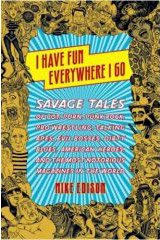
    Mike Edison’s memoir I Have
    Fun Everywhere
    is the perfect summer reading companion for anyone
    who would rather lace their weed with the Ramones than with the Byrds.

    I Have Fun Everywhere chronicles Edison’s
    twenty-something, ’90s rampage through the second tier publishing world
    of male-American fetishes (wrestling, porn, drugs), his first-person
    explorations into rock n’ roll excess (through numerous European tours
    with numerous punk bands), and a sliver of a love story that feels more
    like a kick in the balls than a kiss on the lips.

    The book kicks off with Edison dropping
    out of NYU film school, and discovering wrestling. In his stoned view,
    wrestling is a pure art form, a performance art for the masses that
    plays on classic archetypes. A few wrestling fanzines lead to the editorship
    of Main Event, the flagship publication of the wrestling scene.

    The Main Event gig doesn’t pay much, though,
    and Edison soon broadens his literary wings by pumping out the ragged
    porn novels that used to be a staple in Times Square sex shops before
    Giuliani and his Disney squadron stormed the city walls.

    Through it all, Edison continues
    to rally his various punk bands through small European tours that
    produce just enough money for the plane tickets and the drugs
    on the road. It’s a good life that keeps on giving and eventually leads
    him to his dream job, publisher of High Times magazine.

    At High Times his first mission is
    to push the magazine out of the hippie squalor of irrelevance in which
    it is living, and bring it into the new decade.

    "The first person who suggests
    putting Bob Marley on the cover is gonna be looking for a new job," he says to his new staff, by way of introduction.

    A generational clash is inevitable,
    and the lines are clearly defined by footwear — black Gen-X Chuck
    Taylor high-tops against Boomer Birkenstocks.

    "YOU CAN’T BE THE EDITOR OF
    HIGH TIMES," a High Times veteran yells at him during a meeting.
    "YOU DON’T EVEN LIKE THE BEATLES!"

    No Gen-X memoir is complete without
    a good dose of manic depression and bi-polarity. While Edison struggles
    with constant near-mutinies in High Times, he falls in love and moves
    in with a bi-polar chick who manages to finish law school between bouts
    of self-loathing.

    If there’s one thing Edison knows,
    it’s his audience. A bunch of dateless wrestling fanatics with punk
    music in their stereos, boutique buds in their bongs, and porn on their
    TVs, have little tolerance for a story that ends with the redeeming power
    of love. In their lore, every woman is a Yoko. An empty, heartless,
    sexual succubus.

    (Porn lovers also like their women
    dehumanized, and Edison complies by replacing his girlfriend’s name
    with a simple ________.)

    After finishing law school, _______
    fails to invite him to the graduation.

    "I really appreciate everything
    you’ve done for me," she tells him. "But I don’t need you
    anymore, I can do it on my own."

    It’s a harsh blow, but Edison is
    not one to stay down long. After a lost weekend in Vegas, he returns
    to New York with a new mission: make the High Times movie.

    "How could it possibly fail?"
    he asks.

    Let us count the ways…

  • A Hit and a Miss for Ellis Marsalis

    Irvin Mayfield and Ellis
    Marsalis

    Love Songs, Ballads and Standards
    Basin Street Records

    Trumpeter Irvin Mayfield has
    often been an artist who wears his heart on his sleeve. This sentimental
    exuberance has helped put the panache in Los Hombres Calientes, made
    his breakup concept CD, How Passion Falls, especially vivid, and
    has fueled his tireless efforts (as musician, cultural ambassador, library
    board member, you name it) to resurrect New Orleans after the hurricane
    and flood that took the life of his father. But the combination of overripe
    ballads and the chance to record with his mentor, the pianist and patriarch
    Ellis Marsalis, makes Mayfield’s most every bleat bathetic, and the
    sum of Love Songs corny and starchy. I wouldn’t quite call
    it elevator music. But if I heard it on an escalator, I’d want to
    get off.

    The disc’s problems are symbolized
    by the fact that there are not one, but two versions of the hoary, somnambulant
    Beatles standard, "Yesterday," bookending the record with a studio
    opener and concert closer that aren’t different enough to justify
    the redundancy even if the improvisational acumen were more apparent.
    The song selection sets a high bar—"Superstar" and "A House
    Is Not A Home" have plenty of stirring versions even without Luther
    Vandross’s definitive takes, and material like "Round Midnight"
    and "In A Sentimental Mood" require more than lush atmosphere and
    a few swoons to become distinguished.

    The best things here are a
    solid version of "Mo’ Betta Blues," a "Don’t Know Why" that
    provides much needed whimsy, and Marsalis’s elegant piano on Corinne
    Bailey Rae’s "Like A Star." Not coincidentally, they are three
    of the four tunes recorded last June, post-Katrina; whereas the other
    ten numbers are from 2004. Most of these arrangements were sufficiently
    dewy just with a quartet (drummer Jaz Sawyer and bassist Neal Caine
    abet the leaders), but the Louisiana Philharmonic Orchestra is brought
    in for further sweetening, another sign of overreach. In the liner notes,
    Mayfield says he "didn’t intellectualize" his song choices. Next
    time, a few more brain cells might be a better investment.

    Love Songs, Ballads and
    Standards
    * (one out of five stars)


    Ellis Marsalis Quartet

    An Open Letter to Thelonious
    ELM

    An Open Letter To Thelonious,
    likewise, had the potential to be stodgy and hackneyed. Monk tributes
    come a dime a dozen, and Ellis Marsalis—the father of Wynton Marsalis,
    after all—is a thorough but resolutely orthodox jazz scholar and musician.
    He remains that way on Letter, and proves you don’t have to
    take liberties with classic material to keep it refreshing.

    Marsalis admits in the liner
    notes that he didn’t initially "get" Monk, and there is the diligence
    of atonement in the way he burrows into the crevices of Monk’s fractured
    rhythms and invests himself in both the earnest and wry aspects of the
    great composer’s work. Ellis himself takes the lead on songs involving
    the ladies in Monk’s life, unveiling the languid contentment of "Crespuscule
    With Nellie" and the sweetness of "Ruby, My Dear." He delivers
    a brief but memorable two-handed solo on "Light Blue" (misspelled
    "Light Bue" on the disc) that helps portray an essential Monk contradiction,
    relaxed complexity. And his dappled notes showcase the beauty of "Monk’s
    Mood," including a solo that captures Monk’s ability to be elliptical
    and allusive yet never lax or otherwise inattentive.

    The other star of the quartet
    is Ellis’s youngest son, drummer Jason Marsalis, who among other things
    was Irvin Mayfield’s cohort in Los Hombres Calientes. His drum solos
    on Letter are plentiful and thus inevitably garrulous on occasion,
    but his turn on "Jackie-ing" is pure delight, an adventurous mixture
    of crisp Monk and New Orleans march time, and his hard-bop propulsion
    on "Straight, No Chaser" gives the tune the feel of Blakey’s Jazz
    Messengers
    . Saxophonist Derek Douget and bassist Jason Stewart round
    out the ensemble, with Douget’s soprano horn leading the dialogue
    on "Epistrophy" and the whole band exuding a light-hearted vibe
    on "Teo" (Monk’s paean to his longtime producer, Teo Macero) and
    the irrepressible "Rhythm-A-Ning." After a nifty solo that drops
    in a "Sweet Georgia Brown" quote on the latter tune, Marsalis closes
    out the disc with a solo rendition of "Round Midnight" that is luscious
    with sentiment yet never cloys. Compare its acuity to the pro forma
    romance contained in the "Round Midnight" on Love Songs, and
    hear why good intentions don’t suffice without an artistic follow-through.

    An Open Letter to Thelonious
    **** (four stars)

  • Spurs Scrabble for Survival

    AP Photo/Matt Slocum

    It occurs to me that the best way to recap the first three games of the Spurs-Lakers series is to point out all the places I was wrong. There are plenty of examples so let’s get to it.

    * A high scoring series

    When I looked over the various matchups between San Antonio and LA, I foresaw a lot of offense. But last night’s combined 187 points has been the most prolific game of the three. Part of this is because the series has been played at a pace more to SA’s liking, which spells trouble for their current one-game deficit. Part of it is because both teams are missing more open looks than is customary (and it is different people different nights, although Odom and Parker have not been able to exploit what I perceived as their mismatches), a likely sign of fatigue and/or pressure. But the bulk of it is simply great defense, particularly by the Lakers in their Game Two blowout. I have never seen Parker’s penetration stymied so effectively, not only by Derek Fisher but by the bigs doubling and switching up coverages on the pick and roll.

    * A loooong series for Derek Fisher

    Fisher has not shone in Games One and Three, but he also hasn’t been toasted by Parker the way I thought it would happen. Again, the Lakers’ superb team D had a lot to do with that in Game Two, but Fisher’s foot speed has been better than I expected, and the vast improvement by Jordan Farmar, who has found his confidence again, is getting him more rest. If he and Farmar can cut the distance in point guard production between the two teams, the Lakers are in good shape.

    * Kobe would toast Bowen and Udoka equally

    Maybe it is just a prejudice against gritty, slow-footed vets, because I also underestimated Bruce Bowen’s value in this series, and overestimated how much Udoka could spell him. Doug Collins pointed out last night that Kobe salivates over getting Udoka as his matchup, and even as he spoke, Pops was getting Bowen up to guard the MVP. I think Bowen slipped a bit on defense during the regular season, and wasn’t that effective in either of the first two rounds. But his ability to slow Kobe down a titch and make him work for points and dimes has given San Antonio hope. Given Kobe’s maturity as a distributor, it is crucial that the double teams aren’t automatic and predictable. Bowen’s inexorable hustle has made that possible–and he’s even hit a few of those patented corner treys of his.

    * The Spurs would trade off nights from Ginobili for off nights from Odom

    Wrong again. Ginobili’s value to his team was borne out again last night–his catalytic role on the Spurs is vastly greater than Odom’s versatile and important, but not crucial, contributions to the Lakers, where he remains a distinct third option. That said, if Odom does start to get his act together, San Antonio is in trouble. What is frustrating for him is that he’s missing makeable shots.

    But back to Ginobili for a minute. First of all, the guy comes up big at the most important moments, giving San Antonio someone akin to a poor man’s Kobe. That’s huge. The fact that neither Detroit nor Boston boasts an equivalent presence (do you still believe Billups is Mr. Big Shot? and who on the Celtics side–Paul Pierce?) is one of many reasons why the trophy will likely be held aloft by a Western Conference team in about two weeks.

    But if you are looking for a reason why the Spurs are still in this series–and are a 18-minute collapse away from being up 2-1, check out how well Tim Duncan and the trio of Oberto-Thomas-Horry have defended Pau Gasol and Odom. Now Odom’s problems are becoming well documented–he’s getting ripped by most of the Laker media, with some justification. After shooting well over 50% in the first two rounds, he’s shot 12-33 in the three games thus far, or barely over 36%, this despite the fact that the Spurs don’t have a natural counter for his size and quickness. But Gasol’s underachievement has arguably been just as profound. He also was much better than 50% for the playoffs coming into the Spurs series, and the dip to 46.5% (20-43 FG) is exacerbated by the facts that his shot selection has been generally solid–he’s missing makeable attempts–and that he has only gotten to the free throw line 5 times in the three games, after shooting 59 FTA in the previous 10 playoff games. He’s also grabbing two fewer rebounds per game, his assists rate has been cut in half, and his defense on Duncan has been, as expected, inconsistent. These dips bear watching as Gasol continues much deeper into the postseason than he has ever been before.

    Before we look at the Spurs side of the ledger, I want to point out something about Jordan Farmar and Sashia Vujacic, who provided such a great lift off the bench in Games One and Two, but much less so last night: They’ve both been gunning fools. Give Farmar credit for being LA’s third-leading scorer (10.7 ppg) in this series despite averaging only 20.7 mpg, a testament to his gaudy 11-21 FG shooting. But Farmar, the backup point guard, has zero assists in 62 minutes. Even on a team where Kobe Bryant justifiably hogs the ball and which features the triangle offense that reduces the importance of a point guard, you’d think Farmar would have dropped at least one dime. Maybe there’s a connection between the low shooting percentages of Gasol and Odom and the jack-it-up philosophy of Farmar and Vujacic, who rank 8th and 7th, respectively, in assists-per-minutes played among the nine Lakers who logged double digit minutes of court time thus far in the series (Vlad Rad is last).

    By contrast, little used Brent Barry came off the bench last night and delivered four assists in 21 and a half minutes without a turnover, chipped in a pair of treys and was plus +11. Properly derided for his shooting, Horry’s defense on Odom and tenacity in the paint got him plus +11 in 18 minutes. Add to the bigness of the Big 3–Ginobili had 30 and sparked the resurgence with a pair of first quarter treys; Duncan pulled a 20-20 game (actually 22-21) and is averaging more than 18 board per game in the series, and Parker was a game-best plus +26–and these savvy veteran role players have an acute appreciation of what is required to bag a ring. The Lakers are without question the more talented of the two teams, especially in the depth of their talent. But with the obvious exception of Kobe, and Fisher, they don’t know what it takes to win this deep into the postseason.

    Specifically, they didn’t realize Pops would emphasize nothing but offense–an unprecedented move for the coach–in the practice between Games Two and Three, to counter the sliding traps and pick-and-roll D that Phil Jackson had instituted so effectively. And they didn’t appreciate how many times San Antonio has been counted out in the past few years, only to come up big when it counts. It will really count in Game Four tomorrow night. Will Kobe decide to seize the game with a 30-shot effort, something his miraculous 4th quarter stint in Game Three indicates might be a way to vanquish the Spurs in San Antonio, or will he continue distributing and hope his backcourt mates follow his lead and that his front line finally comes to play in the paint? I’m guessing a little of both, and that the wild cards for the two ballclubs–Ginobili and Odom–will determine the winner.

    But, as we noted at the outset, I’ve been wrong before.


    Tomorrow, a look at the Celts-Pistons after four games.

  • Return To Forever

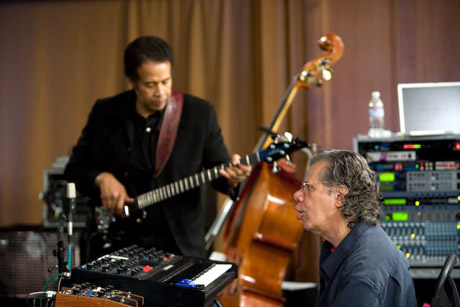
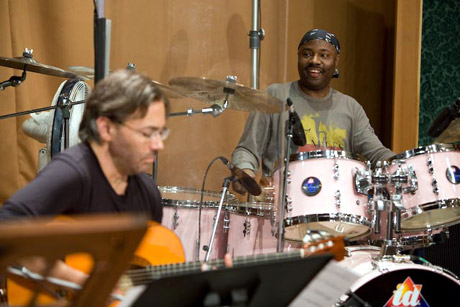
    If extravagant excess, jazz-rock
    division, is your preferred sonic energy drink, the reunion of the most
    fantastic of the various Return To Forever lineups is the gig of the
    summer. Precious few bands—Emerson Lake & Palmer and the Mahavishnu
    Orchestra
    come to mind—indulged in ornate wankery with so much spunk
    and so little fear, and in terms of sheer technical facility, RTF arguably
    eclipses them all. Founding leader Chick Corea has put a notable dent
    in a half-dozen jazz genres; Stanley Clarke was trailblazing what it
    meant to be a fusion bassist as a teenager beside Corea back in the
    early ’70s; drummer Lenny White crammed funk, jazz, and rock into the
    same sidecar; and guitarist Al DiMeola is one of fusion’s most incandescent
    skywriters. Since dropping three classic records more than 30 years
    ago, the quartet members (especially Corea and DiMeola) have continued
    to grow, meaning all those mystically-titled tunes are apt to be given
    distinctive twists. For you young’uns unfamiliar with RTF, this was
    what it was like before video games—we slapped "Romantic Warrior"
    or "Return To the Seventh Galaxy" on the headphones and shut our
    eyes.

  • Shiraz Update: Fish Kabobs, Belly Dancer, and More

    I stopped in at Shiraz Fireroasted Cuisine for dinner the
    other night, to check out the new menu and the belly dancing, and at 8:30 on a
    Saturday night, the place was nearly empty. That’s really a shame, because it
    is a charming little restaurant, with good food and an ambience of Persian arts
    and crafts that’s stylish enough for a date. On earlier visits, I grumbled
    about the lack of vegetarian and fish entrees, but that flaw has been fixed — they now offer salmon kabobs, a spinach pie, and a couple of meatless Persian
    stews.

    Maybe Persian cuisine sounds too exotic, but it’s really
    not: the heart of the menu is the grilled kabobs of beef or chicken. There are
    a few more exotic items on the menu, like the fesenjan, chicken in a
    pomegranate and walnut sauce, and the gheimeh, a beef tenderloin stew with
    yellow lentils and dried limes, but many other dishes are familiar from other
    Middle Eastern cuisines: hummus, eggplant dip, stuffed grape leaves.

    You can check all this out on their website, which also features
    an entertaining video about Persian cuisine, narrated by a very folksy
    Midwesterner.

    Prices are extremely reasonable. The koubideh (skewers of
    seasoned ground beef or chicken, highly recommended) served over saffron rice
    are priced at $10, including flatbread and soup or salad, and the most
    expensive entrees, shish kabobs and the salmon kabobs are priced at $14.
    They’ve got a full bar and a limited wine list, including wines by the glass
    for $6-$8.

    The belly dancing, featured Fridays and Saturdays from 7 to
    10 p.m., was pretty low-key, but it’s hard to play to an empty house.

    6042 Nicollet Ave S., Minneapolis, 612-861-5500

  • Max Ross: Published Poet

    Welcome to a possibly special edition of Poem Worth Reading. The very title of this Cracking Spines segment — that is, Poem Worth Reading — is jeopardized with today’s entry. But because this is a blog, and should thereby not be held to any qualitative standards (self-imposed or otherwise), and because I got the go-ahead from my editor, who said I could post "basically anything…," I’ve decided to go ahead and put up some of my own scribblings. I figure it’s Memorial Day, so maybe there’s less readership, anyway.

    The back-story (feel free to skip): My grandparents own a cabin not far from the Twin Cities, and I was up there this weekend to celebrate the holiday, incidentally by myself (there was leftover pizza, there was beer, there was NBA basketball [if you know my family, you know they don’t know what a tent is, let alone a cabin…yes there’s cable here, but I don’t have it in my regular home, and that’s how I justify watching it]).

    On Sunday, at about five o’clock in the evening, my aunt called, waking me up from my nap. Naturally I was pissed. She said thunderstorms were headed my way. Though normally rain has a soporific effect on me, the ringer of the cabin phone is kind of like a dog whistle for humans, and I couldn’t get back to sleep. So I said, “Screw it” — sadly, I said it out loud — and went out onto the screened-in porch to watch the gathering storm.

    I may appreciate a poem from time to time, but I don’t write ‘em. Nevertheless, immersed as deeply in the woods as a member of my family can hope to get (there’s no Wi-Fi here, at least, and my cell phone is on ‘roam’), watching the boats on the lake return in unison to their docks, then watching the rain fall from a strangely low sky, I realized there was a pen in front of me, and a blank piece of paper.

    "Haikus," I thought (thankfully silently). I don’t mean to take anything away from the Japanese poets that have mastered brevity, nor imply that my haikus are as meaningful or worthwhile as theirs (sadly, a couple of mine tend toward Yoda-esque syntax and conjugation). But let’s face it: As far as poetry goes, the haiku is a fairly accessible form — concise, quick-striking, sometimes poignant. They’re kind of like puns (except sometimes poignant). So really, though Freud may say otherwise, the ultimate goal of this post isn’t necessarily to get more exposure for my writing and launch a new career. Rather, I hope it’s a sort of call-to-arms for all the would-be poets out there, too intimidated by meter and rhyme to grab their journals and head for their various solitudes.

    And I invite all you fearless readers (I really do love puns) to post your own haikus in the ‘comments’ section. (Though please refrain from the likes of "Max Ross: Egomaniac/ where’s Whitman? Or Eliot?/They’re better than you" and so on. Unless you have one that’s really, really good.)

    Also, for those interested, I found the header illustration here.

    So here goes:

    Fat green leaves beaten
    by rain. I’d have picked them from
    their twigs, anyway

    At least the pontoon
    has a canopy. Thank God
    our boat won’t get wet.

    In grade school I learned
    to make rain sounds with clapped hands;
    microwaved popcorn.

    Glass door is open,
    screen door is shut; sound of rain –
    but no rain – enters.

    Something literary
    about rain: its ambition
    to rise back up

    Polaroid lightning
    to remember later how
    hard it really rained.

    I stand here wearing
    my grandfather’s sweatpants, and
    write about the storm.

  • Fly the Flag at Half-Staff

    Happy Memorial Day! Happy Memorial Day? We get so used to wishing happy holidays that we end up saying inanities like these. Is it a happy day — a holiday to commemorate loss of lives, casualties? What do you make from a holiday whose best venue is the cemetery? A celebration of life, perhaps — rather than mourning?

    It’s ok to decorate the grave and fire up the grill on the same day. We just need to stop and find that historical point of balance somewhere within all the beginning-of-summer, commercial, barbecue hype that overwhelms the day.

    Whatever you’re doing at 2 p.m. (3 p.m. Eastern time), stop for a moment. Join others across the country for a national moment of remembrance to commemorate the men and women who have perished while in military service to our country. This isn’t a statement on war. This is not a declaration of violence. You are supporting nothing but the people who have died. You are supporting nothing but life… and humanity.

    MEMORIAL DAY EVENTS

    A number of events across the Twin Cities will pay tribute to our veterans. You’re likely to find crowds and activities in most any cemetery and/or memorial. And you’re likely to find small parades and gatherings in just about any town. But, of course, there’s plenty going on at the State Capitol as well. Join Minnesota Veterans for Peace at the Vietnam Veterans Memorial at 9 a.m., and join the Vietnam Veterans of America at 2:30 p.m. for live speakers, music, and a color guard march.

    Fort Snelling might be the best place to spend the day and get a true feel for military life with a living Timeline of the American Soldier. From 10 a.m. to 5 p.m., costumed staff will map out 225 years of U.S.
    military history for you through period clothing, accouterments, artifacts, and
    firing demonstrations. Guests can explore recreated military
    encampments. And veterans and current military families are admitted free
    of charge.

    Or you can choose spirit over realism and commemorate the day with a traditional Native American ceremony. Honor your veterans, your people, and your land at the Mille Lacs Memorial Day Pow-Wow. Enjoy the beautiful two-hour drive up north to Onamia for a day of Native American dance, music, food, crafts, and games. The outdoor event is sponsored by the local American
    Veterans Post 53 and is held on the museum grounds on the beautiful
    shores of Lake Mille Lacs.

    Also today, Vive Minnesota! continues — with a special veteran’s remembrance at 11 a.m.

    And if you’d like to forget Memorial Day altogether, then I have just the thing: It Came From Another World at the Parkway Theater.

  • Come Join the Vicious Circle

    "That would be a good thing for them to cut on my tombstone: Wherever she went, including here, it was against her better judgment."
    -Dorothy Parker

    Over ten long, occasionally checkered, years as an art critic here in Minnesota, here’s one thing I’ve learned: Making your way in the world today, as a visual artist anyway, takes everything you’ve got. Upfront there are studio costs, exhibition costs, materials costs, opportunity costs, and the constant expense of keeping in coffee, cigarettes, and alcohol (although this last is probably true for most of us). And the money you get back from what you pour your heart and soul into creating is scant, at best. Mere pennies on the investment. And you know how valuable is a penny today, right?

    I don’t even begin to know how a person in this day and age sustains an artistic practice.

    Here’s another thing I’ve learned: The life of the art critic is no quiet afternoon at the corner bar either. You’re often up all night writing, even when you can’t pay your light bill. And your editor keeps telling you the check is in the mail; that is, when there still is an editor to report to, because you can no longer count the number of publications you’ve written for that have unceremoniously shit-canned the entire staff when you weren’t looking or else closed their doors altogether.

    Sometimes I wonder how in hell I’ve lasted so long doing this crazy thing called arts writing.

    And here’s another thing I have long wondered about: If we assume for a moment that we’re all–artists and arts writers–compatriots in the struggle to keep alive the dying, flickering light of artistic goodness in our culture, why, then, don’t we artists and critics get along better? Why aren’t we, at least metaphorically, raising beers to each other in the spirit of collaboration and mutual support for the cause? After all, we all have the same goals at heart, right? We all seek to advance the cause of art in Minnesota and to ensure the survival of ancient and honorable traditions that are much bigger than any single one of us? Right?

    Or, are we all, like everyone else, just in it for ourselves, and ourselves alone?

    Here’s what I know: I list these questions and postulations not to keep you up at night (as often happens to me), but rather to explain something about how we formulated our name for ourselves for this new visual arts blog, "The Thousandth Word," which you happen to have stumbled upon.

    We are six arts writers and critics (some of us also–as explained below in our brief bios–artists and art lovers, friends and neighbors). And we’re calling ourselves "the Vicious Circle," mostly because we acknowledge that the art world itself is just that: a Vicious Circle. No one is getting rich. No one is getting along much. No one seems particularly happy. And yet, our troubles are all the same. We’re caught up in this circle together, against our better judgment. And we all love it despite ourselves in much the same way.

    "The Vicious Circle" works as a name for another reason, because it acknowledges that sometimes, in the service to art, the critical person has to write somewhat negative reactions to what he or she has seen. A good critic simply, from time to time, has to be vicious. It’s part of the secret initiation to the club. Or as Groucho Marx put it, in regards to membership in the original "Vicious Circle" (which is how the Algonquin Round Table referred to themselves back in the 1920s): "The price of admission is a serpent’s tongue and a half-concealed stiletto."

    We are not in this to be mean-spirited, though; we’re art critics, not Sicilian knife fighters. Our goal is to address the art we see with only the utmost lucidity and honesty. And if anything we write lifts your neck feathers, you can always throw a few sharp comments right back at us. It will show you care!

    We hope, then, that you’ll come back often to read and engage with "The Thousandth Word." In the meantime, here are bios for the six writers of the Vicious Circle.


    Rich Barlow: Rich Barlow has an MFA in visual arts from the University of Minnesota. He works as an artist, arts educator, musician, curator, and fringe theater and music producer. He is a founding member of Flaneur Productions.

    Michael Fallon: Michael Fallon is an arts writer and arts administrator who’s written for more publications than he can count, really. But he’s proud that he’s been a member of the International Art Critic’s Association since 2000, and that he founded a local arts writers association, the Visual Art Critics Union of Minnesota (VACUM), in 2002. His other blog blatherings, and more about what he’s up to in his copious spare time, can be found at Art Happy Hour and the Chronicle of Artistic Failure in America.

    Glenn Gordon: Glenn Gordon is a writer, sculptor, and photographer. He was born in the Bronx, grew up in L.A., spent the sixties in Berkeley, lived for many years in Chicago, and moved to the Twin Cities about twenty years ago, working at many biographically colorful jobs all along the way. He’s written widely on architecture, sculpture, photography, woodworking, furniture, craft, and industrial design for national magazines and art journals, and locally for The Rake, Architecture Minnesota, Rain Taxi, and mnartists.org.

    Christina Schmid:
    Christina Schmid’s writing on the visual arts is informed by the years she spent at universities but seeks to go beyond the narrow confines of academic discourse. Her aim is to chronicle her encounters and experiences with contemporary art in order to render the process of meaning-making that art demands of its viewers both more accessible and transparent. She holds advanced degrees in contemporary literature, philosophy, visual and cultural studies from the Karl Franzens University in Graz, Austria and the University of Minnesota in Minneapolis.

    Andy Sturdevant: Andy Sturdevant is a Minneapolis-based artist, curator and writer whose work has appeared in ARP!, The Rake, and Bejeezus magazines, and on mnartists.org. He curated the History Room: 20 Years of No Name and the Soap Factory exhibition at the Soap Factory this year, and is currently working on an accompanying book about the gallery’s history. Andy is also a contributor to the Electric Arc Radio Show music and performance series, which is beginning a new season at the Ritz Theater in Minneapolis this fall.

    Collier White: Collier White is a writer and filmmaker who lives and works in North Minneapolis. He attended the University of Minnesota where he edited the newspaper’s film coverage. After freelancing for several print and online arts journals, he co-founded Object, an online pop-culture journal that garnered much acclaim before dissolving when he left for film school in Denmark. Since returning to Minneapolis, he has written for Ruminator magazine, City Pages and mplsart.com whil
    e continuing to write and direct short films.

  • Why My Novel Is Set in Minneapolis

    I lived in Minneapolis
    for a few years, some years ago, and during that time I came to love
    the town and the quaint Midwestern customs of its citizens. People
    smiled at you on the street—without asking for money. If you were lost,
    they gave you directions—without asking for money. They even assisted
    the elderly across the street; in DC, we use them as decoys for the
    onrushing traffic.

    Minneapolis was
    especially inspiring for me as a writer. You could write about the
    Human Drama of Snow. Or use Snow as a Metaphor for the Universal
    Condition. Or hurt your back shoveling Snow so that you had more Time
    to Write.

    As Shakespeare wrote:

    Snow is the Winter of our Discontent.

    But during my residence
    there, the aspect of Minneapolis that I loved most was the chain of
    lakes inside the city limits. The prevailing theory is that a glacier
    created the lakes, though this story is less than credible to me since
    never once during my stay did a mile-high wall of ice come down from
    Canada.

    Two separate paths
    circumnavigate the lakes of Minneapolis. The Outer Path is for
    Speeders: bikers, inline skaters, and other mobility enthusiasts. While
    I admired their balance, dexterity, and tight clothing, I always
    thought it was odd to be in such a hurry when you are traveling in a
    circle.

    The Inner Path around
    the lakes is for Footers: joggers, walkers, and plodders like me. The
    Inner Path often floods during the spring thaw, forcing both Speeders
    and Footers onto the same ground. This is a recipe for disaster.
    There’s just no getting around me.

    I lived in the top two
    floors of a Victorian house only two blocks from my favorite of the
    lakes: Lake of the Isles, known for its urban wildlife. In the winter,
    around the south side of Lake of the Isles, you could sometimes sight
    the rare Snow Serpent, a Norse American cousin of the Loch Ness Monster
    who hibernates in summer and prowls the icy lake in winter. Many a
    snowman has been devoured by this sly leviathan. In the spring, an
    armada of Canadian geese invades the lake. Each evening, the royal navy
    embarks from the lakeshore to their island harbor, a squadron of
    goslings in regal tow.

    Lake of the Isles is
    also known for, well, isles-two of them near the northwest lakeshore.
    The island closest to land is very close; I always felt that I could
    jump across the narrow channel, or in January, slide across. But
    I never did, because there was a small sign standing akilter near the
    shore and nearly covered by the tall grasses. The sign read ‘Game
    Preserve’, in wavering letters that might have been painted by webbed
    feet.

    Of course, in my imagination, Game Preserve
    referred to some place magical and forbidden, to a Velveteen Rabbit,
    Puff the Magic Dragon, Chutes and Ladders sanctuary in a clearing
    hidden deep in the interior of the tiny island. How I wanted to ignore
    the sign and explore! But I never did.

    After I left
    Minneapolis, the magical island continued to feed my imagination. I
    could never forget the lake, and the sign, and my urge to break the
    rules, step onto the island, and discover that forbidden sanctuary just
    beyond the tree line. So finally I created a character who could.

    I wish there had been a
    bench, there where the path curves and the shore and the island almost
    touch. I think I might be there still.

    Stephen Evans is the author of The Marriage of True Minds, a novel set in Minneapolis, to be published in May by Unbridled Books. He will be reading from his new novel on Saturday, June 7, 2008, 7 p.m., at Magers & Quinn, 3038 Hennepin Ave. S., Minneapolis.

  • Annihilating a Collective Memory

    "Hitler believed modernists
    couldn’t see color as it was in nature, or humans as they were in
    life," remarks one of the scholars interviewed in The Rape of Europa
    a documentary on the artistic pillaging perpetrated by the Nazi
    army during World War II. "He viewed this as a racial deficiency."

    And with that, we learn yet
    another aspect of the Führer’s demented psychological make-up, thoroughly
    extrapolated over the two-hour course of this captivating film. Religion,
    race, politics, and apparently artistic leanings – Hitler was thorough
    in his prejudices. And with art, just as with all his other biases,
    his distastes seem to stem from his own insecurities.

    In 1907, an eighteen-year-old
    Adolf Hitler was rejected from Vienna’s Academy of Fine Arts. The
    film would have it that this occurrence was the seed for his misanthropic
    leanings: "Many of the members of the academy were Jewish," we’re
    told, and it’s suggested that this may have fueled his resentment
    later on. Perhaps it’s a tad over-speculative, but nevertheless one
    wonders what path young Hitler might have taken had he been admitted
    to the school.

    More disturbing (and convincing)
    than the film’s psychoanalytic probing into Hitler’s iniquity is
    its analysis of raw data and records. We see the dictator as he composes
    a list of paintings and sculptures he wants for his collection, which
    he will eventually exhibit in a national museum of the Third Reich.
    Before raiding a given country, a team of art historians and forensic
    specialists pinpoints what masterpieces to plunder before letting the
    troops wreak their havoc. According to the film’s website, by the
    end of the war, the Nazis had looted one fifth of all the known artworks
    in Europe. (Perverse as it may be, I found myself wishing that our nation’s
    leaders had such a high regard for the fine arts.)

    In addition to dismantling
    their military and political infrastructures, Europa
    clearly depicts Hitler’s desire to dismantle nations’ cultural infrastructures,
    too. In France and Italy a certain delicacy is shown (as Hitler respected
    their traditional artists), but in Russia and most of all in Poland,
    the seizing of art is meant to symbolize the felling of an ‘impure’
    society. Decimating a population is one thing, but annihilating its
    art is tantamount to annihilating its collective memory; Hitler contrived — actually contrived — not just to destroy countries, but their
    histories as well. Cultural obliteration is usually a by-product of
    war; here it was the plan. This is exactly what made Hitler so evil,
    and The Rape of Europa for the most part does an effective job
    showing it.

    Speaking now strictly from
    a cinematic standpoint, the film endeavors to be perhaps a bit too thorough.
    While all the stories herein are captivating, they do get repetitive.
    The evacuation of Russia’s Hermitage Museum, for example, is a reiteration
    of the Louvre’s evacuation, which is shown earlier in the movie. While
    both have their tragically fascinating aspects, and both were incredibly
    important events, on screen one does not reinforce the other, but merely
    echoes it.

    Later on, the narrative strays
    when we come to Italy, and the Allies are shown to be the ones destroying
    the art in the air raids on Axis positions. In this instance, the destruction
    is
    incidental, and the segment does little to prove the documentary’s
    central thesis of art appropriation being an integral part of the Nazi’s
    plot.

    Nevertheless, this meandering
    by no means detracts from the overall impact of the film. The Rape
    of Europa
    is a shocking — but easily palatable — study of an
    otherwise unexplored phenomena of the Holocaust, and proves (yet again…despite
    what certain Iranian politicians might say) that we still feel the reverberations
    of World War II today.