Author: Ann Bauer

  • Damn, This Woman Really Cooks

    So why is it that the bad boys of the kitchen get all the good press? Take Anthony Bourdain — a foul-mouthed son-of-a-bitch whom a good friend of mine (an attractive, intelligent woman) told me just today is "her ideal guy." And Gordon Ramsay, the British chef who hosts a show called The F Word. Even our local culinary star Stewart Woodman — formerly of Levain and Five, now the proprietor of Heidi’s along with his wife — has been known to throw a dish or two. But a woman chef with fiery tendencies tends to get a lower level of respect.

    Now I’m not condoning bad behavior. I don’t like it, no matter who’s cursing out the dishwashers or attacking customers because they asked for ketchup with their steak tartare. Yet, when it comes to the guys, bottom line: it seems to be the food that matters. People forgive a lot when a man is an artist in the kitchen (and it doesn’t hurt, either, if he looks like he’d be a beast in bed). Whereas when Marianne Miller showed herself to be a) one of the most talented chefs in the Twin Cities and b) a hot-headed malcontent under whose leadership restaurants collapsed like so many houses of cards, she was crucified.

    This was back in 2005. Miller had moved from Red — the wonderful, scarlet-hued Russian restaurant that operated in the Foshay Tower for about six minutes before repo men came to haul the furniture out — to Bobino, a sweet little nordeast neighborhood spot that had been great once (when JP Samuelson was chef) and fallen into an intense mediocrity bordering on the bad. Miller revived that restaurant like it was a fat, dying banker on a bus. She tended to the overwrought, underdisciplined Bobino, conjuring up an absolutely dazzling menu and earning top reviews for a place everyone previously thought a bore. She was even offered a partnership by grateful owner, Chris Paddock.

    Then, all hell broke loose.

    The rumors flew. I probably shouldn’t repeat them here, as I don’t have a lawyer on retainer and all. Suffice it to say that over the summer of ’05, the staff at Bobino mutinied, the restaurant closed, Paddock lost his shirt, and Miller was accused of just about every indiscretion a chef could commit, both upright and prone.

    What actually happened? I know only one thing for sure. A truly great chef quit cooking. . . .for a long time.

    But as of this week, I’m happy to report, Miller is back, running Saga Hill Cooking School on East Lake Street in Wayzata, just above Five Swans. And she’s got a truly innovative curriculum. This afternoon (11/17), for instance, you can attend the mother/daughter high tea and learn how to set a table properly and bake flaky scones. On Sunday (11/18), Miller will run a two-hour Thanksgiving "Boot Camp" that goes over everything from side dishes to time management. Later in the month, there’ll be a wine buying class and a detox-after-the-holidays seminar.

    I don’t know what kind of crap Miller has pulled in the many kitchens she’s run — and believe me, it’s quite a list. I do know that she’s someone I’d be glad to have teach me to cook, if I were even the slightest bit inclined. Being a bad girl doesn’t seem to have made her a bad chef. Who knows? Maybe being a Bourdain-style loose cannon has made her — like him — inscrutably, maddeningly even a little bit better.

    Saga Hill’s upcoming classes include:

    • Mother-Daughter High Tea

    Grab
    your best friend and confidant for a ladies’ afternoon of learning proper
    high-tea recipes, the art of table setting, and fine manners.


    Hands
    On


    Saturday,
    Nov. 17


    2:00
    p.m.-4:00 p.m.


    $25


    Dinner and a Date

    Calling all singles for an interactive mixer
    of fun and food.


    Hands
    On


    Saturday,
    Nov. 17


    6:30
    p.m.-9:00 p.m.


    $55

    • Thanksgiving Boot Camp

    Shop
    and prep like a pro! Work smarter not harder! Practical advice on time
    management and food preparation as well as foolproof recipes. You will leave
    class with a shopping list, a plan, and the knowledge to make your Thanksgiving
    dinner stress free.


    Demonstration


    Sunday,
    Nov. 18


    11:00
    a.m.-1:00 p.m.


    $45


    Make, Take, ‘n’ Bake: Holiday Pies

    Prepare
    all your Thanksgiving pies ahead of time and bake at home. Class fee includes
    all materials needed.


    Hands
    On


    Sunday,
    Nov. 18


    2:00
    p.m.-5:00 p.m.


    $65


    Make, Take, ‘n’ Bake: Side Dishes

    Prepare
    all your Thanksgiving side dishes ahead of time and bake at home. Class fee
    includes all materials needed.


    Hands
    On


    Tuesday,
    Nov. 20


    2:00
    p.m.-5:00 p.m.


    $75


    Wine Buying

    Sample,
    taste, learn and buy! Buy wine risk free for the holiday season at deep
    discounts.


    Hands
    On


    Tuesday,
    Nov. 20


    6:30
    p.m.-9:00 p.m.


    $20


    Dog Day Afternoon

    Treats,
    tricks and walk. A perfect time to get out of the house and get moving with
    your best fury friend. Learn to make healthy dog treats and some new tricks.
    After class a group social walk will be offered.


    Hands
    On


    Saturday,
    Nov. 24


    2:00
    p.m.-4:00 p.m.


    $45


    Wine Series: Restaurant Guide

    Insider
    information on which restaurants have the best wine lists, value, and service.
    Winetasting during class discussion.


    Hands
    On


    Saturday,
    Nov. 24


    6:30
    p.m.-9:00 p.m.


    $45


    Healthy Eating Boot Camp

    Detox
    and cleanse after the holidays.


    Demonstration


    Tuesday,
    Nov. 27


    2:00
    p.m.-4:00 p.m.


    $45


    Wine-and-Cheese Pairing Class


    Hands
    On


    Tuesday,
    Nov. 27


    6:30
    p.m.-9:00 p.m.


    $65

    • Make, Take, ‘n’ Bake: Metabolism-boosting
    soups


    Hands
    On


    Wednesday,
    Nov. 28


    3:00
    p.m.-5:00 p.m.


    $65

    • Young Chefs

    Class
    information to be determined. Please check back often for updates.


    Hands
    On


    Thursday,
    Nov. 29


    4:00
    p.m.-5:30 p.m.


    $25


    Ladies’ Night: Salon

    Class
    information to be determined. Please check back often for updates.


    Demonstration


    Thursday,
    Nov. 29


    6:30
    p.m.-9:00 p.m.


    $45

    • Holiday-Entertaining Boot Camp

    Shop
    and prep like a pro! Class information to be determined. Please check back
    often for updates.


    Demonstration


    Friday,
    Nov. 30


    2:00
    p.m.-4:00 p.m.


    $45


    Couples’ Class

    Class information to be determined. Please check back
    often for updates.


    Hands
    On


    Friday,
    Nov. 30


    6:30
    p.m.-9:00 p.m.


    $45


  • A Surge in Spanish Wines

    A correction. In my last entry, I mistakenly listed the old — last week’s — Happy Hour wine at Sapor. Rather than the Austrian Gruner Veltliner, the Washington Avenue wine bar is now featuring a Spanish Protocolo Blanco (in addition to the Luzon Mourvedre-Grenache). I’m not famliar with this wine — a blend of Airén and Macabeo grapes — but the tasting notes cite an aroma of banana, apple, and peach, with a "silky" mouthfeel and a strong finish. And this new pairing reflects a trend I’m seeing in the popularity of cheap but interesting Spanish wines.

    For example at Sam’s Wine Shop, just down the street from Sapor, I recently tasted the Salneval Albarino Valle del Salnes 2006, from the area of northwestern Spain that borders Portugal. Salneval is a cooperative of more than 360 growers and is considered one of the highest quality wineries in the region. Their Albarino is a lucid, complex wine: pure lime on the nose, with a foretaste of green leaves and ocean surf and a finish that hints at bell pepper and flint. It has 12.5% alcohol and sells for just $11.99.

    Bill Summerville, partner at La Belle Vie and the principal wine buyer for its sister restaurant, Solera, says it’s about time the general public learned to appreciate fine Spanish wine.

    "Everyone in town is trailing Solera," Summerville says. "The ball was rolling on this five years ago. Wine gains in popularity based on two things: value and people who are willing to take a chance on very high quality. Spain has always produced a lot of value wines, but now they’re also producing wines of fantastic quality on the other end."

    Like France, Spain defines its wines by region (or Tierra) more than varietal: Rioja is one of the most well-known winemaking regions. Others include Rías Baixas, Rueda, and Toro. Summerville warns, however, that the sudden surge in Spanish winemaking has led to "new appellations appearing out of the woodwork," mostly for political or economic purposes.

    Like Italian wines roughly ten years ago, Spanish wines, both great and terrible, are suddenly flooding liquor store and bottle shop shelves. The solution, Summerville says, is to buy from people who know — and care about — the Spanish imports they’re selling. His top recommendations: Sam’s, Solo Vino, and The Wine Thief.

  • Food Police to the World

    Jim Harkness never expected to return to Minnesota. A native of South Minneapolis who studied Chinese in high school, he started his career as an activist specializing in Asian birds, then giant pandas. His work took him to China often, and eventually he became a full-time resident of Beijing, working first with the Ford Foundation, then serving as executive director of World Wildlife Fund China.

    But in 2005, when he heard the Institute for Agriculture and Trade Policy (IATP)—a Minneapolis-based nonprofit that promotes sustainable farming and ecosystems—was searching for a new president, Harkness picked up and moved back home.

    “When I was first told about IATP, I’ll admit, it sounded removed from my lofty ideals,” Harkness says. “But when I saw what this organization does, looking at issues that affect everyone in this world, I realized that food is a very powerful force.”

    IATP was born out of the farm movement in the 1980s that opposed global trade and supported a traditional model for rural family farms. Today, the organization is still fighting the North American Free Trade Agreement and the World Trade Organization, on the premise that both promote nonsustainable, commercial farming that harms both the environment and public health.

    Also among the major issues IATP addresses are the federal subsidies that favor commodity crops such as corn, soybeans, and wheat—as well as the corporate farm entities that produce them—over smaller, independently owned operations that produce a diverse range of foods. The result, according to Harkness, is that roughly eighty-five percent of arable land in the Midwest’s “Farm Belt” is devoted to soybeans and corn. This in turn leads to an economy where other foods must be shipped in from around the country and overseas—making them both ecologically damaging and expensive—while processed products, made with soy byproducts and corn syrup, are plentiful and cheap.

    “Over a fifteen-year period, from about 1985 to 2000, the cost of fresh produce went up thirty-five percent, whereas the price of ground beef and Coca-Cola, in real terms, went down about an equivalent amount,” Harkness says. “That’s because feedlots and the soft-drink industry suddenly had all this very cheap raw material at their disposal, which they would not have had without massive government intervention. And if you look at the onset of America’s obesity crisis, it coincides almost exactly with these changes in policies.”

    According to Food Without Thought, IATP’s 2006 report, childhood obesity skyrocketed between 1970 and 2000—at the same time as spending on processed food climbed to forty percent of the average American’s grocery bill, while produce dropped to claim less than nine percent. Perhaps most alarming: The consumption of high-fructose corn syrup rose one-thousand percent. A cheap, shelf-stable sweetener found in soft drinks and most processed foods, corn syrup provides no nutrients and very little usable energy, but must be processed entirely by the liver, like a toxin. So concurrent with the rise in obesity has been a surge in cases of type 2 diabetes.

    Harkness and IATP are waging battles on many different fronts. The key is for the tiny agency to operate on whatever level is appropriate to the issue at hand, explains Harkness. A major initiative is to lobby for changes in the federal price support system of payments to farmers, so most of IATP’s energy is devoted to rewriting the byzantine national farm bill and swaying national lawmakers. (Part of this involves countering messages from large-scale agribusinesses such as Cargill and General Mills, which is one reason IATP is based in Minnesota.) One goal is to develop language around a “common farmer/public health policy platform” for the next farm bill, developing policies that are good for both producers and consumers.

    But Harkness and his staff also work locally—in North Minneapolis, for instance—to establish farmer’s markets in urban neighborhoods and encourage low-income residents to buy fresh food. Regionally, their top concern right now is the growing enthusiasm for farms that will produce corn exclusively for ethanol. And Internationally, they’re focused on exposing how the World Trade Organization’s policies shape our communities and our lives. IATP’s promotion of fair trade practices has even led to a for-profit company of its own: Peace Coffee is perhaps its best-known success.

    “I took this job because for most of my life, I’ve been concerned with social justice and the sustainability of our planet,” Harkness says. “And I keep working toward those goals using all sorts of different means, whether it’s talking about conserving pandas or giving people decent, affordable food to eat.”

  • Sapor: Be Happy For TWO Hours

    Last time I went to Sapor Cafe, it was with a man who used to say things like, "Don’t you think that dress is a little low-cut?" and "I don’t think I could ever marry a woman who’s as smart as I am." Also, he was a Republican who lived in the suburbs and went antiquing on weekends.

    This was during a brief period in my life when I was trying to be traditional — more like my mom — but it didn’t work out too well. For one thing, it made me irritable. And for another, the man waffled a lot, telling me he couldn’t "handle" a woman like me and retreating, then calling to say he was still hooked and could I meet him for drinks. After a couple weeks of this, I told him we clearly had no future as I was actually quite a bit smarter than he was.

    Maybe this is why I hadn’t been back to Sapor until tonight.

    Well, for a smart woman who drinks quite a bit between the hours of 5 and 7 o’clock, this really was quite stupid. Because Sapor has an amazing Happy Hour menu: everything — from appetizers to beer to wine — is three dollars. And never have I had such a nice, stoutly-poured $3 glass.

    Currently, they’re serving a Luzon Mourvedre-Grenache blend from Spain, which is light, fruity, and not quite dry. The white is an Austrian Gruner Veltliner, aged in stainless steel with a flinty, citrusy edge. You can also get a quesadilla, a plate of French fries with aioli, a small hamburger, a wasabi potato cake, or a bowl of olives for three bucks.

    What’s more, the bar at Sapor is a lovely place to sit, looking out over Washington Avenue and all that rush hour traffic you’re not in. And apparently many people know this already, because while it was nearly empty when I entered at 5:15, by 6:30 the place was jammed.

    The restaurant next door is quite good, too, as I remember. Though I’m going to have to give it another try now that I’m with an enlightened man. Under the circumstances — what with $3 wine and Tanya Siebenaler’s fantastic cuisine and a partner who likes my necklines low and my I.Q. high, rather than the other way around — I’m bound to see Sapor in a whole new light.

  • Take This Bread

    Back on October 23, a reader wrote to tell me that she and a friend had gone to Blackbird and while the overall experience was wonderful ("Both our meals were quite good — [my friend] nearly licked her plate — and I like that it’s in my neighborhood, friendly service, etc."), they were soured by the fact that they were charged $1.50 apiece for a couple slices of bread with foil packs of chilled butter.

    I published her complaint in an entry called The Staff of Life. . . .Shouldn’t it be Free?, omitting the name of the restaurant (because I didn’t want to single out a small, family-owned bistro when many restaurants have the same practice) and asking other readers to weigh in. I had no idea what a firestorm would ensue.

    "If you don’t want to provide bread, don’t provide bread. Charging for bread is tacky," one commenter wrote.

    "I don’t understand why you won’t tell us the name of the place that
    charged for bread," said another. "Don’t you want to prepare us so that we know that we
    will pay for bread if we choose to eat there?"

    "I agree that there’s no reason not to name names here," someone else chimed in. "If it’s a part
    of the dining experience – for good or bad – it seems part of the
    reviewer/blogger’s responsibility to inform and attribute, not simply
    toss off as a curiousity."

    So I’m naming names, but in the interest of fairness, I wanted to give the people at Blackbird an opportunity to respond. So I called Gail Mollner, who owns the cafe with her husband, Chris Stevens.

    She sighed and said, "I thought diners were over this."

    Ten years ago, when she worked at Table of Contents, Mollner says they instituted the practice of charging for bread, in an effort to keep costs to the customer above board.

    Here’s the rest of what she said: "Restaurants have very small profit margins. We’re insane to be doing this. We do it because we love it and because it makes us happy and maybe in five years we’ll make enough money to go to Hawaii. But we can’t compete with the chains on entrée and wine prices. The only way we can compete with fair prices is to be totally up front and honest about everything you as a diner are paying for. I could offer bread for free but then my entrée prices would go up. Because New French Bakery doesn’t just come to my door and give me free bread, so I can’t turn around and give it away for free. In fact, grain prices recently went up about 15% on the commodities market; I just got a letter to this effect. So now I have to turn around and pass along this price to my customers."

    The other point Mollner made is that as a small, neighborhood place with limited seating and a tight budget, they simply can’t afford those patrons who order only a dinner salad, get a free basket of bread, and sit, drinking tea and buttering slices for hours.

    And that foil-wrapped butter (which, if you ask me, was the final straw for our reader)? Mollner said she hates it, too. But there simply isn’t enough space or time in her small kitchen to make, separate, and plate butter pats.

    How about olive oil? I offered. Mid-grade virgin topped with black pepper. Call it done. Studies actually show that people eat less bread when it’s served with olive oil versus butter. But that would require a hefty investment, Mollner pointed out. Cruets, pepper mills, not to mention the oil itself.

    In Blackbird’s defense, I want to point out that the bread they do serve (from New French) is of very high quality. And items such as soup, salad, and lasagna come with a piece or two for the purpose of sopping up dressing or sauce. Also, they’ve put a stop to a major source of wastage — which is a big problem in the restaurant industry. When they first opened, Mollner said they did provide free bread and about half of it went back to the kitchen, untouched. "And I kept thinking, why am I throwing away this beautiful product?"

    For the record, I also called Cafe Maude, which one reader of my original post "accused" of being the offending restaurant. And while Maude does offer a baguette with jam on its mid-day menu (for $2), they do provide free bread in the evening when prices go up.

    "We’ve had discussions about it but we’ve decided it’s just part of the dining experience," says manager Chris Gehrke. "It’s there to tide one over while we prepare what we hope will be a dynamic entrée. Bread is not the star of the meal, but we feel it’s part of the rounded experience."

    I stand by my original recommendation that higher-end restaurants should provide bread gratis but ask patrons if they want it, eliminating perhaps 50% of their bread costs and most of the waste.

    Beyond that, I found it is interesting how exercised people became over this issue. It reminded me of a passage in A Tree Grows In Brooklyn, the 1943 novel by Betty Smith about an impoverished Irish-American family living in turn-of-the-century New York.

    Katie Nolan, the mother in ATGIB, is a tough matriarch who stretches pennies to feed her family, even while her husband, a handsome singing waiter, drinks himself to death. But the one luxury she gives her children (her children, mind you) is coffee: three cups a day. The older, Francie, loves the smell of coffee and enjoys holding the cup in her hand but doesn’t particularly care for the taste. So after her coffee goes cold, it is dumped down the sink, every time.

    Katie’s two sisters — both running lean households of their own — object, to which the usually hardened woman responds: "Francie is entitled to one cup each meal like the rest. If it makes her feel better to throw it away rather than drink it, all right. I think it’s good that people like us can waste something once in a while and get the feeling of how it would be to have lots of money and not have to worry about scrounging."

    There’s something about a basket of bread, delivered with no contract or expectations, that makes a diner feel valued, cared for, and rich. And that feeling, in the end, may be worth every penny a restaurateur pays out to make it happen.

  • The Forever Marriage

    We meet weekly for wine. At Alma, Erté, Heartland Wine Bar, Zander, jP American Bistro, and Barbette. Lesser known places, too. Once, when everything else was packed, we went to the Herkimer (this was a mistake) and once we drove an hour and a half for flights of Amarone at a rural wine bar called Fermentations, then spent another hour drinking coffee so we could drive back.

    It was nine years ago that we stood in a parking lot talking after wine and suddenly she blurted out, "I got married on a whim. I’ve never loved my husband. I can’t live with him any longer. I don’t know what to do."

    We both had families and houses and part-time jobs; each of us had a child with special needs. We were similar in age, education, and income. The difference was, I intended to stay married. She did not. It was her plan, she explained that night, to ask her husband for a divorce. Once their daughter was settled in an appropriate program, once they’d caught up on their bills, once she’d figured out what to say.

    I moved out of state the following year, but we spoke several times a month. In fall, she called one evening to tell me her husband had been diagnosed with a particularly virulent cancer. He was rushed into surgery where tumors like sausages were cut out of his head. When he got out of the hospital, he’d need rehab, chemo, and round-the-clock care. "I can never leave him now," she said.

    I, on the other hand, with my forever marriage? I was divorced within 18 months. I bounced around the country for a while, then came back to Minnesota. Our wine meetings resumed. Her husband went into an experimental drug program that sapped his energy and made him skeletal. He walked around their house in a tattered, knit hat. Their relationship grew more distant but whether this was due to her loss of feeling or his loss of spirit, it was impossible to tell.

    The years went on. Both of our oldest children graduated from high school. Each of us changed jobs — several times. I remarried. And she kept on, through every subsequent surgery, staying with this man who had become increasingly forgetful and frail. Taking him to Mayo, sitting with him through doctor visits, mourning with him at his father’s funeral then visiting his elderly widowed mom. She’s cleaned his surgical wounds and monitored his medications and raised their children essentially on her own. Lately, since her own 90-year-old mother began to fail, my friend who has wanted nothing more for a decade than to be free — to go back to school or meet someone she might truly love — has been shuttling back and forth between the hospital, the nursing home, and parent-teacher conferences at school.

    And me? I buy the wine. I’ve offered more: to sit with her during surgeries or visit her mother or at least pick up her daughter after work. But she tells me over and over that the best way to help is to listen, to be the one person who knows who she is and understands choices she’s made.

    Few of us will ever face this sort of dilemma. It’s a pet subject of literature, however: Mr. Rochester, the dour hero of Jane Eyre, locked his crazy wife in the attic and beseeched Jane to understand that he’d never loved his island bride, even before she went insane. In The Dive From Clausen’s Pier, the 2002 novel by Ann Packer, a young woman decides to break up with her fiancé just moments before he hits the bottom of a lake with his head and is paralyzed from the waist down. In both cases, the disaffected parties do indeed abandon their unloved spouses: Rochester by sequestering her with a nurse; Clausen’s Pier’s Carrie Bell by fleeing to New York. Even in books, it is apparently too much to ask that someone forfeit his or her own happiness to stand by a commitment gone sour.

    That someone I know has done so in real life literally fills me with awe.

    At this point, my friend’s husband is small and terrified, reduced by years of radiation and toxic IV drips and stealthy, fast-growing cancer cells. He can no longer work, drive to the grocery store, or choose an entrée at the restaurant he’s been visiting for 15 years. His wife has become his nurse and keeper. What’s worse for her, however, is the dearth of understanding for exactly what she’s given up.

    I alone knew that she was planning to leave this man. And for nearly a decade, I’ve said nothing. She has confided her moments of wicked ambivalence only in me. Friends and family members offer sympathy of the sort they would if she were a woman losing her lifelong lover and friend. Her responses, she tells me, are hollow. It’s likely they all assume she is stricken with grief. Instead, it’s the emptiness of knowing that while she doesn’t want this man to die, this is the only way she’ll ever escape. Twenty-three years of marriage to someone who has slept in a bedroom across the hall since year twelve.

    We meet at The Peacock Lounge, the bar adjoining Erté. This is a perfect place for a quiet talk or an assignation. Double-high tin ceilings, marble fixtures, a long polished bar, and Van Morrison songs playing back to back.

    "You’re hitting a wall," I tell her sternly. "You need help. Friends who understand what’s going on, hospice, estate counseling. It’s time."

    "You’re right," she says. But all she wants, really, is quiet conversation and Spanish wine. We drink the Arbanta Rioja, a smooth, robust, slightly spicy Tempranillo that costs just six dollars a glass.

    "Why don’t you ever write about this, about me?" she asks after her second.

    "Because it’s not my story to tell," I answer in a righteous voice.

    But of course, this is bullshit. We writers are like vampires, sucking the marrow out of others’ most personal and desperate tales. I’d take her story in a second, if I didn’t think it would do her damage. Or expose her husband to something he should never, ever know.

    "He can’t read any more," she assures me. "Even if he could, he wouldn’t understand." She wants me to write about her life, she says, because it would help her make sense of the last lost decade. She needs to know — to see — that what she has done matters.

    "It does," I insist. But here’s what I do not say, because I’m freakishly inarticulate in person for someone who’s fairly fluid on the page: It matters to ME. Not only is this woman one of my closest friends, she’s also proof of something I very much want to believe. That people in untenable situations routinely do extraordinary things.

    There’s a Martin Luther King, Jr., quote that I pull out often and wave in front of my children. The ultimate measure of a man is not where he stands in moments of comfort and convenience, but where he stands at times of challenge and controversy. It is, I’ll admit, a cheap, motherly trick. But untested as I am in most ways — living a life that is 90 percent comfort and convenience — I like to think that at least I understand.

    There is objective value in personal sacrifice, not just for one man but for all of us. A k
    nitting together of society that occurs in the small moments and generic-seeming households and never-recognized acts. For the small bit of solace it offers, to help sustain the measure of this woman, it’s my privilege to buy the wine.


  • Worship David Beckham for 200 Bucks

    I’ve been puzzling all morning over the logistics of this thing, but I think I’ve finally got it figured out.

    Seems David Beckham is coming to town with his soccer team, the Los Angeles Galaxy to play OUR soccer team, the Minnesota Thunder (what is it with soccer, by the way, aren’t team names are usually plural: Bears, Bulls, Timberwolves?) in something they have dubbed Copa Minnesota — which I frankly don’t get at all — tomorrow at the Metrodome.

    My initial confusion came in because the website devoted to this event lists it under Current News and claims it’s happening. . . .or rather happened. . . .on October 10. But apparently it didn’t, David had some reality TV-related or Spice Girlesque emergency. Some problem occurred, in any case, and the game was postponed.

    Further obfuscating my understanding was this quote from the Galaxy manager, Alexi Lalas: “We are pleased to be able to bring the Galaxy to
    Minnesota and give fans of that state and the entire Midwest a first
    class friendly." I’m not sure what a friendly is or what it has to do with soccer, but as I said, I’m not a sports fan.

    For those of you who are, Temple Restaurant and Bar is hosting a private reception tonight, from 6-9 p.m., in honor of Beckham and his teammates, with hors d’oeuvres and a complimentary host bar. And I think that’s just about as friendly as you get, because don’t we usually revile the incoming team and boo the players and make all their fans sit on the opposite side of the stadium (or have I just been to one too many St. Louis Park – Edina high school football games?) rather than fete them with spicy tuna rolls and Grey Goose?

    Anyway, the good news is that for $200 you can enter the Temple and brush shoulders with Beckham himself — or so I’m told — eating what’s bound to be excellent appetizer fare, and giving the soccer king whatever sort of friendly you like. No word on whether Victoria will be there.

    Temple will re-open for regular business at 9 o’clock tonight. For more information, call 612-767-3770.

  • Food and Sex. . . Hungry?

    There’s nothing new about the link between great food and sultry sex. It’s been around since the era of the ancient Romans, then flagged during repressive periods such as the Dark Ages and the 1950’s, but went through a glorious renaissance right around the time I was born.

    Gael Greene, an outrageous and perversely reed-thin journalist began writing about food for New York Magazine in 1968 and subsequently launched the so-called "forkplay" genre. Her novel Blue Skies, No Candy, was like Erica Jong meets Julia Child — one big orgy, slippery with sauces and peaks of whipped cream. Body secretions and wine; kissing, tasting, and swallowing. Sating every hunger, those located in one’s stomach and those located between the legs.

    Now in her late 60’s, Greene is still writing. Last year, her memoir Insatiable came out, in which she detailed (and I do mean detailed) her sexual encounters with Elvis Presley, Clint Eastwood, the chef at Le Cirque in 1977, and a porn star named Jamie Gillis. In an endearingly sharp turn from haute cuisine and personal erotica, Greene also founded Citymeals-on-Wheels, a charity organization that
    delivers more than two million free meals a year to New York City’s elderly
    shut-ins.

    Now, I’m no Gael Greene (for which my husband is thankful). But I recently wrote a novel about the life of an "accidental" food critic, sent it off to my agent, and received his feedback this week. Great sex, he said. I want more. The food’s important but that can slip into the background. All that hot, post-dinner lovemaking, that’s what we want. White Bordeaux, the sticky steaming meat of braised artichoke hearts, sandwiches of salty little capers with smoked salmon and lemon mayonnaise. Then to bed: taut naked skin, slick contact, whispered words and hard effort, the scents of garlic, wine, and dark chocolate still wafting through the room.

    I’m working on all that.

    Meantime, right here in Minneapolis, there’s a new generation of Greene-style food writers, including Alexis McKinnis who writes a sex column for vita.mn and an about-town foodie blog called Girl Friday. She’s been featured on Kare 11 and elsewhere, but the focus has been entirely — or so it’s seemed to me — on the salacious aspects of her life. And she’s been portrayed as some brand-new species of food writer, rather than someone who’s following in the tradition (fairly well, I might add — McKinnis’s blog is always current and well-written) of food-and-sex journalists from nearly 40 years ago.

    Others are simply trashy, a mess of string bikini odes, scatalogical tales, and gluttony. What Greene understood, and I think McKinnis does, too, is that there’s a delicate balance between sex and food. You have to deliver a vicarious thrill, then back off and leave just a touch to the reader’s imagination. . . .or experience.


  • Diabulimia: Delicious but Deadly

    Imagine you have a medical condition that causes you to lose weight.
    And miraculously, the more you eat, the more you lose. Pastry for
    breakfast, pasta with clam sauce for lunch, a five-course dinner with
    crusty bread and any dessert you like, plus snacks in between — the
    sweeter the better. Follow this diet
    and you can drop five pounds by tomorrow morning, shrink a dress size
    for the weekend, show up at your high school reunion enviably trim.

    There are a few downsides: Your hair will fall out, you’ll be tired
    all the time, your mind will be muddled, and your extremities might
    tingle strangely. Over time, you’ll likely go blind, lose a limb, end
    up on dialysis, or suffer a sudden heart attack. But in the meantime,
    you’d be able to eat anything you want and wear a size two.

    Thousands of the approximately one million people with Type 1 (or juvenile-onset) diabetes are willing to take the risk. Mostly teenagers and young women, they suffer from a unique eating disorder called diabulimia.

    These are girls growing up in the same diet-obsessed America as
    everyone else. They might begin childhood average size, or even a
    little fleshy. Then, inexplicably, they begin to lose weight no matter
    how much they eat. The other symptoms of illness — excessive thirst
    and fatigue — are far less compelling than the ability to eat an
    entire bag of chips without getting fat. But eventually, someone else
    catches on, a parent or a doctor, and they’re diagnosed with diabetes:
    taught to read food labels as carefully as a scientist; warned to
    restrict their caloric intake religiously; and put on a medication
    called insulin that perversely, literally overnight, causes them to
    plump up like a water-soaked sponge.

    Further, they must go through life focused, constantly, on food —
    but only its chemical elements, never its comfort or taste. And the
    cure is hardly attractive: They will gain weight, even eating as
    ascetically as monks. The untreated disease, however, with its wasting
    syndrome? Now that has its appeal.

    Katie, a young woman from suburban Minnesota, was a competitive
    gymnast on a team that was Olympics-bound several years ago. At
    4-foot-10, she weighed about 60 pounds; she collapsed often, but at the
    end of every practice, her coach would stand her in front of the other
    girls. This, he told them, was how a gymnast ought to look.

    One day, Katie’s mother took her to the team doctor, not because of
    her low weight or bouts of fainting, but because the team was going to
    California for a meet and Katie was afraid to fly. They needed
    sedatives. Katie’s regular physician, a man who’d been ignoring her
    appearance and (it would later emerge) blood tests, in order to help
    keep her ultra-slim, happened to be away on an emergency. The doctor
    who was filling in took one look at the emaciated girl and ordered a
    series of tests, then ordered an ambulance. Katie’s blood sugar levels
    were the highest he had ever seen and she was on the brink of
    ketoacidosis, a combination of high blood sugar and dehydration so
    severe it causes a toxic buildup, deteriorates fat and muscle tissue,
    and can cause coma or, if untreated, death.

    In the hospital, endocrinologists diagnosed severe diabetes, got
    Katie’s glucose (blood sugar) levels under control, and taught her how
    to test her blood and give herself insulin injections. She left
    mid-summer weighing 40 pounds more than when she’d gone in — a sturdy,
    round-cheeked girl.

    The response was horror: from her coach, who banished her from the
    team, and from her parents, who had dreamed for years of sending their
    daughter to the Olympics. Her peers weren’t horrified; they were
    amused. People whispered when Katie walked down the halls at school and
    taunted her constantly about how fat she’d become.

    At first, Katie didn’t make the connection between insulin and her
    weight. She tried dieting and wound up going into insulin shock
    (potentially fatal hypoglycemia, or low blood sugar) twice. But it
    wasn’t until college — after she’d begun eating pizza and drinking
    beer and bulked up even more — that Katie realized she was doing
    things backward. Rather than take her insulin and cut down on her food
    intake, she had to do just the opposite if she wanted to lose weight.

    "I remembered back to the time that I was admitted to the hospital
    and how skinny I was," she says. "So I started skipping my shots."
    Also, she ate only refined carbs and sugars: bread, brownies,
    cookies, candy. The opposite of Atkins, this was a diet devoid of
    protein and most nutrients, but it ensured she would absorb no
    calories. No matter how many Dove Bars, croissants and bags of
    M&M’s she consumed, the weight fell off.

    The "magic" Katie had discovered actually was the most dangerous
    component of her disease. Insulin, a hormone produced by the healthy
    pancreas, breaks down sugars and carbohydrates and helps store their
    component molecules — and calories — in the body’s cells. With Type 1
    diabetes, the pancreas produces little or no insulin, so all the sugars
    and simple carbs a juvenile diabetic consumes are "wasted," flushed
    through the body without being stored. It all gets urinated out.

  • Butch Cassidy Jumps into the Vat

    Back in October, I wrote about a downright decent jug wine from Three Thieves, which I bought more for the John Wayne-ness of the design and the silver screwcap than the substance inside.

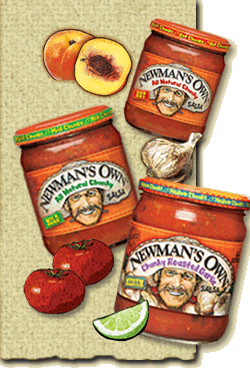
    Today, it was announced that Newman’s Own, the food company-cum-charity owned by Paul Newman and his wife, Joanne Woodward, is adding wine to its list of wares. And their partner in this venture is Rebel Wine Co., the parent of Three Thieves and brother or sister (or distant cousin) to the more pedestrian Sutter Home.

    Newman’s Own already produces everything from bottled salad dressing to organic fig cookies to healthier-than-thou pet food. And its founders appear to exert a power second only to Oprah’s. Most winemakers wait for years to produce their first vintage. But Newman’s Own will release its first wines — a Chardonnay and a Cabernet Sauvignon, both from California — in December. Each will retail for approximately $16 a bottle, making Butch Cassidy’s jug of hooch roughly 40 percent more expensive than Three Thieves.

    I like the idea behind Newman’s Own. It was founded by Newman and his friend A.E. Hotchner, the author of King of the Hill, in 1982. It’s a for-profit corporation that gives 100 percent of its net (after taxes and operating costs) to educational and charitable organizations, including Hole in the Wall Gang Camp, a summer program for seriously ill children in Connecticut. The company’s spot-on tagline: Shameless exploitation in pursuit of the common good.

    I’m amused by the baldly kitschy, folksy way they market their products, with Paul and Joanne dressed up like the couple from American Gothic on many of the labels. Then there’s Paul in a straw hat and bowtie, Paul in a sombrero, Paul like Julius Caesar with a tomato smashed on top of his head.

    But about their products I am, frankly, torn. There’s no doubt in my mind they’re more expensive (by 10-30%) than foodstuffs of similar quality. Yet, this is a company that’s given away $200 million; that premium clearly is going to good use. What’s more, I’ve never seen a food company so forthcoming with information: go on the Newman’s Own website and you can find detailed ingredient and nutrition data on every single thing they sell.

    It remains to be seen whether the Newman’s Own cachet is enough to put a $16 price tag on what likely will be a garden-variety California Chardonnay. With really solid French, South American, Spanish, and Italian wines selling for under $12 a bottle, it will be a tough leap for me to make. I might prefer to drink a white Rhone wine and make my own charitable donations.